



Managing dialogue around
exemplars
David Carless, Masterclass
AHE Manchester,
June 28, 2017
http://davidcarless.edu.hku.hk/
Twitter: @CarlessDavid
The University of Hong Kong
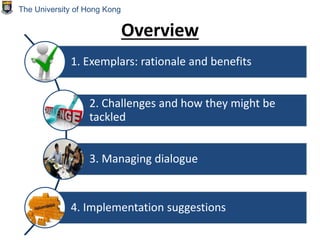
Overview
1. Exemplars: rationale and benefits
2. Challenges and how they might be
tackled
3. Managing dialogue
4. Implementation suggestions
The University of Hong Kong
Teaching Enhancement Project
Enhancing dialogic use of exemplars amongst 10
teachers in a Faculty of Education
The University of Hong Kong
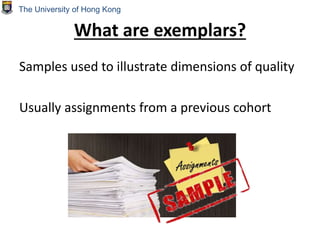
What are exemplars?
Samples used to illustrate dimensions of quality
Usually assignments from a previous cohort
The University of Hong Kong
Why used?
Exemplars convey messages
that nothing else can (Sadler,
2002)
The University of Hong Kong
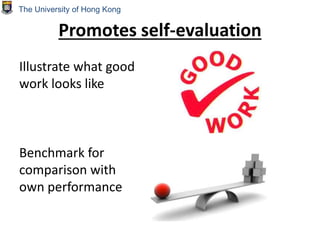
Promotes self-evaluation
Illustrate what good
work looks like
Benchmark for
comparison with
own performance
The University of Hong Kong
Benefits for students
Gain experience in making
judgments
Apply insights to own work &
improve learning outcomes
The University of Hong Kong
Hendry et al., (2012)
Students positive about exemplars
Balanced teacher-led discussion of exemplars as
crucial
The University of Hong Kong
Student views
Rubrics: vague, unclear and do teachers
really use them?
Exemplars: useful & concrete; students
want more of them
(Carless, 2015, 2017)
The University of Hong Kong
‘Model answer syndrome’
May reduce student
creativity
May lead to copying
(Handley & Williams,
2011)
The University of Hong Kong
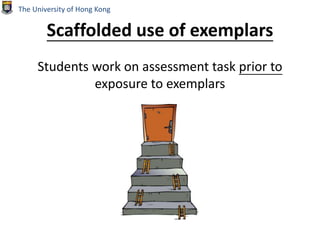
Scaffolded use of exemplars
Students work on assessment task prior to
exposure to exemplars
The University of Hong Kong
Scaffolding steps
Instructional sequences combining:
- Student work in progress;
- Interaction with peers and teachers;
- Analysis of exemplars.
(Carless et al., 2018)
The University of Hong Kong
Time issues
• Collecting them
• Obtaining consent
• Time taken from
instruction
• How many exemplars?
The University of Hong Kong
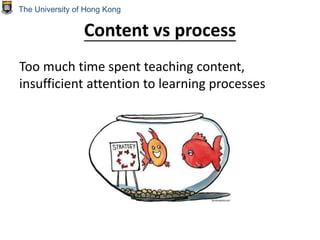
Content vs process
Too much time spent teaching content,
insufficient attention to learning processes
The University of Hong Kong
It’s challenging!
Difficulties for students in evaluating exemplars
accurately
The University of Hong Kong
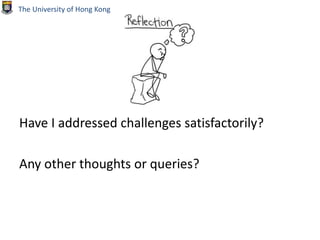
Have I addressed challenges satisfactorily?
Any other thoughts or queries?
The University of Hong Kong
DIALOGIC USE OF EXEMPLARS
The University of Hong Kong
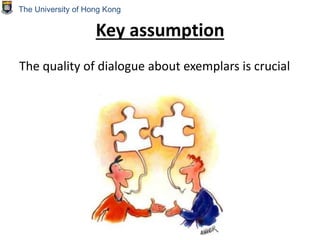
Key assumption
The quality of dialogue about exemplars is crucial
The University of Hong Kong
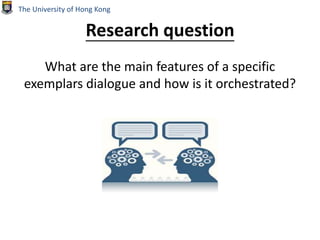
Research question
What are the main features of a specific
exemplars dialogue and how is it orchestrated?
The University of Hong Kong
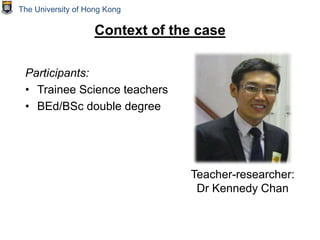
Context of the case
Participants:
• Trainee Science teachers
• BEd/BSc double degree
Teacher-researcher:
Dr Kennedy Chan
The University of Hong Kong
Data collection
• Classroom observation
• Open-ended student survey
• 2 focus group interviews
• Interview with teacher-researcher
• Teacher journal
• Student artefacts: ‘exit slips’, assignments etc.
The University of Hong Kong
Coding scheme
Main teacher moves:
- Eliciting student views
- Summarizing student views
- Elaborating student views
The University of Hong Kong
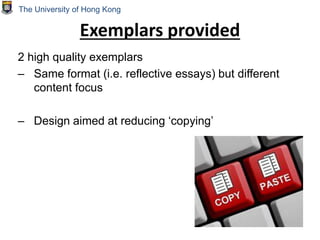
Exemplars provided
2 high quality exemplars
– Same format (i.e. reflective essays) but different
content focus
– Design aimed at reducing ‘copying’
The University of Hong Kong
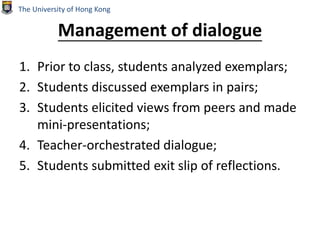
Management of dialogue
1. Prior to class, students analyzed exemplars;
2. Students discussed exemplars in pairs;
3. Students elicited views from peers and made
mini-presentations;
4. Teacher-orchestrated dialogue;
5. Students submitted exit slip of reflections.
The University of Hong Kong
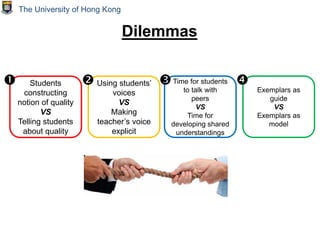
Dilemmas
Students
constructing
notion of quality
VS
Telling students
about quality
 Time for students
to talk with
peers
VS
Time for
developing shared
understandings

Exemplars as
guide
VS
Exemplars as
model
Using students’
voices
VS
Making
teacher’s voice
explicit

The University of Hong Kong
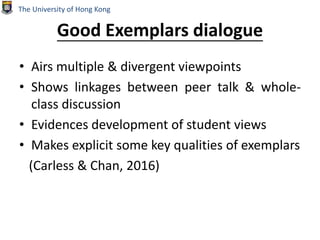
Good Exemplars dialogue
• Airs multiple & divergent viewpoints
• Shows linkages between peer talk & whole-
class discussion
• Evidences development of student views
• Makes explicit some key qualities of exemplars
(Carless & Chan, 2016)
The University of Hong Kong
Implications
The University of Hong Kong
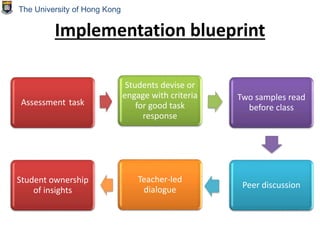
Implementation blueprint
Assessment task
Students devise or
engage with criteria
for good task
response
Two samples read
before class
Peer discussion
Teacher-led
dialogue
Student ownership
of insights
The University of Hong Kong
Exemplars & feedback
By developing capacities to make judgments,
students are learning to decode feedback
(Sadler, 2010)
Analysis of exemplars facilitates student uptake
of feedback (Carless et al., 2018; To & Carless,
2016)
The University of Hong Kong
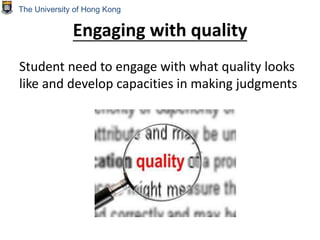
Engaging with quality
Student need to engage with what quality looks
like and develop capacities in making judgments
The University of Hong Kong
COMMENTS,
QUESTIONS
The University of Hong Kong
References
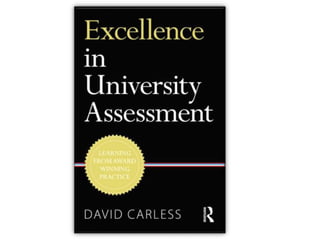
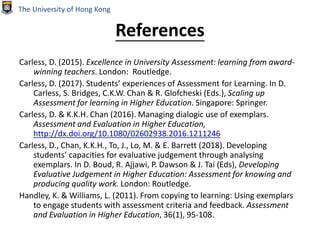
Carless, D. (2015). Excellence in University Assessment: learning from award-
winning teachers. London: Routledge.
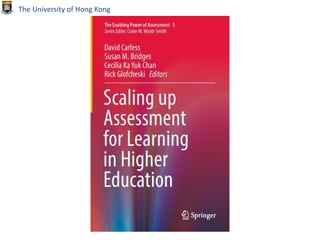
Carless, D. (2017). Students’ experiences of Assessment for Learning. In D.
Carless, S. Bridges, C.K.W. Chan & R. Glofcheski (Eds.), Scaling up
Assessment for learning in Higher Education. Singapore: Springer.
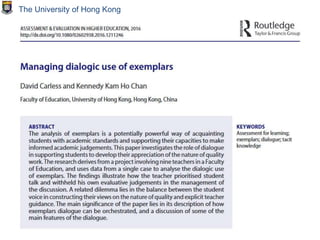
Carless, D. & K.K.H. Chan (2016). Managing dialogic use of exemplars.
Assessment and Evaluation in Higher Education,
http://dx.doi.org/10.1080/02602938.2016.1211246
Carless, D., Chan, K.K.H., To, J., Lo, M. & E. Barrett (2018). Developing
students’ capacities for evaluative judgement through analysing
exemplars. In D. Boud, R. Ajjawi, P. Dawson & J. Tai (Eds), Developing
Evaluative Judgement in Higher Education: Assessment for knowing and
producing quality work. London: Routledge.
Handley, K. & Williams, L. (2011). From copying to learning: Using exemplars
to engage students with assessment criteria and feedback. Assessment
and Evaluation in Higher Education, 36(1), 95-108.
The University of Hong Kong
References
Hendry, G., Armstrong, S. & Bromberger, N. (2012). Implementing
standards‐based assessment effectively: Incorporating discussion
of exemplars into classroom teaching. Assessment and Evaluation
in Higher Education, 37(2), 149-161.
Sadler, D. R. (2002). Ah! … So that’s ‘quality’. In P. Schwartz & G. Webb
(Eds.), Assessment: Case Studies, Experience and Practice from
Higher Education (p.130-136). London: Kogan Page.
Sadler, D. R. (2010). Beyond feedback: Developing student capability in
complex appraisal. Assessment and Evaluation in Higher Education,
35(5), 535-550.
To, J. & Carless, D. (2016). Making productive use of exemplars: Peer
discussion and teacher guidance for positive transfer of strategies.
Journal of Further and Higher Education, 40(6), 746-764.
The University of Hong Kong
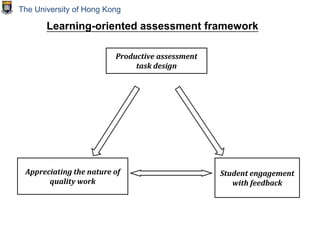
Productive assessment
task design
Appreciating the nature of
quality work
Student engagement
with feedback
Learning-oriented assessment framework
The University of Hong Kong

AHE Exemplars

  • 1.
    Managing dialogue around exemplars DavidCarless, Masterclass AHE Manchester, June 28, 2017 http://davidcarless.edu.hku.hk/ Twitter: @CarlessDavid The University of Hong Kong
  • 2.
    Overview 1. Exemplars: rationaleand benefits 2. Challenges and how they might be tackled 3. Managing dialogue 4. Implementation suggestions The University of Hong Kong
  • 3.
    Teaching Enhancement Project Enhancingdialogic use of exemplars amongst 10 teachers in a Faculty of Education The University of Hong Kong
  • 4.
    What are exemplars? Samplesused to illustrate dimensions of quality Usually assignments from a previous cohort The University of Hong Kong
  • 5.
    Why used? Exemplars conveymessages that nothing else can (Sadler, 2002) The University of Hong Kong
  • 6.
    Promotes self-evaluation Illustrate whatgood work looks like Benchmark for comparison with own performance The University of Hong Kong
  • 7.
    Benefits for students Gainexperience in making judgments Apply insights to own work & improve learning outcomes The University of Hong Kong
  • 8.
    Hendry et al.,(2012) Students positive about exemplars Balanced teacher-led discussion of exemplars as crucial The University of Hong Kong
  • 9.
    Student views Rubrics: vague,unclear and do teachers really use them? Exemplars: useful & concrete; students want more of them (Carless, 2015, 2017) The University of Hong Kong
  • 11.
  • 12.
    ‘Model answer syndrome’ Mayreduce student creativity May lead to copying (Handley & Williams, 2011) The University of Hong Kong
  • 13.
    Scaffolded use ofexemplars Students work on assessment task prior to exposure to exemplars The University of Hong Kong
  • 14.
    Scaffolding steps Instructional sequencescombining: - Student work in progress; - Interaction with peers and teachers; - Analysis of exemplars. (Carless et al., 2018) The University of Hong Kong
  • 15.
    Time issues • Collectingthem • Obtaining consent • Time taken from instruction • How many exemplars? The University of Hong Kong
  • 16.
    Content vs process Toomuch time spent teaching content, insufficient attention to learning processes The University of Hong Kong
  • 17.
    It’s challenging! Difficulties forstudents in evaluating exemplars accurately The University of Hong Kong
  • 18.
    Have I addressedchallenges satisfactorily? Any other thoughts or queries? The University of Hong Kong
  • 19.
    DIALOGIC USE OFEXEMPLARS The University of Hong Kong
  • 20.
    Key assumption The qualityof dialogue about exemplars is crucial The University of Hong Kong
  • 21.
  • 22.
    Research question What arethe main features of a specific exemplars dialogue and how is it orchestrated? The University of Hong Kong
  • 23.
    Context of thecase Participants: • Trainee Science teachers • BEd/BSc double degree Teacher-researcher: Dr Kennedy Chan The University of Hong Kong
  • 24.
    Data collection • Classroomobservation • Open-ended student survey • 2 focus group interviews • Interview with teacher-researcher • Teacher journal • Student artefacts: ‘exit slips’, assignments etc. The University of Hong Kong
  • 25.
    Coding scheme Main teachermoves: - Eliciting student views - Summarizing student views - Elaborating student views The University of Hong Kong
  • 26.
    Exemplars provided 2 highquality exemplars – Same format (i.e. reflective essays) but different content focus – Design aimed at reducing ‘copying’ The University of Hong Kong
  • 27.
    Management of dialogue 1.Prior to class, students analyzed exemplars; 2. Students discussed exemplars in pairs; 3. Students elicited views from peers and made mini-presentations; 4. Teacher-orchestrated dialogue; 5. Students submitted exit slip of reflections. The University of Hong Kong
  • 28.
    Dilemmas Students constructing notion of quality VS Tellingstudents about quality  Time for students to talk with peers VS Time for developing shared understandings  Exemplars as guide VS Exemplars as model Using students’ voices VS Making teacher’s voice explicit  The University of Hong Kong
  • 29.
    Good Exemplars dialogue •Airs multiple & divergent viewpoints • Shows linkages between peer talk & whole- class discussion • Evidences development of student views • Makes explicit some key qualities of exemplars (Carless & Chan, 2016) The University of Hong Kong
  • 30.
  • 31.
    Implementation blueprint Assessment task Studentsdevise or engage with criteria for good task response Two samples read before class Peer discussion Teacher-led dialogue Student ownership of insights The University of Hong Kong
  • 32.
    Exemplars & feedback Bydeveloping capacities to make judgments, students are learning to decode feedback (Sadler, 2010) Analysis of exemplars facilitates student uptake of feedback (Carless et al., 2018; To & Carless, 2016) The University of Hong Kong
  • 33.
    Engaging with quality Studentneed to engage with what quality looks like and develop capacities in making judgments The University of Hong Kong
  • 34.
  • 35.
    References Carless, D. (2015).Excellence in University Assessment: learning from award- winning teachers. London: Routledge. Carless, D. (2017). Students’ experiences of Assessment for Learning. In D. Carless, S. Bridges, C.K.W. Chan & R. Glofcheski (Eds.), Scaling up Assessment for learning in Higher Education. Singapore: Springer. Carless, D. & K.K.H. Chan (2016). Managing dialogic use of exemplars. Assessment and Evaluation in Higher Education, http://dx.doi.org/10.1080/02602938.2016.1211246 Carless, D., Chan, K.K.H., To, J., Lo, M. & E. Barrett (2018). Developing students’ capacities for evaluative judgement through analysing exemplars. In D. Boud, R. Ajjawi, P. Dawson & J. Tai (Eds), Developing Evaluative Judgement in Higher Education: Assessment for knowing and producing quality work. London: Routledge. Handley, K. & Williams, L. (2011). From copying to learning: Using exemplars to engage students with assessment criteria and feedback. Assessment and Evaluation in Higher Education, 36(1), 95-108. The University of Hong Kong
  • 36.
    References Hendry, G., Armstrong,S. & Bromberger, N. (2012). Implementing standards‐based assessment effectively: Incorporating discussion of exemplars into classroom teaching. Assessment and Evaluation in Higher Education, 37(2), 149-161. Sadler, D. R. (2002). Ah! … So that’s ‘quality’. In P. Schwartz & G. Webb (Eds.), Assessment: Case Studies, Experience and Practice from Higher Education (p.130-136). London: Kogan Page. Sadler, D. R. (2010). Beyond feedback: Developing student capability in complex appraisal. Assessment and Evaluation in Higher Education, 35(5), 535-550. To, J. & Carless, D. (2016). Making productive use of exemplars: Peer discussion and teacher guidance for positive transfer of strategies. Journal of Further and Higher Education, 40(6), 746-764. The University of Hong Kong
  • 37.
  • 38.
    The University ofHong Kong Productive assessment task design Appreciating the nature of quality work Student engagement with feedback Learning-oriented assessment framework
  • 39.

Editor's Notes

  • #3 1. Exemplars: rationale and benefits 2. Challenges and how they might be tackled 3. A case study of practice 4. Implementation suggestions
  • #32 Essay Students brainstorm criteria for what a good answer to the task might look like No. of samples? 2 Peer discussion Teacher scaffolding Student ownership