




Analyzing exemplars to support
students’ understandings of
assessment
David Carless, CRADLE seminar,
Melbourne, September 17th, 2015
The University of Hong Kong
Overview
1. Exemplars: rationale and benefits
2. Challenges and how they might be
tackled
3. A case study of practice
4. Implementation suggestions
The University of Hong Kong
Definition
Exemplars are samples of student work used to
illustrate dimensions of quality
Usually assignments from a previous cohort
The University of Hong Kong
Why used?
Exemplars convey messages
that nothing else can (Sadler,
2002)
The University of Hong Kong
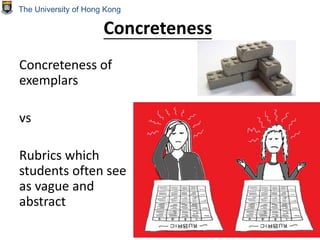
Concreteness
Concreteness of
exemplars
vs
Rubrics which
students often see
as vague and
abstract
The University of Hong Kong
Promote self-evaluation
Illustrate what good
work looks like
Benchmark for
student comparison
with own
performance
The University of Hong Kong
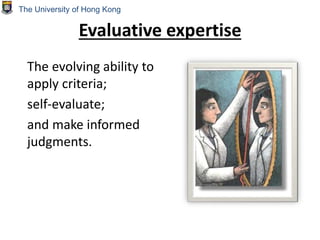
Evaluative expertise
The evolving ability to
apply criteria;
self-evaluate;
and make informed
judgments.
The University of Hong Kong
Analysis
Identify strengths, weaknesses & suggest how
samples could be improved
The University of Hong Kong
Benefits for students
Gain experience in making
judgments
Apply insights to own work
Notice discrepancies between
present level & target level
The University of Hong Kong
Challenges
The University of Hong Kong
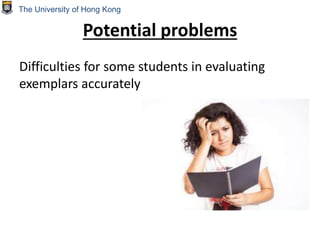
Potential problems
Difficulties for some students in evaluating
exemplars accurately
The University of Hong Kong
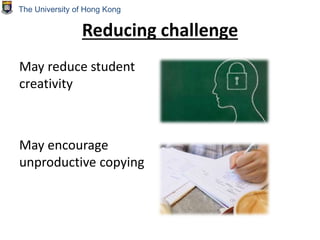
Reducing challenge
May reduce student
creativity
May encourage
unproductive copying
The University of Hong Kong
Time issues
‱ Time in collecting them
‱ Time in seeking consent
for their use
‱ Time taken away from
instruction
The University of Hong Kong
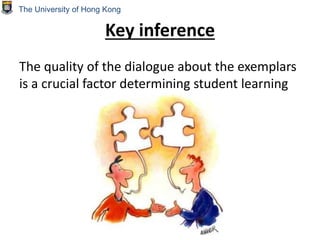
Key inference
The quality of the dialogue about the exemplars
is a crucial factor determining student learning
The University of Hong Kong
Key issue
To what extent does the use of exemplars
facilitate positive learning outcomes?
The University of Hong Kong
ONGOING RESEARCH
The University of Hong Kong
Project 1
Ed D study, Phil Smyth
GT study of how teachers manage the process of
using exemplars
The University of Hong Kong
Project 2
Enhancing dialogic use of exemplars amongst 10
teachers in a Faculty of Education
The University of Hong Kong
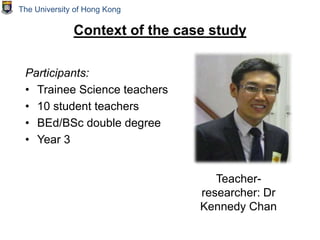
Context of the case study
Participants:
‱ Trainee Science teachers
‱ 10 student teachers
‱ BEd/BSc double degree
‱ Year 3
Teacher-
researcher: Dr
Kennedy Chan
The University of Hong Kong
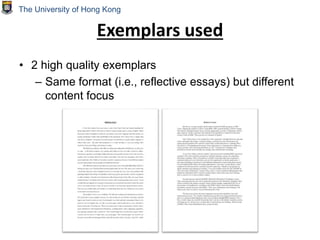
Exemplars used
‱ 2 high quality exemplars
– Same format (i.e., reflective essays) but different
content focus
The University of Hong Kong
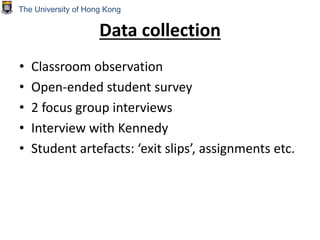
Data collection
‱ Classroom observation
‱ Open-ended student survey
‱ 2 focus group interviews
‱ Interview with Kennedy
‱ Student artefacts: ‘exit slips’, assignments etc.
The University of Hong Kong
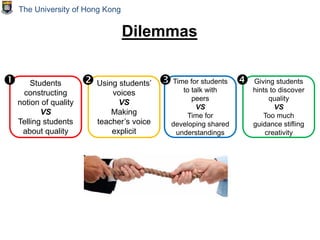
Dilemmas
Students
constructing
notion of quality
VS
Telling students
about quality
 Time for students
to talk with
peers
VS
Time for
developing shared
understandings
 Giving students
hints to discover
quality
VS
Too much
guidance stifling
creativity
Using students’
voices
VS
Making
teacher’s voice
explicit

The University of Hong Kong
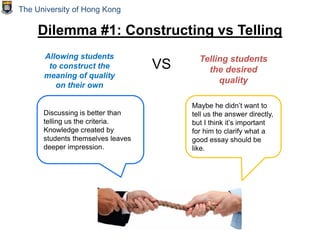
Dilemma #1: Constructing vs Telling
Discussing is better than
telling us the criteria.
Knowledge created by
students themselves leaves
deeper impression.
Telling students
the desired
quality
Allowing students
to construct the
meaning of quality
on their own
Maybe he didn’t want to
tell us the answer directly,
but I think it’s important
for him to clarify what a
good essay should be
like.
VS
The University of Hong Kong
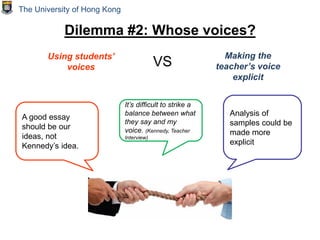
Dilemma #2: Whose voices?
A good essay
should be our
ideas, not
Kennedy’s idea.
Making the
teacher’s voice
explicit
Using students’
voices
Analysis of
samples could be
made more
explicit
It’s difficult to strike a
balance between what
they say and my
voice. (Kennedy, Teacher
Interview)
VS
The University of Hong Kong
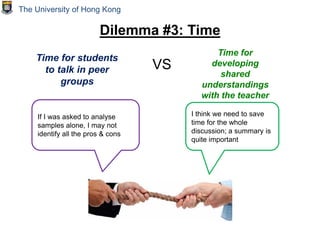
Dilemma #3: Time
If I was asked to analyse
samples alone, I may not
identify all the pros & cons
Time for
developing
shared
understandings
with the teacher
Time for students
to talk in peer
groups
I think we need to save
time for the whole
discussion; a summary is
quite important
VS
The University of Hong Kong
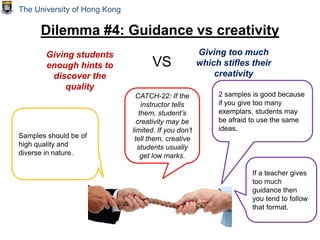
Dilemma #4: Guidance vs creativity
Samples should be of
high quality and
diverse in nature.
CATCH-22: If the
instructor tells
them, student’s
creativity may be
limited. If you don’t
tell them, creative
students usually
get low marks.
Giving too much
which stifles their
creativity
Giving students
enough hints to
discover the
quality
2 samples is good because
if you give too many
exemplars, students may
be afraid to use the same
ideas.
If a teacher gives
too much
guidance then
you tend to follow
that format.
VS
The University of Hong Kong
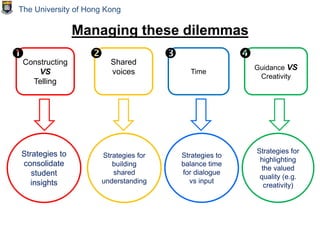
Managing these dilemmas
Constructing
VS
Telling

Time

Guidance VS
Creativity
Shared
voices

Strategies for
highlighting
the valued
quality (e.g.
creativity)
Strategies to
consolidate
student
insights
Strategies to
balance time
for dialogue
vs input
Strategies for
building
shared
understanding
The University of Hong Kong
CONCLUSION
The University of Hong Kong
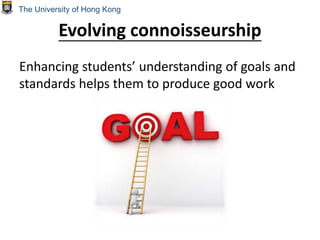
Evolving connoisseurship
Enhancing students’ understanding of goals and
standards helps them to produce good work
The University of Hong Kong
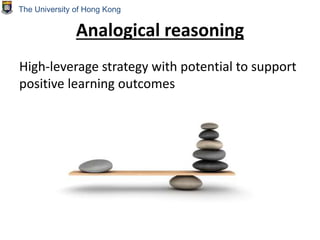
Analogical reasoning
High-leverage strategy with potential to support
positive learning outcomes
The University of Hong Kong
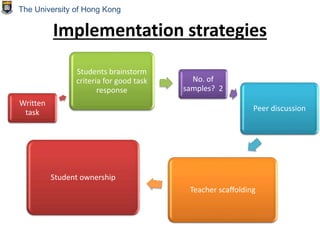
Implementation strategies
Written
task
Students brainstorm
criteria for good task
response
No. of
samples? 2
Peer discussion
Teacher scaffolding
Student ownership
The University of Hong Kong

Analyzing exemplars

  • 1.
    Analyzing exemplars tosupport students’ understandings of assessment David Carless, CRADLE seminar, Melbourne, September 17th, 2015 The University of Hong Kong
  • 2.
    Overview 1. Exemplars: rationaleand benefits 2. Challenges and how they might be tackled 3. A case study of practice 4. Implementation suggestions The University of Hong Kong
  • 3.
    Definition Exemplars are samplesof student work used to illustrate dimensions of quality Usually assignments from a previous cohort The University of Hong Kong
  • 4.
    Why used? Exemplars conveymessages that nothing else can (Sadler, 2002) The University of Hong Kong
  • 5.
    Concreteness Concreteness of exemplars vs Rubrics which studentsoften see as vague and abstract The University of Hong Kong
  • 6.
    Promote self-evaluation Illustrate whatgood work looks like Benchmark for student comparison with own performance The University of Hong Kong
  • 7.
    Evaluative expertise The evolvingability to apply criteria; self-evaluate; and make informed judgments. The University of Hong Kong
  • 8.
    Analysis Identify strengths, weaknesses& suggest how samples could be improved The University of Hong Kong
  • 9.
    Benefits for students Gainexperience in making judgments Apply insights to own work Notice discrepancies between present level & target level The University of Hong Kong
  • 10.
  • 11.
    Potential problems Difficulties forsome students in evaluating exemplars accurately The University of Hong Kong
  • 12.
    Reducing challenge May reducestudent creativity May encourage unproductive copying The University of Hong Kong
  • 13.
    Time issues ‱ Timein collecting them ‱ Time in seeking consent for their use ‱ Time taken away from instruction The University of Hong Kong
  • 14.
    Key inference The qualityof the dialogue about the exemplars is a crucial factor determining student learning The University of Hong Kong
  • 15.
    Key issue To whatextent does the use of exemplars facilitate positive learning outcomes? The University of Hong Kong
  • 16.
  • 17.
    Project 1 Ed Dstudy, Phil Smyth GT study of how teachers manage the process of using exemplars The University of Hong Kong
  • 18.
    Project 2 Enhancing dialogicuse of exemplars amongst 10 teachers in a Faculty of Education The University of Hong Kong
  • 19.
  • 20.
    Context of thecase study Participants: ‱ Trainee Science teachers ‱ 10 student teachers ‱ BEd/BSc double degree ‱ Year 3 Teacher- researcher: Dr Kennedy Chan The University of Hong Kong
  • 21.
    Exemplars used ‱ 2high quality exemplars – Same format (i.e., reflective essays) but different content focus The University of Hong Kong
  • 22.
    Data collection ‱ Classroomobservation ‱ Open-ended student survey ‱ 2 focus group interviews ‱ Interview with Kennedy ‱ Student artefacts: ‘exit slips’, assignments etc. The University of Hong Kong
  • 23.
    Dilemmas Students constructing notion of quality VS Tellingstudents about quality  Time for students to talk with peers VS Time for developing shared understandings  Giving students hints to discover quality VS Too much guidance stifling creativity Using students’ voices VS Making teacher’s voice explicit  The University of Hong Kong
  • 24.
    Dilemma #1: Constructingvs Telling Discussing is better than telling us the criteria. Knowledge created by students themselves leaves deeper impression. Telling students the desired quality Allowing students to construct the meaning of quality on their own Maybe he didn’t want to tell us the answer directly, but I think it’s important for him to clarify what a good essay should be like. VS The University of Hong Kong
  • 25.
    Dilemma #2: Whosevoices? A good essay should be our ideas, not Kennedy’s idea. Making the teacher’s voice explicit Using students’ voices Analysis of samples could be made more explicit It’s difficult to strike a balance between what they say and my voice. (Kennedy, Teacher Interview) VS The University of Hong Kong
  • 26.
    Dilemma #3: Time IfI was asked to analyse samples alone, I may not identify all the pros & cons Time for developing shared understandings with the teacher Time for students to talk in peer groups I think we need to save time for the whole discussion; a summary is quite important VS The University of Hong Kong
  • 27.
    Dilemma #4: Guidancevs creativity Samples should be of high quality and diverse in nature. CATCH-22: If the instructor tells them, student’s creativity may be limited. If you don’t tell them, creative students usually get low marks. Giving too much which stifles their creativity Giving students enough hints to discover the quality 2 samples is good because if you give too many exemplars, students may be afraid to use the same ideas. If a teacher gives too much guidance then you tend to follow that format. VS The University of Hong Kong
  • 28.
    Managing these dilemmas Constructing VS Telling  Time  GuidanceVS Creativity Shared voices  Strategies for highlighting the valued quality (e.g. creativity) Strategies to consolidate student insights Strategies to balance time for dialogue vs input Strategies for building shared understanding The University of Hong Kong
  • 29.
  • 30.
    Evolving connoisseurship Enhancing students’understanding of goals and standards helps them to produce good work The University of Hong Kong
  • 31.
    Analogical reasoning High-leverage strategywith potential to support positive learning outcomes The University of Hong Kong
  • 32.
    Implementation strategies Written task Students brainstorm criteriafor good task response No. of samples? 2 Peer discussion Teacher scaffolding Student ownership The University of Hong Kong

Editor's Notes

  • #3 1. Exemplars: rationale and benefits 2. Challenges and how they might be tackled 3. A case study of practice 4. Implementation suggestions
  • #33 Essay Students brainstorm criteria for what a good answer to the task might look like No. of samples? 2 Peer discussion Teacher scaffolding Student ownership