Colegio De Los Baños

                       A Detailed Lesson Plan in English for Third Year High School


I. Objectives

  At the end of the lesson, the students should be able to:

  1.) Identify the infinitives in the sentence.

  2.) Understand the different usage of infinitives.

  3.) Construct a sentence using infinitives.

II. Subject matter

  Topic: Infinitives

  Reference: Skyways to Effective Communication in English pp. 78-80

  Materials: Cartolina and Manila paper

III. Procedure

                  Teacher’s Activity                                    Student’s Activity
Introduction
Good morning Third Year!                               Good morning Sir Jerome! We’re glad to see you.
I’m glad to see you too. You may take your seat.
Is anyone absent for today?                            No one sir.
That’s great! I’m glad that all of you are present.
Review of the past lesson
Before we proceed to our new lesson, let’s
conduct a short review about our previous lesson.
Can you tell me what our last lesson all about? Yes
Jan Bert.                                              Our Lesson was about The participial phrase.
Yes! That’s right. Now who can tell me the
definition of the participial phrase? Yes Tyra.        A participial phrase is a group of related words
                                                       that contains a participle.
Again, what is a participle? Romulo.                   A participle is a verb form that can be used as an
                                                       adjective.
Correct! Therefore a participial phrase is a group
of related words that contains a participle and act
as an adjective.
There are two kinds of participle. Can you tell me
what are the two kinds of participle? Allen.           The two kinds of participle are the present
                                                       participle and the past participle.
Yes! The two kinds of the participle are the present
participle which ends in –ing and past participle
which ends in –ed, -d or –t
Let’s have an example.

Carrying a heavy pile of books, he caught his foot
on a step.

What is the participial phrase in this sentence? Yes   The participial phrase in the sentence is carrying a
vonn.                                                  heavy pile of books.
Yes! That’s correct because carrying a heavy pile of
books functions as an adjective modifying the
pronoun he.
What kind of participle is carrying? Claudette.        Carrying is an example of a present participle.
Good! Carrying is an example of a present
participle because it ends with -ing
Another example:

Children introduced to music early develop strong
intellectual skills.

What is the participial phrase in this sentence?       The participial phrase in the sentence is
Majam.                                                 introduced to music early.
That’s right! Introduced to music early functions as
an adjective because it modifies the noun children.
What kind of participle is introduced? Emman.          Introduced is an example of a past participle.
Right! Because introduced ends with –ed.
Do you have any questions regarding the past
participle?                                            None Sir.
Motivation
Before we start our new lesson, let us play a game
the name of the game is Verb Pantomime Relay.
I’ll divide the class into two groups and to make it
even, let us count 1 to 2.

Let’s start from you Romulo.
Mechanics:
Each group will form a horizontal line. The first
member of the group will act the verb written in
the card then the next member preceded the first
member will guess the verb and act it as well. All
the group members will follow the same
procedure until it reaches the last member. The
last member is the one who will write the answer
in the blanks.
Rules:
         All of the group members except the first
         one will turn around. They are allowed to
         look only if it’s their turn to guess. Tap the
         shoulder of your group mates as a go
         signal.
         Speaking while acting is illegal.

         The first group to write the correct answer
         will get the point.
         Before starting a round, each group will
         make a rotation.

(The purpose of this game is to review the
students about verb through projecting actions.
Through this, they will be familiarize and able to
distinguish verb forms as a preparation for our
today’s lesson infinitives.)
Lesson proper
Did you enjoy the game?                                   Yes! We enjoyed the game sir.
I enjoyed it too, now we can proceed to our next
lesson. Our lesson for today is about infinitives.
Infinitive is a verb form that can be used as a noun,
an adjective or an adverb. It consists of the word
to plus the basic form of the verb.

Because infinitive is not a verb, you cannot add s,
es, ed or ing.
I’ll use the result of our game as an example.

1.) To kiss our parents before we go to school is a
    Sign of respect.
2.) The place to drive is on the hi way.
3.) Jose Rizal inspires the young generation to
   write with passion.
4.) That water is too cold____.
5.) One of my dreams when I was a child was to
    fly.

In order for you to further understand the
infinitives. I’ve made sentences using the same
infinitive “to play” to emphasize the different
usage of infinitives.
( The teacher will discuss the sentences.)
I have another example here. Vonn, please read
the sentence and identify the infinitives and its
usage.                                                    Lawsuits are useful to punish corporations or to
represent consumers.

                                                       To punish, as an adverb.
Yes! The infinitive is to punish and it was as an
adjective because it modifies the adjective useful.
Another example. Jan, read the sentence and            To jog a mile every day is my goal.
identify the infinitives and its function.
                                                       To jog, as a noun.
Correct! To jog is the infinitive and it serve as a
noun because it is the subject of the sentence.
How about you Emman? Can you read the
sentence and identify the infinitives and how it
was used?                                              We should not allow him to stay.
                                                       To stay, As an adjective.
Very good Emman! The infinitive to stay functions
as an adjective modifying the pronoun him.
Now, Can you give an example of infinitives?                   To push
                                                               To act
                                                               To buy
                                                               To brush
                                                               To clean
Do you have any question regarding infinitives?        None sir.
Follow up activity
Underline the infinitives and write its usage in the
blanks.

_____1.) To become a lawyer is his ambition.
_____2.) This math problem is hard to solve
_____3.) All I want is to help poor people.
_____ 4.) She turned to answer the phone.
_____ 5.) The place to meet is the library.
_____ 6.) She tried to win the speech contest.
_____ 7.) Richard braved the icy rain to throw the
          Smelly squid eyeball stew into the apart-
          Ment dumpster.
_____ 8.) She is the one to call.
_____ 9.) whenever Melissa goes, she always
          Brings a book to read in case conversa-
          tion lags or she has a long wait.
____10.) No matter how fascinating the biology
          Dissection is, Emmanuel turns his head
          And refuses to look.
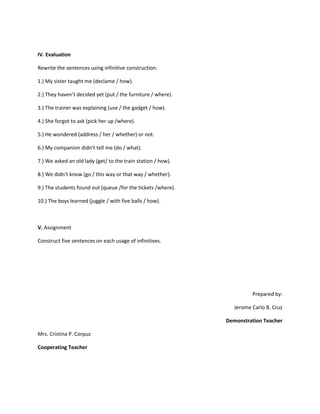
IV. Evaluation

Rewrite the sentences using infinitive construction.

1.) My sister taught me (declame / how).

2.) They haven’t decided yet (put / the furniture / where).

3.) The trainer was explaining (use / the gadget / how).

4.) She forgot to ask (pick her up /where).

5.) He wondered (address / her / whether) or not.

6.) My companion didn’t tell me (do / what).

7.) We asked an old lady (get/ to the train station / how).

8.) We didn’t know (go / this way or that way / whether).

9.) The students found out (queue /for the tickets /where).

10.) The boys learned (juggle / with five balls / how).


V. Assignment

Construct five sentences on each usage of infinitives.


                                                                        Prepared by:

                                                                 Jerome Carlo B. Cruz

                                                              Demonstration Teacher

Mrs. Cristina P. Corpuz

Cooperating Teacher

A detailed Lesson Plan (Infinitives)

  • 1.
    Colegio De LosBaños A Detailed Lesson Plan in English for Third Year High School I. Objectives At the end of the lesson, the students should be able to: 1.) Identify the infinitives in the sentence. 2.) Understand the different usage of infinitives. 3.) Construct a sentence using infinitives. II. Subject matter Topic: Infinitives Reference: Skyways to Effective Communication in English pp. 78-80 Materials: Cartolina and Manila paper III. Procedure Teacher’s Activity Student’s Activity Introduction Good morning Third Year! Good morning Sir Jerome! We’re glad to see you. I’m glad to see you too. You may take your seat. Is anyone absent for today? No one sir. That’s great! I’m glad that all of you are present. Review of the past lesson Before we proceed to our new lesson, let’s conduct a short review about our previous lesson. Can you tell me what our last lesson all about? Yes Jan Bert. Our Lesson was about The participial phrase. Yes! That’s right. Now who can tell me the definition of the participial phrase? Yes Tyra. A participial phrase is a group of related words that contains a participle. Again, what is a participle? Romulo. A participle is a verb form that can be used as an adjective. Correct! Therefore a participial phrase is a group of related words that contains a participle and act as an adjective. There are two kinds of participle. Can you tell me what are the two kinds of participle? Allen. The two kinds of participle are the present participle and the past participle. Yes! The two kinds of the participle are the present
  • 2.
    participle which endsin –ing and past participle which ends in –ed, -d or –t Let’s have an example. Carrying a heavy pile of books, he caught his foot on a step. What is the participial phrase in this sentence? Yes The participial phrase in the sentence is carrying a vonn. heavy pile of books. Yes! That’s correct because carrying a heavy pile of books functions as an adjective modifying the pronoun he. What kind of participle is carrying? Claudette. Carrying is an example of a present participle. Good! Carrying is an example of a present participle because it ends with -ing Another example: Children introduced to music early develop strong intellectual skills. What is the participial phrase in this sentence? The participial phrase in the sentence is Majam. introduced to music early. That’s right! Introduced to music early functions as an adjective because it modifies the noun children. What kind of participle is introduced? Emman. Introduced is an example of a past participle. Right! Because introduced ends with –ed. Do you have any questions regarding the past participle? None Sir. Motivation Before we start our new lesson, let us play a game the name of the game is Verb Pantomime Relay. I’ll divide the class into two groups and to make it even, let us count 1 to 2. Let’s start from you Romulo. Mechanics: Each group will form a horizontal line. The first member of the group will act the verb written in the card then the next member preceded the first member will guess the verb and act it as well. All the group members will follow the same procedure until it reaches the last member. The last member is the one who will write the answer in the blanks.
  • 3.
    Rules: All of the group members except the first one will turn around. They are allowed to look only if it’s their turn to guess. Tap the shoulder of your group mates as a go signal. Speaking while acting is illegal. The first group to write the correct answer will get the point. Before starting a round, each group will make a rotation. (The purpose of this game is to review the students about verb through projecting actions. Through this, they will be familiarize and able to distinguish verb forms as a preparation for our today’s lesson infinitives.) Lesson proper Did you enjoy the game? Yes! We enjoyed the game sir. I enjoyed it too, now we can proceed to our next lesson. Our lesson for today is about infinitives. Infinitive is a verb form that can be used as a noun, an adjective or an adverb. It consists of the word to plus the basic form of the verb. Because infinitive is not a verb, you cannot add s, es, ed or ing. I’ll use the result of our game as an example. 1.) To kiss our parents before we go to school is a Sign of respect. 2.) The place to drive is on the hi way. 3.) Jose Rizal inspires the young generation to write with passion. 4.) That water is too cold____. 5.) One of my dreams when I was a child was to fly. In order for you to further understand the infinitives. I’ve made sentences using the same infinitive “to play” to emphasize the different usage of infinitives. ( The teacher will discuss the sentences.) I have another example here. Vonn, please read the sentence and identify the infinitives and its usage. Lawsuits are useful to punish corporations or to
  • 4.
    represent consumers. To punish, as an adverb. Yes! The infinitive is to punish and it was as an adjective because it modifies the adjective useful. Another example. Jan, read the sentence and To jog a mile every day is my goal. identify the infinitives and its function. To jog, as a noun. Correct! To jog is the infinitive and it serve as a noun because it is the subject of the sentence. How about you Emman? Can you read the sentence and identify the infinitives and how it was used? We should not allow him to stay. To stay, As an adjective. Very good Emman! The infinitive to stay functions as an adjective modifying the pronoun him. Now, Can you give an example of infinitives? To push To act To buy To brush To clean Do you have any question regarding infinitives? None sir. Follow up activity Underline the infinitives and write its usage in the blanks. _____1.) To become a lawyer is his ambition. _____2.) This math problem is hard to solve _____3.) All I want is to help poor people. _____ 4.) She turned to answer the phone. _____ 5.) The place to meet is the library. _____ 6.) She tried to win the speech contest. _____ 7.) Richard braved the icy rain to throw the Smelly squid eyeball stew into the apart- Ment dumpster. _____ 8.) She is the one to call. _____ 9.) whenever Melissa goes, she always Brings a book to read in case conversa- tion lags or she has a long wait. ____10.) No matter how fascinating the biology Dissection is, Emmanuel turns his head And refuses to look.
  • 5.
    IV. Evaluation Rewrite thesentences using infinitive construction. 1.) My sister taught me (declame / how). 2.) They haven’t decided yet (put / the furniture / where). 3.) The trainer was explaining (use / the gadget / how). 4.) She forgot to ask (pick her up /where). 5.) He wondered (address / her / whether) or not. 6.) My companion didn’t tell me (do / what). 7.) We asked an old lady (get/ to the train station / how). 8.) We didn’t know (go / this way or that way / whether). 9.) The students found out (queue /for the tickets /where). 10.) The boys learned (juggle / with five balls / how). V. Assignment Construct five sentences on each usage of infinitives. Prepared by: Jerome Carlo B. Cruz Demonstration Teacher Mrs. Cristina P. Corpuz Cooperating Teacher