Dialogue Method
Santoshini Sahu
Roll no 47
F.Y.B.ED (CC2
assignment)
Dialogue Based Education
Introduction
• Dialogue based educational approach,
which was put forward by Paulo Freire
(1921 – 1997), a Brazilian educator.
• It was designed in such a way to enable
teachers and students to carry out
research together.
• Freire proposes this educational
approach as an alternative to the
traditional educational model which he
calls as banking education.
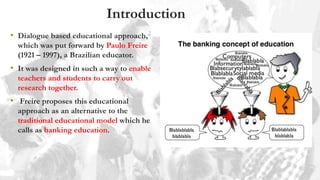
Banking System
Banking education, means a
process in which the
knowledge is directly
transferred to students, the
teacher is the sole distributor
of knowledge, and the
student is the passive receiver
of this knowledge.
Dialogue in Education
• Dialogue come from Greek words ‘Dia’ meaning
‘Through’ and ‘Logos’ meaning ‘Word’
• Dialogue, therefore is mutual sharing of thoughts. It is
not conversation or discussion, where the focus may
be on stressing one’s opinions and sticking to one’s
arguments or beliefs.
• Dialogue involves listening and understanding.
• The teacher and students transform learning into a
collaborative process to illuminate and act on reality.
• Reflections on dialogue are a means to change and a
mean to construct our views.
David Bohm three condition for Dialogue
Participants must suspend
their assumptions.
Participants must view each other
as peers and appreciate that they
involved in a mutual quest for
understanding and insight.
Need of facilitator who aid the
process of collective
understanding of the topic
Aspect of Dialogue based Education
Special Aspect of
Dialogue is listening
A dialogue is a
conversation among
equals.
Dialogue should not
take the form of an
argument, a debate
or a mere discussion
Need of Dialogue in Education
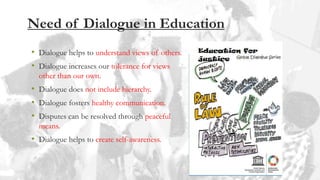
• Dialogue helps to understand views of others.
• Dialogue increases our tolerance for views
other than our own.
• Dialogue does not include hierarchy.
• Dialogue fosters healthy communication.
• Disputes can be resolved through peaceful
means.
• Dialogue helps to create self-awareness.
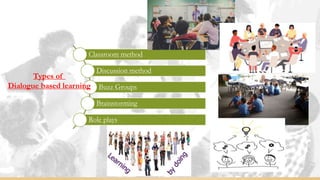
Classroom method
Discussion method
Buzz Groups
Brainstorming
Role plays
Types of
Dialogue based learning
Pros and Cons of dialogue method
Pros
• Dialogue involves perspective taking,
empathy, listening, reasoning and more.
• Effective way to resolve issues with peace.
• It helps to respect and accept diverse view.
• It promotes understanding by exploring the
roots of various crises.
• Rejuvenates through reflection
• People work together and learn how to
think together in analysing a shared
problem
• People explore their different social
dimension.
• With teacher guidance, children a more
active and engage role in classroom.
Cons
• Challenges for those students who
have issues with speaking out or who
do not think quickly (disable student
are excluded).
• Absent of accessible language
• Lack of pre-existing knowledge of the
topics
• If conversation does not go well can
lead to conflict and argument.
• Knowledge emerges through praxis,
without reflection and action it will fail
• Sometime it does not provide a clear
resolution.
Overcome from drawbacks
• Bring idea/solution into reality (Reflection to action).
• Overcome from fear facilitator should involve him into small group with
friend/encourage every student to get involve.
• Facilitator should maintain peace through dialogue.
• Mutual understanding and peer love support the conversation and get result.
• Need to stick in one concept and keep focus till we get result.
• Facilitator should give discussion material before session and student should
prepare for it.
Current status
• School
• Seminar
• Panel Discussion
• Workshop
• Feedback session
Let’s end with example
Dialogue hold in village among villager and outsider Lead to development with effective solution
Dialogue offers an opportunity for collective learning and increase harmony and fellowship.
One cannot restrict education to just one type of experience. Quality education will include a
blend of activity, discovery and dialogue. All these are chosen according to the learning
situation and the age and maturity of learner. Each has its own unique place in helping the
learner develop holistically.
Education is Freedom

Dialogue Based Education.pptx

  • 1.
    Dialogue Method Santoshini Sahu Rollno 47 F.Y.B.ED (CC2 assignment)
  • 2.
  • 4.
    Introduction • Dialogue basededucational approach, which was put forward by Paulo Freire (1921 – 1997), a Brazilian educator. • It was designed in such a way to enable teachers and students to carry out research together. • Freire proposes this educational approach as an alternative to the traditional educational model which he calls as banking education.
  • 5.
    Banking System Banking education,means a process in which the knowledge is directly transferred to students, the teacher is the sole distributor of knowledge, and the student is the passive receiver of this knowledge.
  • 6.
    Dialogue in Education •Dialogue come from Greek words ‘Dia’ meaning ‘Through’ and ‘Logos’ meaning ‘Word’ • Dialogue, therefore is mutual sharing of thoughts. It is not conversation or discussion, where the focus may be on stressing one’s opinions and sticking to one’s arguments or beliefs. • Dialogue involves listening and understanding. • The teacher and students transform learning into a collaborative process to illuminate and act on reality. • Reflections on dialogue are a means to change and a mean to construct our views.
  • 7.
    David Bohm threecondition for Dialogue Participants must suspend their assumptions. Participants must view each other as peers and appreciate that they involved in a mutual quest for understanding and insight. Need of facilitator who aid the process of collective understanding of the topic Aspect of Dialogue based Education Special Aspect of Dialogue is listening A dialogue is a conversation among equals. Dialogue should not take the form of an argument, a debate or a mere discussion
  • 8.
    Need of Dialoguein Education • Dialogue helps to understand views of others. • Dialogue increases our tolerance for views other than our own. • Dialogue does not include hierarchy. • Dialogue fosters healthy communication. • Disputes can be resolved through peaceful means. • Dialogue helps to create self-awareness.
  • 9.
    Classroom method Discussion method BuzzGroups Brainstorming Role plays Types of Dialogue based learning
  • 10.
    Pros and Consof dialogue method Pros • Dialogue involves perspective taking, empathy, listening, reasoning and more. • Effective way to resolve issues with peace. • It helps to respect and accept diverse view. • It promotes understanding by exploring the roots of various crises. • Rejuvenates through reflection • People work together and learn how to think together in analysing a shared problem • People explore their different social dimension. • With teacher guidance, children a more active and engage role in classroom. Cons • Challenges for those students who have issues with speaking out or who do not think quickly (disable student are excluded). • Absent of accessible language • Lack of pre-existing knowledge of the topics • If conversation does not go well can lead to conflict and argument. • Knowledge emerges through praxis, without reflection and action it will fail • Sometime it does not provide a clear resolution.
  • 11.
    Overcome from drawbacks •Bring idea/solution into reality (Reflection to action). • Overcome from fear facilitator should involve him into small group with friend/encourage every student to get involve. • Facilitator should maintain peace through dialogue. • Mutual understanding and peer love support the conversation and get result. • Need to stick in one concept and keep focus till we get result. • Facilitator should give discussion material before session and student should prepare for it.
  • 12.
    Current status • School •Seminar • Panel Discussion • Workshop • Feedback session
  • 13.
    Let’s end withexample Dialogue hold in village among villager and outsider Lead to development with effective solution Dialogue offers an opportunity for collective learning and increase harmony and fellowship. One cannot restrict education to just one type of experience. Quality education will include a blend of activity, discovery and dialogue. All these are chosen according to the learning situation and the age and maturity of learner. Each has its own unique place in helping the learner develop holistically.
  • 14.