
Learning-oriented
assessment
David Carless
Presentation at Hang Seng
Management College,
Jan 22, 2015
The University of Hong Kong
Overview
 Challenges in assessment
 Learning-oriented assessment
 Three key components
 Implications for practice
The University of Hong Kong
Aims of presentation
• To explore how assessment might
become more of a learning tool than a
grading tool
• Drawing on ideas in my forthcoming book
The University of Hong Kong
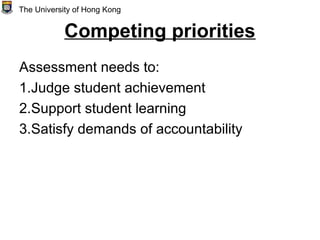
Competing priorities
Assessment needs to:
1.Judge student achievement
2.Support student learning
3.Satisfy demands of accountability
The University of Hong Kong
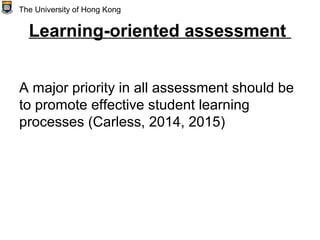
Learning-oriented assessment
A major priority in all assessment should be
to promote effective student learning
processes (Carless, 2014, 2015)
The University of Hong Kong
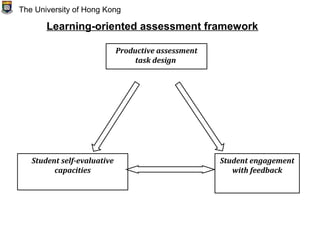
Productive assessment
task design
Student self-evaluative
capacities
Student engagement
with feedback
Learning-oriented assessment framework
Task design principles
• Integrated with instruction and ILOs
• Spreading student effort
• Mirroring real-life uses of the discipline
• Integrated and coherent
• Incorporates feedback dialogues
The University of Hong Kong
Self-evaluative capacities
• The most important thing a teacher can do
is to help students learn for themselves
• “the most effective teaching eventually
makes the teacher unnecessary” (Riordan
& Loacker, 2008)
• Student self-evaluation needs teaching,
modeling, nurturing
The University of Hong Kong
Two proverbs
• Give a man a fish you feed him for a day
• Teach a man to fish you feed him for a
lifetime
• Give a man a fish you feed him for a day
• Give him an iPhone and he won’t bother
you for weeks
The University of Hong Kong
Engagement with feedback
• Feedback needs to connect with students
needs and interests
• Timeliness is important
• Promoting student uptake of feedback
• To appreciate feedback, students need
effective self-evaluative capacities
The University of Hong Kong
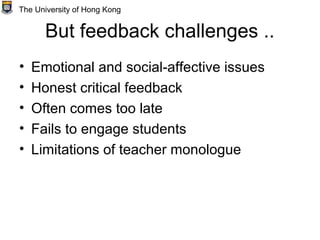
But feedback challenges ..
• Emotional and social-affective issues
• Honest critical feedback
• Often comes too late
• Fails to engage students
• Limitations of teacher monologue
The University of Hong Kong
Implications
The University of Hong Kong
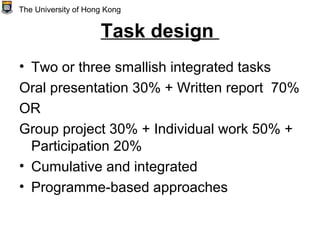
Task design
• Two or three smallish integrated tasks
Oral presentation 30% + Written report 70%
OR
Group project 30% + Individual work 50% +
Participation 20%
• Cumulative and integrated
• Programme-based approaches
The University of Hong Kong
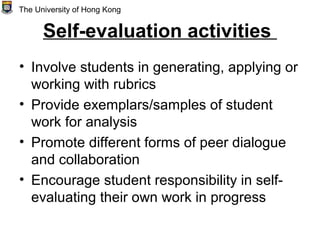
Self-evaluation activities
• Involve students in generating, applying or
working with rubrics
• Provide exemplars/samples of student
work for analysis
• Promote different forms of peer dialogue
and collaboration
• Encourage student responsibility in self-
evaluating their own work in progress
The University of Hong Kong
Feedback activities
• Encouraging dialogues of different forms
- A bit more in-class guidance and feedback,
bit less at end
- Some peer feedback, peer review
- Promote online discussion
• Integrated assignments which promote
student use of feedback
The University of Hong Kong
THANK YOU
The University of Hong Kong

Learning-oriented assessment

  • 1.
    Learning-oriented assessment David Carless Presentation atHang Seng Management College, Jan 22, 2015 The University of Hong Kong
  • 2.
    Overview  Challenges inassessment  Learning-oriented assessment  Three key components  Implications for practice The University of Hong Kong
  • 3.
    Aims of presentation •To explore how assessment might become more of a learning tool than a grading tool • Drawing on ideas in my forthcoming book The University of Hong Kong
  • 5.
    Competing priorities Assessment needsto: 1.Judge student achievement 2.Support student learning 3.Satisfy demands of accountability The University of Hong Kong
  • 6.
    Learning-oriented assessment A majorpriority in all assessment should be to promote effective student learning processes (Carless, 2014, 2015) The University of Hong Kong
  • 7.
    The University ofHong Kong Productive assessment task design Student self-evaluative capacities Student engagement with feedback Learning-oriented assessment framework
  • 8.
    Task design principles •Integrated with instruction and ILOs • Spreading student effort • Mirroring real-life uses of the discipline • Integrated and coherent • Incorporates feedback dialogues The University of Hong Kong
  • 9.
    Self-evaluative capacities • Themost important thing a teacher can do is to help students learn for themselves • “the most effective teaching eventually makes the teacher unnecessary” (Riordan & Loacker, 2008) • Student self-evaluation needs teaching, modeling, nurturing The University of Hong Kong
  • 10.
    Two proverbs • Givea man a fish you feed him for a day • Teach a man to fish you feed him for a lifetime • Give a man a fish you feed him for a day • Give him an iPhone and he won’t bother you for weeks The University of Hong Kong
  • 11.
    Engagement with feedback •Feedback needs to connect with students needs and interests • Timeliness is important • Promoting student uptake of feedback • To appreciate feedback, students need effective self-evaluative capacities The University of Hong Kong
  • 13.
    But feedback challenges.. • Emotional and social-affective issues • Honest critical feedback • Often comes too late • Fails to engage students • Limitations of teacher monologue The University of Hong Kong
  • 14.
  • 15.
    Task design • Twoor three smallish integrated tasks Oral presentation 30% + Written report 70% OR Group project 30% + Individual work 50% + Participation 20% • Cumulative and integrated • Programme-based approaches The University of Hong Kong
  • 16.
    Self-evaluation activities • Involvestudents in generating, applying or working with rubrics • Provide exemplars/samples of student work for analysis • Promote different forms of peer dialogue and collaboration • Encourage student responsibility in self- evaluating their own work in progress The University of Hong Kong
  • 17.
    Feedback activities • Encouragingdialogues of different forms - A bit more in-class guidance and feedback, bit less at end - Some peer feedback, peer review - Promote online discussion • Integrated assignments which promote student use of feedback The University of Hong Kong
  • 18.