Effective Time Management Strategies
for K-3 Reading
Ruth P. Millar
Pamlico County Primary School
March 31, 2015
link to your presentation/wiki here
A Race to the Top Initiative
NC Department of Public Instruction
Educator Effectiveness Division
Ground Rules
• Limit sidebar conversations.
• Be attentive and participate in all activities.
• Share your ideas with colleagues.
• Please unplug your personal devices.
Outcomes
• Review of GTN Initiative.
• Presentation of time on task classroom
management stratgies that encourage student
engagement.
• Review of student data.
• Q and A
Effective Time Management Strategies for K-3 Reading
Presenter: Ruth P. Millar
District: Pamlico County School: PCPS
Internet Log in information
Link to your presentation/wiki
What is the Governor’s
Teacher Network?
• A talented group of 450 outstanding teachers were
selected from 1400 applicants for 2014-15.
• Teachers identify novative digital instructional resources
and design professional development to support key Race
to the Top initiatives in Home Base.
• Network Teachers continue their current educator roles
in their schools and districts and serve in one of two
pathways.
What is the
Governor’s Teacher Network?
Pathway 1 Teachers: Professional Development
• Identify problems of practice around instructional
needs and conduct action research projects in their
schools.
• Investigate and analyze the effectiveness of strategies
and practices on student learning.
• Create professional development sessions and
materials to be posted in Schoolnet and the
Professional Development System in Home Base.
What is Pathway 2?
Pathway 2 Teachers : Instructional Resources
– Create instructional sequences for Home
Base aligned to the NC Standard Course of
Study (unit plans, lesson plans, assessment
components).
– Produce resources available to all NC
teachers through Schoolnet in Home Base.
Action Research
Systematic inquiry conducted by teachers and
other educators to find solutions for critical,
challenging, relevant issues in their classrooms and
schools.
Mills, Geoffrey E, Action Research: A Guide for the Teacher Researcher,
2014
Pathway 1: Action Research
Classroom and school research conducted by
teachers to:
•Positively impact student outcomes.
•Identify problems of practice and promote
effective instructional strategies.
•Create opportunities for teachers to become
reflective practitioners.
•Share research results with other educators.
Mills, Geoffrey E, Action Research: A Guide for the Teacher Researcher, 2014
Problems of Practice
•Discuss with your table partners hinderances that
you encounter within your classroom situation
that detour student engagement.
•As a table comprise a list of these hinderances.
•Display your list on the wall.
•Take a gallery walk. Notice lists from other
groups, are there similar hinderances?
Action Research Focus
My action research focuses on structuring the
reading block for successful student
engagement that:
 Captures the student’s interest,
 Teaches student-led managment of time on
task behaviors and
 Encourages and promotes mastery of skills.
Action Research Plan
Created a collaborative learning enviroment
that is:
 student friendly
 allows for student conversation and
movement
 scaffolded for success
 includes time for leveled instruction and
 progress monitoring of student growth
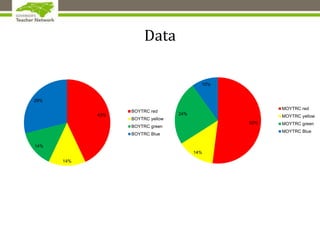
Data
43%
14%
14%
29%
BOYTRC red
BOYTRC yellow
BOYTRC green
BOYTRC Blue
52%
14%
24%
10%
MOYTRC red
MOYTRC yellow
MOYTRC green
MOYTRC Blue
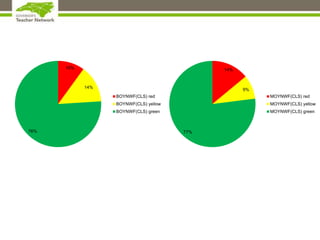
10%
14%
76%
BOYNWF(CLS) red
BOYNWF(CLS) yellow
BOYNWF(CLS) green
14%
9%
77%
MOYNWF(CLS) red
MOYNWF(CLS) yellow
MOYNWF(CLS) green
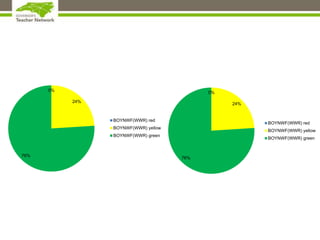
0%
24%
76%
BOYNWF(WWR) red
BOYNWF(WWR) yellow
BOYNWF(WWR) green
0%
24%
76%
BOYNWF(WWR) red
BOYNWF(WWR) yellow
BOYNWF(WWR) green
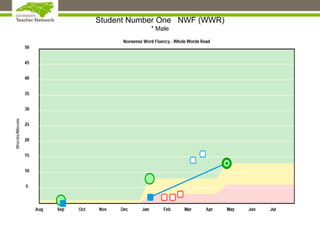
Student Number One NWF (WWR)
* Male
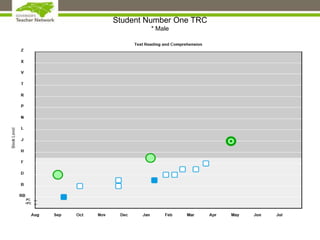
Student Number One TRC
* Male
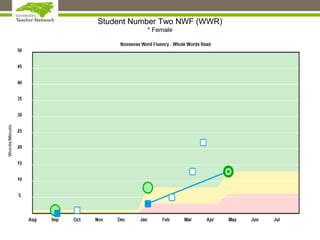
Student Number Two NWF (WWR)
* Female
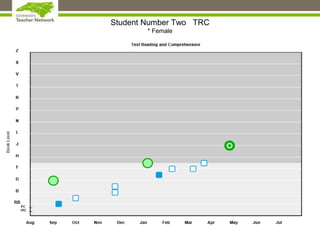
Student Number Two TRC
* Female
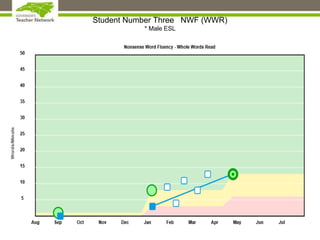
Student Number Three NWF (WWR)
* Male ESL
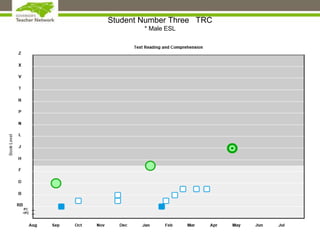
Student Number Three TRC
* Male ESL
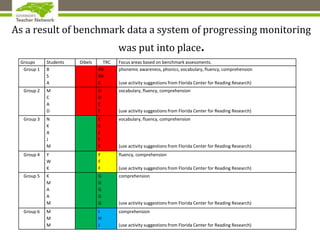
As a result of benchmark data a system of progressing monitoring
was put into place.
Groups Students Dibels TRC Focus areas based on benchmark assessments.
Group 1 B
S
A
RB
RB
C
phonemic awareness, phonics, vocabulary, fluency, comprehension
(use activity suggestions from Florida Center for Reading Research)
Group 2 M
C
A
D
D
D
E
E
vocabulary, fluency, comprehension
(use activity suggestions from Florida Center for Reading Research)
Group 3 N
K
A
J
M
E
E
E
E
E
vocabulary, fluency, comprehension
(use activity suggestions from Florida Center for Reading Research)
Group 4 Y
W
K
F
F
F
fluency, comprehension
(use activity suggestions from Florida Center for Reading Research)
Group 5 K
M
A
A
M
G
G
G
G
G
comprehension
(use activity suggestions from Florida Center for Reading Research)
Group 6 M
M
M
I
H
J
comprehension
(use activity suggestions from Florida Center for Reading Research)
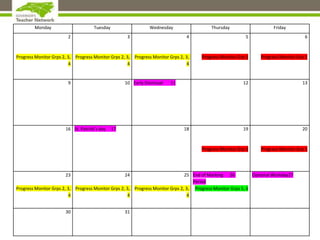
Monday Tuesday Wednesday Thursday Friday
2
Progress Monitor Grps 2, 3,
4
3
Progress Monitor Grps 2, 3,
4
4
Progress Monitor Grps 2, 3,
4
5
Progress Monitor Grp 1
6
Progress Monitor Grp 1
9 10 Early Dismissal 11 12 13
16 St. Patrick’s day 17 18 19
Progress Monitor Grp 1
20
Progress Monitor Grp 1
23
Progress Monitor Grps 2, 3,
4
24
Progress Monitor Grps 2, 3,
4
25
Progress Monitor Grps 2, 3,
4
End of Marking 26
Period
Progress Monitor Grps 5, 6
Optional Workday27
30 31
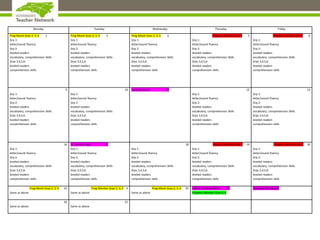
Monday Tuesday Wednesday Thursday Friday
Prog Monit Grps 2, 3, 4 2
Grp 1:
letter/sound fluency
Grp 2:
leveled readers
vocabulary, comprehension Skills
Grps 3,4,5,6:
leveled readers
comprehension skills
Prog Monit Grps 2, 3, 4 3
Grp 1:
letter/sound fluency
Grp 2:
leveled readers
vocabulary, comprehension Skills
Grps 3,4,5,6:
leveled readers
comprehension skills
Prog Monit Grps 2, 3, 4 4
Grp 1:
letter/sound fluency
Grp 2:
leveled readers
vocabulary, comprehension Skills
Grps 3,4,5,6:
leveled readers
comprehension skills
Progress Monitor Grp 1 5
Grp 1:
letter/sound fluency
Grp 2:
leveled readers
vocabulary, comprehension Skills
Grps 3,4,5,6:
leveled readers
comprehension skills
Progress Monitor Grp 1 6
Grp 1:
letter/sound fluency
Grp 2:
leveled readers
vocabulary, comprehension Skills
Grps 3,4,5,6:
leveled readers
comprehension skills
9
Grp 1:
letter/sound fluency
Grp 2:
leveled readers
vocabulary, comprehension Skills
Grps 3,4,5,6:
leveled readers
comprehension skills
10
Grp 1:
letter/sound fluency
Grp 2:
leveled readers
vocabulary, comprehension Skills
Grps 3,4,5,6:
leveled readers
comprehension skills
Early Dismissal 11 12
Grp 1:
letter/sound fluency
Grp 2:
leveled readers
vocabulary, comprehension Skills
Grps 3,4,5,6:
leveled readers
comprehension skills
13
Grp 1:
letter/sound fluency
Grp 2:
leveled readers
vocabulary, comprehension Skills
Grps 3,4,5,6:
leveled readers
comprehension skills
16
Grp 1:
letter/sound fluency
Grp 2:
leveled readers
vocabulary, comprehension Skills
Grps 3,4,5,6:
leveled readers
comprehension skills
St. Patrick’s day 17
Grp 1:
letter/sound fluency
Grp 2:
leveled readers
vocabulary, comprehension Skills
Grps 3,4,5,6:
leveled readers
comprehension skills
18
Grp 1:
letter/sound fluency
Grp 2:
leveled readers
vocabulary, comprehension Skills
Grps 3,4,5,6:
leveled readers
comprehension skills
Progress Monitor Grp 1 19
Grp 1:
letter/sound fluency
Grp 2:
leveled readers
vocabulary, comprehension Skills
Grps 3,4,5,6:
leveled readers
comprehension skills
Progress Monitor Grp 1 20
Grp 1:
letter/sound fluency
Grp 2:
leveled readers
vocabulary, comprehension Skills
Grps 3,4,5,6:
leveled readers
comprehension skills
Prog Monit Grps 2, 3, 4 23
Same as above
Prog Monitor Grps 2, 3, 4 4
Same as above
Prog Monit Grps 2, 3, 4 25
Same as above
End of Marking Period 26
Progress Monitor Grps 5, 6
Optional Workday27
30
Same as above
31
Same as above
Scope of Work
•Problem: lack of time for leveled instruction and progress
monitoring.
•Progress monitoring is the key to meeting students where
they are and taking them to where they need to be for
success.
•All teachers benefit from implementation these strategies
and structures. The overall result is student growth
mastery of skills, and student engagement.
•Students benefit from cooperative grouping with
confidence, collaboration, and 21st century skills that lead
to success in the work place.
Nonnegotiables
•Classroom rules that are student originated.
•A classroom management system that is clearly
understood and visible.
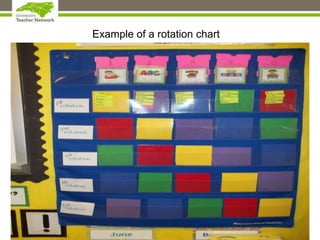
•A rotation chart that is clearly understood,
visible, and user friendly.
•Activities that lead to student success and self
management.
•Consistency in routine and consequences for
noncompliance.
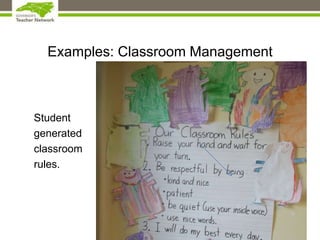
Examples: Classroom Management
Student
generated
classroom
rules.
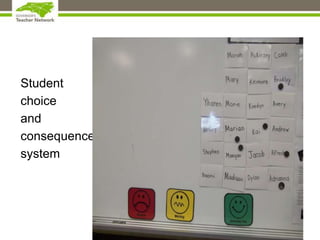
Student
choice
and
consequences
system
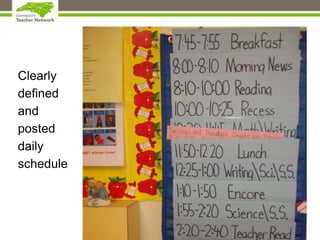
Clearly
defined
and
posted
daily
schedule
Example of a rotation chart
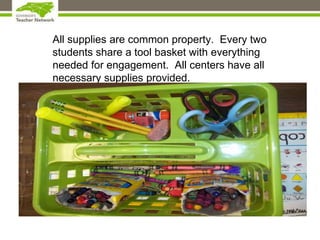
All supplies are common property. Every two
students share a tool basket with everything
needed for engagement. All centers have all
necessary supplies provided.
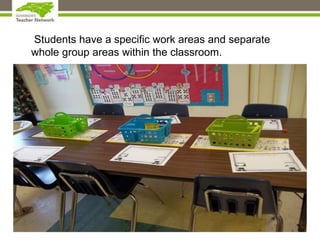
Students have a specific work areas and separate
whole group areas within the classroom.
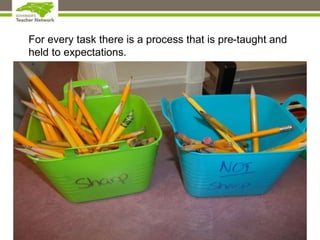
For every task there is a process that is pre-taught and
held to expectations.
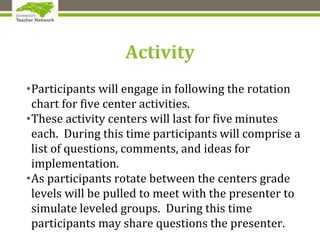
Activity
•Participants will engage in following the rotation
chart for five center activities.
•These activity centers will last for five minutes
each. During this time participants will comprise a
list of questions, comments, and ideas for
implementation.
•As participants rotate between the centers grade
levels will be pulled to meet with the presenter to
simulate leveled groups. During this time
participants may share questions the presenter.
How is HomeBase/Schoolnet
used?
Data on student progress and achievement.
Lesson plans
Unit plans
Grade Book
Comparisons across the district and state
References
• Assessment and progress monitoring data NC Reading 3D program.
• Watts-Taffe, Susan; Laster,B.P.; Broach,Laura; Marinak,Barbara; Connor, Carol
MacDonald; Walker-Dalhouse,Doris (2012). Differentiated Instruction: Making
Informed Teacher Decisions, The Reading Teacher, 66(4), 303-314. Doi:
10.1002/TRTR.1126.
• Kamps, Debra; Abbott, Mary; Greenwood, Charles; Wills, Howard; Veerkamp, Mary;
Kaufman, Jorun (2008). Effects of Small-Group Reading Instruction and Curriculum
Differences for Students Most At Risk In Kindergarten: Two-Year Results for
Secondary and Tertiary-Level Interventions. Journal of Learning Disabilities, v41 n2
p101-114., ERIC EJ796780.
• Denton, Carolyn A. (2000) Classroom Reading Instruction That Supports Struggling
Readers: Key Components for Effective Teaching. RTI Action Network,
http://www.rtinetwork.org/essential/tieredinstruction/tier1/effectiveteaching.
• Kosanovich, Marcia; Ladinsky, Karen; Nelson, Luanne; Torgesen, Joseph (2007).
Differentiated Reading Instruction: Small Group Alternative Lesson Structures for All
Students. Guidance Document for Florida “Reading First” Schools, Florida Center for
Reading Research. 11pp., ERIC ED498777.
• Kosanovich, Marcia (2012). Using “Instructional Routines” to Differentiate Instruction”
A Guide for Teachers, Center on Instruction. 54pp. Eric ED531909
• Collaboration, educational discussions and conversations with colleagues at Pamlico
County Schools, Bayboro, NC.
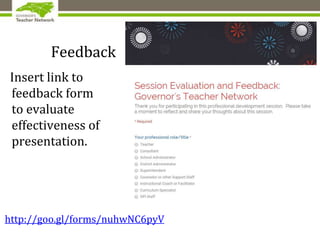
Feedback
Insert link to
feedback form
to evaluate
effectiveness of
presentation.
http://goo.gl/forms/nuhwNC6pyV
Conclusion of Presentation
•Thank you for your participation.
Contact Information:
Name: Ruth P. Millar
School/District: Pamlico County Primary School
Pamlico County
Phone: (252)414-0757
Email: ruthmillar@pamlicoschools.org

Gtn presentation

  • 1.
    Effective Time ManagementStrategies for K-3 Reading Ruth P. Millar Pamlico County Primary School March 31, 2015 link to your presentation/wiki here A Race to the Top Initiative NC Department of Public Instruction Educator Effectiveness Division
  • 2.
    Ground Rules • Limitsidebar conversations. • Be attentive and participate in all activities. • Share your ideas with colleagues. • Please unplug your personal devices.
  • 3.
    Outcomes • Review ofGTN Initiative. • Presentation of time on task classroom management stratgies that encourage student engagement. • Review of student data. • Q and A
  • 4.
    Effective Time ManagementStrategies for K-3 Reading Presenter: Ruth P. Millar District: Pamlico County School: PCPS Internet Log in information Link to your presentation/wiki
  • 5.
    What is theGovernor’s Teacher Network? • A talented group of 450 outstanding teachers were selected from 1400 applicants for 2014-15. • Teachers identify novative digital instructional resources and design professional development to support key Race to the Top initiatives in Home Base. • Network Teachers continue their current educator roles in their schools and districts and serve in one of two pathways.
  • 6.
    What is the Governor’sTeacher Network? Pathway 1 Teachers: Professional Development • Identify problems of practice around instructional needs and conduct action research projects in their schools. • Investigate and analyze the effectiveness of strategies and practices on student learning. • Create professional development sessions and materials to be posted in Schoolnet and the Professional Development System in Home Base.
  • 7.
    What is Pathway2? Pathway 2 Teachers : Instructional Resources – Create instructional sequences for Home Base aligned to the NC Standard Course of Study (unit plans, lesson plans, assessment components). – Produce resources available to all NC teachers through Schoolnet in Home Base.
  • 8.
    Action Research Systematic inquiryconducted by teachers and other educators to find solutions for critical, challenging, relevant issues in their classrooms and schools. Mills, Geoffrey E, Action Research: A Guide for the Teacher Researcher, 2014
  • 9.
    Pathway 1: ActionResearch Classroom and school research conducted by teachers to: •Positively impact student outcomes. •Identify problems of practice and promote effective instructional strategies. •Create opportunities for teachers to become reflective practitioners. •Share research results with other educators. Mills, Geoffrey E, Action Research: A Guide for the Teacher Researcher, 2014
  • 10.
    Problems of Practice •Discusswith your table partners hinderances that you encounter within your classroom situation that detour student engagement. •As a table comprise a list of these hinderances. •Display your list on the wall. •Take a gallery walk. Notice lists from other groups, are there similar hinderances?
  • 11.
    Action Research Focus Myaction research focuses on structuring the reading block for successful student engagement that:  Captures the student’s interest,  Teaches student-led managment of time on task behaviors and  Encourages and promotes mastery of skills.
  • 12.
    Action Research Plan Createda collaborative learning enviroment that is:  student friendly  allows for student conversation and movement  scaffolded for success  includes time for leveled instruction and  progress monitoring of student growth
  • 13.
    Data 43% 14% 14% 29% BOYTRC red BOYTRC yellow BOYTRCgreen BOYTRC Blue 52% 14% 24% 10% MOYTRC red MOYTRC yellow MOYTRC green MOYTRC Blue
  • 14.
    10% 14% 76% BOYNWF(CLS) red BOYNWF(CLS) yellow BOYNWF(CLS)green 14% 9% 77% MOYNWF(CLS) red MOYNWF(CLS) yellow MOYNWF(CLS) green
  • 15.
    0% 24% 76% BOYNWF(WWR) red BOYNWF(WWR) yellow BOYNWF(WWR)green 0% 24% 76% BOYNWF(WWR) red BOYNWF(WWR) yellow BOYNWF(WWR) green
  • 16.
    Student Number OneNWF (WWR) * Male
  • 17.
  • 18.
    Student Number TwoNWF (WWR) * Female
  • 19.
    Student Number TwoTRC * Female
  • 20.
    Student Number ThreeNWF (WWR) * Male ESL
  • 21.
    Student Number ThreeTRC * Male ESL
  • 22.
    As a resultof benchmark data a system of progressing monitoring was put into place. Groups Students Dibels TRC Focus areas based on benchmark assessments. Group 1 B S A RB RB C phonemic awareness, phonics, vocabulary, fluency, comprehension (use activity suggestions from Florida Center for Reading Research) Group 2 M C A D D D E E vocabulary, fluency, comprehension (use activity suggestions from Florida Center for Reading Research) Group 3 N K A J M E E E E E vocabulary, fluency, comprehension (use activity suggestions from Florida Center for Reading Research) Group 4 Y W K F F F fluency, comprehension (use activity suggestions from Florida Center for Reading Research) Group 5 K M A A M G G G G G comprehension (use activity suggestions from Florida Center for Reading Research) Group 6 M M M I H J comprehension (use activity suggestions from Florida Center for Reading Research)
  • 23.
    Monday Tuesday WednesdayThursday Friday 2 Progress Monitor Grps 2, 3, 4 3 Progress Monitor Grps 2, 3, 4 4 Progress Monitor Grps 2, 3, 4 5 Progress Monitor Grp 1 6 Progress Monitor Grp 1 9 10 Early Dismissal 11 12 13 16 St. Patrick’s day 17 18 19 Progress Monitor Grp 1 20 Progress Monitor Grp 1 23 Progress Monitor Grps 2, 3, 4 24 Progress Monitor Grps 2, 3, 4 25 Progress Monitor Grps 2, 3, 4 End of Marking 26 Period Progress Monitor Grps 5, 6 Optional Workday27 30 31
  • 24.
    Monday Tuesday WednesdayThursday Friday Prog Monit Grps 2, 3, 4 2 Grp 1: letter/sound fluency Grp 2: leveled readers vocabulary, comprehension Skills Grps 3,4,5,6: leveled readers comprehension skills Prog Monit Grps 2, 3, 4 3 Grp 1: letter/sound fluency Grp 2: leveled readers vocabulary, comprehension Skills Grps 3,4,5,6: leveled readers comprehension skills Prog Monit Grps 2, 3, 4 4 Grp 1: letter/sound fluency Grp 2: leveled readers vocabulary, comprehension Skills Grps 3,4,5,6: leveled readers comprehension skills Progress Monitor Grp 1 5 Grp 1: letter/sound fluency Grp 2: leveled readers vocabulary, comprehension Skills Grps 3,4,5,6: leveled readers comprehension skills Progress Monitor Grp 1 6 Grp 1: letter/sound fluency Grp 2: leveled readers vocabulary, comprehension Skills Grps 3,4,5,6: leveled readers comprehension skills 9 Grp 1: letter/sound fluency Grp 2: leveled readers vocabulary, comprehension Skills Grps 3,4,5,6: leveled readers comprehension skills 10 Grp 1: letter/sound fluency Grp 2: leveled readers vocabulary, comprehension Skills Grps 3,4,5,6: leveled readers comprehension skills Early Dismissal 11 12 Grp 1: letter/sound fluency Grp 2: leveled readers vocabulary, comprehension Skills Grps 3,4,5,6: leveled readers comprehension skills 13 Grp 1: letter/sound fluency Grp 2: leveled readers vocabulary, comprehension Skills Grps 3,4,5,6: leveled readers comprehension skills 16 Grp 1: letter/sound fluency Grp 2: leveled readers vocabulary, comprehension Skills Grps 3,4,5,6: leveled readers comprehension skills St. Patrick’s day 17 Grp 1: letter/sound fluency Grp 2: leveled readers vocabulary, comprehension Skills Grps 3,4,5,6: leveled readers comprehension skills 18 Grp 1: letter/sound fluency Grp 2: leveled readers vocabulary, comprehension Skills Grps 3,4,5,6: leveled readers comprehension skills Progress Monitor Grp 1 19 Grp 1: letter/sound fluency Grp 2: leveled readers vocabulary, comprehension Skills Grps 3,4,5,6: leveled readers comprehension skills Progress Monitor Grp 1 20 Grp 1: letter/sound fluency Grp 2: leveled readers vocabulary, comprehension Skills Grps 3,4,5,6: leveled readers comprehension skills Prog Monit Grps 2, 3, 4 23 Same as above Prog Monitor Grps 2, 3, 4 4 Same as above Prog Monit Grps 2, 3, 4 25 Same as above End of Marking Period 26 Progress Monitor Grps 5, 6 Optional Workday27 30 Same as above 31 Same as above
  • 25.
    Scope of Work •Problem:lack of time for leveled instruction and progress monitoring. •Progress monitoring is the key to meeting students where they are and taking them to where they need to be for success. •All teachers benefit from implementation these strategies and structures. The overall result is student growth mastery of skills, and student engagement. •Students benefit from cooperative grouping with confidence, collaboration, and 21st century skills that lead to success in the work place.
  • 26.
    Nonnegotiables •Classroom rules thatare student originated. •A classroom management system that is clearly understood and visible. •A rotation chart that is clearly understood, visible, and user friendly. •Activities that lead to student success and self management. •Consistency in routine and consequences for noncompliance.
  • 27.
  • 28.
  • 29.
  • 30.
    Example of arotation chart
  • 31.
    All supplies arecommon property. Every two students share a tool basket with everything needed for engagement. All centers have all necessary supplies provided.
  • 32.
    Students have aspecific work areas and separate whole group areas within the classroom.
  • 33.
    For every taskthere is a process that is pre-taught and held to expectations.
  • 34.
    Activity •Participants will engagein following the rotation chart for five center activities. •These activity centers will last for five minutes each. During this time participants will comprise a list of questions, comments, and ideas for implementation. •As participants rotate between the centers grade levels will be pulled to meet with the presenter to simulate leveled groups. During this time participants may share questions the presenter.
  • 35.
    How is HomeBase/Schoolnet used? Dataon student progress and achievement. Lesson plans Unit plans Grade Book Comparisons across the district and state
  • 36.
    References • Assessment andprogress monitoring data NC Reading 3D program. • Watts-Taffe, Susan; Laster,B.P.; Broach,Laura; Marinak,Barbara; Connor, Carol MacDonald; Walker-Dalhouse,Doris (2012). Differentiated Instruction: Making Informed Teacher Decisions, The Reading Teacher, 66(4), 303-314. Doi: 10.1002/TRTR.1126. • Kamps, Debra; Abbott, Mary; Greenwood, Charles; Wills, Howard; Veerkamp, Mary; Kaufman, Jorun (2008). Effects of Small-Group Reading Instruction and Curriculum Differences for Students Most At Risk In Kindergarten: Two-Year Results for Secondary and Tertiary-Level Interventions. Journal of Learning Disabilities, v41 n2 p101-114., ERIC EJ796780. • Denton, Carolyn A. (2000) Classroom Reading Instruction That Supports Struggling Readers: Key Components for Effective Teaching. RTI Action Network, http://www.rtinetwork.org/essential/tieredinstruction/tier1/effectiveteaching. • Kosanovich, Marcia; Ladinsky, Karen; Nelson, Luanne; Torgesen, Joseph (2007). Differentiated Reading Instruction: Small Group Alternative Lesson Structures for All Students. Guidance Document for Florida “Reading First” Schools, Florida Center for Reading Research. 11pp., ERIC ED498777. • Kosanovich, Marcia (2012). Using “Instructional Routines” to Differentiate Instruction” A Guide for Teachers, Center on Instruction. 54pp. Eric ED531909 • Collaboration, educational discussions and conversations with colleagues at Pamlico County Schools, Bayboro, NC.
  • 37.
    Feedback Insert link to feedbackform to evaluate effectiveness of presentation. http://goo.gl/forms/nuhwNC6pyV
  • 38.
    Conclusion of Presentation •Thankyou for your participation. Contact Information: Name: Ruth P. Millar School/District: Pamlico County Primary School Pamlico County Phone: (252)414-0757 Email: ruthmillar@pamlicoschools.org