


INSTRUCTIONAL PLANNING
MANAGEMENT OF INSTRUCTION
Typical behavior is associated with desire to meet the student’s
needs maybe personal, social and academic. When such needs
are not satisfied or even recognized, by teaching is hampered
and the opportunity for learning is reduced significantly. While it
is accepted that teachers if at all have a little control over
changes that occur in the environment like home and school,
the teacher however has full control over her instructional
competence. When instruction is characterized by a high degree
of competence. The chances of controlling the effects of
misbehavior and all others deter learning are great.
The following are the underlying principles
1.Instructional competence lessens, the effect of negative
forces from the environment.
2. Recurring misbehavior results from poor instruction.
3. The use of positive approaches/techniques in teaching arising
from complete awareness of the underlying causes of misbehavior,
brings about better learning results.
4. Understanding by the teacher of the basic human needs such as
food, security, belonging and recognition eliminates behavior
problems in the classroom.
5.Teachers must be willing to recognize student’s needs for
instruction to be more fulfilling.
6. Teacher behavior facilitates student’s achievements.
7. Effective teaching enhances the teacher’s instructional
competence and helps prevent classroom management problems.
INTRODUCTION:
Planning for effective learning
experiences is one of the skills the teacher has
to develop. Planning insures more or less the
direction that his efforts will take. It helps
create whole-some discipline, a pleasant
classroom atmosphere, and purposeful teachinglearning activities that are free from waste in
terms of time and effort.
Careful planning can give the teacher a
sense of confidence in overcoming nervousness
and preventing wastage and confusion especially
during the first days of teaching.
Planning for Purposeful Instructional
Planning for teaching involves sequences
of steps. It calls for decisions with respect to
each of the tasks involved. If all these tasks
are accomplished successfully, the prospects
that students will master what has been taught
are excellent.

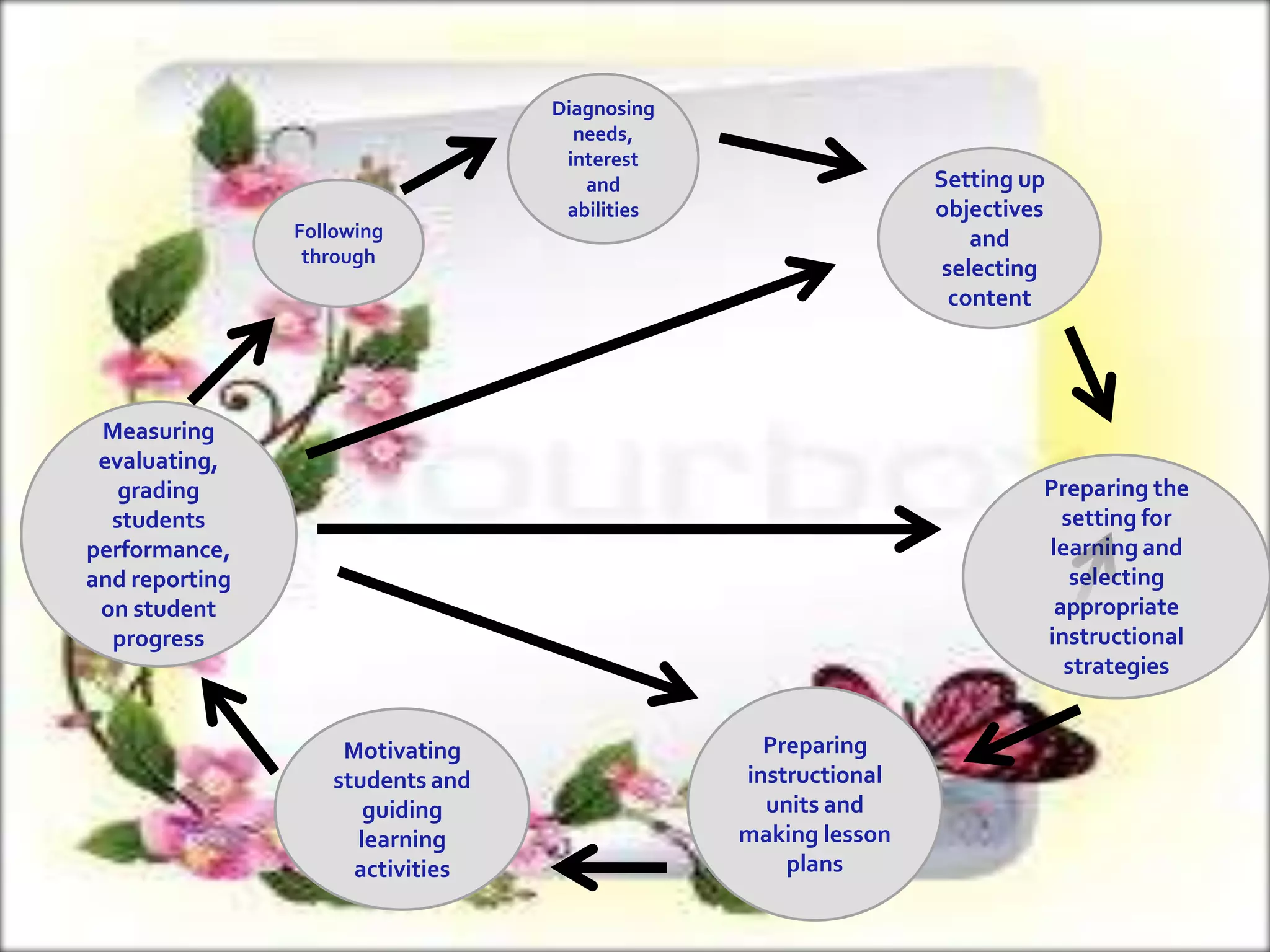
The interrelationships among these tasks are
presented as a cycle.
Following
through

Diagnosing
needs,
interest
and
abilities

Setting up
objectives
and
selecting
content

Measuring
evaluating,
grading
students
performance,
and reporting
on student
progress

Preparing the
setting for
learning and
selecting
appropriate
instructional
strategies
Motivating
students and
guiding
learning
activities

Preparing
instructional
units and
making lesson
plans
The first tasks, diagnosing student’s needs and
abilities, imparts to the teacher the necessity
of discovering the needs, interest , and
capabilities of his capabilities of his
students.
Systematic techniques are available to
the teacher which he can use in gathering
information about the student’s needs and
abilities (Armstrong & Savage, 1938: 114-24):
work samples; conferences; anectodal records;
checklist; interest inventory; teacher test; and
cloze test.
The second task, setting up of
objectives and selecting content,
involves selecting appropriate
learning materials suited to the
needs and interest of the students.
The instructional objectives
describes what the students are
expected to do at the completion of
the instructional sequence to show
they have learned.
The third task is preparing the setting for
learning and selecting instructional strategies.
Once the objectives have been established, the
teacher has to decide on the technique that will
help the students achieve the goals.
To provide for an intellectual
settings and an emotional atmosphere conductive
to learning, it will help the teacher to keep in
mind that an orderly, well-disciplined class is
essential for successful teaching and learning.
Good classroom management is a perquisite to the
maintenance of discipline and control in a
class. Many teachers usually find discipline and
control of classes very difficult.
The fourth tasks is formalizing
units and making lesson plans. This
involves organizing information
about individual students,
objectives, materials and
techniques into a resource unit
that can serve as reference to the
teacher as he does his work from
day to day.
An instructional unit is planned
sequence of learning activities or
lessons covering a period of several
weeks and centered around some major
concepts, mainly content-oriented lessons
or semi-individualized, laboratoryoriented, experience-oriented unit
assignments, or any of a variety of
combinations. Some units may be shorter
than two weeks but others maybe longer
than six weeks in length (Clark and
Starr, 1981:144).
Instructional units provide the teacher
with opportunities to use his creativity
as he plans instructional sequences
systematically for students. In planning
the units, the teacher has to take into
account the needs and the varying levels
of the students. He has to consider
individual differences among students and
has to be selective, taking care, taking
care that relevant topics are not
omitted.
Units are generally designed to be
taught over a number of days. After they
have been developed, the teacher has to
prepare more specific plans for a given
period. These are called lesson plan,
consisting of very specific outline
describing in detail what the teacher and
the students will do on a day to
implement the unit’s objectives. Lesson
plans give a sense of direction and
organization to both teacher and
students.
1. Content or Subject Matter and
Materials. The teacher indicates the
subject matter that he believes will help
attain his objectives. This may be
indicated as generalizations in outline
form. Sometimes, it can be a part of the
procedure or it can be written on a
separate sheet of paper if the teacher
wants more details in the outline.
The teacher should also
consider the materials amay be prepared
to help students concretize what are to
be nd equipment that he may need.
Illustrations and posters emphasized.
2. Procedure or Strategy
a) The teacher should write down in the order of
occurrence the activities that
he and his students are going to do during the
period.
b) He should avoid skimping the planning of the
teaching procedure. He
should not just indicate “lecture on the
principle of capillary for 15 minutes”
1) what he will says and the questions he will
asks;
2) the main points he will bring out; and
3) the experiments he may asks students to
under- take. It is not enough
that he indicates some problems that will be
done on the board.
The teacher should plan which problems
he should work out the answer to
beforehand. If he plans to ask questions,
he should decide what questions to asks
and the answer to the most important
ones. Students teachers and new teachers
are usually required to indicate “Teacher
Activity” and “Student Activity”. The
elements under procedure may vary
according to the subject matter and grade
level of students.
THANK YOU
  
Instructional planning

Instructional planning

  • 1.
  • 2.
    MANAGEMENT OF INSTRUCTION Typicalbehavior is associated with desire to meet the student’s needs maybe personal, social and academic. When such needs are not satisfied or even recognized, by teaching is hampered and the opportunity for learning is reduced significantly. While it is accepted that teachers if at all have a little control over changes that occur in the environment like home and school, the teacher however has full control over her instructional competence. When instruction is characterized by a high degree of competence. The chances of controlling the effects of misbehavior and all others deter learning are great.
  • 3.
    The following arethe underlying principles 1.Instructional competence lessens, the effect of negative forces from the environment. 2. Recurring misbehavior results from poor instruction. 3. The use of positive approaches/techniques in teaching arising from complete awareness of the underlying causes of misbehavior, brings about better learning results. 4. Understanding by the teacher of the basic human needs such as food, security, belonging and recognition eliminates behavior problems in the classroom. 5.Teachers must be willing to recognize student’s needs for instruction to be more fulfilling. 6. Teacher behavior facilitates student’s achievements. 7. Effective teaching enhances the teacher’s instructional competence and helps prevent classroom management problems.
  • 4.
    INTRODUCTION: Planning for effectivelearning experiences is one of the skills the teacher has to develop. Planning insures more or less the direction that his efforts will take. It helps create whole-some discipline, a pleasant classroom atmosphere, and purposeful teachinglearning activities that are free from waste in terms of time and effort. Careful planning can give the teacher a sense of confidence in overcoming nervousness and preventing wastage and confusion especially during the first days of teaching.
  • 5.
    Planning for PurposefulInstructional Planning for teaching involves sequences of steps. It calls for decisions with respect to each of the tasks involved. If all these tasks are accomplished successfully, the prospects that students will master what has been taught are excellent. The interrelationships among these tasks are presented as a cycle.
  • 6.
    Following through Diagnosing needs, interest and abilities Setting up objectives and selecting content Measuring evaluating, grading students performance, and reporting onstudent progress Preparing the setting for learning and selecting appropriate instructional strategies Motivating students and guiding learning activities Preparing instructional units and making lesson plans
  • 7.
    The first tasks,diagnosing student’s needs and abilities, imparts to the teacher the necessity of discovering the needs, interest , and capabilities of his capabilities of his students. Systematic techniques are available to the teacher which he can use in gathering information about the student’s needs and abilities (Armstrong & Savage, 1938: 114-24): work samples; conferences; anectodal records; checklist; interest inventory; teacher test; and cloze test.
  • 8.
    The second task,setting up of objectives and selecting content, involves selecting appropriate learning materials suited to the needs and interest of the students. The instructional objectives describes what the students are expected to do at the completion of the instructional sequence to show they have learned.
  • 9.
    The third taskis preparing the setting for learning and selecting instructional strategies. Once the objectives have been established, the teacher has to decide on the technique that will help the students achieve the goals. To provide for an intellectual settings and an emotional atmosphere conductive to learning, it will help the teacher to keep in mind that an orderly, well-disciplined class is essential for successful teaching and learning. Good classroom management is a perquisite to the maintenance of discipline and control in a class. Many teachers usually find discipline and control of classes very difficult.
  • 10.
    The fourth tasksis formalizing units and making lesson plans. This involves organizing information about individual students, objectives, materials and techniques into a resource unit that can serve as reference to the teacher as he does his work from day to day.
  • 11.
    An instructional unitis planned sequence of learning activities or lessons covering a period of several weeks and centered around some major concepts, mainly content-oriented lessons or semi-individualized, laboratoryoriented, experience-oriented unit assignments, or any of a variety of combinations. Some units may be shorter than two weeks but others maybe longer than six weeks in length (Clark and Starr, 1981:144).
  • 12.
    Instructional units providethe teacher with opportunities to use his creativity as he plans instructional sequences systematically for students. In planning the units, the teacher has to take into account the needs and the varying levels of the students. He has to consider individual differences among students and has to be selective, taking care, taking care that relevant topics are not omitted.
  • 13.
    Units are generallydesigned to be taught over a number of days. After they have been developed, the teacher has to prepare more specific plans for a given period. These are called lesson plan, consisting of very specific outline describing in detail what the teacher and the students will do on a day to implement the unit’s objectives. Lesson plans give a sense of direction and organization to both teacher and students.
  • 14.
    1. Content orSubject Matter and Materials. The teacher indicates the subject matter that he believes will help attain his objectives. This may be indicated as generalizations in outline form. Sometimes, it can be a part of the procedure or it can be written on a separate sheet of paper if the teacher wants more details in the outline. The teacher should also consider the materials amay be prepared to help students concretize what are to be nd equipment that he may need. Illustrations and posters emphasized.
  • 15.
    2. Procedure orStrategy a) The teacher should write down in the order of occurrence the activities that he and his students are going to do during the period. b) He should avoid skimping the planning of the teaching procedure. He should not just indicate “lecture on the principle of capillary for 15 minutes” 1) what he will says and the questions he will asks; 2) the main points he will bring out; and 3) the experiments he may asks students to under- take. It is not enough that he indicates some problems that will be done on the board.
  • 16.
    The teacher shouldplan which problems he should work out the answer to beforehand. If he plans to ask questions, he should decide what questions to asks and the answer to the most important ones. Students teachers and new teachers are usually required to indicate “Teacher Activity” and “Student Activity”. The elements under procedure may vary according to the subject matter and grade level of students.
  • 17.