+

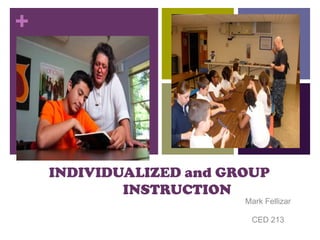
INDIVIDUALIZED and GROUP
INSTRUCTION
Mark Fellizar
CED 213
+

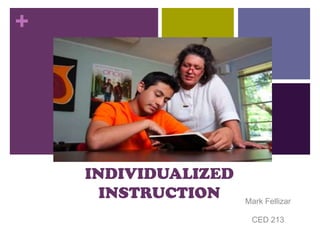
INDIVIDUALIZED
INSTRUCTION

Mark Fellizar
CED 213
+

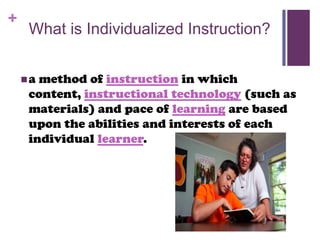
What is Individualized Instruction?
a

method of instruction in which
content, instructional technology (such as
materials) and pace of learning are based
upon the abilities and interests of each
individual learner.
+

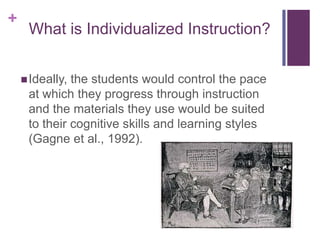
What is Individualized Instruction?
 Ideally,

the students would control the pace
at which they progress through instruction
and the materials they use would be suited
to their cognitive skills and learning styles
(Gagne et al., 1992).
+

What is Individualized Instruction?
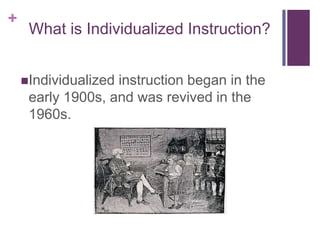
Individualized

instruction began in the
early 1900s, and was revived in the
1960s.
+

*The Keller Plan,

*Individually Prescribed Instruction,
*Program for Learning in Accordance
with Needs, and Individually Guided
Education

are all examples of individualized
instruction in the U.S. (Saettler, 1990).
+

Keller Plan (1963)


Developed by F.S. Keller, a colleague of Skinner, the Keller
plan was used for university college classes.



Main features of Keller Plan


individually paced.



mastery learning.



lectures and demonstrations motivational rather than critical
information.



use of proctors which permitted testing, immediate scoring, tutoring,
personal-social aspect of educational process.
(Saettler, 1990)
+

Individually Prescribed
Instruction (IPI) (1964)


Developed by Learning Research and Development Center of the
University of Pitsburgh.



Lasted into the 1970s when it lost funding and its use dwindled



Main features of IPI:







prepared units.
behavioral objectives.
planned instructional sequences.
used for reading, math and science.
included pretest and posttest for each unit.
materials continually evaluated and upgraded to meet behavioral objectives.

(Saettler, 1990)
+

Program for Learning in Accordance
with Needs (PLAN) (1967)


Headed by Jon C. Flanagan, PLAN was developed under
sponsorship of American Institutes for Research (AIR),
Westinghouse Learning Corporation and fourteen U.S. School
districts.



Abandoned in late 1970s because of upgrading costs



Main features of PLAN





schools selected items from about 6,000 behavioral objectives.
each instructional module took about two weeks instruction and were
made up of approximately. five objectives.
mastery learning.
remedial learning plus retesting.

(Saettler, 1990)
+

Computer-Assisted Instruction
(CAI)


Computer-assisted instruction was first used in education and
training during the 1950s.



Early work was done by IBM



Despite money and research, by the mid seventies it was apparent
that CAI was not going to be the success that people had
believed. Some of the reasons are:






CAI had been oversold and could not deliver.
lack of support from certain sectors.
technical problems in implementation.
lack of quality software.
high cost.
+

Distance education
a

mode of delivering education and teaching,
often on an individual basis, to students who
are not physically present in a traditional
setting such as a classroom.

 provides

"access to learning when the
source of information and the learners are
separated by time and distance, or both
+

Benefits
 Distance

learning may enable students who are
unable to attend a traditional school setting due
to disabilities, handicaps, or sicknesses such as
decreased mobility and immune system
suppression to get a good education.

 May

provide equal access regardless of
socioeconomic status or income, area of
residence, gender, race, age, or cost per
student.
+

Criticism
 Some

students attempt distance education
without proper training of the tools needed to
be successful in the program. Students must
be provided with training on each tool that is
used throughout the program.

 The

lack of advanced technology skills can
lead to an unsuccessful experience. Schools
have a responsibility to adopt a proactive
policy for managing technology barriers.
Kumon advocates the value of independent learning.
Therefore individualized instruction is one of the
fundamental factors of the Kumon Method.
The key to individualized instruction is to study at the
“just right” level, in which students can progress on
their own without being specifically taught.
Students start with their “just right” level
and progress at their own pace
It is essential to start with content that allows
children to easily obtain a perfect score at their
current ability level. If children continue to study at
their own pace at a level that is appropriate to
their ability, they will catch up to their school
grade level and eventually advance far beyond it.
+

SMALL and LARGE
GROUP
INSTRUCTION

Mark Fellizar
CED 213
+

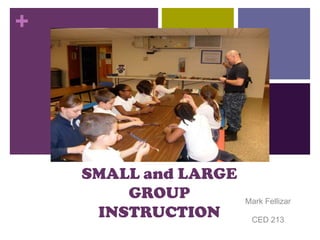
SMALL GROUP INSTRUCTION
Defining Small Group Teaching
The term 'small group teaching', or
'small group learning' as it is often
termed, means different things to
different people. Some are familiar with
the tutorial as being their experience of
small group teaching.
+

SMALL GROUP INSTRUCTION
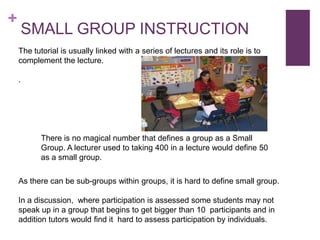
The tutorial is usually linked with a series of lectures and its role is to
complement the lecture.
.

There is no magical number that defines a group as a Small
Group. A lecturer used to taking 400 in a lecture would define 50
as a small group.
As there can be sub-groups within groups, it is hard to define small group.
In a discussion, where participation is assessed some students may not
speak up in a group that begins to get bigger than 10 participants and in
addition tutors would find it hard to assess participation by individuals.
+

SMALL GROUP INSTRUCTION
+

SMALL GROUP INSTRUCTION

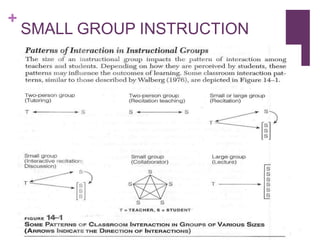
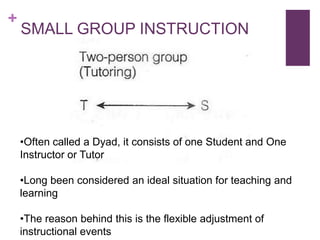
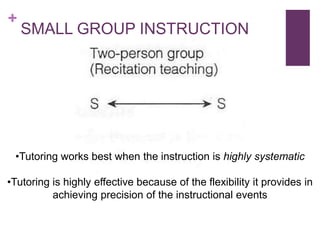
•Often called a Dyad, it consists of one Student and One
Instructor or Tutor
•Long been considered an ideal situation for teaching and
learning
•The reason behind this is the flexible adjustment of
instructional events
+

SMALL GROUP INSTRUCTION

•Tutoring works best when the instruction is highly systematic
•Tutoring is highly effective because of the flexibility it provides in
achieving precision of the instructional events
+

SMALL GROUP INSTRUCTION

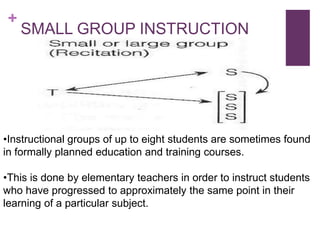
•Instructional groups of up to eight students are sometimes found
in formally planned education and training courses.
•This is done by elementary teachers in order to instruct students
who have progressed to approximately the same point in their
learning of a particular subject.
+

SMALL GROUP INSTRUCTION

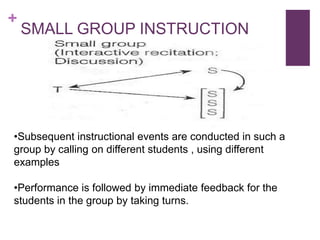
•Subsequent instructional events are conducted in such a
group by calling on different students , using different
examples
•Performance is followed by immediate feedback for the
students in the group by taking turns.
+

SMALL GROUP INSTRUCTION

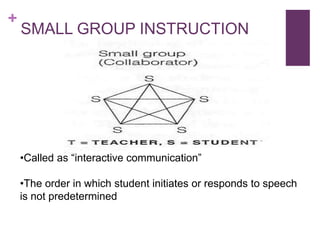
•Called as “interactive communication”
•The order in which student initiates or responds to speech
is not predetermined
+

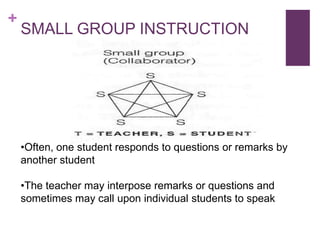
SMALL GROUP INSTRUCTION

•Often, one student responds to questions or remarks by
another student

•The teacher may interpose remarks or questions and
sometimes may call upon individual students to speak
+

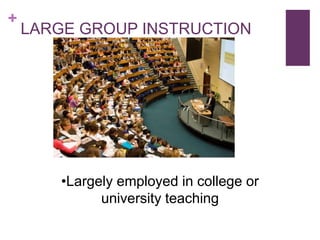
LARGE GROUP INSTRUCTION

•Largely employed in college or
university teaching
+

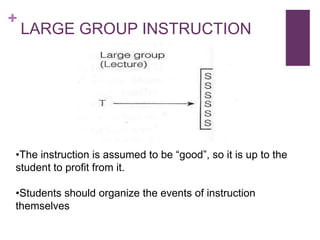
LARGE GROUP INSTRUCTION

•The instruction is assumed to be “good”, so it is up to the
student to profit from it.

•Students should organize the events of instruction
themselves
+

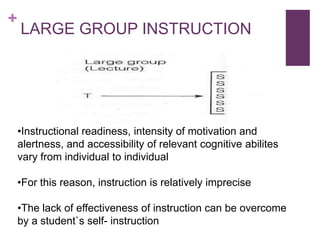
LARGE GROUP INSTRUCTION

•Instructional readiness, intensity of motivation and
alertness, and accessibility of relevant cognitive abilites
vary from individual to individual
•For this reason, instruction is relatively imprecise
•The lack of effectiveness of instruction can be overcome
by a student`s self- instruction
+

REFERENCES:
Gagne, R.M., Wager, W.W., Golas, K.G. & Keller, J.M. (2005). Principles
of instructional design. Toronto, ON: Thomson Wadsworth.
Saettler, P. (1990). The evolution of american educational technology . Englewood,
CO: Libraries Unlimited, Inc.
Schunk, D. H. 2008. "Learning theories:An educational perspective", (5th Ed),
Gagné,R.M
pp.286-287 The Idea of Schema 1987 p. 5
Richey, Rita C. The Legacy of Robert M. Gagné. 2000. 283-291.
http://www.usask.ca/education/coursework/802papers/mergel/brenda.htm

Instructional Systems Design

  • 1.
  • 2.
  • 3.
    + What is IndividualizedInstruction? a method of instruction in which content, instructional technology (such as materials) and pace of learning are based upon the abilities and interests of each individual learner.
  • 4.
    + What is IndividualizedInstruction?  Ideally, the students would control the pace at which they progress through instruction and the materials they use would be suited to their cognitive skills and learning styles (Gagne et al., 1992).
  • 5.
    + What is IndividualizedInstruction? Individualized instruction began in the early 1900s, and was revived in the 1960s.
  • 6.
    + *The Keller Plan, *IndividuallyPrescribed Instruction, *Program for Learning in Accordance with Needs, and Individually Guided Education are all examples of individualized instruction in the U.S. (Saettler, 1990).
  • 7.
    + Keller Plan (1963)  Developedby F.S. Keller, a colleague of Skinner, the Keller plan was used for university college classes.  Main features of Keller Plan  individually paced.  mastery learning.  lectures and demonstrations motivational rather than critical information.  use of proctors which permitted testing, immediate scoring, tutoring, personal-social aspect of educational process. (Saettler, 1990)
  • 8.
    + Individually Prescribed Instruction (IPI)(1964)  Developed by Learning Research and Development Center of the University of Pitsburgh.  Lasted into the 1970s when it lost funding and its use dwindled  Main features of IPI:       prepared units. behavioral objectives. planned instructional sequences. used for reading, math and science. included pretest and posttest for each unit. materials continually evaluated and upgraded to meet behavioral objectives. (Saettler, 1990)
  • 9.
    + Program for Learningin Accordance with Needs (PLAN) (1967)  Headed by Jon C. Flanagan, PLAN was developed under sponsorship of American Institutes for Research (AIR), Westinghouse Learning Corporation and fourteen U.S. School districts.  Abandoned in late 1970s because of upgrading costs  Main features of PLAN     schools selected items from about 6,000 behavioral objectives. each instructional module took about two weeks instruction and were made up of approximately. five objectives. mastery learning. remedial learning plus retesting. (Saettler, 1990)
  • 10.
    + Computer-Assisted Instruction (CAI)  Computer-assisted instructionwas first used in education and training during the 1950s.  Early work was done by IBM  Despite money and research, by the mid seventies it was apparent that CAI was not going to be the success that people had believed. Some of the reasons are:      CAI had been oversold and could not deliver. lack of support from certain sectors. technical problems in implementation. lack of quality software. high cost.
  • 11.
    + Distance education a mode ofdelivering education and teaching, often on an individual basis, to students who are not physically present in a traditional setting such as a classroom.  provides "access to learning when the source of information and the learners are separated by time and distance, or both
  • 12.
    + Benefits  Distance learning mayenable students who are unable to attend a traditional school setting due to disabilities, handicaps, or sicknesses such as decreased mobility and immune system suppression to get a good education.  May provide equal access regardless of socioeconomic status or income, area of residence, gender, race, age, or cost per student.
  • 13.
    + Criticism  Some students attemptdistance education without proper training of the tools needed to be successful in the program. Students must be provided with training on each tool that is used throughout the program.  The lack of advanced technology skills can lead to an unsuccessful experience. Schools have a responsibility to adopt a proactive policy for managing technology barriers.
  • 14.
    Kumon advocates thevalue of independent learning. Therefore individualized instruction is one of the fundamental factors of the Kumon Method. The key to individualized instruction is to study at the “just right” level, in which students can progress on their own without being specifically taught.
  • 15.
    Students start withtheir “just right” level and progress at their own pace It is essential to start with content that allows children to easily obtain a perfect score at their current ability level. If children continue to study at their own pace at a level that is appropriate to their ability, they will catch up to their school grade level and eventually advance far beyond it.
  • 16.
  • 17.
    + SMALL GROUP INSTRUCTION DefiningSmall Group Teaching The term 'small group teaching', or 'small group learning' as it is often termed, means different things to different people. Some are familiar with the tutorial as being their experience of small group teaching.
  • 18.
    + SMALL GROUP INSTRUCTION Thetutorial is usually linked with a series of lectures and its role is to complement the lecture. . There is no magical number that defines a group as a Small Group. A lecturer used to taking 400 in a lecture would define 50 as a small group. As there can be sub-groups within groups, it is hard to define small group. In a discussion, where participation is assessed some students may not speak up in a group that begins to get bigger than 10 participants and in addition tutors would find it hard to assess participation by individuals.
  • 19.
  • 20.
    + SMALL GROUP INSTRUCTION •Oftencalled a Dyad, it consists of one Student and One Instructor or Tutor •Long been considered an ideal situation for teaching and learning •The reason behind this is the flexible adjustment of instructional events
  • 21.
    + SMALL GROUP INSTRUCTION •Tutoringworks best when the instruction is highly systematic •Tutoring is highly effective because of the flexibility it provides in achieving precision of the instructional events
  • 22.
    + SMALL GROUP INSTRUCTION •Instructionalgroups of up to eight students are sometimes found in formally planned education and training courses. •This is done by elementary teachers in order to instruct students who have progressed to approximately the same point in their learning of a particular subject.
  • 23.
    + SMALL GROUP INSTRUCTION •Subsequentinstructional events are conducted in such a group by calling on different students , using different examples •Performance is followed by immediate feedback for the students in the group by taking turns.
  • 24.
    + SMALL GROUP INSTRUCTION •Calledas “interactive communication” •The order in which student initiates or responds to speech is not predetermined
  • 25.
    + SMALL GROUP INSTRUCTION •Often,one student responds to questions or remarks by another student •The teacher may interpose remarks or questions and sometimes may call upon individual students to speak
  • 26.
    + LARGE GROUP INSTRUCTION •Largelyemployed in college or university teaching
  • 27.
    + LARGE GROUP INSTRUCTION •Theinstruction is assumed to be “good”, so it is up to the student to profit from it. •Students should organize the events of instruction themselves
  • 28.
    + LARGE GROUP INSTRUCTION •Instructionalreadiness, intensity of motivation and alertness, and accessibility of relevant cognitive abilites vary from individual to individual •For this reason, instruction is relatively imprecise •The lack of effectiveness of instruction can be overcome by a student`s self- instruction
  • 29.
    + REFERENCES: Gagne, R.M., Wager,W.W., Golas, K.G. & Keller, J.M. (2005). Principles of instructional design. Toronto, ON: Thomson Wadsworth. Saettler, P. (1990). The evolution of american educational technology . Englewood, CO: Libraries Unlimited, Inc. Schunk, D. H. 2008. "Learning theories:An educational perspective", (5th Ed), Gagné,R.M pp.286-287 The Idea of Schema 1987 p. 5 Richey, Rita C. The Legacy of Robert M. Gagné. 2000. 283-291. http://www.usask.ca/education/coursework/802papers/mergel/brenda.htm