Rectangle 7


Title 1


                              BY
                         T.Sivakumar
                        B.PHARMACY
Rectangle 8


Title 1


          1.   DEFINITION
          2.   COMPONENTS OF AEROSOL SYSTEMS
          3.   FORMULATION OF AEROSOLS
          4.   MANUFACTURE OF AEROSOLS
          5.   METERED DOSE INHALER DESIGNS
          6.   DRY POWDER INHALERS
          7.   EVALUATION OF AEROSOLS
          8.   QUALITY CONTROL TESTS FOR AEROSOLS
Rectangle 8


Title 3


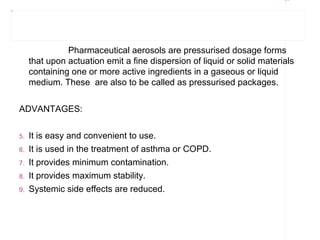
                         Pharmaceutical aerosols are pressurised dosage forms
               that upon actuation emit a fine dispersion of liquid or solid materials
               containing one or more active ingredients in a gaseous or liquid
               medium. These are also to be called as pressurised packages.


          ADVANTAGES:


          5.   It is easy and convenient to use.
          6.   It is used in the treatment of asthma or COPD.
          7.   It provides minimum contamination.
          8.   It provides maximum stability.
          9.   Systemic side effects are reduced.
Rectangle 8


Title 1


          1.   Cost is high.


          3.   Irritation may occur upon topical administration of
               aerosols.


          5.   It leads to inhalation toxicity.
Rectangle 8


          Picture 27


Title 1
Rectangle 8


Title 1


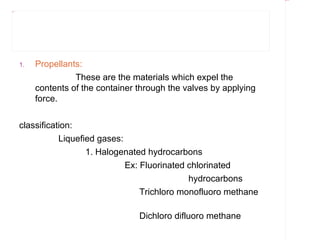
          1.   Propellants:
                         These are the materials which expel the
               contents of the container through the valves by applying
               force.


          classification:
                     Liquefied gases:
                            1. Halogenated hydrocarbons
                                      Ex: Fluorinated chlorinated
                                                      hydrocarbons
                                          Trichloro monofluoro methane

                                         Dichloro difluoro methane
Rectangle 8


2. Hydrocarbon :
            Ex: Propane
                 Butane
                 Isobutane
Compressed gases:

   1. Soluble gases:


               Ex: Carbon dioxide
                   Nitrous oxide
   2. Insoluble gases:


               Ex: Nitrogen
Rectangle 8


Title 1


             various types of materials are used in the manufacture of aerosol
          containers. The containers used in the formulation of aerosols should
          With stand high pressure i.e.,140 to 180 psig and temperature of about
            54.44 c.


          Types of materials used:
          1.Metal
          2.Glass

          Metal: Two types of metal containers are tin plated steel and aluminium


          Glass: Two types of glass containers are plastic coated glass and
            uncoated glass.
Rectangle 8


3.Valves : They help in expelling the contents from the container.
                                             Picture 4


   Parts of valves :
         Mounting cup or Ferrule
         Valve body
         Stem
         Gasket
         Spring
         Dip tube


4.Actuators : These are specially designed buttons placed on the
  valve stem.


Types of actuators:
          Spray actuators
          Foam actuators
          Solid stream actuators
Rectangle 8


Formulation of aerosols:

1.Product concentrate.


2.Propellants.
Rectangle 8


Manufacture of aerosols:

Procedure for the manufacturing of aerosols is carried
out in 2 stages

  1.The concentrate is manufactured.


  2.Then the propellants are added in the formulation.
Rectangle 8


Different apparatus used in manufaturing are

1.The pressure filling apparatus.

2.The cold filling apparatus.

3.The compressed gas filling apparatus.
Rectangle 8


Metered dose inhaler designs:

         In this drug is dissolved or suspended in a liquid propellant
  mixture presented in a pressurized canister fitted with a metering
  valve.


Containers: Thin plated steel , plastic coated glass or aluminium
 containers.


Propellants: Cholro fluoro carbons, hydrofluoro alkanes.

Metering valves: It permits reproducible delivery of small volumes of
 product . It is used in inverted position.
Picture 9   Rectangle 8
Rectangle 8


Filling metered dose inhaler canisters:

       1.Cold Filling.
       2.Pressure Filling.


Advantages of MDIs:
        1.portability.
        2.Low cost.
        3.Disposability.


Disadvantages of MDTs :
          1.Poor inhalation.
       2.Inefficient at drug delivery.
Rectangle 8


Dry powder inhalers:

    In this drug is inhaled as cloud of fine particles. The drug is either
 preloaded in a inhalation device or into hard gelatin capsules or foil
 blister discs.They are propellant free and do not contain any
 excipient other than carrier like lactose.


Advantages:
    1. It is useful for young children.
     2.It delivers larger drug doses than MDIs.


Disavantages:
    1.Liberation of powders from the device.
     2.Less efficient.
Rectangle 8


Title 1


          1.Unit dose.
          •  Spinhaler.
          •  Rotahaler.

          2.Multi dose.
          •  Turbhaler.
          •  Dischaler.
Rectangle 8


Spinhaler:The capsule is placed in a loose-
  fitting rotar is pierced through 2
  needles.Inhaled air flow through the device
  causes rotation of rotar resulting in the
  powder being dispersed to the capsule walls
  and out through the perforations into the air.

Rotahaler:The capsule is inserted into an
 orifice at rear of the device and when the
 two sections are rotated a fin on the inhaler
 barrel pulls the two halves of the capsule
 spins,dispersing its contents,which are
 inhaled through the mouthpiece.
Rectangle 8


Diskhaler:Here aluminium foil blisters are
  placed in disc.Needle will pierce the blisters
  as air flows the blisters causes the powder to
  disperse as the patient will inhales through
  the mouthpiece.

Turbohaler:Here drug is present in reservoir
 from which it flows to disc.The disc is
 rotated by moving the turning grip back and
 forth thus drug is released which is inhaled
 by patient.
Rectangle 8


Title 1


          1.   Moisture content.
          2.   Leak test.
          3.   Particle size determination.
          4.   Microbial limits.
Rectangle 8


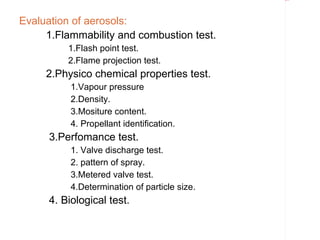
Evaluation of aerosols:
     1.Flammability and combustion test.
          1.Flash point test.
          2.Flame projection test.
     2.Physico chemical properties test.
           1.Vapour pressure
           2.Density.
           3.Mositure content.
           4. Propellant identification.
      3.Perfomance test.
           1. Valve discharge test.
           2. pattern of spray.
           3.Metered valve test.
           4.Determination of particle size.
      4. Biological test.
Rectangle 8


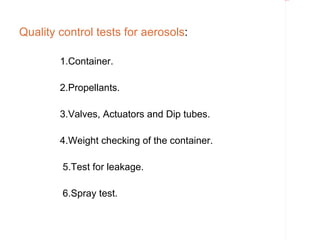
Quality control tests for aerosols:

        1.Container.

        2.Propellants.

        3.Valves, Actuators and Dip tubes.

        4.Weight checking of the container.

         5.Test for leakage.

         6.Spray test.
Rectangle 8


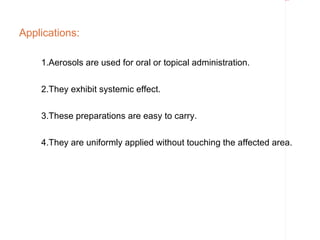
Applications:

    1.Aerosols are used for oral or topical administration.


    2.They exhibit systemic effect.


    3.These preparations are easy to carry.

    4.They are uniformly applied without touching the affected area.
Rectangle 8

Aerosols

  • 1.
    Rectangle 7 Title 1 BY T.Sivakumar B.PHARMACY
  • 2.
    Rectangle 8 Title 1 1. DEFINITION 2. COMPONENTS OF AEROSOL SYSTEMS 3. FORMULATION OF AEROSOLS 4. MANUFACTURE OF AEROSOLS 5. METERED DOSE INHALER DESIGNS 6. DRY POWDER INHALERS 7. EVALUATION OF AEROSOLS 8. QUALITY CONTROL TESTS FOR AEROSOLS
  • 3.
    Rectangle 8 Title 3 Pharmaceutical aerosols are pressurised dosage forms that upon actuation emit a fine dispersion of liquid or solid materials containing one or more active ingredients in a gaseous or liquid medium. These are also to be called as pressurised packages. ADVANTAGES: 5. It is easy and convenient to use. 6. It is used in the treatment of asthma or COPD. 7. It provides minimum contamination. 8. It provides maximum stability. 9. Systemic side effects are reduced.
  • 4.
    Rectangle 8 Title 1 1. Cost is high. 3. Irritation may occur upon topical administration of aerosols. 5. It leads to inhalation toxicity.
  • 5.
    Rectangle 8 Picture 27 Title 1
  • 6.
    Rectangle 8 Title 1 1. Propellants: These are the materials which expel the contents of the container through the valves by applying force. classification: Liquefied gases: 1. Halogenated hydrocarbons Ex: Fluorinated chlorinated hydrocarbons Trichloro monofluoro methane Dichloro difluoro methane
  • 7.
    Rectangle 8 2. Hydrocarbon: Ex: Propane Butane Isobutane Compressed gases: 1. Soluble gases: Ex: Carbon dioxide Nitrous oxide 2. Insoluble gases: Ex: Nitrogen
  • 8.
    Rectangle 8 Title 1 various types of materials are used in the manufacture of aerosol containers. The containers used in the formulation of aerosols should With stand high pressure i.e.,140 to 180 psig and temperature of about 54.44 c. Types of materials used: 1.Metal 2.Glass Metal: Two types of metal containers are tin plated steel and aluminium Glass: Two types of glass containers are plastic coated glass and uncoated glass.
  • 9.
    Rectangle 8 3.Valves :They help in expelling the contents from the container. Picture 4 Parts of valves : Mounting cup or Ferrule Valve body Stem Gasket Spring Dip tube 4.Actuators : These are specially designed buttons placed on the valve stem. Types of actuators: Spray actuators Foam actuators Solid stream actuators
  • 10.
    Rectangle 8 Formulation ofaerosols: 1.Product concentrate. 2.Propellants.
  • 11.
    Rectangle 8 Manufacture ofaerosols: Procedure for the manufacturing of aerosols is carried out in 2 stages 1.The concentrate is manufactured. 2.Then the propellants are added in the formulation.
  • 12.
    Rectangle 8 Different apparatusused in manufaturing are 1.The pressure filling apparatus. 2.The cold filling apparatus. 3.The compressed gas filling apparatus.
  • 13.
    Rectangle 8 Metered doseinhaler designs: In this drug is dissolved or suspended in a liquid propellant mixture presented in a pressurized canister fitted with a metering valve. Containers: Thin plated steel , plastic coated glass or aluminium containers. Propellants: Cholro fluoro carbons, hydrofluoro alkanes. Metering valves: It permits reproducible delivery of small volumes of product . It is used in inverted position.
  • 14.
    Picture 9 Rectangle 8
  • 15.
    Rectangle 8 Filling metereddose inhaler canisters: 1.Cold Filling. 2.Pressure Filling. Advantages of MDIs: 1.portability. 2.Low cost. 3.Disposability. Disadvantages of MDTs : 1.Poor inhalation. 2.Inefficient at drug delivery.
  • 16.
    Rectangle 8 Dry powderinhalers: In this drug is inhaled as cloud of fine particles. The drug is either preloaded in a inhalation device or into hard gelatin capsules or foil blister discs.They are propellant free and do not contain any excipient other than carrier like lactose. Advantages: 1. It is useful for young children. 2.It delivers larger drug doses than MDIs. Disavantages: 1.Liberation of powders from the device. 2.Less efficient.
  • 17.
    Rectangle 8 Title 1 1.Unit dose. • Spinhaler. • Rotahaler. 2.Multi dose. • Turbhaler. • Dischaler.
  • 18.
    Rectangle 8 Spinhaler:The capsuleis placed in a loose- fitting rotar is pierced through 2 needles.Inhaled air flow through the device causes rotation of rotar resulting in the powder being dispersed to the capsule walls and out through the perforations into the air. Rotahaler:The capsule is inserted into an orifice at rear of the device and when the two sections are rotated a fin on the inhaler barrel pulls the two halves of the capsule spins,dispersing its contents,which are inhaled through the mouthpiece.
  • 19.
    Rectangle 8 Diskhaler:Here aluminiumfoil blisters are placed in disc.Needle will pierce the blisters as air flows the blisters causes the powder to disperse as the patient will inhales through the mouthpiece. Turbohaler:Here drug is present in reservoir from which it flows to disc.The disc is rotated by moving the turning grip back and forth thus drug is released which is inhaled by patient.
  • 20.
    Rectangle 8 Title 1 1. Moisture content. 2. Leak test. 3. Particle size determination. 4. Microbial limits.
  • 21.
    Rectangle 8 Evaluation ofaerosols: 1.Flammability and combustion test. 1.Flash point test. 2.Flame projection test. 2.Physico chemical properties test. 1.Vapour pressure 2.Density. 3.Mositure content. 4. Propellant identification. 3.Perfomance test. 1. Valve discharge test. 2. pattern of spray. 3.Metered valve test. 4.Determination of particle size. 4. Biological test.
  • 22.
    Rectangle 8 Quality controltests for aerosols: 1.Container. 2.Propellants. 3.Valves, Actuators and Dip tubes. 4.Weight checking of the container. 5.Test for leakage. 6.Spray test.
  • 23.
    Rectangle 8 Applications: 1.Aerosols are used for oral or topical administration. 2.They exhibit systemic effect. 3.These preparations are easy to carry. 4.They are uniformly applied without touching the affected area.
  • 24.

Editor's Notes