Under supervision of
Mrs. Nimisha Srivastva
Sterile products are the dosage forms of therapeutic
agents that are free of viable microorganisms.
Principally, these include parenteral, ophthalmic and
irrigating preparations of these parenteral products are
unique among dosage forms of drugs because they are
injected through the skin or mucous membrane into
internal body compartments. Thus because they have
circumvented the highly efficient first line of body
defense ,i.e. the skin and mucous membrane, they must
be free from microbial contamination and toxic
components ,as well as possess an exceptionally high
level of purity1. Although parenteral are comes under
category of sterile products but all sterile products
can’t say as parenterals.


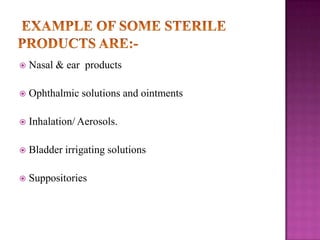
Nasal & ear products



Ophthalmic solutions and ointments



Inhalation/ Aerosols.



Bladder irrigating solutions



Suppositories
Parenteral (Gk, para enteron, beside the intestine)
dosage forms differ from all other drug dosage
forms, because they are injected directly into body
tissue through the primary protective systems of the
human body, the skin, and mucous membranes.

As per USP Parenteral articles are preparations
intended for injection through the skin or other external
boundary tissue, so that the active substance they
contain are administered using gravity or force, directly
into a blood vessel, organ, tissue or lesion.

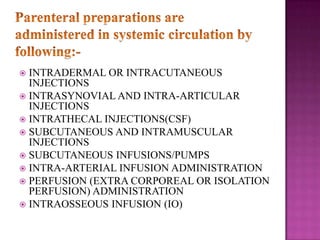
INTRADERMAL OR INTRACUTANEOUS
INJECTIONS
 INTRASYNOVIAL AND INTRA-ARTICULAR
INJECTIONS
 INTRATHECAL INJECTIONS(CSF)
 SUBCUTANEOUS AND INTRAMUSCULAR
INJECTIONS
 SUBCUTANEOUS INFUSIONS/PUMPS
 INTRA-ARTERIAL INFUSION ADMINISTRATION
 PERFUSION (EXTRA CORPOREAL OR ISOLATION
PERFUSION) ADMINISTRATION
 INTRAOSSEOUS INFUSION (IO)

All products must be sterile.
 All products must be free from pyrogenic (endotoxin)
contamination.
 Injectable solutions must be free from visible
particulate matter. This includes reconstituted sterile
powders.
 Products should be isotonic, although strictness of
isotonicity depends on the route of administration.
Products administered into the cerebrospinal fluid must
be isotonic .



An immediate physiological response can be achieved
if necessary, which can be of prime consideration in
clinical condition such as cardiac arrest, asthma and
shock .



Parenteral therapy is required for drugs that are not
effective orally or that are destroyed by digestive
secretions such as insulin other hormones
and antibiotics.


Drug for uncooperative, nauseous or unconscious
patients must be administered by injection.



When

desirable,

parenteral

therapy

gives

the

physician control of the drug since the patient must
return for continued treatment, also in some cases the
patient

cannot

be

relied

upon

to

take

oral

administration.


Parenteral administration can results in local effect for
drugs when desired as in dentistry and anesthesiology.
Parenteral
drugs
are
formulated
as
solutions, suspensions, emulsions, liposome, microsph
eres, nanosystems, and powders to be reconstituted as
solutions.
 WATER
 WATER-MISCIBLE VEHICLES
 NON-AQUEOUS VEHICLES
 SOLUTE
 ADDED SUBSTANCES
(SURFACTANTS,TONICITY ADJUSTER,ANTIOXIDANTS,PRESERVATIVE)



ANTIMICROBIAL AGENTS
Drug products administered by injection are
characterized by three qualities possessed by no other
type of pharmaceutical dosage form: sterility, freedom
from pyrogenicity, and freedom from particulate matter.
Method involved in quality control are –


STERILITY TEST

Ex.-

SAMPLING

CULTURE MEDIA
Fluid Thioglycollate Medium (FTM)
Soybean-Casein Digest (SCD)
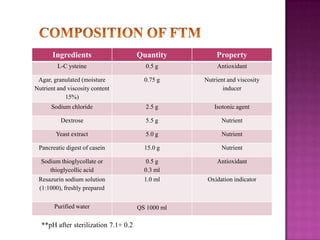
Ingredients

Quantity

Property

L-C ysteine

0.5 g

Antioxidant

Agar, granulated (moisture
Nutrient and viscosity content
15%)

0.75 g

Nutrient and viscosity
inducer

Sodium chloride

2.5 g

Isotonic agent

Dextrose

5.5 g

Nutrient

Yeast extract

5.0 g

Nutrient

Pancreatic digest of casein

15.0 g

Nutrient

Sodium thioglycollate or
thioglycollic acid

0.5 g
0.3 ml

Antioxidant

Resazurin sodium solution
(1:1000), freshly prepared

1.0 ml

Oxidation indicator

Purified water

QS 1000 ml

**pH after sterilization 7.1+ 0.2
The DT method is the more traditional sterility test
method. Basically, the DT method involves three steps:
1. Aseptically opening each sample container from a
recently sterilized batch of product.
2. Using a sterile syringe and needle to withdraw the
required volume of sample for both media from the
container
3. Injecting one-half of the required volume sample into a
test tube containing the required volume of FTM and
the other half volume of sample into a second test tube
containing the required volume of SCD.

Five basic steps are involved in the use of the MF
sterility test method:
1.The filter unit
must be properly assembled and
sterilized prior to use.
2.The contents of the prescribed number of units are
transferred to the filter assembly under strict aseptic
conditions.
3.The contents are filtered with the aid of a vacuum or
pressure differential system.
4. The membrane is removed aseptically and cut in half.
5.One-half of the membrane is placed in a suitable
volume (usually 100 ml) of FTM, and the other
membrane half is placed in an equal volume of SCD.
After a complete arrangement allow injecting the sample by
following ways as USP:1. Rest the ear against the fingers of the left hand and hold the
ear down with the thumb.
2. Introduce the needle with the bevel edge upward near the tip
of the ear vein.
3. Slowly inject a small amount of sample to determine if the
needle is within the vein. If not, a bubble will form or
backpressure will be felt. Withdrawing the needle slightly
and moving it forward again should place it in proper
position.
4.Maintain steady pressure on the syringe plunger and
complete the injection within 10 minutes. Usually, the time
duration for infusion is much less than 10 minutes.
5. Withdraw the needle and apply pressure with the thumb at
the site of injection to retard bleeding and scarring.
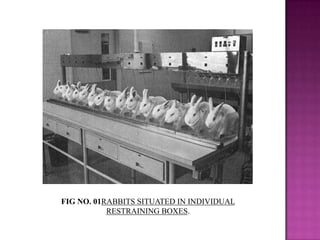
FIG NO. 01RABBITS SITUATED IN INDIVIDUAL
RESTRAINING BOXES.


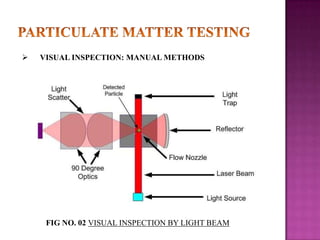
VISUAL INSPECTION: MANUAL METHODS

FIG NO. 02 VISUAL INSPECTION BY LIGHT BEAM
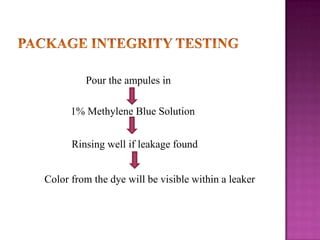
Pour the ampules in
1% Methylene Blue Solution
Rinsing well if leakage found
Color from the dye will be visible within a leaker


Purified water



Water for injection(WFI)



Sterile purified water



Sterile water for injection



Bacteriostatic Water for injection



Sterile water for irrigation
FIG NO 03 A SCHEMATIC OF A TYPICAL PROCESS USED TO CONVERT
POTABLE WATER TO WATER FOR INJECTION
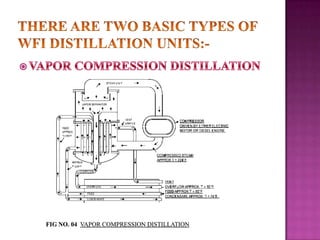
FIG NO. 04 VAPOR COMPRESSION DISTILLATION
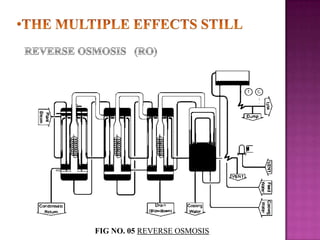
FIG NO. 05 REVERSE OSMOSIS
Contaminants, such as dust, lint, and other particles and
micro-organisms, are found floating in the air, lying on
counters and other surfaces, attached to clothing and
body surfaces of personnel, concentrated in the exhaled
breath of personnel, and deposited on the floor. The
design and control of an aseptic area is directed toward
reducing the presence of these contaminants, so they
are no longer a hazard to aseptic filling. The
classifications used in pharmaceutical practice
normally range from Class 100,000 (Grade D) for
materials support areas to Class 100 (Grade A) for
aseptic areas.
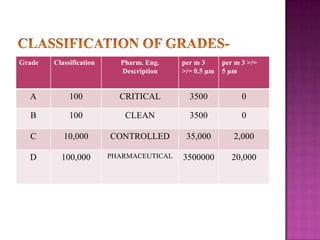
Grade

Classification

Pharm. Eng.
Description

per m 3
>/= 0.5 μm

per m 3 >/=
5 μm

A

100

CRITICAL

3500

0

B

100

CLEAN

3500

0

C

10,000

CONTROLLED

35,000

2,000

D

100,000

PHARMACEUTICAL

3500000

20,000
THANK YOU!..

parenterals....formulation & evaluation

  • 1.
    Under supervision of Mrs.Nimisha Srivastva
  • 2.
    Sterile products arethe dosage forms of therapeutic agents that are free of viable microorganisms. Principally, these include parenteral, ophthalmic and irrigating preparations of these parenteral products are unique among dosage forms of drugs because they are injected through the skin or mucous membrane into internal body compartments. Thus because they have circumvented the highly efficient first line of body defense ,i.e. the skin and mucous membrane, they must be free from microbial contamination and toxic components ,as well as possess an exceptionally high level of purity1. Although parenteral are comes under category of sterile products but all sterile products can’t say as parenterals.
  • 3.
     Nasal & earproducts  Ophthalmic solutions and ointments  Inhalation/ Aerosols.  Bladder irrigating solutions  Suppositories
  • 4.
    Parenteral (Gk, paraenteron, beside the intestine) dosage forms differ from all other drug dosage forms, because they are injected directly into body tissue through the primary protective systems of the human body, the skin, and mucous membranes.  As per USP Parenteral articles are preparations intended for injection through the skin or other external boundary tissue, so that the active substance they contain are administered using gravity or force, directly into a blood vessel, organ, tissue or lesion. 
  • 5.
    INTRADERMAL OR INTRACUTANEOUS INJECTIONS INTRASYNOVIAL AND INTRA-ARTICULAR INJECTIONS  INTRATHECAL INJECTIONS(CSF)  SUBCUTANEOUS AND INTRAMUSCULAR INJECTIONS  SUBCUTANEOUS INFUSIONS/PUMPS  INTRA-ARTERIAL INFUSION ADMINISTRATION  PERFUSION (EXTRA CORPOREAL OR ISOLATION PERFUSION) ADMINISTRATION  INTRAOSSEOUS INFUSION (IO) 
  • 6.
    All products mustbe sterile.  All products must be free from pyrogenic (endotoxin) contamination.  Injectable solutions must be free from visible particulate matter. This includes reconstituted sterile powders.  Products should be isotonic, although strictness of isotonicity depends on the route of administration. Products administered into the cerebrospinal fluid must be isotonic . 
  • 7.
     An immediate physiologicalresponse can be achieved if necessary, which can be of prime consideration in clinical condition such as cardiac arrest, asthma and shock .  Parenteral therapy is required for drugs that are not effective orally or that are destroyed by digestive secretions such as insulin other hormones and antibiotics.
  • 8.
     Drug for uncooperative,nauseous or unconscious patients must be administered by injection.  When desirable, parenteral therapy gives the physician control of the drug since the patient must return for continued treatment, also in some cases the patient cannot be relied upon to take oral administration.  Parenteral administration can results in local effect for drugs when desired as in dentistry and anesthesiology.
  • 9.
    Parenteral drugs are formulated as solutions, suspensions, emulsions,liposome, microsph eres, nanosystems, and powders to be reconstituted as solutions.  WATER  WATER-MISCIBLE VEHICLES  NON-AQUEOUS VEHICLES  SOLUTE  ADDED SUBSTANCES (SURFACTANTS,TONICITY ADJUSTER,ANTIOXIDANTS,PRESERVATIVE)  ANTIMICROBIAL AGENTS
  • 10.
    Drug products administeredby injection are characterized by three qualities possessed by no other type of pharmaceutical dosage form: sterility, freedom from pyrogenicity, and freedom from particulate matter. Method involved in quality control are –  STERILITY TEST Ex.- SAMPLING CULTURE MEDIA Fluid Thioglycollate Medium (FTM) Soybean-Casein Digest (SCD)
  • 11.
    Ingredients Quantity Property L-C ysteine 0.5 g Antioxidant Agar,granulated (moisture Nutrient and viscosity content 15%) 0.75 g Nutrient and viscosity inducer Sodium chloride 2.5 g Isotonic agent Dextrose 5.5 g Nutrient Yeast extract 5.0 g Nutrient Pancreatic digest of casein 15.0 g Nutrient Sodium thioglycollate or thioglycollic acid 0.5 g 0.3 ml Antioxidant Resazurin sodium solution (1:1000), freshly prepared 1.0 ml Oxidation indicator Purified water QS 1000 ml **pH after sterilization 7.1+ 0.2
  • 12.
    The DT methodis the more traditional sterility test method. Basically, the DT method involves three steps: 1. Aseptically opening each sample container from a recently sterilized batch of product. 2. Using a sterile syringe and needle to withdraw the required volume of sample for both media from the container 3. Injecting one-half of the required volume sample into a test tube containing the required volume of FTM and the other half volume of sample into a second test tube containing the required volume of SCD. 
  • 13.
    Five basic stepsare involved in the use of the MF sterility test method: 1.The filter unit must be properly assembled and sterilized prior to use. 2.The contents of the prescribed number of units are transferred to the filter assembly under strict aseptic conditions. 3.The contents are filtered with the aid of a vacuum or pressure differential system. 4. The membrane is removed aseptically and cut in half. 5.One-half of the membrane is placed in a suitable volume (usually 100 ml) of FTM, and the other membrane half is placed in an equal volume of SCD.
  • 14.
    After a completearrangement allow injecting the sample by following ways as USP:1. Rest the ear against the fingers of the left hand and hold the ear down with the thumb. 2. Introduce the needle with the bevel edge upward near the tip of the ear vein. 3. Slowly inject a small amount of sample to determine if the needle is within the vein. If not, a bubble will form or backpressure will be felt. Withdrawing the needle slightly and moving it forward again should place it in proper position. 4.Maintain steady pressure on the syringe plunger and complete the injection within 10 minutes. Usually, the time duration for infusion is much less than 10 minutes. 5. Withdraw the needle and apply pressure with the thumb at the site of injection to retard bleeding and scarring.
  • 15.
    FIG NO. 01RABBITSSITUATED IN INDIVIDUAL RESTRAINING BOXES.
  • 16.
     VISUAL INSPECTION: MANUALMETHODS FIG NO. 02 VISUAL INSPECTION BY LIGHT BEAM
  • 17.
    Pour the ampulesin 1% Methylene Blue Solution Rinsing well if leakage found Color from the dye will be visible within a leaker
  • 18.
     Purified water  Water forinjection(WFI)  Sterile purified water  Sterile water for injection  Bacteriostatic Water for injection  Sterile water for irrigation
  • 19.
    FIG NO 03A SCHEMATIC OF A TYPICAL PROCESS USED TO CONVERT POTABLE WATER TO WATER FOR INJECTION
  • 20.
    FIG NO. 04VAPOR COMPRESSION DISTILLATION
  • 21.
    FIG NO. 05REVERSE OSMOSIS
  • 22.
    Contaminants, such asdust, lint, and other particles and micro-organisms, are found floating in the air, lying on counters and other surfaces, attached to clothing and body surfaces of personnel, concentrated in the exhaled breath of personnel, and deposited on the floor. The design and control of an aseptic area is directed toward reducing the presence of these contaminants, so they are no longer a hazard to aseptic filling. The classifications used in pharmaceutical practice normally range from Class 100,000 (Grade D) for materials support areas to Class 100 (Grade A) for aseptic areas.
  • 23.
    Grade Classification Pharm. Eng. Description per m3 >/= 0.5 μm per m 3 >/= 5 μm A 100 CRITICAL 3500 0 B 100 CLEAN 3500 0 C 10,000 CONTROLLED 35,000 2,000 D 100,000 PHARMACEUTICAL 3500000 20,000
  • 24.