APPROACHES OF GASTRO-RETENTIVE
DRUG DELIVERY SYSTEM OR GRDDS
D R G I O P , A M R A V A T I
- Ms. Sneha Gaurkar
Assistant Professor
P A G E 0 2
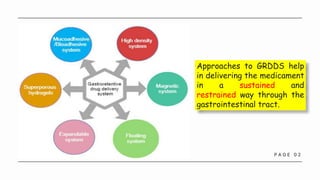
Approaches to GRDDS help
in delivering the medicament
in a sustained and
restrained way through the
gastrointestinal tract.
P A G E 0 3
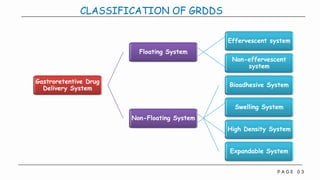
CLASSIFICATION OF GRDDS
Gastroretentive Drug
Delivery System
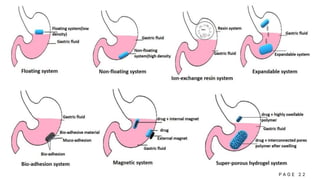
Floating System
Effervescent system
Non-effervescent
system
Non-Floating System
Bioadhesive System
Swelling System
High Density System
Expandable System
P A G E 0 4
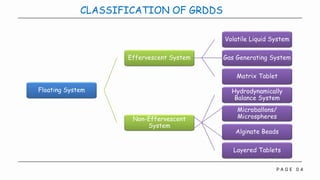
CLASSIFICATION OF GRDDS
Floating System
Effervescent System
Volatile Liquid System
Gas Generating System
Matrix Tablet
Non-Effervescent
System
Hydrodynamically
Balance System
Microballons/
Microspheres
Alginate Beads
Layered Tablets
P A G E 0 5
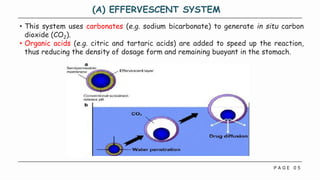
(A) EFFERVESCENT SYSTEM
• This system uses carbonates (e.g. sodium bicarbonate) to generate in situ carbon
dioxide (CO2).
• Organic acids (e.g. citric and tartaric acids) are added to speed up the reaction,
thus reducing the density of dosage form and remaining buoyant in the stomach.
P A G E 0 6
(a) Volatile Liquid/Vacuum Type System
• These are further classified into three types.
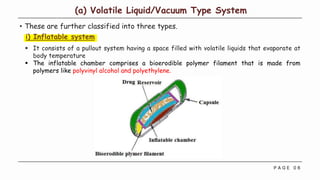
i) Inflatable system
 It consists of a pullout system having a space filled with volatile liquids that evaporate at
body temperature
 The inflatable chamber comprises a bioerodible polymer filament that is made from
polymers like polyvinyl alcohol and polyethylene.
P A G E 0 7
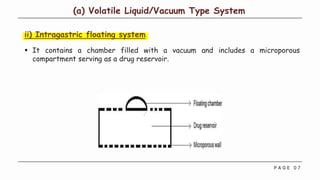
ii) Intragastric floating system
 It contains a chamber filled with a vacuum and includes a microporous
compartment serving as a drug reservoir.
(a) Volatile Liquid/Vacuum Type System
P A G E 0 8
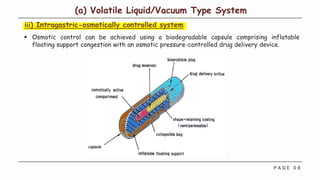
iii) Intragastric-osmotically controlled system
 Osmotic control can be achieved using a biodegradable capsule comprising inflatable
floating support congestion with an osmotic pressure-controlled drug delivery device.
(a) Volatile Liquid/Vacuum Type System
P A G E 0 9
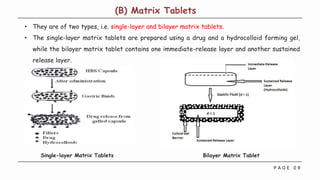
(B) Matrix Tablets
• They are of two types, i.e. single-layer and bilayer matrix tablets.
• The single-layer matrix tablets are prepared using a drug and a hydrocolloid forming gel,
while the bilayer matrix tablet contains one immediate-release layer and another sustained
release layer.
Single-layer Matrix Tablets Bilayer Matrix Tablet
P A G E 1 0
(C) Gas Generating Systems
• Gas-generating systems are prepared using effervescent compounds along with hydrophilic
polymers.
• These are further classified into three types.
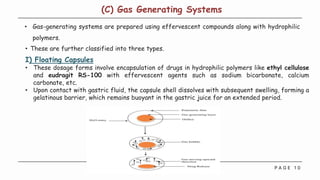
I) Floating Capsules
• These dosage forms involve encapsulation of drugs in hydrophilic polymers like ethyl cellulose
and eudragit RS-100 with effervescent agents such as sodium bicarbonate, calcium
carbonate, etc.
• Upon contact with gastric fluid, the capsule shell dissolves with subsequent swelling, forming a
gelatinous barrier, which remains buoyant in the gastric juice for an extended period.
P A G E 1 1
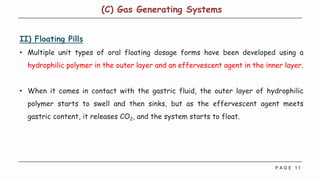
II) Floating Pills
• Multiple unit types of oral floating dosage forms have been developed using a
hydrophilic polymer in the outer layer and an effervescent agent in the inner layer.
• When it comes in contact with the gastric fluid, the outer layer of hydrophilic
polymer starts to swell and then sinks, but as the effervescent agent meets
gastric content, it releases CO2, and the system starts to float.
(C) Gas Generating Systems
P A G E 1 2
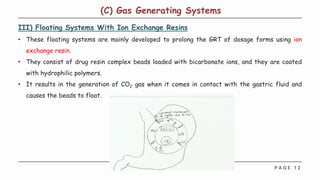
III) Floating Systems With Ion Exchange Resins
• These floating systems are mainly developed to prolong the GRT of dosage forms using ion
exchange resin.
• They consist of drug resin complex beads loaded with bicarbonate ions, and they are coated
with hydrophilic polymers.
• It results in the generation of CO2 gas when it comes in contact with the gastric fluid and
causes the beads to float.
(C) Gas Generating Systems
P A G E 1 3
(B) NON-EFFERVESCENT SYSTEMS
• In non-effervescent floating systems, the drug comes in contact with gastric fluid and it
swells.
• It maintains its shape, and its density remains less than one, hence it floats in gastric juice.
• Matrix forming polymer, gel-forming, or swellable type hydrocolloids are used for these types
of floating systems.
They are further classified as follows:
i. Hydrodynamically balanced systems (HBS)
ii. Microballoons
iii.Alginate beads
iv.Layered tablets
P A G E 1 4
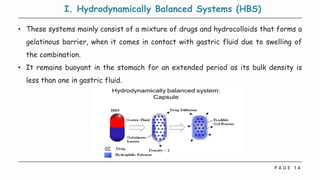
I. Hydrodynamically Balanced Systems (HBS)
• These systems mainly consist of a mixture of drugs and hydrocolloids that forms a
gelatinous barrier, when it comes in contact with gastric fluid due to swelling of
the combination.
• It remains buoyant in the stomach for an extended period as its bulk density is
less than one in gastric fluid.
P A G E 1 5
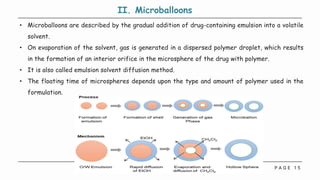
II. Microballoons
• Microballoons are described by the gradual addition of drug-containing emulsion into a volatile
solvent.
• On evaporation of the solvent, gas is generated in a dispersed polymer droplet, which results
in the formation of an interior orifice in the microsphere of the drug with polymer.
• It is also called emulsion solvent diffusion method.
• The floating time of microspheres depends upon the type and amount of polymer used in the
formulation.
P A G E 1 6
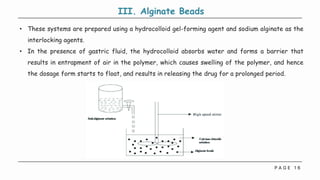
III. Alginate Beads
• These systems are prepared using a hydrocolloid gel-forming agent and sodium alginate as the
interlocking agents.
• In the presence of gastric fluid, the hydrocolloid absorbs water and forms a barrier that
results in entrapment of air in the polymer, which causes swelling of the polymer, and hence
the dosage form starts to float, and results in releasing the drug for a prolonged period.
P A G E 1 7
IV. Layered Tablets
• Layered tablets are more popular due to ease of their preparation, low cost, and
high stability.
• a. Single-layered floating tablets: These tablets were developed by mixing drug
and gas generating agents within the matrix tablet. These formulations have
lower bulk density than gastric fluid, and thus they remain buoyant in the
stomach by increasing GRT.
• b. Double-layered floating tablets: It comprises of two formulations separated by
layering, one on top of the other, having two different release profiles.
P A G E 1 8
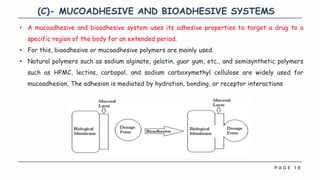
(C)- MUCOADHESIVE AND BIOADHESIVE SYSTEMS
• A mucoadhesive and bioadhesive system uses its adhesive properties to target a drug to a
specific region of the body for an extended period.
• For this, bioadhesive or mucoadhesive polymers are mainly used.
• Natural polymers such as sodium alginate, gelatin, guar gum, etc., and semisynthetic polymers
such as HPMC, lectins, carbopol, and sodium carboxymethyl cellulose are widely used for
mucoadhesion. The adhesion is mediated by hydration, bonding, or receptor interactions
P A G E 1 9
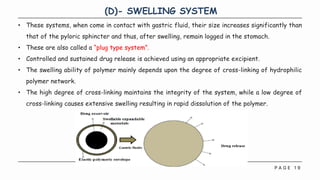
(D)- SWELLING SYSTEM
• These systems, when come in contact with gastric fluid, their size increases significantly than
that of the pyloric sphincter and thus, after swelling, remain logged in the stomach.
• These are also called a “plug type system”.
• Controlled and sustained drug release is achieved using an appropriate excipient.
• The swelling ability of polymer mainly depends upon the degree of cross-linking of hydrophilic
polymer network.
• The high degree of cross-linking maintains the integrity of the system, while a low degree of
cross-linking causes extensive swelling resulting in rapid dissolution of the polymer.
P A G E 2 0
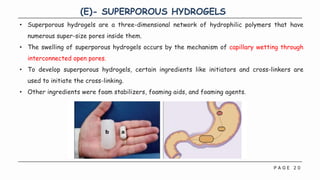
(E)- SUPERPOROUS HYDROGELS
• Superporous hydrogels are a three-dimensional network of hydrophilic polymers that have
numerous super-size pores inside them.
• The swelling of superporous hydrogels occurs by the mechanism of capillary wetting through
interconnected open pores.
• To develop superporous hydrogels, certain ingredients like initiators and cross-linkers are
used to initiate the cross-linking.
• Other ingredients were foam stabilizers, foaming aids, and foaming agents.
P A G E 2 1
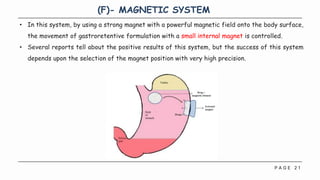
(F)- MAGNETIC SYSTEM
• In this system, by using a strong magnet with a powerful magnetic field onto the body surface,
the movement of gastroretentive formulation with a small internal magnet is controlled.
• Several reports tell about the positive results of this system, but the success of this system
depends upon the selection of the magnet position with very high precision.
P A G E 2 2
P A G E 2 3
T H A N K S !

Approaches of GRDDS.pptx

  • 1.
    APPROACHES OF GASTRO-RETENTIVE DRUGDELIVERY SYSTEM OR GRDDS D R G I O P , A M R A V A T I - Ms. Sneha Gaurkar Assistant Professor
  • 2.
    P A GE 0 2 Approaches to GRDDS help in delivering the medicament in a sustained and restrained way through the gastrointestinal tract.
  • 3.
    P A GE 0 3 CLASSIFICATION OF GRDDS Gastroretentive Drug Delivery System Floating System Effervescent system Non-effervescent system Non-Floating System Bioadhesive System Swelling System High Density System Expandable System
  • 4.
    P A GE 0 4 CLASSIFICATION OF GRDDS Floating System Effervescent System Volatile Liquid System Gas Generating System Matrix Tablet Non-Effervescent System Hydrodynamically Balance System Microballons/ Microspheres Alginate Beads Layered Tablets
  • 5.
    P A GE 0 5 (A) EFFERVESCENT SYSTEM • This system uses carbonates (e.g. sodium bicarbonate) to generate in situ carbon dioxide (CO2). • Organic acids (e.g. citric and tartaric acids) are added to speed up the reaction, thus reducing the density of dosage form and remaining buoyant in the stomach.
  • 6.
    P A GE 0 6 (a) Volatile Liquid/Vacuum Type System • These are further classified into three types. i) Inflatable system  It consists of a pullout system having a space filled with volatile liquids that evaporate at body temperature  The inflatable chamber comprises a bioerodible polymer filament that is made from polymers like polyvinyl alcohol and polyethylene.
  • 7.
    P A GE 0 7 ii) Intragastric floating system  It contains a chamber filled with a vacuum and includes a microporous compartment serving as a drug reservoir. (a) Volatile Liquid/Vacuum Type System
  • 8.
    P A GE 0 8 iii) Intragastric-osmotically controlled system  Osmotic control can be achieved using a biodegradable capsule comprising inflatable floating support congestion with an osmotic pressure-controlled drug delivery device. (a) Volatile Liquid/Vacuum Type System
  • 9.
    P A GE 0 9 (B) Matrix Tablets • They are of two types, i.e. single-layer and bilayer matrix tablets. • The single-layer matrix tablets are prepared using a drug and a hydrocolloid forming gel, while the bilayer matrix tablet contains one immediate-release layer and another sustained release layer. Single-layer Matrix Tablets Bilayer Matrix Tablet
  • 10.
    P A GE 1 0 (C) Gas Generating Systems • Gas-generating systems are prepared using effervescent compounds along with hydrophilic polymers. • These are further classified into three types. I) Floating Capsules • These dosage forms involve encapsulation of drugs in hydrophilic polymers like ethyl cellulose and eudragit RS-100 with effervescent agents such as sodium bicarbonate, calcium carbonate, etc. • Upon contact with gastric fluid, the capsule shell dissolves with subsequent swelling, forming a gelatinous barrier, which remains buoyant in the gastric juice for an extended period.
  • 11.
    P A GE 1 1 II) Floating Pills • Multiple unit types of oral floating dosage forms have been developed using a hydrophilic polymer in the outer layer and an effervescent agent in the inner layer. • When it comes in contact with the gastric fluid, the outer layer of hydrophilic polymer starts to swell and then sinks, but as the effervescent agent meets gastric content, it releases CO2, and the system starts to float. (C) Gas Generating Systems
  • 12.
    P A GE 1 2 III) Floating Systems With Ion Exchange Resins • These floating systems are mainly developed to prolong the GRT of dosage forms using ion exchange resin. • They consist of drug resin complex beads loaded with bicarbonate ions, and they are coated with hydrophilic polymers. • It results in the generation of CO2 gas when it comes in contact with the gastric fluid and causes the beads to float. (C) Gas Generating Systems
  • 13.
    P A GE 1 3 (B) NON-EFFERVESCENT SYSTEMS • In non-effervescent floating systems, the drug comes in contact with gastric fluid and it swells. • It maintains its shape, and its density remains less than one, hence it floats in gastric juice. • Matrix forming polymer, gel-forming, or swellable type hydrocolloids are used for these types of floating systems. They are further classified as follows: i. Hydrodynamically balanced systems (HBS) ii. Microballoons iii.Alginate beads iv.Layered tablets
  • 14.
    P A GE 1 4 I. Hydrodynamically Balanced Systems (HBS) • These systems mainly consist of a mixture of drugs and hydrocolloids that forms a gelatinous barrier, when it comes in contact with gastric fluid due to swelling of the combination. • It remains buoyant in the stomach for an extended period as its bulk density is less than one in gastric fluid.
  • 15.
    P A GE 1 5 II. Microballoons • Microballoons are described by the gradual addition of drug-containing emulsion into a volatile solvent. • On evaporation of the solvent, gas is generated in a dispersed polymer droplet, which results in the formation of an interior orifice in the microsphere of the drug with polymer. • It is also called emulsion solvent diffusion method. • The floating time of microspheres depends upon the type and amount of polymer used in the formulation.
  • 16.
    P A GE 1 6 III. Alginate Beads • These systems are prepared using a hydrocolloid gel-forming agent and sodium alginate as the interlocking agents. • In the presence of gastric fluid, the hydrocolloid absorbs water and forms a barrier that results in entrapment of air in the polymer, which causes swelling of the polymer, and hence the dosage form starts to float, and results in releasing the drug for a prolonged period.
  • 17.
    P A GE 1 7 IV. Layered Tablets • Layered tablets are more popular due to ease of their preparation, low cost, and high stability. • a. Single-layered floating tablets: These tablets were developed by mixing drug and gas generating agents within the matrix tablet. These formulations have lower bulk density than gastric fluid, and thus they remain buoyant in the stomach by increasing GRT. • b. Double-layered floating tablets: It comprises of two formulations separated by layering, one on top of the other, having two different release profiles.
  • 18.
    P A GE 1 8 (C)- MUCOADHESIVE AND BIOADHESIVE SYSTEMS • A mucoadhesive and bioadhesive system uses its adhesive properties to target a drug to a specific region of the body for an extended period. • For this, bioadhesive or mucoadhesive polymers are mainly used. • Natural polymers such as sodium alginate, gelatin, guar gum, etc., and semisynthetic polymers such as HPMC, lectins, carbopol, and sodium carboxymethyl cellulose are widely used for mucoadhesion. The adhesion is mediated by hydration, bonding, or receptor interactions
  • 19.
    P A GE 1 9 (D)- SWELLING SYSTEM • These systems, when come in contact with gastric fluid, their size increases significantly than that of the pyloric sphincter and thus, after swelling, remain logged in the stomach. • These are also called a “plug type system”. • Controlled and sustained drug release is achieved using an appropriate excipient. • The swelling ability of polymer mainly depends upon the degree of cross-linking of hydrophilic polymer network. • The high degree of cross-linking maintains the integrity of the system, while a low degree of cross-linking causes extensive swelling resulting in rapid dissolution of the polymer.
  • 20.
    P A GE 2 0 (E)- SUPERPOROUS HYDROGELS • Superporous hydrogels are a three-dimensional network of hydrophilic polymers that have numerous super-size pores inside them. • The swelling of superporous hydrogels occurs by the mechanism of capillary wetting through interconnected open pores. • To develop superporous hydrogels, certain ingredients like initiators and cross-linkers are used to initiate the cross-linking. • Other ingredients were foam stabilizers, foaming aids, and foaming agents.
  • 21.
    P A GE 2 1 (F)- MAGNETIC SYSTEM • In this system, by using a strong magnet with a powerful magnetic field onto the body surface, the movement of gastroretentive formulation with a small internal magnet is controlled. • Several reports tell about the positive results of this system, but the success of this system depends upon the selection of the magnet position with very high precision.
  • 22.
    P A GE 2 2
  • 23.
    P A GE 2 3 T H A N K S !