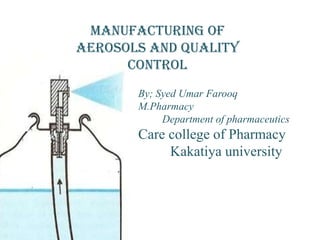
Manufacturing of
Aerosols and Quality
      control
       By; Syed Umar Farooq
       M.Pharmacy
            Department of pharmaceutics
       Care college of Pharmacy
            Kakatiya university
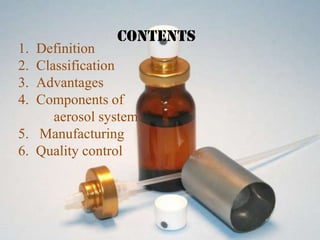
contents
1. Definition
2. Classification
3. Advantages
4. Components of
      aerosol system
5. Manufacturing
6. Quality control
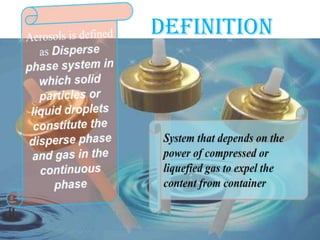
Definition
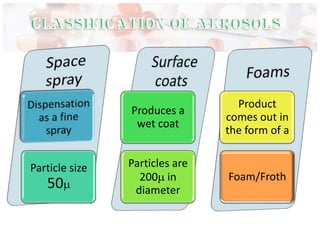
Product
                Produces a
                                comes out in
                 wet coat
                                the form of a


Particle size   Particles are
                  200 in        Foam/Froth
   50            diameter
Advantages
• A dose can be removed with out contamination
  of materials.
• Stability is enhanced for those substances
  adversely affected by oxygen and or moisture.
• sterility can be maintained When it is an
  important factor,
Advantages contd….
• The medication can be delivered directly to the
  affected area in a desired form, such as
  spray, steam, quick breaking foam or stable foam.
• Irritation produced by the mechanical
  application of topical medication is reduced or
  eliminated.
• Ease of convenience of application. Application of
  medication in thin layer
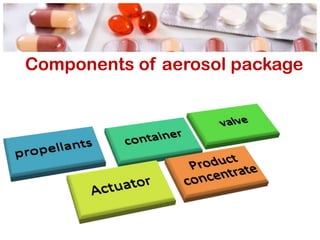
Components of aerosol package
propellants
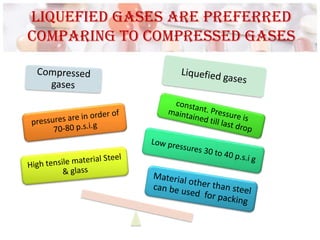
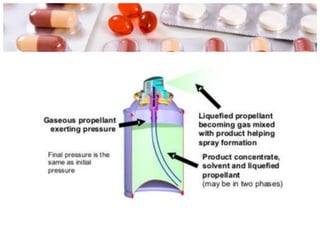
• These are compressed gases at 70 to 80 p.s.i.g
• Compressed gases such as CO2 or nitrogen or
• Liquefied gases like halogen derivatives such as some
  saturated hydro carbons like methane ethane etc…
• A large no of liquid propellants some of which are
  refrigerants gases also have been developed
• Eg. T.F.D.C.E ,T.C.M.F.E etc….
Liquefied gases are preferred
comparing to compressed gases
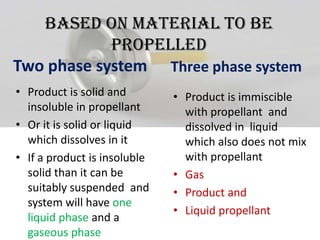
Based on material to be
            propelled
Two phase system Three phase system
• Product is solid and        • Product is immiscible
  insoluble in propellant       with propellant and
• Or it is solid or liquid      dissolved in liquid
  which dissolves in it         which also does not mix
• If a product is insoluble     with propellant
  solid than it can be        • Gas
  suitably suspended and      • Product and
  system will have one
                              • Liquid propellant
  liquid phase and a
  gaseous phase
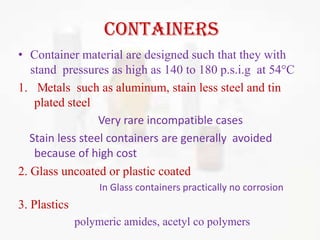
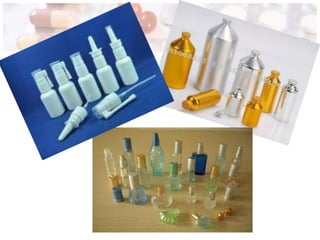
containers
• Container material are designed such that they with
   stand pressures as high as 140 to 180 p.s.i.g at 54 C
1. Metals such as aluminum, stain less steel and tin
    plated steel
                  Very rare incompatible cases
   Stain less steel containers are generally avoided
    because of high cost
2. Glass uncoated or plastic coated
                   In Glass containers practically no corrosion
3. Plastics
              polymeric amides, acetyl co polymers
valves
• The modern day aerosol valves are
  multifunctional i.e they deliver product in desired
  form
• As well as in measured quantities when ever
  required
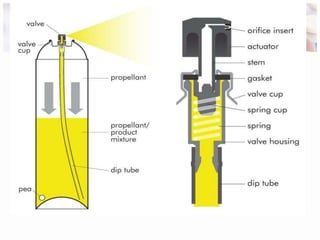
• Components of aerosol valves
• Gaskets :affix valve on container
• Housing
• Stem
• Dip tube
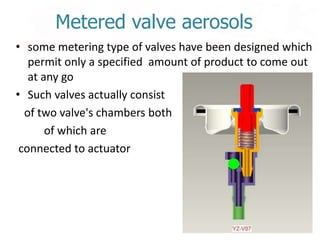
Metered valve aerosols
• some metering type of valves have been designed which
   permit only a specified amount of product to come out
   at any go
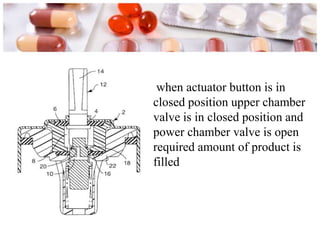
• Such valves actually consist
  of two valve's chambers both
       of which are
 connected to actuator
when actuator button is in
closed position upper chamber
valve is in closed position and
power chamber valve is open
required amount of product is
filled
Actuator
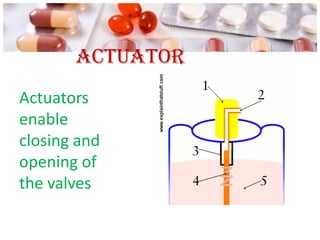
Actuators
enable
closing and
opening of
the valves
Manufacturing

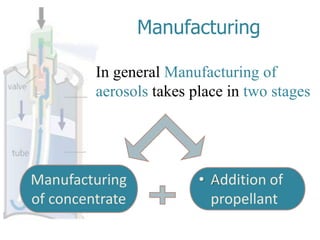
         In general Manufacturing of
         aerosols takes place in two stages


Manufacturing            • Addition of
of concentrate             propellant
•    This manufacturing procedure is quite different
  from non aerosol pharmaceuticals product
• This require Q.C measures during filling operation
  to ensure both concentrate and propellant are
  brought together in the proper proportion
• The aerosol concentrate is prepared and sample is
  tested (early detection prevents loss of other
  components)
• Once the propellant is added product is sealed in to a
  container with a valve
Methods
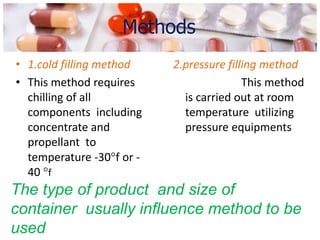
• 1.cold filling method    2.pressure filling method
• This method requires                    This method
  chilling of all            is carried out at room
  components including       temperature utilizing
  concentrate and            pressure equipments
  propellant to
  temperature -30 f or -
  40 f
The type of product and size of
container usually influence method to be
used
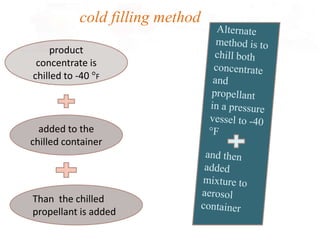
cold filling method
     product
 concentrate is
chilled to -40 F


  added to the
chilled container


Than the chilled
propellant is added
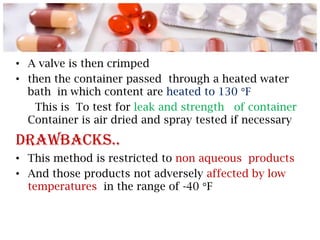
• A valve is then crimped
• then the container passed through a heated water
  bath in which content are heated to 130 F
   This is To test for leak and strength of container
  Container is air dried and spray tested if necessary

Drawbacks..
• This method is restricted to non aqueous products
• And those products not adversely affected by low
  temperatures in the range of -40 F
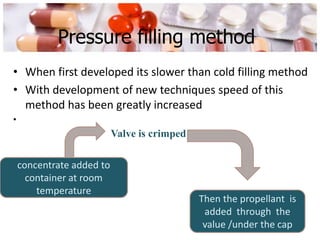
Pressure filling method
• When first developed its slower than cold filling method
• With development of new techniques speed of this
  method has been greatly increased
•
                           Valve is crimped

    concentrate added to
      container at room
        temperature
                                              Then the propellant is
                                               added through the
                                               value /under the cap
• Since the valve contain extremely small opening
   (0.018 to 0.030 inch)
• This step is slow and limits production
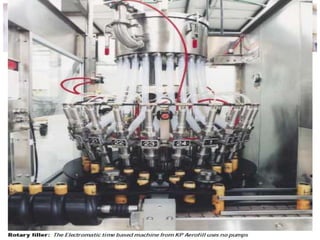
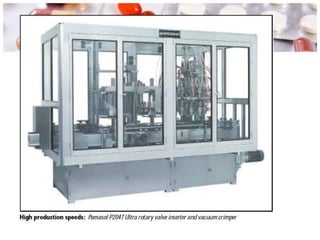
• With development of rotary filling machines which
   allow propellant to be added around and through
   the valve stem
  the speed has been increased
           For those products adversely affected by air
   the air in headspace is evacuated prior to adding of
   propellant
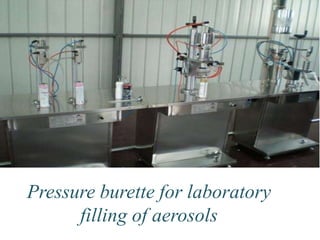
Pressure burette for laboratory
      filling of aerosols
Pressure method is preferred
to the cold  method
1. As some solutions, emulsions, suspensions and
  other preparations cant be chilled
2. There is less danger of contamination of the
  product with moisture
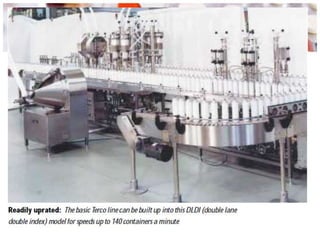
3. High production speed can be achieved
4. Less propellant is lost
5. And the method is not limited
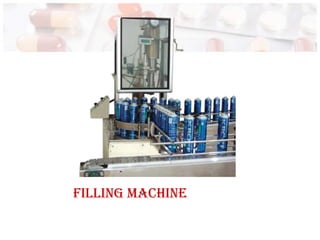
Filling machine
Quality Control &
     Evaluation Of
Pharmaceutical Aerosols
     •   QUALITY CONTROL TESTS It Includes
     •   1. Propellants
     •   2. Valves, Actuator. Dip Tubes
     •   3. Containers
     •   4. Weight Checking
     •   5. Leak Testing
     •   6. Spray Testing
1.Propellents

 • All Propellants are accompanied by Specification
   sheet. Parameter Tested By Identification Purity
   Gas Chromatography Moisture, Halogen,
 • Non-Volatile Residue Determination
2.Valves, Actuator, Dip-tubes
 • This done according to standard procedure as
   found in Military Standards “MIL-STD-105D”. For
   metered dose aerosols test methods was
   developed by ‘Aerosol Specification Committee’
   ‘Industrial Pharmaceutical Technical Section
   ‘Academy Of Pharmaceutical Sciences
 • . The object of this test is to determine
   magnitude of valve delivery & degree of
   uniformity between individual valves. Standard
   test solutions were proposed to rule out
   variation in valve delivery.
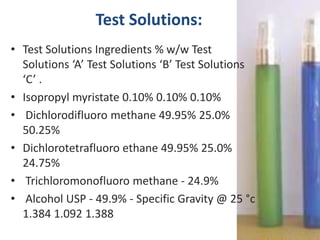
Test Solutions:
• Test Solutions Ingredients % w/w Test
  Solutions ‘A’ Test Solutions ‘B’ Test Solutions
  ‘C’ .
• Isopropyl myristate 0.10% 0.10% 0.10%
• Dichlorodifluoro methane 49.95% 25.0%
  50.25%
• Dichlorotetrafluoro ethane 49.95% 25.0%
  24.75%
• Trichloromonofluoro methane - 24.9%
• Alcohol USP - 49.9% - Specific Gravity @ 25 °c
  1.384 1.092 1.388
Testing Procedure::

• Take 25 valves & placed on containers, Filled with
  specific test solution
• Actuator with 0.020 inch orifice is attached.
• Valve is actuated to fullest extent for 2 sec.
  Repeat this for total 2 individual delivery from
  each 25 test units.
• Individual delivery wt in mg. Valve delivery per
  actuation in µL = Specific gravity of test sol n Valve
  Acceptance : Deliveries Limit’s 54 µL or less ± 15%
  55 to 200 µL ± 10%
Valve acceptance
• Of 50 delivery If 4 or more are outside
  limits : valves are rejected If 3 delivery
  are outside limits : another 25 valves are
  tested : lot is rejected if more than 1
  delivery outside specification If 2 delivery
  from 1 valve are beyond limits : another
  25 valves are tested : lot is rejected if
  more than 1 delivery outside
  specification
•
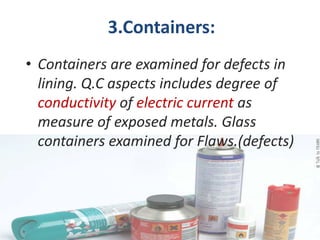
3.Containers:
• Containers are examined for defects in
  lining. Q.C aspects includes degree of
  conductivity of electric current as
  measure of exposed metals. Glass
  containers examined for Flaws.(defects)
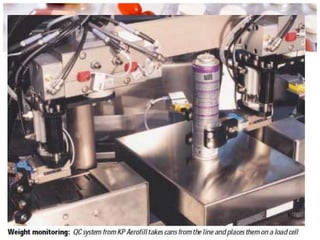
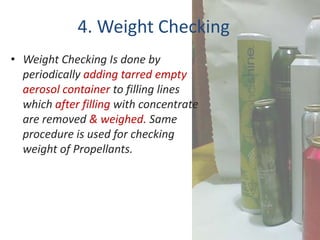
4. Weight Checking
• Weight Checking Is done by
  periodically adding tarred empty
  aerosol container to filling lines
  which after filling with concentrate
  are removed & weighed. Same
  procedure is used for checking
  weight of Propellants.
5.Leak Test:
• Leak Test Is done by measuring the Crimp’s
  dimension & ensuring that they meet
  specification
• . Final testing of valve closure is done by passing
  filled containers through water bath(temp is
  checked repeatedly and values are recorded)
 6. Spray Testing
    . It is done `
    To clear dip tube of pure propellant &
    concentrate,
     To check for defects in valves & spray pattern.
Evaluation Tests
• A. Flammability & combustibility:
• 1.Flash point 2.Flash Projection
• B. Physicochemical characteristics:
• 1.Vapour pressure 2.Density
• 3.Moisture content
• 4.Identification of Propellants
 C. Performance:
•     1. Aerosol valve discharge rate
•     2. Spray pattern
•     3.Dosage with metered valves
•     4. Net contents
•     5.Foam stability
•     6 Particle size determination
•    D. Biological testing:
 1.Therapeutic activity 2.Toxicity studies
A. Flammability &
              combustibility:

• 1.Flash point: Apparatus : Open Cup Tag Apparatus
    Test liquids temp. is allowed to increase slowly &
    temp. at which vapors Ignite is called as Flash Point .
• 2.Flame Projection: Product is sprayed for 4 sec
  onto flame & exact length is measured with ruler.


•
B. Physicochemical characteristics:
• The pressure can be measured simply with a
  pressure gauge /through use of water bath ,test
  gauge and special equipments like
• . Vapor Pressure » Can Puncturing Device.
• 2. Density » Hydrometer, » Pycnometer.
• 3. Moisture » Karl Fisher Method,
• 4. Identification » Gas Chromatography, » IR
  Spectroscopy.
C. Performance: :
• : 1.Aerosol valve discharge rate : Aerosol product
  of known weight is discharged for specific time. By
  reweighing the container, the change in the wt.
  per time dispensed is the Discharge rate in
  gm/sec.
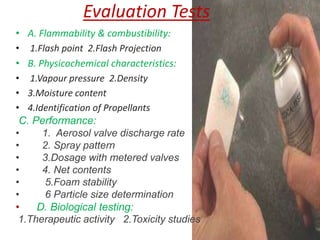
• 2. Spray pattern : The method is based on the
  impingement of spray on piece of paper that has
  treated with Dye-Talc mixture.
3. Dosage with metered valves :
• : Reproducibility of dosage determined by: Accurate
  weighing of filled container followed by dispensing
  several dosage. containers again reweighed & diff. in
  wt. divided by no. of dosage dispensed gives average
  dose.
• 4. Net Contents :
• Tarred cans placed on filling lines are reweighed & then
  difference in wt. is equal to net content. In Destructive
  method : opening the container & removing as much of
  product possible.
5. Foam stability :
• The life of a foam can range from few seconds
  to an hour Various Methods are used
• Visual Evaluation,
• Time for given mass to penetrate the foam,
• Time for given rod to fall which is inserted into
  the foam,
• Rotational Viscometer.
6.Partical Size Determination :
• a). Cascade Impactor :
• Principle : Stream of particle projected through a
  series of nozzle & glass slides at high velocity, larger
  particle are impacted on low velocity stage , &
  smaller on higher velocity stage.
• b) . Light Scattering Decay :
• Principle : As aerosol settles under turbulent
  condition, the changes in the light of a Tyndall beam
  is measured.
D. Biological testing: :
• : 1.Therapeutic Activity : » For Inhalation
  Aerosols : is depends on the particle size. » For
  Topical Aerosols : is applied to test areas &
  adsorption of therapeutic ingredient is
  determined.
• 2.Toxicity : » For Inhalation Aerosols : exposing
  test animals to vapor sprayed from Aerosol
  container.
• For Topical Aerosols : Irritation & Chilling
  effects are determined.
References:
• The Theory & Practice Of Industrial Pharmacy” by Leon
  Lachman, H.A.Liberman, Joseph Kanig, 3 rd
  Edition, Varghese Pub., page no. 613-618.
• Remington’s “The Science & Practice Of Pharmacy” 3 rd
  Edition, Volume-I, page no.1014-1015.
•

Aerosols

  • 1.
    Manufacturing of Aerosols andQuality control By; Syed Umar Farooq M.Pharmacy Department of pharmaceutics Care college of Pharmacy Kakatiya university
  • 2.
    contents 1. Definition 2. Classification 3.Advantages 4. Components of aerosol system 5. Manufacturing 6. Quality control
  • 3.
  • 4.
    Product Produces a comes out in wet coat the form of a Particle size Particles are 200 in Foam/Froth 50 diameter
  • 5.
    Advantages • A dosecan be removed with out contamination of materials. • Stability is enhanced for those substances adversely affected by oxygen and or moisture. • sterility can be maintained When it is an important factor,
  • 6.
    Advantages contd…. • Themedication can be delivered directly to the affected area in a desired form, such as spray, steam, quick breaking foam or stable foam. • Irritation produced by the mechanical application of topical medication is reduced or eliminated. • Ease of convenience of application. Application of medication in thin layer
  • 7.
  • 8.
    propellants • These arecompressed gases at 70 to 80 p.s.i.g • Compressed gases such as CO2 or nitrogen or • Liquefied gases like halogen derivatives such as some saturated hydro carbons like methane ethane etc… • A large no of liquid propellants some of which are refrigerants gases also have been developed • Eg. T.F.D.C.E ,T.C.M.F.E etc….
  • 9.
    Liquefied gases arepreferred comparing to compressed gases
  • 10.
    Based on materialto be propelled Two phase system Three phase system • Product is solid and • Product is immiscible insoluble in propellant with propellant and • Or it is solid or liquid dissolved in liquid which dissolves in it which also does not mix • If a product is insoluble with propellant solid than it can be • Gas suitably suspended and • Product and system will have one • Liquid propellant liquid phase and a gaseous phase
  • 12.
    containers • Container materialare designed such that they with stand pressures as high as 140 to 180 p.s.i.g at 54 C 1. Metals such as aluminum, stain less steel and tin plated steel Very rare incompatible cases Stain less steel containers are generally avoided because of high cost 2. Glass uncoated or plastic coated In Glass containers practically no corrosion 3. Plastics polymeric amides, acetyl co polymers
  • 14.
    valves • The modernday aerosol valves are multifunctional i.e they deliver product in desired form • As well as in measured quantities when ever required • Components of aerosol valves • Gaskets :affix valve on container • Housing • Stem • Dip tube
  • 16.
    Metered valve aerosols •some metering type of valves have been designed which permit only a specified amount of product to come out at any go • Such valves actually consist of two valve's chambers both of which are connected to actuator
  • 17.
    when actuator buttonis in closed position upper chamber valve is in closed position and power chamber valve is open required amount of product is filled
  • 18.
  • 19.
    Manufacturing In general Manufacturing of aerosols takes place in two stages Manufacturing • Addition of of concentrate propellant
  • 20.
    This manufacturing procedure is quite different from non aerosol pharmaceuticals product • This require Q.C measures during filling operation to ensure both concentrate and propellant are brought together in the proper proportion • The aerosol concentrate is prepared and sample is tested (early detection prevents loss of other components) • Once the propellant is added product is sealed in to a container with a valve
  • 21.
    Methods • 1.cold fillingmethod 2.pressure filling method • This method requires This method chilling of all is carried out at room components including temperature utilizing concentrate and pressure equipments propellant to temperature -30 f or - 40 f The type of product and size of container usually influence method to be used
  • 22.
    cold filling method product concentrate is chilled to -40 F added to the chilled container Than the chilled propellant is added
  • 23.
    • A valveis then crimped • then the container passed through a heated water bath in which content are heated to 130 F This is To test for leak and strength of container Container is air dried and spray tested if necessary Drawbacks.. • This method is restricted to non aqueous products • And those products not adversely affected by low temperatures in the range of -40 F
  • 24.
    Pressure filling method •When first developed its slower than cold filling method • With development of new techniques speed of this method has been greatly increased • Valve is crimped concentrate added to container at room temperature Then the propellant is added through the value /under the cap
  • 25.
    • Since thevalve contain extremely small opening (0.018 to 0.030 inch) • This step is slow and limits production • With development of rotary filling machines which allow propellant to be added around and through the valve stem the speed has been increased For those products adversely affected by air the air in headspace is evacuated prior to adding of propellant
  • 26.
    Pressure burette forlaboratory filling of aerosols
  • 27.
    Pressure method ispreferred to the cold method 1. As some solutions, emulsions, suspensions and other preparations cant be chilled 2. There is less danger of contamination of the product with moisture 3. High production speed can be achieved 4. Less propellant is lost 5. And the method is not limited
  • 28.
  • 33.
    Quality Control & Evaluation Of Pharmaceutical Aerosols • QUALITY CONTROL TESTS It Includes • 1. Propellants • 2. Valves, Actuator. Dip Tubes • 3. Containers • 4. Weight Checking • 5. Leak Testing • 6. Spray Testing
  • 34.
    1.Propellents • AllPropellants are accompanied by Specification sheet. Parameter Tested By Identification Purity Gas Chromatography Moisture, Halogen, • Non-Volatile Residue Determination
  • 35.
    2.Valves, Actuator, Dip-tubes • This done according to standard procedure as found in Military Standards “MIL-STD-105D”. For metered dose aerosols test methods was developed by ‘Aerosol Specification Committee’ ‘Industrial Pharmaceutical Technical Section ‘Academy Of Pharmaceutical Sciences • . The object of this test is to determine magnitude of valve delivery & degree of uniformity between individual valves. Standard test solutions were proposed to rule out variation in valve delivery.
  • 36.
    Test Solutions: • TestSolutions Ingredients % w/w Test Solutions ‘A’ Test Solutions ‘B’ Test Solutions ‘C’ . • Isopropyl myristate 0.10% 0.10% 0.10% • Dichlorodifluoro methane 49.95% 25.0% 50.25% • Dichlorotetrafluoro ethane 49.95% 25.0% 24.75% • Trichloromonofluoro methane - 24.9% • Alcohol USP - 49.9% - Specific Gravity @ 25 °c 1.384 1.092 1.388
  • 37.
    Testing Procedure:: • Take25 valves & placed on containers, Filled with specific test solution • Actuator with 0.020 inch orifice is attached. • Valve is actuated to fullest extent for 2 sec. Repeat this for total 2 individual delivery from each 25 test units. • Individual delivery wt in mg. Valve delivery per actuation in µL = Specific gravity of test sol n Valve Acceptance : Deliveries Limit’s 54 µL or less ± 15% 55 to 200 µL ± 10%
  • 38.
    Valve acceptance • Of50 delivery If 4 or more are outside limits : valves are rejected If 3 delivery are outside limits : another 25 valves are tested : lot is rejected if more than 1 delivery outside specification If 2 delivery from 1 valve are beyond limits : another 25 valves are tested : lot is rejected if more than 1 delivery outside specification •
  • 39.
    3.Containers: • Containers areexamined for defects in lining. Q.C aspects includes degree of conductivity of electric current as measure of exposed metals. Glass containers examined for Flaws.(defects)
  • 40.
    4. Weight Checking •Weight Checking Is done by periodically adding tarred empty aerosol container to filling lines which after filling with concentrate are removed & weighed. Same procedure is used for checking weight of Propellants.
  • 41.
    5.Leak Test: • LeakTest Is done by measuring the Crimp’s dimension & ensuring that they meet specification • . Final testing of valve closure is done by passing filled containers through water bath(temp is checked repeatedly and values are recorded) 6. Spray Testing . It is done ` To clear dip tube of pure propellant & concentrate, To check for defects in valves & spray pattern.
  • 42.
    Evaluation Tests • A.Flammability & combustibility: • 1.Flash point 2.Flash Projection • B. Physicochemical characteristics: • 1.Vapour pressure 2.Density • 3.Moisture content • 4.Identification of Propellants C. Performance: • 1. Aerosol valve discharge rate • 2. Spray pattern • 3.Dosage with metered valves • 4. Net contents • 5.Foam stability • 6 Particle size determination • D. Biological testing: 1.Therapeutic activity 2.Toxicity studies
  • 43.
    A. Flammability & combustibility: • 1.Flash point: Apparatus : Open Cup Tag Apparatus Test liquids temp. is allowed to increase slowly & temp. at which vapors Ignite is called as Flash Point . • 2.Flame Projection: Product is sprayed for 4 sec onto flame & exact length is measured with ruler. •
  • 44.
    B. Physicochemical characteristics: •The pressure can be measured simply with a pressure gauge /through use of water bath ,test gauge and special equipments like • . Vapor Pressure » Can Puncturing Device. • 2. Density » Hydrometer, » Pycnometer. • 3. Moisture » Karl Fisher Method, • 4. Identification » Gas Chromatography, » IR Spectroscopy.
  • 45.
    C. Performance: : •: 1.Aerosol valve discharge rate : Aerosol product of known weight is discharged for specific time. By reweighing the container, the change in the wt. per time dispensed is the Discharge rate in gm/sec. • 2. Spray pattern : The method is based on the impingement of spray on piece of paper that has treated with Dye-Talc mixture.
  • 46.
    3. Dosage withmetered valves : • : Reproducibility of dosage determined by: Accurate weighing of filled container followed by dispensing several dosage. containers again reweighed & diff. in wt. divided by no. of dosage dispensed gives average dose. • 4. Net Contents : • Tarred cans placed on filling lines are reweighed & then difference in wt. is equal to net content. In Destructive method : opening the container & removing as much of product possible.
  • 47.
    5. Foam stability: • The life of a foam can range from few seconds to an hour Various Methods are used • Visual Evaluation, • Time for given mass to penetrate the foam, • Time for given rod to fall which is inserted into the foam, • Rotational Viscometer.
  • 48.
    6.Partical Size Determination: • a). Cascade Impactor : • Principle : Stream of particle projected through a series of nozzle & glass slides at high velocity, larger particle are impacted on low velocity stage , & smaller on higher velocity stage. • b) . Light Scattering Decay : • Principle : As aerosol settles under turbulent condition, the changes in the light of a Tyndall beam is measured.
  • 49.
    D. Biological testing:: • : 1.Therapeutic Activity : » For Inhalation Aerosols : is depends on the particle size. » For Topical Aerosols : is applied to test areas & adsorption of therapeutic ingredient is determined. • 2.Toxicity : » For Inhalation Aerosols : exposing test animals to vapor sprayed from Aerosol container. • For Topical Aerosols : Irritation & Chilling effects are determined.
  • 50.
    References: • The Theory& Practice Of Industrial Pharmacy” by Leon Lachman, H.A.Liberman, Joseph Kanig, 3 rd Edition, Varghese Pub., page no. 613-618. • Remington’s “The Science & Practice Of Pharmacy” 3 rd Edition, Volume-I, page no.1014-1015. •

Editor's Notes

  • #9 Pound/square inch (gauge)