NASOPULMONARY
DRUG DELIVERY SYSTEM
Dept. of Pharmaceutics 4
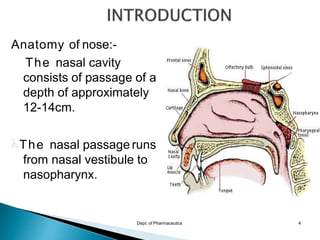
Anatomy of nose:-
The nasal cavity
consists of passage of a
depth of approximately
12-14cm.
The nasal passage runs
from nasal vestibule to
nasopharynx.
5
Nasal secretions are secreted by goblet cells, nasal
glands and transudate from plasma.
 I t contains sodium, potassium, calcium,albumin,
enzymes like leucine,CYP450,Transaminase,etc.
The pH of nasal secretion is 5.5-6.5 in adults and
5.0-6.7 in infants.
Dept. of Pharmaceutics 6
Large nasal mucosal surface area for dose
absorption
Rapid drug absorption via highly-vascularized
mucosa
Rapid onset of action
Ease of administration, non-invasive
Contd..
Dept. of Pharmaceutics 7
Avoidance of the gastrointestinal tract and first-
pass metabolism
Improved bioavailability
Lower dose/reduced side effects
Improved convenience and compliance
Self-administration.
8
Nasal cavity provides smaller absorption surface
when compared to GIT.
Relatively inconvenient to patients when
compared to oral delivery since there is possibility
of nasal irritation.
The histological toxicity of absorption enhancers
used in the nasal drug delivery system is not yet
clearly established.
 Liquid formulation :-
These are usually aqueous solutions of the
drug. The simplest way to give a liquid is by
nose drops.
They are simple to develop and manufacture
compared to solid dosage forms but have a
lower microbiological and chemical stability,
requiring the use of various preservatives.
Dept. of Pharmaceutics 7
 Squeezed bottles :-
These are used for nasal decongestant and work
by spraying a partially atomized jet of liquid into
the nasal cavity.
They give a better absorption of drug by directing
the formulation into the anterior part of the cavity
and covering a large part of nasal mucosa.
Dept. of Pharmaceutics 8
 Metered-dose pump system :-
They can deliver solutions, suspensions or
emulsions with a predetermined volume between
25 and 200 μL, thus offering deposition over a
large area.
Particle size and dose volume are two important
factors for controlling delivery from metered-dose
systems.
Dept. of Pharmaceutics 9
The optimum particle size for deposition in the
nasal cavity is 10μm.
The volume of formulation that can be delivered is
limited by the size of the nasal cavity.
Better absorption is achieved by administering two
doses, one in each nostril, rather than a single
large dose.
Dept. of Pharmaceutics 10
Nasal delivery of organic based
pharmaceuticals
 Various organic based pharmaceuticals have
been investigated for nasal delivery which
includes drug with extensive presystemic
metabolism.
 E.g. Progesterone, Estradiol, Nitroglycerin,
Propranolol, etc.
Dept. of Pharmaceutics 11


B. Nasal delivery of peptide based drugs :-
Dept. of Pharmaceutics 12
 Nasal delivery of peptides and proteins is
depend on –
The structure and size of the molecule.
Nasal residence time
Formulation variables (pH, viscosity)



 E.g. calcitonin, secretin, albumins, insulin,
glucagon, etc.
oAnatomy of pulmonary system
oDelivery systems
oAdvantages of pulmonary drug delivery systems
14
15
The lung is the organ of external respiration, in
which oxygen and carbon dioxide are
exchanged between blood and inhaled air.
The structure of the airways prevent the entry of
and promotes the removal of airborne foreign
particles including microorganisms.
Dept. of Pharmaceutics 16
Contd..
The respiratory tract consists of conducting
regions ( trachea, bronchi, bronchioles, terminal
and respiratory bronchioles) and respiratory
regions (respiratory bronchioles and alveolar
regions).
The upper respiratory tract comprises the nose,
throat, pharynx and larynx; the lower tract
comprises the trachea, bronchi, bronchioles and
the alveolar regions.
Dept. of Pharmaceutics 17
Contd..
Trachea branches into two main bronchi- the
right bronchus is wider and leaves the trachea at
the smaller angle than the left.
The conducting airways are lined with ciliated
epithelial cells.
Dept. of Pharmaceutics 18
Dept. of Pharmaceutics 19
Aerosols are used for the delivery of the drug by
this route of administration.
The aerosols are defined as pressurized dosage
from containing one or more active ingredients
which upon actuation emit a fine dispersion of
liquid or solid materials in gaseous medium.
 There are three main types of aerosols
generating devices:-
i. Pressurized metered dose inhalers.
ii. Dry powder inhalers.
iii. Nebulizers.
Dept. of Pharmaceutics 20
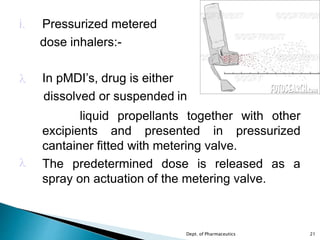
i. Pressurized metered
dose inhalers:-
 In pMDI’s, drug is either
dissolved or suspended in
togetherliquid propellants
excipients and
with other
presented in pressurized
cantainer fitted with metering valve.
 The predetermined dose is released as a
spray on actuation of the metering valve.
Dept. of Pharmaceutics 21
36

 Pharmaceutical aerosols are packaged in tin-
plated steel, plastic coated glass or aluminium
containers.

Aluminium is relatively inert and used uncoated
where there is no chemical instability between
containers and contents.

Alternatively aluminium containers with an internal
coating of chemically resistant organic material
such as epoxy-resin or polytetrafluorine can be
used
Dept. of Pharmaceutics 37
These are liquified gases like chlorofluorocarbons
and hydrofluoroalkanes.
These develop proper pressure within the container
& it expels the product when valve is opened.
At room temperature and pressure, these are gases
but they are readily liquified by decreasing the
temperature or increasing pressure.
The vapour pressure of the mixture of propellants is
given by Raoult’s law,
Contd…
i.e. vapour pressure of the mixed system is equal
to the sum of the mole fraction of each
component multiplied by it’s vapour pressure.
p = pa+ pb
where p = total vapour pressure of the system, pa
& pb= partial vapour pressures of the
components a & b.
Dept. of Pharmaceutics 24
Metering valves:-
It permits the reproducible delivery of small
volumes of product.
Depression of the valve stem allows the contents
of the metering chamber to be discharged through
the orifice in the valve stem and made available to
the patient.
After actuation the metering chamber refills with
liquid from the bulk and is ready to dispense the
next dose.
Dept. of Pharmaceutics 25
ii. Dry powder inhalers:-
In this system drug is inhaled as a cloud of fine
particles.
DPI formulations are propellant free and do not
contain any excipients.
They are breath activated avoiding the
problems of inhalation/actuation coordination
encountered with pMDI’s.
Dept. of Pharmaceutics 26
Dept. of Pharmaceutics 27
Nebulizers:-
It delivers relatively large volume of drug
solutions and suspensions.
They are used for drugs that cannot be
formulated into pMDI’s or DPI’s.
There are three categories :-
a. Jet nebulizers
b. Ultrasonic nebulizers
c. Vibrating-mesh nebulizers
a. Jet nebulizers:-
They are also called as air-
jet or air-blast nebulizers
using compressed gas.
The jet of high velocity gas
is passed tangentially or
coaxially through a narrow
venturi nozzle typically 0.3
to 0.7 mm in diameter.
e.g. Pari LC nebulizer.
Dept. of Pharmaceutics 28
https://youtu.be/YSCtmYcVyxQ
29
Ultrasonic nebulisers use a piezoelectric crystal vibrating at high frequency to create the
aerosol, and do not require gas flow. The vibrations are transmitted through a buffer to the
drug solution and form a fountain of liquid in the nebulisation chamber. Ultrasonic nebulisers
produce a more uniform particle size than jet nebulisers, but are less widely used due to cost.
It break down the drug solution into small droplets via piezoelectric vibration. There is a
baffle within the inhaler, to remove large droplets and return them to the main chamber
of device. (piezoelectricity means electricity resulting from pressure and latent heat)
Vibrating-mesh nebulizers:-
In this device aerosols are generated by passing liquids
through a vibrating mesh or plate with multiple apertures.
https://youtu.be/Js0eYtsVnow
Dept. of Pharmaceutics 31
Smaller doses can be administered locally.
Reduce the potential incidence of adverse
systemic effect.
 I t used when a drug is poorly absorbedorally,
e.g. Na cromoglicate.
 I t is used when drug is rapidlymetabolized
orally, e.g. isoprenaline
Dept. of Pharmaceutics 32
Y.W.Chein; Nasal Systemic Drug Delivery,Vol.39,
page no. 39-67.
Michael E. Aulton; Aulton’s Pharmaceutics- ‘The
Design and Manufacture of Medicines’, 3rd Edition,
page no. 540-563.
Michael J. Rathbone; Oral Mucosal Drug
Delivery,Vol.74,page no.65-79.
www.google.com

Nasopulmonary dds

  • 1.
  • 2.
    Dept. of Pharmaceutics4 Anatomy of nose:- The nasal cavity consists of passage of a depth of approximately 12-14cm. The nasal passage runs from nasal vestibule to nasopharynx.
  • 3.
    5 Nasal secretions aresecreted by goblet cells, nasal glands and transudate from plasma.  I t contains sodium, potassium, calcium,albumin, enzymes like leucine,CYP450,Transaminase,etc. The pH of nasal secretion is 5.5-6.5 in adults and 5.0-6.7 in infants.
  • 4.
    Dept. of Pharmaceutics6 Large nasal mucosal surface area for dose absorption Rapid drug absorption via highly-vascularized mucosa Rapid onset of action Ease of administration, non-invasive Contd..
  • 5.
    Dept. of Pharmaceutics7 Avoidance of the gastrointestinal tract and first- pass metabolism Improved bioavailability Lower dose/reduced side effects Improved convenience and compliance Self-administration.
  • 6.
    8 Nasal cavity providessmaller absorption surface when compared to GIT. Relatively inconvenient to patients when compared to oral delivery since there is possibility of nasal irritation. The histological toxicity of absorption enhancers used in the nasal drug delivery system is not yet clearly established.
  • 7.
     Liquid formulation:- These are usually aqueous solutions of the drug. The simplest way to give a liquid is by nose drops. They are simple to develop and manufacture compared to solid dosage forms but have a lower microbiological and chemical stability, requiring the use of various preservatives. Dept. of Pharmaceutics 7
  • 8.
     Squeezed bottles:- These are used for nasal decongestant and work by spraying a partially atomized jet of liquid into the nasal cavity. They give a better absorption of drug by directing the formulation into the anterior part of the cavity and covering a large part of nasal mucosa. Dept. of Pharmaceutics 8
  • 9.
     Metered-dose pumpsystem :- They can deliver solutions, suspensions or emulsions with a predetermined volume between 25 and 200 μL, thus offering deposition over a large area. Particle size and dose volume are two important factors for controlling delivery from metered-dose systems. Dept. of Pharmaceutics 9
  • 10.
    The optimum particlesize for deposition in the nasal cavity is 10μm. The volume of formulation that can be delivered is limited by the size of the nasal cavity. Better absorption is achieved by administering two doses, one in each nostril, rather than a single large dose. Dept. of Pharmaceutics 10
  • 11.
    Nasal delivery oforganic based pharmaceuticals  Various organic based pharmaceuticals have been investigated for nasal delivery which includes drug with extensive presystemic metabolism.  E.g. Progesterone, Estradiol, Nitroglycerin, Propranolol, etc. Dept. of Pharmaceutics 11  
  • 12.
    B. Nasal deliveryof peptide based drugs :- Dept. of Pharmaceutics 12  Nasal delivery of peptides and proteins is depend on – The structure and size of the molecule. Nasal residence time Formulation variables (pH, viscosity)     E.g. calcitonin, secretin, albumins, insulin, glucagon, etc.
  • 14.
    oAnatomy of pulmonarysystem oDelivery systems oAdvantages of pulmonary drug delivery systems 14
  • 15.
  • 16.
    The lung isthe organ of external respiration, in which oxygen and carbon dioxide are exchanged between blood and inhaled air. The structure of the airways prevent the entry of and promotes the removal of airborne foreign particles including microorganisms. Dept. of Pharmaceutics 16 Contd..
  • 17.
    The respiratory tractconsists of conducting regions ( trachea, bronchi, bronchioles, terminal and respiratory bronchioles) and respiratory regions (respiratory bronchioles and alveolar regions). The upper respiratory tract comprises the nose, throat, pharynx and larynx; the lower tract comprises the trachea, bronchi, bronchioles and the alveolar regions. Dept. of Pharmaceutics 17 Contd..
  • 18.
    Trachea branches intotwo main bronchi- the right bronchus is wider and leaves the trachea at the smaller angle than the left. The conducting airways are lined with ciliated epithelial cells. Dept. of Pharmaceutics 18
  • 19.
    Dept. of Pharmaceutics19 Aerosols are used for the delivery of the drug by this route of administration. The aerosols are defined as pressurized dosage from containing one or more active ingredients which upon actuation emit a fine dispersion of liquid or solid materials in gaseous medium.
  • 20.
     There arethree main types of aerosols generating devices:- i. Pressurized metered dose inhalers. ii. Dry powder inhalers. iii. Nebulizers. Dept. of Pharmaceutics 20
  • 21.
    i. Pressurized metered doseinhalers:-  In pMDI’s, drug is either dissolved or suspended in togetherliquid propellants excipients and with other presented in pressurized cantainer fitted with metering valve.  The predetermined dose is released as a spray on actuation of the metering valve. Dept. of Pharmaceutics 21
  • 22.
    36   Pharmaceutical aerosolsare packaged in tin- plated steel, plastic coated glass or aluminium containers.  Aluminium is relatively inert and used uncoated where there is no chemical instability between containers and contents.  Alternatively aluminium containers with an internal coating of chemically resistant organic material such as epoxy-resin or polytetrafluorine can be used
  • 23.
    Dept. of Pharmaceutics37 These are liquified gases like chlorofluorocarbons and hydrofluoroalkanes. These develop proper pressure within the container & it expels the product when valve is opened. At room temperature and pressure, these are gases but they are readily liquified by decreasing the temperature or increasing pressure. The vapour pressure of the mixture of propellants is given by Raoult’s law, Contd…
  • 24.
    i.e. vapour pressureof the mixed system is equal to the sum of the mole fraction of each component multiplied by it’s vapour pressure. p = pa+ pb where p = total vapour pressure of the system, pa & pb= partial vapour pressures of the components a & b. Dept. of Pharmaceutics 24
  • 25.
    Metering valves:- It permitsthe reproducible delivery of small volumes of product. Depression of the valve stem allows the contents of the metering chamber to be discharged through the orifice in the valve stem and made available to the patient. After actuation the metering chamber refills with liquid from the bulk and is ready to dispense the next dose. Dept. of Pharmaceutics 25
  • 26.
    ii. Dry powderinhalers:- In this system drug is inhaled as a cloud of fine particles. DPI formulations are propellant free and do not contain any excipients. They are breath activated avoiding the problems of inhalation/actuation coordination encountered with pMDI’s. Dept. of Pharmaceutics 26
  • 27.
    Dept. of Pharmaceutics27 Nebulizers:- It delivers relatively large volume of drug solutions and suspensions. They are used for drugs that cannot be formulated into pMDI’s or DPI’s. There are three categories :- a. Jet nebulizers b. Ultrasonic nebulizers c. Vibrating-mesh nebulizers
  • 28.
    a. Jet nebulizers:- Theyare also called as air- jet or air-blast nebulizers using compressed gas. The jet of high velocity gas is passed tangentially or coaxially through a narrow venturi nozzle typically 0.3 to 0.7 mm in diameter. e.g. Pari LC nebulizer. Dept. of Pharmaceutics 28 https://youtu.be/YSCtmYcVyxQ
  • 29.
    29 Ultrasonic nebulisers usea piezoelectric crystal vibrating at high frequency to create the aerosol, and do not require gas flow. The vibrations are transmitted through a buffer to the drug solution and form a fountain of liquid in the nebulisation chamber. Ultrasonic nebulisers produce a more uniform particle size than jet nebulisers, but are less widely used due to cost. It break down the drug solution into small droplets via piezoelectric vibration. There is a baffle within the inhaler, to remove large droplets and return them to the main chamber of device. (piezoelectricity means electricity resulting from pressure and latent heat)
  • 30.
    Vibrating-mesh nebulizers:- In thisdevice aerosols are generated by passing liquids through a vibrating mesh or plate with multiple apertures. https://youtu.be/Js0eYtsVnow
  • 31.
    Dept. of Pharmaceutics31 Smaller doses can be administered locally. Reduce the potential incidence of adverse systemic effect.  I t used when a drug is poorly absorbedorally, e.g. Na cromoglicate.  I t is used when drug is rapidlymetabolized orally, e.g. isoprenaline
  • 32.
    Dept. of Pharmaceutics32 Y.W.Chein; Nasal Systemic Drug Delivery,Vol.39, page no. 39-67. Michael E. Aulton; Aulton’s Pharmaceutics- ‘The Design and Manufacture of Medicines’, 3rd Edition, page no. 540-563. Michael J. Rathbone; Oral Mucosal Drug Delivery,Vol.74,page no.65-79. www.google.com