Vishnu Institute of Pharmaceutical Education and Research
Dry powder Inhalers
By: MR. B CH S NAGA RAJU
M pharm 1st year
Guided by: Dr. K. Vanitha, Ph. D.
Department of Pharmaceutics
 Contents:
1. Introduction & Definition
2. Types of DPI
3. Characteristics
4. Advantages
5. Disadvantages
6. DPI formulation
7. Carriers used in DPI
8. Techniques for DPI
9. Characterization of DPIs
INTRODUCTION
What are dry powder inhalers
Dry Powder Inhalers (DPIs)
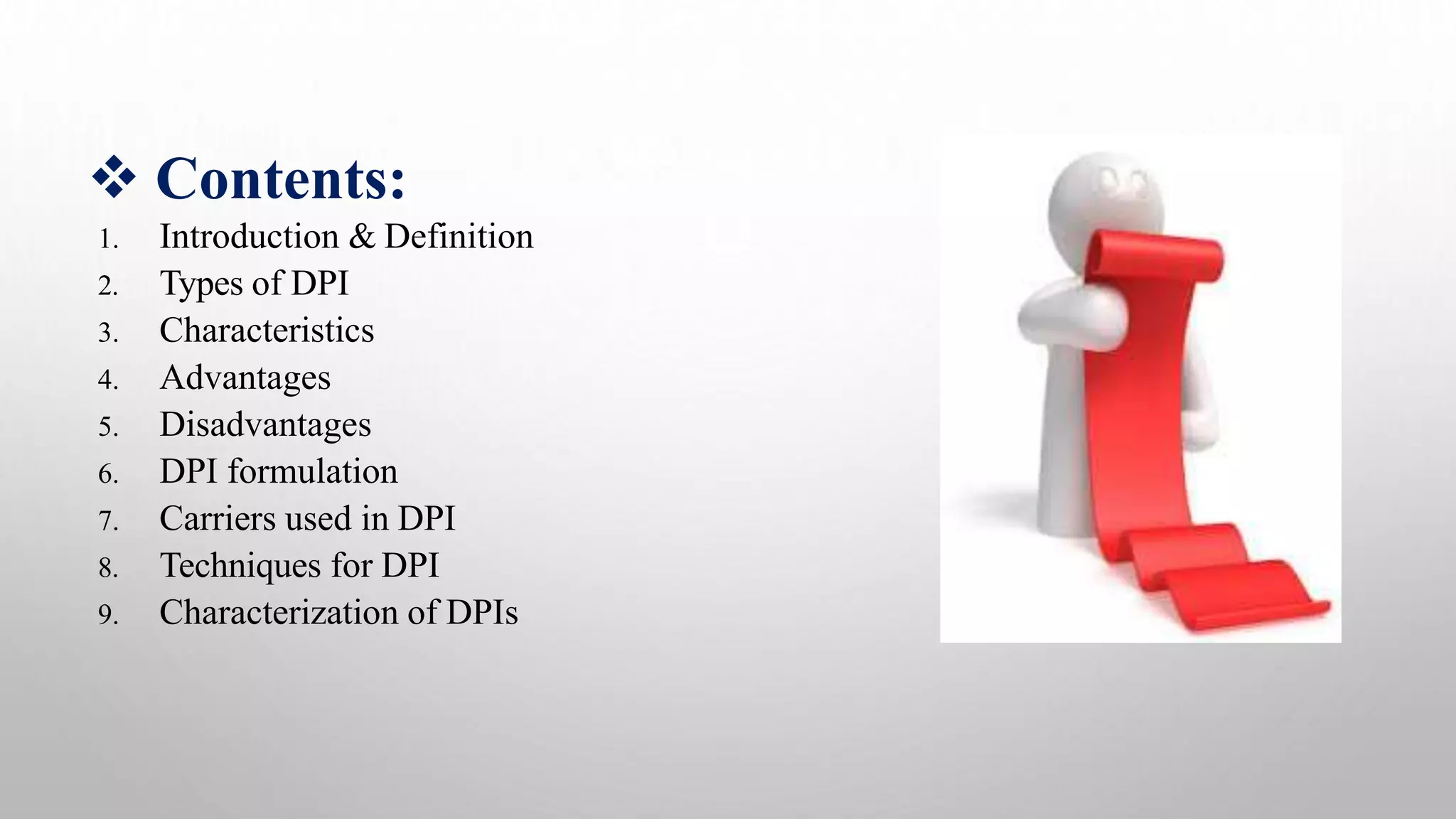
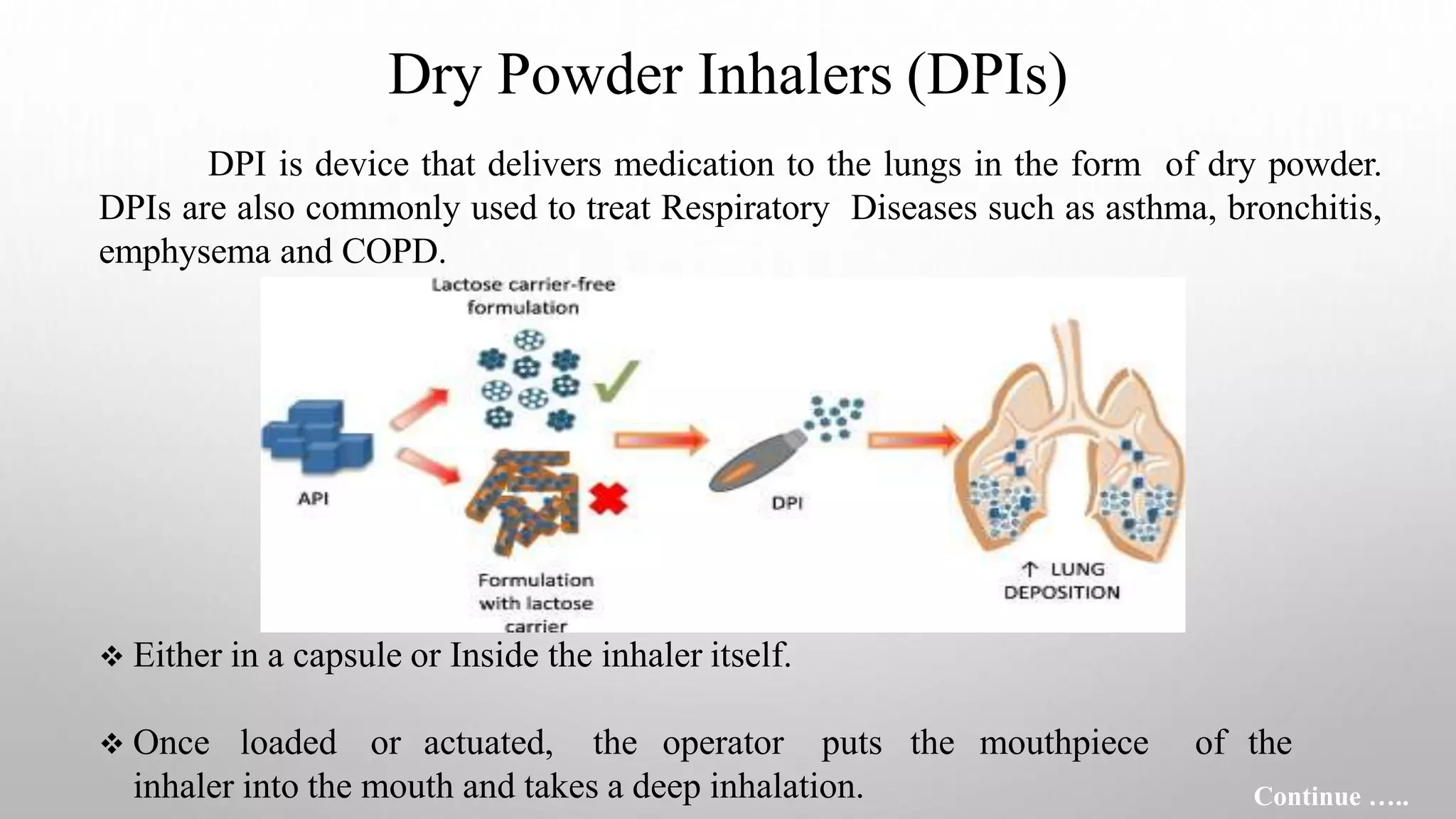
DPI is device that delivers medication to the lungs in the form of dry powder.
DPIs are also commonly used to treat Respiratory Diseases such as asthma, bronchitis,
emphysema and COPD.
 Either in a capsule or Inside the inhaler itself.
 Once loaded or actuated, the operator puts the mouthpiece of the
inhaler into the mouth and takes a deep inhalation. Continue …..
 Commonly used to deliver medications such as inhaled corticosteroids into the lungs.
 This inhaler is breath-activated. The medication is released only when you take a
deep, fast breath in through the inhaler. This is different than a metered dose inhaler
that pushes medication into the lungs.
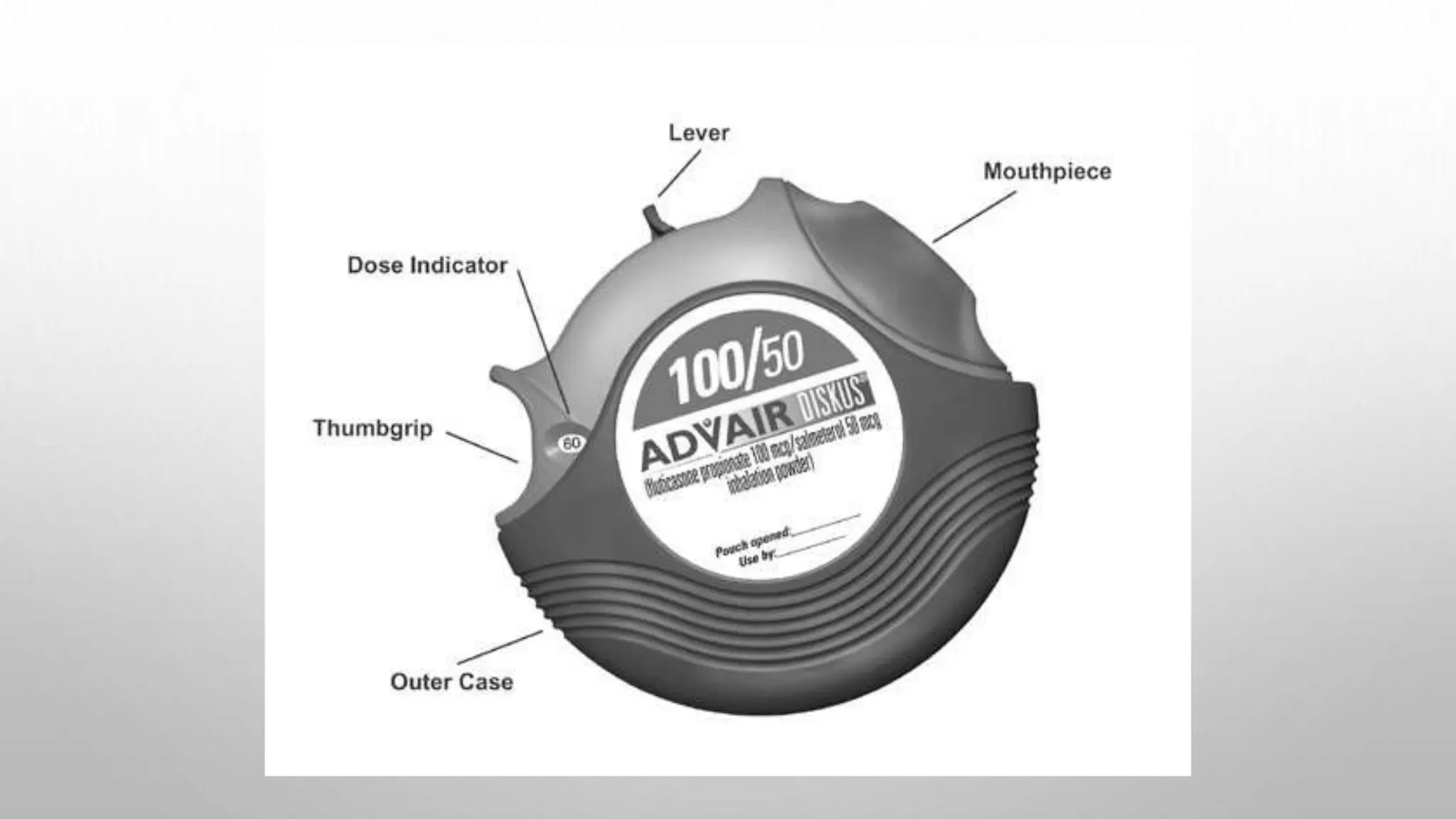
 Marketed examples of dry powder inhalers include:
Eg’s: Advair Diskus, Asmanex, Pulmicort flexhaler.
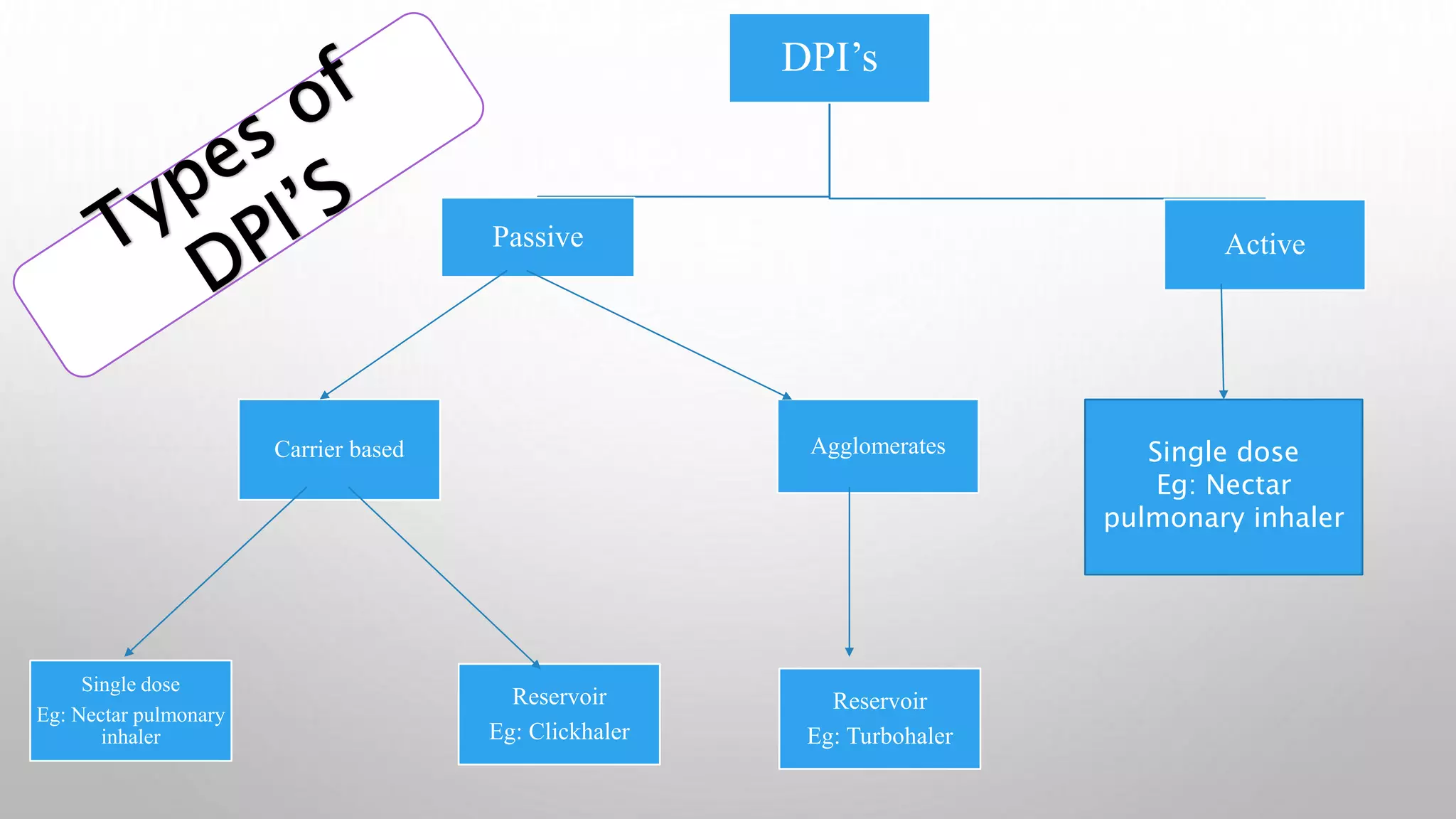
DPI’s
Passive Active
Carrier based Agglomerates
Reservoir
Eg: Clickhaler
Reservoir
Eg: Turbohaler
Single dose
Eg: Nectar pulmonary
inhaler
Single dose
Eg: Nectar
pulmonary inhaler
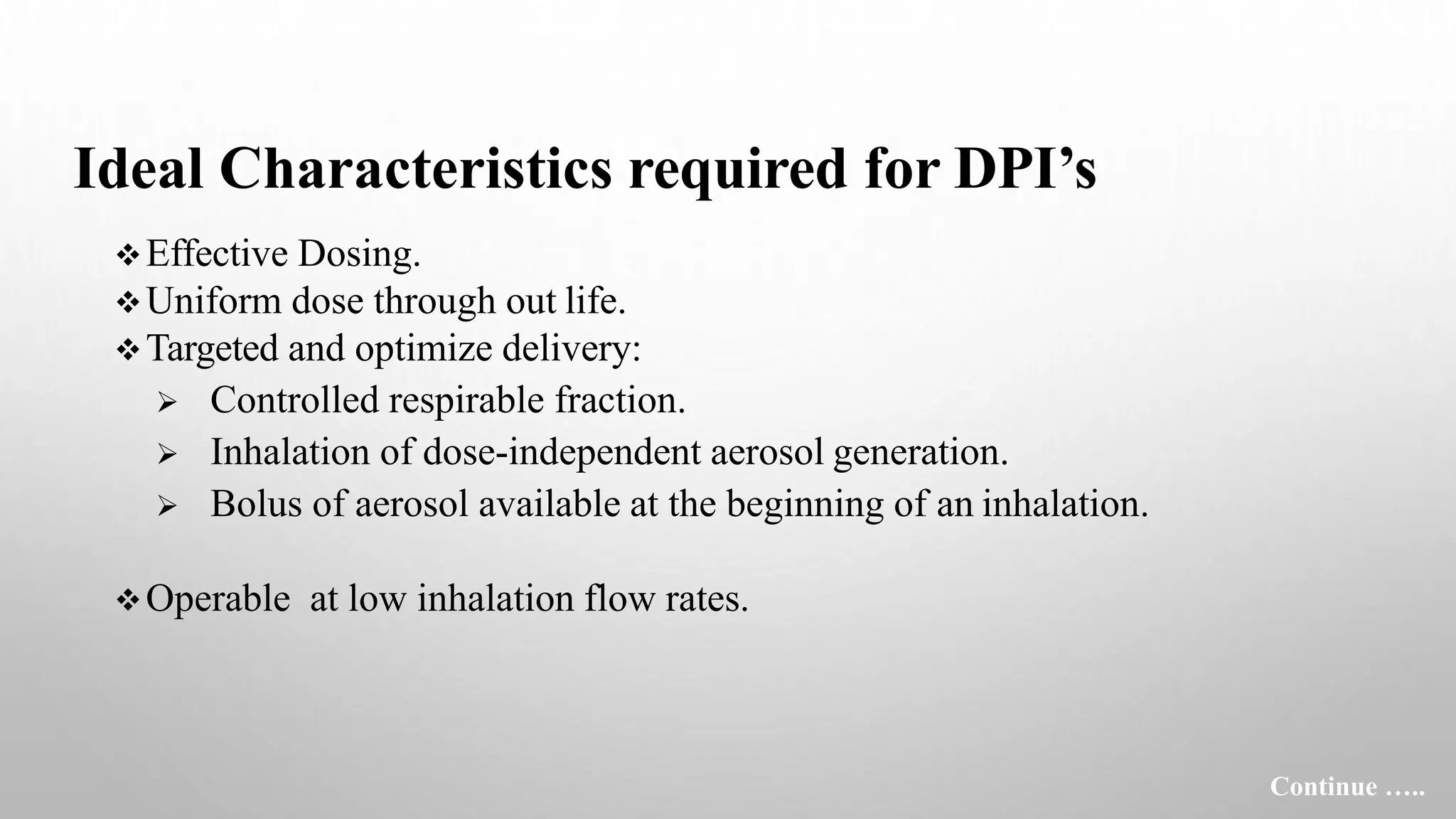
Ideal Characteristics required for DPI’s
Effective Dosing.
Uniform dose through out life.
Targeted and optimize delivery:
 Controlled respirable fraction.
 Inhalation of dose-independent aerosol generation.
 Bolus of aerosol available at the beginning of an inhalation.
Operable at low inhalation flow rates.
Continue …..
Good Environmental production.
Design optimized by the use of, for e.g., particle
engineering, manufacturing innovation, etc.
In-process controls for quality.
Compact, Portable, Cheap, Reusable and Efficient device.
Clear comparative data for complaint.
ADVANTAGES
Formulation
stability.
No need to
hold breath
Breath
Activated
Environmental
sustainability
Propellant
free
design
No
coordination
required.
Less potential for
formulation
problems.
Less potential for
extractable from
device components.
DISADVANTAGES
Development and
manufacturing is more
complex than pMDI.
Have
adequate
inhalation.
More
expensive
than pMDIs.
Less protection
from
environmental
effects.
Deposition efficiency
depends on patients
inspiratory airflow.
Age
dependent
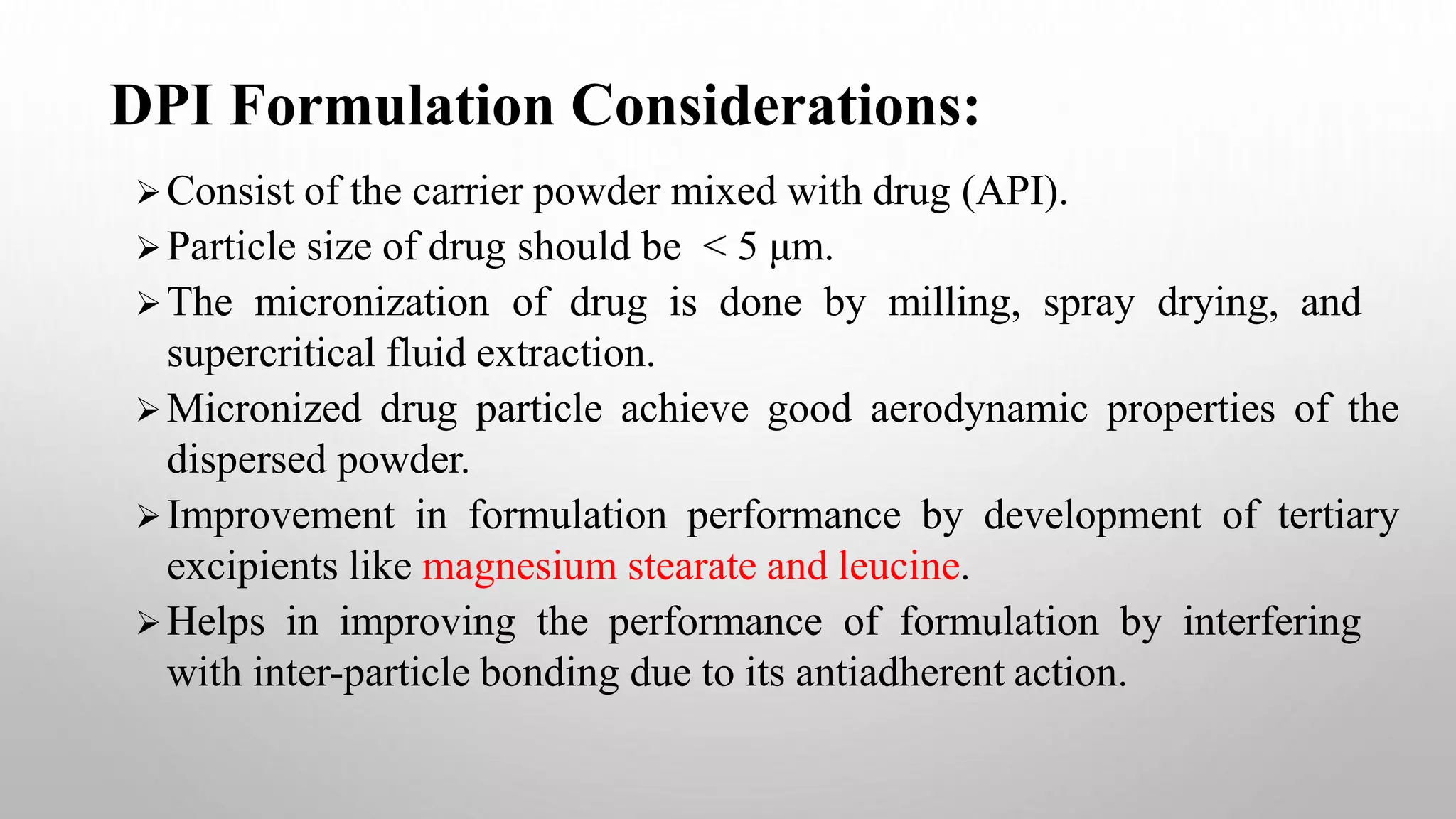
DPI Formulation Considerations:
Consist of the carrier powder mixed with drug (API).
Particle size of drug should be < 5 μm.
The micronization of drug is done by milling, spray drying, and
supercritical fluid extraction.
Micronized drug particle achieve good aerodynamic properties of the
dispersed powder.
Improvement in formulation performance by development of tertiary
excipients like magnesium stearate and leucine.
Helps in improving the performance of formulation by interfering
with inter-particle bonding due to its antiadherent action.
Carriers used in DPIs
 Used to improve drug particle flow ability, improving dosing accuracy,
minimizing the dose variability.
 Tofacilitate the easy emission of drug particles from capsules and
devices, thereby increasing the inhalation efficiency.
 Design of the carrier particle is important for the development of DPIs.
 Characteristicsof carrier particles include physico-chemical stability,
biocompatibility and biodegradability.
 Shouldbe compatible with the drug substance and must be inert,
available and economical.
 Examples of carriers: Lactose, mannitol, glucose, sorbitol, maltitol,
and xylitol.
Advantages of lactose as a carrier
 Well-investigated toxicity profile
 Physical and chemical stability
 Compatibility with the drug substance
 Broad availability
 Low cost.
A) Controlled crystallization or precipitation:
Crystallization, or precipitation, is the process by which particles are produced from
solution of the material in a suitable solvent.
The formation of a stable, crystalline material is normally the target of this final
step.
In the production of materials for use in DPI products, however, the particle size of
the crystallized product is normally too large.
Subsequent reduction in particle size is then necessary and can significantly alter
the physical nature of the material.
B) Micronization:
Micronization involves high energy particle-size reduction technique that can
convert coarse-diameter particles into particles <5µm in diameter. Types of
equipment used as, jet or fluid energy mills and ball mills.
All techniques involve applying a force on the particle, typically in the form of a
collision, either particle-particle or particle-equipment.
As the size of the particle decreases, the number of imperfection decreases.
C) Blending:
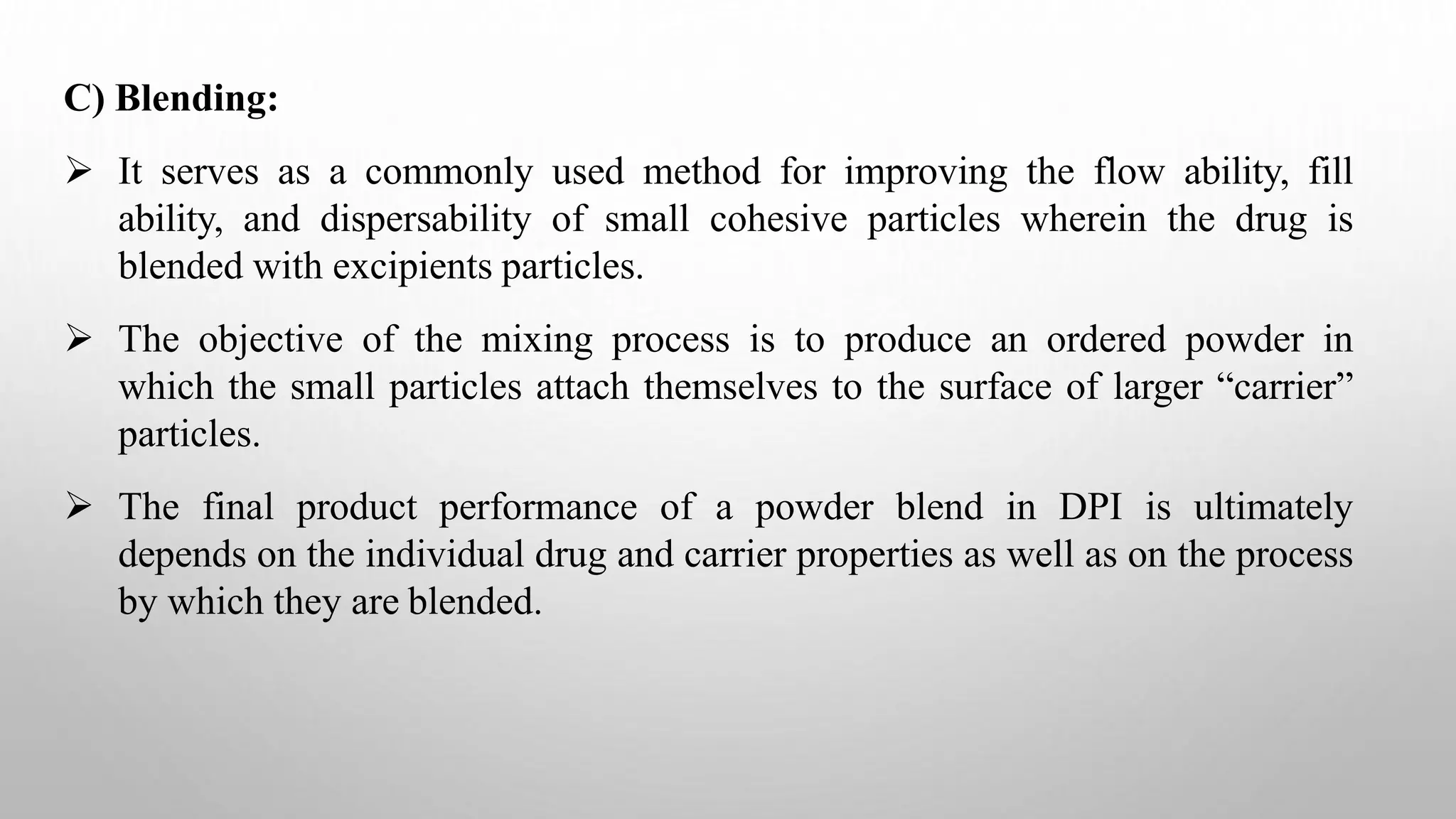
 It serves as a commonly used method for improving the flow ability, fill
ability, and dispersability of small cohesive particles wherein the drug is
blended with excipients particles.
 The objective of the mixing process is to produce an ordered powder in
which the small particles attach themselves to the surface of larger “carrier”
particles.
 The final product performance of a powder blend in DPI is ultimately
depends on the individual drug and carrier properties as well as on the process
by which they are blended.
D) Palletization:
 The process involves deliberate agglomeration of the fine drug material into
less cohesive, larger units.
 Palletization is usually achieved by vibratory sieving or any process that
tumbles powder.
 The resultant pellets must be used in a system capable of deaggregating to an
appropriate particle size for aerosol drug delivery.
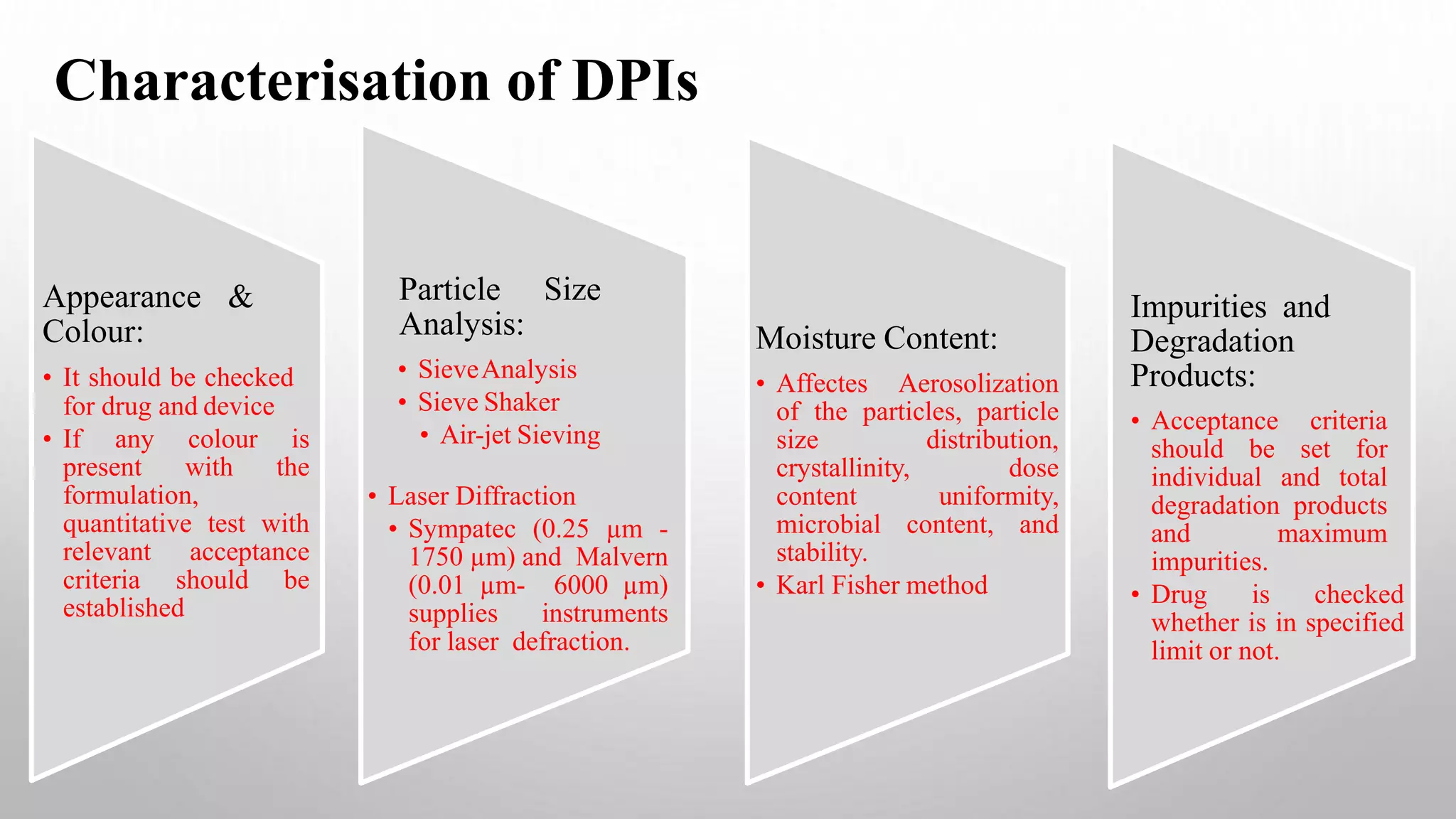
Characterisation of DPIs
Appearance &
Colour:
• It should be checked
for drug and device
• If any colour is
present with the
formulation,
quantitative test with
relevant acceptance
criteria should be
established
Particle Size
Analysis:
• SieveAnalysis
• Sieve Shaker
• Air-jet Sieving
• Laser Diffraction
• Sympatec (0.25 µm -
1750 µm) and Malvern
(0.01 µm- 6000 µm)
supplies instruments
for laser defraction.
Moisture Content:
• Affectes Aerosolization
of the particles, particle
size distribution,
crystallinity, dose
content uniformity,
microbial content, and
stability.
• Karl Fisher method
Impurities and
Degradation
Products:
• Acceptance criteria
should be set for
individual and total
degradation products
and maximum
impurities.
• Drug is checked
whether is in specified
limit or not.
Drug Content (Assay):
• Should be determined
analytically with a
stability indicating
method.
• Acceptance criteria
should as high as
possible.
Microbial Limits:
• Total Aerobic Count
• Total Yeast Count
• Mold Count
• Indicator Pathogens
Delivered Dose
Uniformity:
• Both air flow rate and
total volume of air drawn
through the device should
be thoroughly evaluated.
• Volume of air drawn
through the device be
limited to two litres.
• Apply For both D-M DPI
& P-M DPI.
Ppt on dry powder inhalers

Ppt on dry powder inhalers

  • 1.
    Vishnu Institute ofPharmaceutical Education and Research Dry powder Inhalers By: MR. B CH S NAGA RAJU M pharm 1st year Guided by: Dr. K. Vanitha, Ph. D. Department of Pharmaceutics
  • 2.
     Contents: 1. Introduction& Definition 2. Types of DPI 3. Characteristics 4. Advantages 5. Disadvantages 6. DPI formulation 7. Carriers used in DPI 8. Techniques for DPI 9. Characterization of DPIs
  • 3.
  • 4.
    Dry Powder Inhalers(DPIs) DPI is device that delivers medication to the lungs in the form of dry powder. DPIs are also commonly used to treat Respiratory Diseases such as asthma, bronchitis, emphysema and COPD.  Either in a capsule or Inside the inhaler itself.  Once loaded or actuated, the operator puts the mouthpiece of the inhaler into the mouth and takes a deep inhalation. Continue …..
  • 5.
     Commonly usedto deliver medications such as inhaled corticosteroids into the lungs.  This inhaler is breath-activated. The medication is released only when you take a deep, fast breath in through the inhaler. This is different than a metered dose inhaler that pushes medication into the lungs.  Marketed examples of dry powder inhalers include: Eg’s: Advair Diskus, Asmanex, Pulmicort flexhaler.
  • 7.
    DPI’s Passive Active Carrier basedAgglomerates Reservoir Eg: Clickhaler Reservoir Eg: Turbohaler Single dose Eg: Nectar pulmonary inhaler Single dose Eg: Nectar pulmonary inhaler
  • 8.
    Ideal Characteristics requiredfor DPI’s Effective Dosing. Uniform dose through out life. Targeted and optimize delivery:  Controlled respirable fraction.  Inhalation of dose-independent aerosol generation.  Bolus of aerosol available at the beginning of an inhalation. Operable at low inhalation flow rates. Continue …..
  • 9.
    Good Environmental production. Designoptimized by the use of, for e.g., particle engineering, manufacturing innovation, etc. In-process controls for quality. Compact, Portable, Cheap, Reusable and Efficient device. Clear comparative data for complaint.
  • 10.
    ADVANTAGES Formulation stability. No need to holdbreath Breath Activated Environmental sustainability Propellant free design No coordination required. Less potential for formulation problems. Less potential for extractable from device components.
  • 11.
    DISADVANTAGES Development and manufacturing ismore complex than pMDI. Have adequate inhalation. More expensive than pMDIs. Less protection from environmental effects. Deposition efficiency depends on patients inspiratory airflow. Age dependent
  • 12.
    DPI Formulation Considerations: Consistof the carrier powder mixed with drug (API). Particle size of drug should be < 5 μm. The micronization of drug is done by milling, spray drying, and supercritical fluid extraction. Micronized drug particle achieve good aerodynamic properties of the dispersed powder. Improvement in formulation performance by development of tertiary excipients like magnesium stearate and leucine. Helps in improving the performance of formulation by interfering with inter-particle bonding due to its antiadherent action.
  • 13.
    Carriers used inDPIs  Used to improve drug particle flow ability, improving dosing accuracy, minimizing the dose variability.  Tofacilitate the easy emission of drug particles from capsules and devices, thereby increasing the inhalation efficiency.  Design of the carrier particle is important for the development of DPIs.  Characteristicsof carrier particles include physico-chemical stability, biocompatibility and biodegradability.  Shouldbe compatible with the drug substance and must be inert, available and economical.  Examples of carriers: Lactose, mannitol, glucose, sorbitol, maltitol, and xylitol.
  • 14.
    Advantages of lactoseas a carrier  Well-investigated toxicity profile  Physical and chemical stability  Compatibility with the drug substance  Broad availability  Low cost.
  • 15.
    A) Controlled crystallizationor precipitation: Crystallization, or precipitation, is the process by which particles are produced from solution of the material in a suitable solvent. The formation of a stable, crystalline material is normally the target of this final step. In the production of materials for use in DPI products, however, the particle size of the crystallized product is normally too large. Subsequent reduction in particle size is then necessary and can significantly alter the physical nature of the material.
  • 16.
    B) Micronization: Micronization involveshigh energy particle-size reduction technique that can convert coarse-diameter particles into particles <5µm in diameter. Types of equipment used as, jet or fluid energy mills and ball mills. All techniques involve applying a force on the particle, typically in the form of a collision, either particle-particle or particle-equipment. As the size of the particle decreases, the number of imperfection decreases.
  • 17.
    C) Blending:  Itserves as a commonly used method for improving the flow ability, fill ability, and dispersability of small cohesive particles wherein the drug is blended with excipients particles.  The objective of the mixing process is to produce an ordered powder in which the small particles attach themselves to the surface of larger “carrier” particles.  The final product performance of a powder blend in DPI is ultimately depends on the individual drug and carrier properties as well as on the process by which they are blended.
  • 18.
    D) Palletization:  Theprocess involves deliberate agglomeration of the fine drug material into less cohesive, larger units.  Palletization is usually achieved by vibratory sieving or any process that tumbles powder.  The resultant pellets must be used in a system capable of deaggregating to an appropriate particle size for aerosol drug delivery.
  • 19.
    Characterisation of DPIs Appearance& Colour: • It should be checked for drug and device • If any colour is present with the formulation, quantitative test with relevant acceptance criteria should be established Particle Size Analysis: • SieveAnalysis • Sieve Shaker • Air-jet Sieving • Laser Diffraction • Sympatec (0.25 µm - 1750 µm) and Malvern (0.01 µm- 6000 µm) supplies instruments for laser defraction. Moisture Content: • Affectes Aerosolization of the particles, particle size distribution, crystallinity, dose content uniformity, microbial content, and stability. • Karl Fisher method Impurities and Degradation Products: • Acceptance criteria should be set for individual and total degradation products and maximum impurities. • Drug is checked whether is in specified limit or not.
  • 20.
    Drug Content (Assay): •Should be determined analytically with a stability indicating method. • Acceptance criteria should as high as possible. Microbial Limits: • Total Aerobic Count • Total Yeast Count • Mold Count • Indicator Pathogens Delivered Dose Uniformity: • Both air flow rate and total volume of air drawn through the device should be thoroughly evaluated. • Volume of air drawn through the device be limited to two litres. • Apply For both D-M DPI & P-M DPI.