Parenteral Production
Department of Pharmaceutics | Sagar savale
Mr. Sagar Kishor Savale
[Department of Pharmaceutics]
Mobile No. +91 9960885333
Email: avengersagar16@gmail.com
2/27/2017Sagar Kishor Savale 1
Department of Pharmaceutics | Sagar savale
Parenteral Route
 It is an route of administration other than the oral route, this route of administration bypasses
the alimentary canal.
 It includes, I.V., I. M., Subcutaneous route for parenteral administration.
2/27/2017Sagar Kishor Savale 2
Advantages
 Quick onset of action and site specific or targeted activity.
 It can prevent problem of first pass metabolism or presystolic metabolism.
 Useful for unconscious or vomiting or diarrhea patients.
 Duration of action can be prolonged by modifying formulation.
 Suitable for the drugs which are inactivated in GIT or HCl (GI fluid).
Department of Pharmaceutics | Sagar savale
2/27/2017Sagar Kishor Savale 3
Department of Pharmaceutics | Sagar savale
Dis-Advantages
 Injections may cause pain at the site of injection.
 Only trained person is required.
 If given by wrong route, difficult to control adverse effect.
 Difficult to save patient if overdose.
2/27/2017Sagar Kishor Savale 4
Types of Parenteral
Department of Pharmaceutics | Sagar savale
Based on types of packaging
• Single dose units: ampoules, infusions and prefilled disposable syringes.
• Multiple dose units: multiple dose vials.
2/27/2017Sagar Kishor Savale 5
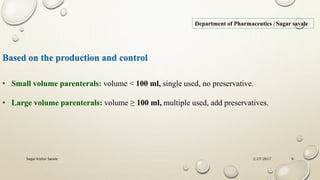
Based on the production and control
• Small volume parenterals: volume < 100 ml, single used, no preservative.
• Large volume parenterals: volume ≥ 100 ml, multiple used, add preservatives.
Department of Pharmaceutics | Sagar savale
2/27/2017Sagar Kishor Savale 6
2/27/2017Sagar Kishor Savale 7
Based on clinical use
• Solutions for irrigation
• Ophthalmic solution
• Dialysis solution
• Diagnostic agent
• Allergenic extracts
• Implants
Department of Pharmaceutics | Sagar savale
2/27/2017Sagar Kishor Savale 8
Department of Pharmaceutics | Sagar savale
Based on physical state of product
• Sterile solutions
• Sterile suspensions
• Sterile emulsions
• Sterile solids
2/27/2017Sagar Kishor Savale 9
Department of Pharmaceutics | Sagar savale
Route of Administration
2/27/2017Sagar Kishor Savale 10
Department of Pharmaceutics | Sagar savale
Subcutaneous (Hypodermis) injection: Below the skin.
Intramuscular injection: Inside the large muscles.
Intravenous injection: inside the veins to blood stream.
2/27/2017Sagar Kishor Savale 11
Intra-arterial injection: Inside the arteries.
Intracardiac injection: Inside the Harte veins or cardiac veins.
Intrathecal injection: Inside the spinal cord.
Department of Pharmaceutics | Sagar savale
2/27/2017Sagar Kishor Savale 12
Intracisternal injection: Inside the one or two cervical nerve.
Intra-articular injection: Inside the articular ends of joints and bones.
Intracerebral injection: Inside the cerebrum.
Department of Pharmaceutics | Sagar savale
2/27/2017Sagar Kishor Savale 13
Department of Pharmaceutics | Sagar savale
Official Types of Injections
Injection: e.g. Insulin Injection USP.
For Injection: e.g. Cefuroxime Injection USP.
Injectable Emulsions: e.g. Propofol USP.
2/27/2017Sagar Kishor Savale 14
Injectable Suspension: e.g. Methyl Prednisolone Acetate Suspension USP.
For Injectable Suspension: e.g. Imipenem and Cilastatin Injectable Suspension USP.
Department of Pharmaceutics | Sagar savale
2/27/2017Sagar Kishor Savale 15
Department of Pharmaceutics | Sagar savale
Requirements of Parenteral Preparations
 Stability
 Sterility
 Free from Pyrogens and Free from foreign particles
2/27/2017Sagar Kishor Savale 16
 Isotonicity
 Specific gravity
 Chemical purity
Department of Pharmaceutics | Sagar savale
2/27/2017Sagar Kishor Savale 17
Department of Pharmaceutics | Sagar savale
Preformulation Factors
 pH /pka
 Solubility
 Thermal/heat effect
 Dissociation constant
 Compatibility studies: FTIR / DSC / TLC/ HPLC
 Oxidation & reduction
 particle size
2/27/2017Sagar Kishor Savale 18
Department of Pharmaceutics | Sagar savale
Formulation of Parenteral Products
1.The active drug
2.Vehicles
• Aqueous vehicle (e.g. water for injection, water for injection free from CO2 ).
• Non-aqueous vehicle (e.g. Ethyl alcohol, propylene glycol, almond oil).
2/27/2017Sagar Kishor Savale 19
Department of Pharmaceutics | Sagar savale
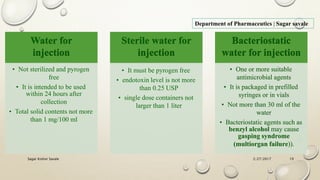
Water for
injection
• Not sterilized and pyrogen
free
• It is intended to be used
within 24 hours after
collection
• Total solid contents not more
than 1 mg/100 ml
Sterile water for
injection
• It must be pyrogen free
• endotoxin level is not more
than 0.25 USP
• single dose containers not
larger than 1 liter
Bacteriostatic
water for injection
• One or more suitable
antimicrobial agents
• It is packaged in prefilled
syringes or in vials
• Not more than 30 ml of the
water
• Bacteriostatic agents such as
benzyl alcohol may cause
gasping syndrome
(multiorgan failure)).
2/27/2017Sagar Kishor Savale 20
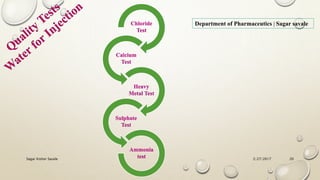
Department of Pharmaceutics | Sagar savaleChloride
Test
Calcium
Test
Heavy
Metal Test
Sulphate
Test
Ammonia
test
2/27/2017Sagar Kishor Savale 21
Department of Pharmaceutics | Sagar savale
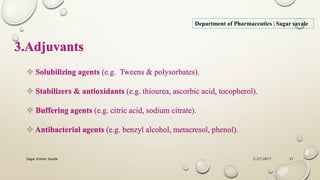
3.Adjuvants
 Solubilizing agents (e.g. Tweens & polysorbates).
 Stabilizers & antioxidants (e.g. thiourea, ascorbic acid, tocopherol).
 Buffering agents (e.g. citric acid, sodium citrate).
 Antibacterial agents (e.g. benzyl alcohol, metacresol, phenol).
2/27/2017Sagar Kishor Savale 22
Department of Pharmaceutics | Sagar savale
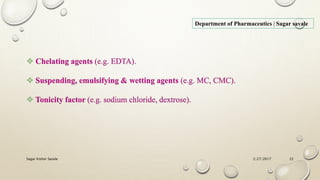
 Chelating agents (e.g. EDTA).
 Suspending, emulsifying & wetting agents (e.g. MC, CMC).
 Tonicity factor (e.g. sodium chloride, dextrose).
2/27/2017Sagar Kishor Savale 23
Department of Pharmaceutics | Sagar savale
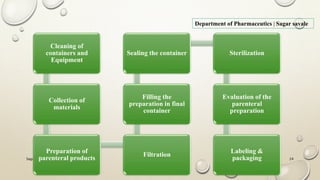
Processing of parenteral preparation
2/27/2017Sagar Kishor Savale 24
Department of Pharmaceutics | Sagar savale
Cleaning of
containers and
Equipment
Collection of
materials
Preparation of
parenteral products
Filtration
Filling the
preparation in final
container
Sealing the container Sterilization
Evaluation of the
parenteral
preparation
Labeling &
packaging
2/27/2017Sagar Kishor Savale 25
Department of Pharmaceutics | Sagar savale
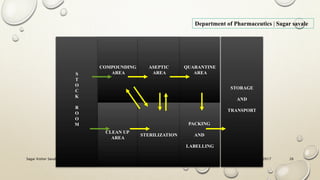
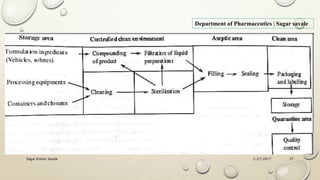
Lay out of Parenteral Manufacturing Area
2/27/2017Sagar Kishor Savale 26
Department of Pharmaceutics | Sagar savale
S
T
O
C
K
R
O
O
M
COMPOUNDING
AREA
CLEAN UP
AREA
ASEPTIC
AREA
QUARANTINE
AREA
STERILIZATION
STORAGE
AND
TRANSPORT
PACKING
AND
LABELLING
2/27/2017Sagar Kishor Savale 27
Department of Pharmaceutics | Sagar savale
2/27/2017Sagar Kishor Savale 28
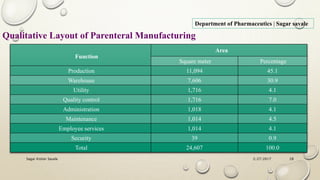
Qualitative Layout of Parenteral Manufacturing
Department of Pharmaceutics | Sagar savale
Function
Area
Square meter Percentage
Production 11,094 45.1
Warehouse 7,606 30.9
Utility 1,716 4.1
Quality control 1,716 7.0
Administration 1,018 4.1
Maintenance 1,014 4.5
Employee services 1,014 4.1
Security 39 0.9
Total 24,607 100.0
2/27/2017Sagar Kishor Savale 29
Department of Pharmaceutics | Sagar savale
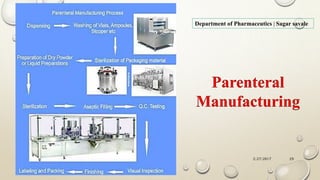
Parenteral
Manufacturing
2/27/2017Sagar Kishor Savale 30
Department of Pharmaceutics | Sagar savale
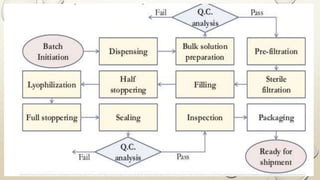
Manufacturing of Parenteral product
(Lyophilized)
2/27/2017Sagar Kishor Savale 31
2/27/2017Sagar Kishor Savale 32
Department of Pharmaceutics | Sagar savale
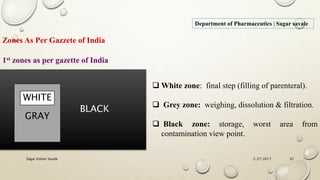
Zones As Per Gazzete of India
1st zones as per gazette of India
BLACK
GRAY
WHITE
 White zone: final step (filling of parenteral).
 Grey zone: weighing, dissolution & filtration.
 Black zone: storage, worst area from
contamination view point.
2/27/2017Sagar Kishor Savale 33
Department of Pharmaceutics | Sagar savale
Environmental Control Zone Grouping
2/27/2017Sagar Kishor Savale 34
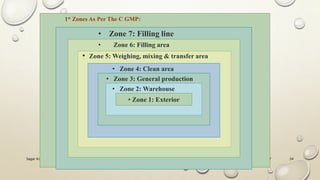
1st Zones As Per The C GMP:
• Zone 1: Exterior
• Zone 7: Filling line
• Zone 6: Filling area
• Zone 5: Weighing, mixing & transfer area
• Zone 4: Clean area
• Zone 3: General production
• Zone 2: Warehouse
2/27/2017Sagar Kishor Savale 35
Air Handling System (Central Air-Conditioning)
Department of Pharmaceutics | Sagar savale
2/27/2017Sagar Kishor Savale 36
Department of Pharmaceutics | Sagar savale
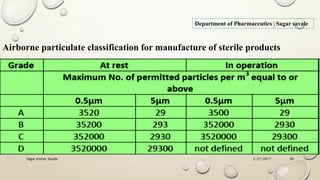
Airborne particulate classification for manufacture of sterile products
2/27/2017Sagar Kishor Savale 37
Department of Pharmaceutics | Sagar savale
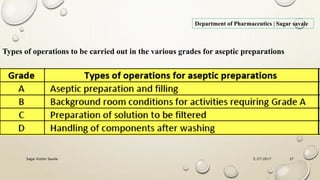
Types of operations to be carried out in the various grades for aseptic preparations
2/27/2017Sagar Kishor Savale 38
Department of Pharmaceutics | Sagar savale
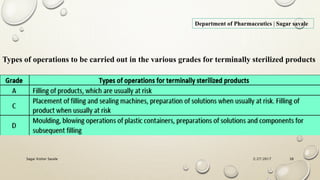
Types of operations to be carried out in the various grades for terminally sterilized products
2/27/2017Sagar Kishor Savale 39
Department of Pharmaceutics | Sagar savale
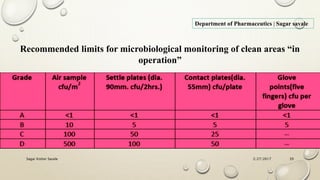
Recommended limits for microbiological monitoring of clean areas “in
operation”
2/27/2017Sagar Kishor Savale 40
Department of Pharmaceutics | Sagar savale
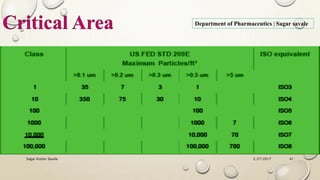
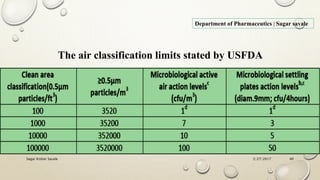
The air classification limits stated by USFDA
2/27/2017Sagar Kishor Savale 41
Department of Pharmaceutics | Sagar savale
Critical Area
2/27/2017Sagar Kishor Savale 42
Department of Pharmaceutics | Sagar savale
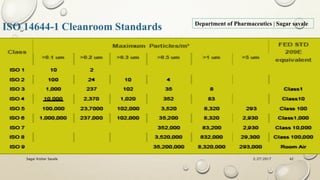
ISO 14644-1 Cleanroom Standards
2/27/2017Sagar Kishor Savale 43
Department of Pharmaceutics | Sagar savale
2/27/2017Sagar Kishor Savale 44
Department of Pharmaceutics | Sagar savale
2/27/2017Sagar Kishor Savale 45
Department of Pharmaceutics | Sagar savale
• Biological indicators (BIs) are the most accepted means of monitoring the sterilization process
because they directly determine whether the most resistant microorganisms (e.g., Geobacillus
or Bacillus species) are present rather than merely determine whether the physical and
chemical conditions necessary for sterilization are met.
• Because spores used in BIs are more resistant and present in greater numbers than are the
common microbial contaminants found on patient care equipment, an inactivated BI indicates
that other potential pathogens in the load have also been killed.
Biological indicators (BIs)
2/27/2017Sagar Kishor Savale 46
Department of Pharmaceutics | Sagar savale
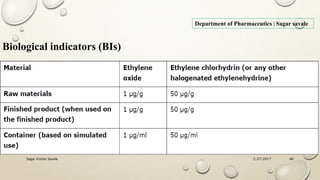
Biological indicators (BIs)
2/27/2017Sagar Kishor Savale 47
Department of Pharmaceutics | Sagar savale
• Biological indicators (BIs) are used for determination of Bacillus
species.
• BIs such as, ethylene oxide, ethylene chlorohydrin, ethylene hydroxide
and halogenated ethylenehydrine.
• BIs was determined by Z value and D Value.
2/27/2017Sagar Kishor Savale 48
Department of Pharmaceutics | Sagar savale
Z value and D Value
 Z value is define as Temperature is required to higher death rate.
 D value is define as reduction of microbial population by 90 % of the factor 10.
 D value is 10 factor greater than Z value.
 e.g. D value is 121 ºc as the Z value is 10 ºc.
2/27/2017Sagar Kishor Savale 49
Department of Pharmaceutics | Sagar savale
Sterile area: the area which are used to kill the all microorganisms.
Techniques
• Celerity study
• Sterility study
• Leakage study
• Pyrogen study
• LAL test
• Assay for content uniformity study
2/27/2017Sagar Kishor Savale 50
Department of Pharmaceutics | Sagar savale
Aseptic area: the area which are used to kill the pathogenic microorganisms.
Techniques:
• HEPA filter integrity test
• Air flow pattern
• Air velocity study
• Heat sensitization study
• Heat distribution study
2/27/2017Sagar Kishor Savale 51
Department of Pharmaceutics | Sagar savale
Quality Control of Parenteral Preparations
2/27/2017Sagar Kishor Savale 52
Department of Pharmaceutics | Sagar savale
 Quality Assurance The planned and systematic activities implemented in a quality system so
that quality requirements for a product or service will be fulfilled.
 Quality Control is a procedure or set of procedures intended to ensure that a manufactured
product or performed service adheres to a defined set of quality criteria or meets the
requirements of the client or customer.
2/27/2017Sagar Kishor Savale 53
Department of Pharmaceutics | Sagar savale
In Process Quality Control Test
 Conductivity measurement
 Volume filled
 Temperature for heat sterilized product
 Environmental control tests
 Visual inspection
2/27/2017Sagar Kishor Savale 54
Department of Pharmaceutics | Sagar savale
Environmental Control
 Traffic control
 Surface disinfection personnel
 Air control (HEPA filters)
2/27/2017Sagar Kishor Savale 55
Department of Pharmaceutics | Sagar savale
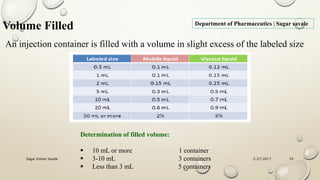
Volume Filled
An injection container is filled with a volume in slight excess of the labeled size
Determination of filled volume:
 10 mL or more 1 container
 3-10 mL 3 containers
 Less than 3 mL 5 containers
2/27/2017Sagar Kishor Savale 56
Department of Pharmaceutics | Sagar savale
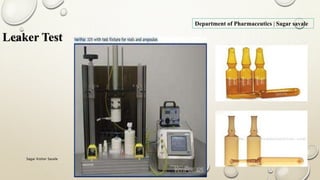
Leakage Test
 visual inspection
 bubble test
 dye tests
 vacuum ionization test
2/27/2017Sagar Kishor Savale 57
Department of Pharmaceutics | Sagar savale
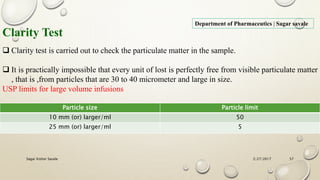
Clarity Test
 Clarity test is carried out to check the particulate matter in the sample.
 It is practically impossible that every unit of lost is perfectly free from visible particulate matter
, that is ,from particles that are 30 to 40 micrometer and large in size.
USP limits for large volume infusions
Particle size Particle limit
10 mm (or) larger/ml 50
25 mm (or) larger/ml 5
2/27/2017Sagar Kishor Savale 58
Department of Pharmaceutics | Sagar savale
Instrumental Methods
This is also called as the particle count method particle counting may be based on
any one of the following principles; change in
Electrical resistance
Light absorption
Light scattering
2/27/2017Sagar Kishor Savale 59
Leaker Test
Department of Pharmaceutics | Sagar savale
2/27/2017Sagar Kishor Savale 60
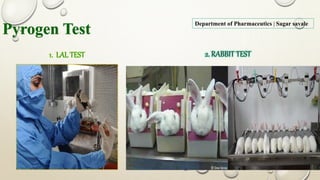
Pyrogen Test
Department of Pharmaceutics | Sagar savale
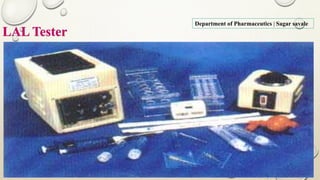
1. LAL TEST 2. RABBIT TEST
2/27/2017Sagar Kishor Savale 61
Department of Pharmaceutics | Sagar savale
LAL Tester
2/27/2017Sagar Kishor Savale 62
Department of Pharmaceutics | Sagar savale
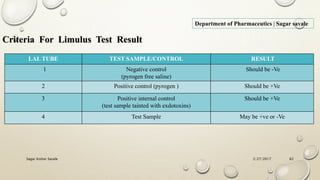
Criteria For Limulus Test Result
LAL TUBE TEST SAMPLE/CONTROL RESULT
1 Negative control
(pyrogen free saline)
Should be -Ve
2 Positive control (pyrogen ) Should be +Ve
3 Positive internal control
(test sample tainted with exdotoxins)
Should be +Ve
4 Test Sample May be +ve or -Ve
2/27/2017Sagar Kishor Savale 63
Department of Pharmaceutics | Sagar savale
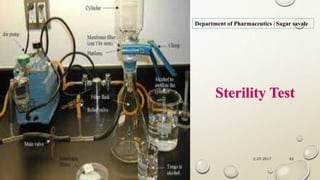
Sterility Test
2/27/2017Sagar Kishor Savale 64
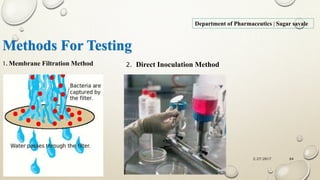
Methods For Testing
Department of Pharmaceutics | Sagar savale
1. Membrane Filtration Method 2. Direct Inoculation Method
2/27/2017Sagar Kishor Savale 65
Department of Pharmaceutics | Sagar savale
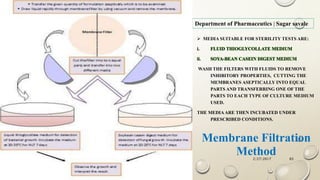
 MEDIA SUITABLE FOR STERILITY TESTS ARE:
i. FLUID THIOGLYCOLLATE MEDIUM
ii. SOYA-BEAN CASEIN DIGEST MEDIUM
WASH THE FILTERS WITH FLUIDS TO REMOVE
INHIBITORY PROPERTIES, CUTTING THE
MEMBRANES ASEPTICALLY INTO EQUAL
PARTS AND TRANSFERRING ONE OF THE
PARTS TO EACH TYPE OF CULTURE MEDIUM
USED.
THE MEDIAARE THEN INCUBATED UNDER
PRESCRIBED CONDITIONS.
Membrane Filtration
Method
2/27/2017Sagar Kishor Savale 66
Department of Pharmaceutics | Sagar savale
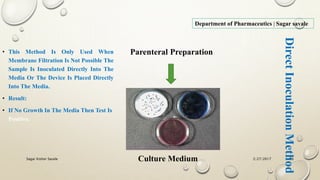
Parenteral Preparation
Culture Medium
• This Method Is Only Used When
Membrane Filtration Is Not Possible The
Sample Is Inoculated Directly Into The
Media Or The Device Is Placed Directly
Into The Media.
• Result:
• If No Growth In The Media Then Test Is
Positive.
DirectInoculationMethod
2/27/2017Sagar Kishor Savale 67
Department of Pharmaceutics | Sagar savale
Lyophilization or freeze drying
o Lyophilization or freeze drying is a process in which water is removed from a product after it is
frozen and placed under a vacuum, allowing the ice to change directly from solid to vapor
without passing through a liquid phase.
o The process consists of three separate, unique, and interdependent processes;
Freezing,
Primary drying (sublimation), and
Secondary drying (desorption).
2/27/2017Sagar Kishor Savale 68
Department of Pharmaceutics | Sagar savale
The advantages of Lyophilization
 Ease of processing a liquid, which simplifies aseptic handling.
 Enhanced stability of a dry powder.
 Removal of water without excessive heating of the product.
 Enhanced product stability in a dry state.
 Rapid and easy dissolution of reconstituted product.
2/27/2017Sagar Kishor Savale 69
Department of Pharmaceutics | Sagar savale
Disadvantages of Lyophilization
 Increased handling and processing time.
 Need for sterile diluent upon reconstitution.
 Cost and complexity of equipment.
2/27/2017Sagar Kishor Savale 70
Department of Pharmaceutics | Sagar savale
The Lyophilization process generally includes the following steps
 Dissolving the drug and excipients in a suitable solvent, generally water for injection (WFI).
 Sterilizing the bulk solution by passing it through a 0.22 micron bacteria-retentive filter.
 Filling into individual sterile containers and partially stoppering the containers under aseptic
conditions.
 Transporting the partially stoppered containers to the lyophilizer and loading into the chamber
under aseptic conditions.
2/27/2017Sagar Kishor Savale 71
Department of Pharmaceutics | Sagar savale
 Freezing the solution by placing the partially stoppered containers on cooled shelves in a
freeze-drying chamber or pre-freezing in another chamber.
 Applying a vacuum to the chamber and heating the shelves in order to evaporate the water
from the frozen state.
 Complete stoppering of the vials usually by hydraulic or screw rod stoppering mechanisms
installed in the lyophilizers.
2/27/2017Sagar Kishor Savale 72
Department of Pharmaceutics | Sagar savale
 There are many new parenteral products, including anti-infectives, biotechnology derived
products, and in-vitro diagnostics which are manufactured as lyophilized products.
 Additionally, inspections have disclosed potency, sterility and stability problems associated
with the manufacture and control of lyophilized products.
2/27/2017Sagar Kishor Savale 73
Department of Pharmaceutics | Sagar savale

Parenteral production

  • 1.
    Parenteral Production Department ofPharmaceutics | Sagar savale Mr. Sagar Kishor Savale [Department of Pharmaceutics] Mobile No. +91 9960885333 Email: avengersagar16@gmail.com 2/27/2017Sagar Kishor Savale 1
  • 2.
    Department of Pharmaceutics| Sagar savale Parenteral Route  It is an route of administration other than the oral route, this route of administration bypasses the alimentary canal.  It includes, I.V., I. M., Subcutaneous route for parenteral administration. 2/27/2017Sagar Kishor Savale 2
  • 3.
    Advantages  Quick onsetof action and site specific or targeted activity.  It can prevent problem of first pass metabolism or presystolic metabolism.  Useful for unconscious or vomiting or diarrhea patients.  Duration of action can be prolonged by modifying formulation.  Suitable for the drugs which are inactivated in GIT or HCl (GI fluid). Department of Pharmaceutics | Sagar savale 2/27/2017Sagar Kishor Savale 3
  • 4.
    Department of Pharmaceutics| Sagar savale Dis-Advantages  Injections may cause pain at the site of injection.  Only trained person is required.  If given by wrong route, difficult to control adverse effect.  Difficult to save patient if overdose. 2/27/2017Sagar Kishor Savale 4
  • 5.
    Types of Parenteral Departmentof Pharmaceutics | Sagar savale Based on types of packaging • Single dose units: ampoules, infusions and prefilled disposable syringes. • Multiple dose units: multiple dose vials. 2/27/2017Sagar Kishor Savale 5
  • 6.
    Based on theproduction and control • Small volume parenterals: volume < 100 ml, single used, no preservative. • Large volume parenterals: volume ≥ 100 ml, multiple used, add preservatives. Department of Pharmaceutics | Sagar savale 2/27/2017Sagar Kishor Savale 6
  • 7.
    2/27/2017Sagar Kishor Savale7 Based on clinical use • Solutions for irrigation • Ophthalmic solution • Dialysis solution • Diagnostic agent • Allergenic extracts • Implants Department of Pharmaceutics | Sagar savale
  • 8.
    2/27/2017Sagar Kishor Savale8 Department of Pharmaceutics | Sagar savale Based on physical state of product • Sterile solutions • Sterile suspensions • Sterile emulsions • Sterile solids
  • 9.
    2/27/2017Sagar Kishor Savale9 Department of Pharmaceutics | Sagar savale Route of Administration
  • 10.
    2/27/2017Sagar Kishor Savale10 Department of Pharmaceutics | Sagar savale Subcutaneous (Hypodermis) injection: Below the skin. Intramuscular injection: Inside the large muscles. Intravenous injection: inside the veins to blood stream.
  • 11.
    2/27/2017Sagar Kishor Savale11 Intra-arterial injection: Inside the arteries. Intracardiac injection: Inside the Harte veins or cardiac veins. Intrathecal injection: Inside the spinal cord. Department of Pharmaceutics | Sagar savale
  • 12.
    2/27/2017Sagar Kishor Savale12 Intracisternal injection: Inside the one or two cervical nerve. Intra-articular injection: Inside the articular ends of joints and bones. Intracerebral injection: Inside the cerebrum. Department of Pharmaceutics | Sagar savale
  • 13.
    2/27/2017Sagar Kishor Savale13 Department of Pharmaceutics | Sagar savale Official Types of Injections Injection: e.g. Insulin Injection USP. For Injection: e.g. Cefuroxime Injection USP. Injectable Emulsions: e.g. Propofol USP.
  • 14.
    2/27/2017Sagar Kishor Savale14 Injectable Suspension: e.g. Methyl Prednisolone Acetate Suspension USP. For Injectable Suspension: e.g. Imipenem and Cilastatin Injectable Suspension USP. Department of Pharmaceutics | Sagar savale
  • 15.
    2/27/2017Sagar Kishor Savale15 Department of Pharmaceutics | Sagar savale Requirements of Parenteral Preparations  Stability  Sterility  Free from Pyrogens and Free from foreign particles
  • 16.
    2/27/2017Sagar Kishor Savale16  Isotonicity  Specific gravity  Chemical purity Department of Pharmaceutics | Sagar savale
  • 17.
    2/27/2017Sagar Kishor Savale17 Department of Pharmaceutics | Sagar savale Preformulation Factors  pH /pka  Solubility  Thermal/heat effect  Dissociation constant  Compatibility studies: FTIR / DSC / TLC/ HPLC  Oxidation & reduction  particle size
  • 18.
    2/27/2017Sagar Kishor Savale18 Department of Pharmaceutics | Sagar savale Formulation of Parenteral Products 1.The active drug 2.Vehicles • Aqueous vehicle (e.g. water for injection, water for injection free from CO2 ). • Non-aqueous vehicle (e.g. Ethyl alcohol, propylene glycol, almond oil).
  • 19.
    2/27/2017Sagar Kishor Savale19 Department of Pharmaceutics | Sagar savale Water for injection • Not sterilized and pyrogen free • It is intended to be used within 24 hours after collection • Total solid contents not more than 1 mg/100 ml Sterile water for injection • It must be pyrogen free • endotoxin level is not more than 0.25 USP • single dose containers not larger than 1 liter Bacteriostatic water for injection • One or more suitable antimicrobial agents • It is packaged in prefilled syringes or in vials • Not more than 30 ml of the water • Bacteriostatic agents such as benzyl alcohol may cause gasping syndrome (multiorgan failure)).
  • 20.
    2/27/2017Sagar Kishor Savale20 Department of Pharmaceutics | Sagar savaleChloride Test Calcium Test Heavy Metal Test Sulphate Test Ammonia test
  • 21.
    2/27/2017Sagar Kishor Savale21 Department of Pharmaceutics | Sagar savale 3.Adjuvants  Solubilizing agents (e.g. Tweens & polysorbates).  Stabilizers & antioxidants (e.g. thiourea, ascorbic acid, tocopherol).  Buffering agents (e.g. citric acid, sodium citrate).  Antibacterial agents (e.g. benzyl alcohol, metacresol, phenol).
  • 22.
    2/27/2017Sagar Kishor Savale22 Department of Pharmaceutics | Sagar savale  Chelating agents (e.g. EDTA).  Suspending, emulsifying & wetting agents (e.g. MC, CMC).  Tonicity factor (e.g. sodium chloride, dextrose).
  • 23.
    2/27/2017Sagar Kishor Savale23 Department of Pharmaceutics | Sagar savale Processing of parenteral preparation
  • 24.
    2/27/2017Sagar Kishor Savale24 Department of Pharmaceutics | Sagar savale Cleaning of containers and Equipment Collection of materials Preparation of parenteral products Filtration Filling the preparation in final container Sealing the container Sterilization Evaluation of the parenteral preparation Labeling & packaging
  • 25.
    2/27/2017Sagar Kishor Savale25 Department of Pharmaceutics | Sagar savale Lay out of Parenteral Manufacturing Area
  • 26.
    2/27/2017Sagar Kishor Savale26 Department of Pharmaceutics | Sagar savale S T O C K R O O M COMPOUNDING AREA CLEAN UP AREA ASEPTIC AREA QUARANTINE AREA STERILIZATION STORAGE AND TRANSPORT PACKING AND LABELLING
  • 27.
    2/27/2017Sagar Kishor Savale27 Department of Pharmaceutics | Sagar savale
  • 28.
    2/27/2017Sagar Kishor Savale28 Qualitative Layout of Parenteral Manufacturing Department of Pharmaceutics | Sagar savale Function Area Square meter Percentage Production 11,094 45.1 Warehouse 7,606 30.9 Utility 1,716 4.1 Quality control 1,716 7.0 Administration 1,018 4.1 Maintenance 1,014 4.5 Employee services 1,014 4.1 Security 39 0.9 Total 24,607 100.0
  • 29.
    2/27/2017Sagar Kishor Savale29 Department of Pharmaceutics | Sagar savale Parenteral Manufacturing
  • 30.
    2/27/2017Sagar Kishor Savale30 Department of Pharmaceutics | Sagar savale Manufacturing of Parenteral product (Lyophilized)
  • 31.
  • 32.
    2/27/2017Sagar Kishor Savale32 Department of Pharmaceutics | Sagar savale Zones As Per Gazzete of India 1st zones as per gazette of India BLACK GRAY WHITE  White zone: final step (filling of parenteral).  Grey zone: weighing, dissolution & filtration.  Black zone: storage, worst area from contamination view point.
  • 33.
    2/27/2017Sagar Kishor Savale33 Department of Pharmaceutics | Sagar savale Environmental Control Zone Grouping
  • 34.
    2/27/2017Sagar Kishor Savale34 1st Zones As Per The C GMP: • Zone 1: Exterior • Zone 7: Filling line • Zone 6: Filling area • Zone 5: Weighing, mixing & transfer area • Zone 4: Clean area • Zone 3: General production • Zone 2: Warehouse
  • 35.
    2/27/2017Sagar Kishor Savale35 Air Handling System (Central Air-Conditioning) Department of Pharmaceutics | Sagar savale
  • 36.
    2/27/2017Sagar Kishor Savale36 Department of Pharmaceutics | Sagar savale Airborne particulate classification for manufacture of sterile products
  • 37.
    2/27/2017Sagar Kishor Savale37 Department of Pharmaceutics | Sagar savale Types of operations to be carried out in the various grades for aseptic preparations
  • 38.
    2/27/2017Sagar Kishor Savale38 Department of Pharmaceutics | Sagar savale Types of operations to be carried out in the various grades for terminally sterilized products
  • 39.
    2/27/2017Sagar Kishor Savale39 Department of Pharmaceutics | Sagar savale Recommended limits for microbiological monitoring of clean areas “in operation”
  • 40.
    2/27/2017Sagar Kishor Savale40 Department of Pharmaceutics | Sagar savale The air classification limits stated by USFDA
  • 41.
    2/27/2017Sagar Kishor Savale41 Department of Pharmaceutics | Sagar savale Critical Area
  • 42.
    2/27/2017Sagar Kishor Savale42 Department of Pharmaceutics | Sagar savale ISO 14644-1 Cleanroom Standards
  • 43.
    2/27/2017Sagar Kishor Savale43 Department of Pharmaceutics | Sagar savale
  • 44.
    2/27/2017Sagar Kishor Savale44 Department of Pharmaceutics | Sagar savale
  • 45.
    2/27/2017Sagar Kishor Savale45 Department of Pharmaceutics | Sagar savale • Biological indicators (BIs) are the most accepted means of monitoring the sterilization process because they directly determine whether the most resistant microorganisms (e.g., Geobacillus or Bacillus species) are present rather than merely determine whether the physical and chemical conditions necessary for sterilization are met. • Because spores used in BIs are more resistant and present in greater numbers than are the common microbial contaminants found on patient care equipment, an inactivated BI indicates that other potential pathogens in the load have also been killed. Biological indicators (BIs)
  • 46.
    2/27/2017Sagar Kishor Savale46 Department of Pharmaceutics | Sagar savale Biological indicators (BIs)
  • 47.
    2/27/2017Sagar Kishor Savale47 Department of Pharmaceutics | Sagar savale • Biological indicators (BIs) are used for determination of Bacillus species. • BIs such as, ethylene oxide, ethylene chlorohydrin, ethylene hydroxide and halogenated ethylenehydrine. • BIs was determined by Z value and D Value.
  • 48.
    2/27/2017Sagar Kishor Savale48 Department of Pharmaceutics | Sagar savale Z value and D Value  Z value is define as Temperature is required to higher death rate.  D value is define as reduction of microbial population by 90 % of the factor 10.  D value is 10 factor greater than Z value.  e.g. D value is 121 ºc as the Z value is 10 ºc.
  • 49.
    2/27/2017Sagar Kishor Savale49 Department of Pharmaceutics | Sagar savale Sterile area: the area which are used to kill the all microorganisms. Techniques • Celerity study • Sterility study • Leakage study • Pyrogen study • LAL test • Assay for content uniformity study
  • 50.
    2/27/2017Sagar Kishor Savale50 Department of Pharmaceutics | Sagar savale Aseptic area: the area which are used to kill the pathogenic microorganisms. Techniques: • HEPA filter integrity test • Air flow pattern • Air velocity study • Heat sensitization study • Heat distribution study
  • 51.
    2/27/2017Sagar Kishor Savale51 Department of Pharmaceutics | Sagar savale Quality Control of Parenteral Preparations
  • 52.
    2/27/2017Sagar Kishor Savale52 Department of Pharmaceutics | Sagar savale  Quality Assurance The planned and systematic activities implemented in a quality system so that quality requirements for a product or service will be fulfilled.  Quality Control is a procedure or set of procedures intended to ensure that a manufactured product or performed service adheres to a defined set of quality criteria or meets the requirements of the client or customer.
  • 53.
    2/27/2017Sagar Kishor Savale53 Department of Pharmaceutics | Sagar savale In Process Quality Control Test  Conductivity measurement  Volume filled  Temperature for heat sterilized product  Environmental control tests  Visual inspection
  • 54.
    2/27/2017Sagar Kishor Savale54 Department of Pharmaceutics | Sagar savale Environmental Control  Traffic control  Surface disinfection personnel  Air control (HEPA filters)
  • 55.
    2/27/2017Sagar Kishor Savale55 Department of Pharmaceutics | Sagar savale Volume Filled An injection container is filled with a volume in slight excess of the labeled size Determination of filled volume:  10 mL or more 1 container  3-10 mL 3 containers  Less than 3 mL 5 containers
  • 56.
    2/27/2017Sagar Kishor Savale56 Department of Pharmaceutics | Sagar savale Leakage Test  visual inspection  bubble test  dye tests  vacuum ionization test
  • 57.
    2/27/2017Sagar Kishor Savale57 Department of Pharmaceutics | Sagar savale Clarity Test  Clarity test is carried out to check the particulate matter in the sample.  It is practically impossible that every unit of lost is perfectly free from visible particulate matter , that is ,from particles that are 30 to 40 micrometer and large in size. USP limits for large volume infusions Particle size Particle limit 10 mm (or) larger/ml 50 25 mm (or) larger/ml 5
  • 58.
    2/27/2017Sagar Kishor Savale58 Department of Pharmaceutics | Sagar savale Instrumental Methods This is also called as the particle count method particle counting may be based on any one of the following principles; change in Electrical resistance Light absorption Light scattering
  • 59.
    2/27/2017Sagar Kishor Savale59 Leaker Test Department of Pharmaceutics | Sagar savale
  • 60.
    2/27/2017Sagar Kishor Savale60 Pyrogen Test Department of Pharmaceutics | Sagar savale 1. LAL TEST 2. RABBIT TEST
  • 61.
    2/27/2017Sagar Kishor Savale61 Department of Pharmaceutics | Sagar savale LAL Tester
  • 62.
    2/27/2017Sagar Kishor Savale62 Department of Pharmaceutics | Sagar savale Criteria For Limulus Test Result LAL TUBE TEST SAMPLE/CONTROL RESULT 1 Negative control (pyrogen free saline) Should be -Ve 2 Positive control (pyrogen ) Should be +Ve 3 Positive internal control (test sample tainted with exdotoxins) Should be +Ve 4 Test Sample May be +ve or -Ve
  • 63.
    2/27/2017Sagar Kishor Savale63 Department of Pharmaceutics | Sagar savale Sterility Test
  • 64.
    2/27/2017Sagar Kishor Savale64 Methods For Testing Department of Pharmaceutics | Sagar savale 1. Membrane Filtration Method 2. Direct Inoculation Method
  • 65.
    2/27/2017Sagar Kishor Savale65 Department of Pharmaceutics | Sagar savale  MEDIA SUITABLE FOR STERILITY TESTS ARE: i. FLUID THIOGLYCOLLATE MEDIUM ii. SOYA-BEAN CASEIN DIGEST MEDIUM WASH THE FILTERS WITH FLUIDS TO REMOVE INHIBITORY PROPERTIES, CUTTING THE MEMBRANES ASEPTICALLY INTO EQUAL PARTS AND TRANSFERRING ONE OF THE PARTS TO EACH TYPE OF CULTURE MEDIUM USED. THE MEDIAARE THEN INCUBATED UNDER PRESCRIBED CONDITIONS. Membrane Filtration Method
  • 66.
    2/27/2017Sagar Kishor Savale66 Department of Pharmaceutics | Sagar savale Parenteral Preparation Culture Medium • This Method Is Only Used When Membrane Filtration Is Not Possible The Sample Is Inoculated Directly Into The Media Or The Device Is Placed Directly Into The Media. • Result: • If No Growth In The Media Then Test Is Positive. DirectInoculationMethod
  • 67.
    2/27/2017Sagar Kishor Savale67 Department of Pharmaceutics | Sagar savale Lyophilization or freeze drying o Lyophilization or freeze drying is a process in which water is removed from a product after it is frozen and placed under a vacuum, allowing the ice to change directly from solid to vapor without passing through a liquid phase. o The process consists of three separate, unique, and interdependent processes; Freezing, Primary drying (sublimation), and Secondary drying (desorption).
  • 68.
    2/27/2017Sagar Kishor Savale68 Department of Pharmaceutics | Sagar savale The advantages of Lyophilization  Ease of processing a liquid, which simplifies aseptic handling.  Enhanced stability of a dry powder.  Removal of water without excessive heating of the product.  Enhanced product stability in a dry state.  Rapid and easy dissolution of reconstituted product.
  • 69.
    2/27/2017Sagar Kishor Savale69 Department of Pharmaceutics | Sagar savale Disadvantages of Lyophilization  Increased handling and processing time.  Need for sterile diluent upon reconstitution.  Cost and complexity of equipment.
  • 70.
    2/27/2017Sagar Kishor Savale70 Department of Pharmaceutics | Sagar savale The Lyophilization process generally includes the following steps  Dissolving the drug and excipients in a suitable solvent, generally water for injection (WFI).  Sterilizing the bulk solution by passing it through a 0.22 micron bacteria-retentive filter.  Filling into individual sterile containers and partially stoppering the containers under aseptic conditions.  Transporting the partially stoppered containers to the lyophilizer and loading into the chamber under aseptic conditions.
  • 71.
    2/27/2017Sagar Kishor Savale71 Department of Pharmaceutics | Sagar savale  Freezing the solution by placing the partially stoppered containers on cooled shelves in a freeze-drying chamber or pre-freezing in another chamber.  Applying a vacuum to the chamber and heating the shelves in order to evaporate the water from the frozen state.  Complete stoppering of the vials usually by hydraulic or screw rod stoppering mechanisms installed in the lyophilizers.
  • 72.
    2/27/2017Sagar Kishor Savale72 Department of Pharmaceutics | Sagar savale  There are many new parenteral products, including anti-infectives, biotechnology derived products, and in-vitro diagnostics which are manufactured as lyophilized products.  Additionally, inspections have disclosed potency, sterility and stability problems associated with the manufacture and control of lyophilized products.
  • 73.
    2/27/2017Sagar Kishor Savale73 Department of Pharmaceutics | Sagar savale