SIMULATED MOVING BED
CHROMATOGRAPHY- AN ADVANCED
CHROMATOGRAPHY TECHNIQUE
Article written and published at www.worldofchemicals.com
Abstract
 Chromatographic processes play an important role in the
production of bio-pharmaceuticals. Polypeptides, proteins,
enzymes and antibodies are captured, purified and polished by
ion exchange, size exclusion, reverse phase, hydrophobic
interaction or affinity chromatographic processes.
 Their scales range from a few kilograms a year of very potent
compounds tolarge bulk productions of several tons. Only
recently research groups primarily from academics have started
to investigate continuous operating technologies such as
simulated moving bed chromatography (SMB) to increase
productivity of purification processes for bio-pharmaceuticals
 which is based on counter-current moving bed chromatography.
This technology has been used in large scale operations in the
petrochemical and sugar industries for almost half a century.This
article will addresses the fundamentals of simulated moving bed
chromatography technology and its applications.
Introduction
 In the last decade the concept of simulated moving bed (SMB)
chromatography has been successfully applied in several fields, e.g. for
the separation of enantiomers and purification of pharmaceutical
proteins. In order to further increase potential of SMB chromatography,
several increasingly sophisticated modes of operation have been
developed based on applying gradients and on dynamically varying
certain parameters during the separation.
 Examples include new process variantsVariCol, PowerFeed and
ModiCon. Another alternative capable to enhance the process
performance is based on the introduction of an enrichment step
between zones I and II.
 The process was developed in the 1960s for the purification of sugars
from molasses. It was used to pharmaceutical industry for the
purification of enantiomers from racemic mixtures. Its applications have
expanded beyond the sugar and racemic separations to more complex
separations.
Introduction Cont
 SMB chromatography has received attention for chiral separations since early 1990s
and is today, considered as a cost-effective preparative scale purification technology
and common to tool for separating isomers at production scale, and several active
pharmaceutical ingredient (API) and intermediate producers. The design method was
verified with rate model simulations and then tested for enantioseparation of
phenylpropanolamine.
 Both high purity (>99 per cent) and high yield (>99 per cent) were achieved
experimentally using an SMB with a pressure limit of 2.4 MPa. It enables substance
mixtures to be continuously separated and extracted in two fractions. By repeated
use of the SMB process each partial fraction can be separated into a further fraction-
up to binary substance mixtures.Typically, the SMB process is set up in advance for a
two component mixture. Following this, both substances can be immediately
extracted in pure form-up to 1000 kg per year.
 It is a continuous multi-column chromatographic process has become one of the
preferred techniques for the separation of the enantiomers of a chiral compound.
Several active pharmaceutical ingredients, including blockbuster drugs, are
manufactured using the SMB technology. Compared to single column preparative
chromatography, SMB separations achieve higher productivity and purity, while
reducing the solvent consumption. In the last few years, rapid developments have
been made in the areas of design, improved process schemes, optimization and
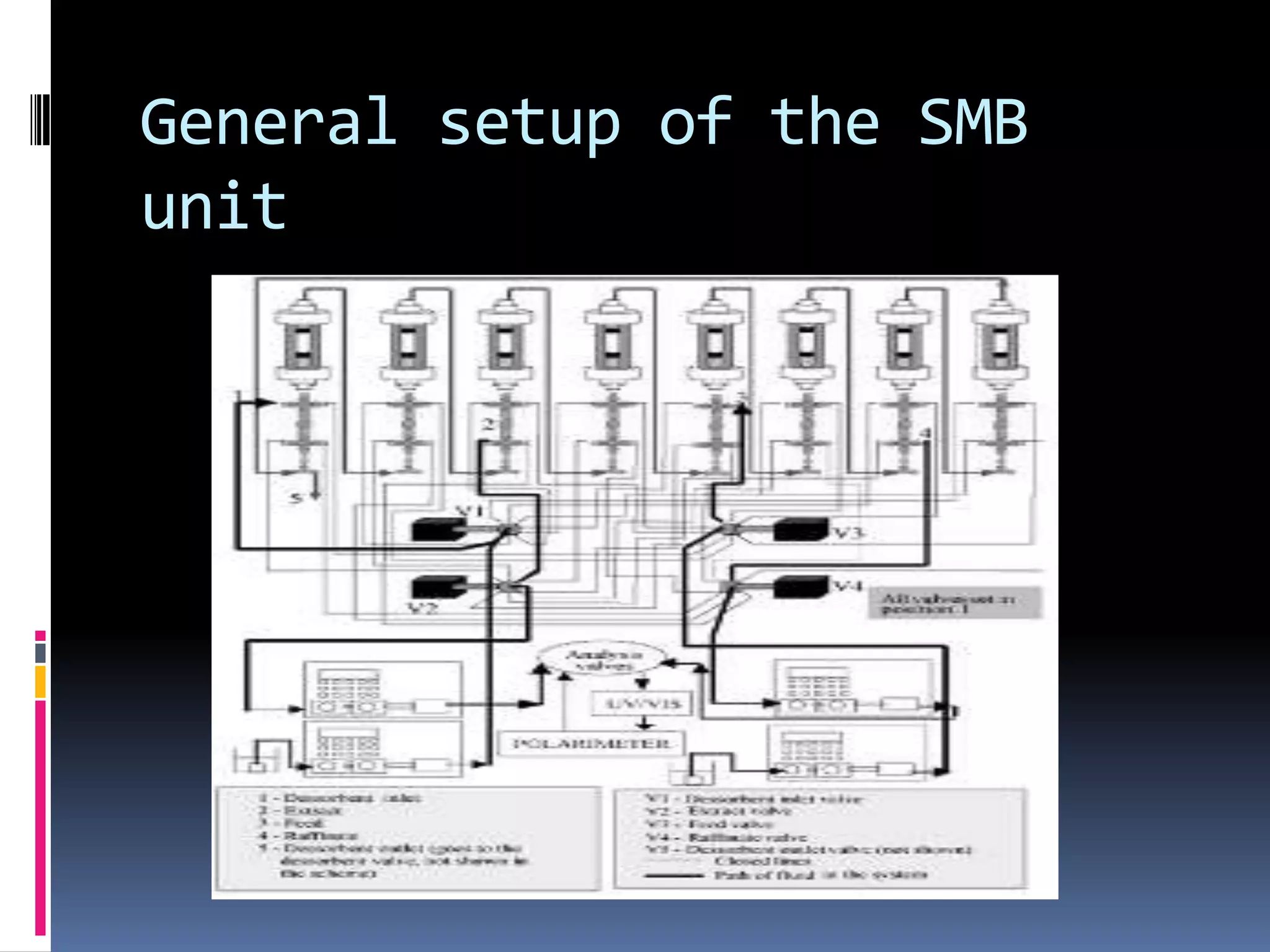
General setup of the SMB
unit
General setup of the SMB
unit cont ..
 imulated Moving Bed Chromatography is a continuous
purification technique that has higher throughput and
requires less solvent than regular batch chromatography. It
is used to separate particles and/or chemical compounds
that would be difficult separation problems in
petrochemical, fine chemical and pharmaceutical
industries.The SMB process employs a series connection of
several chromatographic columns.
 It permits large amounts of mobile phase to be saved and
productivity increased, thus reducing production costs. Its
advantages such as reduction of solvent consumption, high
productivity and final purities as well as low investment
costs in comparison to eluent chromatography. Simulated
Moving Bed Chromatography units can operate under high
productivity overloaded conditions.
Principle and Method
 1. Determine the phase volume ratio or porosity between
the stationary and mobile phase.
 2. Determine the adsorption isotherms for each component
based on the overload chromatogram from each
component of the mixture.
 3. Determine the isotherm parameters using the
isothermFit software.
 4. Arrange the hardware.
 5. Simulation of the process and optimization of the
interpretation using the SMB_Guide simulation software.
 6. Carry out a continuous SMB separation.
 7. Optimize the productivity.
Basic schematic diagram of
SMB
Basic schematic diagram of
SMB Process
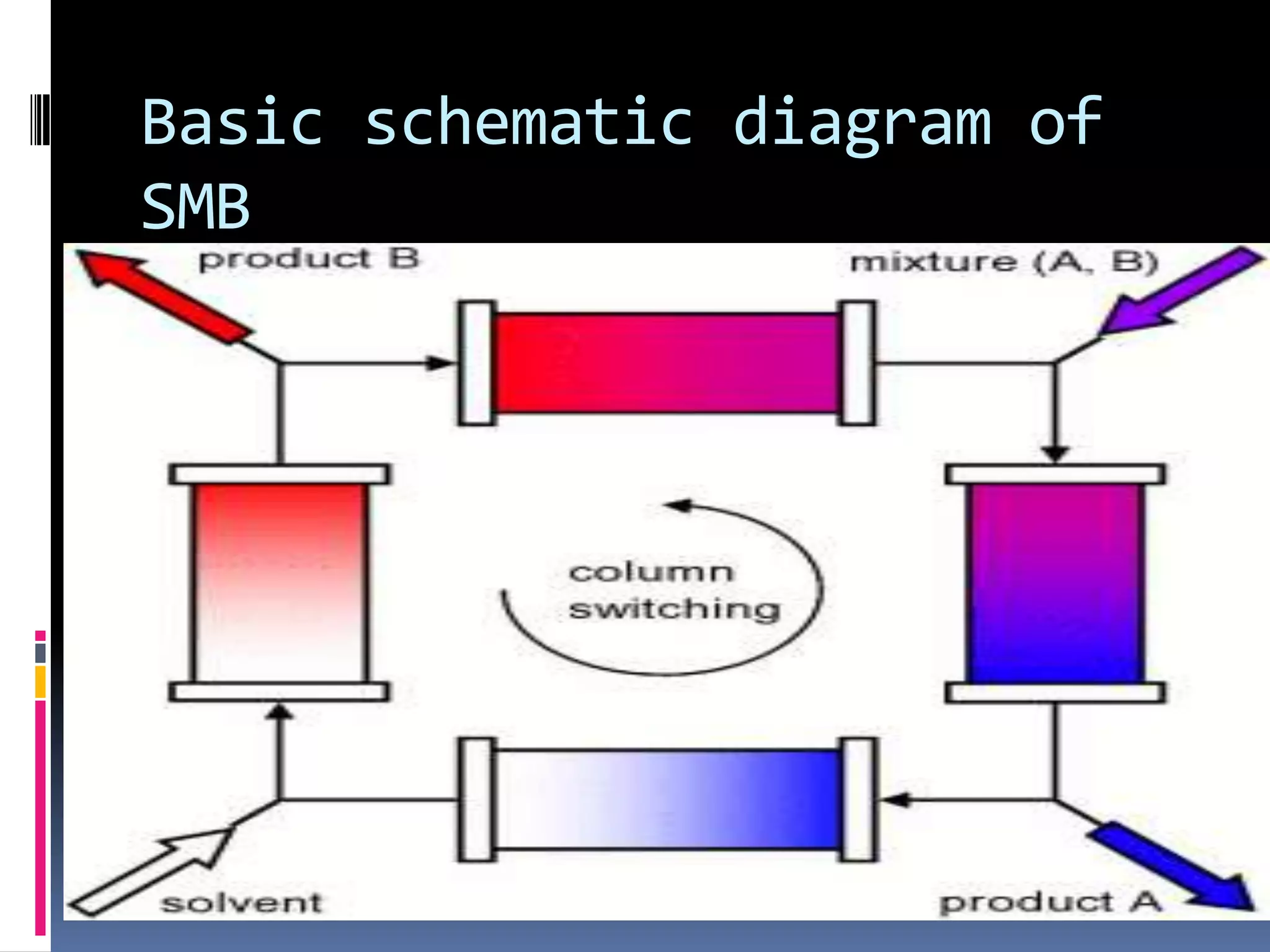
 Simulated Moving Bed Chromatography is a chromatographic
technique based on a flow of liquid (mobile phase) moving
countercurrent to a constant flow of solid (stationary phase).
Countercurrent flow enhances the potential for the separation
and, hence, makes the process more efficient. It also allows a
continuous flow of feed material to be separated, which
improves the throughput of the equipment compared to
traditional batch chromatography.
 Providing a constant flow of solid is impractical in a production
process.Therefore, the solid instead is packed into high pressure
columns.These columns are arranged in a ring formation made
up of four sections with one or more columns per section.Two
inlet streams (feed and eluent) and two outlets streams (extract
and raffinate) are directed in alternating order to and from the
column ring.The inlet and outlet position is switched at regular
time intervals in the direction of the liquid flow, thus simulating
countercurrent movement of columns.
Basic schematic diagram of
SMB Process
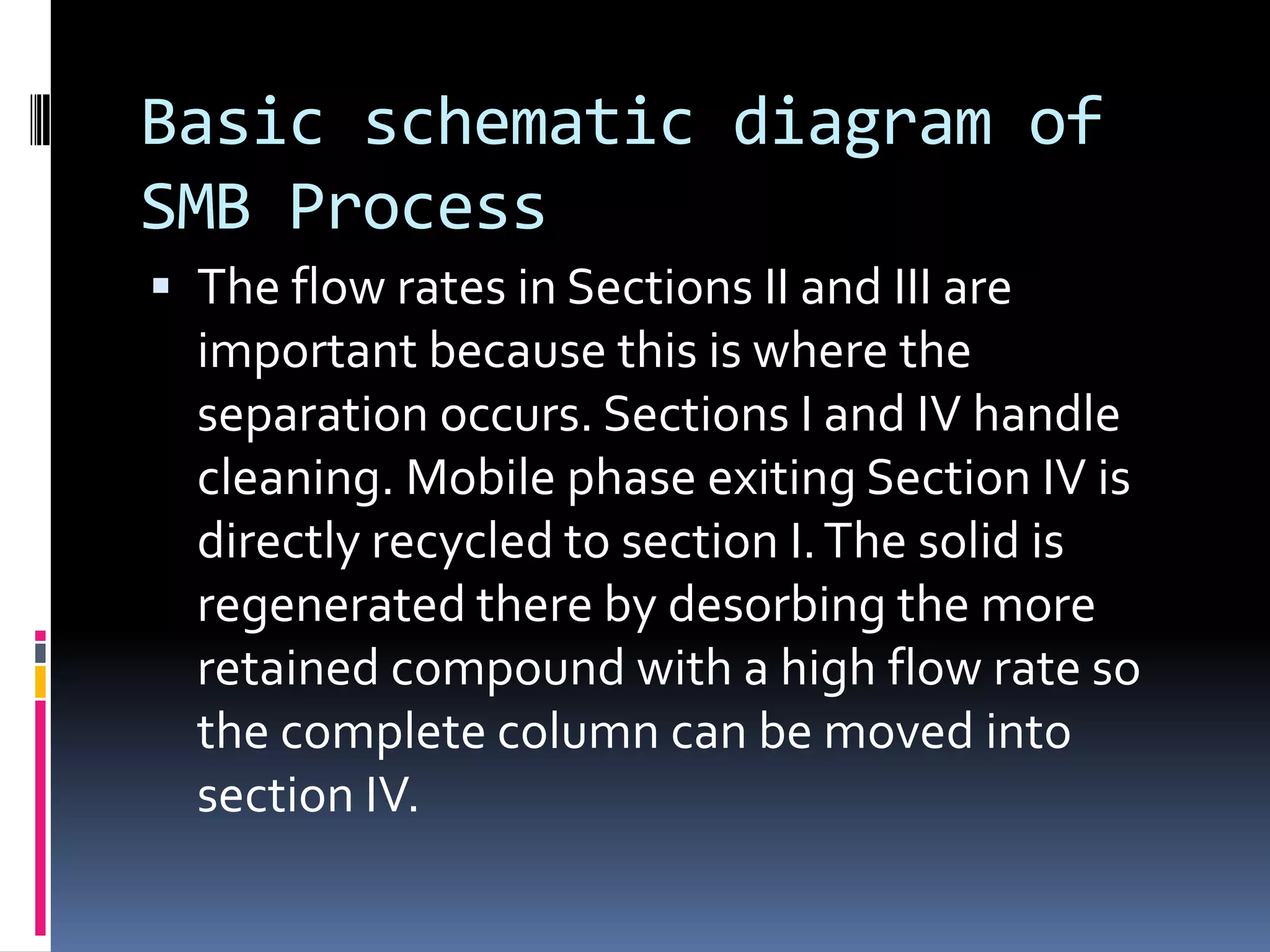
 The flow rates in Sections II and III are
important because this is where the
separation occurs. Sections I and IV handle
cleaning. Mobile phase exiting Section IV is
directly recycled to section I.The solid is
regenerated there by desorbing the more
retained compound with a high flow rate so
the complete column can be moved into
section IV.
Advantages
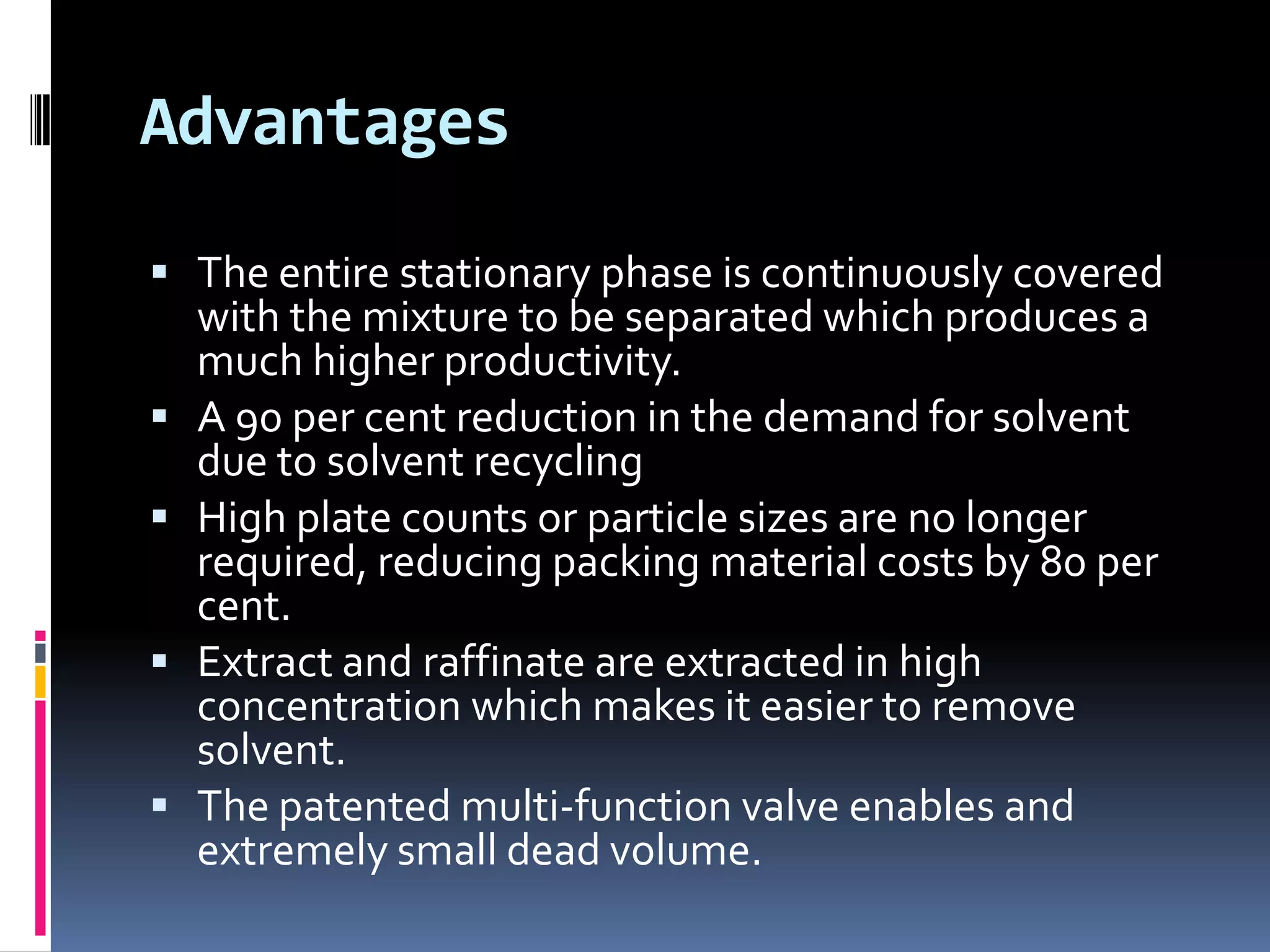
 The entire stationary phase is continuously covered
with the mixture to be separated which produces a
much higher productivity.
 A 90 per cent reduction in the demand for solvent
due to solvent recycling
 High plate counts or particle sizes are no longer
required, reducing packing material costs by 80 per
cent.
 Extract and raffinate are extracted in high
concentration which makes it easier to remove
solvent.
 The patented multi-function valve enables and
extremely small dead volume.
Applications
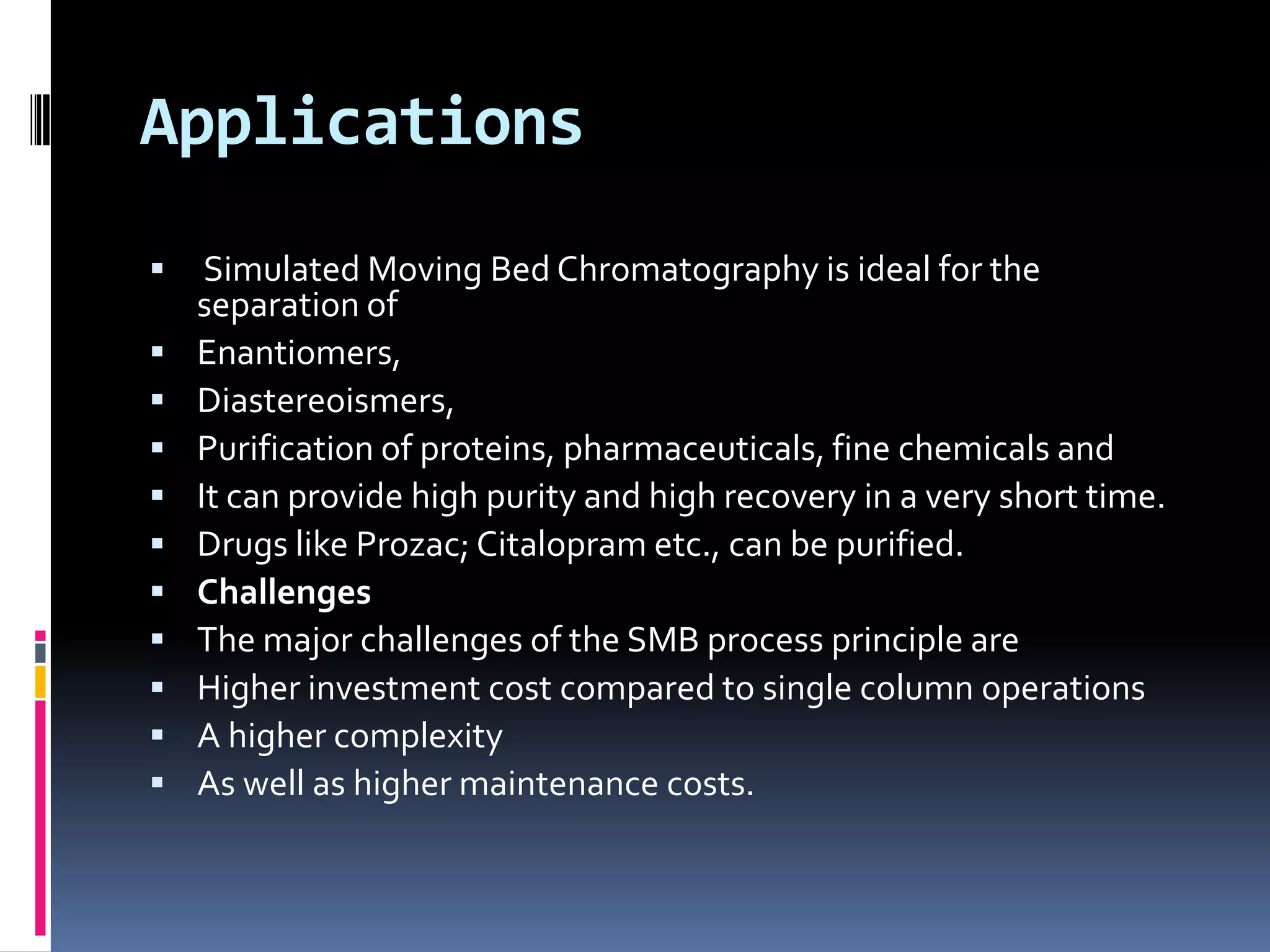
 Simulated Moving Bed Chromatography is ideal for the
separation of
 Enantiomers,
 Diastereoismers,
 Purification of proteins, pharmaceuticals, fine chemicals and
 It can provide high purity and high recovery in a very short time.
 Drugs like Prozac; Citalopram etc., can be purified.
 Challenges
 The major challenges of the SMB process principle are
 Higher investment cost compared to single column operations
 A higher complexity
 As well as higher maintenance costs.
Conclusion
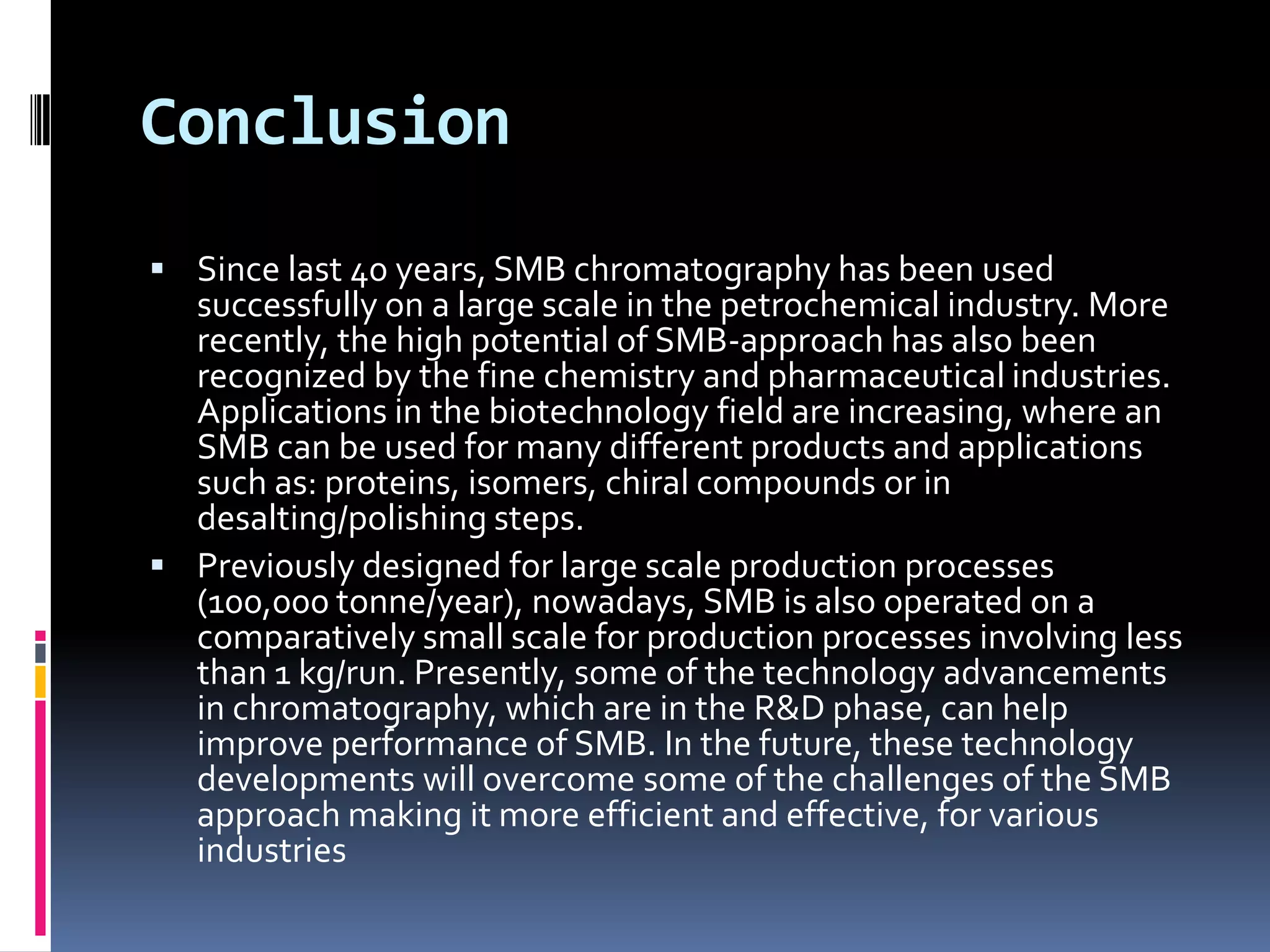
 Since last 40 years, SMB chromatography has been used
successfully on a large scale in the petrochemical industry. More
recently, the high potential of SMB-approach has also been
recognized by the fine chemistry and pharmaceutical industries.
Applications in the biotechnology field are increasing, where an
SMB can be used for many different products and applications
such as: proteins, isomers, chiral compounds or in
desalting/polishing steps.
 Previously designed for large scale production processes
(100,000 tonne/year), nowadays, SMB is also operated on a
comparatively small scale for production processes involving less
than 1 kg/run. Presently, some of the technology advancements
in chromatography, which are in the R&D phase, can help
improve performance of SMB. In the future, these technology
developments will overcome some of the challenges of the SMB
approach making it more efficient and effective, for various
industries
Reference
 [1] Dr. Kathleen Mihlbachler, Ph.D., Eli Lilly and Company, Advances in
Large-Scale Biopharmaceutical Manufacturing and Scale-Up
Production, Available from -
http://www.bioplanassociates.com/asm/Abst21.html
 [2]Yi Xie ,Yoon-Mo Koo,and Nien-Hwa LindaWang, Preparative
Chromatographic Separation: Simulated Moving Bed and Modified
Chromatography Methods, 2001, 6: 363-375, Available from -
http://www.bbe.or.kr/storage/journal/BBE/6_6/6726/articlefile/article.pd
f
 [3]Arvind Rajendranb, Galatea Paredesa, Marco Mazzotti, Simulated
moving bed chromatography for the separation of enantiomers,Volume
1216, Issue 4, 23 January 2009, Pages 709-738, Available from
http://www.sciencedirect.com/science/article/pii/S0021967308018451
 [4] Separations Analytical Instruments
bv website,http://www.separations.nl/docs/SMB%20Knauer%20SMB.pd
f

Industrial Applications Of Chromatography Technique

  • 1.
    SIMULATED MOVING BED CHROMATOGRAPHY-AN ADVANCED CHROMATOGRAPHY TECHNIQUE Article written and published at www.worldofchemicals.com
  • 2.
    Abstract  Chromatographic processesplay an important role in the production of bio-pharmaceuticals. Polypeptides, proteins, enzymes and antibodies are captured, purified and polished by ion exchange, size exclusion, reverse phase, hydrophobic interaction or affinity chromatographic processes.  Their scales range from a few kilograms a year of very potent compounds tolarge bulk productions of several tons. Only recently research groups primarily from academics have started to investigate continuous operating technologies such as simulated moving bed chromatography (SMB) to increase productivity of purification processes for bio-pharmaceuticals  which is based on counter-current moving bed chromatography. This technology has been used in large scale operations in the petrochemical and sugar industries for almost half a century.This article will addresses the fundamentals of simulated moving bed chromatography technology and its applications.
  • 3.
    Introduction  In thelast decade the concept of simulated moving bed (SMB) chromatography has been successfully applied in several fields, e.g. for the separation of enantiomers and purification of pharmaceutical proteins. In order to further increase potential of SMB chromatography, several increasingly sophisticated modes of operation have been developed based on applying gradients and on dynamically varying certain parameters during the separation.  Examples include new process variantsVariCol, PowerFeed and ModiCon. Another alternative capable to enhance the process performance is based on the introduction of an enrichment step between zones I and II.  The process was developed in the 1960s for the purification of sugars from molasses. It was used to pharmaceutical industry for the purification of enantiomers from racemic mixtures. Its applications have expanded beyond the sugar and racemic separations to more complex separations.
  • 4.
    Introduction Cont  SMBchromatography has received attention for chiral separations since early 1990s and is today, considered as a cost-effective preparative scale purification technology and common to tool for separating isomers at production scale, and several active pharmaceutical ingredient (API) and intermediate producers. The design method was verified with rate model simulations and then tested for enantioseparation of phenylpropanolamine.  Both high purity (>99 per cent) and high yield (>99 per cent) were achieved experimentally using an SMB with a pressure limit of 2.4 MPa. It enables substance mixtures to be continuously separated and extracted in two fractions. By repeated use of the SMB process each partial fraction can be separated into a further fraction- up to binary substance mixtures.Typically, the SMB process is set up in advance for a two component mixture. Following this, both substances can be immediately extracted in pure form-up to 1000 kg per year.  It is a continuous multi-column chromatographic process has become one of the preferred techniques for the separation of the enantiomers of a chiral compound. Several active pharmaceutical ingredients, including blockbuster drugs, are manufactured using the SMB technology. Compared to single column preparative chromatography, SMB separations achieve higher productivity and purity, while reducing the solvent consumption. In the last few years, rapid developments have been made in the areas of design, improved process schemes, optimization and
  • 5.
    General setup ofthe SMB unit
  • 6.
    General setup ofthe SMB unit cont ..  imulated Moving Bed Chromatography is a continuous purification technique that has higher throughput and requires less solvent than regular batch chromatography. It is used to separate particles and/or chemical compounds that would be difficult separation problems in petrochemical, fine chemical and pharmaceutical industries.The SMB process employs a series connection of several chromatographic columns.  It permits large amounts of mobile phase to be saved and productivity increased, thus reducing production costs. Its advantages such as reduction of solvent consumption, high productivity and final purities as well as low investment costs in comparison to eluent chromatography. Simulated Moving Bed Chromatography units can operate under high productivity overloaded conditions.
  • 7.
    Principle and Method 1. Determine the phase volume ratio or porosity between the stationary and mobile phase.  2. Determine the adsorption isotherms for each component based on the overload chromatogram from each component of the mixture.  3. Determine the isotherm parameters using the isothermFit software.  4. Arrange the hardware.  5. Simulation of the process and optimization of the interpretation using the SMB_Guide simulation software.  6. Carry out a continuous SMB separation.  7. Optimize the productivity.
  • 8.
  • 9.
    Basic schematic diagramof SMB Process  Simulated Moving Bed Chromatography is a chromatographic technique based on a flow of liquid (mobile phase) moving countercurrent to a constant flow of solid (stationary phase). Countercurrent flow enhances the potential for the separation and, hence, makes the process more efficient. It also allows a continuous flow of feed material to be separated, which improves the throughput of the equipment compared to traditional batch chromatography.  Providing a constant flow of solid is impractical in a production process.Therefore, the solid instead is packed into high pressure columns.These columns are arranged in a ring formation made up of four sections with one or more columns per section.Two inlet streams (feed and eluent) and two outlets streams (extract and raffinate) are directed in alternating order to and from the column ring.The inlet and outlet position is switched at regular time intervals in the direction of the liquid flow, thus simulating countercurrent movement of columns.
  • 10.
    Basic schematic diagramof SMB Process  The flow rates in Sections II and III are important because this is where the separation occurs. Sections I and IV handle cleaning. Mobile phase exiting Section IV is directly recycled to section I.The solid is regenerated there by desorbing the more retained compound with a high flow rate so the complete column can be moved into section IV.
  • 11.
    Advantages  The entirestationary phase is continuously covered with the mixture to be separated which produces a much higher productivity.  A 90 per cent reduction in the demand for solvent due to solvent recycling  High plate counts or particle sizes are no longer required, reducing packing material costs by 80 per cent.  Extract and raffinate are extracted in high concentration which makes it easier to remove solvent.  The patented multi-function valve enables and extremely small dead volume.
  • 12.
    Applications  Simulated MovingBed Chromatography is ideal for the separation of  Enantiomers,  Diastereoismers,  Purification of proteins, pharmaceuticals, fine chemicals and  It can provide high purity and high recovery in a very short time.  Drugs like Prozac; Citalopram etc., can be purified.  Challenges  The major challenges of the SMB process principle are  Higher investment cost compared to single column operations  A higher complexity  As well as higher maintenance costs.
  • 13.
    Conclusion  Since last40 years, SMB chromatography has been used successfully on a large scale in the petrochemical industry. More recently, the high potential of SMB-approach has also been recognized by the fine chemistry and pharmaceutical industries. Applications in the biotechnology field are increasing, where an SMB can be used for many different products and applications such as: proteins, isomers, chiral compounds or in desalting/polishing steps.  Previously designed for large scale production processes (100,000 tonne/year), nowadays, SMB is also operated on a comparatively small scale for production processes involving less than 1 kg/run. Presently, some of the technology advancements in chromatography, which are in the R&D phase, can help improve performance of SMB. In the future, these technology developments will overcome some of the challenges of the SMB approach making it more efficient and effective, for various industries
  • 14.
    Reference  [1] Dr.Kathleen Mihlbachler, Ph.D., Eli Lilly and Company, Advances in Large-Scale Biopharmaceutical Manufacturing and Scale-Up Production, Available from - http://www.bioplanassociates.com/asm/Abst21.html  [2]Yi Xie ,Yoon-Mo Koo,and Nien-Hwa LindaWang, Preparative Chromatographic Separation: Simulated Moving Bed and Modified Chromatography Methods, 2001, 6: 363-375, Available from - http://www.bbe.or.kr/storage/journal/BBE/6_6/6726/articlefile/article.pd f  [3]Arvind Rajendranb, Galatea Paredesa, Marco Mazzotti, Simulated moving bed chromatography for the separation of enantiomers,Volume 1216, Issue 4, 23 January 2009, Pages 709-738, Available from http://www.sciencedirect.com/science/article/pii/S0021967308018451  [4] Separations Analytical Instruments bv website,http://www.separations.nl/docs/SMB%20Knauer%20SMB.pd f