
JSPM’S
Charak college of Pharmacy and Reaserch,
Gate No.720/1&2 Punenagar Road,Wagholi,Pune 412207


 Liquid chromatography and Mass
           Spectrometry

    Presented By,                Guided By,
 Miss. Mayuri Shitre          Dr. Rajesh J Oswal
                            Prof.Sandip Kshirsagar

   Department of Pharmaceutical Chemistry
Content
 Introduction
 Liquid chromatography
 Mass spectrometry
 Liquid chromatography mass spectrometry (LCMS)
 Interface
 Application of LCMS
Introduction
 Definition:
 Liquid chromatography–mass spectrometry (LC-
  MS, or alternatively HPLC-MS) is an analytical
  chemistry technique that combines the physical
  separation capabilities of liquid chromatography,(or
  HPLC) with the mass analysis capabilities of mass
  spectrometry
 LC-MS is a powerful technique used for many
  applications which has very high sensitivity and
  selectivity.
Liquid Chromatography
 Scale:
   A major difference between traditional HPLC and the
  chromatography used in LC-MS is that in the latter case the
  scale is usually much smaller, both with respect to the
  internal diameter of the column and even more so with
  respect to flow rate since it scales as the square of the
  diameter.
 Flow splitting
   When standard bore (4.6 mm) columns are used the flow
  is often split ~10:1 . This can be beneficial by allowing the
  use of other techniques in tandem such as MS and UV. The
  mass spectrometry on the other hand will give improved
  sensitivity at flow rates of 200 μL/m
Mass spectrometry
Instrumental Requirement:
 Ionisation source
   Electron impact ioniser
   Field ionisation technique
   Thermal ionisation
   Matrix assisted ionisation
 Ion collector:
   Faraday cup collector
   Electron multiplier
Analysers:
  Double focousing
  Quadrapole mass analyser
  Time of flight spectrometer
  Plasma desorption.
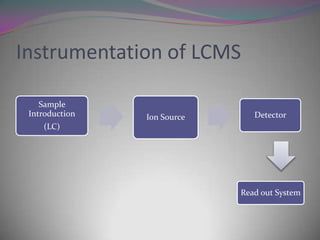
Instrumentation of LCMS

    Sample
 Introduction   Ion Source      Detector
    (LC)


                             Read out System
Interface in LCMS
 Interface: The problem encounter when interface
    HPLC with mass is mismatch between mass flow in
    HPLC.
   The methods to overcome problems are:
   Thermospray method
   Monodisperse aerosol generation interface
   Moving Belt interface
Application of LCMS
1.Pharmacokinetics
 LC-MS is very commonly used in pharmacokinetics
  studies of pharmaceuticals and is thus the most
  frequently used technique in the field of bioanalysis .
 These studies give information about how quickly a
  drug will be cleared from the hepatic blood flow, and
  organs of the body.
 MS is used for this due to high sensitivity and
  exceptional specificity compared to UV (as long as the
  analyte can be suitably ionised), and short analysis
  time.
• The major advantage MS has is the use of tandem MS-MS.
The detector may be programmed to select certain ions to
fragment. The process is essentially a selection
technique, but is in fact more complex.
•The measured quantity is the sum of molecule fragments
chosen by the operator. As long as there are no
interferences or ion suppression, the LC separation can be
quite quick.
•It is common now to have analysis times of 1 minute or less
by MS-MS detection, compared to over 10 mins with UV
detection
2.Proteomics/ metabolomics

 LC-MS is also used in the study of proteomics where again
 components of a complex mixture must be detected and
 identified in some manner.

 Samples of complex biological fluids like human serum may
 be run in a modern LC-MS/MS system and result in over 1000
 proteins being identified, provided that the sample was first
 separated on an SDS-PAGE gel or HPLC-SCX.
• The bottom-proteomics LC-MS approach to
proteomics generally involves protease digestion
and denaturation (usually trypsin as a
protease, urea to denature tertiary structure and
iodoacetamide to cap cystesine residues) followed
by LC-MS with peptide mass fingerprinting or LC-
MS/MS (tandem MS) to derive sequence of
individual peptides.LC-MS/MS is most commonly
used for proteomic analysis of complex samples
where peptide masses may overlap even with a
high-resolution mass spectrometer.
3.Drug development

LC-MS is frequently used in drug development at many
 different stages including Peptide Mapping, Glycoprotein
Mapping, Natural Products Dereplication, Bioaffinity
Screening, In Vivo Drug Screening, Metabolic Stability
Screening, Metabolite Identification, Impurity Identification,
 Degradant Identification, Quantitative Bioanalysis, and
 Quality Control.
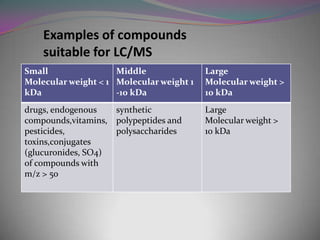
Examples of compounds
   suitable for LC/MS
   analysis
Small           Middle                    Large
Molecular weight < 1 Molecular weight 1   Molecular weight >
kDa                  -10 kDa              10 kDa
drugs, endogenous   synthetic             Large
compounds,vitamins, polypeptides and      Molecular weight >
pesticides,         polysaccharides       10 kDa
toxins,conjugates
(glucuronides, SO4)
of compounds with
m/z > 50
Mayuri shitre

Mayuri shitre

  • 1.
    JSPM’S Charak college ofPharmacy and Reaserch, Gate No.720/1&2 Punenagar Road,Wagholi,Pune 412207 Liquid chromatography and Mass Spectrometry Presented By, Guided By, Miss. Mayuri Shitre Dr. Rajesh J Oswal Prof.Sandip Kshirsagar Department of Pharmaceutical Chemistry
  • 2.
    Content  Introduction  Liquidchromatography  Mass spectrometry  Liquid chromatography mass spectrometry (LCMS)  Interface  Application of LCMS
  • 3.
    Introduction  Definition:  Liquidchromatography–mass spectrometry (LC- MS, or alternatively HPLC-MS) is an analytical chemistry technique that combines the physical separation capabilities of liquid chromatography,(or HPLC) with the mass analysis capabilities of mass spectrometry  LC-MS is a powerful technique used for many applications which has very high sensitivity and selectivity.
  • 4.
    Liquid Chromatography  Scale: A major difference between traditional HPLC and the chromatography used in LC-MS is that in the latter case the scale is usually much smaller, both with respect to the internal diameter of the column and even more so with respect to flow rate since it scales as the square of the diameter.  Flow splitting When standard bore (4.6 mm) columns are used the flow is often split ~10:1 . This can be beneficial by allowing the use of other techniques in tandem such as MS and UV. The mass spectrometry on the other hand will give improved sensitivity at flow rates of 200 μL/m
  • 5.
    Mass spectrometry Instrumental Requirement: Ionisation source Electron impact ioniser Field ionisation technique Thermal ionisation Matrix assisted ionisation  Ion collector: Faraday cup collector Electron multiplier
  • 6.
    Analysers: Doublefocousing Quadrapole mass analyser Time of flight spectrometer Plasma desorption.
  • 7.
    Instrumentation of LCMS Sample Introduction Ion Source Detector (LC) Read out System
  • 8.
    Interface in LCMS Interface: The problem encounter when interface HPLC with mass is mismatch between mass flow in HPLC.  The methods to overcome problems are:  Thermospray method  Monodisperse aerosol generation interface  Moving Belt interface
  • 9.
    Application of LCMS 1.Pharmacokinetics LC-MS is very commonly used in pharmacokinetics studies of pharmaceuticals and is thus the most frequently used technique in the field of bioanalysis .  These studies give information about how quickly a drug will be cleared from the hepatic blood flow, and organs of the body.  MS is used for this due to high sensitivity and exceptional specificity compared to UV (as long as the analyte can be suitably ionised), and short analysis time.
  • 10.
    • The majoradvantage MS has is the use of tandem MS-MS. The detector may be programmed to select certain ions to fragment. The process is essentially a selection technique, but is in fact more complex. •The measured quantity is the sum of molecule fragments chosen by the operator. As long as there are no interferences or ion suppression, the LC separation can be quite quick. •It is common now to have analysis times of 1 minute or less by MS-MS detection, compared to over 10 mins with UV detection
  • 11.
    2.Proteomics/ metabolomics  LC-MSis also used in the study of proteomics where again components of a complex mixture must be detected and identified in some manner.  Samples of complex biological fluids like human serum may be run in a modern LC-MS/MS system and result in over 1000 proteins being identified, provided that the sample was first separated on an SDS-PAGE gel or HPLC-SCX.
  • 12.
    • The bottom-proteomicsLC-MS approach to proteomics generally involves protease digestion and denaturation (usually trypsin as a protease, urea to denature tertiary structure and iodoacetamide to cap cystesine residues) followed by LC-MS with peptide mass fingerprinting or LC- MS/MS (tandem MS) to derive sequence of individual peptides.LC-MS/MS is most commonly used for proteomic analysis of complex samples where peptide masses may overlap even with a high-resolution mass spectrometer.
  • 13.
    3.Drug development LC-MS isfrequently used in drug development at many different stages including Peptide Mapping, Glycoprotein Mapping, Natural Products Dereplication, Bioaffinity Screening, In Vivo Drug Screening, Metabolic Stability Screening, Metabolite Identification, Impurity Identification, Degradant Identification, Quantitative Bioanalysis, and Quality Control.
  • 14.
    Examples of compounds suitable for LC/MS analysis Small Middle Large Molecular weight < 1 Molecular weight 1 Molecular weight > kDa -10 kDa 10 kDa drugs, endogenous synthetic Large compounds,vitamins, polypeptides and Molecular weight > pesticides, polysaccharides 10 kDa toxins,conjugates (glucuronides, SO4) of compounds with m/z > 50