1
Presented By:-
Mr. Sachin R. Naksakhare
M.Pharm Sem-III
Guided By:-
Dr. R. P. Bhole
Dr. D .Y Patil Institute Of Pharmaceutical Science and
Research, Pimpri, Pune
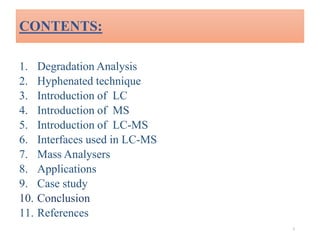
CONTENTS:
1. Degradation Analysis
2. Hyphenated technique
3. Introduction of LC
4. Introduction of MS
5. Introduction of LC-MS
6. Interfaces used in LC-MS
7. Mass Analysers
8. Applications
9. Case study
10. Conclusion
11. References
2
1. Degradation Analysis
To help to identify reactions that cause degradation of
pharmaceutical product.
The stability of a drug product or a drug substance is a critical
parameter which may affect purity, potency and safety.
Changes in drug stability can risk patient safety by formation of
a toxic degradation products or deliver a lower dose than
expected.
Knowledge of the stability of molecule helps in selecting proper
formulation and packaging.
The various type of Degradation
1. Hydrolysis [Acidic, Alkaline and Neutral]
2. Oxidation
3. Photolytic
4. Thermal 3
This two Guideline are used for stability testing:-
1. ICH Q1A(R2) [Stability Testing of New Drug Substances
and Products]
2. ICH Q1B [Photostability Testing of New Active
Substances and Medicinal Products]
Degradation studies are carried out for the following
reasons:
To solve stability-related problems.
To generate more stable formulation.
To identify impurities related to drug substances.
To develop and validate a stability indicating method.
To determine degradation pathways of drug substances and
drug products.
4
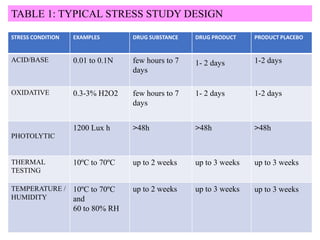
STRESS CONDITION EXAMPLES DRUG SUBSTANCE DRUG PRODUCT PRODUCT PLACEBO
ACID/BASE 0.01 to 0.1N few hours to 7
days
1- 2 days 1-2 days
OXIDATIVE 0.3-3% H2O2 few hours to 7
days
1- 2 days 1-2 days
PHOTOLYTIC
1200 Lux h >48h >48h >48h
THERMAL
TESTING
10ºC to 70ºC up to 2 weeks up to 3 weeks up to 3 weeks
TEMPERATURE /
HUMIDITY
10ºC to 70ºC
and
60 to 80% RH
up to 2 weeks up to 3 weeks up to 3 weeks
TABLE 1: TYPICAL STRESS STUDY DESIGN
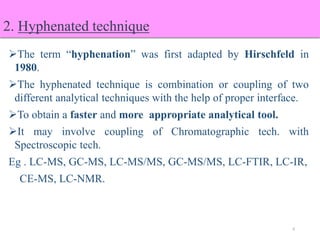
2. Hyphenated technique
The term “hyphenation” was first adapted by Hirschfeld in
1980.
The hyphenated technique is combination or coupling of two
different analytical techniques with the help of proper interface.
To obtain a faster and more appropriate analytical tool.
It may involve coupling of Chromatographic tech. with
Spectroscopic tech.
Eg . LC-MS, GC-MS, LC-MS/MS, GC-MS/MS, LC-FTIR, LC-IR,
CE-MS, LC-NMR.
6
3. Introduction of LC
Chromatography is first invented by Mikhail Tswett , a botanist
in 1906 .
Liquid chromatography is type of chromatography in which
analyte molecule get partition between moving mobile phase and
stationary phase.
LC is the most widely used in the analytical separation
techniques.
In liquid chromatography includes following techniques:-
1. Partition chromatography,
2. Adsorption chromatography,
3. Ion-exchange chromatography,
4. Size-exclusion chromatography,
5. Affinity chromatography,
6. Chiral chromatography. 7
8
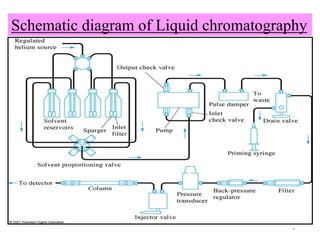
Schematic diagram of Liquid chromatography
4. Introduction of MS
Mass spectroscopy (MS) is an analytical technique used to
measure the mass-to-charge (m/z) ratio of ions.
Used to find the composition of a physical sample by
generating a mass spectrum representing the masses of
sample components.
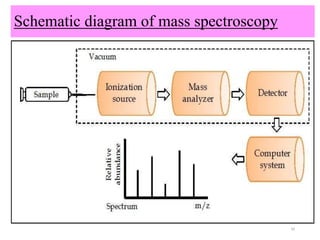
All mass spectrometers consist of three basic parts: Ion
source, Mass analyzer, and Detector system.
9
Schematic diagram of mass spectroscopy
10
5. Introduction of LC-MS
LC-MS is an analytical chemistry technique that combines the
physical separation capabilities of LC with the mass analysis
capabilities of MS.
LC-MS in recent years, has become one of the most powerful
analytical techniques for qualitative and quantitative analysis.
LC separates the sample components and then introduces them
to the mass spectrometer.
MS creates and detects charged ions.
The LC/MS data may be used to provide information about the
molecular weight, structure, identity and quantity of specific
sample components.
11
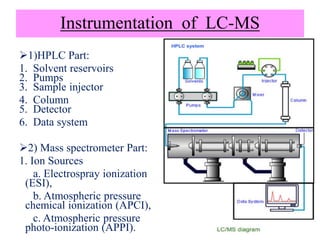
Instrumentation of LC-MS
1)HPLC Part:
1. Solvent reservoirs
2. Pumps
3. Sample injector
4. Column
5. Detector
6. Data system
2) Mass spectrometer Part:
1. Ion Sources
a. Electrospray ionization
(ESI),
b. Atmospheric pressure
chemical ionization (APCI),
c. Atmospheric pressure
photo-ionization (APPI). 12
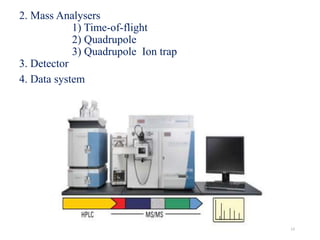
2. Mass Analysers
1) Time-of-flight
2) Quadrupole
3) Quadrupole Ion trap
3. Detector
4. Data system
13
Advantages of LC-MS
High sensitivity.
High selectivity.
Multi-component simultaneous analysis.
Accurate qualitative and quantitative analysis
14
6. Interfaces used in LC-MS
The currently, the most common LC-MS interfaces are:-
1. Electrospray ionization (ESI),
2. Atmospheric pressure chemical ionization (APCI),
3. Atmospheric pressure photo-ionization (APPI).
15
6.1 Electrospray ionization (ESI)
MS using ESI is called (ESI-MS) or (ES-MS).
ESI is also called 'soft ionization' technique, since there is
very little fragmentation.
Electrospray ionization is the ion source of choice to
couple LC with MS.
ESI is a technique used in MS to produce ions using an
electrospray in which a high voltage is applied to a liquid to
create an aerosol.
16
17
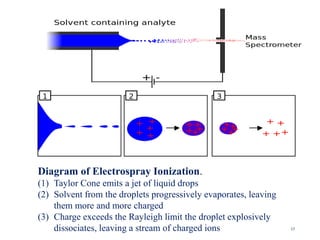
Diagram of Electrospray Ionization.
(1) Taylor Cone emits a jet of liquid drops
(2) Solvent from the droplets progressively evaporates, leaving
them more and more charged
(3) Charge exceeds the Rayleigh limit the droplet explosively
dissociates, leaving a stream of charged ions
Advantages:-
Higher MW possible due to multiple charges.
Provides good sensitivity.
Can be used for volatiles, non-volatiles and polar
compounds.
Easy to Operate.
Flow rate up to 1ml/min.
Disadvantages:-
It is very little structural information can be gained from the
simple MS.
Need Solubility in Polar Solvent.
18
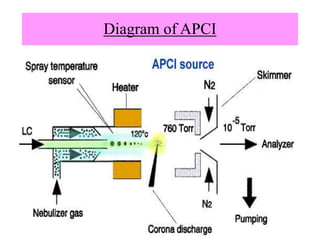
6.2 Atmospheric pressure chemical ionization (APCI)
APCI usually consists of three main parts: Nebulizer
probe, ionization region and ion-transfer region.
The chemical ionization process where the solvent acts as
the CI reagent gas to ionize the sample.
The LC eluate into a nebulizer with a flow rate 0.2-
2.0mL/min.
Mobile phase and analyte are first nebulized (N2) and
vapourised by heating to 1200 C .
The resulting vapour is ionized using a corona discharge
needles.
Subsequent ion/molecule reactions then cause ionization of
the analyte.
19
Diagram of APCI
20
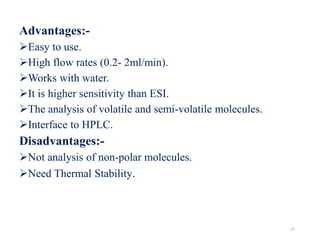
Advantages:-
Easy to use.
High flow rates (0.2- 2ml/min).
Works with water.
It is higher sensitivity than ESI.
The analysis of volatile and semi-volatile molecules.
Interface to HPLC.
Disadvantages:-
Not analysis of non-polar molecules.
Need Thermal Stability.
21
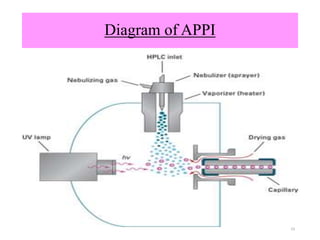
6.3 Atmospheric pressure photo-ionization (APPI)
In this technique, UV light photons are used to ionize sample
molecules.
The APPI method in high sensitivity ionization of both nonpolar
and low-polarity compounds.
They are exposed to the UV light, the analyte molecules are
ionized in two ways
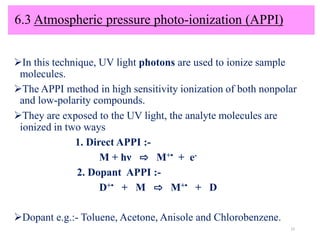
1. Direct APPI :-
M + hν ⇨ M+• + e-
2. Dopant APPI :-
D+• + M ⇨ M+• + D
Dopant e.g.:- Toluene, Acetone, Anisole and Chlorobenzene.
22
Diagram of APPI
23
Advantages:-
APPI can analyze both nonpolar and low-polarity
compounds.
High enough to ionize the target molecules.
Interface to HPLC.
Disadvantages:-
Flow rate 0.1ml/min.
Need Volatile Sample.
Need Thermal Stability.
24
7. Mass Analyzers
A mass analyzer is the component of the mass
spectrometer that takes ionized masses and separates
according to their mass-to-charge (m/z) ratios of ions.
The sample has been ionized, the beam of ions is accelerated
by an electric filed and then passes into the mass analyzers.
There are many different ionization methods for different
applications, there are also several types of mass analyzers.
1. Time-of-flight
2. Quadrupole
3. Quadrupole Ion trap
25
7.1 Time-of-flight (TOF)
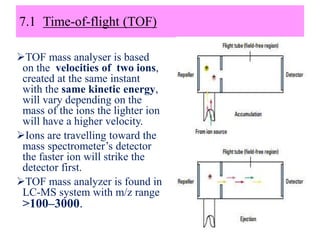
TOF mass analyser is based
on the velocities of two ions,
created at the same instant
with the same kinetic energy,
will vary depending on the
mass of the ions the lighter ion
will have a higher velocity.
Ions are travelling toward the
mass spectrometer’s detector
the faster ion will strike the
detector first.
TOF mass analyzer is found in
LC-MS system with m/z range
>100–3000.
26
Advantages:-
High Mass Range.
Fast Scanning.
High resolution and high sensitivity.
Mechanically simple.
Disadvantages:-
Low Accuracy .
27
7.2 Quadrupole
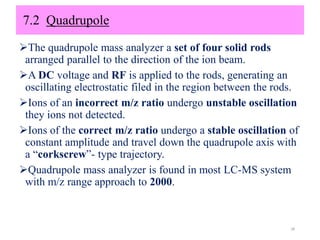
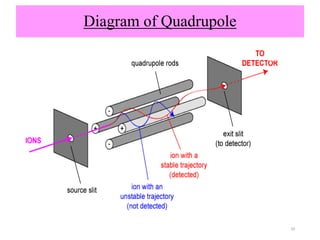
The quadrupole mass analyzer a set of four solid rods
arranged parallel to the direction of the ion beam.
A DC voltage and RF is applied to the rods, generating an
oscillating electrostatic filed in the region between the rods.
Ions of an incorrect m/z ratio undergo unstable oscillation
they ions not detected.
Ions of the correct m/z ratio undergo a stable oscillation of
constant amplitude and travel down the quadrupole axis with
a “corkscrew”- type trajectory.
Quadrupole mass analyzer is found in most LC-MS system
with m/z range approach to 2000.
28
Diagram of Quadrupole
29
Advantages:-
Inexpensive.
Easily Interfaced to Many Ionization Methods.
Disadvantages:-
Low Resolution.
MS/MS requires multiple analyzers.
Slow Scanning.
30
7.3 Quadrupole Ion trap
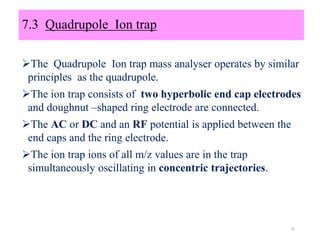
The Quadrupole Ion trap mass analyser operates by similar
principles as the quadrupole.
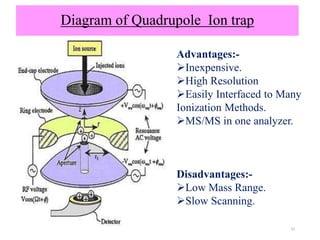
The ion trap consists of two hyperbolic end cap electrodes
and doughnut –shaped ring electrode are connected.
The AC or DC and an RF potential is applied between the
end caps and the ring electrode.
The ion trap ions of all m/z values are in the trap
simultaneously oscillating in concentric trajectories.
31
Diagram of Quadrupole Ion trap
32
Advantages:-
Inexpensive.
High Resolution
Easily Interfaced to Many
Ionization Methods.
MS/MS in one analyzer.
Disadvantages:-
Low Mass Range.
Slow Scanning.
8. Applications
1. Molecular Weight Determination.
2. Drug Discovery.
3. Food Applications.
4. Biomedical Application.
5. Environmental Application.
6. Biochemical Screening for Genetic Disorders.
7. Therapeutic Drug Monitoring and Toxicology.
33
34
35
36
37
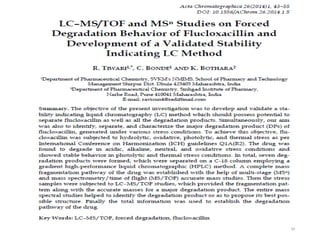
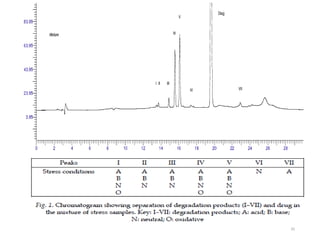
The developed LC method help to separate drug as well as all
the degradation products flucloxacillin which proved its
stability indicating nature.
The drug degraded under acid, alkaline neutral and oxidative
stress, while it was found to be stable under thermal and
photolytic stress conditions.
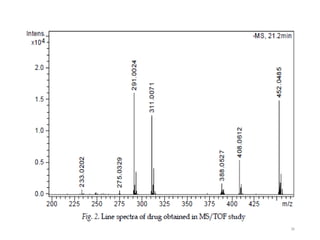
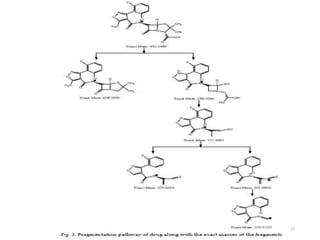
To resolve the structure of degradation product, mass
fragmentation pattern of drug was established with the help of
MS/TOF and MSn studies.
The LC-MS hyphenated tech. helps to separate drug as well as
degradation products by use of LC and the MS help to identify
the structure of each degradation product as a result we can
understand degradation pathway of drug molecule.
The LC-MS has provide to be sensitive and specific tech. for
the analysis of pharmaceutical product.
38
10. Conclusion
11. References
1. Skoog DA ., Holler FJ., Crouch SR., Principle of Instrumental
Analysis, 6th ed., Eastern Press Banglore, 2015, page no:-806-844.
2. Pavia, Lampman, Kriz, Vyvyan, Spectroscopy International Edition,
4th ed., Cengage Leanng, Delhi, 2014, page no:-413-511.
3. Chatwal GR., Anand SK., Instrumental Methods of Chemical Analysis,
5th edition, Himalaya Publishing House, Delhi, 2014, page no:-2.56-
2.67.
4. Tiwari R. N.; Bonde C. G.; LC–MS/TOF and MSn Studies on Forced
Degradation Behavior of Flucloxacillin and Development of a
Validated Stability Indicating LC method , Acta Chromatographica
2014, volume-1, page no.:43-55.
5. Hapse S.A., Bhagat B.V., Sawant P.D., Rapanwad, P.B. Hyphenated
Techniques: A Review IJPPR 2017,volume-8, Issue:2, page no.:33-44.
6. Kalpesh N Patel, Jayvadan K Patel, Introduction to Hyphenated
Techniques and their Applications in Pharmacy, Review article,
Pharmaceutical Methods 2010, volume-1, Issue:1, page no.:1-13 39
7. Blessy Mn, Ruchi D. Patel, et. al. ; Development of forced
degradation and stability indicating studies of drugs—A Review
“Journal of Pharmaceutical Analysis” 2013,page no.:59-165.
8. ICH, Stability Testing of New Drug Substances and Products
Q1A(R2), in: International Conference on Harmonisation, IFMPA,
Geneva, 2003.
9. ICH, Stability Testing of Photostability Testing of New Drug
Substances and Products Q1B, in: International Conference on
Harmonisation, IFMPA, Geneva, 1996.
10. http://www.news-medical.net/life-sciences/Liquid-
Chromatography-Mass-Spectrometry-(LC-MS)-Applications.as
40
41
Thank you

Degradation Analysis Using LC-MS/MS

  • 1.
    1 Presented By:- Mr. SachinR. Naksakhare M.Pharm Sem-III Guided By:- Dr. R. P. Bhole Dr. D .Y Patil Institute Of Pharmaceutical Science and Research, Pimpri, Pune
  • 2.
    CONTENTS: 1. Degradation Analysis 2.Hyphenated technique 3. Introduction of LC 4. Introduction of MS 5. Introduction of LC-MS 6. Interfaces used in LC-MS 7. Mass Analysers 8. Applications 9. Case study 10. Conclusion 11. References 2
  • 3.
    1. Degradation Analysis Tohelp to identify reactions that cause degradation of pharmaceutical product. The stability of a drug product or a drug substance is a critical parameter which may affect purity, potency and safety. Changes in drug stability can risk patient safety by formation of a toxic degradation products or deliver a lower dose than expected. Knowledge of the stability of molecule helps in selecting proper formulation and packaging. The various type of Degradation 1. Hydrolysis [Acidic, Alkaline and Neutral] 2. Oxidation 3. Photolytic 4. Thermal 3
  • 4.
    This two Guidelineare used for stability testing:- 1. ICH Q1A(R2) [Stability Testing of New Drug Substances and Products] 2. ICH Q1B [Photostability Testing of New Active Substances and Medicinal Products] Degradation studies are carried out for the following reasons: To solve stability-related problems. To generate more stable formulation. To identify impurities related to drug substances. To develop and validate a stability indicating method. To determine degradation pathways of drug substances and drug products. 4
  • 5.
    STRESS CONDITION EXAMPLESDRUG SUBSTANCE DRUG PRODUCT PRODUCT PLACEBO ACID/BASE 0.01 to 0.1N few hours to 7 days 1- 2 days 1-2 days OXIDATIVE 0.3-3% H2O2 few hours to 7 days 1- 2 days 1-2 days PHOTOLYTIC 1200 Lux h >48h >48h >48h THERMAL TESTING 10ºC to 70ºC up to 2 weeks up to 3 weeks up to 3 weeks TEMPERATURE / HUMIDITY 10ºC to 70ºC and 60 to 80% RH up to 2 weeks up to 3 weeks up to 3 weeks TABLE 1: TYPICAL STRESS STUDY DESIGN
  • 6.
    2. Hyphenated technique Theterm “hyphenation” was first adapted by Hirschfeld in 1980. The hyphenated technique is combination or coupling of two different analytical techniques with the help of proper interface. To obtain a faster and more appropriate analytical tool. It may involve coupling of Chromatographic tech. with Spectroscopic tech. Eg . LC-MS, GC-MS, LC-MS/MS, GC-MS/MS, LC-FTIR, LC-IR, CE-MS, LC-NMR. 6
  • 7.
    3. Introduction ofLC Chromatography is first invented by Mikhail Tswett , a botanist in 1906 . Liquid chromatography is type of chromatography in which analyte molecule get partition between moving mobile phase and stationary phase. LC is the most widely used in the analytical separation techniques. In liquid chromatography includes following techniques:- 1. Partition chromatography, 2. Adsorption chromatography, 3. Ion-exchange chromatography, 4. Size-exclusion chromatography, 5. Affinity chromatography, 6. Chiral chromatography. 7
  • 8.
    8 Schematic diagram ofLiquid chromatography
  • 9.
    4. Introduction ofMS Mass spectroscopy (MS) is an analytical technique used to measure the mass-to-charge (m/z) ratio of ions. Used to find the composition of a physical sample by generating a mass spectrum representing the masses of sample components. All mass spectrometers consist of three basic parts: Ion source, Mass analyzer, and Detector system. 9
  • 10.
    Schematic diagram ofmass spectroscopy 10
  • 11.
    5. Introduction ofLC-MS LC-MS is an analytical chemistry technique that combines the physical separation capabilities of LC with the mass analysis capabilities of MS. LC-MS in recent years, has become one of the most powerful analytical techniques for qualitative and quantitative analysis. LC separates the sample components and then introduces them to the mass spectrometer. MS creates and detects charged ions. The LC/MS data may be used to provide information about the molecular weight, structure, identity and quantity of specific sample components. 11
  • 12.
    Instrumentation of LC-MS 1)HPLCPart: 1. Solvent reservoirs 2. Pumps 3. Sample injector 4. Column 5. Detector 6. Data system 2) Mass spectrometer Part: 1. Ion Sources a. Electrospray ionization (ESI), b. Atmospheric pressure chemical ionization (APCI), c. Atmospheric pressure photo-ionization (APPI). 12
  • 13.
    2. Mass Analysers 1)Time-of-flight 2) Quadrupole 3) Quadrupole Ion trap 3. Detector 4. Data system 13
  • 14.
    Advantages of LC-MS Highsensitivity. High selectivity. Multi-component simultaneous analysis. Accurate qualitative and quantitative analysis 14
  • 15.
    6. Interfaces usedin LC-MS The currently, the most common LC-MS interfaces are:- 1. Electrospray ionization (ESI), 2. Atmospheric pressure chemical ionization (APCI), 3. Atmospheric pressure photo-ionization (APPI). 15
  • 16.
    6.1 Electrospray ionization(ESI) MS using ESI is called (ESI-MS) or (ES-MS). ESI is also called 'soft ionization' technique, since there is very little fragmentation. Electrospray ionization is the ion source of choice to couple LC with MS. ESI is a technique used in MS to produce ions using an electrospray in which a high voltage is applied to a liquid to create an aerosol. 16
  • 17.
    17 Diagram of ElectrosprayIonization. (1) Taylor Cone emits a jet of liquid drops (2) Solvent from the droplets progressively evaporates, leaving them more and more charged (3) Charge exceeds the Rayleigh limit the droplet explosively dissociates, leaving a stream of charged ions
  • 18.
    Advantages:- Higher MW possibledue to multiple charges. Provides good sensitivity. Can be used for volatiles, non-volatiles and polar compounds. Easy to Operate. Flow rate up to 1ml/min. Disadvantages:- It is very little structural information can be gained from the simple MS. Need Solubility in Polar Solvent. 18
  • 19.
    6.2 Atmospheric pressurechemical ionization (APCI) APCI usually consists of three main parts: Nebulizer probe, ionization region and ion-transfer region. The chemical ionization process where the solvent acts as the CI reagent gas to ionize the sample. The LC eluate into a nebulizer with a flow rate 0.2- 2.0mL/min. Mobile phase and analyte are first nebulized (N2) and vapourised by heating to 1200 C . The resulting vapour is ionized using a corona discharge needles. Subsequent ion/molecule reactions then cause ionization of the analyte. 19
  • 20.
  • 21.
    Advantages:- Easy to use. Highflow rates (0.2- 2ml/min). Works with water. It is higher sensitivity than ESI. The analysis of volatile and semi-volatile molecules. Interface to HPLC. Disadvantages:- Not analysis of non-polar molecules. Need Thermal Stability. 21
  • 22.
    6.3 Atmospheric pressurephoto-ionization (APPI) In this technique, UV light photons are used to ionize sample molecules. The APPI method in high sensitivity ionization of both nonpolar and low-polarity compounds. They are exposed to the UV light, the analyte molecules are ionized in two ways 1. Direct APPI :- M + hν ⇨ M+• + e- 2. Dopant APPI :- D+• + M ⇨ M+• + D Dopant e.g.:- Toluene, Acetone, Anisole and Chlorobenzene. 22
  • 23.
  • 24.
    Advantages:- APPI can analyzeboth nonpolar and low-polarity compounds. High enough to ionize the target molecules. Interface to HPLC. Disadvantages:- Flow rate 0.1ml/min. Need Volatile Sample. Need Thermal Stability. 24
  • 25.
    7. Mass Analyzers Amass analyzer is the component of the mass spectrometer that takes ionized masses and separates according to their mass-to-charge (m/z) ratios of ions. The sample has been ionized, the beam of ions is accelerated by an electric filed and then passes into the mass analyzers. There are many different ionization methods for different applications, there are also several types of mass analyzers. 1. Time-of-flight 2. Quadrupole 3. Quadrupole Ion trap 25
  • 26.
    7.1 Time-of-flight (TOF) TOFmass analyser is based on the velocities of two ions, created at the same instant with the same kinetic energy, will vary depending on the mass of the ions the lighter ion will have a higher velocity. Ions are travelling toward the mass spectrometer’s detector the faster ion will strike the detector first. TOF mass analyzer is found in LC-MS system with m/z range >100–3000. 26
  • 27.
    Advantages:- High Mass Range. FastScanning. High resolution and high sensitivity. Mechanically simple. Disadvantages:- Low Accuracy . 27
  • 28.
    7.2 Quadrupole The quadrupolemass analyzer a set of four solid rods arranged parallel to the direction of the ion beam. A DC voltage and RF is applied to the rods, generating an oscillating electrostatic filed in the region between the rods. Ions of an incorrect m/z ratio undergo unstable oscillation they ions not detected. Ions of the correct m/z ratio undergo a stable oscillation of constant amplitude and travel down the quadrupole axis with a “corkscrew”- type trajectory. Quadrupole mass analyzer is found in most LC-MS system with m/z range approach to 2000. 28
  • 29.
  • 30.
    Advantages:- Inexpensive. Easily Interfaced toMany Ionization Methods. Disadvantages:- Low Resolution. MS/MS requires multiple analyzers. Slow Scanning. 30
  • 31.
    7.3 Quadrupole Iontrap The Quadrupole Ion trap mass analyser operates by similar principles as the quadrupole. The ion trap consists of two hyperbolic end cap electrodes and doughnut –shaped ring electrode are connected. The AC or DC and an RF potential is applied between the end caps and the ring electrode. The ion trap ions of all m/z values are in the trap simultaneously oscillating in concentric trajectories. 31
  • 32.
    Diagram of QuadrupoleIon trap 32 Advantages:- Inexpensive. High Resolution Easily Interfaced to Many Ionization Methods. MS/MS in one analyzer. Disadvantages:- Low Mass Range. Slow Scanning.
  • 33.
    8. Applications 1. MolecularWeight Determination. 2. Drug Discovery. 3. Food Applications. 4. Biomedical Application. 5. Environmental Application. 6. Biochemical Screening for Genetic Disorders. 7. Therapeutic Drug Monitoring and Toxicology. 33
  • 34.
  • 35.
  • 36.
  • 37.
  • 38.
    The developed LCmethod help to separate drug as well as all the degradation products flucloxacillin which proved its stability indicating nature. The drug degraded under acid, alkaline neutral and oxidative stress, while it was found to be stable under thermal and photolytic stress conditions. To resolve the structure of degradation product, mass fragmentation pattern of drug was established with the help of MS/TOF and MSn studies. The LC-MS hyphenated tech. helps to separate drug as well as degradation products by use of LC and the MS help to identify the structure of each degradation product as a result we can understand degradation pathway of drug molecule. The LC-MS has provide to be sensitive and specific tech. for the analysis of pharmaceutical product. 38 10. Conclusion
  • 39.
    11. References 1. SkoogDA ., Holler FJ., Crouch SR., Principle of Instrumental Analysis, 6th ed., Eastern Press Banglore, 2015, page no:-806-844. 2. Pavia, Lampman, Kriz, Vyvyan, Spectroscopy International Edition, 4th ed., Cengage Leanng, Delhi, 2014, page no:-413-511. 3. Chatwal GR., Anand SK., Instrumental Methods of Chemical Analysis, 5th edition, Himalaya Publishing House, Delhi, 2014, page no:-2.56- 2.67. 4. Tiwari R. N.; Bonde C. G.; LC–MS/TOF and MSn Studies on Forced Degradation Behavior of Flucloxacillin and Development of a Validated Stability Indicating LC method , Acta Chromatographica 2014, volume-1, page no.:43-55. 5. Hapse S.A., Bhagat B.V., Sawant P.D., Rapanwad, P.B. Hyphenated Techniques: A Review IJPPR 2017,volume-8, Issue:2, page no.:33-44. 6. Kalpesh N Patel, Jayvadan K Patel, Introduction to Hyphenated Techniques and their Applications in Pharmacy, Review article, Pharmaceutical Methods 2010, volume-1, Issue:1, page no.:1-13 39
  • 40.
    7. Blessy Mn,Ruchi D. Patel, et. al. ; Development of forced degradation and stability indicating studies of drugs—A Review “Journal of Pharmaceutical Analysis” 2013,page no.:59-165. 8. ICH, Stability Testing of New Drug Substances and Products Q1A(R2), in: International Conference on Harmonisation, IFMPA, Geneva, 2003. 9. ICH, Stability Testing of Photostability Testing of New Drug Substances and Products Q1B, in: International Conference on Harmonisation, IFMPA, Geneva, 1996. 10. http://www.news-medical.net/life-sciences/Liquid- Chromatography-Mass-Spectrometry-(LC-MS)-Applications.as 40
  • 41.