Presented by
SUMAN ROY
UG-IV
Metallurgical & Material Engineering Dept.
Jadavpur University
What is Solvent Extraction ?
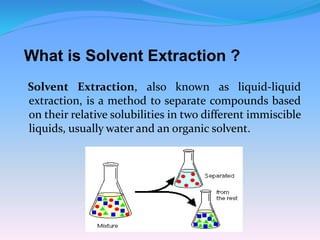
Solvent Extraction, also known as liquid-liquid
extraction, is a method to separate compounds based
on their relative solubilities in two different immiscible
liquids, usually water and an organic solvent.
Importance of the process:
The Solvent Extraction(S.E.) process was first
developed as a tool of analytical chemistry. Every
metallic element of the periodic table could be
virtually separated by this process.
Back in 1940’s , S.E. was primarily used to separate
nuclear and rare earth elements.
However, availability of inexpensive and effective
reagents led to the establishment of large scale S.E.
processes for extraction of non-ferrous metals from
hydrometallurgical leach liquors.
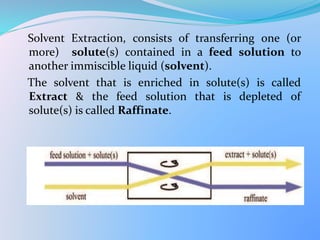
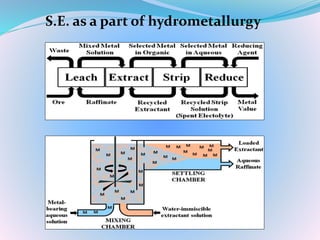
Solvent Extraction, consists of transferring one (or
more) solute(s) contained in a feed solution to
another immiscible liquid (solvent).
The solvent that is enriched in solute(s) is called
Extract & the feed solution that is depleted of
solute(s) is called Raffinate.
S.E. as a part of hydrometallurgy
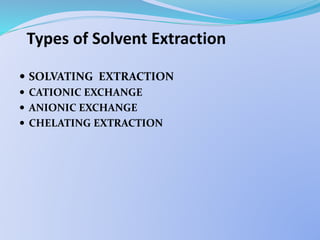
Types of Solvent Extraction
 SOLVATING EXTRACTION
 CATIONIC EXCHANGE
 ANIONIC EXCHANGE
 CHELATING EXTRACTION
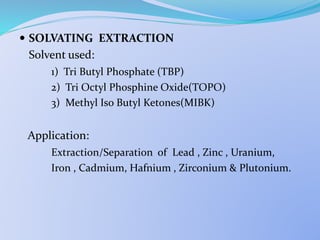
 SOLVATING EXTRACTION
Solvent used:
1) Tri Butyl Phosphate (TBP)
2) Tri Octyl Phosphine Oxide(TOPO)
3) Methyl Iso Butyl Ketones(MIBK)
Application:
Extraction/Separation of Lead , Zinc , Uranium,
Iron , Cadmium, Hafnium , Zirconium & Plutonium.
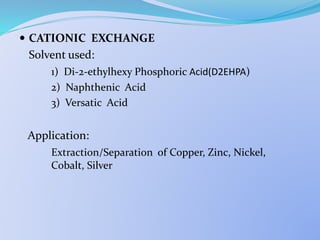
 CATIONIC EXCHANGE
Solvent used:
1) Di-2-ethylhexy Phosphoric Acid(D2EHPA)
2) Naphthenic Acid
3) Versatic Acid
Application:
Extraction/Separation of Copper, Zinc, Nickel,
Cobalt, Silver
 ANIONIC EXCHANGE
Solvent used:
1) Primary Amines(RNH2)
2) Secondary Amines(R2NH)
3) Tertiary Amines(R3N) (R=> C12 – C14)
Application:
Extraction/Separation of Uranium, Thorium,
Vanadium, Cobalt
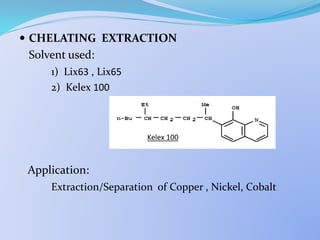
 CHELATING EXTRACTION
Solvent used:
1) Lix63 , Lix65
2) Kelex 100
Application:
Extraction/Separation of Copper , Nickel, Cobalt
Kelex 100
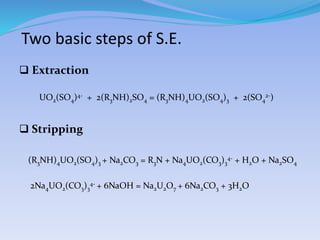
Two basic steps of S.E.
 Extraction
UO2(SO4)4- + 2(R3NH)2SO4 = (R3NH)4UO2(SO4)3 + 2(SO4
2-)
 Stripping
(R3NH)4UO2(SO4)3 + Na2CO3 = R3N + Na4UO2(CO3)3
4- + H2O + Na2SO4
2Na4UO2(CO3)3
4- + 6NaOH = Na2U2O7 + 6Na2CO3 + 3H2O
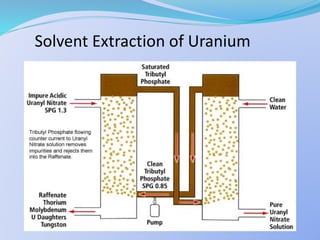
Solvent Extraction of Uranium
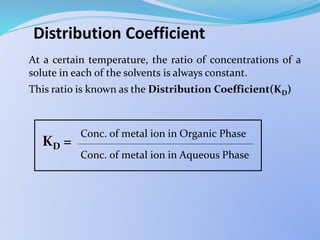
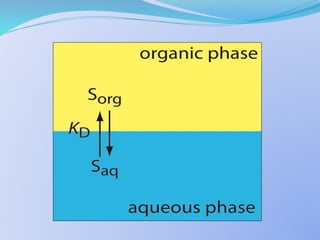
Distribution Coefficient
At a certain temperature, the ratio of concentrations of a
solute in each of the solvents is always constant.
This ratio is known as the Distribution Coefficient(KD)
KD =
Conc. of metal ion in Organic Phase
Conc. of metal ion in Aqueous Phase
Extraction Equilibria
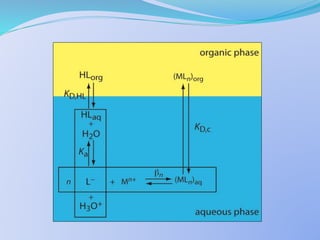
For a chelating reagent, HR, the extraction reaction for
a metal ion Mn+ can be represented as:
Maq
n+ + n HRorg MRn org + H+
aq
The Extraction Constant(Kex) is given by:
Kex =
[MRn]org [H+]n
aq
[Mn+]aq [HR]n
org
The extraction constant can also be expressed as:
Kex =
KD .[H+]n
aq
[HR]n
org
Where,
KD =
[MRn]org
[Mn+]aq
The extraction constant can also be expressed as:
Kex =
log KD = log Kex + n pH + n log [HR]org
KD .[H+]n
aq
[HR]n
org
Where,
KD =
[MRn]org
[Mn+]aq
Extraction Coefficient
 It indicates how much of the metal will move from
the aqueous phase to the organic phase in a single
contact.
Effective extraction coefficient (EF) can be expressed as:
EF =
[Mn+]org (Vol.)org
[Mn+]aq (Vol.)aq
Single Stage vs. Multistage
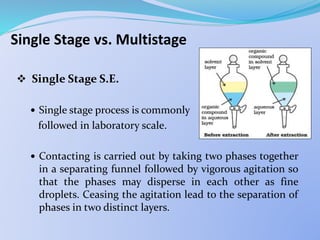
 Single Stage S.E.
 Single stage process is commonly
followed in laboratory scale.
 Contacting is carried out by taking two phases together
in a separating funnel followed by vigorous agitation so
that the phases may disperse in each other as fine
droplets. Ceasing the agitation lead to the separation of
phases in two distinct layers.
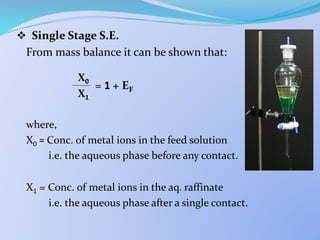
 Single Stage S.E.
From mass balance it can be shown that:
= 1 +
where,
X0 = Conc. of metal ions in the feed solution
i.e. the aqueous phase before any contact.
X1 = Conc. of metal ions in the aq. raffinate
i.e. the aqueous phase after a single contact.
X1
X0
[Mn+]org (Vol.)org
[Mn+]aq (Vol.)aq
 Single Stage S.E.
From mass balance it can be shown that:
= 1 + EF
where,
X0 = Conc. of metal ions in the feed solution
i.e. the aqueous phase before any contact.
X1 = Conc. of metal ions in the aq. raffinate
i.e. the aqueous phase after a single contact.
X1
X0
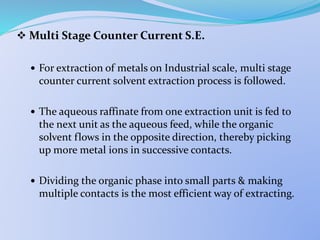
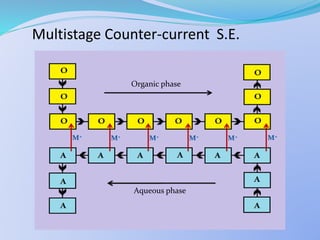
 Multi Stage Counter Current S.E.
 For extraction of metals on Industrial scale, multi stage
counter current solvent extraction process is followed.
 The aqueous raffinate from one extraction unit is fed to
the next unit as the aqueous feed, while the organic
solvent flows in the opposite direction, thereby picking
up more metal ions in successive contacts.
 Dividing the organic phase into small parts & making
multiple contacts is the most efficient way of extracting.
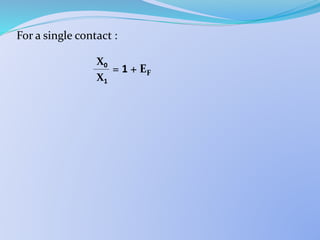
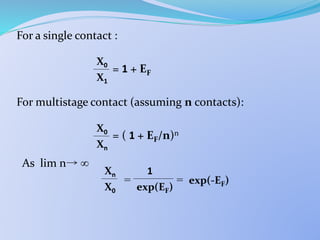
For a single contact :
= 1 + EF
X1
X0
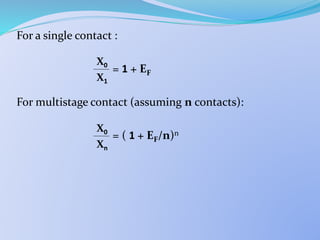
For a single contact :
= 1 + EF
For multistage contact (assuming n contacts):
= ( 1 + EF/n)n
X1
X0
Xn
X0
For a single contact :
= 1 + EF
For multistage contact (assuming n contacts):
= ( 1 + EF/n)n
As lim n ∞
= = exp(-EF)
X1
X0
Xn
X0
X0
Xn 1
exp(EF)
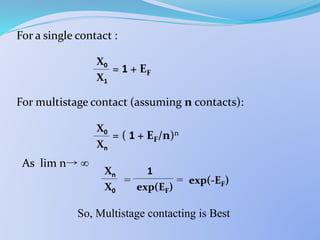
For a single contact :
= 1 + EF
For multistage contact (assuming n contacts):
= ( 1 + EF/n)n
As lim n ∞
= = exp(-EF)
So, Multistage contacting is Best
X1
X0
Xn
X0
X0
Xn 1
exp(EF)
Multistage Counter-current S.E.
Organic phase
Aqueous phase
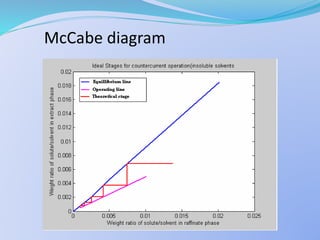
McCabe diagram
Selection of Organic Solvent
High extraction capacity
 Selectivity
 Easily Stripped
 Immiscible in aqueous phase
 Sufficient density difference with the aq. phase
 Low Viscosity
 Non toxic
 Non explosive
 Cheap
Diluents
 Diluent is required for dissolving or diluting the organic extractant so
that its physical properties like viscosity and density become more
favorable for better mixing of the two phases and their separation.
 Aliphatic or Aromatic hydrocarbons or a combination of both, are used
as diluent.
 Diluent affects the extraction, scrubbing, stripping and phase
separation process quite significantly.
 Examples of some common diluents:
 Kerosene
 Benzene
 Chloroform
 Xylene
 Naptha
 Toluene
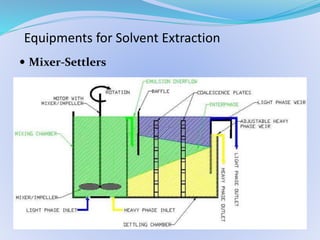
Equipments for Solvent Extraction
 Mixer-Settlers
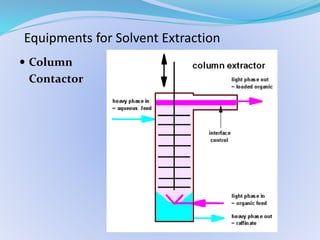
Equipments for Solvent Extraction
 Column
Contactor
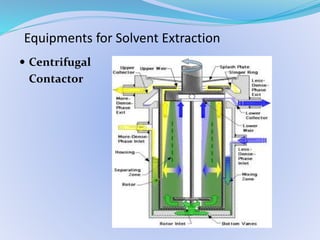
Equipments for Solvent Extraction
 Centrifugal
Contactor
Application
Today the process of Solvent Extraction is widely applied in
miscellaneous fields of Science and Technology
 Analytical Chemistry
 Extraction of Rare-earths & PGM
 Waste water treatment
 Mineral oil treatment & dewaxing
 Food industry(essential oil extraction)
 Perfume industry(fragrance extraction)
 Pharmaceutical industry
Conclusion
In spite of having the advantage of a rapid extraction kinetics with
a feasibility of recycling the solvent, there are some drawbacks of
this process.
 Use of toxic and flammable organic diluents
 Sometimes the cost of solvent system becomes too expensive
 In several cases there is loss of organic solvent in the process
 Solvent Extraction may not pollute the air as much as other
pyrometallurgical processes, but a lot of toxic chemicals find
their way into the waterbodies, polluting them.
The extensive application of S.E. has become a field(& industry!)
of its own. With proper modeling of the process, invention of new
equipments, use of more effective extractants and a better
understanding of the science behind it may lead it to be one of the
most important extraction processes in metallurgy.
Solvent Extraction

Solvent Extraction

  • 1.
    Presented by SUMAN ROY UG-IV Metallurgical& Material Engineering Dept. Jadavpur University
  • 2.
    What is SolventExtraction ? Solvent Extraction, also known as liquid-liquid extraction, is a method to separate compounds based on their relative solubilities in two different immiscible liquids, usually water and an organic solvent.
  • 3.
    Importance of theprocess: The Solvent Extraction(S.E.) process was first developed as a tool of analytical chemistry. Every metallic element of the periodic table could be virtually separated by this process. Back in 1940’s , S.E. was primarily used to separate nuclear and rare earth elements. However, availability of inexpensive and effective reagents led to the establishment of large scale S.E. processes for extraction of non-ferrous metals from hydrometallurgical leach liquors.
  • 4.
    Solvent Extraction, consistsof transferring one (or more) solute(s) contained in a feed solution to another immiscible liquid (solvent). The solvent that is enriched in solute(s) is called Extract & the feed solution that is depleted of solute(s) is called Raffinate.
  • 5.
    S.E. as apart of hydrometallurgy
  • 6.
    Types of SolventExtraction  SOLVATING EXTRACTION  CATIONIC EXCHANGE  ANIONIC EXCHANGE  CHELATING EXTRACTION
  • 7.
     SOLVATING EXTRACTION Solventused: 1) Tri Butyl Phosphate (TBP) 2) Tri Octyl Phosphine Oxide(TOPO) 3) Methyl Iso Butyl Ketones(MIBK) Application: Extraction/Separation of Lead , Zinc , Uranium, Iron , Cadmium, Hafnium , Zirconium & Plutonium.
  • 8.
     CATIONIC EXCHANGE Solventused: 1) Di-2-ethylhexy Phosphoric Acid(D2EHPA) 2) Naphthenic Acid 3) Versatic Acid Application: Extraction/Separation of Copper, Zinc, Nickel, Cobalt, Silver
  • 9.
     ANIONIC EXCHANGE Solventused: 1) Primary Amines(RNH2) 2) Secondary Amines(R2NH) 3) Tertiary Amines(R3N) (R=> C12 – C14) Application: Extraction/Separation of Uranium, Thorium, Vanadium, Cobalt
  • 10.
     CHELATING EXTRACTION Solventused: 1) Lix63 , Lix65 2) Kelex 100 Application: Extraction/Separation of Copper , Nickel, Cobalt Kelex 100
  • 11.
    Two basic stepsof S.E.  Extraction UO2(SO4)4- + 2(R3NH)2SO4 = (R3NH)4UO2(SO4)3 + 2(SO4 2-)  Stripping (R3NH)4UO2(SO4)3 + Na2CO3 = R3N + Na4UO2(CO3)3 4- + H2O + Na2SO4 2Na4UO2(CO3)3 4- + 6NaOH = Na2U2O7 + 6Na2CO3 + 3H2O
  • 12.
  • 13.
    Distribution Coefficient At acertain temperature, the ratio of concentrations of a solute in each of the solvents is always constant. This ratio is known as the Distribution Coefficient(KD) KD = Conc. of metal ion in Organic Phase Conc. of metal ion in Aqueous Phase
  • 16.
    Extraction Equilibria For achelating reagent, HR, the extraction reaction for a metal ion Mn+ can be represented as: Maq n+ + n HRorg MRn org + H+ aq The Extraction Constant(Kex) is given by: Kex = [MRn]org [H+]n aq [Mn+]aq [HR]n org
  • 17.
    The extraction constantcan also be expressed as: Kex = KD .[H+]n aq [HR]n org Where, KD = [MRn]org [Mn+]aq
  • 18.
    The extraction constantcan also be expressed as: Kex = log KD = log Kex + n pH + n log [HR]org KD .[H+]n aq [HR]n org Where, KD = [MRn]org [Mn+]aq
  • 19.
    Extraction Coefficient  Itindicates how much of the metal will move from the aqueous phase to the organic phase in a single contact. Effective extraction coefficient (EF) can be expressed as: EF = [Mn+]org (Vol.)org [Mn+]aq (Vol.)aq
  • 20.
    Single Stage vs.Multistage  Single Stage S.E.  Single stage process is commonly followed in laboratory scale.  Contacting is carried out by taking two phases together in a separating funnel followed by vigorous agitation so that the phases may disperse in each other as fine droplets. Ceasing the agitation lead to the separation of phases in two distinct layers.
  • 21.
     Single StageS.E. From mass balance it can be shown that: = 1 + where, X0 = Conc. of metal ions in the feed solution i.e. the aqueous phase before any contact. X1 = Conc. of metal ions in the aq. raffinate i.e. the aqueous phase after a single contact. X1 X0 [Mn+]org (Vol.)org [Mn+]aq (Vol.)aq
  • 22.
     Single StageS.E. From mass balance it can be shown that: = 1 + EF where, X0 = Conc. of metal ions in the feed solution i.e. the aqueous phase before any contact. X1 = Conc. of metal ions in the aq. raffinate i.e. the aqueous phase after a single contact. X1 X0
  • 23.
     Multi StageCounter Current S.E.  For extraction of metals on Industrial scale, multi stage counter current solvent extraction process is followed.  The aqueous raffinate from one extraction unit is fed to the next unit as the aqueous feed, while the organic solvent flows in the opposite direction, thereby picking up more metal ions in successive contacts.  Dividing the organic phase into small parts & making multiple contacts is the most efficient way of extracting.
  • 24.
    For a singlecontact : = 1 + EF X1 X0
  • 25.
    For a singlecontact : = 1 + EF For multistage contact (assuming n contacts): = ( 1 + EF/n)n X1 X0 Xn X0
  • 26.
    For a singlecontact : = 1 + EF For multistage contact (assuming n contacts): = ( 1 + EF/n)n As lim n ∞ = = exp(-EF) X1 X0 Xn X0 X0 Xn 1 exp(EF)
  • 27.
    For a singlecontact : = 1 + EF For multistage contact (assuming n contacts): = ( 1 + EF/n)n As lim n ∞ = = exp(-EF) So, Multistage contacting is Best X1 X0 Xn X0 X0 Xn 1 exp(EF)
  • 28.
  • 29.
  • 30.
    Selection of OrganicSolvent High extraction capacity  Selectivity  Easily Stripped  Immiscible in aqueous phase  Sufficient density difference with the aq. phase  Low Viscosity  Non toxic  Non explosive  Cheap
  • 31.
    Diluents  Diluent isrequired for dissolving or diluting the organic extractant so that its physical properties like viscosity and density become more favorable for better mixing of the two phases and their separation.  Aliphatic or Aromatic hydrocarbons or a combination of both, are used as diluent.  Diluent affects the extraction, scrubbing, stripping and phase separation process quite significantly.  Examples of some common diluents:  Kerosene  Benzene  Chloroform  Xylene  Naptha  Toluene
  • 32.
    Equipments for SolventExtraction  Mixer-Settlers
  • 33.
    Equipments for SolventExtraction  Column Contactor
  • 34.
    Equipments for SolventExtraction  Centrifugal Contactor
  • 35.
    Application Today the processof Solvent Extraction is widely applied in miscellaneous fields of Science and Technology  Analytical Chemistry  Extraction of Rare-earths & PGM  Waste water treatment  Mineral oil treatment & dewaxing  Food industry(essential oil extraction)  Perfume industry(fragrance extraction)  Pharmaceutical industry
  • 36.
    Conclusion In spite ofhaving the advantage of a rapid extraction kinetics with a feasibility of recycling the solvent, there are some drawbacks of this process.  Use of toxic and flammable organic diluents  Sometimes the cost of solvent system becomes too expensive  In several cases there is loss of organic solvent in the process  Solvent Extraction may not pollute the air as much as other pyrometallurgical processes, but a lot of toxic chemicals find their way into the waterbodies, polluting them. The extensive application of S.E. has become a field(& industry!) of its own. With proper modeling of the process, invention of new equipments, use of more effective extractants and a better understanding of the science behind it may lead it to be one of the most important extraction processes in metallurgy.