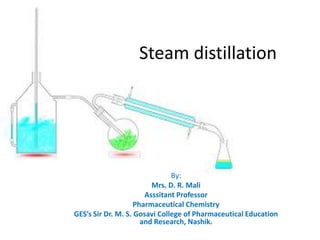
Steam distillation
By:
Mrs. D. R. Mali
Asssitant Professor
Pharmaceutical Chemistry
GES’s Sir Dr. M. S. Gosavi College of Pharmaceutical Education
and Research, Nashik.
 Distillation is the process of separating the
components or substances from a liquid mixture
by using selective boiling and condensation.
 It may result : Complete separation (pure
components), or Partial separation (selected
components in high conc.)
 In industrial chemistry, distillation is a unit
operation of practically universal importance.
 A physical separation process, not a chemical
reaction.
 Aspecial type of distillation
Temperature sensitive materials like
natural aromatic compounds.
It once was a popular laboratory method
for
purification of organic compounds.
Distillation at lower temperatures,
reducing the deterioration of the desired
products.
 Steam distillation may be applied under
reduced pressure: if the substances to be
distilled are very sensitive to heat.
 After distillation the vapours are condensed.
 The immediate product is a two-phase
system of water and the organic distillate,
allowing separation of the components by
decantation, partitioning or other suitable
methods.
 When a mixture of two practically immiscible
liquids is heated liquid exerts its own vapour
pressure as a function of temperature as if
the other constituent were not present.
 The vapour pressure of the whole system
increases.
 Boiling begins when the sum of the vapour
pressures of the two immiscible liquids just
exceeds the atmospheric pressure.
 In this way, many organic compounds insoluble
in water can be purified at a temperature well
below the point at which decomposition occurs.
 For example, the boiling point of bromobenzene
is 156 °C and the boiling point of water is 100 °C,
but a mixture of the two boils at 95 °C.
 Thus, bromobenzene can be easily distilled at a
temperature 61 °C below its normal boiling
point.
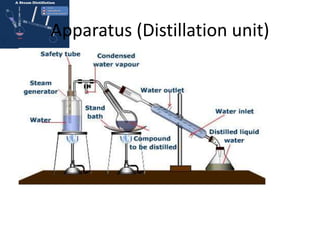
Apparatus (Distillation unit)
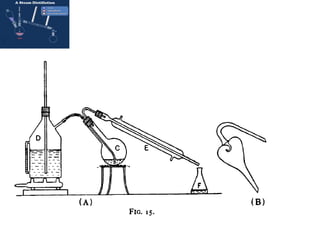
• A round-bottomed flask (C)
• A glass inlet tube which reaches almost to the
bottom of the flask
• A steam generator (D)
• Water condenser (double surface type) (E)
• An additional a still-head (B)
• Receiver (F)
The flask is clamped at an angle.
To prevent the solution in C from being
splashed into the entrance of the outlet
tube.
An addition a still-head is used in place of
the outlet tube, since spray will be
trapped in the still-head, and returned as
a steady stream of liquid to the flask C.
 A vigorous current of steam blown in from D.
 The mixture in C is thus rapidly heated
 The vapour of the organic compound mixed
with steam passes over and is condensed in
E.
 If the flask C contains a large volume of
material or material which requires
prolonged distillation, it should be heated by
a Bunsen burner.
 If the organic compound which is being
steam-distilled is freely soluble in water, an
aqueous solution will ultimately collect in the
receiver F.
 The compound must then be isolated by
ether extraction, etc.
 Alternatively, a water-insoluble compound, if
liquid, will form a separate layer in F, or if
solid, will probably crystallise in the aqueous
distillate.
Applications
It is employed in the manufacture of essential
oils, for use in perfumes for example. In this
method, steam is passed through plant material
containing desired oils.
Eucalyptus oil and orange oil obtained in the
industrial scale.
It is used to separate intermediate or final
products during synthesis of complex organic
compounds.
Also widely used in petroleum refineries and
petrochemical plants.
Steam distillation

Steam distillation

  • 1.
    Steam distillation By: Mrs. D.R. Mali Asssitant Professor Pharmaceutical Chemistry GES’s Sir Dr. M. S. Gosavi College of Pharmaceutical Education and Research, Nashik.
  • 2.
     Distillation isthe process of separating the components or substances from a liquid mixture by using selective boiling and condensation.  It may result : Complete separation (pure components), or Partial separation (selected components in high conc.)  In industrial chemistry, distillation is a unit operation of practically universal importance.  A physical separation process, not a chemical reaction.
  • 3.
     Aspecial typeof distillation Temperature sensitive materials like natural aromatic compounds. It once was a popular laboratory method for purification of organic compounds. Distillation at lower temperatures, reducing the deterioration of the desired products.
  • 4.
     Steam distillationmay be applied under reduced pressure: if the substances to be distilled are very sensitive to heat.  After distillation the vapours are condensed.  The immediate product is a two-phase system of water and the organic distillate, allowing separation of the components by decantation, partitioning or other suitable methods.
  • 5.
     When amixture of two practically immiscible liquids is heated liquid exerts its own vapour pressure as a function of temperature as if the other constituent were not present.  The vapour pressure of the whole system increases.  Boiling begins when the sum of the vapour pressures of the two immiscible liquids just exceeds the atmospheric pressure.
  • 6.
     In thisway, many organic compounds insoluble in water can be purified at a temperature well below the point at which decomposition occurs.  For example, the boiling point of bromobenzene is 156 °C and the boiling point of water is 100 °C, but a mixture of the two boils at 95 °C.  Thus, bromobenzene can be easily distilled at a temperature 61 °C below its normal boiling point.
  • 7.
  • 8.
    • A round-bottomedflask (C) • A glass inlet tube which reaches almost to the bottom of the flask • A steam generator (D) • Water condenser (double surface type) (E) • An additional a still-head (B) • Receiver (F)
  • 9.
    The flask isclamped at an angle. To prevent the solution in C from being splashed into the entrance of the outlet tube. An addition a still-head is used in place of the outlet tube, since spray will be trapped in the still-head, and returned as a steady stream of liquid to the flask C.
  • 10.
     A vigorouscurrent of steam blown in from D.  The mixture in C is thus rapidly heated  The vapour of the organic compound mixed with steam passes over and is condensed in E.  If the flask C contains a large volume of material or material which requires prolonged distillation, it should be heated by a Bunsen burner.
  • 11.
     If theorganic compound which is being steam-distilled is freely soluble in water, an aqueous solution will ultimately collect in the receiver F.  The compound must then be isolated by ether extraction, etc.  Alternatively, a water-insoluble compound, if liquid, will form a separate layer in F, or if solid, will probably crystallise in the aqueous distillate.
  • 13.
    Applications It is employedin the manufacture of essential oils, for use in perfumes for example. In this method, steam is passed through plant material containing desired oils. Eucalyptus oil and orange oil obtained in the industrial scale. It is used to separate intermediate or final products during synthesis of complex organic compounds. Also widely used in petroleum refineries and petrochemical plants.