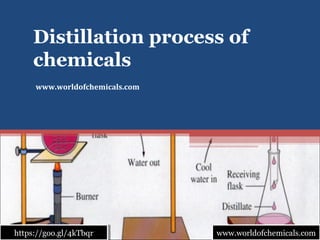
Distillation process of
chemicals
www.worldofchemicals.comwww.worldofchemicals.comhttps://goo.gl/4kTbqrhttps://goo.gl/4kTbqr
www.worldofchemicals.com
What is carbon?
• The process of distillation starts when a liquid is heated to boiling
point. The liquid starts evaporate, by appearing in a vapor form.
• Distillation is expended to detach liquids from nonvolatile solids, as
in the separation of alcoholic liquors from fermented materials, or
in the separation of two or more liquids with distinct boiling points,
as in the separation of gasoline, kerosene, and lubricating oil from
crude oil.
• Further, industrial applications incorporate the processing of the
chemical products that is as formaldehyde, phenol and the
purification of seawater.
www.worldofchemicals.comwww.worldofchemicals.comhttps://goo.gl/4kTbqrhttps://goo.gl/4kTbqr
Types of distillation
• Batch distillation: A combination of twofold instable components 
is warmed till it gets boiled. The suspension will comprise a greater 
concentration of the above volatile component, thus more of it will 
be reduced and detached from the system. This alters the ratio of 
substance in the boiling mixture, increasing its boiling point.
• Continuous distillation: Continuous Distillation is a continuing 
process, through a new liquid fed into the process and disconnected 
segments constantly removed. Since the new material is used as an 
input, the absorptions of the components will not vary as in batch 
distillation.
www.worldofchemicals.comwww.worldofchemicals.comhttps://goo.gl/4kTbqrhttps://goo.gl/4kTbqr
• Simple distillation: In simple distillation, vapors enter in the 
condenser, cools and vapors are collected. The subsequent liquid 
has a structure matching to that of the vapor, therefore simple 
distillation is used when components have greatly different boiling 
points or to separate volatile from non-volatile components.
• Fractional distillation: Batch and continuous distillation may 
integrate to fractional distillation, which includes use of a 
fractionating column above the distillation bottle. The column has a 
greater surface area, letting for more effectual condensation of 
vapor and an enhanced separation. Fractionating column might also 
be set up to contain subsystems with distinct liquid-vapor 
equilibrium values.
www.worldofchemicals.comwww.worldofchemicals.comhttps://goo.gl/4kTbqrhttps://goo.gl/4kTbqr
• Steam distillation: Steam distillation is a way utilized for 
distilling composites that are heat subtle. For steam distillation 
water is added to the distilling bottle. Boiling point of the 
constituents’ descents as these might be parted at a lower 
temperature of the component’s decomposition point.
www.worldofchemicals.comwww.worldofchemicals.comhttps://goo.gl/4kTbqrhttps://goo.gl/4kTbqr
Industrial application of
distillation process
• Distillation process is used in chemistry to disperse and cleanse 
liquids.
• Distillation is exploited in making vinegar, alcoholic beverages and 
purified water. It is a one of the ancient technique of desalinating 
water.
• Distillation is also used on an industrial scale for the purpose of 
purifying chemicals.
• Fossil fuel industry utilizes distillation to discrete components of 
crude oil to prepare chemical feedstock, fuel and petroleum.
www.worldofchemicals.comwww.worldofchemicals.comhttps://goo.gl/4kTbqrhttps://goo.gl/4kTbqr
Thank You
https://goo.gl/4kTbqr
To read this article follow the link:

Distillation