DISTILLATION
DISTILLATION
Distillation is a process in which a liquid or vapour mixture of two or
more substances is separated into its component fractions of desired
purity, by theapplication and removal of heat.
Distillation is done on the basis of differences in their
volatilities in a boiling liquid mixture. Distillation is a
physical separation process, and not a chemical reaction.
Principle:
Separation of componentsfrom aliquid mixtureviadistillation depends
on the differences in boiling points of the individual
components. And also depends on the vapour pressure
characteristics of liquid mixtures.
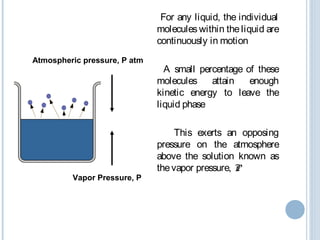
For any liquid, the individual
molecules within theliquid are
continuously in motion
A small percentage of these
molecules attain enough
kinetic energy to leave the
liquid phase
This exerts an opposing
pressure on the atmosphere
above the solution known as
thevapor pressure, P
Atmospheric pressure, P atm
Vapor Pressure, P
P < P atm P ≥ P atm
When enough energy, in the form of heat, is imparted to
the solution the vapor pressure becomes equal to
the atmospheric pressure and the liquid begins to
boil
RAOULT’SLAW
 In a solution of two miscible liquids (A & B) the partial
pressure of component “A” (PA) in the solution equals
the partial pressure of pure “A” (PA
o
) times its mole fraction
(NA)
 Partial Pressure of A in solution = PA = (PA
o
) x (NA)
 Partial Pressure of Bin solution = PB = (PB
o
) x (NB)
 When the total pressure (sum of the partial pressures) is
equal to or greater than the applied pressure, normally
Atmospheric Pressure(760 mm Hg), thesolution boils
Ptotal = PA + PB
= PA
o
NA + PB
o
NB
 If the sum of the two partial pressures of the two compounds
in amixtureislessthan theapplied pressure, themixturewill
not boil. The solution must be heated until the combined
vapor pressureequalstheapplied pressure
VAPOR ENRICHMENT
 From Raoult’sLaw wecan obtain thefollowing relationships:
 NNAA
vaporvapor
==P˚P˚AA/P/PTT
And
 NNBB
vaporvapor
==P˚P˚BB/P/PTT
 If AA ismorevolatilethan BB, BPAA < BPBB and P˚P˚AA > P˚P˚BB
Then
 NNAA
vaporvapor
>>NNAA
liquidliquid
 The result of this process is that when a mixture of two miscible
liquids with different boiling points is heated, the vapor will have a
different composition than the liquid. THE VAPOR ISTHE VAPOR IS
ENRICHED IN THE MORE VOLATILE (LOWER BOILING)ENRICHED IN THE MORE VOLATILE (LOWER BOILING)
COMPONENTCOMPONENT.
TYPESOF DISTILLATION
 Simple Distillation
 Fractional Distillation
 Vacuum Distillation
 Azeotropic Distillation
Simple
Distillation
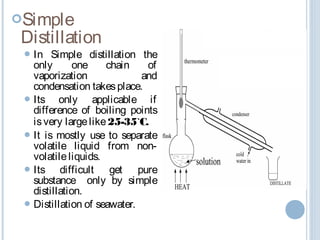
In Simple distillation the
only one chain of
vaporization and
condensation takesplace.
Its only applicable if
difference of boiling points
isvery largelike25-35`C.
It is mostly use to separate
volatile liquid from non-
volatileliquids.
Its difficult get pure
substance only by simple
distillation.
Distillation of seawater.
 Fractional
Distillation
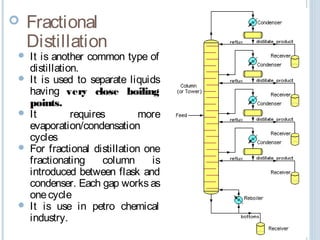
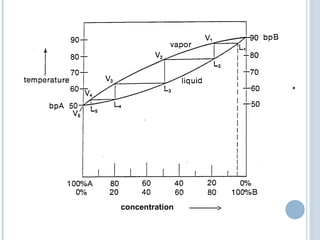
 It is another common type of
distillation.
 It is used to separate liquids
having very close boiling
points.
 It requires more
evaporation/condensation
cycles
 For fractional distillation one
fractionating column is
introduced between flask and
condenser. Each gap works as
onecycle
 It is use in petro chemical
industry.
concentration
Vacuum Distillation
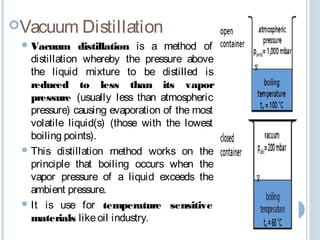
Vacuum distillation is a method of
distillation whereby the pressure above
the liquid mixture to be distilled is
reduced to less than its vapor
pressure (usually less than atmospheric
pressure) causing evaporation of the most
volatile liquid(s) (those with the lowest
boiling points).
This distillation method works on the
principle that boiling occurs when the
vapor pressure of a liquid exceeds the
ambient pressure.
It is use for temperature sensitive
materials likeoil industry.
AZEOTROPIC DISTILLATION
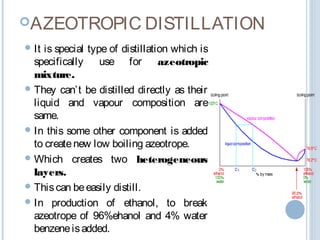
It is special type of distillation which is
specifically use for azeotropic
mixture.
They can’t be distilled directly as their
liquid and vapour composition are
same.
In this some other component is added
to createnew low boiling azeotrope.
Which creates two heterogeneous
layers.
Thiscan beeasily distill.
In production of ethanol, to break
azeotrope of 96%ehanol and 4% water
benzeneisadded.
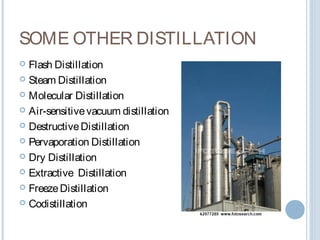
SOME OTHER DISTILLATION
 Flash Distillation
 Steam Distillation
 Molecular Distillation
 Air-sensitivevacuum distillation
 DestructiveDistillation
 Pervaporation Distillation
 Dry Distillation
 Extractive Distillation
 FreezeDistillation
 Codistillation
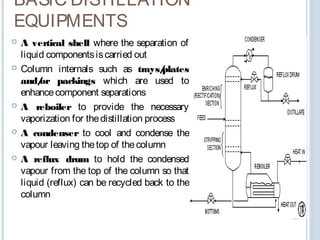
BASIC DISTILLATION
EQUIPMENTS
 A vertical shell where the separation of
liquid componentsiscarried out
 Column internals such as trays/plates
and/or packings which are used to
enhancecomponent separations
 A reboiler to provide the necessary
vaporization for thedistillation process
 A condenser to cool and condense the
vapour leaving thetop of thecolumn
 A reflux drum to hold the condensed
vapour from the top of the column so that
liquid (reflux) can be recycled back to the
column
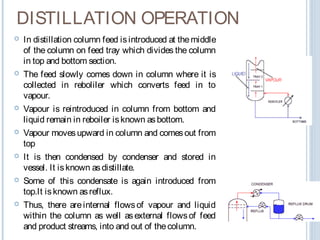
DISTILLATION OPERATION
 In distillation column feed is introduced at themiddle
of the column on feed tray which divides the column
in top and bottom section.
 The feed slowly comes down in column where it is
collected in reboliler which converts feed in to
vapour.
 Vapour is reintroduced in column from bottom and
liquid remain in reboiler isknown asbottom.
 Vapour movesupward in column and comesout from
top
 It is then condensed by condenser and stored in
vessel. It isknown asdistillate.
 Some of this condensate is again introduced from
top.It isknown asreflux.
 Thus, there are internal flows of vapour and liquid
within the column as well as external flows of feed
and product streams, into and out of thecolumn.
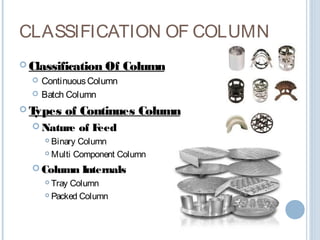
CLASSIFICATION OF COLUMN
 Classification Of Column
 ContinuousColumn
 Batch Column
 Types of Continues Column
 Nature of Feed
 Binary Column
 Multi Component Column
 Column Internals
 Tray Column
 Packed Column
THANK YOU…

Distillation

  • 1.
  • 2.
    DISTILLATION Distillation is aprocess in which a liquid or vapour mixture of two or more substances is separated into its component fractions of desired purity, by theapplication and removal of heat. Distillation is done on the basis of differences in their volatilities in a boiling liquid mixture. Distillation is a physical separation process, and not a chemical reaction. Principle: Separation of componentsfrom aliquid mixtureviadistillation depends on the differences in boiling points of the individual components. And also depends on the vapour pressure characteristics of liquid mixtures.
  • 3.
    For any liquid,the individual molecules within theliquid are continuously in motion A small percentage of these molecules attain enough kinetic energy to leave the liquid phase This exerts an opposing pressure on the atmosphere above the solution known as thevapor pressure, P Atmospheric pressure, P atm Vapor Pressure, P
  • 4.
    P < Patm P ≥ P atm When enough energy, in the form of heat, is imparted to the solution the vapor pressure becomes equal to the atmospheric pressure and the liquid begins to boil
  • 5.
    RAOULT’SLAW  In asolution of two miscible liquids (A & B) the partial pressure of component “A” (PA) in the solution equals the partial pressure of pure “A” (PA o ) times its mole fraction (NA)  Partial Pressure of A in solution = PA = (PA o ) x (NA)  Partial Pressure of Bin solution = PB = (PB o ) x (NB)  When the total pressure (sum of the partial pressures) is equal to or greater than the applied pressure, normally Atmospheric Pressure(760 mm Hg), thesolution boils Ptotal = PA + PB = PA o NA + PB o NB  If the sum of the two partial pressures of the two compounds in amixtureislessthan theapplied pressure, themixturewill not boil. The solution must be heated until the combined vapor pressureequalstheapplied pressure
  • 6.
    VAPOR ENRICHMENT  FromRaoult’sLaw wecan obtain thefollowing relationships:  NNAA vaporvapor ==P˚P˚AA/P/PTT And  NNBB vaporvapor ==P˚P˚BB/P/PTT  If AA ismorevolatilethan BB, BPAA < BPBB and P˚P˚AA > P˚P˚BB Then  NNAA vaporvapor >>NNAA liquidliquid  The result of this process is that when a mixture of two miscible liquids with different boiling points is heated, the vapor will have a different composition than the liquid. THE VAPOR ISTHE VAPOR IS ENRICHED IN THE MORE VOLATILE (LOWER BOILING)ENRICHED IN THE MORE VOLATILE (LOWER BOILING) COMPONENTCOMPONENT.
  • 7.
    TYPESOF DISTILLATION  SimpleDistillation  Fractional Distillation  Vacuum Distillation  Azeotropic Distillation
  • 8.
    Simple Distillation In Simple distillationthe only one chain of vaporization and condensation takesplace. Its only applicable if difference of boiling points isvery largelike25-35`C. It is mostly use to separate volatile liquid from non- volatileliquids. Its difficult get pure substance only by simple distillation. Distillation of seawater.
  • 9.
     Fractional Distillation  Itis another common type of distillation.  It is used to separate liquids having very close boiling points.  It requires more evaporation/condensation cycles  For fractional distillation one fractionating column is introduced between flask and condenser. Each gap works as onecycle  It is use in petro chemical industry.
  • 10.
  • 11.
    Vacuum Distillation Vacuum distillationis a method of distillation whereby the pressure above the liquid mixture to be distilled is reduced to less than its vapor pressure (usually less than atmospheric pressure) causing evaporation of the most volatile liquid(s) (those with the lowest boiling points). This distillation method works on the principle that boiling occurs when the vapor pressure of a liquid exceeds the ambient pressure. It is use for temperature sensitive materials likeoil industry.
  • 12.
    AZEOTROPIC DISTILLATION It isspecial type of distillation which is specifically use for azeotropic mixture. They can’t be distilled directly as their liquid and vapour composition are same. In this some other component is added to createnew low boiling azeotrope. Which creates two heterogeneous layers. Thiscan beeasily distill. In production of ethanol, to break azeotrope of 96%ehanol and 4% water benzeneisadded.
  • 13.
    SOME OTHER DISTILLATION Flash Distillation  Steam Distillation  Molecular Distillation  Air-sensitivevacuum distillation  DestructiveDistillation  Pervaporation Distillation  Dry Distillation  Extractive Distillation  FreezeDistillation  Codistillation
  • 14.
    BASIC DISTILLATION EQUIPMENTS  Avertical shell where the separation of liquid componentsiscarried out  Column internals such as trays/plates and/or packings which are used to enhancecomponent separations  A reboiler to provide the necessary vaporization for thedistillation process  A condenser to cool and condense the vapour leaving thetop of thecolumn  A reflux drum to hold the condensed vapour from the top of the column so that liquid (reflux) can be recycled back to the column
  • 15.
    DISTILLATION OPERATION  Indistillation column feed is introduced at themiddle of the column on feed tray which divides the column in top and bottom section.  The feed slowly comes down in column where it is collected in reboliler which converts feed in to vapour.  Vapour is reintroduced in column from bottom and liquid remain in reboiler isknown asbottom.  Vapour movesupward in column and comesout from top  It is then condensed by condenser and stored in vessel. It isknown asdistillate.  Some of this condensate is again introduced from top.It isknown asreflux.  Thus, there are internal flows of vapour and liquid within the column as well as external flows of feed and product streams, into and out of thecolumn.
  • 16.
    CLASSIFICATION OF COLUMN Classification Of Column  ContinuousColumn  Batch Column  Types of Continues Column  Nature of Feed  Binary Column  Multi Component Column  Column Internals  Tray Column  Packed Column
  • 17.