MIT-WPU | School of Pharmacy
WORLD’S FIRST UNIVERSITY
FOR LIFE TRANSFORMATION
Hyphenated Chromatographic Method And
Chip Based Chromatography Separation
Name: Ms. Rutuja Sanjay Desai
Class and Sem: 1st Yr. Ph.D, Sem-I
ERP No: 1102231006
Email: rutuja.sanjay@mitwpu.edu.in
12/20/2023 1
2023-2024
Presentation on
12/20/2023 2
HYPHENATED TECHNIQUES
• Hyphenated technique is a combination or coupling of two analytical
techniques with the help of proper interface.
• The hyphenated technique is developed from the coupling of a
separation technique and detection technique. The term "hyphenation"
was first adapted by Hirschfeld in 1980 to refer to the on-line
combination of a separation technique and one or more spectroscopic
detection techniques.
• The aim of the coupling is to obtain an information-rich detection for
both identification and quantification compared to that with a single
analytical technique.
12/20/2023 3
For fast and accurate analysis
• A Higher degree of automation.
• Higher sample throughput.
• Better reproducibility.
• Reduction of contamination due to its closed system.
• Separation of quantification at the same time.
ADVANTAGES
12/20/2023 4
Double hyphenated techniques.
Triple hyphenated techniques.
Double hyphenated techniques:
• LC-MS
• LC-NMR
• LC-IR
• CE-MS
• GC-IR
• GC-MS
• HPLC-DAD
• GC-FTIR
TYPES OF HYPHENATED TECHNIQUES
12/20/2023 5
• Gas Chromatography - Mass Spectrometry (GC-MS) is an analytical
method that combines the features of gas chromatography and mass
spectrometry to identify different substances with in a test sample.
• GC-MS separates chemical mixtures into individual components (using a
gas chromatograph) and identifies / quantifies the components at a
molecular level (using a MS detector).
• It is one of the most accurate and efficient tools for analyzing volatile
organic samples.
• Mass spectrometer (MS) is an instrument that serves for establishment of
the molecular weight and structure of both inorganic and organic
compounds, and the identification and determination of analytes in
complex mixtures.
HYPHENATED TECHNIQUE (GC-MS/MS)
12/20/2023 6
GC-MS instrument separates chemical mixtures (the GC component)
and identifies the components at a molecular level (the MS
component).
GC works on the principle that a mixture will separate into individual
substances when heated.
The heated gases are carried through a column with an inert gas.
•As the separated substances emerge from the column opening, they
flow into MS.
•Mass spectrometry identifies compounds by the mass of the analyte
molecule.
PRINCIPLE
12/20/2023 7
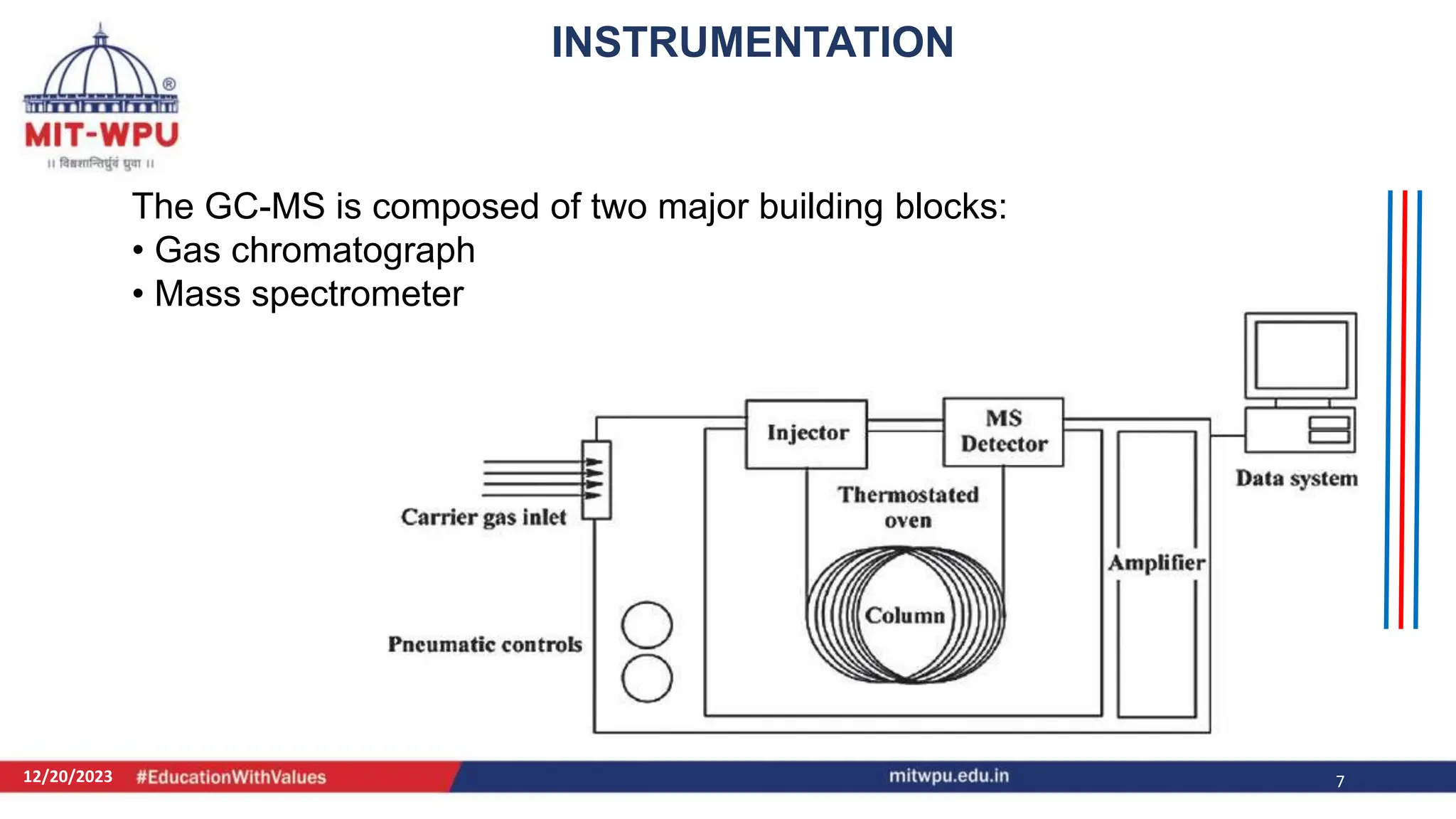
The GC-MS is composed of two major building blocks:
• Gas chromatograph
• Mass spectrometer
INSTRUMENTATION
12/20/2023 8
The molecules are retained by the capillary column and elute from the
column at different times.
• The Mass spectrometer capture, ionize, accelerate, deflect and
detect the ionized molecules separately by breaking each molecule
into ionize fragments and detecting these fragments using their mass
to charge ratio.
Types of Mass spectrometer Detectors:
1. Quadrupole Mass Spectrometer- most common
2. Ion Trap Mass Spectrometer
3. Magnetic Mass Spectrometer
INSTRUMENTATION
12/20/2023 9
• Accurate identification of a particular molecule is possible.
• Differentiate between multiple molecules in the same amount of
time.
• Identification carried out at a molecular level.
• Easy to Operate.
ADVANTAGES OF GC-MS
12/20/2023 10
• Quantitation of pollutants in drinking and waste water.
• Identification of unknown organic compounds in hazardous waste
dumps and reaction products by synthetic organic chemistry
• Quantitation of drug in metabolites and urine is done for the
pharmacological and forensic use.
• Used for drug analysis, pesticide and herbicide detection
• Characterization of odour and flavor component of food
• Law enforcement
• Sports Anti- doping analysis
• Medical Diagnosis
• Security of Airports
• Criminal Forensics
APPLICATION
12/20/2023 11
• The coupling of MS with LC (LC-MS) was an obvious extension but
progress in this area was limited for many years due to the relative
incompatibility of existing MS ion sources with a continuous liquid
stream.
• The reasons for choosing LC-MS over LC with conventional detectors
are essentially the same as with GC-MS, namely high specificity and the
ability to handle complex mixtures.
• Analytes are separated by Liquid Chromatography (LC) prior to
analysis by Mass Spectrometry (MS)
• Provides enhanced specificity, based on retention times
• Reduces the number of molecules entering the MS ionization source at
a given time
• reduces the competition for charge
Liquid Chromatography-Mass Spectrometry
(LC/MS)
12/20/2023 12
Liquid chromatography-mass spectrometry is the technique which
performs separation by liquid chromatography and mass analysis with
the help of the mass spectrometry.
Liquid chromatography tandem mass spectrometry (LC-MS/MS)
• Liquid Chromatography
• Separates mixture components
• Based on polarity
• Tandem Mass Spectrometry
• Detector
• Identification & Quantification of components
• Based on compound mass
PRINCIPLE
12/20/2023 13
It is now generally accepted as the preferred technique for quantitation of
small molecule drugs, metabolites in biological matrices (plasma, blood,
serum, urine, and tissue)
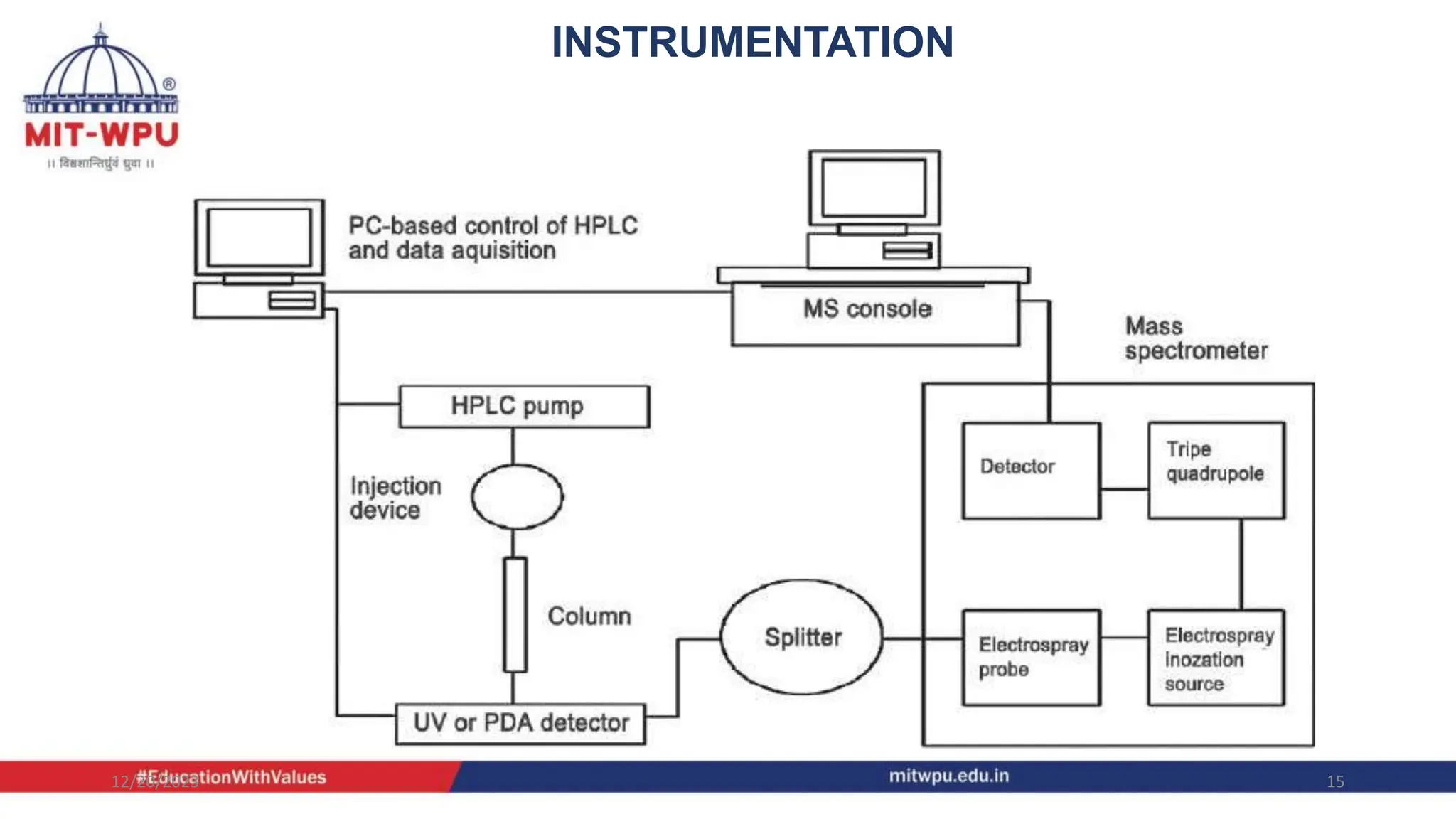
• Electrospray needle is used as bridge to connect the liquid
chromatography with that of the mass.
• LC-MS is mainly separated into the three parts-
• Chromatography - In liquid chromatography separation is performed
which is detected with the help of Photo diode Array.
• These separated components then transferred to the interface.
• 2. Interface - In interface the liquid is volatilized and transferred to the
MS.
• 3. Spectrometry - With the help of various ionization techniques the
compound is ionized and then it is analyzed by mass analyzer.
PRINCIPLE
12/20/2023 14
Various mass analyzers are used viz. Quadrupoles, quadrupole ion
traps, time-to-flight (TOF), time-to-flight reflection (TOFR), and ion
cyclotron resonance (ICR) mass analyzers.
It is a method that combines separation power of HPLC with detection
power of Mass spectrometry.
• In LC-MS we remove the detector from the column of LC and fit the
column to interface of MS.
• In most of the cases the interface used in LC-MS are ionization source
• A liquid sample is introduced into the ionization source of the mass
spectrometer.
Example: Extracts from plasma, serum, whole blood, Urine, CSF, etc.
INSTRUMENTATION
12/20/2023 15
INSTRUMENTATION
12/20/2023 16
• Mass spectrometers work by ionizing molecules and then sorting and
identifying the ions according to their mass- to-charge (m/z) ratios.
The mobile phase is the solvent that moves the solute throughout
column.
Solvent strength and selectivity: - It is the ability of solvent to elute
solutes from a column.
COLUMN
The use of di-functional or tri-functional silanes to create bonded groups
with two or three attachment points leading to phases with higher stability
in low or higher pH and lower bleed for LC-MS
• Most widely used columns for LC-MS are: -
(1) fast LC column :- the use of short column. (15-50mm)
(2) Micro LC column :- the use of large column. (20-150mm)
LC-MS SYSTEM COMPONENTS
12/20/2023 17
• Accuracy and Precision
• Robustness
• Sensitivity
• Allows multi-analyte panels
• Requires less sample prep
• Compatible with generic sample prep
• Versatility, can easily add new compounds
• Lower cost-per-sample
• Speed
ADVANTAGES OF LC-MS/MS
12/20/2023 18
• LC-MS used to detect compounds from polyaromatic (non-polar) to
peptide and proteins.
• LC-MS used for compounds identification and purity.
• Used for determination of pesticides, herbicides & organic pollutant
for environmental monitoring.
• Proteome analysis is done by this technique.
APPLICATIONS
12/20/2023 19
• The direct coupling of TLC/HPTLC with mass spectrometry (MS) is of
particular interest because of the later's high sensitivity, rapid analysis,
and ability to aid structural characterization.
• TLC-MS is a versatile technique for separation as well as identification
of Pharmaceuticals and Phytopharmaceuticals. Traditionally the
separation was carried out by TLC/HPTLC then the separated
materials was removed and then identified by Mass spectrometry.
• This technique provides efficient, quick and simple method for
identification and separation of Narcotic drugs and psychotropic
substances.
HPTLC-MS
12/20/2023 20
• HPTLC-MS is cost-effective because the chromatographic run is
decoupled with the detection step.
• Rapid and contamination-free elution of selected zones.
• Online transfer into the mass spectrometer.
• Advantages of HPTLC include that the technique is simple to learn,
operate, several analysis works could be done on same time, is a fast and
economic technique.
• Thin layer chromatography/high-performance thin-layer chromatography
can be used interchangeably for methods developed in the twenty-first
century.
KEY FEATURES
12/20/2023 21
• The versatile instrument is used to isolate unknown compounds from a
HPTLC/TLC plate and transfer them into a mass spectrometer for
identification or structure elucidation.
• TLC/MS Interface can be bring together to any brand of LC-coupled
mass spectrometer.
• Plug and play installation by two HPLC fittings at a given HPLC-MS
system.
• Semi-automatic instrument involving automatic piston movement for
pressure seal the HPTLC/TLC zone on both glass plates and aluminum
foils take out directly from the plate using a suitable solvent delivered by
theHPLC/HPTLC pump Online transfer into the mass spectrometer.
• Automatic cleaning of the piston between the extractions.
HPTLC-S PRINCIPLE
12/20/2023 22
CHIP BASED CHROMATOGRAPHIC SEPARATION
12/20/2023 23
is a new revolutionary microfluidic chip-based technology specifically
designed for nanospray LC/MS most often used for applications with
limited sample amounts or when there is a need for analysis of trace level
components in complex mixtures
Problems of nanospray:
• use of multiple small capillary tubing connections
• frequent clogging or leaking at the columns and nanospray needle
Solution by HPLC-Chip/MS system
• integrate all components directly onto a reusable biocompatible polymer
HPLC-Chip.
• HPLC Chip Cube MS interface module performs• Solvent and sample
delivery to the chip,
• high pressure switching of flows and
• automated chip loading and positioning in the MS source
12/20/2023 24
•Eliminates the traditional fittings, valves and connections.
•Reduces the possibility of leaks and eliminates all post-column dead
volumes
•Peak dispersion is virtually eliminated, resulting in narrower, better-fetined
peaks angefined peaks and greatly improved separations
12/20/2023 25
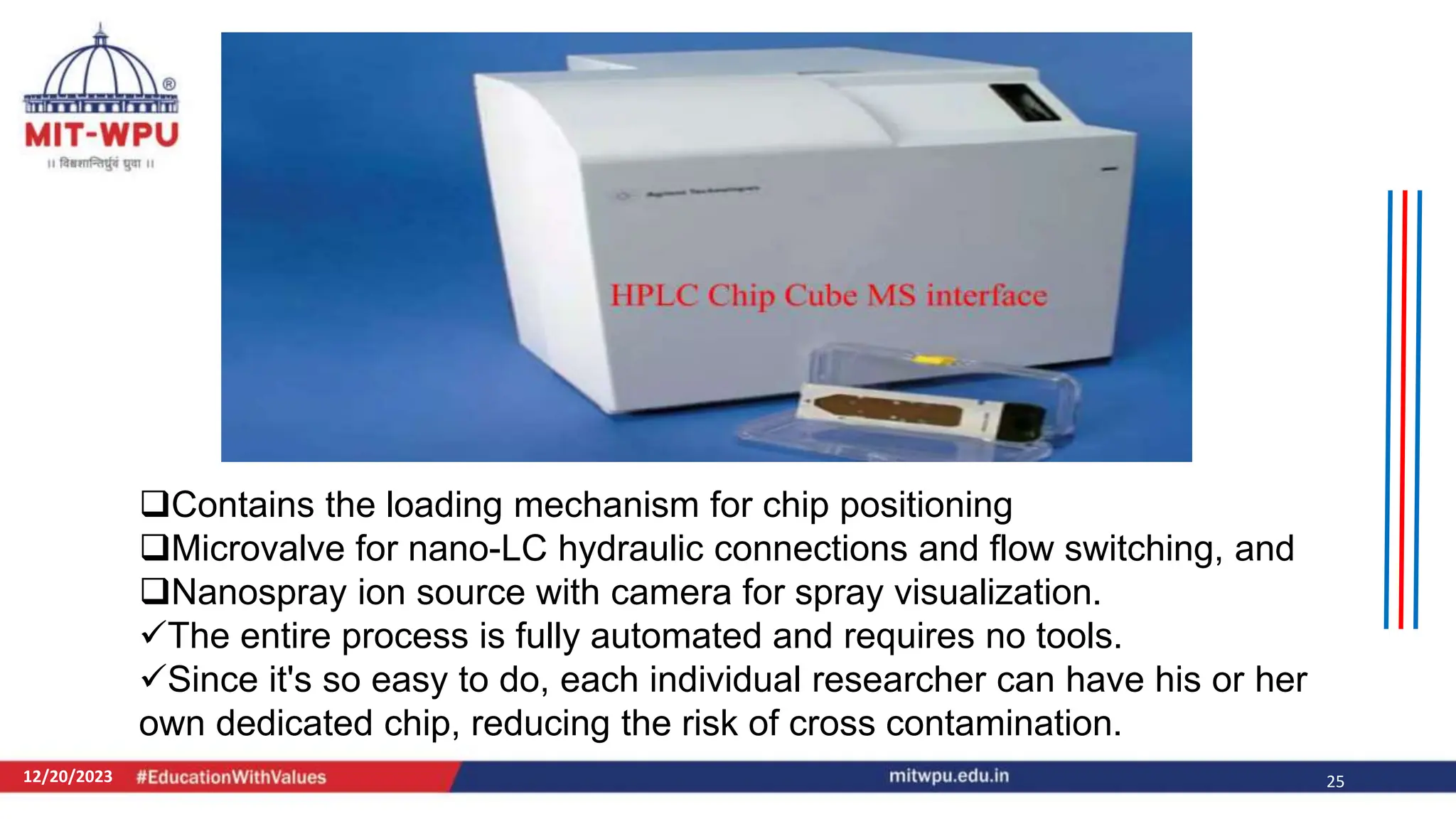
Contains the loading mechanism for chip positioning
Microvalve for nano-LC hydraulic connections and flow switching, and
Nanospray ion source with camera for spray visualization.
The entire process is fully automated and requires no tools.
Since it's so easy to do, each individual researcher can have his or her
own dedicated chip, reducing the risk of cross contamination.
12/20/2023 26
Automatic HPLC Chip Loading
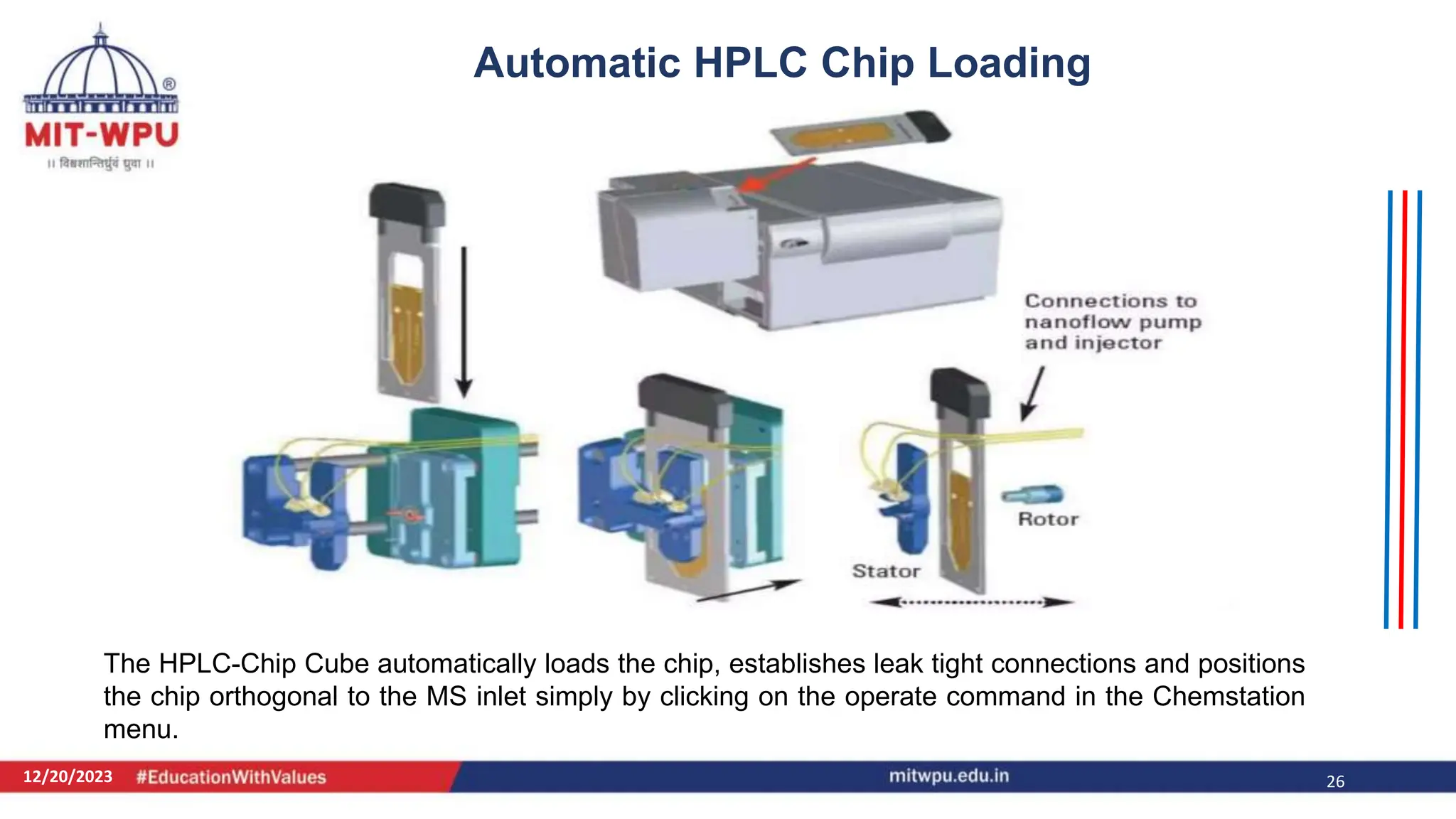
The HPLC-Chip Cube automatically loads the chip, establishes leak tight connections and positions
the chip orthogonal to the MS inlet simply by clicking on the operate command in the Chemstation
menu.
12/20/2023 27
Unique rotor-in-rotor microwave for fluid delivery to multi-layered HPLC-Chip
12/20/2023 28
• The HPLC-Chip Cube MS interface is fully integrated with and controlled from Chem Station
software.
• Loading or replacement of the chip is simple and can be completed in a few seconds with a simple
mouse click
Chem-Station Operation for easy integration and control
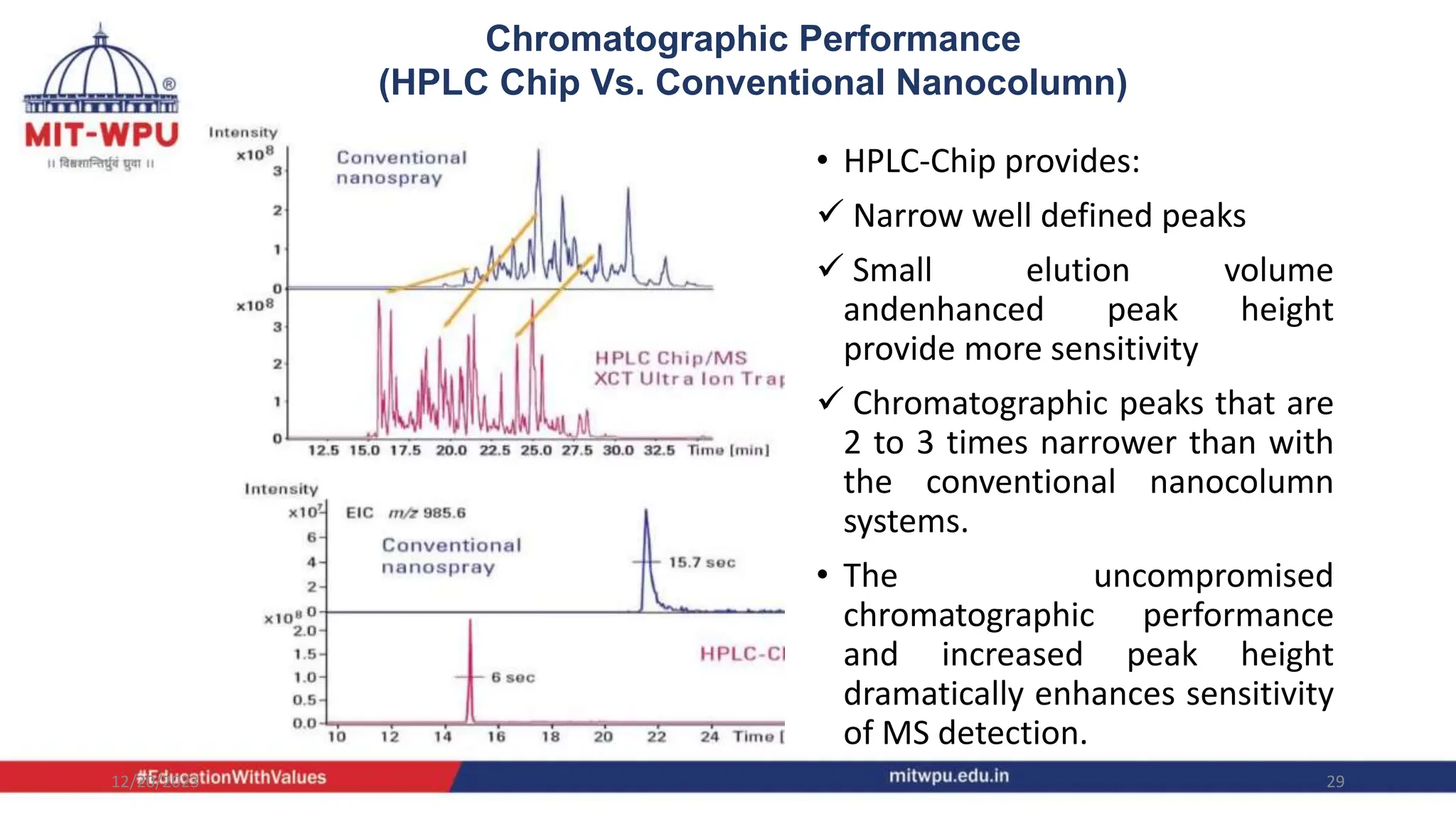
• HPLC-Chip provides:
 Narrow well defined peaks
 Small elution volume
andenhanced peak height
provide more sensitivity
 Chromatographic peaks that are
2 to 3 times narrower than with
the conventional nanocolumn
systems.
• The uncompromised
chromatographic performance
and increased peak height
dramatically enhances sensitivity
of MS detection.
12/20/2023 29
Chromatographic Performance
(HPLC Chip Vs. Conventional Nanocolumn)
12/20/2023 30
THANK YOU
S. No.124, Paud Road, Kothrud, Pune,
411038

Hyphenated Chromatography Techniques in Analysis

  • 1.
    MIT-WPU | Schoolof Pharmacy WORLD’S FIRST UNIVERSITY FOR LIFE TRANSFORMATION Hyphenated Chromatographic Method And Chip Based Chromatography Separation Name: Ms. Rutuja Sanjay Desai Class and Sem: 1st Yr. Ph.D, Sem-I ERP No: 1102231006 Email: rutuja.sanjay@mitwpu.edu.in 12/20/2023 1 2023-2024 Presentation on
  • 2.
    12/20/2023 2 HYPHENATED TECHNIQUES •Hyphenated technique is a combination or coupling of two analytical techniques with the help of proper interface. • The hyphenated technique is developed from the coupling of a separation technique and detection technique. The term "hyphenation" was first adapted by Hirschfeld in 1980 to refer to the on-line combination of a separation technique and one or more spectroscopic detection techniques. • The aim of the coupling is to obtain an information-rich detection for both identification and quantification compared to that with a single analytical technique.
  • 3.
    12/20/2023 3 For fastand accurate analysis • A Higher degree of automation. • Higher sample throughput. • Better reproducibility. • Reduction of contamination due to its closed system. • Separation of quantification at the same time. ADVANTAGES
  • 4.
    12/20/2023 4 Double hyphenatedtechniques. Triple hyphenated techniques. Double hyphenated techniques: • LC-MS • LC-NMR • LC-IR • CE-MS • GC-IR • GC-MS • HPLC-DAD • GC-FTIR TYPES OF HYPHENATED TECHNIQUES
  • 5.
    12/20/2023 5 • GasChromatography - Mass Spectrometry (GC-MS) is an analytical method that combines the features of gas chromatography and mass spectrometry to identify different substances with in a test sample. • GC-MS separates chemical mixtures into individual components (using a gas chromatograph) and identifies / quantifies the components at a molecular level (using a MS detector). • It is one of the most accurate and efficient tools for analyzing volatile organic samples. • Mass spectrometer (MS) is an instrument that serves for establishment of the molecular weight and structure of both inorganic and organic compounds, and the identification and determination of analytes in complex mixtures. HYPHENATED TECHNIQUE (GC-MS/MS)
  • 6.
    12/20/2023 6 GC-MS instrumentseparates chemical mixtures (the GC component) and identifies the components at a molecular level (the MS component). GC works on the principle that a mixture will separate into individual substances when heated. The heated gases are carried through a column with an inert gas. •As the separated substances emerge from the column opening, they flow into MS. •Mass spectrometry identifies compounds by the mass of the analyte molecule. PRINCIPLE
  • 7.
    12/20/2023 7 The GC-MSis composed of two major building blocks: • Gas chromatograph • Mass spectrometer INSTRUMENTATION
  • 8.
    12/20/2023 8 The moleculesare retained by the capillary column and elute from the column at different times. • The Mass spectrometer capture, ionize, accelerate, deflect and detect the ionized molecules separately by breaking each molecule into ionize fragments and detecting these fragments using their mass to charge ratio. Types of Mass spectrometer Detectors: 1. Quadrupole Mass Spectrometer- most common 2. Ion Trap Mass Spectrometer 3. Magnetic Mass Spectrometer INSTRUMENTATION
  • 9.
    12/20/2023 9 • Accurateidentification of a particular molecule is possible. • Differentiate between multiple molecules in the same amount of time. • Identification carried out at a molecular level. • Easy to Operate. ADVANTAGES OF GC-MS
  • 10.
    12/20/2023 10 • Quantitationof pollutants in drinking and waste water. • Identification of unknown organic compounds in hazardous waste dumps and reaction products by synthetic organic chemistry • Quantitation of drug in metabolites and urine is done for the pharmacological and forensic use. • Used for drug analysis, pesticide and herbicide detection • Characterization of odour and flavor component of food • Law enforcement • Sports Anti- doping analysis • Medical Diagnosis • Security of Airports • Criminal Forensics APPLICATION
  • 11.
    12/20/2023 11 • Thecoupling of MS with LC (LC-MS) was an obvious extension but progress in this area was limited for many years due to the relative incompatibility of existing MS ion sources with a continuous liquid stream. • The reasons for choosing LC-MS over LC with conventional detectors are essentially the same as with GC-MS, namely high specificity and the ability to handle complex mixtures. • Analytes are separated by Liquid Chromatography (LC) prior to analysis by Mass Spectrometry (MS) • Provides enhanced specificity, based on retention times • Reduces the number of molecules entering the MS ionization source at a given time • reduces the competition for charge Liquid Chromatography-Mass Spectrometry (LC/MS)
  • 12.
    12/20/2023 12 Liquid chromatography-massspectrometry is the technique which performs separation by liquid chromatography and mass analysis with the help of the mass spectrometry. Liquid chromatography tandem mass spectrometry (LC-MS/MS) • Liquid Chromatography • Separates mixture components • Based on polarity • Tandem Mass Spectrometry • Detector • Identification & Quantification of components • Based on compound mass PRINCIPLE
  • 13.
    12/20/2023 13 It isnow generally accepted as the preferred technique for quantitation of small molecule drugs, metabolites in biological matrices (plasma, blood, serum, urine, and tissue) • Electrospray needle is used as bridge to connect the liquid chromatography with that of the mass. • LC-MS is mainly separated into the three parts- • Chromatography - In liquid chromatography separation is performed which is detected with the help of Photo diode Array. • These separated components then transferred to the interface. • 2. Interface - In interface the liquid is volatilized and transferred to the MS. • 3. Spectrometry - With the help of various ionization techniques the compound is ionized and then it is analyzed by mass analyzer. PRINCIPLE
  • 14.
    12/20/2023 14 Various massanalyzers are used viz. Quadrupoles, quadrupole ion traps, time-to-flight (TOF), time-to-flight reflection (TOFR), and ion cyclotron resonance (ICR) mass analyzers. It is a method that combines separation power of HPLC with detection power of Mass spectrometry. • In LC-MS we remove the detector from the column of LC and fit the column to interface of MS. • In most of the cases the interface used in LC-MS are ionization source • A liquid sample is introduced into the ionization source of the mass spectrometer. Example: Extracts from plasma, serum, whole blood, Urine, CSF, etc. INSTRUMENTATION
  • 15.
  • 16.
    12/20/2023 16 • Massspectrometers work by ionizing molecules and then sorting and identifying the ions according to their mass- to-charge (m/z) ratios. The mobile phase is the solvent that moves the solute throughout column. Solvent strength and selectivity: - It is the ability of solvent to elute solutes from a column. COLUMN The use of di-functional or tri-functional silanes to create bonded groups with two or three attachment points leading to phases with higher stability in low or higher pH and lower bleed for LC-MS • Most widely used columns for LC-MS are: - (1) fast LC column :- the use of short column. (15-50mm) (2) Micro LC column :- the use of large column. (20-150mm) LC-MS SYSTEM COMPONENTS
  • 17.
    12/20/2023 17 • Accuracyand Precision • Robustness • Sensitivity • Allows multi-analyte panels • Requires less sample prep • Compatible with generic sample prep • Versatility, can easily add new compounds • Lower cost-per-sample • Speed ADVANTAGES OF LC-MS/MS
  • 18.
    12/20/2023 18 • LC-MSused to detect compounds from polyaromatic (non-polar) to peptide and proteins. • LC-MS used for compounds identification and purity. • Used for determination of pesticides, herbicides & organic pollutant for environmental monitoring. • Proteome analysis is done by this technique. APPLICATIONS
  • 19.
    12/20/2023 19 • Thedirect coupling of TLC/HPTLC with mass spectrometry (MS) is of particular interest because of the later's high sensitivity, rapid analysis, and ability to aid structural characterization. • TLC-MS is a versatile technique for separation as well as identification of Pharmaceuticals and Phytopharmaceuticals. Traditionally the separation was carried out by TLC/HPTLC then the separated materials was removed and then identified by Mass spectrometry. • This technique provides efficient, quick and simple method for identification and separation of Narcotic drugs and psychotropic substances. HPTLC-MS
  • 20.
    12/20/2023 20 • HPTLC-MSis cost-effective because the chromatographic run is decoupled with the detection step. • Rapid and contamination-free elution of selected zones. • Online transfer into the mass spectrometer. • Advantages of HPTLC include that the technique is simple to learn, operate, several analysis works could be done on same time, is a fast and economic technique. • Thin layer chromatography/high-performance thin-layer chromatography can be used interchangeably for methods developed in the twenty-first century. KEY FEATURES
  • 21.
    12/20/2023 21 • Theversatile instrument is used to isolate unknown compounds from a HPTLC/TLC plate and transfer them into a mass spectrometer for identification or structure elucidation. • TLC/MS Interface can be bring together to any brand of LC-coupled mass spectrometer. • Plug and play installation by two HPLC fittings at a given HPLC-MS system. • Semi-automatic instrument involving automatic piston movement for pressure seal the HPTLC/TLC zone on both glass plates and aluminum foils take out directly from the plate using a suitable solvent delivered by theHPLC/HPTLC pump Online transfer into the mass spectrometer. • Automatic cleaning of the piston between the extractions. HPTLC-S PRINCIPLE
  • 22.
    12/20/2023 22 CHIP BASEDCHROMATOGRAPHIC SEPARATION
  • 23.
    12/20/2023 23 is anew revolutionary microfluidic chip-based technology specifically designed for nanospray LC/MS most often used for applications with limited sample amounts or when there is a need for analysis of trace level components in complex mixtures Problems of nanospray: • use of multiple small capillary tubing connections • frequent clogging or leaking at the columns and nanospray needle Solution by HPLC-Chip/MS system • integrate all components directly onto a reusable biocompatible polymer HPLC-Chip. • HPLC Chip Cube MS interface module performs• Solvent and sample delivery to the chip, • high pressure switching of flows and • automated chip loading and positioning in the MS source
  • 24.
    12/20/2023 24 •Eliminates thetraditional fittings, valves and connections. •Reduces the possibility of leaks and eliminates all post-column dead volumes •Peak dispersion is virtually eliminated, resulting in narrower, better-fetined peaks angefined peaks and greatly improved separations
  • 25.
    12/20/2023 25 Contains theloading mechanism for chip positioning Microvalve for nano-LC hydraulic connections and flow switching, and Nanospray ion source with camera for spray visualization. The entire process is fully automated and requires no tools. Since it's so easy to do, each individual researcher can have his or her own dedicated chip, reducing the risk of cross contamination.
  • 26.
    12/20/2023 26 Automatic HPLCChip Loading The HPLC-Chip Cube automatically loads the chip, establishes leak tight connections and positions the chip orthogonal to the MS inlet simply by clicking on the operate command in the Chemstation menu.
  • 27.
    12/20/2023 27 Unique rotor-in-rotormicrowave for fluid delivery to multi-layered HPLC-Chip
  • 28.
    12/20/2023 28 • TheHPLC-Chip Cube MS interface is fully integrated with and controlled from Chem Station software. • Loading or replacement of the chip is simple and can be completed in a few seconds with a simple mouse click Chem-Station Operation for easy integration and control
  • 29.
    • HPLC-Chip provides: Narrow well defined peaks  Small elution volume andenhanced peak height provide more sensitivity  Chromatographic peaks that are 2 to 3 times narrower than with the conventional nanocolumn systems. • The uncompromised chromatographic performance and increased peak height dramatically enhances sensitivity of MS detection. 12/20/2023 29 Chromatographic Performance (HPLC Chip Vs. Conventional Nanocolumn)
  • 30.
    12/20/2023 30 THANK YOU S.No.124, Paud Road, Kothrud, Pune, 411038