ADDIE
A systematic instructional design model
What is ADDIE?
• A systematic approach (model) for
developing effective instruction.
• One of the most popular models in
instructional design.
• Outcome of each step feeds into the
subsequent step.
• Evaluation is ongoing throughout each layer
of design.
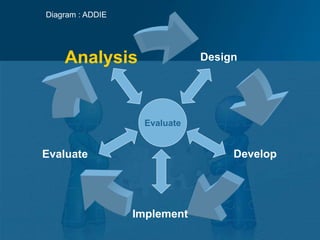
Design
Evaluate
Analysis
Develop
Implement
Evaluate
Diagram : ADDIE
Analysis
• During analysis, the designer identifies the
learning problem, the goals and objectives,
the audience’s needs, existing knowledge,
and any other relevant characteristics.
Analysis also considers the learning
environment, any constraints, the delivery
options, and the timeline for the project.
-- Learning-Theories.com: Knowledge base and webliography (n.d.). Retrieved
May 5, 2008 from http://www.learning-theories.com/addie-model.html
Masalah dikenalpasti melalui temubual,
pemerhatian, soal selidik dll.
Mengenalpasti punca masalah tersebut agar
matlamat dan objektif dapat dicapai dengan
mengambil kira pengetahuan sedia ada
pengguna dan juga keperluan pengguna untuk
pembelajaran berlaku.
Analisis juga mengambil kira persekitaran
pembelajaran, bentuk penyampaian, kekangan
yang wujud dan jangka masa projek.
Design
• A systematic process of specifying learning
objectives. Detailed storyboards and
prototypes are often made, and the look and
feel, graphic design, user-interface and
content is determined here.
-- Learning-Theories.com: Knowledge base and webliography (n.d.). Retrieved
May 5, 2008 from http://www.learning-theories.com/addie-model.html
Development
• The actual creation (production) of the
content and learning materials based on the
Design phase.
-- Learning-Theories.com: Knowledge base and webliography (n.d.). Retrieved
May 5, 2008 from http://www.learning-theories.com/addie-model.html
Implementation
• During implementation, the plan is put into
action and a procedure for training the
learner and teacher is developed. Materials
are delivered or distributed to the student
group. After delivery, the effectiveness of the
training materials is evaluated.
•
-- Learning-Theories.com: Knowledge base and webliography (n.d.). Retrieved
May 5, 2008 from http://www.learning-theories.com/addie-model.html
Evaluation
• This phase consists of (1) formative and (2)
summative evaluation. Formative evaluation
is present in each stage of the ADDIE
process. Summative evaluation consists of
tests designed for criterion-related referenced
items and providing opportunities for
feedback from the users. Revisions are
made as necessary.
-- Learning-Theories.com: Knowledge base and webliography (n.d.). Retrieved
May 5, 2008 from http://www.learning-theories.com/addie-model.html

addie model

  • 1.
  • 2.
    What is ADDIE? •A systematic approach (model) for developing effective instruction. • One of the most popular models in instructional design. • Outcome of each step feeds into the subsequent step. • Evaluation is ongoing throughout each layer of design.
  • 3.
  • 4.
    Analysis • During analysis,the designer identifies the learning problem, the goals and objectives, the audience’s needs, existing knowledge, and any other relevant characteristics. Analysis also considers the learning environment, any constraints, the delivery options, and the timeline for the project. -- Learning-Theories.com: Knowledge base and webliography (n.d.). Retrieved May 5, 2008 from http://www.learning-theories.com/addie-model.html
  • 5.
    Masalah dikenalpasti melaluitemubual, pemerhatian, soal selidik dll. Mengenalpasti punca masalah tersebut agar matlamat dan objektif dapat dicapai dengan mengambil kira pengetahuan sedia ada pengguna dan juga keperluan pengguna untuk pembelajaran berlaku. Analisis juga mengambil kira persekitaran pembelajaran, bentuk penyampaian, kekangan yang wujud dan jangka masa projek.
  • 6.
    Design • A systematicprocess of specifying learning objectives. Detailed storyboards and prototypes are often made, and the look and feel, graphic design, user-interface and content is determined here. -- Learning-Theories.com: Knowledge base and webliography (n.d.). Retrieved May 5, 2008 from http://www.learning-theories.com/addie-model.html
  • 7.
    Development • The actualcreation (production) of the content and learning materials based on the Design phase. -- Learning-Theories.com: Knowledge base and webliography (n.d.). Retrieved May 5, 2008 from http://www.learning-theories.com/addie-model.html
  • 8.
    Implementation • During implementation,the plan is put into action and a procedure for training the learner and teacher is developed. Materials are delivered or distributed to the student group. After delivery, the effectiveness of the training materials is evaluated. • -- Learning-Theories.com: Knowledge base and webliography (n.d.). Retrieved May 5, 2008 from http://www.learning-theories.com/addie-model.html
  • 9.
    Evaluation • This phaseconsists of (1) formative and (2) summative evaluation. Formative evaluation is present in each stage of the ADDIE process. Summative evaluation consists of tests designed for criterion-related referenced items and providing opportunities for feedback from the users. Revisions are made as necessary. -- Learning-Theories.com: Knowledge base and webliography (n.d.). Retrieved May 5, 2008 from http://www.learning-theories.com/addie-model.html