
Instructional designMandirashahiAssociate professorNCHPED
definations	Instructional Design as a Process:Instructional Design is the systematic development of instructional specifications using learning and instructional theory to ensure the quality of instruction. It is the entire process of analysis of learning needs and goals and the development of a delivery system to meet those needs. It includes development of instructional materials and activities; and tryout and evaluation of all instruction and learner activities.
DesignADDIE processPerhaps the most common model used for creating instructional materials is the ADDIE Process. This acronym stands for the 5 phases contained in the model:Analyze – analyze learner characteristics, task to be learned, etc.Identify Instructional Goals, Conduct Instructional Analysis, Analyze Learners and ContextsDesign – develop learning objectives, choose an instructional approachWrite Performance Objectives, Develop Assessment Instruments, Develop Instructional StrategyDevelop – create instructional or training materialsDesign and selection of materials appropriate for learning activity, Design and Conduct Formative EvaluationImplement – deliver or distribute the instructional materialsEvaluate – make sure the materials achieved the desired goalsDesign and Conduct Summative EvaluationMost of the current instructional design models are variations of the ADDIE process.[21]Dick,W.O,.Carey, L.,&Carey, J.O.(2004)Systematic Design of Instruction. Boston,MA:Allyn&Bacon.
Source: http://en.wikipedia.org/wiki/ADDIE_ModelFigure 1 ADDIE Model, Diagram by: Steven J. McGriff, Instructional Systems, College of Education, Penn State UniversityKemp's Instructional Design Model
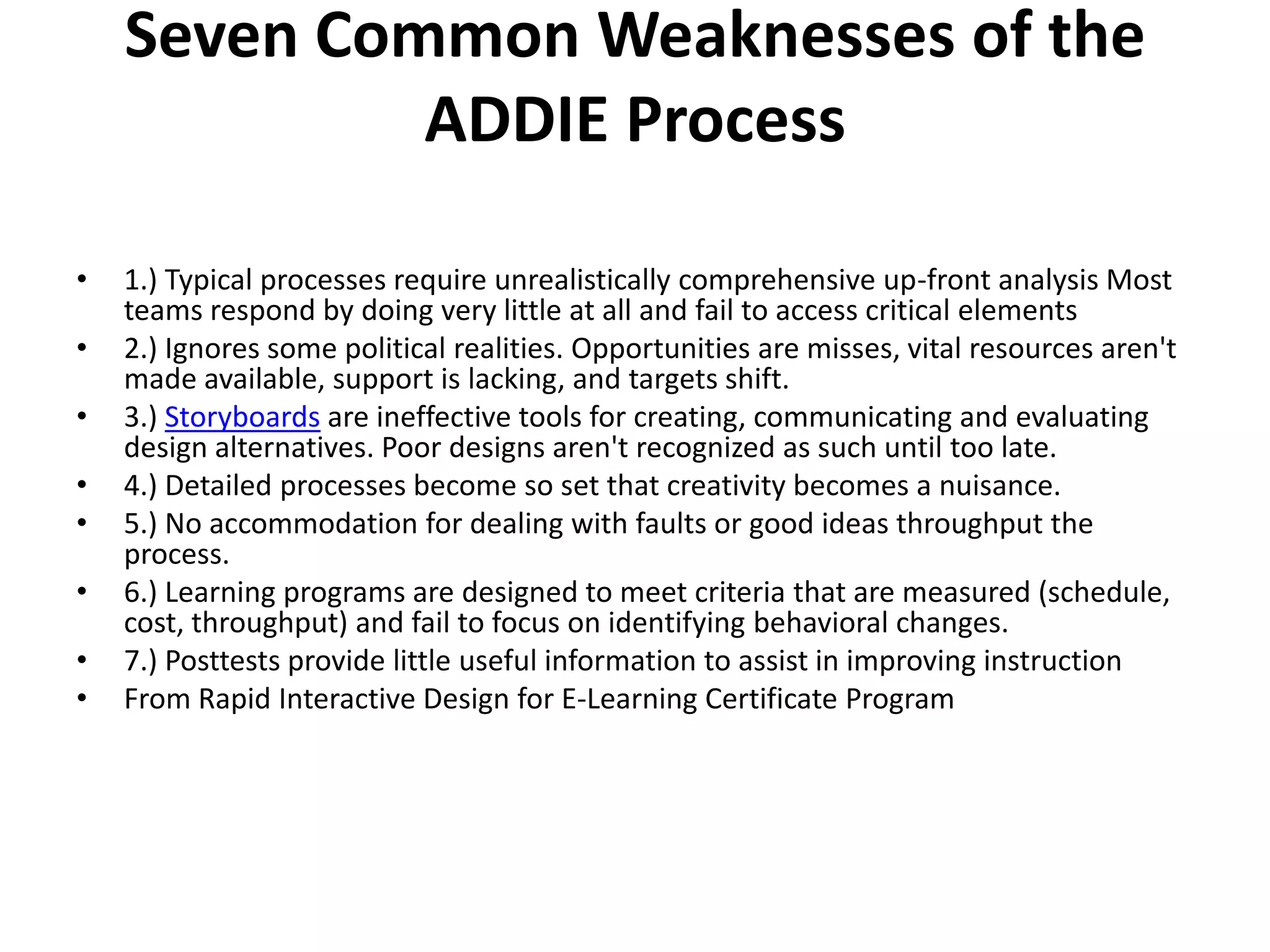
Seven Common Weaknesses of the ADDIE Process 1.) Typical processes require unrealistically comprehensive up-front analysis Most teams respond by doing very little at all and fail to access critical elements2.) Ignores some political realities. Opportunities are misses, vital resources aren't made available, support is lacking, and targets shift.3.) Storyboards are ineffective tools for creating, communicating and evaluating design alternatives. Poor designs aren't recognized as such until too late.4.) Detailed processes become so set that creativity becomes a nuisance.5.) No accommodation for dealing with faults or good ideas throughput the process.6.) Learning programs are designed to meet criteria that are measured (schedule, cost, throughput) and fail to focus on identifying behavioral changes.7.) Posttests provide little useful information to assist in improving instructionFrom Rapid Interactive Design for E-Learning Certificate Program

Instructional design

  • 1.
  • 2.
    definations Instructional Design asa Process:Instructional Design is the systematic development of instructional specifications using learning and instructional theory to ensure the quality of instruction. It is the entire process of analysis of learning needs and goals and the development of a delivery system to meet those needs. It includes development of instructional materials and activities; and tryout and evaluation of all instruction and learner activities.
  • 4.
    DesignADDIE processPerhaps themost common model used for creating instructional materials is the ADDIE Process. This acronym stands for the 5 phases contained in the model:Analyze – analyze learner characteristics, task to be learned, etc.Identify Instructional Goals, Conduct Instructional Analysis, Analyze Learners and ContextsDesign – develop learning objectives, choose an instructional approachWrite Performance Objectives, Develop Assessment Instruments, Develop Instructional StrategyDevelop – create instructional or training materialsDesign and selection of materials appropriate for learning activity, Design and Conduct Formative EvaluationImplement – deliver or distribute the instructional materialsEvaluate – make sure the materials achieved the desired goalsDesign and Conduct Summative EvaluationMost of the current instructional design models are variations of the ADDIE process.[21]Dick,W.O,.Carey, L.,&Carey, J.O.(2004)Systematic Design of Instruction. Boston,MA:Allyn&Bacon.
  • 5.
    Source: http://en.wikipedia.org/wiki/ADDIE_ModelFigure 1ADDIE Model, Diagram by: Steven J. McGriff, Instructional Systems, College of Education, Penn State UniversityKemp's Instructional Design Model
  • 6.
    Seven Common Weaknessesof the ADDIE Process 1.) Typical processes require unrealistically comprehensive up-front analysis Most teams respond by doing very little at all and fail to access critical elements2.) Ignores some political realities. Opportunities are misses, vital resources aren't made available, support is lacking, and targets shift.3.) Storyboards are ineffective tools for creating, communicating and evaluating design alternatives. Poor designs aren't recognized as such until too late.4.) Detailed processes become so set that creativity becomes a nuisance.5.) No accommodation for dealing with faults or good ideas throughput the process.6.) Learning programs are designed to meet criteria that are measured (schedule, cost, throughput) and fail to focus on identifying behavioral changes.7.) Posttests provide little useful information to assist in improving instructionFrom Rapid Interactive Design for E-Learning Certificate Program