MODEL PENGEMBANGAN KURIKULUM
DOSEN MK: PROF. DR. ISHAK ABDULHAK,
               M.PD
            SEMISTER III
     TAHUN AKADEMIK 2012/2013
MODELS OF CURRICULUM DEVELOPMENT

          By Juma Abdu Wamaungo
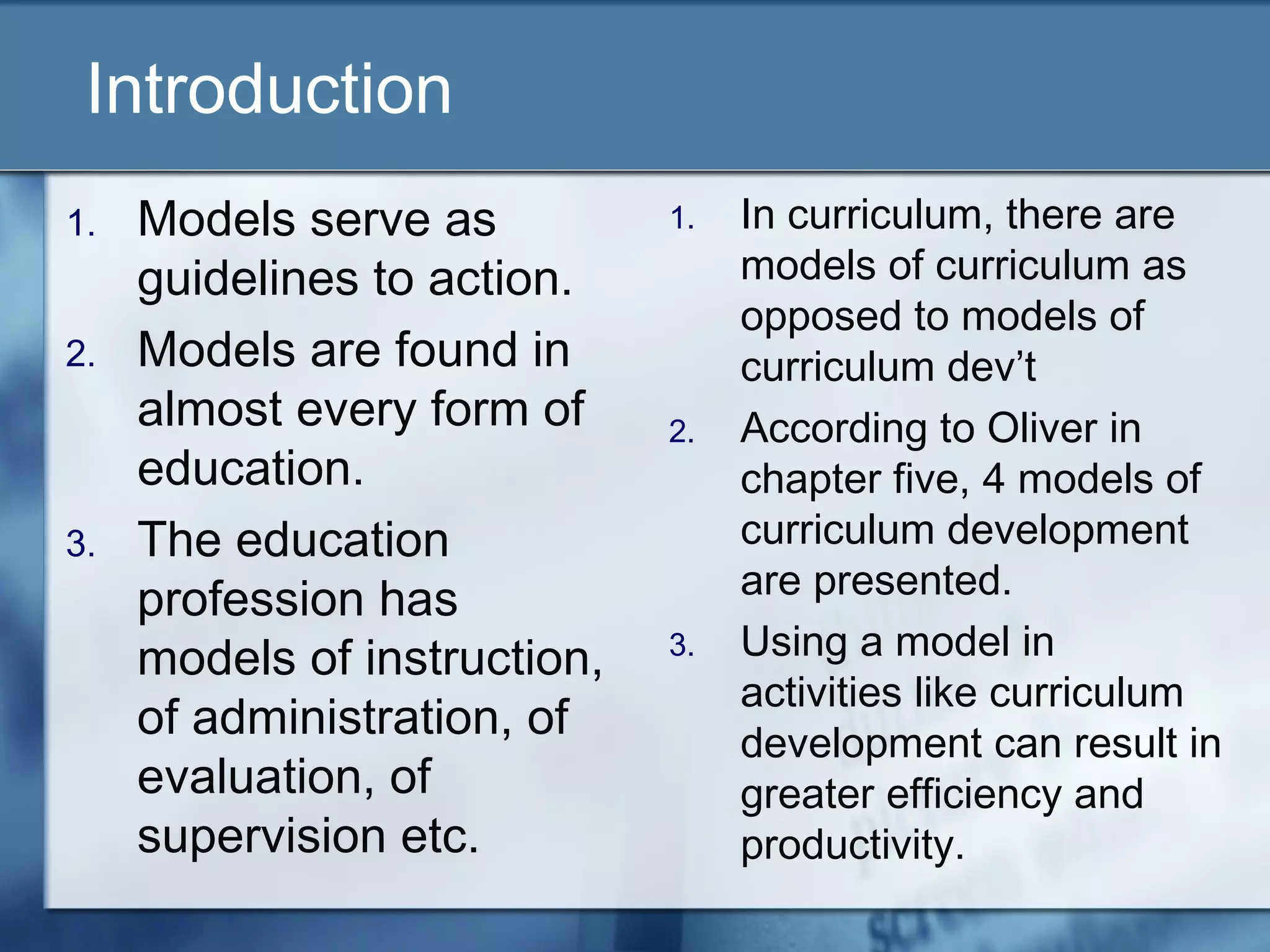
Introduction
1.   Models serve as          1.   In curriculum, there are
     guidelines to action.         models of curriculum as
                                   opposed to models of
2.   Models are found in           curriculum dev’t
     almost every form of     2.   According to Oliver in
     education.                    chapter five, 4 models of
3.   The education                 curriculum development
     profession has                are presented.
     models of instruction,   3.   Using a model in
                                   activities like curriculum
     of administration, of         development can result in
     evaluation, of                greater efficiency and
     supervision etc.              productivity.
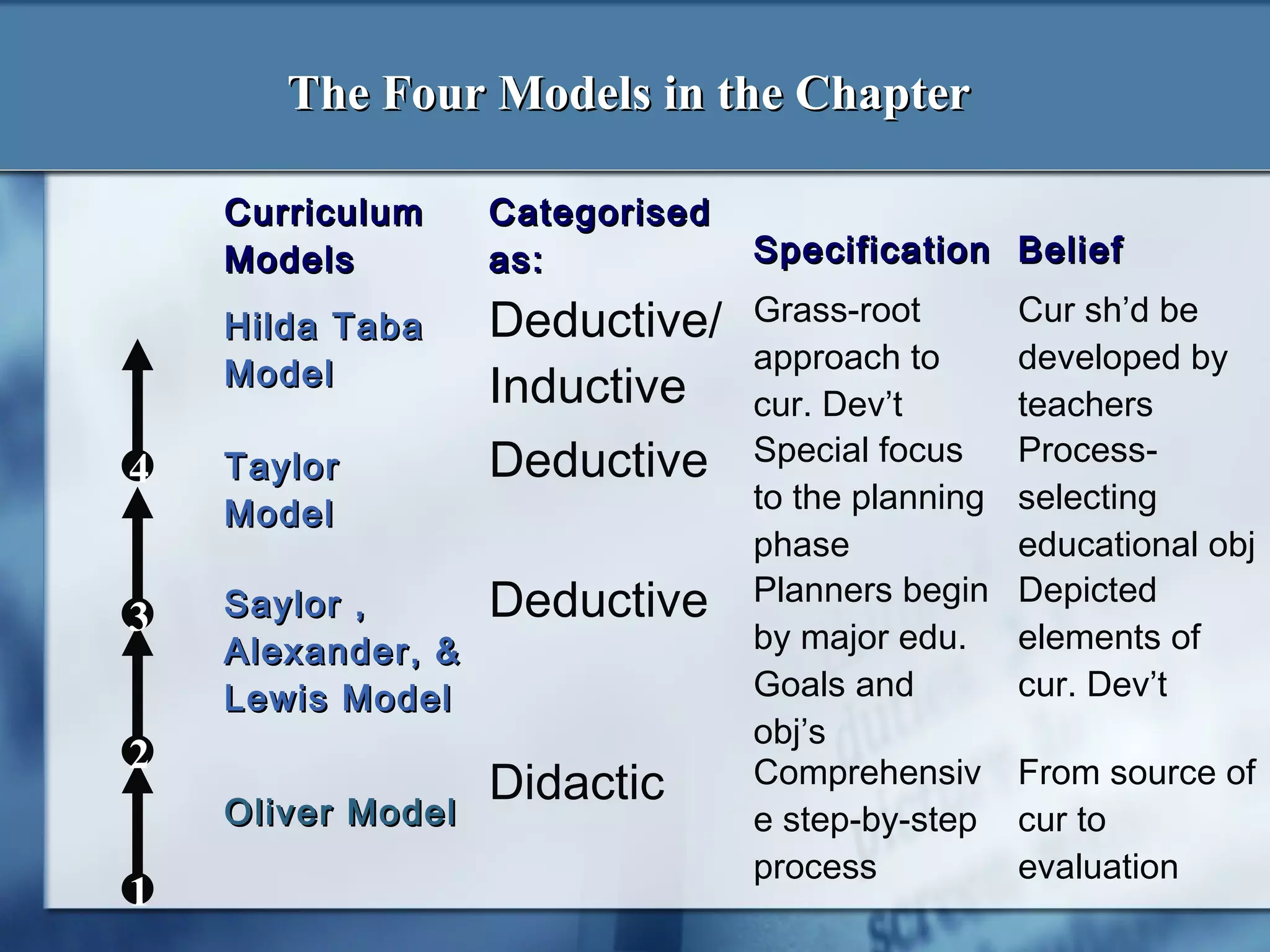
The Four Models in the Chapter

    Curriculum     Categorised
    Models         as:           Specification Belief

    Hilda Taba     Deductive/    Grass-root        Cur sh’d be
    Model                        approach to       developed by
                   Inductive     cur. Dev’t        teachers
4   Taylor         Deductive     Special focus     Process-
    Model                        to the planning   selecting
                                 phase             educational obj

3   Saylor ,       Deductive     Planners begin    Depicted
    Alexander, &                 by major edu.     elements of
    Lewis Model                  Goals and         cur. Dev’t
                                 obj’s
2
                   Didactic      Comprehensiv      From source of
    Oliver Model                 e step-by-step    cur to
                                 process           evaluation
1
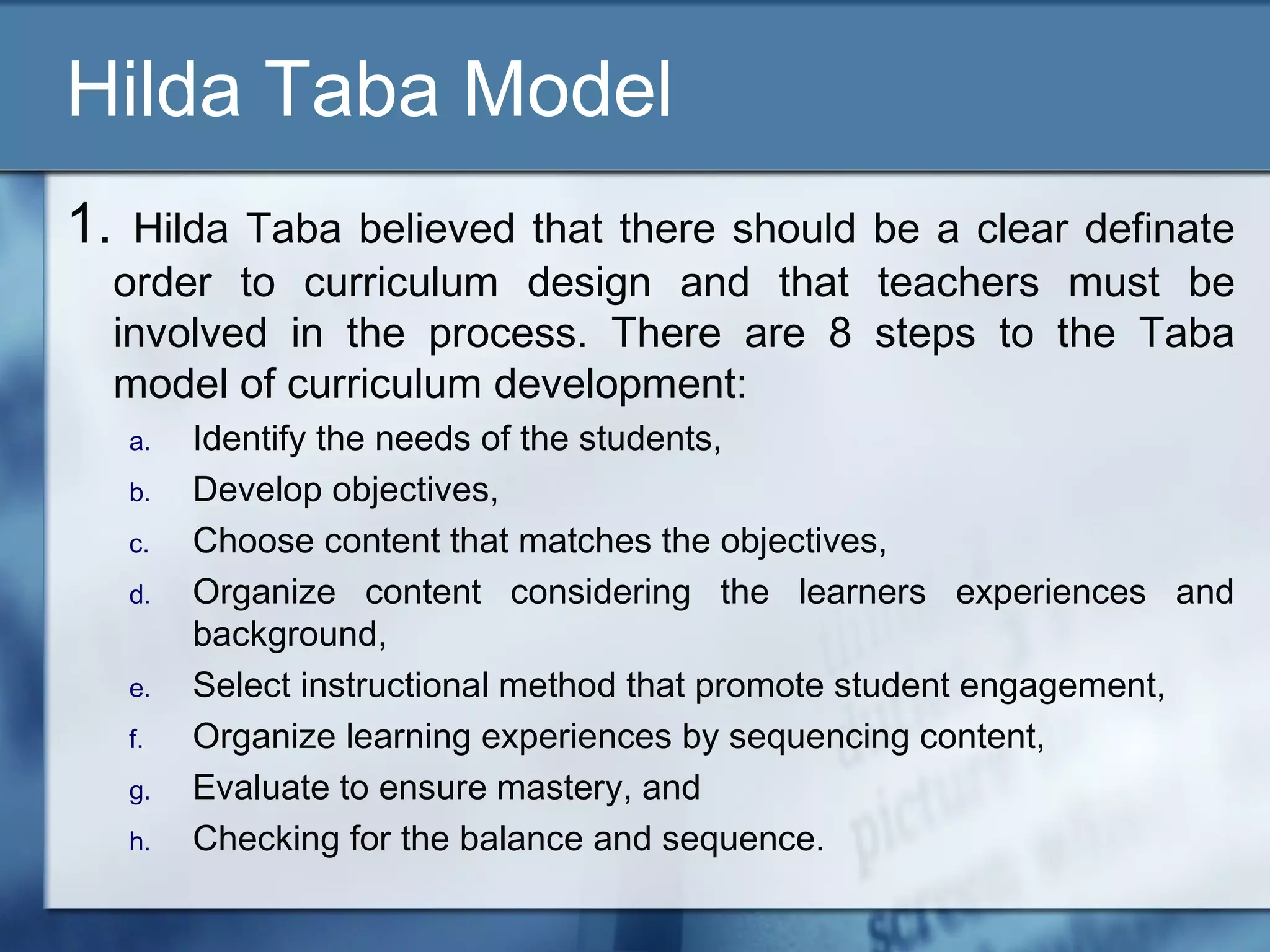
Hilda Taba Model
1.    Hilda Taba believed that there should be a clear definate
     order to curriculum design and that teachers must be
     involved in the process. There are 8 steps to the Taba
     model of curriculum development:
     a.   Identify the needs of the students,
     b.   Develop objectives,
     c.   Choose content that matches the objectives,
     d.   Organize content considering the learners experiences and
          background,
     e.   Select instructional method that promote student engagement,
     f.   Organize learning experiences by sequencing content,
     g.   Evaluate to ensure mastery, and
     h.   Checking for the balance and sequence.
Application of the Taba Model
Taba model is currently used today in most
curriculum designs. The steps still used are:
a.   Identifying the needs of the students
b.   Developing objectives
c.   Selecting instructional methods
d.   Organizing learning experiences
e.   Evaluating
Tyler Model
1. From Tyler’s model of curriculum development,
   there are four basic questions:
a. What is the purpose of the education?
b. What educational experiences will attain the
   purposes?
c. How can these experiences be effectively
   organized?
d. How can we determine when the purposes are
   met?
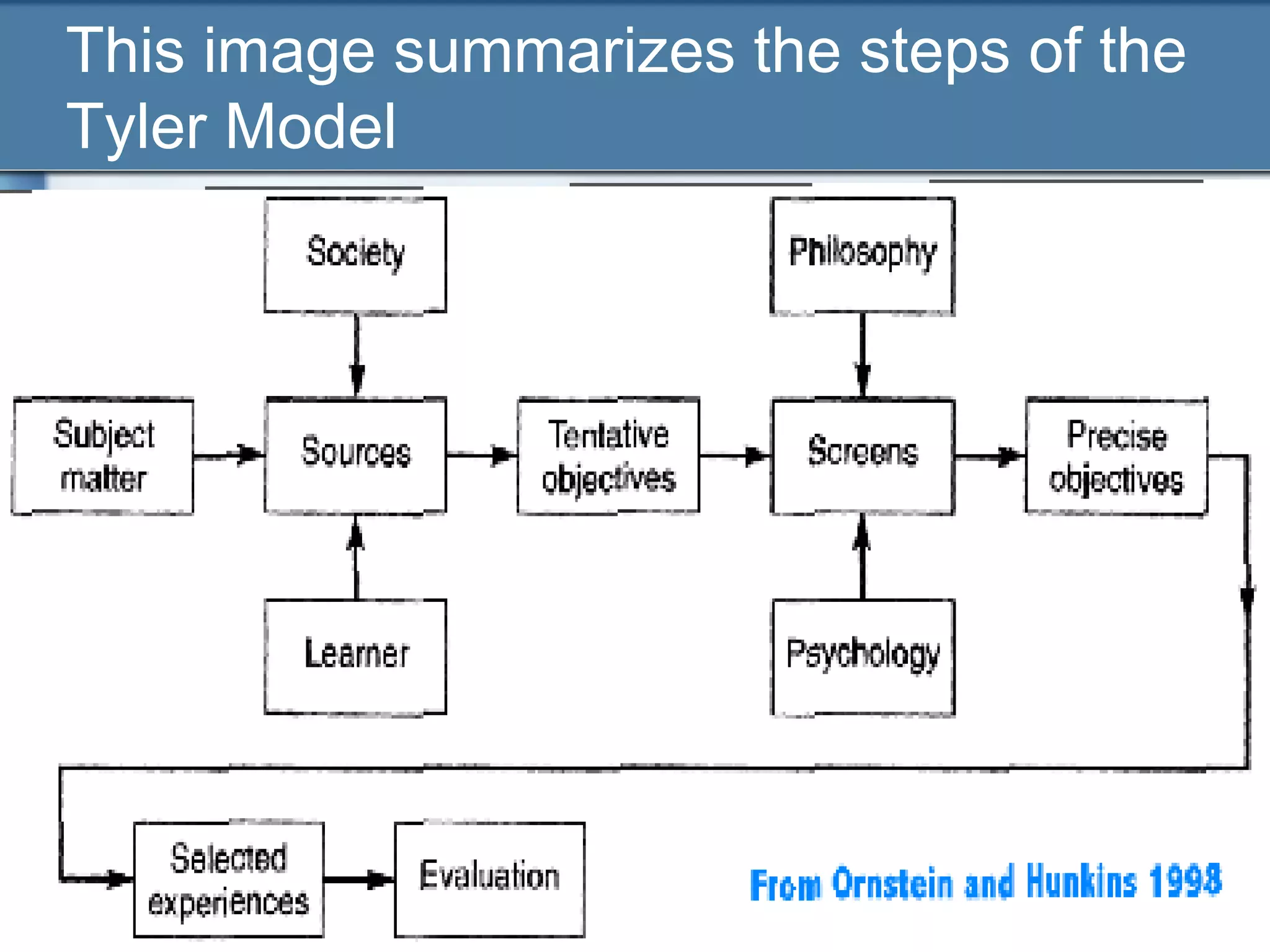
This image summarizes the steps of the
Tyler Model
Saylor, Alexander and Lewis
Model
The curriculum planner must begin by setting educational goals and specific objectives
that they wish to accomplish. Saylor, Alexander and Lewis classified sets of broad goals
into four domains under which learning experiences may take place: personal
development, social competence, continued learning skills, and specialization.
a.Once the learning goals, objectives and domains have been established, the planners
can then move into the process of planning the curriculum.
b.The first step, curriculum designing, is made by the curriculum planning groups.
Here, the curriculum workers decide on the appropriate learning opportunities for
each domain and how and when these opportunities will be made available.
c.After the designs have been created, curriculum implementation begins. Teachers
select the methods through which the curriculum will be related to the learner.
Teachers identify the specific instructional objectives before selecting the strategies to
implement.
d.Finally, teachers and curriculum planners evaluate the curriculum. They evaluate the
total educational program and the evaluation program itself during this step of the
process. This process allows educators to determine whether or not the goals and
learning objectives have been met.
Oliva Model of Curriculum Dev
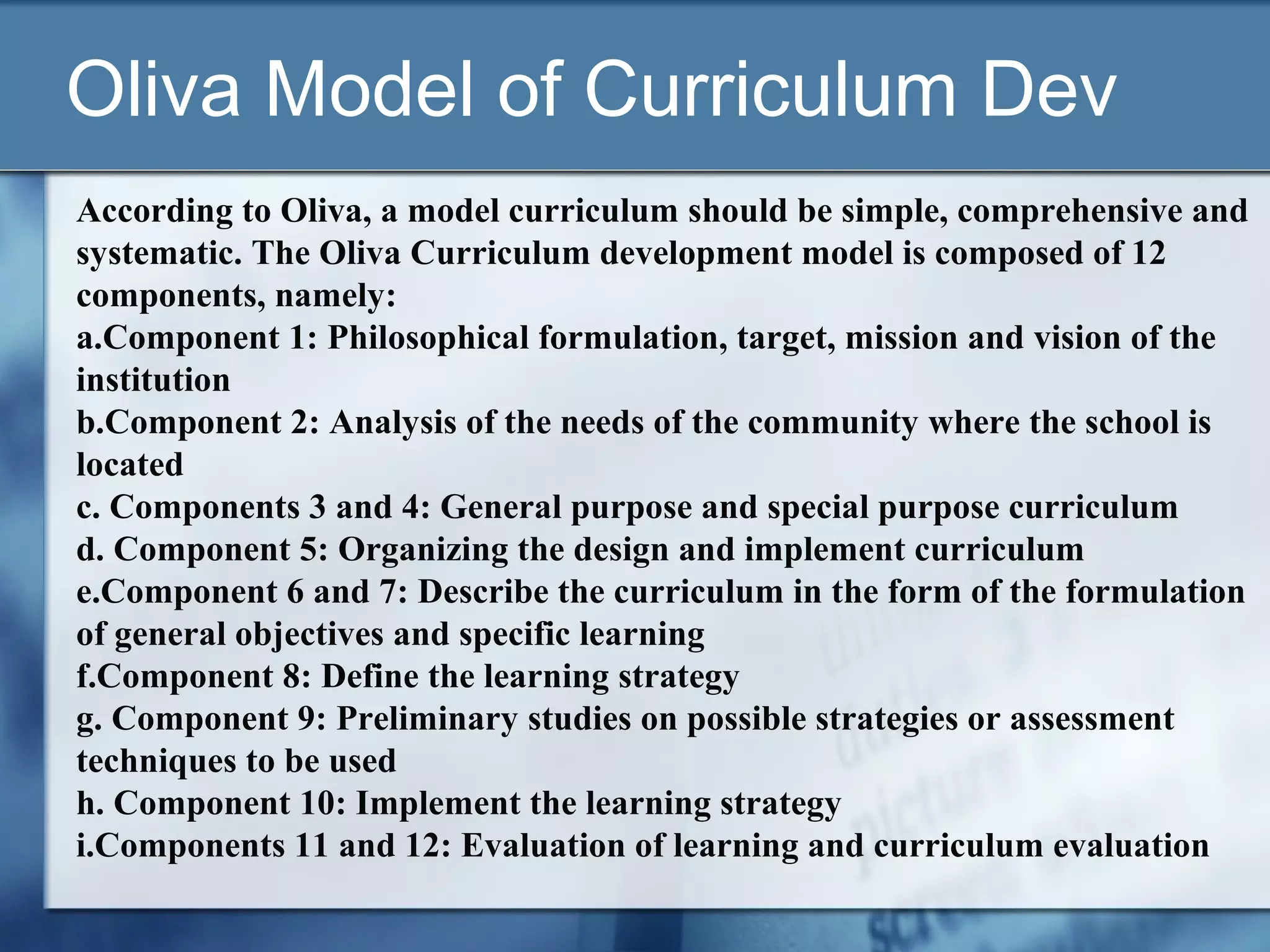
According to Oliva, a model curriculum should be simple, comprehensive and
systematic. The Oliva Curriculum development model is composed of 12
components, namely:
a.Component 1: Philosophical formulation, target, mission and vision of the
institution
b.Component 2: Analysis of the needs of the community where the school is
located
c. Components 3 and 4: General purpose and special purpose curriculum
d. Component 5: Organizing the design and implement curriculum
e.Component 6 and 7: Describe the curriculum in the form of the formulation
of general objectives and specific learning
f.Component 8: Define the learning strategy
g. Component 9: Preliminary studies on possible strategies or assessment
techniques to be used
h. Component 10: Implement the learning strategy
i.Components 11 and 12: Evaluation of learning and curriculum evaluation
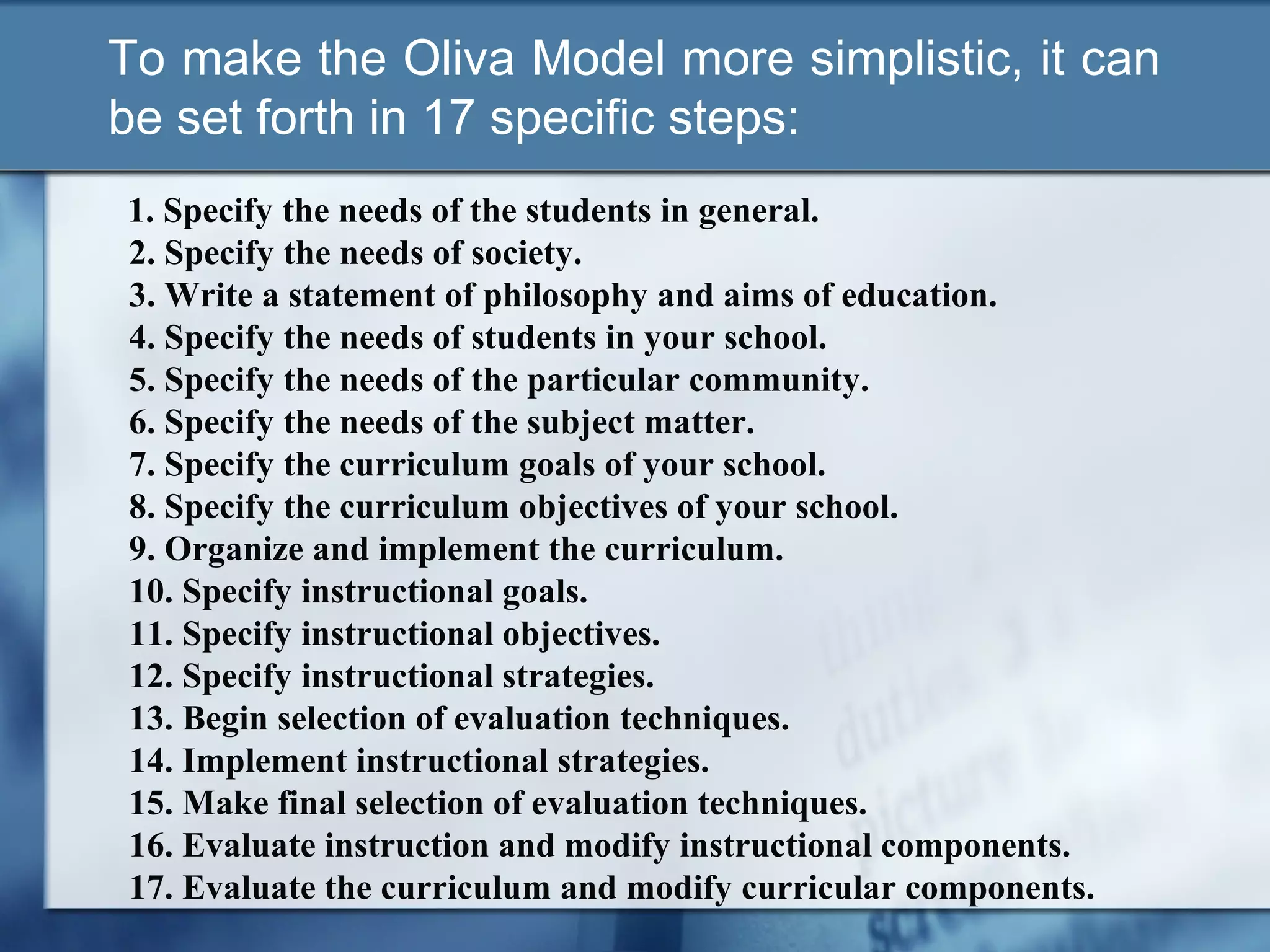
To make the Oliva Model more simplistic, it can
be set forth in 17 specific steps:
1. Specify the needs of the students in general.
2. Specify the needs of society.
3. Write a statement of philosophy and aims of education.
4. Specify the needs of students in your school.
5. Specify the needs of the particular community.
6. Specify the needs of the subject matter.
7. Specify the curriculum goals of your school.
8. Specify the curriculum objectives of your school.
9. Organize and implement the curriculum.
10. Specify instructional goals.
11. Specify instructional objectives.
12. Specify instructional strategies.
13. Begin selection of evaluation techniques.
14. Implement instructional strategies.
15. Make final selection of evaluation techniques.
16. Evaluate instruction and modify instructional components.
17. Evaluate the curriculum and modify curricular components.
End of the Presentation
       THANKS

Models of curriculum

  • 1.
    MODEL PENGEMBANGAN KURIKULUM DOSENMK: PROF. DR. ISHAK ABDULHAK, M.PD SEMISTER III TAHUN AKADEMIK 2012/2013 MODELS OF CURRICULUM DEVELOPMENT By Juma Abdu Wamaungo
  • 2.
    Introduction 1. Models serve as 1. In curriculum, there are guidelines to action. models of curriculum as opposed to models of 2. Models are found in curriculum dev’t almost every form of 2. According to Oliver in education. chapter five, 4 models of 3. The education curriculum development profession has are presented. models of instruction, 3. Using a model in activities like curriculum of administration, of development can result in evaluation, of greater efficiency and supervision etc. productivity.
  • 3.
    The Four Modelsin the Chapter Curriculum Categorised Models as: Specification Belief Hilda Taba Deductive/ Grass-root Cur sh’d be Model approach to developed by Inductive cur. Dev’t teachers 4 Taylor Deductive Special focus Process- Model to the planning selecting phase educational obj 3 Saylor , Deductive Planners begin Depicted Alexander, & by major edu. elements of Lewis Model Goals and cur. Dev’t obj’s 2 Didactic Comprehensiv From source of Oliver Model e step-by-step cur to process evaluation 1
  • 4.
    Hilda Taba Model 1. Hilda Taba believed that there should be a clear definate order to curriculum design and that teachers must be involved in the process. There are 8 steps to the Taba model of curriculum development: a. Identify the needs of the students, b. Develop objectives, c. Choose content that matches the objectives, d. Organize content considering the learners experiences and background, e. Select instructional method that promote student engagement, f. Organize learning experiences by sequencing content, g. Evaluate to ensure mastery, and h. Checking for the balance and sequence.
  • 5.
    Application of theTaba Model Taba model is currently used today in most curriculum designs. The steps still used are: a. Identifying the needs of the students b. Developing objectives c. Selecting instructional methods d. Organizing learning experiences e. Evaluating
  • 6.
    Tyler Model 1. FromTyler’s model of curriculum development, there are four basic questions: a. What is the purpose of the education? b. What educational experiences will attain the purposes? c. How can these experiences be effectively organized? d. How can we determine when the purposes are met?
  • 7.
    This image summarizesthe steps of the Tyler Model
  • 8.
    Saylor, Alexander andLewis Model The curriculum planner must begin by setting educational goals and specific objectives that they wish to accomplish. Saylor, Alexander and Lewis classified sets of broad goals into four domains under which learning experiences may take place: personal development, social competence, continued learning skills, and specialization. a.Once the learning goals, objectives and domains have been established, the planners can then move into the process of planning the curriculum. b.The first step, curriculum designing, is made by the curriculum planning groups. Here, the curriculum workers decide on the appropriate learning opportunities for each domain and how and when these opportunities will be made available. c.After the designs have been created, curriculum implementation begins. Teachers select the methods through which the curriculum will be related to the learner. Teachers identify the specific instructional objectives before selecting the strategies to implement. d.Finally, teachers and curriculum planners evaluate the curriculum. They evaluate the total educational program and the evaluation program itself during this step of the process. This process allows educators to determine whether or not the goals and learning objectives have been met.
  • 9.
    Oliva Model ofCurriculum Dev According to Oliva, a model curriculum should be simple, comprehensive and systematic. The Oliva Curriculum development model is composed of 12 components, namely: a.Component 1: Philosophical formulation, target, mission and vision of the institution b.Component 2: Analysis of the needs of the community where the school is located c. Components 3 and 4: General purpose and special purpose curriculum d. Component 5: Organizing the design and implement curriculum e.Component 6 and 7: Describe the curriculum in the form of the formulation of general objectives and specific learning f.Component 8: Define the learning strategy g. Component 9: Preliminary studies on possible strategies or assessment techniques to be used h. Component 10: Implement the learning strategy i.Components 11 and 12: Evaluation of learning and curriculum evaluation
  • 10.
    To make theOliva Model more simplistic, it can be set forth in 17 specific steps: 1. Specify the needs of the students in general. 2. Specify the needs of society. 3. Write a statement of philosophy and aims of education. 4. Specify the needs of students in your school. 5. Specify the needs of the particular community. 6. Specify the needs of the subject matter. 7. Specify the curriculum goals of your school. 8. Specify the curriculum objectives of your school. 9. Organize and implement the curriculum. 10. Specify instructional goals. 11. Specify instructional objectives. 12. Specify instructional strategies. 13. Begin selection of evaluation techniques. 14. Implement instructional strategies. 15. Make final selection of evaluation techniques. 16. Evaluate instruction and modify instructional components. 17. Evaluate the curriculum and modify curricular components.
  • 11.
    End of thePresentation THANKS