Lecture 4
Introduction
 The resistance an individual acquires during life is called
acquired immunity.
 Active Immunity (Adaptive Immunity) Active immunity or
adaptive immunity is capable of recognizing and selectively
eliminating specific foreign microorganisms and molecules, i.e. tumor
antigens, transplanted antigens, etc.
 This involves the active functioning of the individual’s immune
apparatus, either in producing antibody or creating immune-
competent cells for cell-mediated immunity (CMI).
Conti……….
 Active immunity sets in only after a latent period, which
the immunological machinery needs for its functioning.
 Once developed the active immunity is long lasting.
 When the individual is facing the same antigen
subsequently (next), there is no latent or lag phase and
the immune response is prompt (on time), powerful and
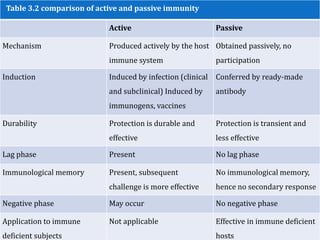
prolonged (Table 3.2).
Table 3.2 comparison of active and passive immunity
Active Passive
Mechanism Produced actively by the host
immune system
Obtained passively, no
participation
Induction Induced by infection (clinical
and subclinical) Induced by
immunogens, vaccines
Conferred by ready-made
antibody
Durability Protection is durable and
effective
Protection is transient and
less effective
Lag phase Present No lag phase
Immunological memory Present, subsequent
challenge is more effective
No immunological memory,
hence no secondary response
Negative phase May occur No negative phase
Application to immune
deficient subjects
Not applicable Effective in immune deficient
hosts
Conti…….
 In contrast to the innate immune response, which
recognize the common molecular patterns such as PAMPs
in potential invaders, the adaptive immune system resorts
to a highly different approach with a very large repertoire
of specific antigen receptors that can recognize virtually
(almost), any component of the foreign invader.
Conti………
 Adaptive immunity focuses on four important
characteristic features. They are:
1. Antigenic specificity.
2. Diversity.
3. Immunological memory.
4. Self/non-self recognition.
Conti………
 The antigenic specificity of the immune system permits it to
distinguish minor difference among antigens.
 The antibodies can distinguish between two protein molecules
that differ in only a single amino acid.
 The immune system is capable of generating emendous
diversity in its recognition molecules, permitting to recognize
vast (huge) arrays of unique structures on foreign antigens.
Conti……..
 Once the immune system recognized and responded
to an antigen, it exhibits immunological memory to
recognize the same antigen, subsequently and react in a
heightened manner (Refer Table 3.2).
 Finally, the immune system, normally responds to
foreign antigens, indicating that it is capable of
distinguishing self from non-self.
Conti………
 The adaptive immunity is not independent of innate
immunity. They interact constantly.
 The phagocytic cells crucial (important ) to nonspecific
immune responses are intimately (closely) involved in
igniting the specific immune response.
 Conversely various soluble factors produced during specific
immune response have been shown to augment the activity
of these phagocytic cells.
Conti……..
 Naturally acquired active immunity: This type of immunity is
obtained when a person is exposed to antigens in the course of daily
life.
 Once acquired, the immunity lasts for rest of its life such as in measles
and chickenpox. For other diseases, especially in intestinal diseases, the
immunity is short lasting (permanent).
 Subclinical infections can also conform immunity as that occurs in
tuberculosis. Adults have natural immunity against polio after repeated
subclinical infections.
Conti………
 In syphilis, malaria and few other diseases, a special type of immunity
is observed known as infection immunity (premunition).
 The immunity to reinfection lasts as long as the original infection
persists.
 Artificially acquired active immunity: This type of immunity results
from vaccination or immunization.
 Vaccinations may be inactivated bacterial toxins (toxoids), killed
microorganisms, live but attenuated microorganisms or parts of
microorganisms such as capsules.
Conti……..
 These substances can no longer cause disease, but can stimulate
immune response.
 Examples of vaccines are as follows:
 1. Bacterial vaccines
 Live and attenuated → Bacille Calmette- Guérin (BCG)
formTuberculosis
 Killed → Typhoid-paratyphoid A and B vaccine (TAB) for enteric fever
Taboral vaccine for typhoid
 (oral vaccines) Cholera vaccine Pertussis vaccine Bacterial capsule
polysaccharides
Conti………
• Haemophilus influenzae
• Pneumococcus
• Meningococcus.
 Subunit → Vi polysaccharide for typhoid (Vi virulence)
 Bacterial products and killed bacteria → Triple vaccine.
 2. Viral vaccines Live and attenuated → Smallpox Oral
polio (Sabin),Influenza Measles, mumps, rubella (MMR)
Conti…….
 Killed (inactivated) → Injectable Polio (Salk) Yellow fever
Influenza Rabies
 Subunit → Hepatitis B vaccine.
 Live vaccines initiate an infection without causing any injury or
diseases.
 The immunity lasts for several years. Booster dose may or may
not be required. Live oral (polio) or nasal spray (influenza)
vaccines provide local immunity.
Conti………
 Killed vaccines are generally less immunogenic than the
live vaccines and the immunity lasts only for a short period.
Therefore, they are administered repeatedly.
 Killed vaccines are given parenterally.
Conti…….
 Passive Immunity
 Passive immunity is resistance exhibited by the host,
when ready-made antibodies or defensive cells are
introduced into the body.
 This form of protection is passive, because the individuals
own immune system does not make antibodies or defensive
cells against the disease producing agents or toxins.
Conti………..
 Naturally acquired passive immunity: This type of
immunity involves natural transfer of antibodies from
mother to her infant and also from mother to fetus.
 Certain antibodies (IgA) are passed from the mother to
her nursing infants in breast milk, especially in the first
secretion called colostrum.
 The immunity in infants last as long as baby feeds on
breast milk.
Conti………
 During pregnancy, some of the maternal antibodies are
also transferred through placenta to the fetus.
 If the mother is immune to diphtheria, rubella or polio,
the newborn will be temporarily immune to these diseases
as well .
 Artificially acquired passive immunity: This type of
immunity involves the introduction of antibodies into the
body.
Conti………..
 These antibodies come from animal or person, who is already
immune to the disease. They are:
 1. Hyperimmune sera of animal or human origin. Common
examples are antitetanus serum (ATS), antidiphtheria serum
(ADS), anti-gas-gangrene serum (AGS), antisnake venom, etc.
 2. Convalescent sera from patients very recently recovered
from measles, rubella, etc.
Conti………..
 3. Pooled gamma globulin serum against common infectious diseases.
 4. Human gamma globulin is also used in the treatment of
immunodeficiency diseases.
 Indication of Passive Immunization
 1. For providing immediate and temporary protection in a non-immune
host.
 2. Treatment of some infections.
 3. Antilymphocytic serum (ALS) may be given for suppression of
lymphocytes in transplantation surgery.
Conti………
 4. Passive immunization may also be employed to suppress
active immunity, when the latter may be injurious.
 The commonest example is the use of Rh immunoglobulin
during delivery to prevent immune response to rhesus
factor in Rhnegative women with Rh-positive babies.
Conti………
 5. Combined immunization. At times, both active and
passive immunization is given together.
 Ideally, it is employed to provide immediate protection to
non-immune individual with a tetanus-prone wound.
 Tetanus immunoglobulin (TIG) will provide immediate
passive immunity and toxoid will initiate active immunity.
Adoptive Immunity
 Adoptive immunity is a special type of immunization,
where the immunocompetent cells are injected.
 At times, instead of whole lymphocytes, an extract of
lymphocytes (transfer factor of Lawrence) may be
introduced as a therapeutic procedure in certain disease,
such as lepromatous leprosy, immunodeficiency diseases
such as Wiskott-Aldrich syndrome, disseminated
malignancy, etc.
Conti………..
 Recent studies indicate that the adoptive T cell transfer is
done, preferably, in the treatment of virus-related diseases
in particular, cytomegalovirus (CMV) infection and
Epstein-Barr virus (EBV) infection—associated
lymphoproliferative diseases (LPDs).
Conti………
 Local Immunity
 The mucosal immune system is composed of the
lymphoid tissues that are associated with the mucosal
surface of the gastrointestinal, respiratory and the
urogenital tracts. These include mucosal-related Igs.
 The system involves production of mucosal-related Ig that
is IgA (secretory immunoglobulin).
Conti………
 The primary function of the mucosal immune system is to
provide defense to the host at mucosal surface, locally.
 Optimal host defense at the mucosal surface depends on both
intact mucosal immue responses and non-immunologic
protective functions such as residential bacterial flora, mucosal
motor activity (peristalsis; ciliary function), mucus secretion that
create barrier between potential pathogens and epithelial
surfaces and innate immunity factors (lactoferin, lactoperoxidase
and lysozyme).
Conti……….
 The concept local immunity has gained importance in the
treatment of infections, which are either localized or where
it is operative in combating infection at the site of primary
entry of pathogens.
 The Sabin vaccine (for poliomyelitis) is administered orally to
promote local IgA (secretory IgA) production in the intestinal
tract. This prevents entry and multiplication of the organism.
Conti……….
 Influenza (live-attenuated) vaccine is most effective when
given in nasal spray. Research to find out an oral vaccine
against cholera is on the process.
 Herd Immunity
 Herd immunity refers to an overall immunity
exhibited by a community, which is relevant in the
control of epidemic diseases.
Conti……….
 When the herd immunity is satisfactory, epidemic does not
occur. When it is less, the prevention of epidemic can be
done by mass immunization.
 There are limits to the herd immunity.
 However, if a significant number of unprotected
individuals become infected, the infection could spread
rapidly through the unprotected members of population.
Conti……
 In the course of that rapid replication, new mutant forms
might arise that could evade the immune response and
produce diseases in vaccinated individuals as well.

Acquired Immunity. lecture 4 chapter 3.pptx

  • 1.
  • 2.
    Introduction  The resistancean individual acquires during life is called acquired immunity.  Active Immunity (Adaptive Immunity) Active immunity or adaptive immunity is capable of recognizing and selectively eliminating specific foreign microorganisms and molecules, i.e. tumor antigens, transplanted antigens, etc.  This involves the active functioning of the individual’s immune apparatus, either in producing antibody or creating immune- competent cells for cell-mediated immunity (CMI).
  • 3.
    Conti……….  Active immunitysets in only after a latent period, which the immunological machinery needs for its functioning.  Once developed the active immunity is long lasting.  When the individual is facing the same antigen subsequently (next), there is no latent or lag phase and the immune response is prompt (on time), powerful and prolonged (Table 3.2).
  • 4.
    Table 3.2 comparisonof active and passive immunity Active Passive Mechanism Produced actively by the host immune system Obtained passively, no participation Induction Induced by infection (clinical and subclinical) Induced by immunogens, vaccines Conferred by ready-made antibody Durability Protection is durable and effective Protection is transient and less effective Lag phase Present No lag phase Immunological memory Present, subsequent challenge is more effective No immunological memory, hence no secondary response Negative phase May occur No negative phase Application to immune deficient subjects Not applicable Effective in immune deficient hosts
  • 5.
    Conti…….  In contrastto the innate immune response, which recognize the common molecular patterns such as PAMPs in potential invaders, the adaptive immune system resorts to a highly different approach with a very large repertoire of specific antigen receptors that can recognize virtually (almost), any component of the foreign invader.
  • 6.
    Conti………  Adaptive immunityfocuses on four important characteristic features. They are: 1. Antigenic specificity. 2. Diversity. 3. Immunological memory. 4. Self/non-self recognition.
  • 7.
    Conti………  The antigenicspecificity of the immune system permits it to distinguish minor difference among antigens.  The antibodies can distinguish between two protein molecules that differ in only a single amino acid.  The immune system is capable of generating emendous diversity in its recognition molecules, permitting to recognize vast (huge) arrays of unique structures on foreign antigens.
  • 8.
    Conti……..  Once theimmune system recognized and responded to an antigen, it exhibits immunological memory to recognize the same antigen, subsequently and react in a heightened manner (Refer Table 3.2).  Finally, the immune system, normally responds to foreign antigens, indicating that it is capable of distinguishing self from non-self.
  • 9.
    Conti………  The adaptiveimmunity is not independent of innate immunity. They interact constantly.  The phagocytic cells crucial (important ) to nonspecific immune responses are intimately (closely) involved in igniting the specific immune response.  Conversely various soluble factors produced during specific immune response have been shown to augment the activity of these phagocytic cells.
  • 10.
    Conti……..  Naturally acquiredactive immunity: This type of immunity is obtained when a person is exposed to antigens in the course of daily life.  Once acquired, the immunity lasts for rest of its life such as in measles and chickenpox. For other diseases, especially in intestinal diseases, the immunity is short lasting (permanent).  Subclinical infections can also conform immunity as that occurs in tuberculosis. Adults have natural immunity against polio after repeated subclinical infections.
  • 11.
    Conti………  In syphilis,malaria and few other diseases, a special type of immunity is observed known as infection immunity (premunition).  The immunity to reinfection lasts as long as the original infection persists.  Artificially acquired active immunity: This type of immunity results from vaccination or immunization.  Vaccinations may be inactivated bacterial toxins (toxoids), killed microorganisms, live but attenuated microorganisms or parts of microorganisms such as capsules.
  • 12.
    Conti……..  These substancescan no longer cause disease, but can stimulate immune response.  Examples of vaccines are as follows:  1. Bacterial vaccines  Live and attenuated → Bacille Calmette- Guérin (BCG) formTuberculosis  Killed → Typhoid-paratyphoid A and B vaccine (TAB) for enteric fever Taboral vaccine for typhoid  (oral vaccines) Cholera vaccine Pertussis vaccine Bacterial capsule polysaccharides
  • 13.
    Conti……… • Haemophilus influenzae •Pneumococcus • Meningococcus.  Subunit → Vi polysaccharide for typhoid (Vi virulence)  Bacterial products and killed bacteria → Triple vaccine.  2. Viral vaccines Live and attenuated → Smallpox Oral polio (Sabin),Influenza Measles, mumps, rubella (MMR)
  • 14.
    Conti…….  Killed (inactivated)→ Injectable Polio (Salk) Yellow fever Influenza Rabies  Subunit → Hepatitis B vaccine.  Live vaccines initiate an infection without causing any injury or diseases.  The immunity lasts for several years. Booster dose may or may not be required. Live oral (polio) or nasal spray (influenza) vaccines provide local immunity.
  • 15.
    Conti………  Killed vaccinesare generally less immunogenic than the live vaccines and the immunity lasts only for a short period. Therefore, they are administered repeatedly.  Killed vaccines are given parenterally.
  • 16.
    Conti…….  Passive Immunity Passive immunity is resistance exhibited by the host, when ready-made antibodies or defensive cells are introduced into the body.  This form of protection is passive, because the individuals own immune system does not make antibodies or defensive cells against the disease producing agents or toxins.
  • 17.
    Conti………..  Naturally acquiredpassive immunity: This type of immunity involves natural transfer of antibodies from mother to her infant and also from mother to fetus.  Certain antibodies (IgA) are passed from the mother to her nursing infants in breast milk, especially in the first secretion called colostrum.  The immunity in infants last as long as baby feeds on breast milk.
  • 18.
    Conti………  During pregnancy,some of the maternal antibodies are also transferred through placenta to the fetus.  If the mother is immune to diphtheria, rubella or polio, the newborn will be temporarily immune to these diseases as well .  Artificially acquired passive immunity: This type of immunity involves the introduction of antibodies into the body.
  • 19.
    Conti………..  These antibodiescome from animal or person, who is already immune to the disease. They are:  1. Hyperimmune sera of animal or human origin. Common examples are antitetanus serum (ATS), antidiphtheria serum (ADS), anti-gas-gangrene serum (AGS), antisnake venom, etc.  2. Convalescent sera from patients very recently recovered from measles, rubella, etc.
  • 20.
    Conti………..  3. Pooledgamma globulin serum against common infectious diseases.  4. Human gamma globulin is also used in the treatment of immunodeficiency diseases.  Indication of Passive Immunization  1. For providing immediate and temporary protection in a non-immune host.  2. Treatment of some infections.  3. Antilymphocytic serum (ALS) may be given for suppression of lymphocytes in transplantation surgery.
  • 21.
    Conti………  4. Passiveimmunization may also be employed to suppress active immunity, when the latter may be injurious.  The commonest example is the use of Rh immunoglobulin during delivery to prevent immune response to rhesus factor in Rhnegative women with Rh-positive babies.
  • 22.
    Conti………  5. Combinedimmunization. At times, both active and passive immunization is given together.  Ideally, it is employed to provide immediate protection to non-immune individual with a tetanus-prone wound.  Tetanus immunoglobulin (TIG) will provide immediate passive immunity and toxoid will initiate active immunity.
  • 23.
    Adoptive Immunity  Adoptiveimmunity is a special type of immunization, where the immunocompetent cells are injected.  At times, instead of whole lymphocytes, an extract of lymphocytes (transfer factor of Lawrence) may be introduced as a therapeutic procedure in certain disease, such as lepromatous leprosy, immunodeficiency diseases such as Wiskott-Aldrich syndrome, disseminated malignancy, etc.
  • 24.
    Conti………..  Recent studiesindicate that the adoptive T cell transfer is done, preferably, in the treatment of virus-related diseases in particular, cytomegalovirus (CMV) infection and Epstein-Barr virus (EBV) infection—associated lymphoproliferative diseases (LPDs).
  • 25.
    Conti………  Local Immunity The mucosal immune system is composed of the lymphoid tissues that are associated with the mucosal surface of the gastrointestinal, respiratory and the urogenital tracts. These include mucosal-related Igs.  The system involves production of mucosal-related Ig that is IgA (secretory immunoglobulin).
  • 26.
    Conti………  The primaryfunction of the mucosal immune system is to provide defense to the host at mucosal surface, locally.  Optimal host defense at the mucosal surface depends on both intact mucosal immue responses and non-immunologic protective functions such as residential bacterial flora, mucosal motor activity (peristalsis; ciliary function), mucus secretion that create barrier between potential pathogens and epithelial surfaces and innate immunity factors (lactoferin, lactoperoxidase and lysozyme).
  • 27.
    Conti……….  The conceptlocal immunity has gained importance in the treatment of infections, which are either localized or where it is operative in combating infection at the site of primary entry of pathogens.  The Sabin vaccine (for poliomyelitis) is administered orally to promote local IgA (secretory IgA) production in the intestinal tract. This prevents entry and multiplication of the organism.
  • 28.
    Conti……….  Influenza (live-attenuated)vaccine is most effective when given in nasal spray. Research to find out an oral vaccine against cholera is on the process.  Herd Immunity  Herd immunity refers to an overall immunity exhibited by a community, which is relevant in the control of epidemic diseases.
  • 29.
    Conti……….  When theherd immunity is satisfactory, epidemic does not occur. When it is less, the prevention of epidemic can be done by mass immunization.  There are limits to the herd immunity.  However, if a significant number of unprotected individuals become infected, the infection could spread rapidly through the unprotected members of population.
  • 30.
    Conti……  In thecourse of that rapid replication, new mutant forms might arise that could evade the immune response and produce diseases in vaccinated individuals as well.