Page 1
Page 2
1. DEFINITION.
2. CHEMICAL NATURE OF ANTIGEN.
3. TYPES OF ANTIGEN.
4. HAPTENS.
5. SUPER ANTIGEN.
6. DETERMINANTS OF ANTIGENICITY.
7. ADJUVANTS.
8. EPITOPES.
9 . USES.
10. ANTIGEN DETECTION METHOD.
Page 3
ANTIGENS
Definition:- Any substance when introduced into the body stimulate
the production of antibody and react with the specific antibody and
antigen receptors present on lymphocytes are called antigen.
Immunogens:- Are the molecules which induce an immune
response.
All antigens are immunogens, but all immunogens are not antigen.
Page 4
CHEMICAL NATURE OF ANTIGEN
• Most naturally occurring antigens are proteins ,
polysaccharides followed by lipids and nucleic acids.
• All proteins are not antigenic in nature.
Page 5
TYPES OF ANTIGEN
1. Based on the ability to carry immunogenicity and
immunological reaction:
a) Complete antigen.
b) Hapten.
2. Based on origin:
I. a) Microbial antigen. II. a) Exogenous
b)Tissue antigen. b) Endogenous
Page 6
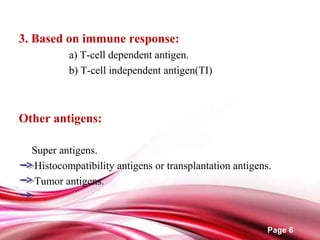
3. Based on immune response:
a) T-cell dependent antigen.
b) T-cell independent antigen(TI)
Other antigens:
Super antigens.
Histocompatibility antigens or transplantation antigens.
Tumor antigens.
Page 7
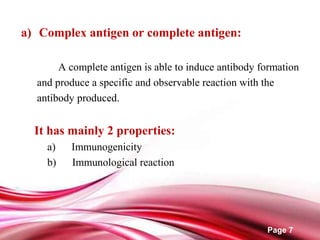
a) Complex antigen or complete antigen:
A complete antigen is able to induce antibody formation
and produce a specific and observable reaction with the
antibody produced.
It has mainly 2 properties:
a) Immunogenicity
b) Immunological reaction
Page 8
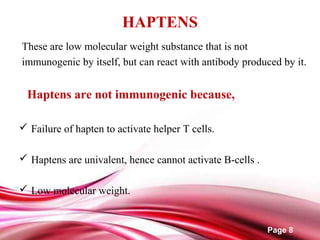
HAPTENS
These are low molecular weight substance that is not
immunogenic by itself, but can react with antibody produced by it.
Haptens are not immunogenic because,
 Failure of hapten to activate helper T cells.
 Haptens are univalent, hence cannot activate B-cells .
 Low molecular weight.
Page 9
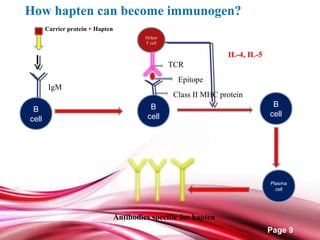
How hapten can become immunogen?
Carrier protein + Hapten
B
cell
B
cell
Helper
T cell
B
cell
Plasma
cell
B
cell
B
cell
Helper
T cell
B
cell
Plasma
cell
IgM
IL-4, IL-5
TCR
Epitope
Class II MHC protein
Antibodies specific for hapten
Page 10
Types of haptens
1. Complex hapten – One that can participate in
precipitation reaction and are usually polyvalent in nature.
2. Simple hapten – Hapten which do not participate in
precipitation reaction is called as simple hapten.
Page 11
ADJUVANTS
Adjuvants are the substance that when mixed with an
antigen and injected with it, boost the immunogenicity of
the antigen. Adjuvants increase both strength and duration
of immune response.
E.g. Aluminium potassium sulphate(alum)
Freund’s water-in-oil
Page 12
Functions of adjuvant
i. Boost immune response when antigen has low
immunogenecity and when small amount of
antigen is available
ii. enhance co-stimulatoty signals
iii. Prolong retention of immunogen
iv. Increase the effective size of the immunogen
v. Increase local inflammation by stimulating local
influx of macrophages or immune cells to
injected sites
Page 13
2) Based on origin:
I. Microbial antigen:
These are structural antigens.
e.g., Flagellar H-antigen, Fimbrilar antigen.
Tissue antigen:
e.g, Blood group antigen, Transplantation antigen.
II Exogenous antigen:
Antigen which are present outside the cell.
Endogenous antigen:
Antigen of self immune system.
Page 14
3. Based on immune response.
a) T cell dependent antigen (TD).
b) T cell independent antigen (TI).
TI type I
TI type II
Page 15
a) T-cell dependent antigen(TD):
Antigen that require help of T cell to activate B cell for
antibody production is called T dependent antigen.
e.g. Erythrocytes, serum proteins.
 Induce immunoglobulin isotypes – IgM, IgG, IgA,and IgE.
 Show immunological memory.
 Require preliminary processing.
 Rapidly metabolized in the body.
Page 16
b) T cell independent antigen(TI):
Antigen directly stimulates antibody production without the
help of T-cell are called TI antigen.
e.g. Pneumococcal capsular polysaccharides.
Flagellar protein - flagellin.
There are 2 subtypes:
i) TI type I:
 These are antigens of microbial origin.
 Can activate both mature and immature B cell.
e.g. Lipopolysaccharides.
Page 17
ii) TI type II: These are polysaccharides that can activate only
mature B cell.
 Consisting of limited number of epitopes.
 Antibody response is usually limited to IgM and IgG3.
 Do not show immunological memory.
 These are metabolized slowly and remain in the body for long
periods.
Page 18
SUPERANTIGEN
Superantigens are the antigens which polyclonally activate a
large fraction or number of the T cells (up to 25%) .
E.g. a) Staphylococcal enterotoxins (food poisoning).
b) Streptococcal pyogenic exotoxins.
c) Mouse mammary tumor virus.
Page 19
Histocompatibility antigen or Transplantation antigen:
Antigen that participate in graft rejection are called transplantation or
histocompatibility antigen.
e.g. Blood group antigen are important in transplantation.
Tumor Antigens:
Tumor antigens are antigen that are present in malignant cells
but are absent in corresponding normal cells of the host.
e.g. 1. Alpha fetoprotein in hepatomas.
2.Carcinoembryonic antigen found in colonic cancer
Page 20
Determinants of antigenicity or immunogenecity:
a. Size.
b. Chemical structures.
c. Foreignness.
d. Susceptibility to tissue enzyme.
e. Antigenic specificity.
f . Species specificity.
g . Isospecifity.
h . Autospecificity.
i . Heterophile specificity
Page 21
a) Size:
A substance or molecule should have optimum size to
induce immunogen (10,000 D). Smaller molecules may
either be weakly or non immunogens.
E.g. Heamocyanin - large molecule and highly immunogen.
Haptens - low molecular weight molecule and are
non immunogenic .
Page 22
b)Chemical structure:
Proteins are highly immunogenic followed by polysaccharide,
lipids and nucleic acid.
Note: Gelatin is not immunogenic because of increased tyrosin
content.
c)Foreignness:
Antigens which are foreign to the individual (non self) induce an
immune response. Self antigen are usually not immunogenic
because they do not come in contact with immune system during
the developmental stage. Breakdown of this
mechanism will result in autoimmune disease.
Self antigen E.g . Eye lens antigen.
Page 23
d) Susceptibility to tissue enzymes:
Substances which can be metabolised and are susceptible to the
action of tissue enzymes behave as a good antigen.
Substance that are not susceptible to tissue enzyme are not
immunogenic.
e.g. Polystyrene latex.
Substance that cannot be metabolised in the body
e.g. D- aminoacid.
e) Anitigenic specificity:
Depends on position of antigenic determinant group in the antigen
molecule.
Page 24
f) Species specificity:
These antigens are present in all members or individual
of a species.
Species specific antigen has got phylogenetic relationship
used to trace evolutionary relationship and in forensic
application for the identification of species of blood and
seminal fluid.
g) Isospecificity:
It depends on isoantigen present on some but not all the
members of species. They are genetically determined.
e.g. Blood group antigen, transplantation antigen,
HLA antigen.
Page 25
h) Autospecificity:
Self antigen are usually non antigenic but there are exception –
Lens protein and sperm. These are not recognized as self antigen
because they do not come in contact with immune system, therefore
it is not recognised. when these are released into tissue following
injury antibodies are produced against them resulting in
autoimmune disease.
i) Heterophile specificity:
Same or closely related antigen present in different tissues of more
than one species are known as heterophile antigen.
E.g, 1.Forssman antigen- absent in rabbit.
2. Antigen used in Weil-Felix reaction.
3. Antigen used in Paul-Bunnel reaction.
Page 26
J) Organ specificity:
Organ specific antigens are confined to a particular organ.
Some organs like Brain, kidney and lens protein
of one species share specificity with that of another
species.
E.g. Brain specific antigen are shared by man and sheep.
Page 27
EPITOPES (ANTIGENIC DETERMINANT)
Immunologically active region of an immunogen that binds to
antigen-specific membrane receptors on lymphocytes
or secreted antibodies.
Structure:
Size: Very small, consisting of four or five aminoacid or
monosaccharides residues.
Conformation:
Linear
Non linear.
Site: Internal(with in antigen)
external(on the antigen)
Page 28
Uses:
Laboratory diagnosis of infectious disease by antigen
detection.
Diagnosis of non infectious diseases. e.g. Autoimmune
disease.
In epidemiology of infectious diseases.
Detection of enzyme or hormone (hCG)
Used in vaccine preparation.
Page 29
Antigen detection methods:
1.Enzyme Immuno Assay for detecting antigen in
a) Bacterial antigens:
 Capsular antigen of Streptococcus pneumoniae.
 Haemophilus influenzae type b.
b) In virology:
 Rota virus in stool filtrates.
 Respiratory syncytial virus in case of lower respiratory tract
specimen.
Page 30
c) In Parasitology:
 E. histolytica dispar
 Giardia lamblia
 Cryptosporidium parvum.
d) In Mycology:
 Histoplasma and Cryptococcus antigen test.
Page 31
2. Immunofluorescence technique.
3.Agglutination test.
4.Immunodiffusion test.
5.Complement fixation test
Page 32
REFERENCES :-
1. Review of Medical Microbiology and Immunology by
Warren Levinson, 10th
edition.
2. Text Book of Microbiology by Ananthanarayan and Paniker,
7th
edition.
3. Immunology, International edition by Ivan Roitt, David B
Roth, Jonathan Brastaff, David Male, 7th
edition.
4. Immunology by Kuby, 6th
edition.
5. Encylopedia of immunology.
Page 33