ACTIVE ANDPASSIVE
IMMUNIZATION
The Nature ofDisease
• Pathogenic Organisms
• Genetic Disorders
• Toxic Chemicals
• Other Environmental Factors
• Physical Damage to Organs
• Nutritional Disorders
Types of PathogenicOrganisms
• Viruses
• Bacteria
• Protozoan
• Fungi
• Animal
• Parasites
Mechanisms of Disease byPathogens
• Utilization of host nutritional resources
• Physical damage to host tissues
• Production of toxic substances
• Chromosomal and gene damage
• Body cells behave abnormally
Defense Mechanisms
1. External Defense
2. Internal Defense
3. Immune Defense
• Skin acts as barrier to microbes and viruses
- sweat has a low pH
• Mucus traps foreign particles
• Tears
- Lysozyme has antimicrobial action
• Gastric stomach acid
1st Line of Defense
Body Coverings: The Skin
sweat gland
epidermis
sebaceous
glands
Body Coverings: Mucous Membranes
mucus
cilia
• Phagocytic cells (WBCs)
- Natural Killer (NK) Cells: attack virus
infected cells
•
•
Inflammatory Response
Antimicrobial proteins
- Lysozyme
- Interferon
- Antibodies
2nd Line of Defense
Nonspecific Phagocytosis
Neutrophils
Monocytes
Eosinophils
Mechanism ofPhagocytosis
Macrophage
Inflammatory Response
Histamine &
prostaglandins
released
Capillaries dilate
Clotting begins
Chemotactic factors
attract phagocytic
cells
Phagocytes
consume
pathogens & cell
debris
Lymphatic System
3rd Line of Defense
Human
Immunity:
• The state of being immune from or insusceptible to a particular
disease.
• The condition that permits either natural or acquired
resistance to disease.
• The ability of the cell to react immunologically in the presence
of antigen.
How immunitydevelops
• During the body’s first encounter with a pathogen there
will be few lymphocytes with specific receptors
• It takes time to divide to form clones, B lymphocytes to
secrete antibodies, T lymphocyteproduction
• If the same pathogen invades again persisting memory
cells can give a faster, more effective response
Characteristics ofImmunity
• Recognition of self versus non-self
• Response is specific
• Retains a “memory” allowing an accelerated second response
• Can respond to many different materials
• Involves lymphocytes and antibodies
Types of Immunity
• Active Immunity
- Naturally-Acquired Active Immunity
- Artificially-Acquired Active Immunity
• Passive Immunity
- Naturally-Acquired Passive Immunity
- Artificially-Acquired Passive Immunity
Types of
Immunity
• An infection is an example of acquiring natural
immunity. It is called ACTIVE as your body needs to
work to produce the necessary antibodies
• When a mother breast feeds her baby she passes
antibodies to it. This is a way of acquiring PASSIVE
immunity as it is a way of gaining antibodies without
the immune system having to produce them.
• The thick, yellowish milk (colostrum) that is produced
for the first few days after birth is particularly rich in
antibodies.
Natural immunity: active andpassive
Artificial immunity: active andpassive
• An alternative to natural immunity
developing is to give vaccinations
(artificial immunity)
• Antigen is injected into the body.
• This may be in the form of an
inactivated bacterial toxin or
attenuated (not harmful) virus which
would promote ACTIVE immunity;
• or the injection of antibodies or
antitoxins which would promote
PASSIVE immunity (eg Clostridium
tetani)
• The production of antibodies against a specific disease by the
immune system.
• Naturally acquired through disease
• Artificially acquired through vaccination
• Vaccines include inactivated toxins, killed microbes, parts of
microbes, and viable but weakened microbes.
• Memory cells are only produced in active immunity.
• Protection for active immunity is permanent whereas in
passive immunity it is only temporary.
• Antigens are only encountered in active immunity.
• Active immunity takes several weeks to become active but
passive is immediate
ActiveImmunity
• A vaccinated person has a secondary response based on
memory cells when encountering the specific pathogen.
• Routine immunization against infectious diseases such as measles
and whooping cough, and has led to the eradication of smallpox, a
viral disease.
• Unfortunately, not all infectious agents are easily managed by
vaccination.
• HIV vaccine in the works
PassiveImmunity
• When antibodies produced in one body (human or
animal) are transfer to another to induce protection
against disease.
• Body does not produce its own antibodies, depends
upon ready-made antibodies.
• Passive immunity may be induced by:
- Administration of an antibody-containing
preparation (immune globulin or
antiserum)
- Transfer of maternal antibodies across the
placenta
- Transfer of lymphocytes, to induce passive
cellular immunity
• Passive Immunity- Protection against disease through
antibodies produced by another human being or animal.
• Ex. Maternal antibodies , Colostrum
• Passive immunity doesn’t last as long as active immunity (only
weeks or months):
• No lymphocytes are stimulated to clone themselves
• No memory cells have been made
• Effective, but temporary as this type of immunity can only last
as long as the antibodies/toxins last in the blood
PassiveImmunity Cntd…
• Passive immunity can be transferred artificially by
injecting antibodies from an animal that is already
immune to a disease into another animal.
• Rabies treatment: injection with antibodies against rabies virus that
are both passive immunizations (the immediate fight) and active
immunizations (longer term defense).
PassiveImmunity Cntd…
• Passive immunity differs from active immunity in the
following respects:
- Immunity is rapidly established
- Immunity produced is only temporary (days to
month)
- No education of the reticuloendothelial system
• Active immunity is superior to passive
immunity because:
- Duration of protection is long lasting
- Severe reactions are rare
- Protective efficacy is more
- Active immunization is less expensive
VACCINES
Types of vaccines
Vaccination
• Vaccination is a method of giving antigen to stimulate the immune
response through active immunization.
• A vaccine is an immuno-biological substance designed to produce
specific protection against a given disease.
• A vaccine is “antigenic” but not “pathogenic”.
One of the most effective «weapons» in medicine
1798 Edward Jenner immunizes first time against smallpox
1885 Louis Pasteur prepares the 1st vaccine against Rabbies
1927 BCG (bacillus Galmette-Guerin)
1955 Salk vaccine against poliomyelitis
1960 MMR (Measles, Mumps and Rubella)……..
Types ofvaccines
• Live vaccines
• Attenuated live vaccines
• Inactivated (killed vaccines)
• Toxoids
• Polysaccharide and polypeptide
(cellular fraction) vaccines
• Surface antigen (recombinant) vaccines
Live vaccines
• Live vaccines are made from live infectious
agents without any amendment.
• The only live vaccine is “Variola” small pox
vaccine, made of live vaccinia cow-pox virus
(not variola virus) which is not pathogenic but
antigenic, giving cross immunity for variola.
Live attenuated (avirulent)vaccines
• Virulent pathogenic organisms are treated to become
attenuated and avirulent but antigenic. They have lost
their capacity to induce full-blown disease but retain
their immunogenicity.
• Attenuated– live microbe (usually virus) which has a
vital function inactivated by heat, chemicals or genetic
manipulation e.g. Rabies virus vaccine, MMR
(Bacillus
antibody
(Measles, Mumps and Rubella), BCG
Calmette Guerin vaccine for M. tuberculosis
• Risk it could revert back to infectious agent
• will stimulate both cell mediated and
mediated immune response
Live attenuated (avirulent) vaccinescontd..
Live attenuated vaccines should not be administered to
persons with suppressed immune response due to:
• Leukemia and lymphoma
• Other malignancies
corticosteroids and anti-metabolic
• Receiving
agents
• Radiation
• pregnancy
Inactivated (killed)vaccines
• Organisms are killed or inactivated by heat or
chemicals but remain antigenic.
• They are usually safe but less effective than live
attenuated vaccines.
• The only absolute contraindication to their
administration is a severe local or general reaction to a
previous dose
Toxoids
• They are prepared by detoxifying the exotoxins of some
bacteria rendering them antigenic but not pathogenic.
• Adjuvant (e.g. alum precipitation) is used to increase the
potency of vaccine.
• The antibodies produces in the body as a consequence of toxoid
administration neutralize the toxic moiety produced during
infection rather than act upon the organism itself.
• In general toxoids are highly efficacious and safe
immunizing agents.
Polysaccharide and polypeptidevaccines
• They are prepared from extracted cellular fractions e.g.
meningococcal vaccine from the polysaccharide
antigen of the cell wall, the pneumococcal vaccine
from the polysaccharide contained in the capsule of the
organism, and hepatitis B polypeptide vaccine.
• Their efficacy and safety appear to be high.
Surface antigen (recombinant)vaccines
• It is prepared by cloning HBsAg gene in yeast cells
where it is expressed.
• HBsAg produced is then used for vaccine preparations.
Their efficacy and safety also appear to be high.
TYPES OFVACCINES
Live
vaccines
Live
Attenuated
vaccines
Killed
Inactivated
vaccines
Toxoids Cellular
fraction
vaccines
Recombinan
t vaccines
•Small
pox
variola
vaccine
•BCG
•Typhoid
oral
•Plague
•Typhoid
•Cholera
•Pertussis
•Plague
•Rabies
•Salk polio
•Intra-
muscular
influenza
•Japanise
encephalitis
•Diphtheria
•Tetanus
•Meningococcal
polysaccharide
vaccine
•Pneumococcal
polysaccharide
vaccine
•Hepatitis B
polypeptide
vaccine
•Hepatitis B
vaccine
•Oral polio
•Yellow
fever
•Measles
•Mumps
•Rubella
•Intranasal
Influenza
•Typhus
Routes ofadministration
• Deep subcutaneous or intramuscular route (most
vaccines)
• Oral route ( oral BCG vaccine)
• Intradermal route (BCG vaccine)
• Scarification (small pox vaccine)
• Intranasal route
(live attenuated influenza vaccine)
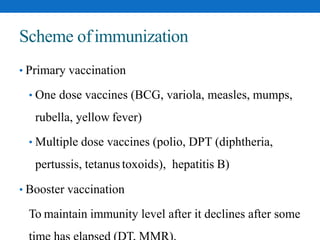
Scheme ofimmunization
• Primary vaccination
• One dose vaccines (BCG, variola, measles, mumps,
rubella, yellow fever)
• Multiple dose vaccines (polio, DPT (diphtheria,
pertussis, tetanus toxoids), hepatitis B)
• Booster vaccination
To maintain immunity level after it declines after some
Periods of maintained immunity by vaccines
• Short period (months):
• Two years:
• Three to five years:
• Five or more years:
• Ten years:
• Solid immunity:
cholera vaccine
TAB vaccine
DPT vaccine
BCG vaccine
Yellow fever vaccine
MMR (measles, mumps, and
rubella vaccines)
Levels ofeffectiveness
• Absolutely protective(100%): yellow fever vaccine
• Almost absolutely protective (99%): Variola, measles, mumps,
rubella vaccines, and diphtheria and tetanus toxoids.
• Highly protective (80-95%): polio, BCG, Hepatitis B, and
pertussis vaccines.
• Moderately protective (40-60%) TAB, cholera vaccine, and
influenza killed vaccine.
The ColdChain
• The "cold chain" is a system of storage and transport of
vaccines at low temperature from the manufacturer to the actual
vaccination site.
• The cold chain system is necessary because vaccine failure may
occur due to failure to store and transport under strict
temperature controls.
The Cold ChainEquipment
Cold chain equipment consists of the following:
(a)Walk in cold rooms: They are located at regional level,
meant to store vaccines up to 3 months and serve districts.
(b)Deep freezers (300 ltr) and Ice lined Refrigerators:
supplied to all districts and the WIC locations to store
vaccines. Deep freezers are used for making ice packs and to
store OPV and measles vaccines.
(c)Small deep freezers and ILR (140 ltr) : One set is provided
to PHCs, and Family Planning Centers
• (d) Cold boxes: Cold boxes
peripheral centers. These are
are supplied to all
used mainly for
transportation of the vaccines.
• (e) Vaccine carriers: Vaccine carriers are used to
carry small quantities of vaccines (16-20 vials) for the
out of reach sessions. 4 fully frozen ice packs are used
for lining the sides, and vials of DPT, DT, TT and
diluents should not be placed in direct contact with
frozen ice packs. The carriers should be closed tightly.
• (f) Ice packs: The ice packs contain water and no salt
should be added to it.
• Among the vaccines, Polio vaccine is the most sensitive to heat,
requiring storage at minus 20 degree C.
• Vaccines which must be stored in the FREEZER
COMPARTMENT are : polio and measles.
• Vaccines which must be stored in the COLD PART but never
allowed to freeze are : typhoid, DPT, tetanus toxoid, DT, BCG
and diluents
VaccinationCoverage
• Vaccination coverage is the percent of at risk or susceptible
individuals, or population who have been fully immunized
against particular diseases by vaccines or toxoids. To be
significantly effective in prevention of disease on mass or
community level at least a satisfactory proportion (75% or
more) of the at risk population must be immunized.
Herd immunity: At least 80-85% of the
population need to be vaccinated to reduce the
chance of somebody catching the disease –
even some one who has not been vaccinated-
to safe levels.
Ways of achieving satisfactoryimmunization
coverage
• Efficient immunization service; urban and rural
• Health awareness and cooperation of the public
• Periodic mass immunization campaigns, to cover those
who missed regular immunizations
• Outreach programs in rural and nomad areas, and home
visits
Application of activeimmunization
• Infants and children expanded immunization program
(schedule)
• Active immunization for adult females
• Vaccination for special occupations
• Vaccination for special life styles
• Vaccination for special environmental situations
• Vaccinations for special health status persons
• Vaccinations in travel
• Vaccines against bioterrorism

Active and Passive Immunization.pptx

  • 1.
  • 2.
    The Nature ofDisease •Pathogenic Organisms • Genetic Disorders • Toxic Chemicals • Other Environmental Factors • Physical Damage to Organs • Nutritional Disorders
  • 3.
    Types of PathogenicOrganisms •Viruses • Bacteria • Protozoan • Fungi • Animal • Parasites
  • 4.
    Mechanisms of DiseasebyPathogens • Utilization of host nutritional resources • Physical damage to host tissues • Production of toxic substances • Chromosomal and gene damage • Body cells behave abnormally
  • 5.
    Defense Mechanisms 1. ExternalDefense 2. Internal Defense 3. Immune Defense
  • 6.
    • Skin actsas barrier to microbes and viruses - sweat has a low pH • Mucus traps foreign particles • Tears - Lysozyme has antimicrobial action • Gastric stomach acid 1st Line of Defense
  • 7.
    Body Coverings: TheSkin sweat gland epidermis sebaceous glands
  • 8.
    Body Coverings: MucousMembranes mucus cilia
  • 9.
    • Phagocytic cells(WBCs) - Natural Killer (NK) Cells: attack virus infected cells • • Inflammatory Response Antimicrobial proteins - Lysozyme - Interferon - Antibodies 2nd Line of Defense
  • 10.
  • 11.
  • 12.
    Inflammatory Response Histamine & prostaglandins released Capillariesdilate Clotting begins Chemotactic factors attract phagocytic cells Phagocytes consume pathogens & cell debris
  • 13.
    Lymphatic System 3rd Lineof Defense Human
  • 14.
    Immunity: • The stateof being immune from or insusceptible to a particular disease. • The condition that permits either natural or acquired resistance to disease. • The ability of the cell to react immunologically in the presence of antigen.
  • 15.
    How immunitydevelops • Duringthe body’s first encounter with a pathogen there will be few lymphocytes with specific receptors • It takes time to divide to form clones, B lymphocytes to secrete antibodies, T lymphocyteproduction • If the same pathogen invades again persisting memory cells can give a faster, more effective response
  • 16.
    Characteristics ofImmunity • Recognitionof self versus non-self • Response is specific • Retains a “memory” allowing an accelerated second response • Can respond to many different materials • Involves lymphocytes and antibodies
  • 17.
    Types of Immunity •Active Immunity - Naturally-Acquired Active Immunity - Artificially-Acquired Active Immunity • Passive Immunity - Naturally-Acquired Passive Immunity - Artificially-Acquired Passive Immunity
  • 18.
  • 19.
    • An infectionis an example of acquiring natural immunity. It is called ACTIVE as your body needs to work to produce the necessary antibodies • When a mother breast feeds her baby she passes antibodies to it. This is a way of acquiring PASSIVE immunity as it is a way of gaining antibodies without the immune system having to produce them. • The thick, yellowish milk (colostrum) that is produced for the first few days after birth is particularly rich in antibodies. Natural immunity: active andpassive
  • 20.
    Artificial immunity: activeandpassive • An alternative to natural immunity developing is to give vaccinations (artificial immunity) • Antigen is injected into the body. • This may be in the form of an inactivated bacterial toxin or attenuated (not harmful) virus which would promote ACTIVE immunity; • or the injection of antibodies or antitoxins which would promote PASSIVE immunity (eg Clostridium tetani)
  • 21.
    • The productionof antibodies against a specific disease by the immune system. • Naturally acquired through disease • Artificially acquired through vaccination • Vaccines include inactivated toxins, killed microbes, parts of microbes, and viable but weakened microbes. • Memory cells are only produced in active immunity. • Protection for active immunity is permanent whereas in passive immunity it is only temporary. • Antigens are only encountered in active immunity. • Active immunity takes several weeks to become active but passive is immediate ActiveImmunity
  • 22.
    • A vaccinatedperson has a secondary response based on memory cells when encountering the specific pathogen. • Routine immunization against infectious diseases such as measles and whooping cough, and has led to the eradication of smallpox, a viral disease. • Unfortunately, not all infectious agents are easily managed by vaccination. • HIV vaccine in the works
  • 23.
    PassiveImmunity • When antibodiesproduced in one body (human or animal) are transfer to another to induce protection against disease. • Body does not produce its own antibodies, depends upon ready-made antibodies. • Passive immunity may be induced by: - Administration of an antibody-containing preparation (immune globulin or antiserum) - Transfer of maternal antibodies across the placenta - Transfer of lymphocytes, to induce passive cellular immunity
  • 24.
    • Passive Immunity-Protection against disease through antibodies produced by another human being or animal. • Ex. Maternal antibodies , Colostrum • Passive immunity doesn’t last as long as active immunity (only weeks or months): • No lymphocytes are stimulated to clone themselves • No memory cells have been made • Effective, but temporary as this type of immunity can only last as long as the antibodies/toxins last in the blood PassiveImmunity Cntd…
  • 25.
    PassiveImmunity Cntd… • Passiveimmunity can be transferred artificially by injecting antibodies from an animal that is already immune to a disease into another animal. • Rabies treatment: injection with antibodies against rabies virus that are both passive immunizations (the immediate fight) and active immunizations (longer term defense).
  • 26.
    PassiveImmunity Cntd… • Passiveimmunity differs from active immunity in the following respects: - Immunity is rapidly established - Immunity produced is only temporary (days to month) - No education of the reticuloendothelial system • Active immunity is superior to passive immunity because: - Duration of protection is long lasting - Severe reactions are rare - Protective efficacy is more - Active immunization is less expensive
  • 27.
  • 28.
    Vaccination • Vaccination isa method of giving antigen to stimulate the immune response through active immunization. • A vaccine is an immuno-biological substance designed to produce specific protection against a given disease. • A vaccine is “antigenic” but not “pathogenic”. One of the most effective «weapons» in medicine 1798 Edward Jenner immunizes first time against smallpox 1885 Louis Pasteur prepares the 1st vaccine against Rabbies 1927 BCG (bacillus Galmette-Guerin) 1955 Salk vaccine against poliomyelitis 1960 MMR (Measles, Mumps and Rubella)……..
  • 29.
    Types ofvaccines • Livevaccines • Attenuated live vaccines • Inactivated (killed vaccines) • Toxoids • Polysaccharide and polypeptide (cellular fraction) vaccines • Surface antigen (recombinant) vaccines
  • 30.
    Live vaccines • Livevaccines are made from live infectious agents without any amendment. • The only live vaccine is “Variola” small pox vaccine, made of live vaccinia cow-pox virus (not variola virus) which is not pathogenic but antigenic, giving cross immunity for variola.
  • 31.
    Live attenuated (avirulent)vaccines •Virulent pathogenic organisms are treated to become attenuated and avirulent but antigenic. They have lost their capacity to induce full-blown disease but retain their immunogenicity. • Attenuated– live microbe (usually virus) which has a vital function inactivated by heat, chemicals or genetic manipulation e.g. Rabies virus vaccine, MMR (Bacillus antibody (Measles, Mumps and Rubella), BCG Calmette Guerin vaccine for M. tuberculosis • Risk it could revert back to infectious agent • will stimulate both cell mediated and mediated immune response
  • 32.
    Live attenuated (avirulent)vaccinescontd.. Live attenuated vaccines should not be administered to persons with suppressed immune response due to: • Leukemia and lymphoma • Other malignancies corticosteroids and anti-metabolic • Receiving agents • Radiation • pregnancy
  • 33.
    Inactivated (killed)vaccines • Organismsare killed or inactivated by heat or chemicals but remain antigenic. • They are usually safe but less effective than live attenuated vaccines. • The only absolute contraindication to their administration is a severe local or general reaction to a previous dose
  • 34.
    Toxoids • They areprepared by detoxifying the exotoxins of some bacteria rendering them antigenic but not pathogenic. • Adjuvant (e.g. alum precipitation) is used to increase the potency of vaccine. • The antibodies produces in the body as a consequence of toxoid administration neutralize the toxic moiety produced during infection rather than act upon the organism itself. • In general toxoids are highly efficacious and safe immunizing agents.
  • 35.
    Polysaccharide and polypeptidevaccines •They are prepared from extracted cellular fractions e.g. meningococcal vaccine from the polysaccharide antigen of the cell wall, the pneumococcal vaccine from the polysaccharide contained in the capsule of the organism, and hepatitis B polypeptide vaccine. • Their efficacy and safety appear to be high.
  • 36.
    Surface antigen (recombinant)vaccines •It is prepared by cloning HBsAg gene in yeast cells where it is expressed. • HBsAg produced is then used for vaccine preparations. Their efficacy and safety also appear to be high.
  • 37.
    TYPES OFVACCINES Live vaccines Live Attenuated vaccines Killed Inactivated vaccines Toxoids Cellular fraction vaccines Recombinan tvaccines •Small pox variola vaccine •BCG •Typhoid oral •Plague •Typhoid •Cholera •Pertussis •Plague •Rabies •Salk polio •Intra- muscular influenza •Japanise encephalitis •Diphtheria •Tetanus •Meningococcal polysaccharide vaccine •Pneumococcal polysaccharide vaccine •Hepatitis B polypeptide vaccine •Hepatitis B vaccine •Oral polio •Yellow fever •Measles •Mumps •Rubella •Intranasal Influenza •Typhus
  • 38.
    Routes ofadministration • Deepsubcutaneous or intramuscular route (most vaccines) • Oral route ( oral BCG vaccine) • Intradermal route (BCG vaccine) • Scarification (small pox vaccine) • Intranasal route (live attenuated influenza vaccine)
  • 39.
    Scheme ofimmunization • Primaryvaccination • One dose vaccines (BCG, variola, measles, mumps, rubella, yellow fever) • Multiple dose vaccines (polio, DPT (diphtheria, pertussis, tetanus toxoids), hepatitis B) • Booster vaccination To maintain immunity level after it declines after some
  • 40.
    Periods of maintainedimmunity by vaccines • Short period (months): • Two years: • Three to five years: • Five or more years: • Ten years: • Solid immunity: cholera vaccine TAB vaccine DPT vaccine BCG vaccine Yellow fever vaccine MMR (measles, mumps, and rubella vaccines)
  • 41.
    Levels ofeffectiveness • Absolutelyprotective(100%): yellow fever vaccine • Almost absolutely protective (99%): Variola, measles, mumps, rubella vaccines, and diphtheria and tetanus toxoids. • Highly protective (80-95%): polio, BCG, Hepatitis B, and pertussis vaccines. • Moderately protective (40-60%) TAB, cholera vaccine, and influenza killed vaccine.
  • 42.
    The ColdChain • The"cold chain" is a system of storage and transport of vaccines at low temperature from the manufacturer to the actual vaccination site. • The cold chain system is necessary because vaccine failure may occur due to failure to store and transport under strict temperature controls.
  • 43.
    The Cold ChainEquipment Coldchain equipment consists of the following: (a)Walk in cold rooms: They are located at regional level, meant to store vaccines up to 3 months and serve districts. (b)Deep freezers (300 ltr) and Ice lined Refrigerators: supplied to all districts and the WIC locations to store vaccines. Deep freezers are used for making ice packs and to store OPV and measles vaccines. (c)Small deep freezers and ILR (140 ltr) : One set is provided to PHCs, and Family Planning Centers
  • 44.
    • (d) Coldboxes: Cold boxes peripheral centers. These are are supplied to all used mainly for transportation of the vaccines. • (e) Vaccine carriers: Vaccine carriers are used to carry small quantities of vaccines (16-20 vials) for the out of reach sessions. 4 fully frozen ice packs are used for lining the sides, and vials of DPT, DT, TT and diluents should not be placed in direct contact with frozen ice packs. The carriers should be closed tightly. • (f) Ice packs: The ice packs contain water and no salt should be added to it.
  • 45.
    • Among thevaccines, Polio vaccine is the most sensitive to heat, requiring storage at minus 20 degree C. • Vaccines which must be stored in the FREEZER COMPARTMENT are : polio and measles. • Vaccines which must be stored in the COLD PART but never allowed to freeze are : typhoid, DPT, tetanus toxoid, DT, BCG and diluents
  • 46.
    VaccinationCoverage • Vaccination coverageis the percent of at risk or susceptible individuals, or population who have been fully immunized against particular diseases by vaccines or toxoids. To be significantly effective in prevention of disease on mass or community level at least a satisfactory proportion (75% or more) of the at risk population must be immunized.
  • 47.
    Herd immunity: Atleast 80-85% of the population need to be vaccinated to reduce the chance of somebody catching the disease – even some one who has not been vaccinated- to safe levels.
  • 48.
    Ways of achievingsatisfactoryimmunization coverage • Efficient immunization service; urban and rural • Health awareness and cooperation of the public • Periodic mass immunization campaigns, to cover those who missed regular immunizations • Outreach programs in rural and nomad areas, and home visits
  • 49.
    Application of activeimmunization •Infants and children expanded immunization program (schedule) • Active immunization for adult females • Vaccination for special occupations • Vaccination for special life styles • Vaccination for special environmental situations • Vaccinations for special health status persons • Vaccinations in travel • Vaccines against bioterrorism