What is immunity ?
Immunity is the ability of the body to fight against infections and to protect the body
from the all types of foreign bodies like bacteria , virus ,toxic substances etc and it is also
called defence mechanism of our body .
Innate immunity
Innate immunity or non-specific immunity that a host uses immediately or within
several hours after exposure to almost any microbe . It is known as first line of defense . It
is present in all multicellular organism including plants and insects.
Types of innate immunity :
Specific immunity :
• Resistance showed by all members in species for a pathogen
For example : Bacillus anthracis affects humans but not chickens , all species shown
immunity against b.anthracis
MECHANISM:
• Difference in physiological and biochemical composition between tissues of different
species is responsible for the species specific immunity
Racial immunity :
• Different races within a species , may shows different immune response is known as racial
immunity
For example :Africans resistance to Plasmodium falciparum (malaria)
MECHANISM : mostly genetics
Individual immunity :
• A particular individual is resistance to infection
For example : common cold
MECHANISM : several factors such as age , hormones , nutrition , and etc..
FIRST LINE OF DEFENSE :
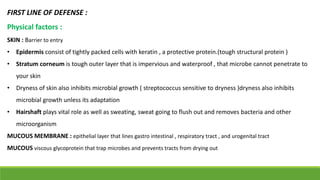
Physical factors :
SKIN : Barrier to entry
• Epidermis consist of tightly packed cells with keratin , a protective protein.(tough structural protein )
• Stratum corneum is tough outer layer that is impervious and waterproof , that microbe cannot penetrate to
your skin
• Dryness of skin also inhibits microbial growth ( streptococcus sensitive to dryness )dryness also inhibits
microbial growth unless its adaptation
• Hairshaft plays vital role as well as sweating, sweat going to flush out and removes bacteria and other
microorganism
MUCOUS MEMBRANE : epithelial layer that lines gastro intestinal , respiratory tract , and urogenital tract
MUCOUS viscous glycoprotein that trap microbes and prevents tracts from drying out
b) CHEMICAL FACTORS
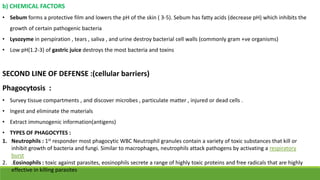
• Sebum forms a protective film and lowers the pH of the skin ( 3-5). Sebum has fatty acids (decrease pH) which inhibits the
growth of certain pathogenic bacteria
• Lysozyme in perspiration , tears , saliva , and urine destroy bacterial cell walls (commonly gram +ve organisms)
• Low pH(1.2-3) of gastric juice destroys the most bacteria and toxins
SECOND LINE OF DEFENSE :(cellular barriers)
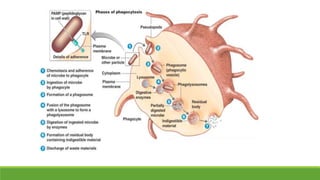
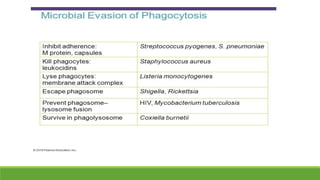
Phagocytosis :
• Survey tissue compartments , and discover microbes , particulate matter , injured or dead cells .
• Ingest and eliminate the materials
• Extract immunogenic information(antigens)
• TYPES OF PHAGOCYTES :
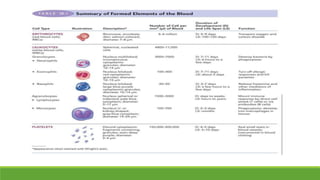
1. Neutrophils : 1st responder most phagocytic WBC Neutrophil granules contain a variety of toxic substances that kill or
inhibit growth of bacteria and fungi. Similar to macrophages, neutrophils attack pathogens by activating a respiratory
burst
2. .Eosinophils : toxic against parasites, eosinophils secrete a range of highly toxic proteins and free radicals that are highly
effective in killing parasites
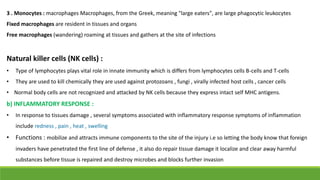
3 . Monocytes : macrophages Macrophages, from the Greek, meaning "large eaters", are large phagocytic leukocytes
Fixed macrophages are resident in tissues and organs
Free macrophages (wandering) roaming at tissues and gathers at the site of infections
Natural killer cells (NK cells) :
• Type of lymphocytes plays vital role in innate immunity which is differs from lymphocytes cells B-cells and T-cells
• They are used to kill chemically they are used against protozoans , fungi , virally infected host cells , cancer cells
• Normal body cells are not recognized and attacked by NK cells because they express intact self MHC antigens.
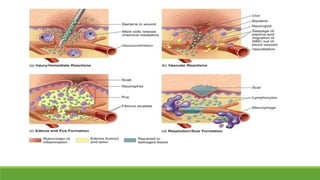
b) INFLAMMATORY RESPONSE :
• In response to tissues damage , several symptoms associated with inflammatory response symptoms of inflammation
include redness , pain , heat , swelling
• Functions : mobilize and attracts immune components to the site of the injury i.e so letting the body know that foreign
invaders have penetrated the first line of defense , it also do repair tissue damage it localize and clear away harmful
substances before tissue is repaired and destroy microbes and blocks further invasion
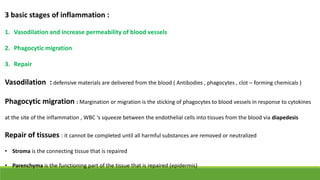
3 basic stages of inflammation :
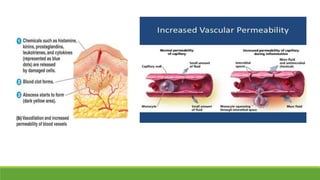
1. Vasodilation and increase permeability of blood vessels
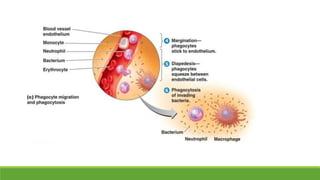
2. Phagocytic migration
3. Repair
Vasodilation : defensive materials are delivered from the blood ( Antibodies , phagocytes , clot – forming chemicals )
Phagocytic migration : Margination or migration is the sticking of phagocytes to blood vessels in response to cytokines
at the site of the inflammation , WBC ‘s squeeze between the endothelial cells into tissues from the blood via diapedesis
Repair of tissues : it cannot be completed until all harmful substances are removed or neutralized
• Stroma is the connecting tissue that is repaired
• Parenchyma is the functioning part of the tissue that is repaired (epidermis)
Fever (pyrogens):
Exogenous pyrogens : products of infection agents such as bacteria , fungi , virus , protozoans , endotoxin , blood products
vaccines , or injectable solutions coming from outside the body
Endogenous pyrogens : liberated by monocytes , neutrophils , and macrophages during phagocytosis such as interleukin -1
and tumour necrosis factor
Iron removal : lactoferrin iron removal
CHEMICAL BARRIER :
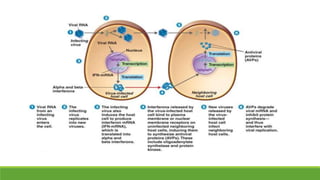
(i) Interferons
(ii) Complement system
Interferons :
• Produced by virally infected cells
• Binds to uninfected cells ‘s receptors
• Induces the production of anti viral proteins that inhibits viral replication
• Enhances immune response
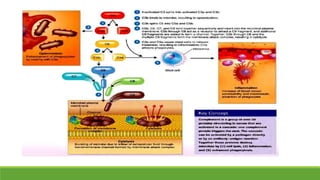
Complement system :
• A group of serum protein produce by the liver that assist immune system in destroying microbes
• It acts as cascade in a process called complement activation it basically signal transduction pathway
• It used to dilate arteries so again to increase blood flow during inflammation
• It also act as chemotactic agents
• Proteins are designated with upper case C and number in order of discovery
• Activated fragments are indicated with a and b .
Outcome of complement activation :
Cytolysis activated complement proteins by membrane attack complex (MAC)
Opsonization promotes attachment of phagocyte to a microbe
Inflammation activated complement protein bind to mast cells , releasing histamines
REFERENCE ;
https://www.youtube.com/watch?v=eyGLg1OzdUQ
https://nios.ac.in/media/documents/dmlt/Microbiology/Less
on-55.pdf
https://www.youtube.com/watch?v=jCEQZ6V25ZY
https://www.youtube.com/watch?v=LSGgPeQBpfk
https://slideplayer.com/slide/5674398/
THANKS TO
• The Chairman
• The Secretary Management Committee
• The Principal of Sri Paramakalyani College
• The Head - Department of Microbiology
• The Staff Members - Department of Microbiology

INNATE IMMUNITY

  • 2.
    What is immunity? Immunity is the ability of the body to fight against infections and to protect the body from the all types of foreign bodies like bacteria , virus ,toxic substances etc and it is also called defence mechanism of our body . Innate immunity Innate immunity or non-specific immunity that a host uses immediately or within several hours after exposure to almost any microbe . It is known as first line of defense . It is present in all multicellular organism including plants and insects.
  • 3.
    Types of innateimmunity : Specific immunity : • Resistance showed by all members in species for a pathogen For example : Bacillus anthracis affects humans but not chickens , all species shown immunity against b.anthracis MECHANISM: • Difference in physiological and biochemical composition between tissues of different species is responsible for the species specific immunity
  • 4.
    Racial immunity : •Different races within a species , may shows different immune response is known as racial immunity For example :Africans resistance to Plasmodium falciparum (malaria) MECHANISM : mostly genetics Individual immunity : • A particular individual is resistance to infection For example : common cold MECHANISM : several factors such as age , hormones , nutrition , and etc..
  • 6.
    FIRST LINE OFDEFENSE : Physical factors : SKIN : Barrier to entry • Epidermis consist of tightly packed cells with keratin , a protective protein.(tough structural protein ) • Stratum corneum is tough outer layer that is impervious and waterproof , that microbe cannot penetrate to your skin • Dryness of skin also inhibits microbial growth ( streptococcus sensitive to dryness )dryness also inhibits microbial growth unless its adaptation • Hairshaft plays vital role as well as sweating, sweat going to flush out and removes bacteria and other microorganism MUCOUS MEMBRANE : epithelial layer that lines gastro intestinal , respiratory tract , and urogenital tract MUCOUS viscous glycoprotein that trap microbes and prevents tracts from drying out
  • 7.
    b) CHEMICAL FACTORS •Sebum forms a protective film and lowers the pH of the skin ( 3-5). Sebum has fatty acids (decrease pH) which inhibits the growth of certain pathogenic bacteria • Lysozyme in perspiration , tears , saliva , and urine destroy bacterial cell walls (commonly gram +ve organisms) • Low pH(1.2-3) of gastric juice destroys the most bacteria and toxins SECOND LINE OF DEFENSE :(cellular barriers) Phagocytosis : • Survey tissue compartments , and discover microbes , particulate matter , injured or dead cells . • Ingest and eliminate the materials • Extract immunogenic information(antigens) • TYPES OF PHAGOCYTES : 1. Neutrophils : 1st responder most phagocytic WBC Neutrophil granules contain a variety of toxic substances that kill or inhibit growth of bacteria and fungi. Similar to macrophages, neutrophils attack pathogens by activating a respiratory burst 2. .Eosinophils : toxic against parasites, eosinophils secrete a range of highly toxic proteins and free radicals that are highly effective in killing parasites
  • 10.
    3 . Monocytes: macrophages Macrophages, from the Greek, meaning "large eaters", are large phagocytic leukocytes Fixed macrophages are resident in tissues and organs Free macrophages (wandering) roaming at tissues and gathers at the site of infections Natural killer cells (NK cells) : • Type of lymphocytes plays vital role in innate immunity which is differs from lymphocytes cells B-cells and T-cells • They are used to kill chemically they are used against protozoans , fungi , virally infected host cells , cancer cells • Normal body cells are not recognized and attacked by NK cells because they express intact self MHC antigens. b) INFLAMMATORY RESPONSE : • In response to tissues damage , several symptoms associated with inflammatory response symptoms of inflammation include redness , pain , heat , swelling • Functions : mobilize and attracts immune components to the site of the injury i.e so letting the body know that foreign invaders have penetrated the first line of defense , it also do repair tissue damage it localize and clear away harmful substances before tissue is repaired and destroy microbes and blocks further invasion
  • 11.
    3 basic stagesof inflammation : 1. Vasodilation and increase permeability of blood vessels 2. Phagocytic migration 3. Repair Vasodilation : defensive materials are delivered from the blood ( Antibodies , phagocytes , clot – forming chemicals ) Phagocytic migration : Margination or migration is the sticking of phagocytes to blood vessels in response to cytokines at the site of the inflammation , WBC ‘s squeeze between the endothelial cells into tissues from the blood via diapedesis Repair of tissues : it cannot be completed until all harmful substances are removed or neutralized • Stroma is the connecting tissue that is repaired • Parenchyma is the functioning part of the tissue that is repaired (epidermis)
  • 15.
    Fever (pyrogens): Exogenous pyrogens: products of infection agents such as bacteria , fungi , virus , protozoans , endotoxin , blood products vaccines , or injectable solutions coming from outside the body Endogenous pyrogens : liberated by monocytes , neutrophils , and macrophages during phagocytosis such as interleukin -1 and tumour necrosis factor Iron removal : lactoferrin iron removal CHEMICAL BARRIER : (i) Interferons (ii) Complement system Interferons : • Produced by virally infected cells • Binds to uninfected cells ‘s receptors • Induces the production of anti viral proteins that inhibits viral replication • Enhances immune response
  • 17.
    Complement system : •A group of serum protein produce by the liver that assist immune system in destroying microbes • It acts as cascade in a process called complement activation it basically signal transduction pathway • It used to dilate arteries so again to increase blood flow during inflammation • It also act as chemotactic agents • Proteins are designated with upper case C and number in order of discovery • Activated fragments are indicated with a and b . Outcome of complement activation : Cytolysis activated complement proteins by membrane attack complex (MAC) Opsonization promotes attachment of phagocyte to a microbe Inflammation activated complement protein bind to mast cells , releasing histamines
  • 19.
  • 22.
    THANKS TO • TheChairman • The Secretary Management Committee • The Principal of Sri Paramakalyani College • The Head - Department of Microbiology • The Staff Members - Department of Microbiology