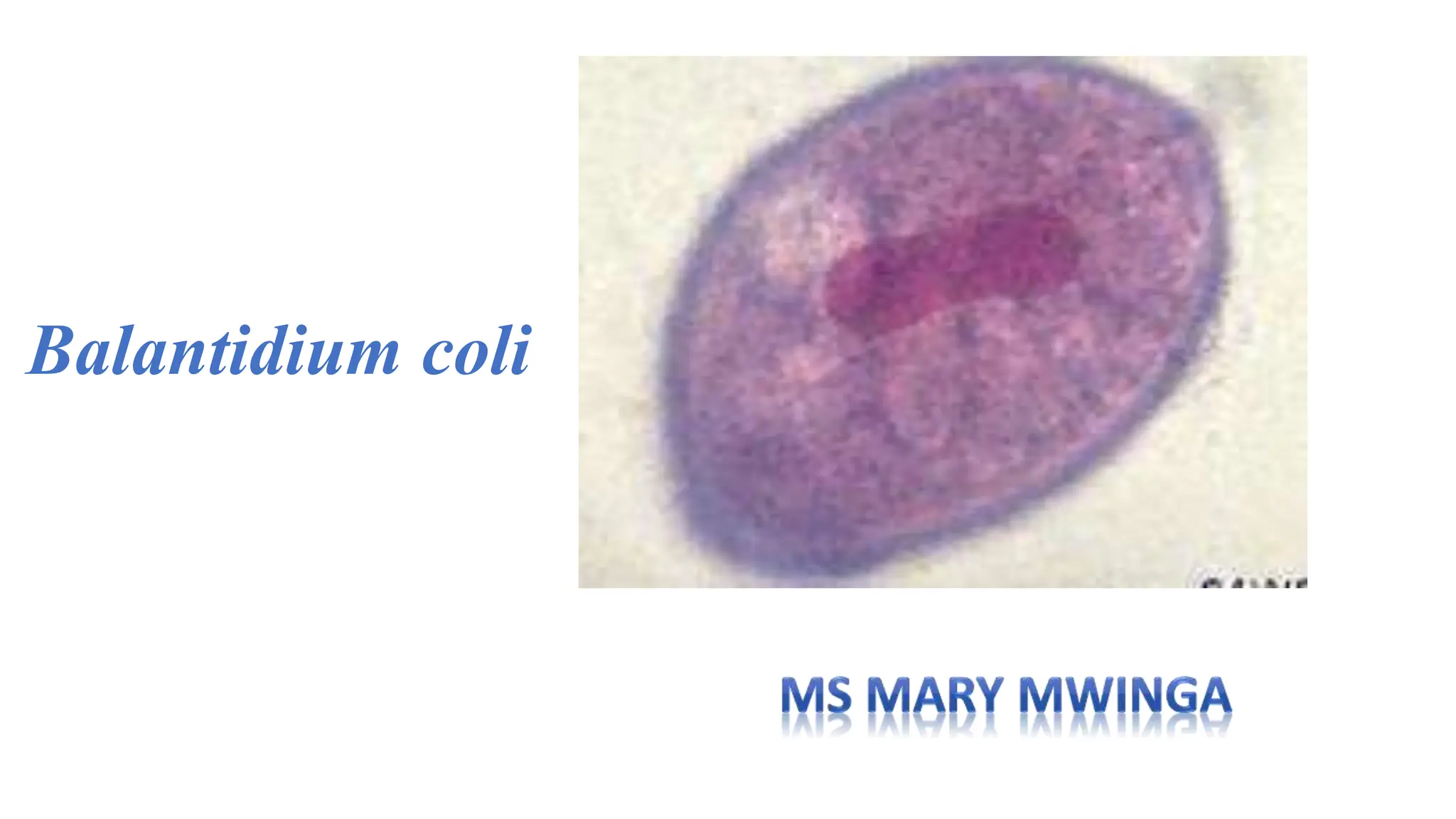
Balantidium coli
INTRODUCTION
• It is largest protozoan
• Only ciliated parasites of humans
• Causes Balantidiasis
Taxonomy:
belongs to Phylum Ciliophora
Class: Litostomatea
Order: Vestibuliferida
Family: Balantidiidae
Habitat: large intestines of man, pig (main reservoir) and other animals.
MORPHOLOGY
• Two forms:
a. Trophozoite – in dysenteric stool
b. Cyst: - in carriers and chronic cases
Both forms: binucleated - large macronucleus and small micronucleus
TROPHOZOITE
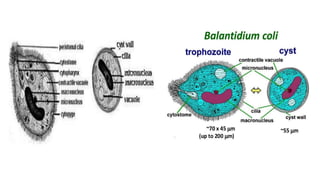
• Found in active stage of disease – invasive form
• shape: oval
• Size: 30-300 µm long x 30-100 µm breadth
• Whole body covered with a row of tiny delicate cilia – organ of locomotion
• Cilia present near the mouth part – longer  called “adoral cilia”
• Anterior end- narrow
- Bears a groove (peristome) that leads to a mouth (cytostome)
- followed by a short funnel shaped gullet (cytopharynx) extending up to one-third
of the body.
• Posterior end- broad, round
- Bears an excretory opening (cytopyge)
TROPHOZOITE
• No anus
• Cytoplasm- outer clear ectoplasm and inner granular endoplasm
Endoplasm
- Contains two nuclei: large kidney shaped macronucleus in center
and a small micronucleus in the concavity of the macronucleus
- Two contractile vacuoles: lie side by side or one above the other maintain the
proper osmotic pressure inside cell
- Numerous food vacuole: contains food particles like debris from host gut,
bacteria, starch grains, fat droplets and occasional RBCs, etc.
 Where digestion of food particles takes place.
CYST
• Shape: round
• Size: 40-60 µm
• Immobile and dominant
• Surrounded by a thick transparent cyst wall allows the cysts to
resist degradation in the acidic environment of the stomach and the
basic environment of the small intestine
- Contains two nuclei- macronucleus and micronucleus and vacuoles
- Cilia- seen in younger cyst but is absorbed on maturity movement
ceases
Development in large intestine- Life cycle
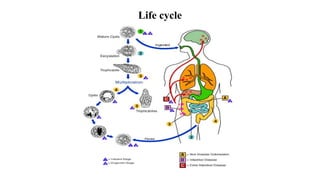
• Mode of transmission: faecal-oral route
• Virulence factor: Hyaluronidase- help to penetrate intestinal mucosa
• Excystation: occurs in small intestine- when trophozoites are produced from cysts
- Multiplication in large intestine
- Single trophozoite forms from each cyst
- trophozoite- is the feeding stage of the parasite  multiply either in gut lumen or
enter the sub mucosa of large intestine
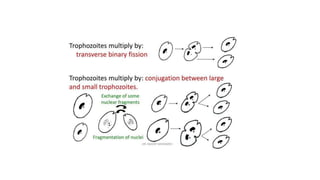
Cell division Asexual reproduction
Sexual reproduction
Asexual reproduction
• Division by binary fission
• Micronucleus divide first followed by macronucleus
• A transverse septum forms – separates the cytoplasm into halves.
Sexual reproduction
• Replicate sexually (Syngamy) by conjugation
• Two trophozoites come in contact with each other at their anterior ends
• Exchange the nuclear material for few moments then they detach
• No increase in number of trophozoites
• Both trophozoite and cyst are excreted in faeces
• Trophozoites disintegrates, cysts are resistant and are infective to man and pig
Life cycle
Risk factors
• Pig’s faeces carrying vast volumes of Balantidium coli contaminates
water sources
• Humans who work with pigs  exposed to Balantidium coli.
Clinical features
Asymptomatic carriers
• Results from majority of infection
• Harbours the cyst and spread the infection
Acute disease
• Similar to acute amoebic dysentery
• Trophozoites invade gut sub mucosa- form multiple tiny superficial ulcers
- Ulcers with necrotic base and undermined edge
• Microscopically- cluster of trophozoites are found in sub mucosa with inflammatory cells
(lymphocytic)
• Patients present have frequent diarrhoea with profuse mucus and blood.
• Other features- fever, nausea, vomiting and abdominal pain
• Haemorrhage- may lead to shock and death
Clinical features
Chronic disease
• Have periods of increased bowel movements (mucous or rarely bloody)
• Alternate periods of constipations
• Organism load is less and requires repeated stool examination
Complications
• Seen in immunocompromised and malnourished people
• Perforation of large intestine, involvement of appendix, peritonitis, severe
dehydration leading to renal failure
• Extra intestinal manifestations- rare: liver abscess, pleuritis and pneumonia
EPIDEMIOLOGY
Balantidiasis:
• Distributed worldwide- in tropical and subtropical countries with
increased pig to human contact
• Highest prevalence- 20% reported from mountain districts of West
Irian (Indonesia)
• Human outbreak reported from Pacific Island of Truk in 1973
• India: rare
LABORATORY DIAGNOSIS
• Stool examination-detects trophozoites and cysts
• Histopathology
• Culture
• serology
STOOL MICROSCOPY
• Trophozoites- detected in acute disease (dysenteric stool)
-easy to identify by its rotatory motility, large kidney shaped macronucleus and
presence of cilia
• Cysts- seen in chronic cases or carriers
- round, 40-60 µm in size, surrounded by a cyst wall and presence of two nuclei
HISTOPATHOLOGY
• Histopathological staining of biopsy tissue or scrapping of the ulcers
taken by sigmoidoscopy
-reveals clusters of trophozoites, cysts and lymphocytic infiltration
found in sub mucosa
CULTURE
• Media used: Boeck and Drbohlav egg serum media and Balamuth’s media
• Culture rarely necessary as parasites are easily detected by stool microscopy or
histopathology
Serology
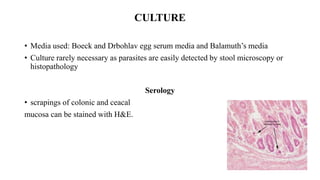
• scrapings of colonic and ceacal
mucosa can be stained with H&E.
PREVENTION
• Treatment of carriers shedding the cysts
• Hygienic rearing of pigs and prevention of pig to human contact
• Prevention of contamination of food or water with pig and human
faeces
TREATMENT
• DOC: Tetracycline- 500 mg four times a day for 10 days
• Alternatively Metronidazole- 750 mg three times a day for 5-7 days
• Treatment of carriers- preventing spread of the disease.
• No relapse or drug resistance reported
Things to remember
Trophozoite
• Shape Oval, pointed at anterior end
• Size 30-300 µm long x 30-100 µm wide
• Surface Covered in cilia
• Not infective
• Reproduction By binary fission or conjugation
• Nuclei: Macronucleus and micronucleus
Cyst
• Shape Spherical
• Size 40-60 m across
• Surface Covered with thick, hard cyst wall
• with cilia
• Infectious: Infective
• Reproduction Non-reproductive
• Nuclei: macronucleus and micronucleus

Balantidium coli.pdf

  • 1.
  • 2.
    INTRODUCTION • It islargest protozoan • Only ciliated parasites of humans • Causes Balantidiasis Taxonomy: belongs to Phylum Ciliophora Class: Litostomatea Order: Vestibuliferida Family: Balantidiidae Habitat: large intestines of man, pig (main reservoir) and other animals.
  • 3.
    MORPHOLOGY • Two forms: a.Trophozoite – in dysenteric stool b. Cyst: - in carriers and chronic cases Both forms: binucleated - large macronucleus and small micronucleus
  • 4.
    TROPHOZOITE • Found inactive stage of disease – invasive form • shape: oval • Size: 30-300 µm long x 30-100 µm breadth • Whole body covered with a row of tiny delicate cilia – organ of locomotion • Cilia present near the mouth part – longer  called “adoral cilia” • Anterior end- narrow - Bears a groove (peristome) that leads to a mouth (cytostome) - followed by a short funnel shaped gullet (cytopharynx) extending up to one-third of the body. • Posterior end- broad, round - Bears an excretory opening (cytopyge)
  • 5.
    TROPHOZOITE • No anus •Cytoplasm- outer clear ectoplasm and inner granular endoplasm Endoplasm - Contains two nuclei: large kidney shaped macronucleus in center and a small micronucleus in the concavity of the macronucleus - Two contractile vacuoles: lie side by side or one above the other maintain the proper osmotic pressure inside cell - Numerous food vacuole: contains food particles like debris from host gut, bacteria, starch grains, fat droplets and occasional RBCs, etc.  Where digestion of food particles takes place.
  • 7.
    CYST • Shape: round •Size: 40-60 µm • Immobile and dominant • Surrounded by a thick transparent cyst wall allows the cysts to resist degradation in the acidic environment of the stomach and the basic environment of the small intestine - Contains two nuclei- macronucleus and micronucleus and vacuoles - Cilia- seen in younger cyst but is absorbed on maturity movement ceases
  • 8.
    Development in largeintestine- Life cycle • Mode of transmission: faecal-oral route • Virulence factor: Hyaluronidase- help to penetrate intestinal mucosa • Excystation: occurs in small intestine- when trophozoites are produced from cysts - Multiplication in large intestine - Single trophozoite forms from each cyst - trophozoite- is the feeding stage of the parasite  multiply either in gut lumen or enter the sub mucosa of large intestine Cell division Asexual reproduction Sexual reproduction
  • 10.
    Asexual reproduction • Divisionby binary fission • Micronucleus divide first followed by macronucleus • A transverse septum forms – separates the cytoplasm into halves. Sexual reproduction • Replicate sexually (Syngamy) by conjugation • Two trophozoites come in contact with each other at their anterior ends • Exchange the nuclear material for few moments then they detach • No increase in number of trophozoites • Both trophozoite and cyst are excreted in faeces • Trophozoites disintegrates, cysts are resistant and are infective to man and pig
  • 11.
  • 12.
    Risk factors • Pig’sfaeces carrying vast volumes of Balantidium coli contaminates water sources • Humans who work with pigs  exposed to Balantidium coli.
  • 13.
    Clinical features Asymptomatic carriers •Results from majority of infection • Harbours the cyst and spread the infection Acute disease • Similar to acute amoebic dysentery • Trophozoites invade gut sub mucosa- form multiple tiny superficial ulcers - Ulcers with necrotic base and undermined edge • Microscopically- cluster of trophozoites are found in sub mucosa with inflammatory cells (lymphocytic) • Patients present have frequent diarrhoea with profuse mucus and blood. • Other features- fever, nausea, vomiting and abdominal pain • Haemorrhage- may lead to shock and death
  • 14.
    Clinical features Chronic disease •Have periods of increased bowel movements (mucous or rarely bloody) • Alternate periods of constipations • Organism load is less and requires repeated stool examination Complications • Seen in immunocompromised and malnourished people • Perforation of large intestine, involvement of appendix, peritonitis, severe dehydration leading to renal failure • Extra intestinal manifestations- rare: liver abscess, pleuritis and pneumonia
  • 15.
    EPIDEMIOLOGY Balantidiasis: • Distributed worldwide-in tropical and subtropical countries with increased pig to human contact • Highest prevalence- 20% reported from mountain districts of West Irian (Indonesia) • Human outbreak reported from Pacific Island of Truk in 1973 • India: rare
  • 16.
    LABORATORY DIAGNOSIS • Stoolexamination-detects trophozoites and cysts • Histopathology • Culture • serology
  • 17.
    STOOL MICROSCOPY • Trophozoites-detected in acute disease (dysenteric stool) -easy to identify by its rotatory motility, large kidney shaped macronucleus and presence of cilia • Cysts- seen in chronic cases or carriers - round, 40-60 µm in size, surrounded by a cyst wall and presence of two nuclei
  • 18.
    HISTOPATHOLOGY • Histopathological stainingof biopsy tissue or scrapping of the ulcers taken by sigmoidoscopy -reveals clusters of trophozoites, cysts and lymphocytic infiltration found in sub mucosa
  • 19.
    CULTURE • Media used:Boeck and Drbohlav egg serum media and Balamuth’s media • Culture rarely necessary as parasites are easily detected by stool microscopy or histopathology Serology • scrapings of colonic and ceacal mucosa can be stained with H&E.
  • 20.
    PREVENTION • Treatment ofcarriers shedding the cysts • Hygienic rearing of pigs and prevention of pig to human contact • Prevention of contamination of food or water with pig and human faeces
  • 21.
    TREATMENT • DOC: Tetracycline-500 mg four times a day for 10 days • Alternatively Metronidazole- 750 mg three times a day for 5-7 days • Treatment of carriers- preventing spread of the disease. • No relapse or drug resistance reported
  • 22.
    Things to remember Trophozoite •Shape Oval, pointed at anterior end • Size 30-300 µm long x 30-100 µm wide • Surface Covered in cilia • Not infective • Reproduction By binary fission or conjugation • Nuclei: Macronucleus and micronucleus
  • 23.
    Cyst • Shape Spherical •Size 40-60 m across • Surface Covered with thick, hard cyst wall • with cilia • Infectious: Infective • Reproduction Non-reproductive • Nuclei: macronucleus and micronucleus