Ajay Subedi
Janamaitri foundation institute of
health
sciences,Balaju,Kathmandu,Nepal
2
In 1896, Gruber and Durham published the
first report about the ability of antibody to
clumps cells, based on observation of
agglutination of bacterial cells by serum
ABO blood group
Typhoid fever
Brucellosis
• It is one of important laboratory method to detect
antigen antibody reaction.
• It provides flexible and useful method for semi
quantitating of either antigen or antibody
concentration.
• The reaction occurs between insoluble antigen
and appropriate antibody.
• The reaction will results in forming aggregate or
agglutinate.
• Antibodies that produce such reactions are
called agglutinins.
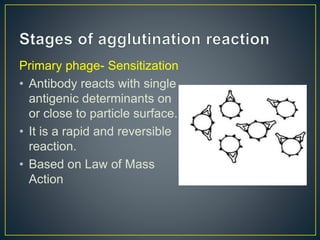
Primary phage- Sensitization
• Antibody reacts with single
antigenic determinants on
or close to particle surface.
• It is a rapid and reversible
reaction.
• Based on Law of Mass
Action
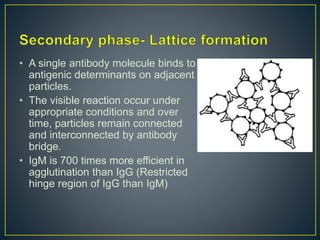
• A single antibody molecule binds to
antigenic determinants on adjacent
particles.
• The visible reaction occur under
appropriate conditions and over
time, particles remain connected
and interconnected by antibody
bridge.
• IgM is 700 times more efficient in
agglutination than IgG (Restricted
hinge region of IgG than IgM)
• Erythrocytes and bacterial cells have slightly
negative charge in their surface
• Like charges tend to repel
• Use of low ionic strength saline (Use of 5 to 30%
albumin neutralize the surface charge)
• Increase the viscosity (red cells)- add dextran or
polyethylene glycol (PEG)
• Agitation and centrifugation
• Temperature- (IgG- 30-37/ IgM-4-27); ABO-IgM
• pH- best 6.5-7.5; IgM- best at low pH
6
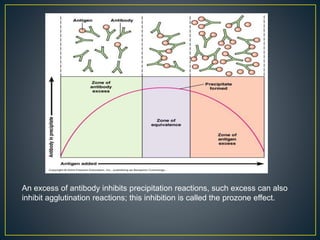
An excess of antibody inhibits precipitation reactions, such excess can also
inhibit agglutination reactions; this inhibition is called the prozone effect.
8
• Antibodies can agglutinate multivalent particulate
antigens, such as Red Blood Cells (RBCs) or bacteria or
latex particles
• Some viruses also have the ability to agglutinate with
RBCs.
• This behavior is called agglutination.
• Serological tests based on agglutination are usually more
sensitive than those based on precipitation
• Direct
• Passive
• Reverse Passive
• Agglutination Inhibition
• Coagglutination
9
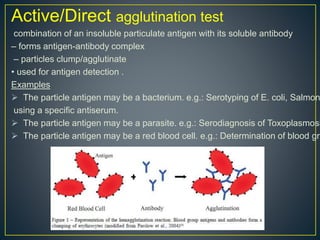
Active/Direct agglutination test
combination of an insoluble particulate antigen with its soluble antibody
– forms antigen-antibody complex
– particles clump/agglutinate
• used for antigen detection .
Examples
 The particle antigen may be a bacterium. e.g.: Serotyping of E. coli, Salmon
using a specific antiserum.
 The particle antigen may be a parasite. e.g.: Serodiagnosis of Toxoplasmosi
 The particle antigen may be a red blood cell. e.g.: Determination of blood gro
11
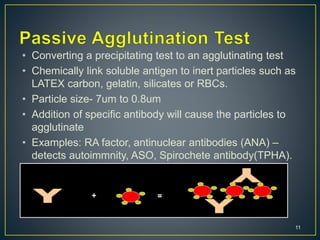
• Converting a precipitating test to an agglutinating test
• Chemically link soluble antigen to inert particles such as
LATEX carbon, gelatin, silicates or RBCs.
• Particle size- 7um to 0.8um
• Addition of specific antibody will cause the particles to
agglutinate
• Examples: RA factor, antinuclear antibodies (ANA) –
detects autoimmnity, ASO, Spirochete antibody(TPHA).
+ =
E.g. Rose waaler test –detects rheumatoid arthritis
• RA factor in rheumatoid arthritis patients acts as antibody
to human gamma globulin.
• It can agglutinate red cells coated with globulins
• Antigen is sheep RBCs suspension sensitized with rabbit
anti sheep erythrocytes antibody (amboreceptor).
Examples
• Microhemagglutination test for Syphilis (MHA-TP)
• Hemagglutination treponemal test for Syphilis (HATTS)
• Passive hemagglutination tests for antibody to
extracellular antigen of Streptococci
• Rubella indirect hemagglutination test
• Hemagglutination Inhibition Test (HAI) for Avian
Influenza
• Quantitative Micro Hemagglutination Test (HA)
2.Latex agglutination : latex particles used as carrier molecules
Eg: antigen coated latex particles are used in detection of ASO ,
S.agalactiae, Clostridium difficile toxins A and B , rotavirus
Antibody coated latex particles are used in detection of CRP, RA
factor, HCG.
Reaction is dependent on
• Amount and avidity of antigen bound to carrier
• Time of the incubation with specimen
• Environment of interaction (pH, Protein concentration etc)
3.RPR or rapid plasma reagin:
• Used for syphillis
• Carbon is the carrier particle
• Cardiolipin antigen is coated with charcoal (carbon)
• Detect reagin – an antibody like substance in the plasma
of syphillis
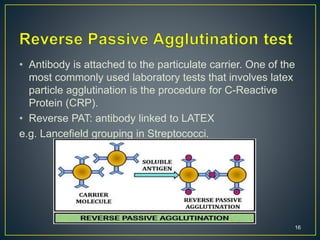
• Antibody is attached to the particulate carrier. One of the
most commonly used laboratory tests that involves latex
particle agglutination is the procedure for C-Reactive
Protein (CRP).
• Reverse PAT: antibody linked to LATEX
e.g. Lancefield grouping in Streptococci.
16
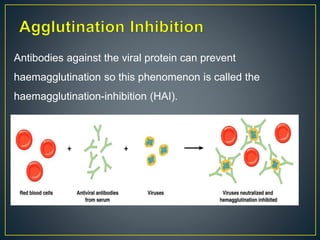
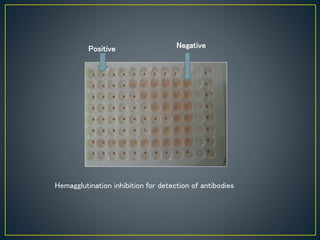
Antibodies against the viral protein can prevent
haemagglutination so this phenomenon is called the
haemagglutination-inhibition (HAI).
Positive Negative
Hemagglutination inhibition for detection of antibodies
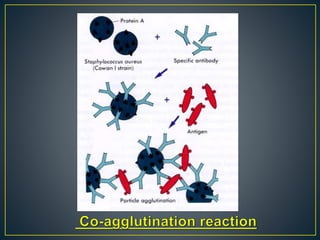
Co-agglutination:
• The test is based on the presence of protein A on the
outer surface of Staphylococcus aureus produced by
most strains(Heat killed Cowan 1 strain).
• The antibody(IgG) binds by Fc portion to protein A and
the antigen combining Fab portion is free.
• Coagglutination test can be done for sterptococcus(
lancefield groups), Spneumoniae, N.gonorrhoea,
N.meningitidis
• When a particulate antigen is mixed with its antibody in
the presence of electolytes at a suitable temperature and
pH, the particles are clumped or agglutinated
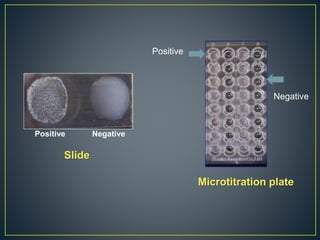
Agglutination tests can be done :
• On slides
• In tubes
• In microtritation plates
22
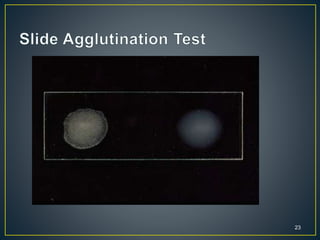
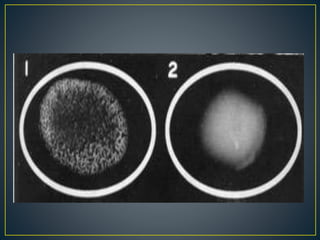
• Used for serotyping (e.g. Salmonella)
• Antigen: isolated Salmonella in suspension
• Antibody: specific antisera against Salmonella
Procedure:
• Place test Salmonella in a drop of saline on a
slide,
• Add a drop of antiserum, mix and rock slide for
approx. 1 minute.
• Examine for agglutination
23
25
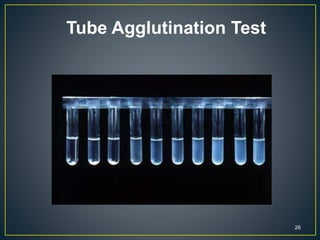
• Also known as the standard agglutination test or serum
agglutination test (SAT)
• Test serum is diluted in a series of tubes (doubling
dilutions)
• Constant defined amount of antigen is then added to
each tube and tubes incubated for ~20h @37°C
• Particular antigen clumps at the bottom of the test tube
• Test is read at 50% agglutination
• Quantitative
• Confirmatory test for ELISA reactors
• Example: Brucellosis screening
26
Tube Agglutination Test
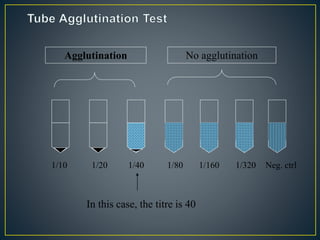
No agglutination
Agglutination
1/10 1/20 1/40 1/80 1/160 1/320 Neg. ctrl
In this case, the titre is 40
Negative
Positive
Positive Negative
Slide
Microtitration plate
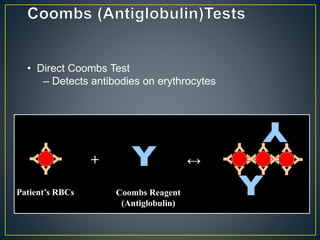
• Direct Coombs Test
– Detects antibodies on erythrocytes
+ ↔
Patient’s RBCs Coombs Reagent
(Antiglobulin)
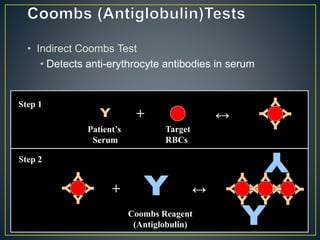
• Indirect Coombs Test
• Detects anti-erythrocyte antibodies in serum
Patient’s
Serum
Target
RBCs
+ ↔
Step 1
+ ↔
Coombs Reagent
(Antiglobulin)
Step 2
• • Weil – Felix Test or Reaction in Serodiagnosis
of typhus fevers is heterophile agglutination test
and sharing of common antigen between typhus,
Rickettsiae and some strains of Proteus bacilli.
• Positive in Mycoplasma ( Primary Atypical )
Pneumonia
• The patients sera agglutinated human O group
erythrocytes at 4 o c the agglutination being
reversible at 37 0 c.
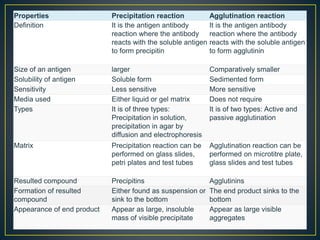
Properties Precipitation reaction Agglutination reaction
Definition It is the antigen antibody
reaction where the antibody
reacts with the soluble antigen
to form precipitin
It is the antigen antibody
reaction where the antibody
reacts with the soluble antigen
to form agglutinin
Size of an antigen larger Comparatively smaller
Solubility of antigen Soluble form Sedimented form
Sensitivity Less sensitive More sensitive
Media used Either liquid or gel matrix Does not require
Types It is of three types:
Precipitation in solution,
precipitation in agar by
diffusion and electrophoresis
It is of two types: Active and
passive agglutination
Matrix Precipitation reaction can be
performed on glass slides,
petri plates and test tubes
Agglutination reaction can be
performed on microtitre plate,
glass slides and test tubes
Resulted compound Precipitins Agglutinins
Formation of resulted
compound
Either found as suspension or
sink to the bottom
The end product sinks to the
bottom
Appearance of end product Appear as large, insoluble
mass of visible precipitate
Appear as large visible
aggregates
34

Agglutination test ,antigen antibody reaction

  • 1.
    Ajay Subedi Janamaitri foundationinstitute of health sciences,Balaju,Kathmandu,Nepal
  • 2.
    2 In 1896, Gruberand Durham published the first report about the ability of antibody to clumps cells, based on observation of agglutination of bacterial cells by serum ABO blood group Typhoid fever Brucellosis
  • 3.
    • It isone of important laboratory method to detect antigen antibody reaction. • It provides flexible and useful method for semi quantitating of either antigen or antibody concentration. • The reaction occurs between insoluble antigen and appropriate antibody. • The reaction will results in forming aggregate or agglutinate. • Antibodies that produce such reactions are called agglutinins.
  • 4.
    Primary phage- Sensitization •Antibody reacts with single antigenic determinants on or close to particle surface. • It is a rapid and reversible reaction. • Based on Law of Mass Action
  • 5.
    • A singleantibody molecule binds to antigenic determinants on adjacent particles. • The visible reaction occur under appropriate conditions and over time, particles remain connected and interconnected by antibody bridge. • IgM is 700 times more efficient in agglutination than IgG (Restricted hinge region of IgG than IgM)

  • 6.
    • Erythrocytes andbacterial cells have slightly negative charge in their surface • Like charges tend to repel • Use of low ionic strength saline (Use of 5 to 30% albumin neutralize the surface charge) • Increase the viscosity (red cells)- add dextran or polyethylene glycol (PEG) • Agitation and centrifugation • Temperature- (IgG- 30-37/ IgM-4-27); ABO-IgM • pH- best 6.5-7.5; IgM- best at low pH 6
  • 7.
    An excess ofantibody inhibits precipitation reactions, such excess can also inhibit agglutination reactions; this inhibition is called the prozone effect.
  • 8.
    8 • Antibodies canagglutinate multivalent particulate antigens, such as Red Blood Cells (RBCs) or bacteria or latex particles • Some viruses also have the ability to agglutinate with RBCs. • This behavior is called agglutination. • Serological tests based on agglutination are usually more sensitive than those based on precipitation
  • 9.
    • Direct • Passive •Reverse Passive • Agglutination Inhibition • Coagglutination 9
  • 10.
    Active/Direct agglutination test combinationof an insoluble particulate antigen with its soluble antibody – forms antigen-antibody complex – particles clump/agglutinate • used for antigen detection . Examples  The particle antigen may be a bacterium. e.g.: Serotyping of E. coli, Salmon using a specific antiserum.  The particle antigen may be a parasite. e.g.: Serodiagnosis of Toxoplasmosi  The particle antigen may be a red blood cell. e.g.: Determination of blood gro
  • 11.
    11 • Converting aprecipitating test to an agglutinating test • Chemically link soluble antigen to inert particles such as LATEX carbon, gelatin, silicates or RBCs. • Particle size- 7um to 0.8um • Addition of specific antibody will cause the particles to agglutinate • Examples: RA factor, antinuclear antibodies (ANA) – detects autoimmnity, ASO, Spirochete antibody(TPHA). + =
  • 12.
    E.g. Rose waalertest –detects rheumatoid arthritis • RA factor in rheumatoid arthritis patients acts as antibody to human gamma globulin. • It can agglutinate red cells coated with globulins • Antigen is sheep RBCs suspension sensitized with rabbit anti sheep erythrocytes antibody (amboreceptor).
  • 13.
    Examples • Microhemagglutination testfor Syphilis (MHA-TP) • Hemagglutination treponemal test for Syphilis (HATTS) • Passive hemagglutination tests for antibody to extracellular antigen of Streptococci • Rubella indirect hemagglutination test • Hemagglutination Inhibition Test (HAI) for Avian Influenza • Quantitative Micro Hemagglutination Test (HA)
  • 14.
    2.Latex agglutination :latex particles used as carrier molecules Eg: antigen coated latex particles are used in detection of ASO , S.agalactiae, Clostridium difficile toxins A and B , rotavirus Antibody coated latex particles are used in detection of CRP, RA factor, HCG. Reaction is dependent on • Amount and avidity of antigen bound to carrier • Time of the incubation with specimen • Environment of interaction (pH, Protein concentration etc)
  • 15.
    3.RPR or rapidplasma reagin: • Used for syphillis • Carbon is the carrier particle • Cardiolipin antigen is coated with charcoal (carbon) • Detect reagin – an antibody like substance in the plasma of syphillis
  • 16.
    • Antibody isattached to the particulate carrier. One of the most commonly used laboratory tests that involves latex particle agglutination is the procedure for C-Reactive Protein (CRP). • Reverse PAT: antibody linked to LATEX e.g. Lancefield grouping in Streptococci. 16
  • 17.
    Antibodies against theviral protein can prevent haemagglutination so this phenomenon is called the haemagglutination-inhibition (HAI).
  • 18.
  • 19.
    Co-agglutination: • The testis based on the presence of protein A on the outer surface of Staphylococcus aureus produced by most strains(Heat killed Cowan 1 strain). • The antibody(IgG) binds by Fc portion to protein A and the antigen combining Fab portion is free. • Coagglutination test can be done for sterptococcus( lancefield groups), Spneumoniae, N.gonorrhoea, N.meningitidis
  • 21.
    • When aparticulate antigen is mixed with its antibody in the presence of electolytes at a suitable temperature and pH, the particles are clumped or agglutinated Agglutination tests can be done : • On slides • In tubes • In microtritation plates
  • 22.
    22 • Used forserotyping (e.g. Salmonella) • Antigen: isolated Salmonella in suspension • Antibody: specific antisera against Salmonella Procedure: • Place test Salmonella in a drop of saline on a slide, • Add a drop of antiserum, mix and rock slide for approx. 1 minute. • Examine for agglutination
  • 23.
  • 25.
    25 • Also knownas the standard agglutination test or serum agglutination test (SAT) • Test serum is diluted in a series of tubes (doubling dilutions) • Constant defined amount of antigen is then added to each tube and tubes incubated for ~20h @37°C • Particular antigen clumps at the bottom of the test tube • Test is read at 50% agglutination • Quantitative • Confirmatory test for ELISA reactors • Example: Brucellosis screening
  • 26.
  • 27.
    No agglutination Agglutination 1/10 1/201/40 1/80 1/160 1/320 Neg. ctrl In this case, the titre is 40
  • 28.
  • 29.
    • Direct CoombsTest – Detects antibodies on erythrocytes + ↔ Patient’s RBCs Coombs Reagent (Antiglobulin)
  • 30.
    • Indirect CoombsTest • Detects anti-erythrocyte antibodies in serum Patient’s Serum Target RBCs + ↔ Step 1 + ↔ Coombs Reagent (Antiglobulin) Step 2
  • 31.
    • • Weil– Felix Test or Reaction in Serodiagnosis of typhus fevers is heterophile agglutination test and sharing of common antigen between typhus, Rickettsiae and some strains of Proteus bacilli.
  • 32.
    • Positive inMycoplasma ( Primary Atypical ) Pneumonia • The patients sera agglutinated human O group erythrocytes at 4 o c the agglutination being reversible at 37 0 c.
  • 33.
    Properties Precipitation reactionAgglutination reaction Definition It is the antigen antibody reaction where the antibody reacts with the soluble antigen to form precipitin It is the antigen antibody reaction where the antibody reacts with the soluble antigen to form agglutinin Size of an antigen larger Comparatively smaller Solubility of antigen Soluble form Sedimented form Sensitivity Less sensitive More sensitive Media used Either liquid or gel matrix Does not require Types It is of three types: Precipitation in solution, precipitation in agar by diffusion and electrophoresis It is of two types: Active and passive agglutination Matrix Precipitation reaction can be performed on glass slides, petri plates and test tubes Agglutination reaction can be performed on microtitre plate, glass slides and test tubes Resulted compound Precipitins Agglutinins Formation of resulted compound Either found as suspension or sink to the bottom The end product sinks to the bottom Appearance of end product Appear as large, insoluble mass of visible precipitate Appear as large visible aggregates
  • 34.

Editor's Notes

  • #2 Prepared by Ajay subedi.