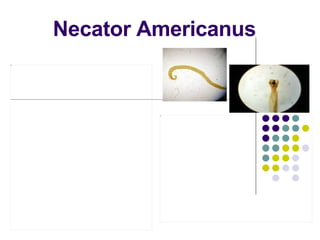
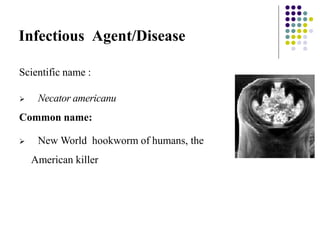
Necator Americanus
Infectious Agent/Disease
Scientific name :
 Necator americanu
Common name:
 New World hookworm of humans, the
American killer
Kingdom:Animalia
Phylum:Aschelminthes
Class:Nematoda
Order:Strongiloidae
Family:Ancylostomatidae
subfamily Necatorinae;
Genus:Necator
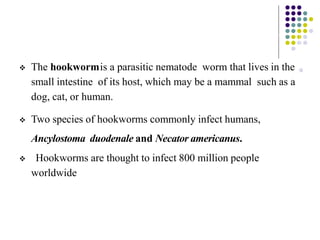
 The hookwormis a parasitic nematode worm that lives in the
small intestine of its host, which may be a mammal such as a
dog, cat, or human.
 Two species of hookworms commonly infect humans,
Ancylostoma duodenale and Necator americanus.
 Hookworms are thought to infect 800 million people
worldwide
 Hookworm is a leading cause of maternal and child
morbidity in the developing countries of the tropics
and subtropics. In susceptible children hookworms
cause intellectual, cognitive and growth retardation,
intrauterine growth retardation, prematurity, and low
birth weight among newborns born to infected
mothers.
Characteristics:
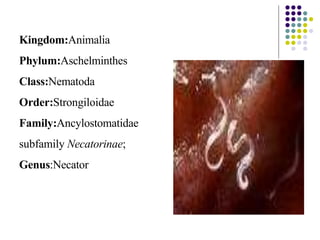
 has a pair of dorsal and a pair of ventral cutting plates
surrounding the anterior margin of the buccal capsule
 In addition, a pair of subdorsal and a pair of subventral teeth are
near the rear of the buccal capsule.
 Males are 7 to 9 mm long and have a bursa diagnostic for
the genus. The needlelike spicules have minute barbs at their
tips and are fused distally.
 Adult malesare 8 to 11 mm long and have a bursa
characteristic for the species. The
needlelike spicules have simple tips and are never fused
distally.

Females are 9 to 11 mm long and have the vulva located in
about the middle of the body.
 AdultsFemalesare 10 to 13 mm long, with the vulva
located about a third of the body length from the posterior
 eggsare 64-76 X35-40 µm head curves opposite to
curvature ofbody, giving a hooked appearance to the
anterior end
 intestinalnematode parasite
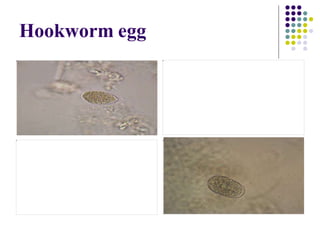
Hookworm egg
Mode of Transmission
Infective larvae, develop from eggs excreted in feces and
penetrate the skin, usually by the dorsum of the bare
feet or between the toes; vertical transmission from
mother to child is possible.
Epidemiology
Widely in tropical and subtropical countries, where improper
disposal of human feces is practiced; occurs in South East Asia,
South Pacific and East Africa and South America - moisture and
temperature conditions favour development of larvae; sporadic
cases occurs in southeastern US; prevalence higher in rural areas;
universal susceptibility
 Incubation Period:
-Variable; GI symptoms can appear 35-40 days after exposure to
filariform larvae
 Communicability:
-Not directly transmitted from person-to-person
Pathogenicity
Infective larvae penetrate skin and travel via the lymphatics to
enter the bloodstream, the lungs and the small intestine; adult
parasites attached to the villi of small intestines suck blood causing
abdominal discomfort, diarrhea, cramps, anorexia, weight loss;
clinical features correspond mainly to the intensity of infection;
heavy infection leads to development of iron deficiency and
hypochromic microcytic anemia;leading causes of iron- deficiency
anemia in children resulting in physical and mental retardation in
development; infection causes cutaneous larva migrans - a self-
limiting condition characterized by skin eruption; fatality is rare; no
evidence of immunity in the infected.
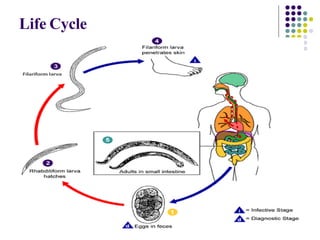
Life Cycle

Eggs are passed in the stool , and under favorable conditions
(moisture, warmth, shade), larvae hatch in 1 to 2 days.
The released rhabditiform larvae grow in the feces and/or the soil,
and after 5 to 10 days (and two molts) they become filariform,
(third-stage) larvae that are infective These infective larvae can
survive 3 to 4 weeks in favorable environmental conditions
. On contact with the human host, the larvae penetrate the skin and
are carried through the veins to the heart and then to the lungs.
They penetrate into the pulmonary alveoli, ascend the bronchial tree
to the pharynx, and are swallowed The larvae reach the small
intestine, where they reside and mature into adults. Adult worms
live in the lumen of the small intestine, where they attach to
the intestinal wall with resultant blood loss by the hos Most
adult worms are eliminated in 1 to 2
Viability
 DRUG SUSCEPTIBILITY:
Sensitive to, mebendazola, pyrantel pamoate, levamisole and
albendazole-is effective both in the intestinal stage and
during the stage the parasite is still migrating under the
skin.
 DRUG RESISTANCE:
Mebendazola resistant strains have been reported.
 SUSCEPTIBILITYTO
DISINFECTANTS:
-Susceptible to 1% sodium hypochlorite, 2% glutaraldehyde.
 PHYSICAL INACTIVATION:
-Larvae sensitive to desiccation and freezing.
 SURVIVAL OUTSIDE HOST:
-Larvae can survive up to 3-4 weeks in moist, optimal survival in
moist, sandy or loamy soil with ambient temperatures of 24-
32° C.
 Similarities between the Ancylostoma
duodonale and Necator americanus.
 Infective stage: Filariform larva
 Definitive host man: Man
 Habitat Small Intestine
 Mode of Attachment: Oral attachment to mucosa by
sucking
 Mode of Nutrition: Sucking and Ingesting of blood
 Laboratory diagnosis
Concentration methods and Direct Fecal Smear
 Treatment
Albendazole, Mebendazole, or Pyrantel Pamoate
 Diagnostic Feature – Egg In Morula
 Difrerences between Necator Americanus and
Ancylostoma duodonale.
 Common Name
N.C.-New world hookworm, American murderer
A.C.-Old world hookworm
 EtiologicAgent of N.C-.Necatoriasis, Uncinariasis
A.C.-Ancylostomiasis, Wakana disease
 Portalof Entry
N.C.-Usually via skin penetration rather than
ingestion
A.C.
Usually via ingestion rather than skin penetration
necator-americanus.pptx

necator-americanus.pptx

  • 1.
  • 2.
    Infectious Agent/Disease Scientific name:  Necator americanu Common name:  New World hookworm of humans, the American killer
  • 3.
  • 4.
     The hookwormisa parasitic nematode worm that lives in the small intestine of its host, which may be a mammal such as a dog, cat, or human.  Two species of hookworms commonly infect humans, Ancylostoma duodenale and Necator americanus.  Hookworms are thought to infect 800 million people worldwide
  • 5.
     Hookworm isa leading cause of maternal and child morbidity in the developing countries of the tropics and subtropics. In susceptible children hookworms cause intellectual, cognitive and growth retardation, intrauterine growth retardation, prematurity, and low birth weight among newborns born to infected mothers.
  • 6.
    Characteristics:  has apair of dorsal and a pair of ventral cutting plates surrounding the anterior margin of the buccal capsule  In addition, a pair of subdorsal and a pair of subventral teeth are near the rear of the buccal capsule.  Males are 7 to 9 mm long and have a bursa diagnostic for the genus. The needlelike spicules have minute barbs at their tips and are fused distally.
  • 7.
     Adult malesare8 to 11 mm long and have a bursa characteristic for the species. The needlelike spicules have simple tips and are never fused distally.  Females are 9 to 11 mm long and have the vulva located in about the middle of the body.  AdultsFemalesare 10 to 13 mm long, with the vulva located about a third of the body length from the posterior
  • 8.
     eggsare 64-76X35-40 µm head curves opposite to curvature ofbody, giving a hooked appearance to the anterior end  intestinalnematode parasite
  • 9.
  • 10.
    Mode of Transmission Infectivelarvae, develop from eggs excreted in feces and penetrate the skin, usually by the dorsum of the bare feet or between the toes; vertical transmission from mother to child is possible.
  • 11.
    Epidemiology Widely in tropicaland subtropical countries, where improper disposal of human feces is practiced; occurs in South East Asia, South Pacific and East Africa and South America - moisture and temperature conditions favour development of larvae; sporadic cases occurs in southeastern US; prevalence higher in rural areas; universal susceptibility
  • 12.
     Incubation Period: -Variable;GI symptoms can appear 35-40 days after exposure to filariform larvae  Communicability: -Not directly transmitted from person-to-person
  • 13.
    Pathogenicity Infective larvae penetrateskin and travel via the lymphatics to enter the bloodstream, the lungs and the small intestine; adult parasites attached to the villi of small intestines suck blood causing abdominal discomfort, diarrhea, cramps, anorexia, weight loss; clinical features correspond mainly to the intensity of infection;
  • 14.
    heavy infection leadsto development of iron deficiency and hypochromic microcytic anemia;leading causes of iron- deficiency anemia in children resulting in physical and mental retardation in development; infection causes cutaneous larva migrans - a self- limiting condition characterized by skin eruption; fatality is rare; no evidence of immunity in the infected.
  • 15.
  • 16.
     Eggs are passedin the stool , and under favorable conditions (moisture, warmth, shade), larvae hatch in 1 to 2 days. The released rhabditiform larvae grow in the feces and/or the soil, and after 5 to 10 days (and two molts) they become filariform, (third-stage) larvae that are infective These infective larvae can survive 3 to 4 weeks in favorable environmental conditions
  • 17.
    . On contactwith the human host, the larvae penetrate the skin and are carried through the veins to the heart and then to the lungs. They penetrate into the pulmonary alveoli, ascend the bronchial tree to the pharynx, and are swallowed The larvae reach the small intestine, where they reside and mature into adults. Adult worms live in the lumen of the small intestine, where they attach to the intestinal wall with resultant blood loss by the hos Most adult worms are eliminated in 1 to 2
  • 18.
    Viability  DRUG SUSCEPTIBILITY: Sensitiveto, mebendazola, pyrantel pamoate, levamisole and albendazole-is effective both in the intestinal stage and during the stage the parasite is still migrating under the skin.  DRUG RESISTANCE: Mebendazola resistant strains have been reported.
  • 19.
     SUSCEPTIBILITYTO DISINFECTANTS: -Susceptible to1% sodium hypochlorite, 2% glutaraldehyde.  PHYSICAL INACTIVATION: -Larvae sensitive to desiccation and freezing.  SURVIVAL OUTSIDE HOST: -Larvae can survive up to 3-4 weeks in moist, optimal survival in moist, sandy or loamy soil with ambient temperatures of 24- 32° C.
  • 20.
     Similarities betweenthe Ancylostoma duodonale and Necator americanus.  Infective stage: Filariform larva  Definitive host man: Man
  • 21.
     Habitat SmallIntestine  Mode of Attachment: Oral attachment to mucosa by sucking  Mode of Nutrition: Sucking and Ingesting of blood
  • 22.
     Laboratory diagnosis Concentrationmethods and Direct Fecal Smear  Treatment Albendazole, Mebendazole, or Pyrantel Pamoate  Diagnostic Feature – Egg In Morula
  • 23.
     Difrerences betweenNecator Americanus and Ancylostoma duodonale.  Common Name N.C.-New world hookworm, American murderer A.C.-Old world hookworm
  • 24.
     EtiologicAgent ofN.C-.Necatoriasis, Uncinariasis A.C.-Ancylostomiasis, Wakana disease  Portalof Entry N.C.-Usually via skin penetration rather than ingestion
  • 25.
    A.C. Usually via ingestionrather than skin penetration