SAMRAT PRITHVIRAJ CHAUHAN,
GOVERNMENT COLLEGE, AJMER
Department of chemistry
CARBENE
Submitted by- Priyanka Yadav
M. Sc chemistry semester 1st
CONTENT :-
 WHAT IS CARBENE?
 TYPES OF CARBENES
 STRUCTURE AND BONDING
 FORMATION OF CARBENES
 REACTION OF CARBENES
WHAT IS CARBENE?
 A carbene is a molecule containing neutral carbon atom with a
valence of two and two unshared valence electrons.
 Carbene are uncharged electron deficient molecular species
that contain a divalent carbon atom surrounded by a sextet of
electrons and two substituents.
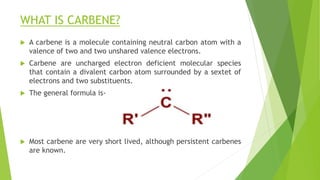
 The general formula is-
 Most carbene are very short lived, although persistent carbenes
are known.
TYPES OF CARBENE :-
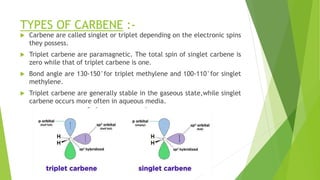
 Carbene are called singlet or triplet depending on the electronic spins
they possess.
 Triplet carbene are paramagnetic. The total spin of singlet carbene is
zero while that of triplet carbene is one.
 Bond angle are 130-150°for triplet methylene and 100-110°for singlet
methylene.
 Triplet carbene are generally stable in the gaseous state,while singlet
carbene occurs more often in aqueous media.
STRUCTURE AND BONDING :-
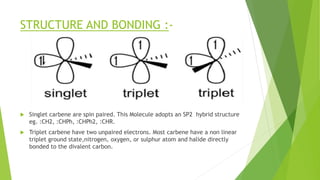
 Singlet carbene are spin paired. This Molecule adopts an SP2 hybrid structure
eg. :CH2, :CHPh, :CHPh2, :CHR.
 Triplet carbene have two unpaired electrons. Most carbene have a non linear
triplet ground state,nitrogen, oxygen, or sulphur atom and halide directly
bonded to the divalent carbon.
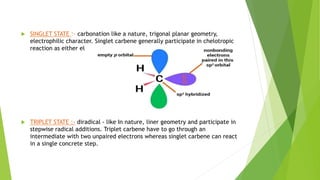
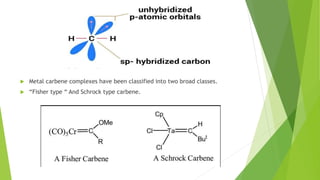
 SINGLET STATE :- carbonation like a nature, trigonal planar geometry,
electrophilic character. Singlet carbene generally participate in chelotropic
reaction as either electrophiles or nucleophiles.
 TRIPLET STATE :- diradical - like In nature, liner geometry and participate in
stepwise radical additions. Triplet carbene have to go through an
intermediate with two unpaired electrons whereas singlet carbene can react
in a single concrete step.
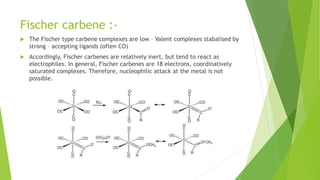
 Metal carbene complexes have been classified into two broad classes.
 “Fisher type “ And Schrock type carbene.
Fischer carbene :-
 The Fischer type carbene complexes are low – Valent complexes stabalised by
strong – accepting ligands (often CO)
 Accordingly, Fischer carbenes are relatively inert, but tend to react as
electrophiles. In general, Fischer carbenes are 18 electrons, coordinatively
saturated complexes. Therefore, nucleophilic attack at the metal is not
possible.
Schrock carbenes :-
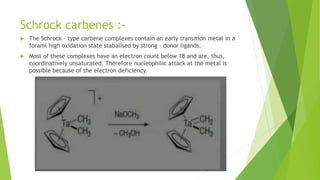
 The Schrock – type carbene complexes contain an early transition metal in a
foraml high oxidation state stabalised by strong – donor ligands.
 Most of these complexes have an electron count below 18 and are, thus,
coordinatively unsaturated. Therefore nucleophilic attack at the metal is
possible because of the electron deficiency.
FORMATION OF CARBENES :-
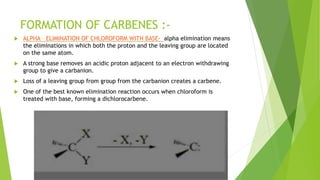
 ALPHA – ELIMINATION OF CHLOROFORM WITH BASE- alpha elimination means
the eliminations in which both the proton and the leaving group are located
on the same atom.
 A strong base removes an acidic proton adjacent to an electron withdrawing
group to give a carbanion.
 Loss of a leaving group from group from the carbanion creates a carbene.
 One of the best known elimination reaction occurs when chloroform is
treated with base, forming a dichlorocarbene.
 The more common dehydrogenations (to form alkenes) are called beta
elimination because the hydrogen and the halogen are lost from adjacent
carbon atom.
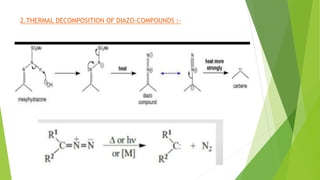
2.THERMAL DECOMPOSITION OF DIAZO-COMPOUNDS :-
3. PHOTOLYSIS OF DIAZIRINE :-
4. PHOTOLYSIS OF KETENE :-
REACTION OF CARBENES :-
 Carbenes are highly electrophilic species. Three major classes of carbene
reaction
1. Carbene insertion
2. Carbene addition
3. Carbene rearrangements.
1. CARBENE INSERTION :-
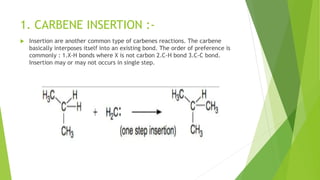
 Insertion are another common type of carbenes reactions. The carbene
basically interposes itself into an existing bond. The order of preference is
commonly : 1.X-H bonds where X is not carbon 2.C-H bond 3.C-C bond.
Insertion may or may not occurs in single step.
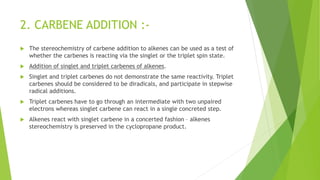
2. CARBENE ADDITION :-
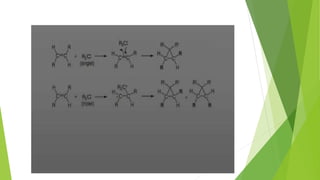
 The stereochemistry of carbene addition to alkenes can be used as a test of
whether the carbenes is reacting via the singlet or the triplet spin state.
 Addition of singlet and triplet carbenes of alkenes.
 Singlet and triplet carbenes do not demonstrate the same reactivity. Triplet
carbenes should be considered to be diradicals, and participate in stepwise
radical additions.
 Triplet carbenes have to go through an intermediate with two unpaired
electrons whereas singlet carbene can react in a single concreted step.
 Alkenes react with singlet carbene in a concerted fashion – alkenes
stereochemistry is preserved in the cyclopropane product.
3. CARBENE REARRANGEMENT :-
 Wolf rearrangements
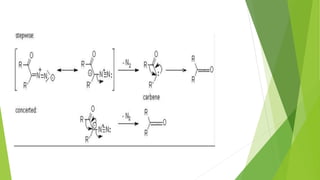
 The wolf rearrangements is a reaction in organic chemistry in which an alpha
– diazocarbonyl compounds is converted into a ketene by loss of dinitrogen
with accompanying 1,2 – rearrangements.
 The wolf rearrangements yields a ketene as an intermediate product, which
can undergo nucleophilic attack with weakly acidic nucleophiles such as
water, alcohols and amines, to generate carboxylic acid derivative.
 The wolf rearrangements can be induced via thermolysis, photolysis,
or transition metal catalysis.
 Migratory aptitude : H>> aryl >> alkyl
REFERENCE:-
 Reaction mechanism in organic chemistry,S.M Mukherjee and S.P Singh,
Macmillan
 Advanced organic chemistry –Reaction, mechanism and structure,jerry March,
John Wiley
THANK YOU

Carbene

  • 1.
    SAMRAT PRITHVIRAJ CHAUHAN, GOVERNMENTCOLLEGE, AJMER Department of chemistry CARBENE Submitted by- Priyanka Yadav M. Sc chemistry semester 1st
  • 2.
    CONTENT :-  WHATIS CARBENE?  TYPES OF CARBENES  STRUCTURE AND BONDING  FORMATION OF CARBENES  REACTION OF CARBENES
  • 3.
    WHAT IS CARBENE? A carbene is a molecule containing neutral carbon atom with a valence of two and two unshared valence electrons.  Carbene are uncharged electron deficient molecular species that contain a divalent carbon atom surrounded by a sextet of electrons and two substituents.  The general formula is-  Most carbene are very short lived, although persistent carbenes are known.
  • 4.
    TYPES OF CARBENE:-  Carbene are called singlet or triplet depending on the electronic spins they possess.  Triplet carbene are paramagnetic. The total spin of singlet carbene is zero while that of triplet carbene is one.  Bond angle are 130-150°for triplet methylene and 100-110°for singlet methylene.  Triplet carbene are generally stable in the gaseous state,while singlet carbene occurs more often in aqueous media.
  • 5.
    STRUCTURE AND BONDING:-  Singlet carbene are spin paired. This Molecule adopts an SP2 hybrid structure eg. :CH2, :CHPh, :CHPh2, :CHR.  Triplet carbene have two unpaired electrons. Most carbene have a non linear triplet ground state,nitrogen, oxygen, or sulphur atom and halide directly bonded to the divalent carbon.
  • 6.
     SINGLET STATE:- carbonation like a nature, trigonal planar geometry, electrophilic character. Singlet carbene generally participate in chelotropic reaction as either electrophiles or nucleophiles.  TRIPLET STATE :- diradical - like In nature, liner geometry and participate in stepwise radical additions. Triplet carbene have to go through an intermediate with two unpaired electrons whereas singlet carbene can react in a single concrete step.
  • 7.
     Metal carbenecomplexes have been classified into two broad classes.  “Fisher type “ And Schrock type carbene.
  • 8.
    Fischer carbene :- The Fischer type carbene complexes are low – Valent complexes stabalised by strong – accepting ligands (often CO)  Accordingly, Fischer carbenes are relatively inert, but tend to react as electrophiles. In general, Fischer carbenes are 18 electrons, coordinatively saturated complexes. Therefore, nucleophilic attack at the metal is not possible.
  • 9.
    Schrock carbenes :- The Schrock – type carbene complexes contain an early transition metal in a foraml high oxidation state stabalised by strong – donor ligands.  Most of these complexes have an electron count below 18 and are, thus, coordinatively unsaturated. Therefore nucleophilic attack at the metal is possible because of the electron deficiency.
  • 10.
    FORMATION OF CARBENES:-  ALPHA – ELIMINATION OF CHLOROFORM WITH BASE- alpha elimination means the eliminations in which both the proton and the leaving group are located on the same atom.  A strong base removes an acidic proton adjacent to an electron withdrawing group to give a carbanion.  Loss of a leaving group from group from the carbanion creates a carbene.  One of the best known elimination reaction occurs when chloroform is treated with base, forming a dichlorocarbene.
  • 11.
     The morecommon dehydrogenations (to form alkenes) are called beta elimination because the hydrogen and the halogen are lost from adjacent carbon atom.
  • 12.
    2.THERMAL DECOMPOSITION OFDIAZO-COMPOUNDS :-
  • 13.
    3. PHOTOLYSIS OFDIAZIRINE :- 4. PHOTOLYSIS OF KETENE :-
  • 14.
    REACTION OF CARBENES:-  Carbenes are highly electrophilic species. Three major classes of carbene reaction 1. Carbene insertion 2. Carbene addition 3. Carbene rearrangements.
  • 15.
    1. CARBENE INSERTION:-  Insertion are another common type of carbenes reactions. The carbene basically interposes itself into an existing bond. The order of preference is commonly : 1.X-H bonds where X is not carbon 2.C-H bond 3.C-C bond. Insertion may or may not occurs in single step.
  • 16.
    2. CARBENE ADDITION:-  The stereochemistry of carbene addition to alkenes can be used as a test of whether the carbenes is reacting via the singlet or the triplet spin state.  Addition of singlet and triplet carbenes of alkenes.  Singlet and triplet carbenes do not demonstrate the same reactivity. Triplet carbenes should be considered to be diradicals, and participate in stepwise radical additions.  Triplet carbenes have to go through an intermediate with two unpaired electrons whereas singlet carbene can react in a single concreted step.  Alkenes react with singlet carbene in a concerted fashion – alkenes stereochemistry is preserved in the cyclopropane product.
  • 18.
    3. CARBENE REARRANGEMENT:-  Wolf rearrangements  The wolf rearrangements is a reaction in organic chemistry in which an alpha – diazocarbonyl compounds is converted into a ketene by loss of dinitrogen with accompanying 1,2 – rearrangements.  The wolf rearrangements yields a ketene as an intermediate product, which can undergo nucleophilic attack with weakly acidic nucleophiles such as water, alcohols and amines, to generate carboxylic acid derivative.  The wolf rearrangements can be induced via thermolysis, photolysis, or transition metal catalysis.  Migratory aptitude : H>> aryl >> alkyl
  • 20.
    REFERENCE:-  Reaction mechanismin organic chemistry,S.M Mukherjee and S.P Singh, Macmillan  Advanced organic chemistry –Reaction, mechanism and structure,jerry March, John Wiley
  • 21.