Lecture No. 02
Course title:
Inorganic Polymers
Topic: Classification of Inorganic Polymers
Course instructor: Dr. Salma Amir
FGCW Peshawar
Definition
 Inorganic polymers are linearly chained large molecules composed of
inorganic main chain with inorganic or organic side groups
 Examples :
(a) Clay or Sand
(b) Silicones
(c) Cross-linked phosphates
(d) Borazine
(e) Thiazyl halides
Classification of inorganic polymers
There are different ways of classifying inorganic polymers.
 1. Based on homo and hetero atomic backbone
 2. Based on type of reaction
 3. Based on bridging bonds
 4. Based on main elements
1st classification
Based on homo- and hetero atomic backbone
Depending on whether the polymer contains the atoms of only one element or of different
elements in its backbone, the polymers are classified into the following two groups.
 1. Homo-atomic polymers. These polymers contain the atoms of only one element in
their back bones. Silicon, phosphorus, sulphur, germanium and tin form homo-atomic
inorganic polymers. For example, sulphur has a tendency to form chain or rings in its
elemental form (S8) and in several compounds, like persulphides (H-S-S-H, H-S-S-S-H, H-
S-S-S-S-H etc.), polythionic acids etc. Single bond strengths in homo-atomic inorganic
polymers are 54 to 60 Kcal for sulphur, about 53 Kcal for silicon, 48-53 for phosphorus,
about 45 for germanium and about 39 for tin.
 2. Hetero-atomic polymers. These contain the atoms of different elements in their
backbones.
2nd classification
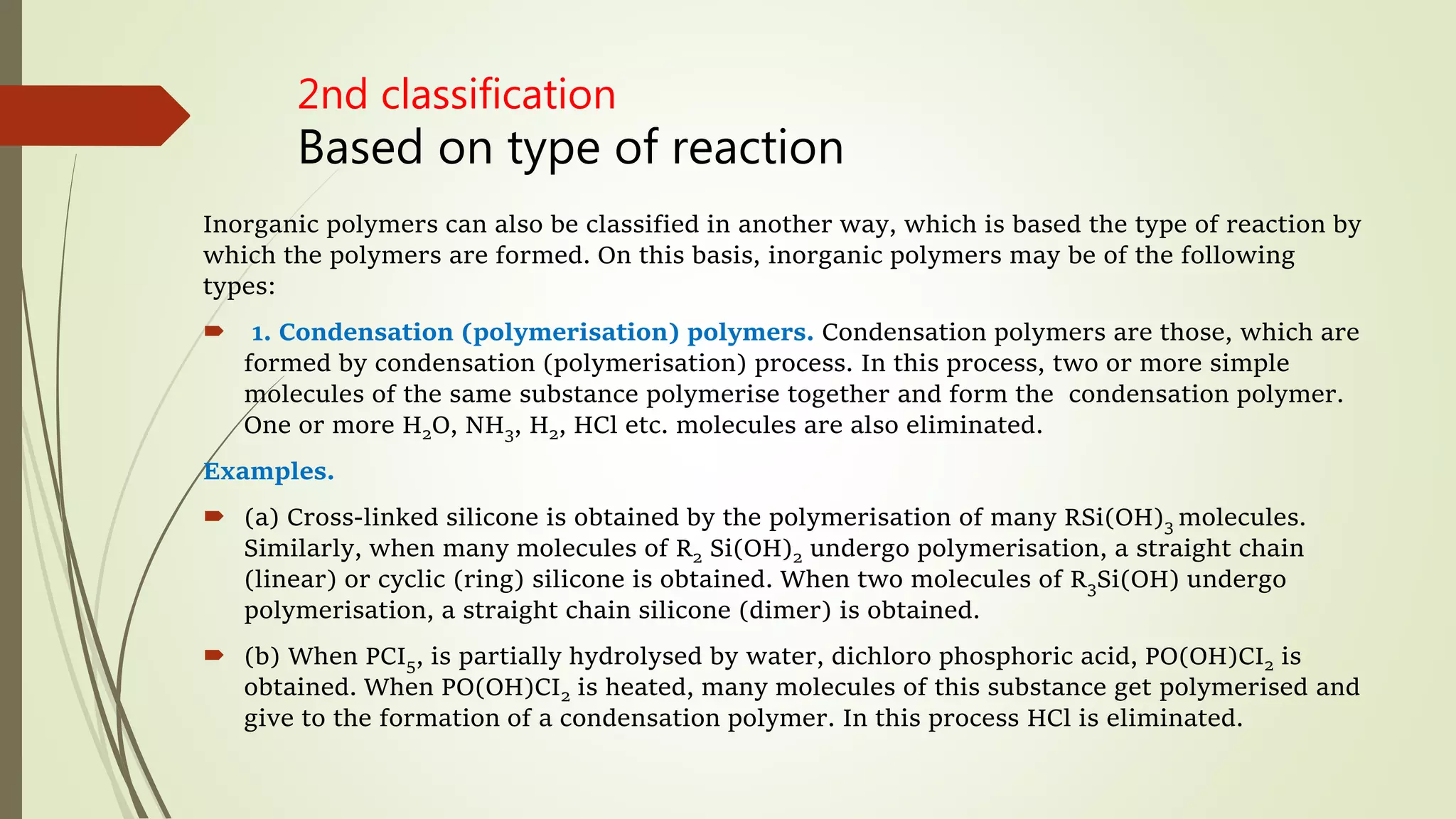
Based on type of reaction
Inorganic polymers can also be classified in another way, which is based the type of reaction by
which the polymers are formed. On this basis, inorganic polymers may be of the following
types:
 1. Condensation (polymerisation) polymers. Condensation polymers are those, which are
formed by condensation (polymerisation) process. In this process, two or more simple
molecules of the same substance polymerise together and form the condensation polymer.
One or more H2O, NH3, H2, HCl etc. molecules are also eliminated.
Examples.
 (a) Cross-linked silicone is obtained by the polymerisation of many RSi(OH)3 molecules.
Similarly, when many molecules of R2 Si(OH)2 undergo polymerisation, a straight chain
(linear) or cyclic (ring) silicone is obtained. When two molecules of R3Si(OH) undergo
polymerisation, a straight chain silicone (dimer) is obtained.
 (b) When PCI5, is partially hydrolysed by water, dichloro phosphoric acid, PO(OH)CI2 is
obtained. When PO(OH)CI2 is heated, many molecules of this substance get polymerised and
give to the formation of a condensation polymer. In this process HCl is eliminated.
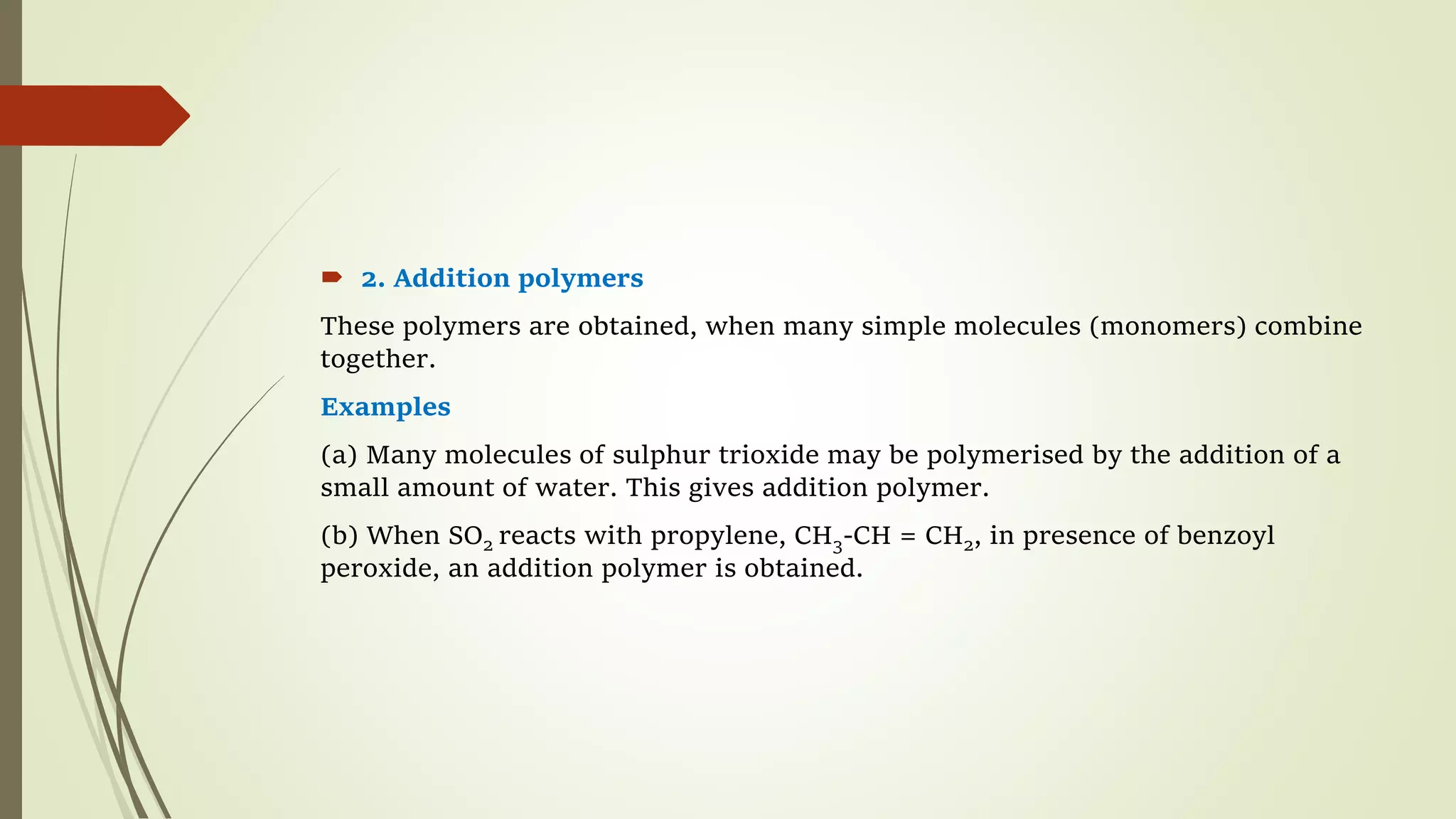
 2. Addition polymers
These polymers are obtained, when many simple molecules (monomers) combine
together.
Examples
(a) Many molecules of sulphur trioxide may be polymerised by the addition of a
small amount of water. This gives addition polymer.
(b) When SO2 reacts with propylene, CH3-CH = CH2, in presence of benzoyl
peroxide, an addition polymer is obtained.
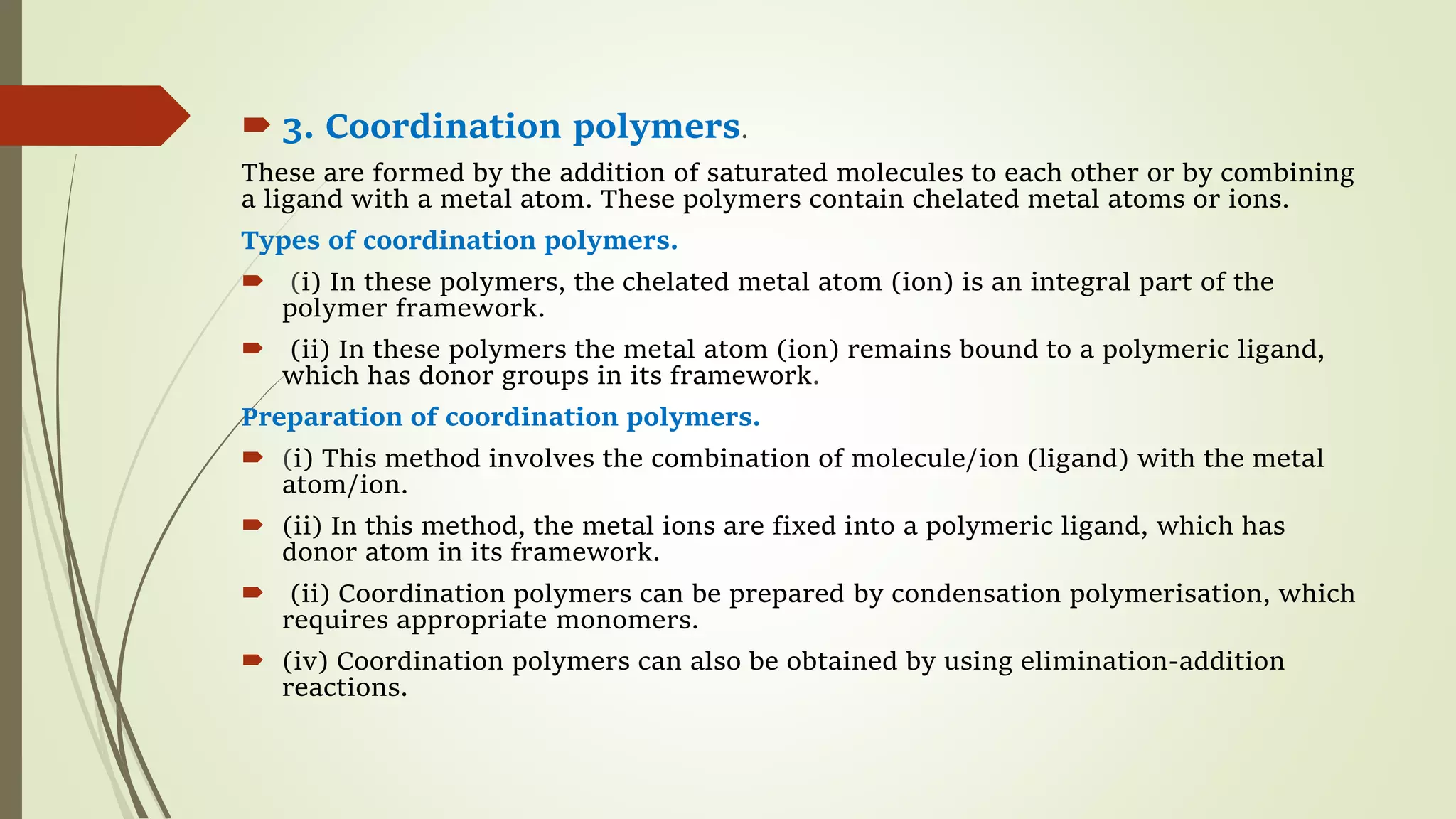
 3. Coordination polymers.
These are formed by the addition of saturated molecules to each other or by combining
a ligand with a metal atom. These polymers contain chelated metal atoms or ions.
Types of coordination polymers.
 (i) In these polymers, the chelated metal atom (ion) is an integral part of the
polymer framework.
 (ii) In these polymers the metal atom (ion) remains bound to a polymeric ligand,
which has donor groups in its framework.
Preparation of coordination polymers.
 (i) This method involves the combination of molecule/ion (ligand) with the metal
atom/ion.
 (ii) In this method, the metal ions are fixed into a polymeric ligand, which has
donor atom in its framework.
 (ii) Coordination polymers can be prepared by condensation polymerisation, which
requires appropriate monomers.
 (iv) Coordination polymers can also be obtained by using elimination-addition
reactions.
3rd classification
Based on bridging bonds
According to this classification, the inorganic polymers can be classified into the
following categories :
 1. Polymers containing two bridging bonds per units, e.g., homo-atomic sulphur,
selenium and teturium polymers.
 2. The alternating silicone-oxygen polymers. Examples are silicones and related
compounds.
 3. The alternating phosphorus-nitrogen polymers. Examples are phosphonitrilic
halides, (NPX2)n.
 4. The alternating phosphorus-oxygen polymers. Examples are metaphosphates,
polyphosphates and cross-linked phosphates.
 5. The alternating sulphur-nitrogen polymers. Examples are (i) polymeric nitrides
of sulphur (e.g S2N2, S4N4, S5N2, etc.) (ii) thiazyl halides, [e.g., (NSF)3,
(NSF)4,(NSCI)3] (iii) imides sulphur (e.g., S7(NH), S6 (NH)2, S5(NH)3, and S4(NH)4].
4th classification
Based on main elements
This classification is based on the element which forms inorganic
polymers. Thus, we have:
 1. Polymers containing boron. Examples are: (a) Borazine,
(BH)3(NH)3 or B3N3H6. (b) substituted borazines like (i) B-trimethyl
borazine, [B(CH3)3 (NH)3] (ii) Boroxine, (BH)3O3(iii) N-trimethyl
borazine, (BH)3 [N(CH3)]3 (c) Boron nitride, (BN)n.
 2. Polymers containing silicon. These are called silicones.
 3. Polymers containing phosphorus. Examples are: (a)
Metaphosphates, (b) Polyphosphates, (c) Cross-linked phosphates,
(d) Phosphonitrilic halides, [PNX2]n.
 4. Polymeric compounds of sulphur. Examples are nitrides of
sulphur, thiazyl halides, imides of sulphur.

Classification of inorganic polymers by Dr. Salma Amir

  • 1.
    Lecture No. 02 Coursetitle: Inorganic Polymers Topic: Classification of Inorganic Polymers Course instructor: Dr. Salma Amir FGCW Peshawar
  • 2.
    Definition  Inorganic polymersare linearly chained large molecules composed of inorganic main chain with inorganic or organic side groups  Examples : (a) Clay or Sand (b) Silicones (c) Cross-linked phosphates (d) Borazine (e) Thiazyl halides
  • 3.
    Classification of inorganicpolymers There are different ways of classifying inorganic polymers.  1. Based on homo and hetero atomic backbone  2. Based on type of reaction  3. Based on bridging bonds  4. Based on main elements
  • 4.
    1st classification Based onhomo- and hetero atomic backbone Depending on whether the polymer contains the atoms of only one element or of different elements in its backbone, the polymers are classified into the following two groups.  1. Homo-atomic polymers. These polymers contain the atoms of only one element in their back bones. Silicon, phosphorus, sulphur, germanium and tin form homo-atomic inorganic polymers. For example, sulphur has a tendency to form chain or rings in its elemental form (S8) and in several compounds, like persulphides (H-S-S-H, H-S-S-S-H, H- S-S-S-S-H etc.), polythionic acids etc. Single bond strengths in homo-atomic inorganic polymers are 54 to 60 Kcal for sulphur, about 53 Kcal for silicon, 48-53 for phosphorus, about 45 for germanium and about 39 for tin.  2. Hetero-atomic polymers. These contain the atoms of different elements in their backbones.
  • 5.
    2nd classification Based ontype of reaction Inorganic polymers can also be classified in another way, which is based the type of reaction by which the polymers are formed. On this basis, inorganic polymers may be of the following types:  1. Condensation (polymerisation) polymers. Condensation polymers are those, which are formed by condensation (polymerisation) process. In this process, two or more simple molecules of the same substance polymerise together and form the condensation polymer. One or more H2O, NH3, H2, HCl etc. molecules are also eliminated. Examples.  (a) Cross-linked silicone is obtained by the polymerisation of many RSi(OH)3 molecules. Similarly, when many molecules of R2 Si(OH)2 undergo polymerisation, a straight chain (linear) or cyclic (ring) silicone is obtained. When two molecules of R3Si(OH) undergo polymerisation, a straight chain silicone (dimer) is obtained.  (b) When PCI5, is partially hydrolysed by water, dichloro phosphoric acid, PO(OH)CI2 is obtained. When PO(OH)CI2 is heated, many molecules of this substance get polymerised and give to the formation of a condensation polymer. In this process HCl is eliminated.
  • 6.
     2. Additionpolymers These polymers are obtained, when many simple molecules (monomers) combine together. Examples (a) Many molecules of sulphur trioxide may be polymerised by the addition of a small amount of water. This gives addition polymer. (b) When SO2 reacts with propylene, CH3-CH = CH2, in presence of benzoyl peroxide, an addition polymer is obtained.
  • 7.
     3. Coordinationpolymers. These are formed by the addition of saturated molecules to each other or by combining a ligand with a metal atom. These polymers contain chelated metal atoms or ions. Types of coordination polymers.  (i) In these polymers, the chelated metal atom (ion) is an integral part of the polymer framework.  (ii) In these polymers the metal atom (ion) remains bound to a polymeric ligand, which has donor groups in its framework. Preparation of coordination polymers.  (i) This method involves the combination of molecule/ion (ligand) with the metal atom/ion.  (ii) In this method, the metal ions are fixed into a polymeric ligand, which has donor atom in its framework.  (ii) Coordination polymers can be prepared by condensation polymerisation, which requires appropriate monomers.  (iv) Coordination polymers can also be obtained by using elimination-addition reactions.
  • 8.
    3rd classification Based onbridging bonds According to this classification, the inorganic polymers can be classified into the following categories :  1. Polymers containing two bridging bonds per units, e.g., homo-atomic sulphur, selenium and teturium polymers.  2. The alternating silicone-oxygen polymers. Examples are silicones and related compounds.  3. The alternating phosphorus-nitrogen polymers. Examples are phosphonitrilic halides, (NPX2)n.  4. The alternating phosphorus-oxygen polymers. Examples are metaphosphates, polyphosphates and cross-linked phosphates.  5. The alternating sulphur-nitrogen polymers. Examples are (i) polymeric nitrides of sulphur (e.g S2N2, S4N4, S5N2, etc.) (ii) thiazyl halides, [e.g., (NSF)3, (NSF)4,(NSCI)3] (iii) imides sulphur (e.g., S7(NH), S6 (NH)2, S5(NH)3, and S4(NH)4].
  • 9.
    4th classification Based onmain elements This classification is based on the element which forms inorganic polymers. Thus, we have:  1. Polymers containing boron. Examples are: (a) Borazine, (BH)3(NH)3 or B3N3H6. (b) substituted borazines like (i) B-trimethyl borazine, [B(CH3)3 (NH)3] (ii) Boroxine, (BH)3O3(iii) N-trimethyl borazine, (BH)3 [N(CH3)]3 (c) Boron nitride, (BN)n.  2. Polymers containing silicon. These are called silicones.  3. Polymers containing phosphorus. Examples are: (a) Metaphosphates, (b) Polyphosphates, (c) Cross-linked phosphates, (d) Phosphonitrilic halides, [PNX2]n.  4. Polymeric compounds of sulphur. Examples are nitrides of sulphur, thiazyl halides, imides of sulphur.