Alcohols
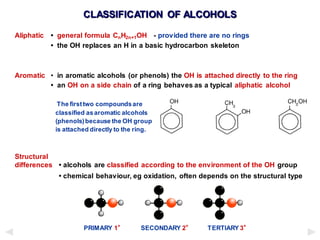
CLASSIFICATION OF ALCOHOLS
Aliphatic • general formula CnH2n+1OH - provided there are no rings
• the OH replaces an H in a basic hydrocarbon skeleton
Aromatic • in aromatic alcohols (or phenols) the OH is attached directly to the ring
• an OH on a side chain of a ring behaves as a typical aliphatic alcohol
The firsttwo compoundsare
classified asaromatic alcohols
(phenols)because the OH group
is attached directly to the ring.
Structural
differences • alcohols are classified according to the environment of the OH group
• chemical behaviour, eg oxidation, often depends on the structural type
PRIMARY 1° SECONDARY 2° TERTIARY 3°
3
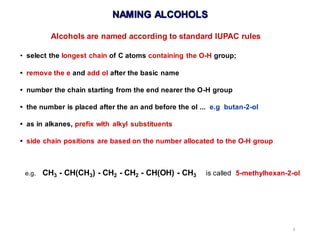
Alcohols are named according to standard IUPAC rules
• select the longest chain of C atoms containing the O-H group;
• remove the e and add ol after the basic name
• number the chain starting from the end nearer the O-H group
• the number is placed after the an and before the ol ... e.g butan-2-ol
• as in alkanes, prefix with alkyl substituents
• side chain positions are based on the number allocated to the O-H group
e.g. CH3 - CH(CH3) - CH2 - CH2 - CH(OH) - CH3 is called 5-methylhexan-2-ol
NAMING ALCOHOLS
4
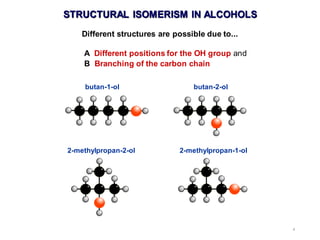
STRUCTURAL ISOMERISM IN ALCOHOLS
Different structures are possible due to...
A Different positions for the OH group and
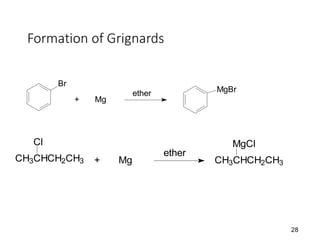
B Branching of the carbon chain
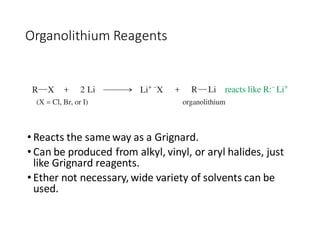
butan-1-ol butan-2-ol
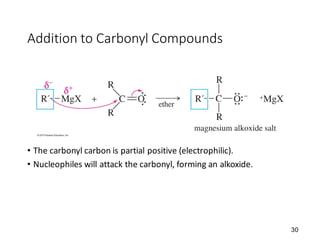
2-methylpropan-1-ol
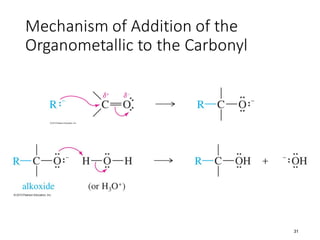
2-methylpropan-2-ol
5
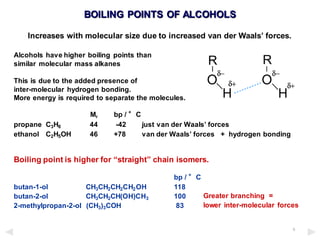
BOILING POINTS OF ALCOHOLS
Increases with molecular size due to increased van der Waals’ forces.
Alcohols have higher boiling points than
similar molecular mass alkanes
This is due to the added presence of
inter-molecular hydrogen bonding.
More energy is required to separate the molecules.
Mr bp / °C
propane C3H8 44 -42 just van der Waals’ forces
ethanol C2H5OH 46 +78 van der Waals’ forces + hydrogen bonding
Boiling point is higher for “straight” chain isomers.
bp / °C
butan-1-ol CH3CH2CH2CH2OH 118
butan-2-ol CH3CH2CH(OH)CH3 100
2-methylpropan-2-ol (CH3)3COH 83
Greater branching =
lower inter-molecular forces
6
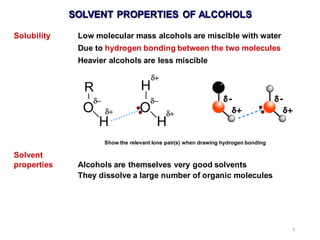
SOLVENT PROPERTIES OF ALCOHOLS
Solubility Low molecular mass alcohols are miscible with water
Due to hydrogen bonding between the two molecules
Heavier alcohols are less miscible
Solvent
properties Alcohols are themselves very good solvents
They dissolve a large number of organic molecules
Show the relevant lone pair(s) when drawing hydrogen bonding
CHEMICAL PROPERTIES OF ALCOHOLS
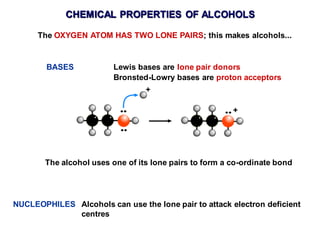
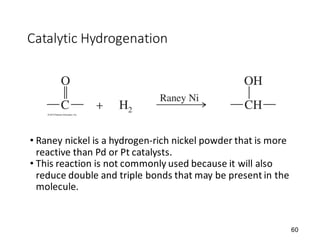
The OXYGEN ATOM HAS TWO LONE PAIRS; this makes alcohols...
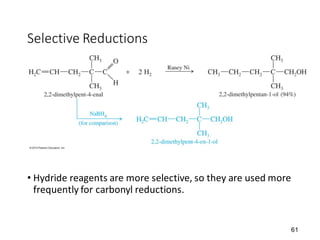
BASES Lewis bases are lone pair donors
Bronsted-Lowry bases are proton acceptors
The alcohol uses one of its lone pairs to form a co-ordinate bond
NUCLEOPHILES Alcohols can use the lone pair to attack electron deficient
centres
Reactions of Alcohols
9
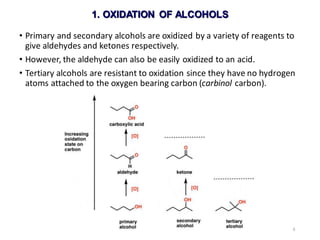
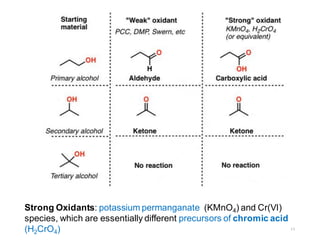
• Primary and secondary alcohols are oxidized by a variety of reagents to
give aldehydes and ketones respectively.
• However, the aldehyde can also be easily oxidized to an acid.
• Tertiary alcohols are resistant to oxidation since they have no hydrogen
atoms attached to the oxygen bearing carbon (carbinol carbon).
1. OXIDATION OF ALCOHOLS
10
1. Oxidation
Weak Oxidants: pyridinium chlorochromate (PCC), Dess-Martin
Periodinane (DMP), the Swern oxidation [(COCl)2, DMSO, NEt3)]
and CrO3/pyridine (the “Collins reagent“)
11
Strong Oxidants: potassium permanganate (KMnO4) and Cr(VI)
species, which are essentially different precursors of chromic acid
(H2CrO4)
12
OXIDATION OF ALCOHOLS
Why 1° and 2° alcohols are easily oxidised and 3° alcohols are not
For oxidation to take place easily you must have two hydrogen atoms on
adjacent C and O atoms.
H H
R C O + [O] R C O + H2O
H H
H H
R C O + [O] R C O + H2O
R R
R H
R C O + [O]
R
This is possible in 1° and 2° alcohols but not in 3° alcohols.
1°
2°
3°
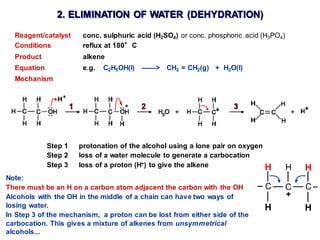
2. ELIMINATION OF WATER (DEHYDRATION)
Reagent/catalyst conc. sulphuric acid (H2SO4) or conc. phosphoric acid (H3PO4)
Conditions reflux at 180°C
Product alkene
Equation e.g. C2H5OH(l) ——> CH2 = CH2(g) + H2O(l)
Mechanism
Step 1 protonation of the alcohol using a lone pair on oxygen
Step 2 loss of a water molecule to generate a carbocation
Step 3 loss of a proton (H+) to give the alkene
Note:
There must be an H on a carbon atom adjacent the carbon with the OH
Alcohols with the OH in the middle of a chain can have two ways of
losing water.
In Step 3 of the mechanism, a proton can be lost from either side of the
carbocation. This gives a mixture of alkenes from unsymmetrical
alcohols...
2. ELIMINATION OF WATER (DEHYDRATION)
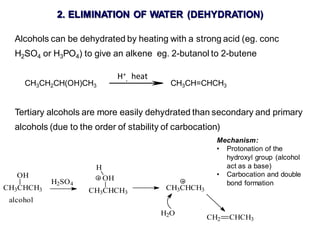
Alcohols can be dehydrated by heating with a strong acid (eg. conc
H2SO4 or H3PO4) to give an alkene eg. 2-butanol to 2-butene
CH3CH2CH(OH)CH3 CH3CH=CHCH3
Tertiary alcohols are more easily dehydrated than secondary and primary
alcohols (due to the order of stability of carbocation)
H+
, heat
CH3CHCH3
OH
H2SO4
alcohol
CH3CHCH3
OH
H
CH3CHCH3
CH2 CHCH3
H2O
Mechanism:
• Protonation of the
hydroxyl group (alcohol
act as a base)
• Carbocation and double
bond formation
15
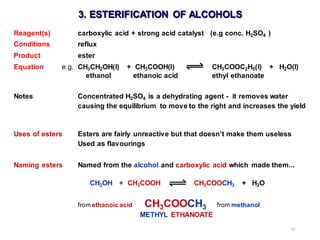
3. ESTERIFICATION OF ALCOHOLS
Reagent(s) carboxylic acid + strong acid catalyst (e.g conc. H2SO4 )
Conditions reflux
Product ester
Equation e.g. CH3CH2OH(l) + CH3COOH(l) CH3COOC2H5(l) + H2O(l)
ethanol ethanoic acid ethyl ethanoate
Notes Concentrated H2SO4 is a dehydrating agent - it removes water
causing the equilibrium to move to the right and increases the yield
Uses of esters Esters are fairly unreactive but that doesn’t make them useless
Used as flavourings
Naming esters Named from the alcohol and carboxylic acid which made them...
CH3OH + CH3COOH CH3COOCH3 + H2O
from ethanoic acid CH3COOCH3 from methanol
METHYL ETHANOATE
16
4. REACTION WITH METALS
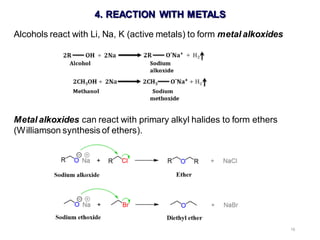
Alcohols react with Li, Na, K (active metals) to form metal alkoxides
Metal alkoxides can react with primary alkyl halides to form ethers
(Williamson synthesis of ethers).
17
5. REACTION WITH HALOGEN ACIDS
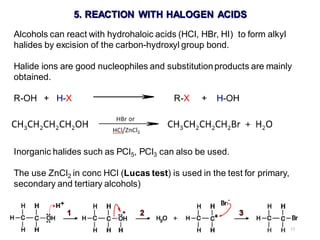
Alcohols can react with hydrohaloic acids (HCl, HBr, HI) to form alkyl
halides by excision of the carbon-hydroxyl group bond.
Halide ions are good nucleophiles and substitutionproducts are mainly
obtained.
R-OH + H-X R-X + H-OH
Inorganic halides such as PCl5, PCl3 can also be used.
The use ZnCl2 in conc HCl (Lucas test) is used in the test for primary,
secondary and tertiary alcohols)
Synthesis of Alcohols
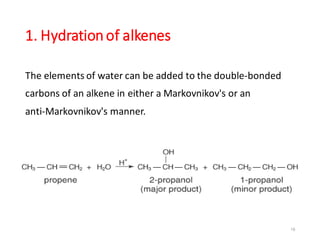
1. Hydrationof alkenes
The elements of water can be added to the double‐bonded
carbons of an alkene in either a Markovnikov's or an
anti‐Markovnikov's manner.
19
20
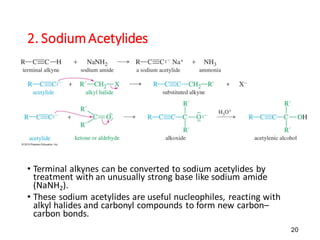
2. SodiumAcetylides
• Terminal alkynes can be converted to sodium acetylides by
treatment with an unusually strong base like sodium amide
(NaNH2).
• These sodium acetylides are useful nucleophiles, reacting with
alkyl halides and carbonyl compounds to form new carbon–
carbon bonds.
21
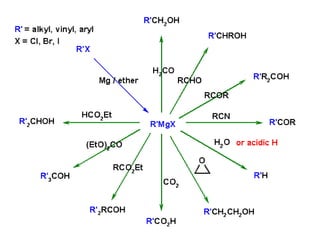
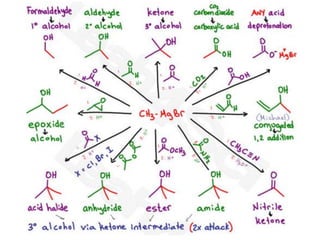
3. Preparation of Alcohols by
Organometallic reagents
21
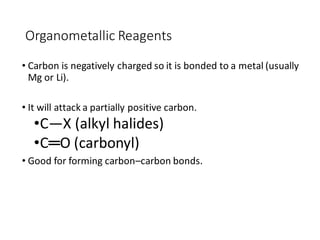
Organometallic Reagents
• Carbon is negatively charged so it is bonded to a metal (usually
Mg or Li).
• It will attack a partially positive carbon.
•C—X (alkyl halides)
•C═O (carbonyl)
• Good for forming carbon–carbon bonds.
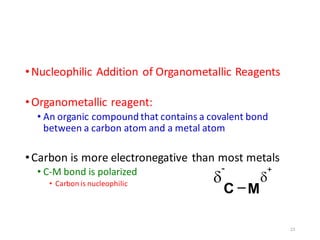
•Nucleophilic Addition of Organometallic Reagents
•Organometallic reagent:
• An organic compound that contains a covalent bond
between a carbon atom and a metal atom
•Carbon is more electronegative than most metals
• C-M bond is polarized
• Carbon is nucleophilic
23
C

-

+
M
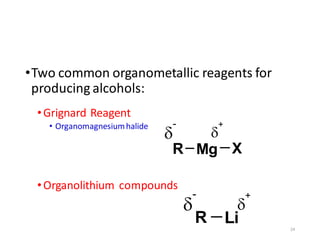
•Two common organometallic reagents for
producing alcohols:
•Grignard Reagent
• Organomagnesiumhalide
•Organolithium compounds
24
R

-

+
Li
NaBH4
ether
R

-

+
R
O
Li
Mg X
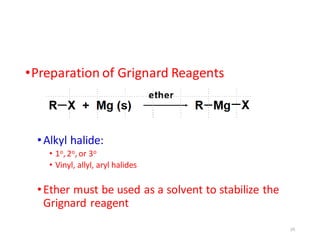
•Preparation of Grignard Reagents
•Alkyl halide:
• 1o, 2o, or 3o
• Vinyl, allyl, aryl halides
•Ether must be used as a solvent to stabilize the
Grignard reagent
25
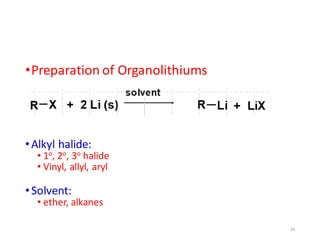
•Preparation of Organolithiums
•Alkyl halide:
• 1o, 2o, 3o halide
• Vinyl, allyl, aryl
•Solvent:
• ether, alkanes
26
27
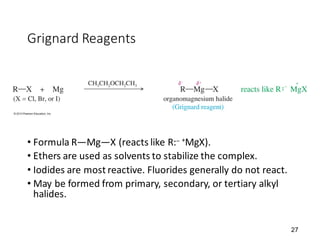
Grignard Reagents
• Formula R—Mg—X (reacts like R:– +MgX).
• Ethers are used as solvents to stabilize the complex.
• Iodides are most reactive. Fluorides generally do not react.
• May be formed from primary, secondary, or tertiary alkyl
halides.
28
Formation of Grignards
Br
+ Mg
ether MgBr
CH3CHCH2CH3
Cl
ether
+ Mg CH3CHCH2CH3
MgCl
Organolithium Reagents
• Reacts the same way as a Grignard.
• Can be produced from alkyl, vinyl, or aryl halides, just
like Grignard reagents.
• Ether not necessary,wide variety of solvents can be
used.
30
Addition to Carbonyl Compounds
• The carbonyl carbon is partial positive (electrophilic).
• Nucleophiles will attack the carbonyl, forming an alkoxide.
31
Mechanism of Addition of the
Organometallic to the Carbonyl
32
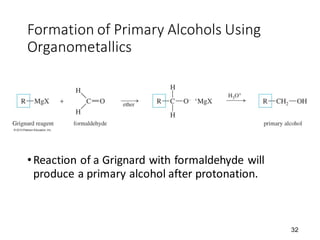
Formation of Primary Alcohols Using
Organometallics
•Reaction of a Grignard with formaldehyde will
produce a primary alcohol after protonation.
33
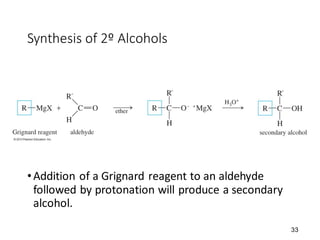
Synthesis of 2º Alcohols
•Addition of a Grignard reagent to an aldehyde
followed by protonation will produce a secondary
alcohol.
34
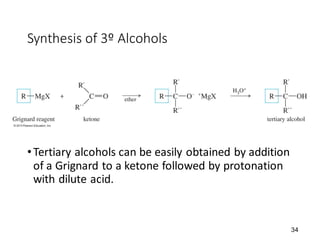
Synthesis of 3º Alcohols
•Tertiary alcohols can be easily obtained by addition
of a Grignard to a ketone followed by protonation
with dilute acid.
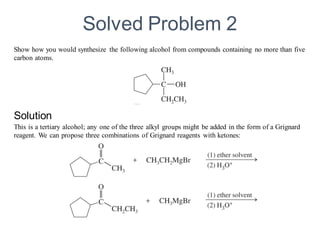
Show how you would synthesize the following alcohol from compounds containing no more than five
carbon atoms.
This is a tertiary alcohol; any one of the three alkyl groups might be added in the form of a Grignard
reagent. We can propose three combinations of Grignard reagents with ketones:
Solved Problem 2
Solution
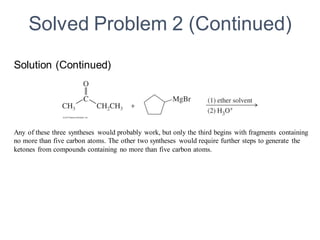
Any of these three syntheses would probably work, but only the third begins with fragments containing
no more than five carbon atoms. The other two syntheses would require further steps to generate the
ketones from compounds containing no more than five carbon atoms.
Solved Problem 2 (Continued)
Solution (Continued)
Note the use of
to show separate reactions with one
reaction arrow.
(1)
(2)
Grignard Reactions with
Acid Chlorides and Esters
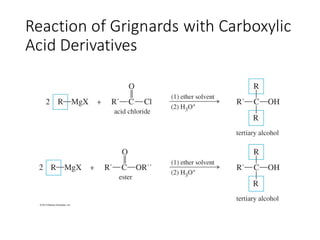
• Use two moles of Grignard reagent.
• The product is a tertiary alcohol with
two identical alkyl groups.
• Reaction with one mole of Grignard reagent produces a
ketone intermediate, which reacts with the second mole of
Grignard reagent.
Reaction of Grignards with Carboxylic
Acid Derivatives
40
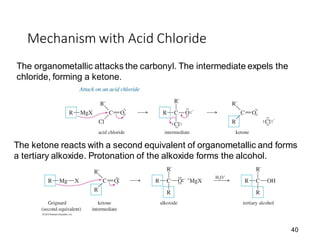
Mechanism with Acid Chloride
The organometallic attacks the carbonyl. The intermediate expels the
chloride, forming a ketone.
The ketone reacts with a second equivalent of organometallic and forms
a tertiary alkoxide. Protonation of the alkoxide forms the alcohol.
41
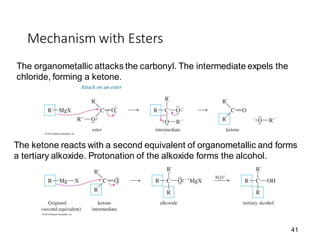
Mechanism with Esters
The organometallic attacks the carbonyl. The intermediate expels the
chloride, forming a ketone.
The ketone reacts with a second equivalent of organometallic and forms
a tertiary alkoxide. Protonation of the alkoxide forms the alcohol.
42
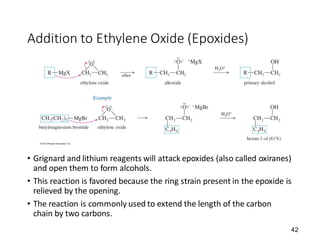
Addition to Ethylene Oxide (Epoxides)
• Grignard and lithium reagents will attack epoxides (also called oxiranes)
and open them to form alcohols.
• This reaction is favored because the ring strain present in the epoxide is
relieved by the opening.
• The reaction is commonly used to extend the length of the carbon
chain by two carbons.
The reaction of a Grignard reagent with
an epoxide is the only Grignard reaction
we have seen where the new OH group
is NOT on the same carbon atom where
the Grignard formed a new bond. In this
case, the new OH group appears on the
second carbon from the new bond.
44
45
46
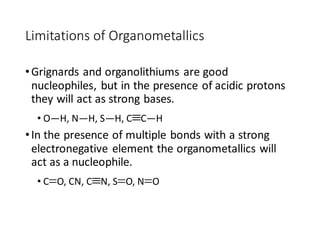
Limitations of Organometallics
•Grignards and organolithiums are good
nucleophiles, but in the presence of acidic protons
they will act as strong bases.
• O—H, N—H, S—H, CC—H
•In the presence of multiple bonds with a strong
electronegative element the organometallics will
act as a nucleophile.
• CO, CN, CN, SO, NO
48
4. Preparation of Alcohols by
Reduction
48
•Reduction of Carbonyls (Aldehydes and
Ketones)
•Common reducing agents and conditions:
•NaBH4 (sodium borohydride)
• alcohol, ether, or H2O as solvent
•(1) LiAlH4 (lithium aluminum hydride =LAH)
(2) H3O+
•Raney Ni
• finely divided H2-bearing form of Ni
• also reduces C=C to alkane 49
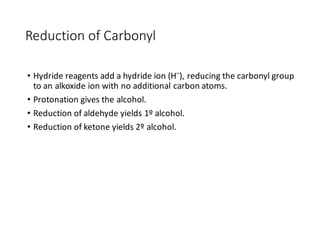
Reduction of Carbonyl
• Hydride reagents add a hydride ion (H–
), reducing the carbonyl group
to an alkoxide ion with no additional carbon atoms.
• Protonation gives the alcohol.
• Reduction of aldehyde yields 1º alcohol.
• Reduction of ketone yields 2º alcohol.
51
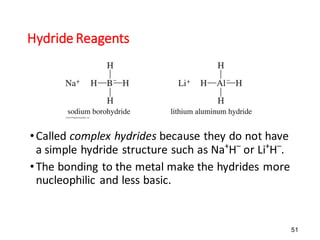
Hydride Reagents
•Called complex hydrides because they do not have
a simple hydride structure such as Na+
H–
or Li+
H–
.
•The bonding to the metal make the hydrides more
nucleophilic and less basic.
SodiumBorohydride
•NaBH4 is a source of hydrides (H–
).
•Hydride attacks the carbonyl carbon, forming an
alkoxide ion.
•Then the alkoxide ion is protonated by dilute acid.
•Only reacts with aldehydes or ketones, not with
esters or carboxylic acids.
•Can reduce a ketone or an aldehyde in the
presence of an acid or an ester.
53
Mechanism of Hydride Reduction
• Reaction 1: The hydride attacksthe carbonyl of the
aldehyde or the ketone, forming an alkoxide ion.
• Reaction 2: Protonation of the intermediate forms the
alcohol.
54
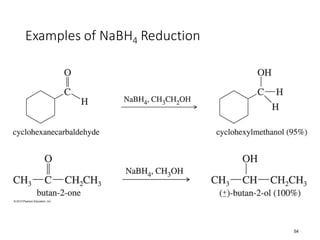
Examples of NaBH4 Reduction
LithiumAluminumHydride
• Stronger reducing agent than sodium borohydride.
• Dangerous to work with.
• Reduces ketones and aldehydes into the corresponding
alcohol.
• Converts esters and carboxylic acids to 1º alcohols.
56
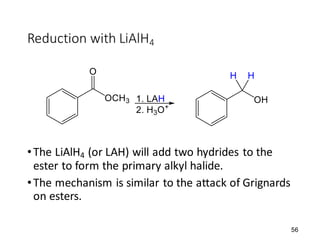
Reduction with LiAlH4
•The LiAlH4 (or LAH) will add two hydrides to the
ester to form the primary alkyl halide.
•The mechanism is similar to the attack of Grignards
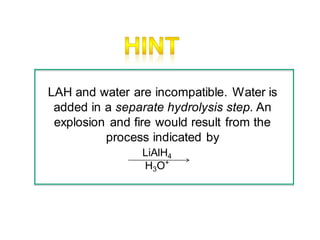
on esters.
LAH and water are incompatible. Water is
added in a separate hydrolysis step. An
explosion and fire would result from the
process indicated by
LiAlH4
H3O+
58
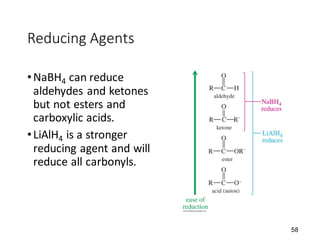
Reducing Agents
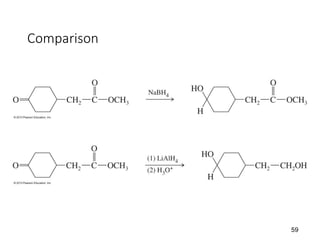
•NaBH4 can reduce
aldehydes and ketones
but not esters and
carboxylic acids.
•LiAlH4 is a stronger
reducing agent and will
reduce all carbonyls.
59
Comparison
60
Catalytic Hydrogenation
• Raney nickel is a hydrogen-rich nickel powder that is more
reactive than Pd or Pt catalysts.
• This reaction is not commonly used because it will also
reduce double and triple bonds that may be present in the
molecule.
61
Selective Reductions
• Hydride reagents are more selective, so they are used more
frequently for carbonyl reductions.
62
THIOLS
62
Thiols (Mercaptans)
•Sulfur analogues of alcohols are called thiols.
•The —SH group is called a mercapto group.
•Named by adding the suffix -thiol to the alkane
name.
64
Nomenclature
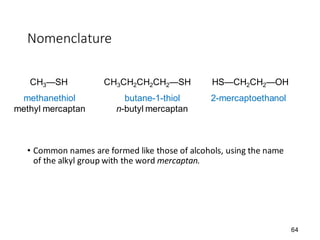
• Common names are formed like those of alcohols, using the name
of the alkyl group with the word mercaptan.
CH3—SH CH3CH2CH2CH2—SH HS—CH2CH2—OH
methanethiol
methyl mercaptan
butane-1-thiol
n-butyl mercaptan
2-mercaptoethanol
65
Acidity of Thiols
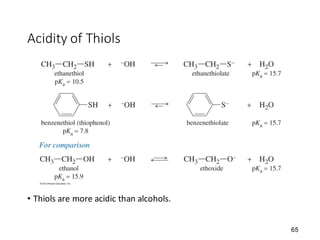
• Thiols are more acidic than alcohols.
66
Synthesis of Thiols
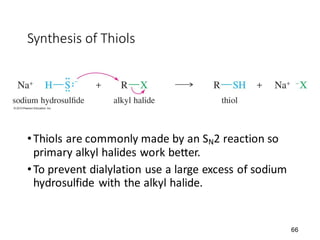
•Thiols are commonly made by an SN2 reaction so
primary alkyl halides work better.
•To prevent dialylation use a large excess of sodium
hydrosulfide with the alkyl halide.
Thiol Oxidation
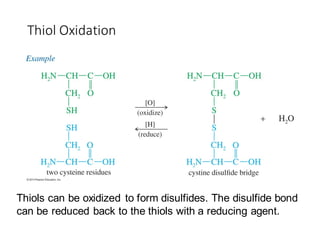
Thiols can be oxidized to form disulfides. The disulfide bond
can be reduced back to the thiols with a reducing agent.

Alcohol...Grignard reagent...Thiols.pdf slide

  • 1.
  • 2.
    CLASSIFICATION OF ALCOHOLS Aliphatic• general formula CnH2n+1OH - provided there are no rings • the OH replaces an H in a basic hydrocarbon skeleton Aromatic • in aromatic alcohols (or phenols) the OH is attached directly to the ring • an OH on a side chain of a ring behaves as a typical aliphatic alcohol The firsttwo compoundsare classified asaromatic alcohols (phenols)because the OH group is attached directly to the ring. Structural differences • alcohols are classified according to the environment of the OH group • chemical behaviour, eg oxidation, often depends on the structural type PRIMARY 1° SECONDARY 2° TERTIARY 3°
  • 3.
    3 Alcohols are namedaccording to standard IUPAC rules • select the longest chain of C atoms containing the O-H group; • remove the e and add ol after the basic name • number the chain starting from the end nearer the O-H group • the number is placed after the an and before the ol ... e.g butan-2-ol • as in alkanes, prefix with alkyl substituents • side chain positions are based on the number allocated to the O-H group e.g. CH3 - CH(CH3) - CH2 - CH2 - CH(OH) - CH3 is called 5-methylhexan-2-ol NAMING ALCOHOLS
  • 4.
    4 STRUCTURAL ISOMERISM INALCOHOLS Different structures are possible due to... A Different positions for the OH group and B Branching of the carbon chain butan-1-ol butan-2-ol 2-methylpropan-1-ol 2-methylpropan-2-ol
  • 5.
    5 BOILING POINTS OFALCOHOLS Increases with molecular size due to increased van der Waals’ forces. Alcohols have higher boiling points than similar molecular mass alkanes This is due to the added presence of inter-molecular hydrogen bonding. More energy is required to separate the molecules. Mr bp / °C propane C3H8 44 -42 just van der Waals’ forces ethanol C2H5OH 46 +78 van der Waals’ forces + hydrogen bonding Boiling point is higher for “straight” chain isomers. bp / °C butan-1-ol CH3CH2CH2CH2OH 118 butan-2-ol CH3CH2CH(OH)CH3 100 2-methylpropan-2-ol (CH3)3COH 83 Greater branching = lower inter-molecular forces
  • 6.
    6 SOLVENT PROPERTIES OFALCOHOLS Solubility Low molecular mass alcohols are miscible with water Due to hydrogen bonding between the two molecules Heavier alcohols are less miscible Solvent properties Alcohols are themselves very good solvents They dissolve a large number of organic molecules Show the relevant lone pair(s) when drawing hydrogen bonding
  • 7.
    CHEMICAL PROPERTIES OFALCOHOLS The OXYGEN ATOM HAS TWO LONE PAIRS; this makes alcohols... BASES Lewis bases are lone pair donors Bronsted-Lowry bases are proton acceptors The alcohol uses one of its lone pairs to form a co-ordinate bond NUCLEOPHILES Alcohols can use the lone pair to attack electron deficient centres
  • 8.
  • 9.
    9 • Primary andsecondary alcohols are oxidized by a variety of reagents to give aldehydes and ketones respectively. • However, the aldehyde can also be easily oxidized to an acid. • Tertiary alcohols are resistant to oxidation since they have no hydrogen atoms attached to the oxygen bearing carbon (carbinol carbon). 1. OXIDATION OF ALCOHOLS
  • 10.
    10 1. Oxidation Weak Oxidants:pyridinium chlorochromate (PCC), Dess-Martin Periodinane (DMP), the Swern oxidation [(COCl)2, DMSO, NEt3)] and CrO3/pyridine (the “Collins reagent“)
  • 11.
    11 Strong Oxidants: potassiumpermanganate (KMnO4) and Cr(VI) species, which are essentially different precursors of chromic acid (H2CrO4)
  • 12.
    12 OXIDATION OF ALCOHOLS Why1° and 2° alcohols are easily oxidised and 3° alcohols are not For oxidation to take place easily you must have two hydrogen atoms on adjacent C and O atoms. H H R C O + [O] R C O + H2O H H H H R C O + [O] R C O + H2O R R R H R C O + [O] R This is possible in 1° and 2° alcohols but not in 3° alcohols. 1° 2° 3°
  • 13.
    2. ELIMINATION OFWATER (DEHYDRATION) Reagent/catalyst conc. sulphuric acid (H2SO4) or conc. phosphoric acid (H3PO4) Conditions reflux at 180°C Product alkene Equation e.g. C2H5OH(l) ——> CH2 = CH2(g) + H2O(l) Mechanism Step 1 protonation of the alcohol using a lone pair on oxygen Step 2 loss of a water molecule to generate a carbocation Step 3 loss of a proton (H+) to give the alkene Note: There must be an H on a carbon atom adjacent the carbon with the OH Alcohols with the OH in the middle of a chain can have two ways of losing water. In Step 3 of the mechanism, a proton can be lost from either side of the carbocation. This gives a mixture of alkenes from unsymmetrical alcohols...
  • 14.
    2. ELIMINATION OFWATER (DEHYDRATION) Alcohols can be dehydrated by heating with a strong acid (eg. conc H2SO4 or H3PO4) to give an alkene eg. 2-butanol to 2-butene CH3CH2CH(OH)CH3 CH3CH=CHCH3 Tertiary alcohols are more easily dehydrated than secondary and primary alcohols (due to the order of stability of carbocation) H+ , heat CH3CHCH3 OH H2SO4 alcohol CH3CHCH3 OH H CH3CHCH3 CH2 CHCH3 H2O Mechanism: • Protonation of the hydroxyl group (alcohol act as a base) • Carbocation and double bond formation
  • 15.
    15 3. ESTERIFICATION OFALCOHOLS Reagent(s) carboxylic acid + strong acid catalyst (e.g conc. H2SO4 ) Conditions reflux Product ester Equation e.g. CH3CH2OH(l) + CH3COOH(l) CH3COOC2H5(l) + H2O(l) ethanol ethanoic acid ethyl ethanoate Notes Concentrated H2SO4 is a dehydrating agent - it removes water causing the equilibrium to move to the right and increases the yield Uses of esters Esters are fairly unreactive but that doesn’t make them useless Used as flavourings Naming esters Named from the alcohol and carboxylic acid which made them... CH3OH + CH3COOH CH3COOCH3 + H2O from ethanoic acid CH3COOCH3 from methanol METHYL ETHANOATE
  • 16.
    16 4. REACTION WITHMETALS Alcohols react with Li, Na, K (active metals) to form metal alkoxides Metal alkoxides can react with primary alkyl halides to form ethers (Williamson synthesis of ethers).
  • 17.
    17 5. REACTION WITHHALOGEN ACIDS Alcohols can react with hydrohaloic acids (HCl, HBr, HI) to form alkyl halides by excision of the carbon-hydroxyl group bond. Halide ions are good nucleophiles and substitutionproducts are mainly obtained. R-OH + H-X R-X + H-OH Inorganic halides such as PCl5, PCl3 can also be used. The use ZnCl2 in conc HCl (Lucas test) is used in the test for primary, secondary and tertiary alcohols)
  • 18.
  • 19.
    1. Hydrationof alkenes Theelements of water can be added to the double‐bonded carbons of an alkene in either a Markovnikov's or an anti‐Markovnikov's manner. 19
  • 20.
    20 2. SodiumAcetylides • Terminalalkynes can be converted to sodium acetylides by treatment with an unusually strong base like sodium amide (NaNH2). • These sodium acetylides are useful nucleophiles, reacting with alkyl halides and carbonyl compounds to form new carbon– carbon bonds.
  • 21.
    21 3. Preparation ofAlcohols by Organometallic reagents 21
  • 22.
    Organometallic Reagents • Carbonis negatively charged so it is bonded to a metal (usually Mg or Li). • It will attack a partially positive carbon. •C—X (alkyl halides) •C═O (carbonyl) • Good for forming carbon–carbon bonds.
  • 23.
    •Nucleophilic Addition ofOrganometallic Reagents •Organometallic reagent: • An organic compound that contains a covalent bond between a carbon atom and a metal atom •Carbon is more electronegative than most metals • C-M bond is polarized • Carbon is nucleophilic 23 C  -  + M
  • 24.
    •Two common organometallicreagents for producing alcohols: •Grignard Reagent • Organomagnesiumhalide •Organolithium compounds 24 R  -  + Li NaBH4 ether R  -  + R O Li Mg X
  • 25.
    •Preparation of GrignardReagents •Alkyl halide: • 1o, 2o, or 3o • Vinyl, allyl, aryl halides •Ether must be used as a solvent to stabilize the Grignard reagent 25
  • 26.
    •Preparation of Organolithiums •Alkylhalide: • 1o, 2o, 3o halide • Vinyl, allyl, aryl •Solvent: • ether, alkanes 26
  • 27.
    27 Grignard Reagents • FormulaR—Mg—X (reacts like R:– +MgX). • Ethers are used as solvents to stabilize the complex. • Iodides are most reactive. Fluorides generally do not react. • May be formed from primary, secondary, or tertiary alkyl halides.
  • 28.
    28 Formation of Grignards Br +Mg ether MgBr CH3CHCH2CH3 Cl ether + Mg CH3CHCH2CH3 MgCl
  • 29.
    Organolithium Reagents • Reactsthe same way as a Grignard. • Can be produced from alkyl, vinyl, or aryl halides, just like Grignard reagents. • Ether not necessary,wide variety of solvents can be used.
  • 30.
    30 Addition to CarbonylCompounds • The carbonyl carbon is partial positive (electrophilic). • Nucleophiles will attack the carbonyl, forming an alkoxide.
  • 31.
    31 Mechanism of Additionof the Organometallic to the Carbonyl
  • 32.
    32 Formation of PrimaryAlcohols Using Organometallics •Reaction of a Grignard with formaldehyde will produce a primary alcohol after protonation.
  • 33.
    33 Synthesis of 2ºAlcohols •Addition of a Grignard reagent to an aldehyde followed by protonation will produce a secondary alcohol.
  • 34.
    34 Synthesis of 3ºAlcohols •Tertiary alcohols can be easily obtained by addition of a Grignard to a ketone followed by protonation with dilute acid.
  • 35.
    Show how youwould synthesize the following alcohol from compounds containing no more than five carbon atoms. This is a tertiary alcohol; any one of the three alkyl groups might be added in the form of a Grignard reagent. We can propose three combinations of Grignard reagents with ketones: Solved Problem 2 Solution
  • 36.
    Any of thesethree syntheses would probably work, but only the third begins with fragments containing no more than five carbon atoms. The other two syntheses would require further steps to generate the ketones from compounds containing no more than five carbon atoms. Solved Problem 2 (Continued) Solution (Continued)
  • 37.
    Note the useof to show separate reactions with one reaction arrow. (1) (2)
  • 38.
    Grignard Reactions with AcidChlorides and Esters • Use two moles of Grignard reagent. • The product is a tertiary alcohol with two identical alkyl groups. • Reaction with one mole of Grignard reagent produces a ketone intermediate, which reacts with the second mole of Grignard reagent.
  • 39.
    Reaction of Grignardswith Carboxylic Acid Derivatives
  • 40.
    40 Mechanism with AcidChloride The organometallic attacks the carbonyl. The intermediate expels the chloride, forming a ketone. The ketone reacts with a second equivalent of organometallic and forms a tertiary alkoxide. Protonation of the alkoxide forms the alcohol.
  • 41.
    41 Mechanism with Esters Theorganometallic attacks the carbonyl. The intermediate expels the chloride, forming a ketone. The ketone reacts with a second equivalent of organometallic and forms a tertiary alkoxide. Protonation of the alkoxide forms the alcohol.
  • 42.
    42 Addition to EthyleneOxide (Epoxides) • Grignard and lithium reagents will attack epoxides (also called oxiranes) and open them to form alcohols. • This reaction is favored because the ring strain present in the epoxide is relieved by the opening. • The reaction is commonly used to extend the length of the carbon chain by two carbons.
  • 43.
    The reaction ofa Grignard reagent with an epoxide is the only Grignard reaction we have seen where the new OH group is NOT on the same carbon atom where the Grignard formed a new bond. In this case, the new OH group appears on the second carbon from the new bond.
  • 44.
  • 45.
  • 46.
  • 47.
    Limitations of Organometallics •Grignardsand organolithiums are good nucleophiles, but in the presence of acidic protons they will act as strong bases. • O—H, N—H, S—H, CC—H •In the presence of multiple bonds with a strong electronegative element the organometallics will act as a nucleophile. • CO, CN, CN, SO, NO
  • 48.
    48 4. Preparation ofAlcohols by Reduction 48
  • 49.
    •Reduction of Carbonyls(Aldehydes and Ketones) •Common reducing agents and conditions: •NaBH4 (sodium borohydride) • alcohol, ether, or H2O as solvent •(1) LiAlH4 (lithium aluminum hydride =LAH) (2) H3O+ •Raney Ni • finely divided H2-bearing form of Ni • also reduces C=C to alkane 49
  • 50.
    Reduction of Carbonyl •Hydride reagents add a hydride ion (H– ), reducing the carbonyl group to an alkoxide ion with no additional carbon atoms. • Protonation gives the alcohol. • Reduction of aldehyde yields 1º alcohol. • Reduction of ketone yields 2º alcohol.
  • 51.
    51 Hydride Reagents •Called complexhydrides because they do not have a simple hydride structure such as Na+ H– or Li+ H– . •The bonding to the metal make the hydrides more nucleophilic and less basic.
  • 52.
    SodiumBorohydride •NaBH4 is asource of hydrides (H– ). •Hydride attacks the carbonyl carbon, forming an alkoxide ion. •Then the alkoxide ion is protonated by dilute acid. •Only reacts with aldehydes or ketones, not with esters or carboxylic acids. •Can reduce a ketone or an aldehyde in the presence of an acid or an ester.
  • 53.
    53 Mechanism of HydrideReduction • Reaction 1: The hydride attacksthe carbonyl of the aldehyde or the ketone, forming an alkoxide ion. • Reaction 2: Protonation of the intermediate forms the alcohol.
  • 54.
  • 55.
    LithiumAluminumHydride • Stronger reducingagent than sodium borohydride. • Dangerous to work with. • Reduces ketones and aldehydes into the corresponding alcohol. • Converts esters and carboxylic acids to 1º alcohols.
  • 56.
    56 Reduction with LiAlH4 •TheLiAlH4 (or LAH) will add two hydrides to the ester to form the primary alkyl halide. •The mechanism is similar to the attack of Grignards on esters.
  • 57.
    LAH and waterare incompatible. Water is added in a separate hydrolysis step. An explosion and fire would result from the process indicated by LiAlH4 H3O+
  • 58.
    58 Reducing Agents •NaBH4 canreduce aldehydes and ketones but not esters and carboxylic acids. •LiAlH4 is a stronger reducing agent and will reduce all carbonyls.
  • 59.
  • 60.
    60 Catalytic Hydrogenation • Raneynickel is a hydrogen-rich nickel powder that is more reactive than Pd or Pt catalysts. • This reaction is not commonly used because it will also reduce double and triple bonds that may be present in the molecule.
  • 61.
    61 Selective Reductions • Hydridereagents are more selective, so they are used more frequently for carbonyl reductions.
  • 62.
  • 63.
    Thiols (Mercaptans) •Sulfur analoguesof alcohols are called thiols. •The —SH group is called a mercapto group. •Named by adding the suffix -thiol to the alkane name.
  • 64.
    64 Nomenclature • Common namesare formed like those of alcohols, using the name of the alkyl group with the word mercaptan. CH3—SH CH3CH2CH2CH2—SH HS—CH2CH2—OH methanethiol methyl mercaptan butane-1-thiol n-butyl mercaptan 2-mercaptoethanol
  • 65.
    65 Acidity of Thiols •Thiols are more acidic than alcohols.
  • 66.
    66 Synthesis of Thiols •Thiolsare commonly made by an SN2 reaction so primary alkyl halides work better. •To prevent dialylation use a large excess of sodium hydrosulfide with the alkyl halide.
  • 67.
    Thiol Oxidation Thiols canbe oxidized to form disulfides. The disulfide bond can be reduced back to the thiols with a reducing agent.