Nair Vijayalakshmi
MSc (Inorganic Chemistry) Part I
Organic Chemistry
Aromatic Nucleophilic Substitution
CONTENT
• Aromatic Nucleophilic Substitution
• SNAr mechanism
• SN1 mechanism
• Benzyne mechanism
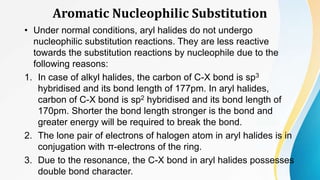
Aromatic Nucleophilic Substitution
• Under normal conditions, aryl halides do not undergo
nucleophilic substitution reactions. They are less reactive
towards the substitution reactions by nucleophile due to the
following reasons:
1. In case of alkyl halides, the carbon of C-X bond is sp3
hybridised and its bond length of 177pm. In aryl halides,
carbon of C-X bond is sp2 hybridised and its bond length of
170pm. Shorter the bond length stronger is the bond and
greater energy will be required to break the bond.
2. The lone pair of electrons of halogen atom in aryl halides is in
conjugation with π-electrons of the ring.
3. Due to the resonance, the C-X bond in aryl halides possesses
double bond character.
SNAr mechanism
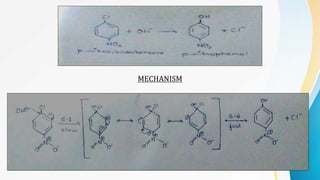
• Aryl halides does not undergo this mechanism easily because
of the conjugation between lone pair of electrons on Cl and the
C-atom in the ring.
• But if there is a strong withdrawing group in the ring such as
nitro (-NO2) group then it would undergo the reaction readily.
• It's important that the withdrawing group must be present either
at ortho or para-position. As the resonating structures do not
have negative charge at meta-position, hence the presence of
withdrawing group on meta-position has no effect on reactivity.
MECHANISM
SN1 mechanism
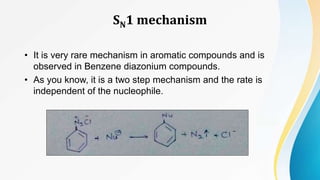
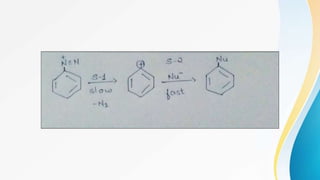
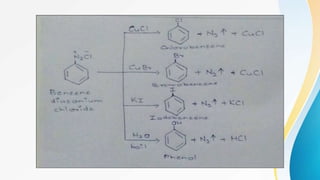
• It is very rare mechanism in aromatic compounds and is
observed in Benzene diazonium compounds.
• As you know, it is a two step mechanism and the rate is
independent of the nucleophile.
MECHANISM
Benzyne mechanism
• It is also known as SNEA mechanism as elimination and addition
reaction occurs.
• It would not be easy to remove the chloride group from the ring
due to conjugation between lone pair of electrons of chloride atom
and carbon atom in the ring.
• It was possible in SNAr mechanism due to presence of a strong
withdrawing group.
• So here, the adjacent H-atom in the ring is used for the reaction.
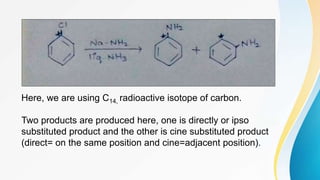
Here, we are using C14, radioactive isotope of carbon.
Two products are produced here, one is directly or ipso
substituted product and the other is cine substituted product
(direct= on the same position and cine=adjacent position).
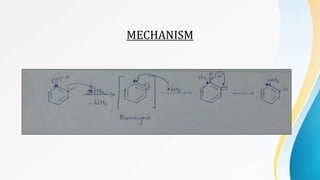
MECHANISM
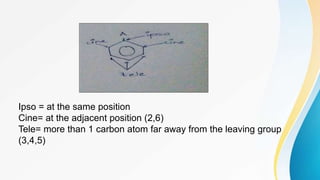
Ipso = at the same position
Cine= at the adjacent position (2,6)
Tele= more than 1 carbon atom far away from the leaving group
(3,4,5)
Reference
1. Organic Chemistry, J. Claydens, N. Greeves, S. Warren
and P. Wothers, Oxford University Press.
2. Advanced Organic Chemistry, B.S. Bahl and Arun Bahl,
S. Chand and company Ltd.
3. https://nptel.ac.in
4. https://m.youtube.com
Acknowledgement
I would like to express my gratitude to our
HOD, Prof.Sandeep Borde and Prof.Jameson Masih for
giving me this opportunity. I also thank my friends for their
support.
Aromatic Nucleophilic Substitution

Aromatic Nucleophilic Substitution

  • 1.
    Nair Vijayalakshmi MSc (InorganicChemistry) Part I Organic Chemistry Aromatic Nucleophilic Substitution
  • 2.
    CONTENT • Aromatic NucleophilicSubstitution • SNAr mechanism • SN1 mechanism • Benzyne mechanism
  • 3.
    Aromatic Nucleophilic Substitution •Under normal conditions, aryl halides do not undergo nucleophilic substitution reactions. They are less reactive towards the substitution reactions by nucleophile due to the following reasons: 1. In case of alkyl halides, the carbon of C-X bond is sp3 hybridised and its bond length of 177pm. In aryl halides, carbon of C-X bond is sp2 hybridised and its bond length of 170pm. Shorter the bond length stronger is the bond and greater energy will be required to break the bond. 2. The lone pair of electrons of halogen atom in aryl halides is in conjugation with π-electrons of the ring. 3. Due to the resonance, the C-X bond in aryl halides possesses double bond character.
  • 4.
    SNAr mechanism • Arylhalides does not undergo this mechanism easily because of the conjugation between lone pair of electrons on Cl and the C-atom in the ring. • But if there is a strong withdrawing group in the ring such as nitro (-NO2) group then it would undergo the reaction readily. • It's important that the withdrawing group must be present either at ortho or para-position. As the resonating structures do not have negative charge at meta-position, hence the presence of withdrawing group on meta-position has no effect on reactivity.
  • 5.
  • 6.
    SN1 mechanism • Itis very rare mechanism in aromatic compounds and is observed in Benzene diazonium compounds. • As you know, it is a two step mechanism and the rate is independent of the nucleophile.
  • 7.
  • 9.
    Benzyne mechanism • Itis also known as SNEA mechanism as elimination and addition reaction occurs. • It would not be easy to remove the chloride group from the ring due to conjugation between lone pair of electrons of chloride atom and carbon atom in the ring. • It was possible in SNAr mechanism due to presence of a strong withdrawing group. • So here, the adjacent H-atom in the ring is used for the reaction.
  • 10.
    Here, we areusing C14, radioactive isotope of carbon. Two products are produced here, one is directly or ipso substituted product and the other is cine substituted product (direct= on the same position and cine=adjacent position).
  • 11.
  • 12.
    Ipso = atthe same position Cine= at the adjacent position (2,6) Tele= more than 1 carbon atom far away from the leaving group (3,4,5)
  • 13.
    Reference 1. Organic Chemistry,J. Claydens, N. Greeves, S. Warren and P. Wothers, Oxford University Press. 2. Advanced Organic Chemistry, B.S. Bahl and Arun Bahl, S. Chand and company Ltd. 3. https://nptel.ac.in 4. https://m.youtube.com
  • 14.
    Acknowledgement I would liketo express my gratitude to our HOD, Prof.Sandeep Borde and Prof.Jameson Masih for giving me this opportunity. I also thank my friends for their support.