Self-declarations
 The content is exclusively meant for academic purposes
for enhancing teaching and learning.
 Any other use for economic/commercial purpose is strictly
prohibited. The users of the content shall not distribute,
disseminate or share it with anyone else
 Its use is restricted to advancement of individual
knowledge.
 The information provided in this e-content is authentic and
best as per knowledge.
ELECTRONIC EFFECTS
INDUCTIVE EFFECT ,
MESOMERIC EFFECT
ELECTROMERIC EFFECTS
BY
-Neha Tripathee
Assistant Professor
K.M.G.G.P.G.COLLEGE BADALPUR
B.Sc.I .PAPER II,UNIT II
Inductive Effect
 The inductive effect is a permanent
state of polarization. The electron
density in a bond between two unlike
atoms is not uniform.
 The inductive effect is a distance-
dependent phenomenon
 The inductive effect is permanent, but
relatively weak, and can be easily
overshadowed by the electronic
effects discussed later.
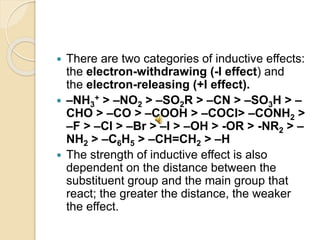
 There are two categories of inductive effects:
the electron-withdrawing (-I effect) and
the electron-releasing (+I effect).
 –NH3
+ > –NO2 > –SO2R > –CN > –SO3H > –
CHO > –CO > –COOH > –COCl> –CONH2 >
–F > –Cl > –Br > –I > –OH > -OR > -NR2 > –
NH2 > –C6H5 > –CH=CH2 > –H
 The strength of inductive effect is also
dependent on the distance between the
substituent group and the main group that
react; the greater the distance, the weaker
the effect.
Applications-
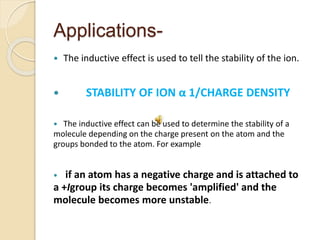
 The inductive effect is used to tell the stability of the ion.
 STABILITY OF ION α 1/CHARGE DENSITY
 The inductive effect can be used to determine the stability of a
molecule depending on the charge present on the atom and the
groups bonded to the atom. For example
 if an atom has a negative charge and is attached to
a +Igroup its charge becomes 'amplified' and the
molecule becomes more unstable.
CONT….
 If an atom has a negative charge and
is attached to a -I group its charge
becomes 'de-amplified' and the
molecule becomes more stable than if
I-effect was not taken into
consideration.
 STABILITY OF CARBOCATION-
 tertiary carbocation > secondary
carbocation >primary carbocation >
methyl carbocation
STRENGTH OF CARBOXYLIC ACID
 It depends on the extent of its
ionisation, The more ionized is it, the
stronger it is.
 As an acid becomes stronger, the
numerical value of its pKa drops.
 Thus Acetic acid < formic acid <
chloro aceic acid
 And mono chloro acetic acid<dichloro
acetic acid<tri chloro acetic acid
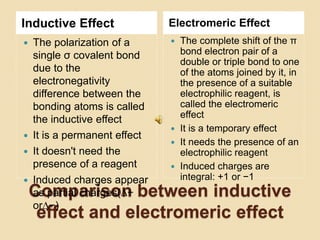
Comparison between inductive
effect and electromeric effect
Inductive Effect Electromeric Effect
 The polarization of a
single σ covalent bond
due to the
electronegativity
difference between the
bonding atoms is called
the inductive effect
 It is a permanent effect
 It doesn't need the
presence of a reagent
 Induced charges appear
as partial charges(∆+
or∆−)
 The complete shift of the π
bond electron pair of a
double or triple bond to one
of the atoms joined by it, in
the presence of a suitable
electrophilic reagent, is
called the electromeric
effect
 It is a temporary effect
 It needs the presence of an
electrophilic reagent
 Induced charges are
integral: +1 or −1
ELECTROMERIC EFFECT-
 This effect is shown by those
compounds containing multiple bonds.
When a double bond or triple bond is
exposed to an attack by a reagent, a pair
of bonding electrons involved in the pi
bond is transferred completely from one
atom to another. This effect will remain
as long as the attacking reagent is
present. As soon as the reagent is
removed, the polarized molecule will
come back to the original state.
+E and -E groups
 Electromeric effect can be classified into
+E and -E effects based on the direction
of transfer of the electron pair.
 When the electron pair moves towards
the attacking reagent, it is termed as the
+E effect. The addition of acids on
alkene is an example of the +E effect.
 The -E effect can be found in reactions
such as addition of nucleophiles to
carbonyl compounds.
MESOMERIC EFFECT-
 The concepts of mesomeric effect,
mesomerism and mesomer were introduced
by Ingold in 1938 as an alternative to
Pauling's synonymous concept of
resonance.[1] "Mesomerism" in this context is
often encountered in German and French
literature, but in English literature the term
"resonance" dominates.
 Mesomeric effect can be transmitted along
any number of carbon atoms in a conjugated
system. This accounts for the resonance
stabilization of the molecule due to
delocalization of charge.
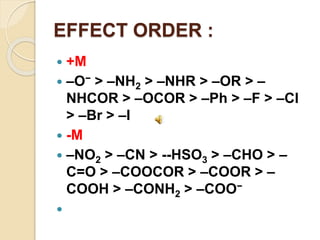
EFFECT ORDER :
 +M
 –O− > –NH2 > –NHR > –OR > –
NHCOR > –OCOR > –Ph > –F > –Cl
> –Br > –I
 -M
 –NO2 > –CN > --HSO3 > –CHO > –
C=O > –COOCOR > –COOR > –
COOH > –CONH2 > –COO−

 MESOMERIC EFFECT IS A
PERMANENT EFFECT AS THE
INDUCTIVE EFFECT.
 IT OPERATES IN COMPOUNDS
WHERE THER IS CONJUGATION
,I.e. PAI BOND AND SIGMA BOND
BOTH ARE THERE.
 IT IS RESPONSIBLE FOR MORE
THAN ONE RESONANCE HYBRID
STRUCTURES OR MESOMERIC
FORMS OF THE COMPOUND.
Electronic effects inductive,mesomeric,electromeric

Electronic effects inductive,mesomeric,electromeric

  • 1.
    Self-declarations  The contentis exclusively meant for academic purposes for enhancing teaching and learning.  Any other use for economic/commercial purpose is strictly prohibited. The users of the content shall not distribute, disseminate or share it with anyone else  Its use is restricted to advancement of individual knowledge.  The information provided in this e-content is authentic and best as per knowledge.
  • 2.
    ELECTRONIC EFFECTS INDUCTIVE EFFECT, MESOMERIC EFFECT ELECTROMERIC EFFECTS BY -Neha Tripathee Assistant Professor K.M.G.G.P.G.COLLEGE BADALPUR B.Sc.I .PAPER II,UNIT II
  • 3.
    Inductive Effect  Theinductive effect is a permanent state of polarization. The electron density in a bond between two unlike atoms is not uniform.  The inductive effect is a distance- dependent phenomenon  The inductive effect is permanent, but relatively weak, and can be easily overshadowed by the electronic effects discussed later.
  • 4.
     There aretwo categories of inductive effects: the electron-withdrawing (-I effect) and the electron-releasing (+I effect).  –NH3 + > –NO2 > –SO2R > –CN > –SO3H > – CHO > –CO > –COOH > –COCl> –CONH2 > –F > –Cl > –Br > –I > –OH > -OR > -NR2 > – NH2 > –C6H5 > –CH=CH2 > –H  The strength of inductive effect is also dependent on the distance between the substituent group and the main group that react; the greater the distance, the weaker the effect.
  • 5.
    Applications-  The inductiveeffect is used to tell the stability of the ion.  STABILITY OF ION α 1/CHARGE DENSITY  The inductive effect can be used to determine the stability of a molecule depending on the charge present on the atom and the groups bonded to the atom. For example  if an atom has a negative charge and is attached to a +Igroup its charge becomes 'amplified' and the molecule becomes more unstable.
  • 6.
    CONT….  If anatom has a negative charge and is attached to a -I group its charge becomes 'de-amplified' and the molecule becomes more stable than if I-effect was not taken into consideration.  STABILITY OF CARBOCATION-  tertiary carbocation > secondary carbocation >primary carbocation > methyl carbocation
  • 7.
    STRENGTH OF CARBOXYLICACID  It depends on the extent of its ionisation, The more ionized is it, the stronger it is.  As an acid becomes stronger, the numerical value of its pKa drops.  Thus Acetic acid < formic acid < chloro aceic acid  And mono chloro acetic acid<dichloro acetic acid<tri chloro acetic acid
  • 8.
    Comparison between inductive effectand electromeric effect Inductive Effect Electromeric Effect  The polarization of a single σ covalent bond due to the electronegativity difference between the bonding atoms is called the inductive effect  It is a permanent effect  It doesn't need the presence of a reagent  Induced charges appear as partial charges(∆+ or∆−)  The complete shift of the π bond electron pair of a double or triple bond to one of the atoms joined by it, in the presence of a suitable electrophilic reagent, is called the electromeric effect  It is a temporary effect  It needs the presence of an electrophilic reagent  Induced charges are integral: +1 or −1
  • 9.
    ELECTROMERIC EFFECT-  Thiseffect is shown by those compounds containing multiple bonds. When a double bond or triple bond is exposed to an attack by a reagent, a pair of bonding electrons involved in the pi bond is transferred completely from one atom to another. This effect will remain as long as the attacking reagent is present. As soon as the reagent is removed, the polarized molecule will come back to the original state.
  • 10.
    +E and -Egroups  Electromeric effect can be classified into +E and -E effects based on the direction of transfer of the electron pair.  When the electron pair moves towards the attacking reagent, it is termed as the +E effect. The addition of acids on alkene is an example of the +E effect.  The -E effect can be found in reactions such as addition of nucleophiles to carbonyl compounds.
  • 11.
    MESOMERIC EFFECT-  Theconcepts of mesomeric effect, mesomerism and mesomer were introduced by Ingold in 1938 as an alternative to Pauling's synonymous concept of resonance.[1] "Mesomerism" in this context is often encountered in German and French literature, but in English literature the term "resonance" dominates.  Mesomeric effect can be transmitted along any number of carbon atoms in a conjugated system. This accounts for the resonance stabilization of the molecule due to delocalization of charge.
  • 12.
    EFFECT ORDER : +M  –O− > –NH2 > –NHR > –OR > – NHCOR > –OCOR > –Ph > –F > –Cl > –Br > –I  -M  –NO2 > –CN > --HSO3 > –CHO > – C=O > –COOCOR > –COOR > – COOH > –CONH2 > –COO− 
  • 13.
     MESOMERIC EFFECTIS A PERMANENT EFFECT AS THE INDUCTIVE EFFECT.  IT OPERATES IN COMPOUNDS WHERE THER IS CONJUGATION ,I.e. PAI BOND AND SIGMA BOND BOTH ARE THERE.  IT IS RESPONSIBLE FOR MORE THAN ONE RESONANCE HYBRID STRUCTURES OR MESOMERIC FORMS OF THE COMPOUND.