LIGAND SUBSTITUTION
REACTIONS IN OCTAHEDRAL
COMPLEXES
Submitted by
Shahdan Borbora
M.Sc. 3rd Semester
Roll No. 11
CONTENTS
Introduction
Mechanisms Of Ligand Substitution
Reactions
Hydrolysis Reactions
Anation Reactions
Conclusion
References
INTRODUCTION
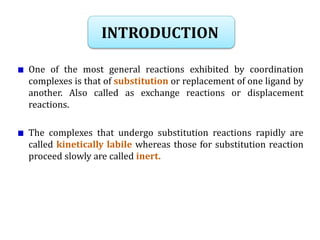
One of the most general reactions exhibited by coordination
complexes is that of substitution or replacement of one ligand by
another. Also called as exchange reactions or displacement
reactions.
The complexes that undergo substitution reactions rapidly are
called kinetically labile whereas those for substitution reaction
proceed slowly are called inert.
TERMS OF SIGNIFICANCE
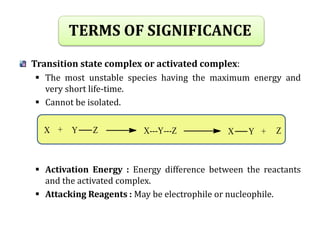
Transition state complex or activated complex:
 The most unstable species having the maximum energy and
very short life-time.
 Cannot be isolated.
 Activation Energy : Energy difference between the reactants
and the activated complex.
 Attacking Reagents : May be electrophile or nucleophile.
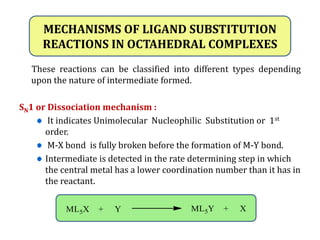
MECHANISMS OF LIGAND SUBSTITUTION
REACTIONS IN OCTAHEDRAL COMPLEXES
These reactions can be classified into different types depending
upon the nature of intermediate formed.
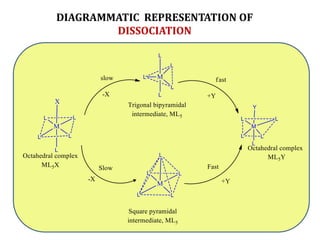
SN1 or Dissociation mechanism :
It indicates Unimolecular Nucleophilic Substitution or 1st
order.
M-X bond is fully broken before the formation of M-Y bond.
Intermediate is detected in the rate determining step in which
the central metal has a lower coordination number than it has in
the reactant.
The two step mechanism
Step 1
Step 2
Rate = K [ML5X]
DIAGRAMMATIC REPRESENTATION OF
DISSOCIATION
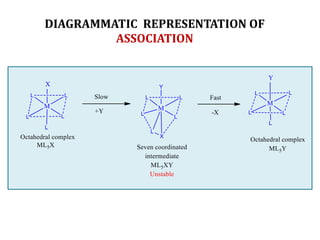
SN2 or Association mechanism
Intermediate at the rate-determining step has a higher coordination
number than that in the reactant.
M-Y bond is fully formed before the breaking of M-X bond.
It is of 2nd order and also involves two steps.
Step 1
Step 2
Rate = K[ML5X][Y]
DIAGRAMMATIC REPRESENTATION OF
ASSOCIATION
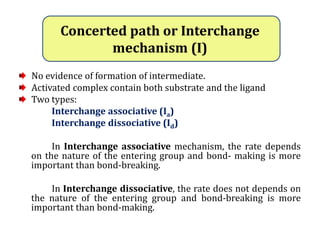
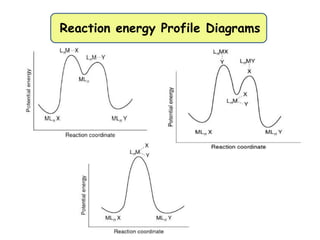
Concerted path or Interchange
mechanism (I)
No evidence of formation of intermediate.
Activated complex contain both substrate and the ligand
Two types:
Interchange associative (Ia)
Interchange dissociative (Id)
In Interchange associative mechanism, the rate depends
on the nature of the entering group and bond- making is more
important than bond-breaking.
In Interchange dissociative, the rate does not depends on
the nature of the entering group and bond-breaking is more
important than bond-making.
Reaction energy Profile Diagrams
HYDROLYSIS REACTIONS
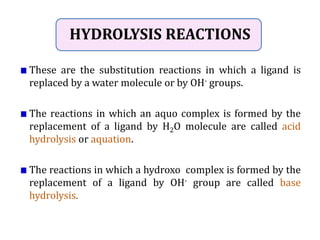
These are the substitution reactions in which a ligand is
replaced by a water molecule or by OH- groups.
The reactions in which an aquo complex is formed by the
replacement of a ligand by H2O molecule are called acid
hydrolysis or aquation.
The reactions in which a hydroxo complex is formed by the
replacement of a ligand by OH- group are called base
hydrolysis.
ACID HYDROLYSIS
Occurs in neutral and acid solutions (pH<3)
Rate is independent of water molecule
Rate= K[Co(NH3)5Cl]2+
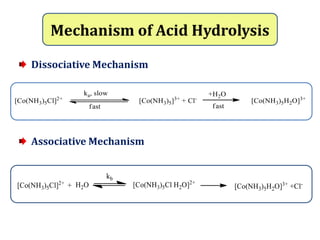
Mechanism of Acid Hydrolysis
Dissociative Mechanism
Associative Mechanism
Factors affecting acid hydrolysis
Crowding of a reaction centre may favor a dissociative process.
Due to inductive effect rate increases. Increasing alkyl substitution
will distort the electron density towards the metal atom and favors
dissociative process.
The rate decreases with increase in the overall charge on the metal.
This indicates dissociative process.
Ligands possessing lone pair of electron favor dissociative process and
ligands which withdraws electron from the metal centers by
delocalization of electron pairs favor associative process.
Base Hydrolysis
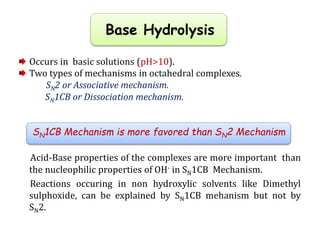
Occurs in basic solutions (pH>10).
Two types of mechanisms in octahedral complexes.
SN2 or Associative mechanism.
SN1CB or Dissociation mechanism.
SN1CB Mechanism is more favored than SN2 Mechanism
Acid-Base properties of the complexes are more important than
the nucleophilic properties of OH- in SN1CB Mechanism.
Reactions occuring in non hydroxylic solvents like Dimethyl
sulphoxide, can be explained by SN1CB mehanism but not by
SN2.
SN2 or Associative mechanism
Rate= K[Co(NH3)5Cl]2+ [OH-]
SN1CB or Dissociation mechanism
• Rate = k1[CB]; where CB= Conjugate Base ,
[CB] =
Anation Reactions
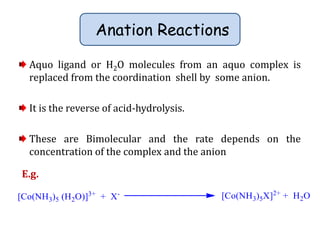
Aquo ligand or H2O molecules from an aquo complex is
replaced from the coordination shell by some anion.
It is the reverse of acid-hydrolysis.
These are Bimolecular and the rate depends on the
concentration of the complex and the anion
E.g.
CONCLUSION
The Substitution reactions of Co(III) and Cr(III) complexes were the
first extensively studied due to the inertness of these two metals.
Most evidences support the Id mechanisms for substitution in Co(III)
complexes and a little dependence of reaction rates on the nature of
the incoming ligand. The reaction in which H2O replaces Cl- in
[Co(NMeH2)5Cl]2+ takes place 22 times faster than the same reaction
for[Co(NH3)5Cl]2+. The dissociation of Cl- ligand is encouraged by the
greater steric requirements of methylamine.
If the reaction proceeded by an Ia or Association pathway, the order of
rates would be the opposite because the rate of the reaction is
decreased due to the steric repulsion of the incoming ligand.
Reference
House, James E. Inorganic Chemistry, Third edition, Elsevier Academic
Press, 2008, Page no:403-407 .
ISBN 978-0-12-356786-4.
Huheey, James E.; Keiter, Ellen A.; Keiter, Richard L.; Medhi, Okhil K.
Inorganic Chemistry Principles of Structure and Reactivity, Fourth
edition, Pearson Education, Inc. 2014, page no: 551-557.
ISBN 978-81-775-8130-0.
Malik, Wahid U.; Tuli, G.D.; Madan, R.D.; Selected Topics in Inorganic
Chemistry, Seventh edition, S.Chand & Company Ltd. 2012, page no: 510-
526.
ISBN 81-219-0600-8 code 04039
22

Ligand substitution reactions

  • 1.
    LIGAND SUBSTITUTION REACTIONS INOCTAHEDRAL COMPLEXES Submitted by Shahdan Borbora M.Sc. 3rd Semester Roll No. 11
  • 2.
    CONTENTS Introduction Mechanisms Of LigandSubstitution Reactions Hydrolysis Reactions Anation Reactions Conclusion References
  • 3.
    INTRODUCTION One of themost general reactions exhibited by coordination complexes is that of substitution or replacement of one ligand by another. Also called as exchange reactions or displacement reactions. The complexes that undergo substitution reactions rapidly are called kinetically labile whereas those for substitution reaction proceed slowly are called inert.
  • 4.
    TERMS OF SIGNIFICANCE Transitionstate complex or activated complex:  The most unstable species having the maximum energy and very short life-time.  Cannot be isolated.  Activation Energy : Energy difference between the reactants and the activated complex.  Attacking Reagents : May be electrophile or nucleophile.
  • 5.
    MECHANISMS OF LIGANDSUBSTITUTION REACTIONS IN OCTAHEDRAL COMPLEXES These reactions can be classified into different types depending upon the nature of intermediate formed. SN1 or Dissociation mechanism : It indicates Unimolecular Nucleophilic Substitution or 1st order. M-X bond is fully broken before the formation of M-Y bond. Intermediate is detected in the rate determining step in which the central metal has a lower coordination number than it has in the reactant.
  • 6.
    The two stepmechanism Step 1 Step 2 Rate = K [ML5X]
  • 7.
  • 8.
    SN2 or Associationmechanism Intermediate at the rate-determining step has a higher coordination number than that in the reactant. M-Y bond is fully formed before the breaking of M-X bond. It is of 2nd order and also involves two steps. Step 1 Step 2 Rate = K[ML5X][Y]
  • 9.
  • 10.
    Concerted path orInterchange mechanism (I) No evidence of formation of intermediate. Activated complex contain both substrate and the ligand Two types: Interchange associative (Ia) Interchange dissociative (Id) In Interchange associative mechanism, the rate depends on the nature of the entering group and bond- making is more important than bond-breaking. In Interchange dissociative, the rate does not depends on the nature of the entering group and bond-breaking is more important than bond-making.
  • 11.
  • 12.
    HYDROLYSIS REACTIONS These arethe substitution reactions in which a ligand is replaced by a water molecule or by OH- groups. The reactions in which an aquo complex is formed by the replacement of a ligand by H2O molecule are called acid hydrolysis or aquation. The reactions in which a hydroxo complex is formed by the replacement of a ligand by OH- group are called base hydrolysis.
  • 13.
    ACID HYDROLYSIS Occurs inneutral and acid solutions (pH<3) Rate is independent of water molecule Rate= K[Co(NH3)5Cl]2+
  • 14.
    Mechanism of AcidHydrolysis Dissociative Mechanism Associative Mechanism
  • 15.
    Factors affecting acidhydrolysis Crowding of a reaction centre may favor a dissociative process. Due to inductive effect rate increases. Increasing alkyl substitution will distort the electron density towards the metal atom and favors dissociative process. The rate decreases with increase in the overall charge on the metal. This indicates dissociative process. Ligands possessing lone pair of electron favor dissociative process and ligands which withdraws electron from the metal centers by delocalization of electron pairs favor associative process.
  • 16.
    Base Hydrolysis Occurs inbasic solutions (pH>10). Two types of mechanisms in octahedral complexes. SN2 or Associative mechanism. SN1CB or Dissociation mechanism. SN1CB Mechanism is more favored than SN2 Mechanism Acid-Base properties of the complexes are more important than the nucleophilic properties of OH- in SN1CB Mechanism. Reactions occuring in non hydroxylic solvents like Dimethyl sulphoxide, can be explained by SN1CB mehanism but not by SN2.
  • 17.
    SN2 or Associativemechanism Rate= K[Co(NH3)5Cl]2+ [OH-] SN1CB or Dissociation mechanism
  • 18.
    • Rate =k1[CB]; where CB= Conjugate Base , [CB] =
  • 19.
    Anation Reactions Aquo ligandor H2O molecules from an aquo complex is replaced from the coordination shell by some anion. It is the reverse of acid-hydrolysis. These are Bimolecular and the rate depends on the concentration of the complex and the anion E.g.
  • 20.
    CONCLUSION The Substitution reactionsof Co(III) and Cr(III) complexes were the first extensively studied due to the inertness of these two metals. Most evidences support the Id mechanisms for substitution in Co(III) complexes and a little dependence of reaction rates on the nature of the incoming ligand. The reaction in which H2O replaces Cl- in [Co(NMeH2)5Cl]2+ takes place 22 times faster than the same reaction for[Co(NH3)5Cl]2+. The dissociation of Cl- ligand is encouraged by the greater steric requirements of methylamine. If the reaction proceeded by an Ia or Association pathway, the order of rates would be the opposite because the rate of the reaction is decreased due to the steric repulsion of the incoming ligand.
  • 21.
    Reference House, James E.Inorganic Chemistry, Third edition, Elsevier Academic Press, 2008, Page no:403-407 . ISBN 978-0-12-356786-4. Huheey, James E.; Keiter, Ellen A.; Keiter, Richard L.; Medhi, Okhil K. Inorganic Chemistry Principles of Structure and Reactivity, Fourth edition, Pearson Education, Inc. 2014, page no: 551-557. ISBN 978-81-775-8130-0. Malik, Wahid U.; Tuli, G.D.; Madan, R.D.; Selected Topics in Inorganic Chemistry, Seventh edition, S.Chand & Company Ltd. 2012, page no: 510- 526. ISBN 81-219-0600-8 code 04039
  • 22.