MISS. V.R.MANGRULE
ASSISTANT PROFESSOR,
PHARMACEUTICAL CHEMISTRY.
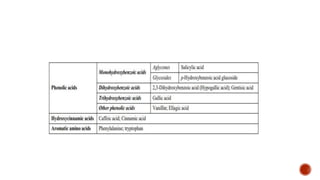
 Aromatic acids are a type of aromatic compound. Included in that class are
substances containing an aromatic ring and an organic acid functional group.
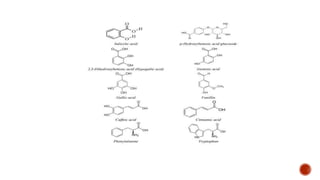
 There are several categories of aromatic acids including:
(i) Phenolic acids: substances containing an aromatic ring and an organic
carboxylic acid function (C6-C1 skeleton).
(ii) Aromatic amino acids (e.g. Phenylalanine, Tryptophan)
A: Periodic trends
 First, we will focus on individual atoms, and think about trends associated with
the position of an element on the periodic table.
 When moving vertically within a given column of the periodic table, we again
observe a clear periodic trend in acidity.
 This is best illustrated with the halo acids and halides: basicity, like
electronegativity, increases as we move up the column.
 Conversely, acidity in the haloacids increases as we move down the column.
 In order to make sense of this trend, we will once again consider the stability of
the conjugate bases.
 Because fluorine is the most electronegative halogen element, we might expect
fluoride to also be the least basic halogen ion.
 But in fact, it is the least stable, and the most basic!
 It turns out that when moving vertically in the periodic table, the size of the atom
trumps its electronegativity with regard to basicity.
 The atomic radius of iodine is approximately twice that of fluorine, so in an iodide
ion, the negative charge is spread out over a significantly larger volume:
B: Resonance effects
A huge stabilizing factor for a conjugate base is if the negative charge can be
delocalized through resonance.
Consider the acidity of methanol and acetic acid.
 In methoxide ion, the negative charge is localized (concentrated) on the oxygen
atom.
Resonance stabilizes both acetic acid and acetate ion,
In acetic acid, the stabilization is small because the resonance contribution
involves separation of charge.
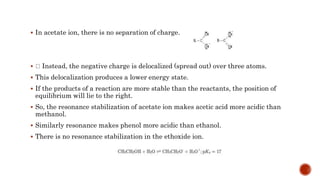
 In acetate ion, there is no separation of charge.
 Instead, the negative charge is delocalized (spread out) over three atoms.
 This delocalization produces a lower energy state.
 If the products of a reaction are more stable than the reactants, the position of
equilibrium will lie to the right.
 So, the resonance stabilization of acetate ion makes acetic acid more acidic than
methanol.
 Similarly resonance makes phenol more acidic than ethanol.
 There is no resonance stabilization in the ethoxide ion.
 Resonance stabilizes both phenol and phenoxide ion by delocalization of electrons
into the ring.
 However, this localization in phenol involves separation of charge and makes the
oxygen atom positive.
 The same delocalization in phenoxide ion provides much more stabilization
because there is no charge separation.
 The position of equilibrium lies to the right. pKa = 10 Thus, phenol is 107 times
as acidic as ethanol because resonance stabilizes the phenoxide ion.
C:Inductive effects
 The inductive effect plays a vital role in deciding the acidity and basicity of a
molecule.
 Groups having +I effect attached to a molecule increases the overall electron
density on the molecule and the molecule is able to donate electrons, making it
basic.
 Similarly, groups having -I effect attached to a molecule decreases the overall
electron density on the molecule making it electron deficient which results in its
acidity.
 As the number of -I groups attached to a molecule increases, its acidity increases;
as the number of +I groups on a molecule increases, its basicity increases
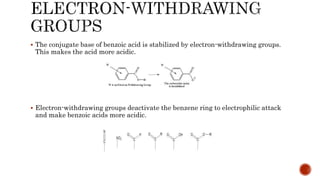
 The conjugate base of benzoic acid is stabilized by electron-withdrawing groups.
This makes the acid more acidic.
 Electron-withdrawing groups deactivate the benzene ring to electrophilic attack
and make benzoic acids more acidic.
 The conjugate base of benzoic acid is destabilized by electron-donating groups.
This makes the acid less acidic.
 Electron-donating groups activate the benzene ring to electrophilic attack and
make benzoic acids less acidic
It is behaves differently for different systems.
 For aliphatic systems with no conjugation, it behaves as an electron withdrawing group
due to -I effect.
 For aliphatic systems with conjugation, it behaves as an electron withdrawing group by -I
effect and an electron donating group by mesomeric effect.
 For aromatic systems,
 When it is in ortho position, it behaves as an electron withdrawing group by -I effect and an electron
donating group due to mesomeric effect.
 When it is in meta position, it behaves as an electron withdrawing group by -I effect. Since the
distance has increased as compared to ortho, its effect decreases.
 When it is in para position, it behaves as an electron donating group by mesomeric effect. Since the
distance has increased further, the electron withdrawing nature by -I effect is negligible.
 Preferred IUPAC name: Benzoic acid
 Systematic IUPAC name: Benzenecarboxylic acid
 Other names : Carboxybenzene, Dracylic acid, Phenylmethanoic acid
 Chemical formula : C7H6O2
 Molar mass: 122.123 g·mol−1
 Appearance: Colorless crystalline solid
 Density :1.2659 g/cm3 (15 °C)
 Melting point :122 °C
 Solubility in water: Insoluble [1.7 g/L (0 °C); 2.7 g/L (18 °C); 3.44 g/L (25 °C); 5.51
g/L (40 °C); 21.45 g/L (75 °C); 56.31 g/L (100 °C)]
 Solubility: soluble in acetone, benzene, CCl4, CHCl3, alcohol, ethyl ether, hexane,
phenyls, liquid ammonia, acetate
 Benzoic acid used as precursor to plasticizers.
 Benzoic acid and its salts are used as food preservatives.
 Benzoic acid is a constituent of Whitfield's ointment which is used for the
treatment of fungal skin diseases such as tinea, ringworm, and athlete's foot. As
the principal component of gum benzoin, benzoic acid is also a major ingredient in
both tincture of benzoin and Friar's balsam.
 Use as topical antiseptics and inhalant decongestants.
 Benzoic acid is a precursor to benzoyl chloride, C6H5C(O)Cl by treatment with
thionyl chloride, phosgene or one of the chlorides of phosphorus.
 Benzoyl chloride is an important starting material for several benzoic acid
derivatives like benzyl benzoate, which is used in artificial flavours and insect
repellents.
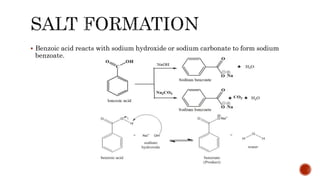
 Benzoic acid reacts with sodium hydroxide or sodium carbonate to form sodium
benzoate.
 The acid-catalyzed reaction between a carboxylic acid and an alcohol to give an
ester and water.
 The alcohol is usually used as the solvent, and therefore present in excess.
 The acid must be strong; sulfuric acid, phosphoric acid, or p-toluenesulfonic acid
are often used for this purpose.
Step 1:
 The dissociation of sulphuric acid will produce hydrogen ion which can be used to
protonates the carbonyl group in benzoic acid.
 The carbonyl group is protonated reversibly and caused the positive charge of
carbonyl group to be increased.
 Thus this increases the reactivity of carbonyl group towards nucleophile.
 The C-O double bond is broken in order to stabilize the OH+ group to form
hydroxyl group in the benzoic acid molecule.
 The methanol acts as a nucleophile attacks the benzoic acid.
 Step 2:
 The methanol successful attacked the carbonyl group to form a new C-O bond to the
carboxyl group in the benzoic acid to form a tetrahedral intermediate.
 This is called nucleophilic addition.
 The oxygen atom in the carboxyl group in benzoic acid is more electronegative due to its
lone pair electron.
 The lone pair electron in the particular electron attracts the hydrogen atom from the
methanol to form oxonium ion.
 Now, the oxygen atom in the methanol becomes unstable and hence the C-H bond will tend
to be broken down.
 The electron between the C-H bond will delocalised to the oxygen atom of the methanol.
 The formation of oxonium ion in the carboxyl group in benzoic acid tends to be released
from the intermediate to form water.
 Eventually, another hydroxyl group will donate the lone pair electron to the attached
oxygen atom to form a more stable intermediate.
Step 3:
 The hydrogen atom in the ester intermediate will be attacked the acid in diagram
3 and the acid catalyze is regenerated. Thus, finally the methyl benzoate is formed
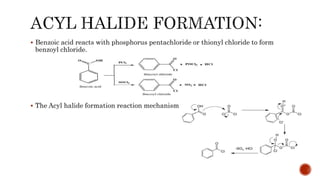
 Benzoic acid reacts with phosphorus pentachloride or thionyl chloride to form
benzoyl chloride.
 The Acyl halide formation reaction mechanism
 Benzoic acid undergoes reduction with lithium aluminium hydride to give benzyl
alcohol.
Reduction of Benzoic acid to Benzoyl alcohol reaction mechanism
Step I: Deprotonation
 Step II: Nucleopilic attack by the hydride anion
 Step III: Leaving group removal
 Step IV: Nucleopilic attack by the hydride anion
 Step V: The alkoxide is protonated
The proposed mechanism begins with hydrogen
abstraction by the hydroxyl radical, which itself is
produced by the Cu2+ -catalysed reduction of dioxygen
by ascorbic acid:
 Nitration of benzoic acid will yield meta nitro benzoic acid or m-nitrobenzoic acid
as major products.
 If a mixture of concentrated sulfuric acid and fuming nitric acid is used, further
nitration of the initial product will result in the formation of 3,5-dinitrobenzoic
acid as a secondary product.
 The carboxyllic acid group on the benzene is a strong deactivating group. Most
deactivating groups are meta-directing.
 This is simply because the electron donating effects of activating groups push
electron density onto the ortho- and para-positions, while the electron
withdrawing effects of deactivating groups pull electron density away from the
ortho- and para-positions.
 In both cases, the meta-position is left almost unaffected, and when electron
density is pulled away from the ortho- and para-positions, then the meta-position
becomes the more reactive site.
 Carboxyl group in benzoic acid is an electron withdrawing group and therefore, it
is meta directing.
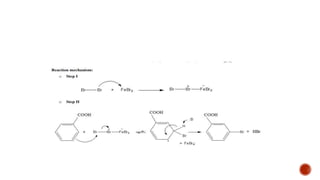
 Similarly bromination of benzoic acid will yield meta bromo benzoic acid or m-
bromo acid as major products.
 Salicylic acid is used as a food preservative, a bactericidal and an antiseptic.
 Salicylic acid as a medication is used most commonly to help remove the outer
layer of the skin.
 As such, it is used to treat warts, psoriasis, acne, ringworm, dandruff, and
ichthyosis.
 Salicylic acid is a keratolytic
 Gallic acid is a Trihydroxybenzoic acid, a type of phenolic acid, found in gallnuts, sumac,
witch hazel, tea leaves, oak bark, and other plants.
 The gallic acid groups are usually bonded to form dimers such as ellagic acid. o
Hydrolyzable tannins break down on hydrolysis to give gallic acid and glucose or ellagic
acid and glucose, known as gallotannins and ellagitannins, respectively.
 The gallic acid extracted from grape seeds has been shown to induce apoptosis or cell
death in prostate and breast cancer cells. In addition to being toxic towards cancerous
cells, gallic acid does not have any negative effects on healthy cells.
 As an antioxidant, gallic acid can defend the body against free radicals and oxidative
damage.
 Gallic acid has anti-fungal and anti-viral effects and anti-inflammatory properties.
 Gallic acid can support the heart as well, particularly the hearts of patients suffering
from type-1 diabetes.
 Supplements of galic acid were noted to decrease the chances of developing heart-related
conditions among these individuals.
 Regular intake of foods with gallic acid can be good for the brain. Gallic acid can defend
the brain’s nerves and tissue from deterioration caused by neurodegenerative disease.
 Aspirin is used to reduce fever and relieve mild to moderate pain from conditions
such as muscle aches, toothaches, common cold, and headaches. It may also be
used to reduce pain and swelling in conditions such as arthritis. Aspirin is known
as a salicylate and a nonsteroidal anti-inflammatory drug (NSAID).
 Aspirin to prevent blood clots.
 This effect reduces the risk of stroke and heart attack. o Used of aspirin in low
doses as a "blood thinner" to prevent blood clots.
AROMATIC ACIDS .pptx

AROMATIC ACIDS .pptx

  • 1.
  • 2.
     Aromatic acidsare a type of aromatic compound. Included in that class are substances containing an aromatic ring and an organic acid functional group.  There are several categories of aromatic acids including: (i) Phenolic acids: substances containing an aromatic ring and an organic carboxylic acid function (C6-C1 skeleton). (ii) Aromatic amino acids (e.g. Phenylalanine, Tryptophan)
  • 5.
    A: Periodic trends First, we will focus on individual atoms, and think about trends associated with the position of an element on the periodic table.  When moving vertically within a given column of the periodic table, we again observe a clear periodic trend in acidity.  This is best illustrated with the halo acids and halides: basicity, like electronegativity, increases as we move up the column.  Conversely, acidity in the haloacids increases as we move down the column.
  • 6.
     In orderto make sense of this trend, we will once again consider the stability of the conjugate bases.  Because fluorine is the most electronegative halogen element, we might expect fluoride to also be the least basic halogen ion.  But in fact, it is the least stable, and the most basic!  It turns out that when moving vertically in the periodic table, the size of the atom trumps its electronegativity with regard to basicity.  The atomic radius of iodine is approximately twice that of fluorine, so in an iodide ion, the negative charge is spread out over a significantly larger volume:
  • 7.
    B: Resonance effects Ahuge stabilizing factor for a conjugate base is if the negative charge can be delocalized through resonance. Consider the acidity of methanol and acetic acid.  In methoxide ion, the negative charge is localized (concentrated) on the oxygen atom. Resonance stabilizes both acetic acid and acetate ion, In acetic acid, the stabilization is small because the resonance contribution involves separation of charge.
  • 8.
     In acetateion, there is no separation of charge.  Instead, the negative charge is delocalized (spread out) over three atoms.  This delocalization produces a lower energy state.  If the products of a reaction are more stable than the reactants, the position of equilibrium will lie to the right.  So, the resonance stabilization of acetate ion makes acetic acid more acidic than methanol.  Similarly resonance makes phenol more acidic than ethanol.  There is no resonance stabilization in the ethoxide ion.
  • 9.
     Resonance stabilizesboth phenol and phenoxide ion by delocalization of electrons into the ring.  However, this localization in phenol involves separation of charge and makes the oxygen atom positive.  The same delocalization in phenoxide ion provides much more stabilization because there is no charge separation.  The position of equilibrium lies to the right. pKa = 10 Thus, phenol is 107 times as acidic as ethanol because resonance stabilizes the phenoxide ion.
  • 10.
    C:Inductive effects  Theinductive effect plays a vital role in deciding the acidity and basicity of a molecule.  Groups having +I effect attached to a molecule increases the overall electron density on the molecule and the molecule is able to donate electrons, making it basic.  Similarly, groups having -I effect attached to a molecule decreases the overall electron density on the molecule making it electron deficient which results in its acidity.  As the number of -I groups attached to a molecule increases, its acidity increases; as the number of +I groups on a molecule increases, its basicity increases
  • 12.
     The conjugatebase of benzoic acid is stabilized by electron-withdrawing groups. This makes the acid more acidic.  Electron-withdrawing groups deactivate the benzene ring to electrophilic attack and make benzoic acids more acidic.
  • 13.
     The conjugatebase of benzoic acid is destabilized by electron-donating groups. This makes the acid less acidic.  Electron-donating groups activate the benzene ring to electrophilic attack and make benzoic acids less acidic
  • 15.
    It is behavesdifferently for different systems.  For aliphatic systems with no conjugation, it behaves as an electron withdrawing group due to -I effect.  For aliphatic systems with conjugation, it behaves as an electron withdrawing group by -I effect and an electron donating group by mesomeric effect.  For aromatic systems,  When it is in ortho position, it behaves as an electron withdrawing group by -I effect and an electron donating group due to mesomeric effect.  When it is in meta position, it behaves as an electron withdrawing group by -I effect. Since the distance has increased as compared to ortho, its effect decreases.  When it is in para position, it behaves as an electron donating group by mesomeric effect. Since the distance has increased further, the electron withdrawing nature by -I effect is negligible.
  • 16.
     Preferred IUPACname: Benzoic acid  Systematic IUPAC name: Benzenecarboxylic acid  Other names : Carboxybenzene, Dracylic acid, Phenylmethanoic acid  Chemical formula : C7H6O2  Molar mass: 122.123 g·mol−1  Appearance: Colorless crystalline solid  Density :1.2659 g/cm3 (15 °C)  Melting point :122 °C  Solubility in water: Insoluble [1.7 g/L (0 °C); 2.7 g/L (18 °C); 3.44 g/L (25 °C); 5.51 g/L (40 °C); 21.45 g/L (75 °C); 56.31 g/L (100 °C)]  Solubility: soluble in acetone, benzene, CCl4, CHCl3, alcohol, ethyl ether, hexane, phenyls, liquid ammonia, acetate
  • 17.
     Benzoic acidused as precursor to plasticizers.  Benzoic acid and its salts are used as food preservatives.  Benzoic acid is a constituent of Whitfield's ointment which is used for the treatment of fungal skin diseases such as tinea, ringworm, and athlete's foot. As the principal component of gum benzoin, benzoic acid is also a major ingredient in both tincture of benzoin and Friar's balsam.  Use as topical antiseptics and inhalant decongestants.  Benzoic acid is a precursor to benzoyl chloride, C6H5C(O)Cl by treatment with thionyl chloride, phosgene or one of the chlorides of phosphorus.  Benzoyl chloride is an important starting material for several benzoic acid derivatives like benzyl benzoate, which is used in artificial flavours and insect repellents.
  • 20.
     Benzoic acidreacts with sodium hydroxide or sodium carbonate to form sodium benzoate.
  • 21.
     The acid-catalyzedreaction between a carboxylic acid and an alcohol to give an ester and water.  The alcohol is usually used as the solvent, and therefore present in excess.  The acid must be strong; sulfuric acid, phosphoric acid, or p-toluenesulfonic acid are often used for this purpose.
  • 22.
    Step 1:  Thedissociation of sulphuric acid will produce hydrogen ion which can be used to protonates the carbonyl group in benzoic acid.  The carbonyl group is protonated reversibly and caused the positive charge of carbonyl group to be increased.  Thus this increases the reactivity of carbonyl group towards nucleophile.  The C-O double bond is broken in order to stabilize the OH+ group to form hydroxyl group in the benzoic acid molecule.  The methanol acts as a nucleophile attacks the benzoic acid.
  • 23.
     Step 2: The methanol successful attacked the carbonyl group to form a new C-O bond to the carboxyl group in the benzoic acid to form a tetrahedral intermediate.  This is called nucleophilic addition.  The oxygen atom in the carboxyl group in benzoic acid is more electronegative due to its lone pair electron.  The lone pair electron in the particular electron attracts the hydrogen atom from the methanol to form oxonium ion.  Now, the oxygen atom in the methanol becomes unstable and hence the C-H bond will tend to be broken down.  The electron between the C-H bond will delocalised to the oxygen atom of the methanol.  The formation of oxonium ion in the carboxyl group in benzoic acid tends to be released from the intermediate to form water.  Eventually, another hydroxyl group will donate the lone pair electron to the attached oxygen atom to form a more stable intermediate.
  • 24.
    Step 3:  Thehydrogen atom in the ester intermediate will be attacked the acid in diagram 3 and the acid catalyze is regenerated. Thus, finally the methyl benzoate is formed
  • 25.
     Benzoic acidreacts with phosphorus pentachloride or thionyl chloride to form benzoyl chloride.  The Acyl halide formation reaction mechanism
  • 26.
     Benzoic acidundergoes reduction with lithium aluminium hydride to give benzyl alcohol. Reduction of Benzoic acid to Benzoyl alcohol reaction mechanism Step I: Deprotonation
  • 27.
     Step II:Nucleopilic attack by the hydride anion  Step III: Leaving group removal
  • 28.
     Step IV:Nucleopilic attack by the hydride anion  Step V: The alkoxide is protonated
  • 29.
    The proposed mechanismbegins with hydrogen abstraction by the hydroxyl radical, which itself is produced by the Cu2+ -catalysed reduction of dioxygen by ascorbic acid:
  • 30.
     Nitration ofbenzoic acid will yield meta nitro benzoic acid or m-nitrobenzoic acid as major products.  If a mixture of concentrated sulfuric acid and fuming nitric acid is used, further nitration of the initial product will result in the formation of 3,5-dinitrobenzoic acid as a secondary product.  The carboxyllic acid group on the benzene is a strong deactivating group. Most deactivating groups are meta-directing.  This is simply because the electron donating effects of activating groups push electron density onto the ortho- and para-positions, while the electron withdrawing effects of deactivating groups pull electron density away from the ortho- and para-positions.  In both cases, the meta-position is left almost unaffected, and when electron density is pulled away from the ortho- and para-positions, then the meta-position becomes the more reactive site.
  • 32.
     Carboxyl groupin benzoic acid is an electron withdrawing group and therefore, it is meta directing.  Similarly bromination of benzoic acid will yield meta bromo benzoic acid or m- bromo acid as major products.
  • 35.
     Salicylic acidis used as a food preservative, a bactericidal and an antiseptic.  Salicylic acid as a medication is used most commonly to help remove the outer layer of the skin.  As such, it is used to treat warts, psoriasis, acne, ringworm, dandruff, and ichthyosis.  Salicylic acid is a keratolytic
  • 36.
     Gallic acidis a Trihydroxybenzoic acid, a type of phenolic acid, found in gallnuts, sumac, witch hazel, tea leaves, oak bark, and other plants.  The gallic acid groups are usually bonded to form dimers such as ellagic acid. o Hydrolyzable tannins break down on hydrolysis to give gallic acid and glucose or ellagic acid and glucose, known as gallotannins and ellagitannins, respectively.  The gallic acid extracted from grape seeds has been shown to induce apoptosis or cell death in prostate and breast cancer cells. In addition to being toxic towards cancerous cells, gallic acid does not have any negative effects on healthy cells.  As an antioxidant, gallic acid can defend the body against free radicals and oxidative damage.  Gallic acid has anti-fungal and anti-viral effects and anti-inflammatory properties.  Gallic acid can support the heart as well, particularly the hearts of patients suffering from type-1 diabetes.  Supplements of galic acid were noted to decrease the chances of developing heart-related conditions among these individuals.  Regular intake of foods with gallic acid can be good for the brain. Gallic acid can defend the brain’s nerves and tissue from deterioration caused by neurodegenerative disease.
  • 37.
     Aspirin isused to reduce fever and relieve mild to moderate pain from conditions such as muscle aches, toothaches, common cold, and headaches. It may also be used to reduce pain and swelling in conditions such as arthritis. Aspirin is known as a salicylate and a nonsteroidal anti-inflammatory drug (NSAID).  Aspirin to prevent blood clots.  This effect reduces the risk of stroke and heart attack. o Used of aspirin in low doses as a "blood thinner" to prevent blood clots.