Reaction Mechanism in Catalytic Ester Hydrolysis by Lipases
Yuvraj Uboveja
CCNSB
LIPASES
Lipases are water-soluble enzymes that catalyze the hydrolysis of ester
bonds in triacylglycerols.
Mol. Wt. - ~19kDa - ~60kDa
---> Belongs to alpha/beta hydrolase fold family
---> The active site, composed of a Ser-His-Asp/Glu catalytic triad.
--- Interfacial activation phenomenon
--- Through Conformational Rearrangement of Lid
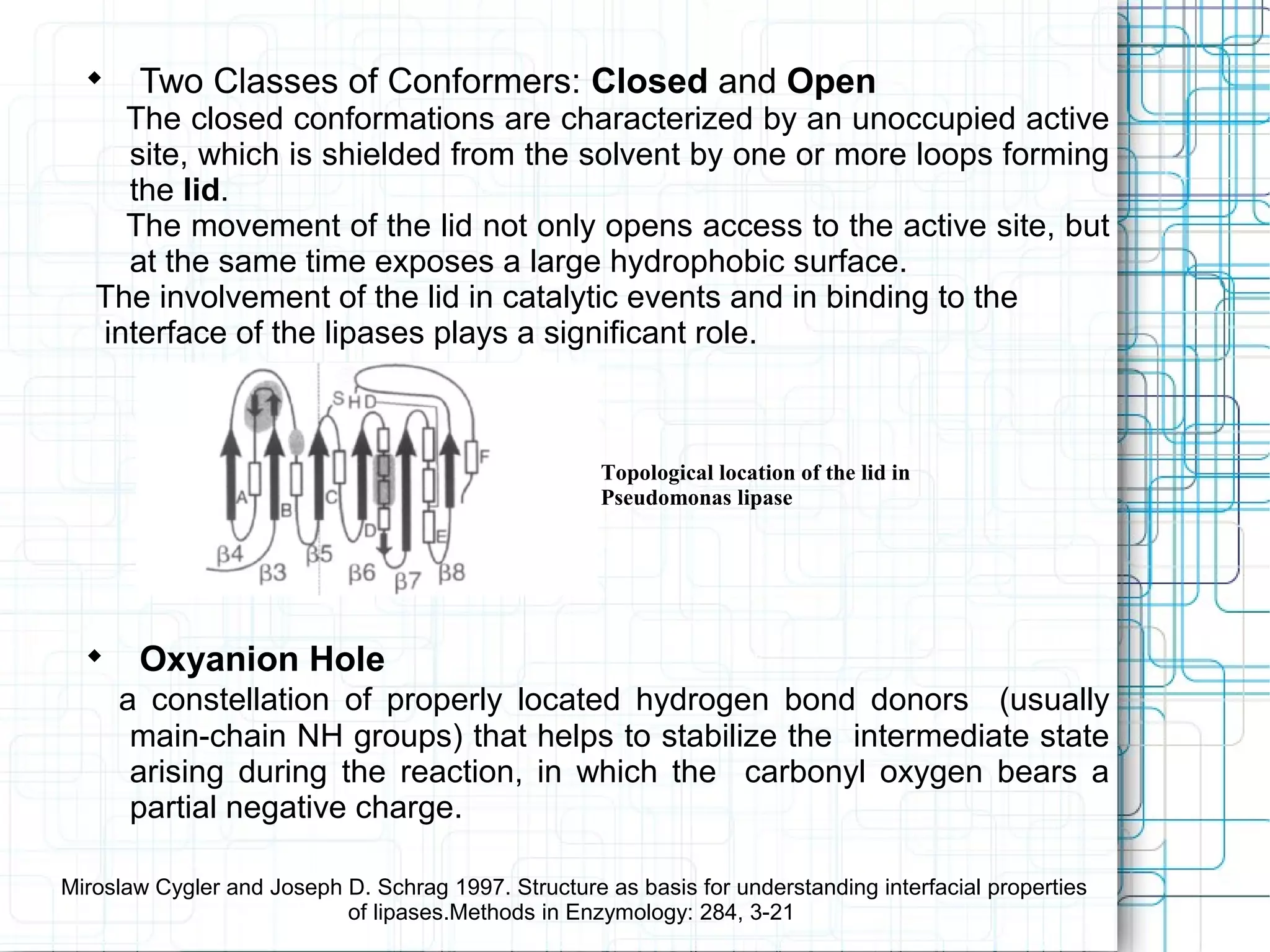
S after beta5,
H after beta8,
D/E after beta7
Common Lipase Fold
Miroslaw Cygler and Joseph D. Schrag 1997. Structure as basis for understanding interfacial properties
of lipases.Methods in Enzymology: 284, 3-21

Two Classes of Conformers: Closed and Open
The closed conformations are characterized by an unoccupied active
site, which is shielded from the solvent by one or more loops forming
the lid.
The movement of the lid not only opens access to the active site, but
at the same time exposes a large hydrophobic surface.
The involvement of the lid in catalytic events and in binding to the
interface of the lipases plays a significant role.

Oxyanion Hole
a constellation of properly located hydrogen bond donors (usually
main-chain NH groups) that helps to stabilize the intermediate state
arising during the reaction, in which the carbonyl oxygen bears a
partial negative charge.
Topological location of the lid in
Pseudomonas lipase
Miroslaw Cygler and Joseph D. Schrag 1997. Structure as basis for understanding interfacial properties
of lipases.Methods in Enzymology: 284, 3-21
Substrate-Binding Sites
Miroslaw Cygler and Joseph D. Schrag 1997. Structure as basis for understanding interfacial properties
of lipases.Methods in Enzymology: 284, 3-21
 indicates that the scissile fatty acyl chain
maintains a similar orientation and position
relative to the nucleophile elbow super
secondary structural element and serine-
histidine diad in all lipases.
This chain is held firmly near the hydrolyzed
bond.
Molecular Modeling and its Experimental Verification for the Catalytic Mechanism of
Candida antarctica Lipase B
Kwon et. al. (2007)
Objective: To study reaction mechanism and conformational preference of catalytic hydrolysis and
the esterification reaction by quantum mechanical and molecular dynamics simulation analysis.
Model System: CALB (Candida antarctica lipase B) with esters.
Summary: Using quantum mechanical analysis, the ping-pong bi-bi mechanism was applied and energies
and 3-dimensional binding configurations of the whole reaction pathways were calculated. Further
molecular dynamics simulation analysis was performed on the basis of the transition state obtained from
quantum mechanical study to observe the effect of structures of the substrates. Calculation results using
substrates of different chain length and chiral configurations were compared for conformational
preference.
Calculated results from molecular modeling studies have been compared qualitatively with the experimental
data using racemic mixtures of (±)-cis-4-acetamido-cyclopent-2-ene-1- ethyl acetate as substrates.
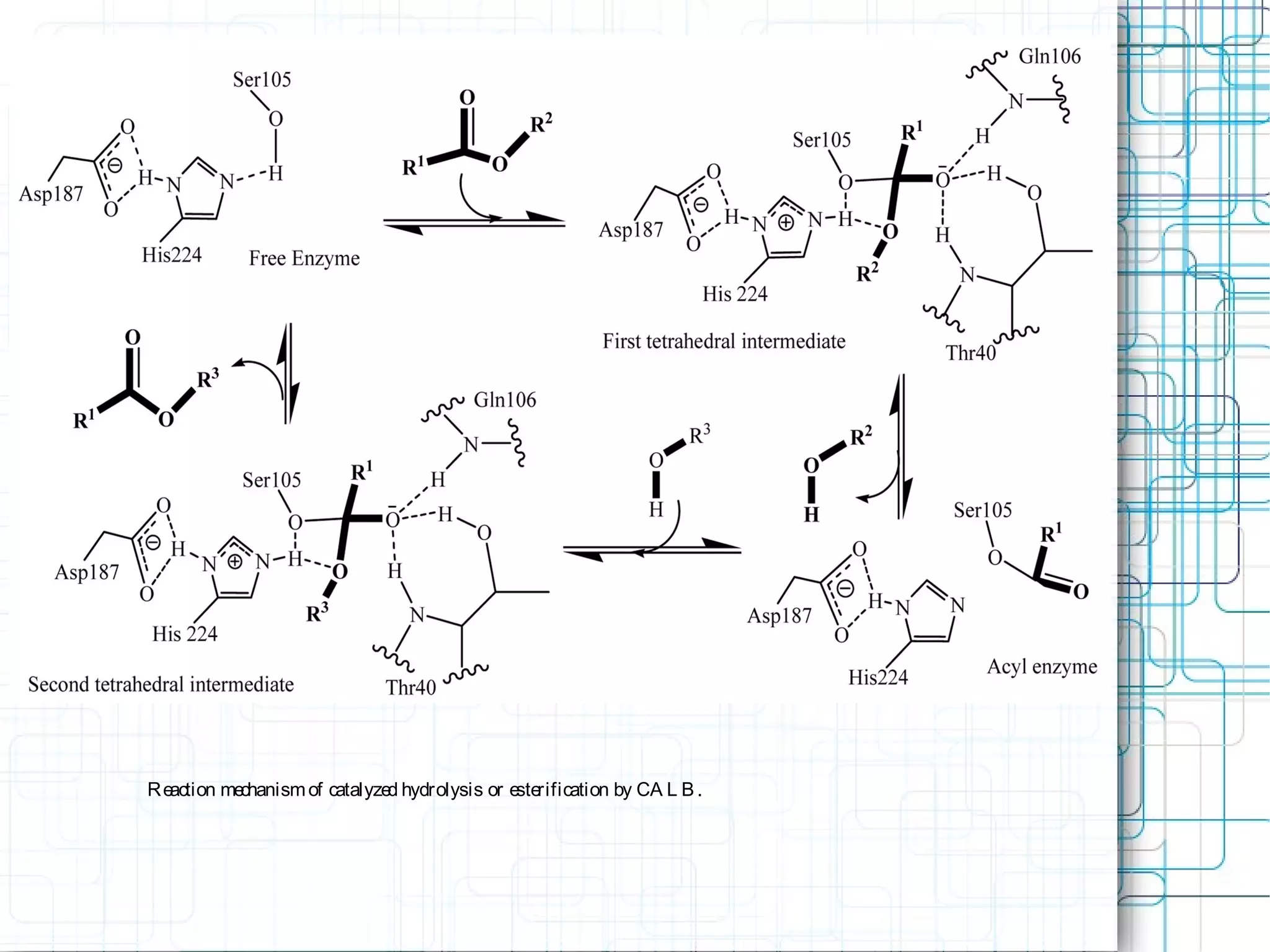
Ping-Pong Bi-Bi mechanism
Methodology:
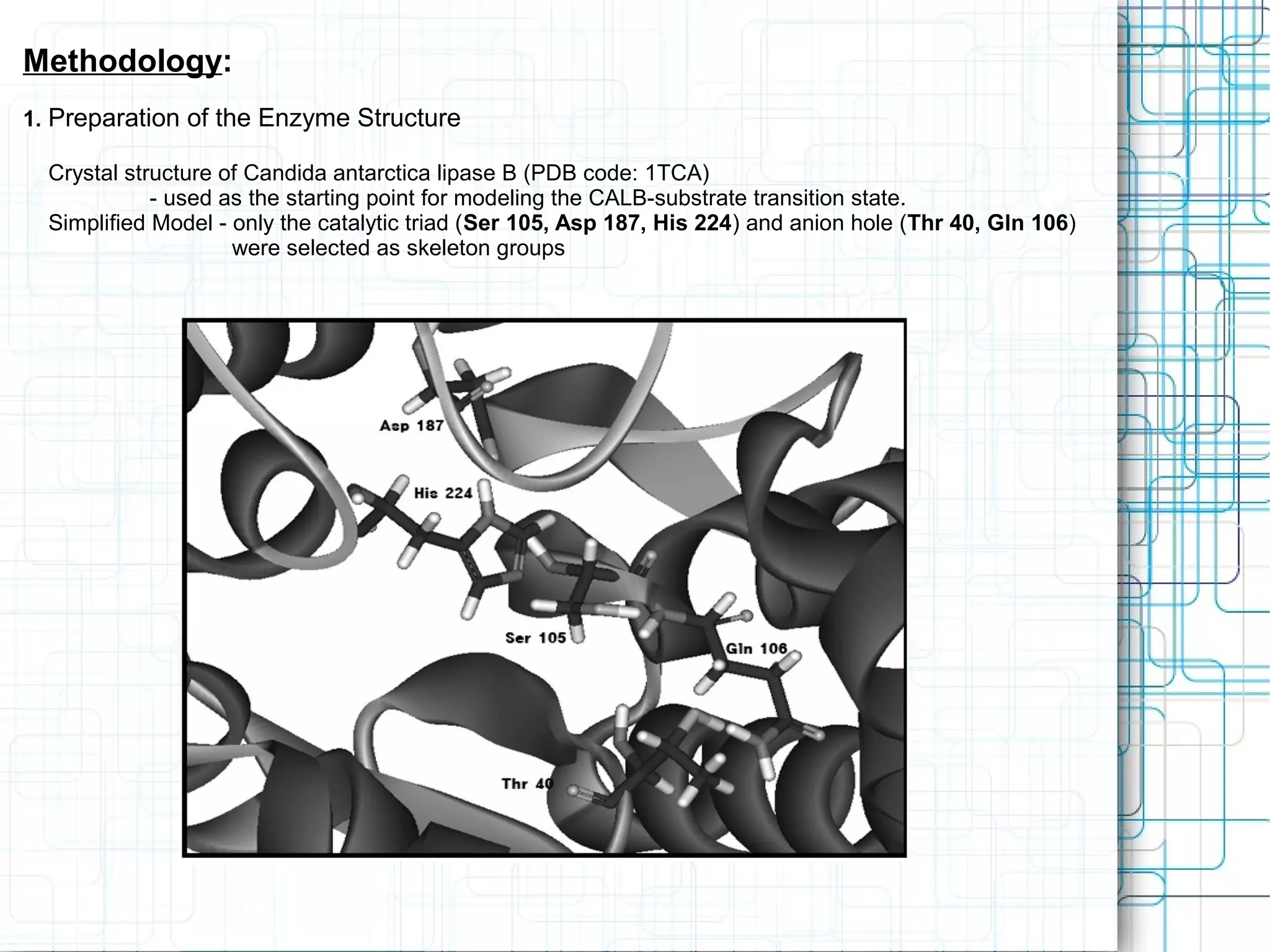
1. Preparation of the Enzyme Structure
Crystal structure of Candida antarctica lipase B (PDB code: 1TCA)
- used as the starting point for modeling the CALB-substrate transition state.
Simplified Model - only the catalytic triad (Ser 105, Asp 187, His 224) and anion hole (Thr 40, Gln 106)
were selected as skeleton groups
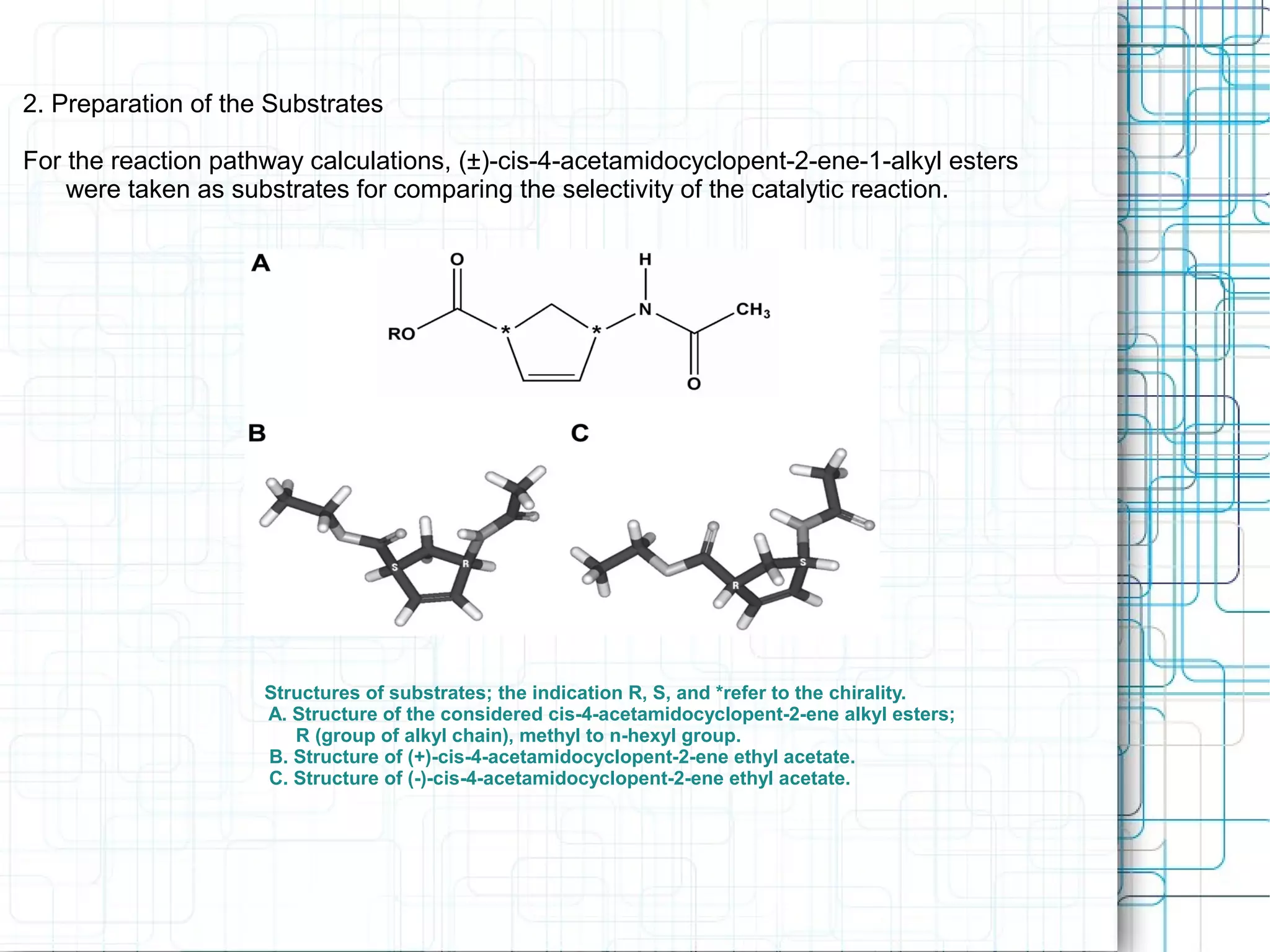
Structures of substrates; the indication R, S, and *refer to the chirality.
A. Structure of the considered cis-4-acetamidocyclopent-2-ene alkyl esters;
R (group of alkyl chain), methyl to n-hexyl group.
B. Structure of (+)-cis-4-acetamidocyclopent-2-ene ethyl acetate.
C. Structure of (-)-cis-4-acetamidocyclopent-2-ene ethyl acetate.
2. Preparation of the Substrates
For the reaction pathway calculations, (±)-cis-4-acetamidocyclopent-2-ene-1-alkyl esters
were taken as substrates for comparing the selectivity of the catalytic reaction.
3. Reaction Pathway Calculation: Quantum Mechanical Calculation Method
The semiempirical PM3 method has been used within the MOPAC 6.1 software package to
study the reaction pathway of the simplified model of the CALB enzyme catalyzed reaction.
4. Reaction Selectivity Calculation: Molecular Dynamic Simulation Method
The CHARMM force fields were used with Accerlys DS Modeling 1.1 software to perform MD
simulation of the simplified model system. During the simulations, the positions of non-hydrogen
atoms of active sites had been fixed, and positions of substrates and hydrogen atoms were
optimized for configurational energy.
The simulation process was divided into five steps:
a) The first minimization step (steepest descent method/500 times).
b) The second minimization step (adopted basis Newton Raphson method/ 500 times).
c) Heating (2,000 times, time step=0.001 ps).
d) Equilibrium (1,000 times, time step=0.001 ps).
e) MDNVT (3,000 times, time step=0.001 ps)
Reaction mechanismof catalyzed hydrolysis or esterification by CA L B.
Results:
A. Calculation of Complete Reaction Pathways
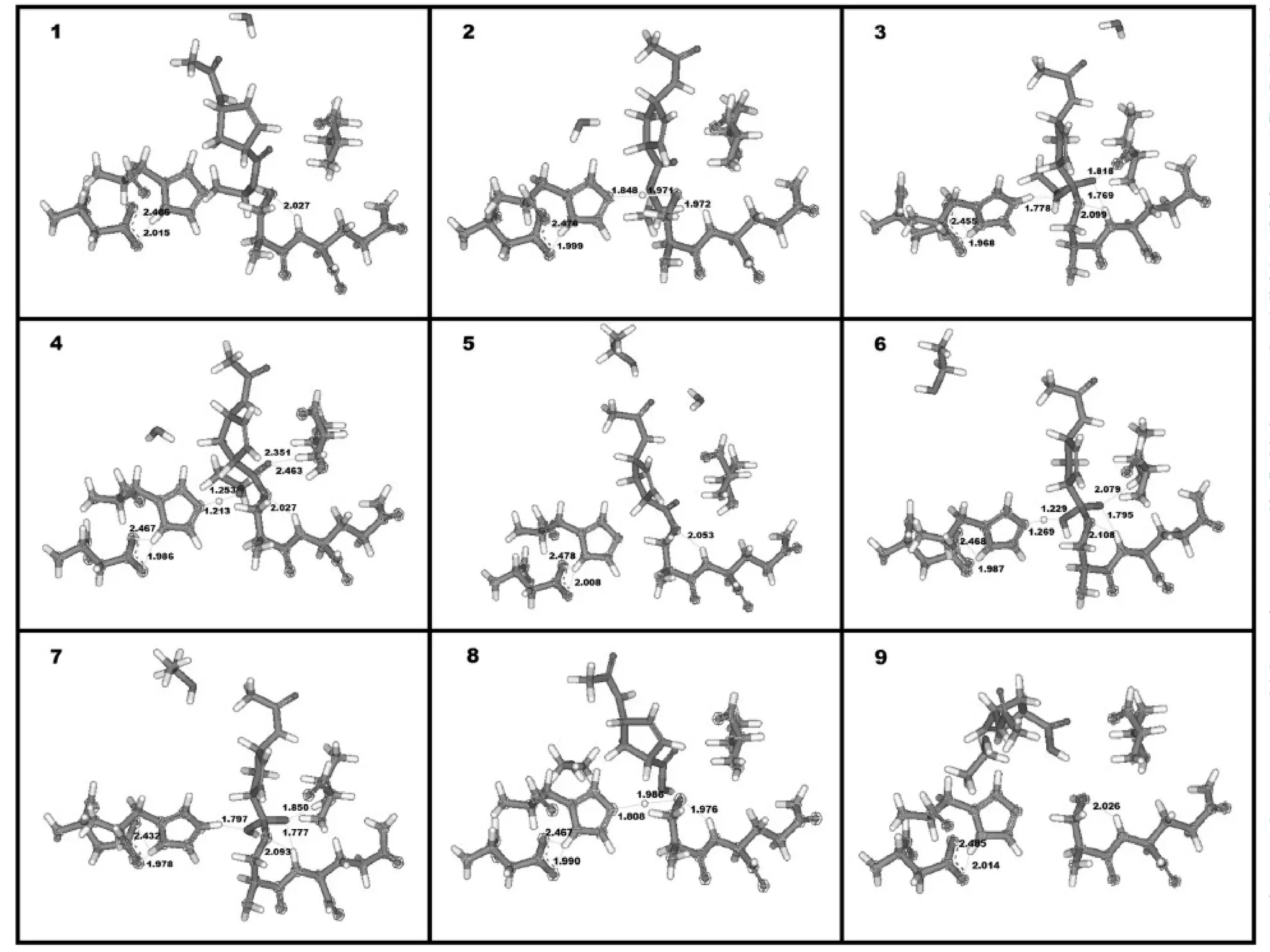
Conformational e nergies of CALBand e thyl este r c omplex.
T hereaction mechanismof theCA L B enzymeconsists of a total of 9 detailed steps, for which the
optimization and calculation of theminimization energy needs to beconsidered.
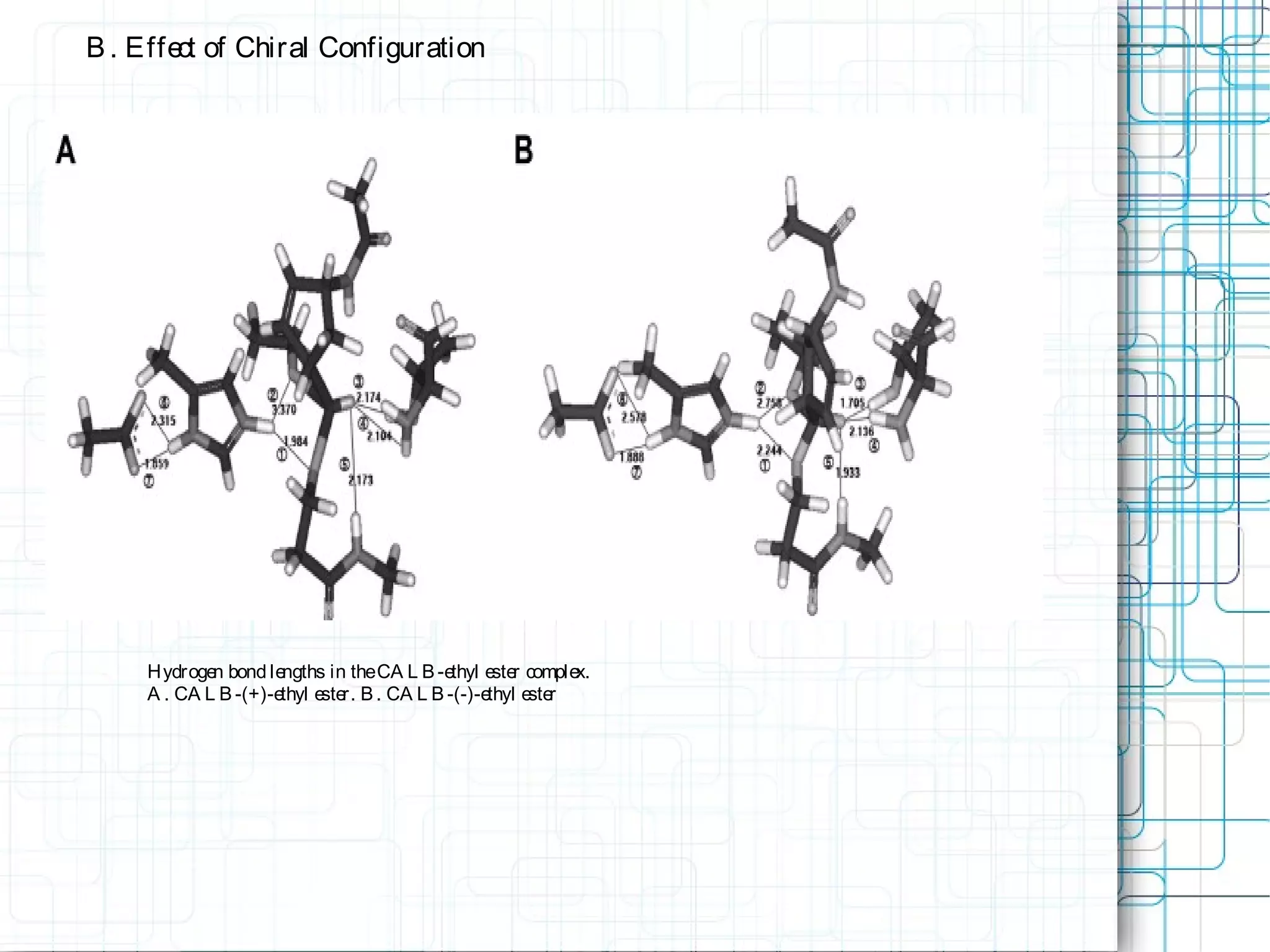
Hydrogen bond lengths in theCA L B-ethyl ester complex.
A . CA L B-(+)-ethyl ester. B . CA L B-(-)-ethyl ester
B . Effect of Chiral Configuration
C. Effect of Alkyl Chain Length of Substrates
T he enzyme-alkyl ester complexes were made by changing the alkyl group size (methyl to n-hexyl) of substrate on the CA L B
enzymeactivesite.
S imilar results about thehydrogen bond length regardless of whether thealkyl chain length was changed or not.
Questions

What is the proper orientation of the lipase
at the interface and how does it penetrates
into lipid bilayer.

How does lipid fits into the active site being
larger in size as compared to tunnel size.
This would help us predict about stereo-selectivity of lipases and
conformational rearrangement of the lid.

Lipases - Ester Hydrolysis

  • 1.
    Reaction Mechanism inCatalytic Ester Hydrolysis by Lipases Yuvraj Uboveja CCNSB
  • 2.
    LIPASES Lipases are water-solubleenzymes that catalyze the hydrolysis of ester bonds in triacylglycerols. Mol. Wt. - ~19kDa - ~60kDa ---> Belongs to alpha/beta hydrolase fold family ---> The active site, composed of a Ser-His-Asp/Glu catalytic triad. --- Interfacial activation phenomenon --- Through Conformational Rearrangement of Lid S after beta5, H after beta8, D/E after beta7 Common Lipase Fold Miroslaw Cygler and Joseph D. Schrag 1997. Structure as basis for understanding interfacial properties of lipases.Methods in Enzymology: 284, 3-21
  • 3.
     Two Classes ofConformers: Closed and Open The closed conformations are characterized by an unoccupied active site, which is shielded from the solvent by one or more loops forming the lid. The movement of the lid not only opens access to the active site, but at the same time exposes a large hydrophobic surface. The involvement of the lid in catalytic events and in binding to the interface of the lipases plays a significant role.  Oxyanion Hole a constellation of properly located hydrogen bond donors (usually main-chain NH groups) that helps to stabilize the intermediate state arising during the reaction, in which the carbonyl oxygen bears a partial negative charge. Topological location of the lid in Pseudomonas lipase Miroslaw Cygler and Joseph D. Schrag 1997. Structure as basis for understanding interfacial properties of lipases.Methods in Enzymology: 284, 3-21
  • 4.
    Substrate-Binding Sites Miroslaw Cyglerand Joseph D. Schrag 1997. Structure as basis for understanding interfacial properties of lipases.Methods in Enzymology: 284, 3-21  indicates that the scissile fatty acyl chain maintains a similar orientation and position relative to the nucleophile elbow super secondary structural element and serine- histidine diad in all lipases. This chain is held firmly near the hydrolyzed bond.
  • 5.
    Molecular Modeling andits Experimental Verification for the Catalytic Mechanism of Candida antarctica Lipase B Kwon et. al. (2007) Objective: To study reaction mechanism and conformational preference of catalytic hydrolysis and the esterification reaction by quantum mechanical and molecular dynamics simulation analysis. Model System: CALB (Candida antarctica lipase B) with esters. Summary: Using quantum mechanical analysis, the ping-pong bi-bi mechanism was applied and energies and 3-dimensional binding configurations of the whole reaction pathways were calculated. Further molecular dynamics simulation analysis was performed on the basis of the transition state obtained from quantum mechanical study to observe the effect of structures of the substrates. Calculation results using substrates of different chain length and chiral configurations were compared for conformational preference. Calculated results from molecular modeling studies have been compared qualitatively with the experimental data using racemic mixtures of (±)-cis-4-acetamido-cyclopent-2-ene-1- ethyl acetate as substrates. Ping-Pong Bi-Bi mechanism
  • 6.
    Methodology: 1. Preparation ofthe Enzyme Structure Crystal structure of Candida antarctica lipase B (PDB code: 1TCA) - used as the starting point for modeling the CALB-substrate transition state. Simplified Model - only the catalytic triad (Ser 105, Asp 187, His 224) and anion hole (Thr 40, Gln 106) were selected as skeleton groups
  • 7.
    Structures of substrates;the indication R, S, and *refer to the chirality. A. Structure of the considered cis-4-acetamidocyclopent-2-ene alkyl esters; R (group of alkyl chain), methyl to n-hexyl group. B. Structure of (+)-cis-4-acetamidocyclopent-2-ene ethyl acetate. C. Structure of (-)-cis-4-acetamidocyclopent-2-ene ethyl acetate. 2. Preparation of the Substrates For the reaction pathway calculations, (±)-cis-4-acetamidocyclopent-2-ene-1-alkyl esters were taken as substrates for comparing the selectivity of the catalytic reaction.
  • 8.
    3. Reaction PathwayCalculation: Quantum Mechanical Calculation Method The semiempirical PM3 method has been used within the MOPAC 6.1 software package to study the reaction pathway of the simplified model of the CALB enzyme catalyzed reaction. 4. Reaction Selectivity Calculation: Molecular Dynamic Simulation Method The CHARMM force fields were used with Accerlys DS Modeling 1.1 software to perform MD simulation of the simplified model system. During the simulations, the positions of non-hydrogen atoms of active sites had been fixed, and positions of substrates and hydrogen atoms were optimized for configurational energy. The simulation process was divided into five steps: a) The first minimization step (steepest descent method/500 times). b) The second minimization step (adopted basis Newton Raphson method/ 500 times). c) Heating (2,000 times, time step=0.001 ps). d) Equilibrium (1,000 times, time step=0.001 ps). e) MDNVT (3,000 times, time step=0.001 ps)
  • 9.
    Reaction mechanismof catalyzedhydrolysis or esterification by CA L B.
  • 10.
    Results: A. Calculation ofComplete Reaction Pathways Conformational e nergies of CALBand e thyl este r c omplex. T hereaction mechanismof theCA L B enzymeconsists of a total of 9 detailed steps, for which the optimization and calculation of theminimization energy needs to beconsidered.
  • 12.
    Hydrogen bond lengthsin theCA L B-ethyl ester complex. A . CA L B-(+)-ethyl ester. B . CA L B-(-)-ethyl ester B . Effect of Chiral Configuration
  • 14.
    C. Effect ofAlkyl Chain Length of Substrates T he enzyme-alkyl ester complexes were made by changing the alkyl group size (methyl to n-hexyl) of substrate on the CA L B enzymeactivesite. S imilar results about thehydrogen bond length regardless of whether thealkyl chain length was changed or not.
  • 15.
    Questions  What is theproper orientation of the lipase at the interface and how does it penetrates into lipid bilayer.  How does lipid fits into the active site being larger in size as compared to tunnel size. This would help us predict about stereo-selectivity of lipases and conformational rearrangement of the lid.