Chapter 33-1   Alternating Current Circuits AC Sources  Resistors in AC Circuits (R, RL, RC)  The RLC  Series Circuit Power in an AC  Circuit   Resonance in  a RLC  Series Circuit  Transformers and Power Transmission Rectifiers and Filters
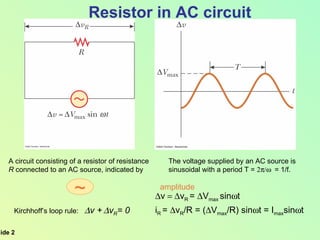
The voltage supplied by an AC source is  sinusoidal with a period T =   = 1/f. A circuit consisting of a resistor of resistance R  connected to an AC source, indicated by  Resistor in AC circuit  v  v R  =   V max  sin  t i R  =   v R /R = (  V max /R) sin  t = I max sin  t Kirchhoff’s loop rule:   v +    v R = 0   amplitude ~
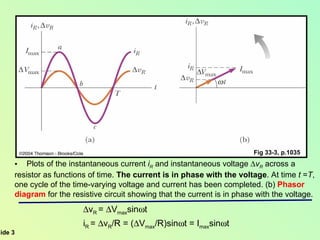
Fig 33-3, p.1035 Plots of the instantaneous current  i R   and instantaneous voltage   v R   across a  resistor as functions of time.  The current is in phase with the voltage . At time  t  = T ,  one cycle of the time-varying voltage and current has been completed. (b)  Phasor  diagram  for the resistive circuit showing that the current is in phase with the voltage.   v R  =   V max sin  t i R  =   v R /R = (  V max /R)sin  t = I max sin  t
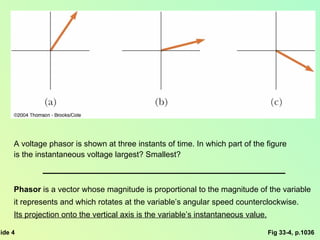
Fig 33-4, p.1036 A voltage phasor is shown at three instants of time. In which part of the figure  is the instantaneous voltage largest? Smallest? Phasor  is a vector whose magnitude is proportional to the magnitude of the variable it represents and which rotates at the variable’s angular speed counterclockwise.  Its projection onto the vertical axis is the variable’s instantaneous value.
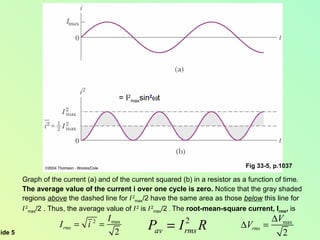
Fig 33-5, p.1037 Graph of the current (a) and of the current squared (b) in a resistor as a function of time.  The average value of the current i over one cycle is zero.  Notice that the gray shaded  regions  above   the dashed line for  I   2 max /2 have the same area as those  below   this line for  I   2 max /2 . Thus, the average value of  I   2  is  I   2 max /2  .  The  root-mean-square   current, I rms ,  is = I 2 max sin 2  t
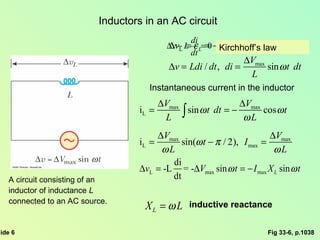
Fig 33-6, p.1038 A circuit consisting of an  inductor of inductance  L  connected to an AC source. inductive reactance Inductors in an AC circuit Kirchhoff’s law Instantaneous current in the inductor
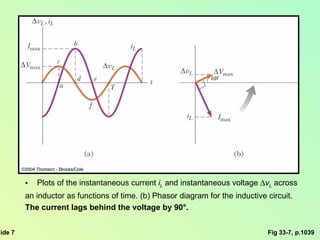
Fig 33-7, p.1039 Plots of the instantaneous current  i L   and instantaneous voltage   v L   across  an inductor as functions of time. (b) Phasor diagram for the inductive circuit.  The current lags behind the voltage by 90°.
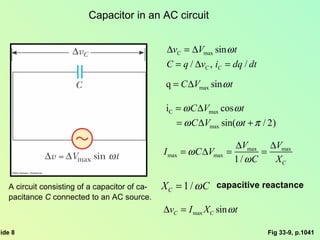
Fig 33-9, p.1041 A circuit consisting of a capacitor of ca- pacitance  C  connected to an AC source.   capacitive reactance Capacitor in an AC circuit
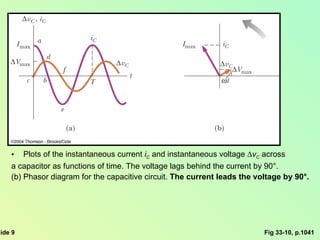
Fig 33-10, p.1041 Plots of the instantaneous current  i C   and instantaneous voltage   v C   across  a capacitor as functions of time. The voltage lags behind the current by 90°.  (b) Phasor diagram for the capacitive circuit.  The current leads the voltage by 90°.
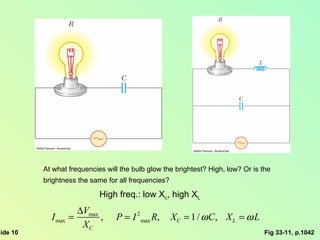
Fig 33-11, p.1042 At what frequencies will the bulb glow the brightest? High, low? Or is the  brightness the same for all frequencies?  High freq.: low X c , high X L
 
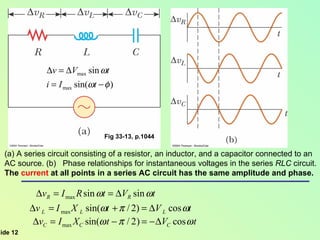
Fig 33-13, p.1044 A series circuit consisting of a resistor, an inductor, and a capacitor connected to an  AC source. (b)  Phase relationships for instantaneous voltages in the series  RLC  circuit. The  current  at all points in a series AC circuit has the same amplitude and phase.
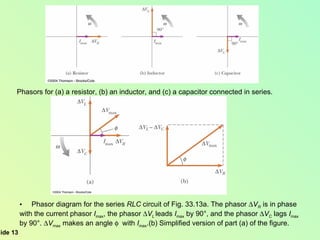
Phasors for (a) a resistor, (b) an inductor, and (c) a capacitor connected in series.  Phasor diagram for the series  RLC  circuit of Fig. 33.13a. The phasor   V R   is in phase  with the current phasor  I max , the phasor   V L  leads  I max  by 90°, and the phasor   V C   lags  I max   by 90°.   V max  makes an angle     with  I max .(b) Simplified version of part (a) of the figure.
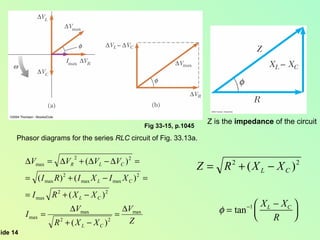
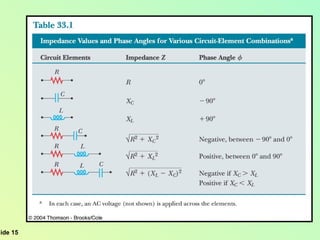
Fig 33-15, p.1045 Phasor diagrams for the series  RLC  circuit of Fig. 33.13a.  Z is the  impedance  of the circuit
 
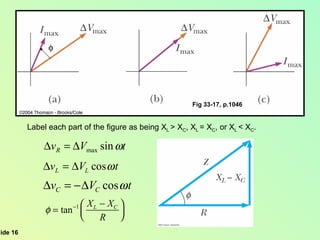
Fig 33-17, p.1046 Label each part of the figure as being X L  > X C , X L  = X C , or X L  < X C .  
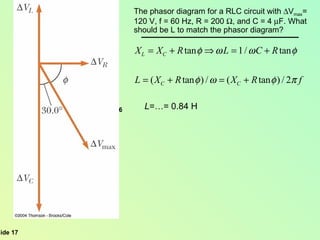
Fig 33-18, p.1046 The phasor diagram for a RLC circuit with   V max = 120 V, f = 60 Hz, R = 200   , and C = 4   F. What should be L to match the phasor diagram? L =…= 0.84 H
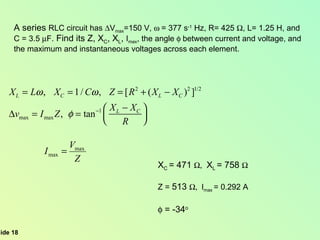
A series  RLC circuit has   V max =150 V,   = 377 s -1  Hz, R= 425   , L= 1.25 H, and  C = 3.5   F.  Find its Z, X C , X L ,  I max , the angle   between current and voltage, and  the maximum and instantaneous voltages across each element. X C  = 471    X L  = 758   Z =  513   I max  = 0.292 A  = -34 o
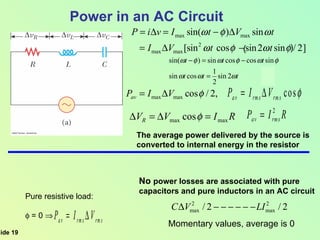
Power in an AC Circuit The average power delivered by the source is  converted to internal energy in the resistor Pure resistive load:   = 0     No   power losses are associated with pure  capacitors and pure inductors in an AC circuit  ( ) Momentary values, average is 0
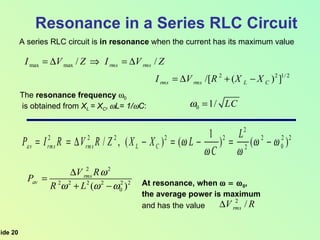
Resonance in a Series RLC Circuit A series RLC circuit is  in resonance  when the current has its maximum value The  resonance   frequency   0 is obtained from  X L  = X C ,    L= 1/  C : At resonance, when   0 ,  the average power is maximum and has the value
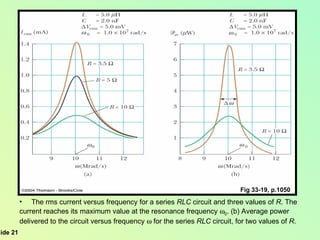
Fig 33-19, p.1050 The rms current versus frequency for a series  RLC  circuit and three values of  R . The current reaches its maximum value at the resonance frequency   0 . (b) Average power delivered to the circuit versus frequency    for the series  RLC  circuit, for two values of  R .
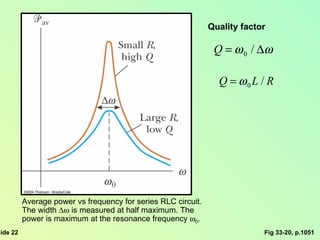
Fig 33-20, p.1051 Quality factor Average power vs frequency for series RLC circuit. The width    is measured at half maximum. The  power is maximum at the resonance frequency   0 .
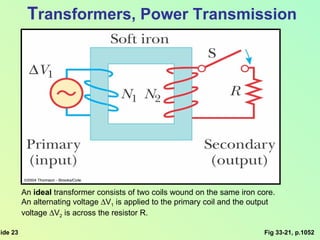
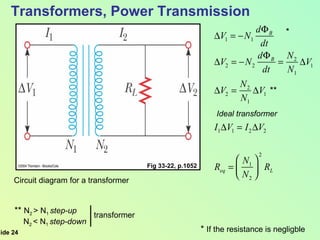
Fig 33-21, p.1052 An  ideal  transformer consists of two coils wound on the same iron core.  An alternating voltage   V 1  is applied to the primary coil and the output voltage   V 2  is across the resistor R. T ransformers, Power Transmission
Fig 33-22, p.1052 Circuit diagram for a transformer ** **  N 2  > N 1  step-up N 2  < N 1  step-down transformer Transformers, Power Transmission Ideal transformer * *  If the resistance is negligble
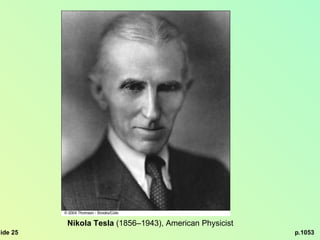
p.1053 Nikola Tesla  (1856–1943), American Physicist
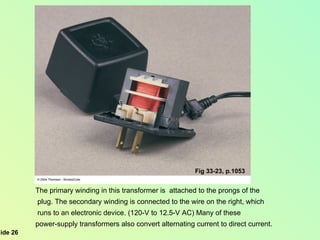
Fig 33-23, p.1053 The primary winding in this transformer is  attached to the prongs of the plug. The secondary winding is connected to the wire on the right, which runs to an electronic device. (120-V to 12.5-V AC) Many of these  power-supply transformers also convert alternating current to direct current.
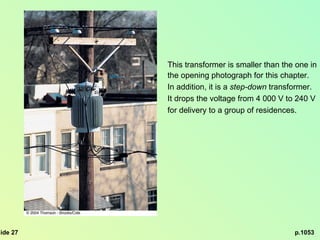
p.1053 This transformer is smaller than the one in the opening photograph for this chapter. In addition, it is a  step-down  transformer. It drops the voltage from 4 000 V to 240 V for delivery to a group of residences.
Summary Alternating Current Circuits AC Sources  Resistors in AC Circuits (R, RL, RC)  The RLC  Series Circuit Power in an AC  Circuit  Resonance in  a RLC  Series Circuit  Transformers and Power Transmission

AC electricity

  • 1.
    Chapter 33-1 Alternating Current Circuits AC Sources Resistors in AC Circuits (R, RL, RC) The RLC Series Circuit Power in an AC Circuit Resonance in a RLC Series Circuit Transformers and Power Transmission Rectifiers and Filters
  • 2.
    The voltage suppliedby an AC source is sinusoidal with a period T =  = 1/f. A circuit consisting of a resistor of resistance R connected to an AC source, indicated by Resistor in AC circuit  v  v R =  V max sin  t i R =  v R /R = (  V max /R) sin  t = I max sin  t Kirchhoff’s loop rule:  v +  v R = 0 amplitude ~
  • 3.
    Fig 33-3, p.1035Plots of the instantaneous current i R and instantaneous voltage  v R across a resistor as functions of time. The current is in phase with the voltage . At time t = T , one cycle of the time-varying voltage and current has been completed. (b) Phasor diagram for the resistive circuit showing that the current is in phase with the voltage.  v R =  V max sin  t i R =  v R /R = (  V max /R)sin  t = I max sin  t
  • 4.
    Fig 33-4, p.1036A voltage phasor is shown at three instants of time. In which part of the figure is the instantaneous voltage largest? Smallest? Phasor is a vector whose magnitude is proportional to the magnitude of the variable it represents and which rotates at the variable’s angular speed counterclockwise. Its projection onto the vertical axis is the variable’s instantaneous value.
  • 5.
    Fig 33-5, p.1037Graph of the current (a) and of the current squared (b) in a resistor as a function of time. The average value of the current i over one cycle is zero. Notice that the gray shaded regions above the dashed line for I 2 max /2 have the same area as those below this line for I 2 max /2 . Thus, the average value of I 2 is I 2 max /2 . The root-mean-square current, I rms , is = I 2 max sin 2  t
  • 6.
    Fig 33-6, p.1038A circuit consisting of an inductor of inductance L connected to an AC source. inductive reactance Inductors in an AC circuit Kirchhoff’s law Instantaneous current in the inductor
  • 7.
    Fig 33-7, p.1039Plots of the instantaneous current i L and instantaneous voltage  v L across an inductor as functions of time. (b) Phasor diagram for the inductive circuit. The current lags behind the voltage by 90°.
  • 8.
    Fig 33-9, p.1041A circuit consisting of a capacitor of ca- pacitance C connected to an AC source. capacitive reactance Capacitor in an AC circuit
  • 9.
    Fig 33-10, p.1041Plots of the instantaneous current i C and instantaneous voltage  v C across a capacitor as functions of time. The voltage lags behind the current by 90°. (b) Phasor diagram for the capacitive circuit. The current leads the voltage by 90°.
  • 10.
    Fig 33-11, p.1042At what frequencies will the bulb glow the brightest? High, low? Or is the brightness the same for all frequencies? High freq.: low X c , high X L
  • 11.
  • 12.
    Fig 33-13, p.1044A series circuit consisting of a resistor, an inductor, and a capacitor connected to an AC source. (b) Phase relationships for instantaneous voltages in the series RLC circuit. The current at all points in a series AC circuit has the same amplitude and phase.
  • 13.
    Phasors for (a)a resistor, (b) an inductor, and (c) a capacitor connected in series. Phasor diagram for the series RLC circuit of Fig. 33.13a. The phasor  V R is in phase with the current phasor I max , the phasor  V L leads I max by 90°, and the phasor  V C lags I max by 90°.  V max makes an angle  with I max .(b) Simplified version of part (a) of the figure.
  • 14.
    Fig 33-15, p.1045Phasor diagrams for the series RLC circuit of Fig. 33.13a. Z is the impedance of the circuit
  • 15.
  • 16.
    Fig 33-17, p.1046Label each part of the figure as being X L > X C , X L = X C , or X L < X C . 
  • 17.
    Fig 33-18, p.1046The phasor diagram for a RLC circuit with  V max = 120 V, f = 60 Hz, R = 200  , and C = 4  F. What should be L to match the phasor diagram? L =…= 0.84 H
  • 18.
    A series RLC circuit has  V max =150 V,  = 377 s -1 Hz, R= 425  , L= 1.25 H, and C = 3.5  F. Find its Z, X C , X L , I max , the angle  between current and voltage, and the maximum and instantaneous voltages across each element. X C = 471  X L = 758  Z = 513  I max = 0.292 A  = -34 o
  • 19.
    Power in anAC Circuit The average power delivered by the source is converted to internal energy in the resistor Pure resistive load:  = 0  No power losses are associated with pure capacitors and pure inductors in an AC circuit ( ) Momentary values, average is 0
  • 20.
    Resonance in aSeries RLC Circuit A series RLC circuit is in resonance when the current has its maximum value The resonance frequency  0 is obtained from X L = X C ,  L= 1/  C : At resonance, when  0 , the average power is maximum and has the value
  • 21.
    Fig 33-19, p.1050The rms current versus frequency for a series RLC circuit and three values of R . The current reaches its maximum value at the resonance frequency  0 . (b) Average power delivered to the circuit versus frequency  for the series RLC circuit, for two values of R .
  • 22.
    Fig 33-20, p.1051Quality factor Average power vs frequency for series RLC circuit. The width  is measured at half maximum. The power is maximum at the resonance frequency  0 .
  • 23.
    Fig 33-21, p.1052An ideal transformer consists of two coils wound on the same iron core. An alternating voltage  V 1 is applied to the primary coil and the output voltage  V 2 is across the resistor R. T ransformers, Power Transmission
  • 24.
    Fig 33-22, p.1052Circuit diagram for a transformer ** ** N 2 > N 1 step-up N 2 < N 1 step-down transformer Transformers, Power Transmission Ideal transformer * * If the resistance is negligble
  • 25.
    p.1053 Nikola Tesla (1856–1943), American Physicist
  • 26.
    Fig 33-23, p.1053The primary winding in this transformer is attached to the prongs of the plug. The secondary winding is connected to the wire on the right, which runs to an electronic device. (120-V to 12.5-V AC) Many of these power-supply transformers also convert alternating current to direct current.
  • 27.
    p.1053 This transformeris smaller than the one in the opening photograph for this chapter. In addition, it is a step-down transformer. It drops the voltage from 4 000 V to 240 V for delivery to a group of residences.
  • 28.
    Summary Alternating CurrentCircuits AC Sources Resistors in AC Circuits (R, RL, RC) The RLC Series Circuit Power in an AC Circuit Resonance in a RLC Series Circuit Transformers and Power Transmission