Chapter 33
Alternating Current Circuits
Electrical appliances in the house use alternating current (AC) circuits.
If an AC source applies an alternating voltage to a series circuit containing
resistor, inductor, and capacitor, what are the amplitude and time characteristics
of the alternating current.
Other devices will be discussed
 Transformers
 Power transmission
 Electrical filters
Introduction
AC Circuits
An AC circuit consists of a combination of circuit elements and a power source.
The power source provides an alternating voltage, Dv.
Notation note:
 Lower case symbols will indicate instantaneous values.
 Capital letters will indicate fixed values.
Section 33.1
AC Voltage
The output of an AC power source is sinusoidal and varies with time according to
the following equation:
 Δv = ΔVmax sin ωt
 Δv is the instantaneous voltage.
 ΔVmax is the maximum output voltage of the source.
 Also called the voltage amplitude
 ω is the angular frequency of the AC voltage.
Section 33.1
AC Voltage, cont.
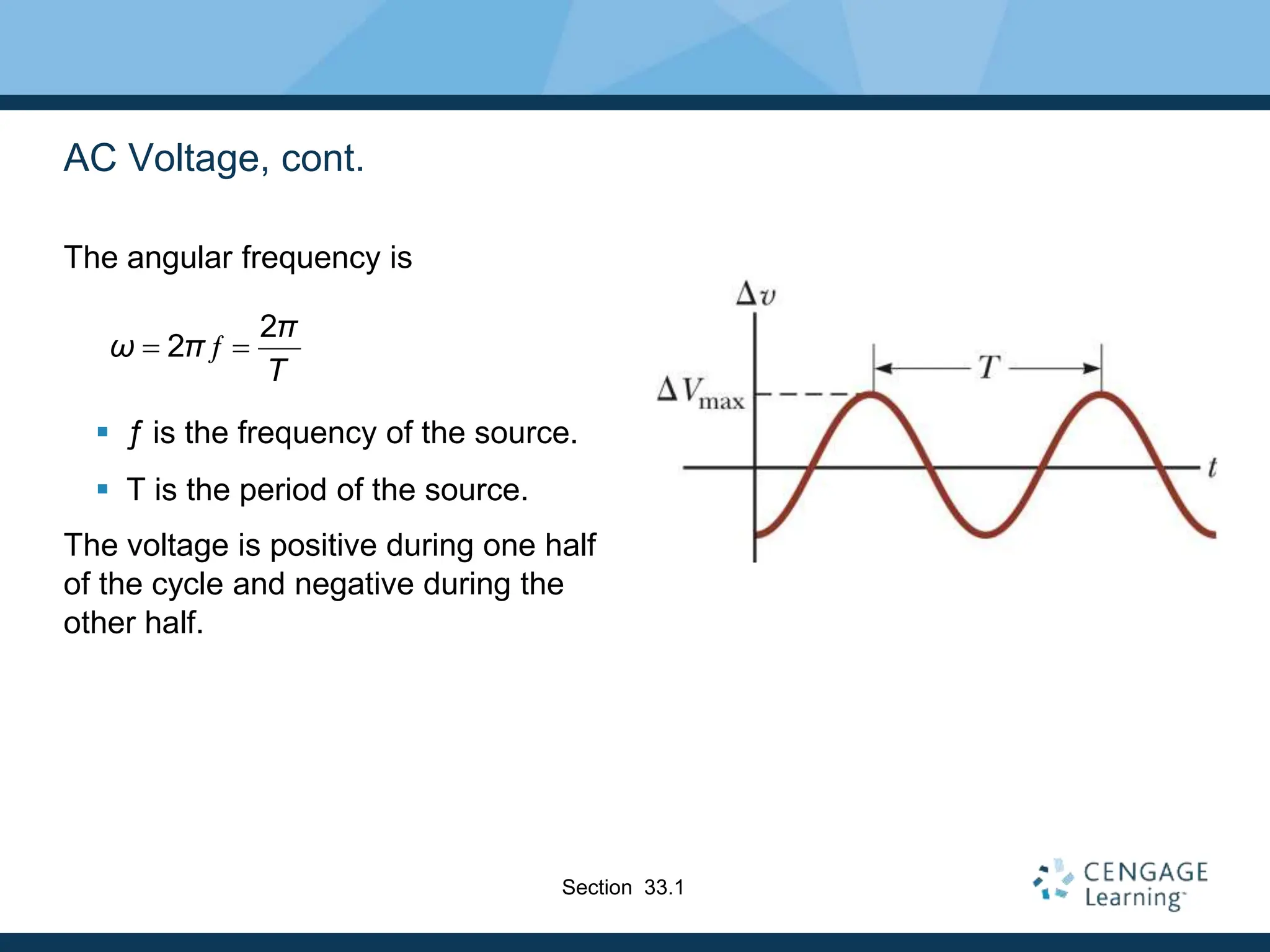
The angular frequency is
 ƒ is the frequency of the source.
 T is the period of the source.
The voltage is positive during one half
of the cycle and negative during the
other half.
2
2 ƒ
π
ω π
T
 
Section 33.1
AC Voltage, final
The current in any circuit driven by an AC source is an alternating current that
varies sinusoidally with time.
Commercial electric power plants in the US use a frequency of 60 Hz.
 This corresponds with an angular frequency of 377 rad/s.
Section 33.1
Resistors in an AC Circuit
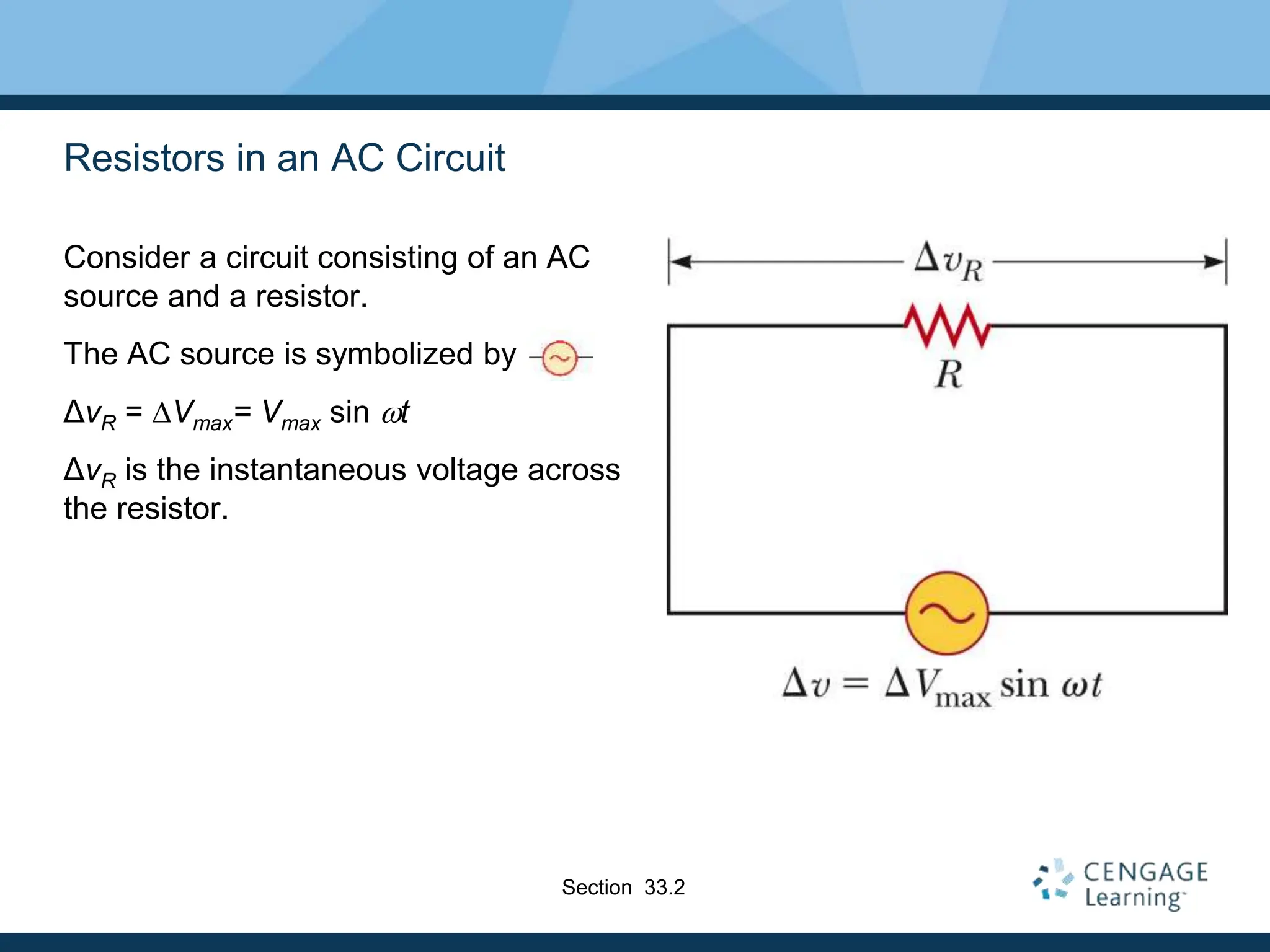
Consider a circuit consisting of an AC
source and a resistor.
The AC source is symbolized by
ΔvR = DVmax= Vmax sin wt
ΔvR is the instantaneous voltage across
the resistor.
Section 33.2
Resistors in an AC Circuit, cont.
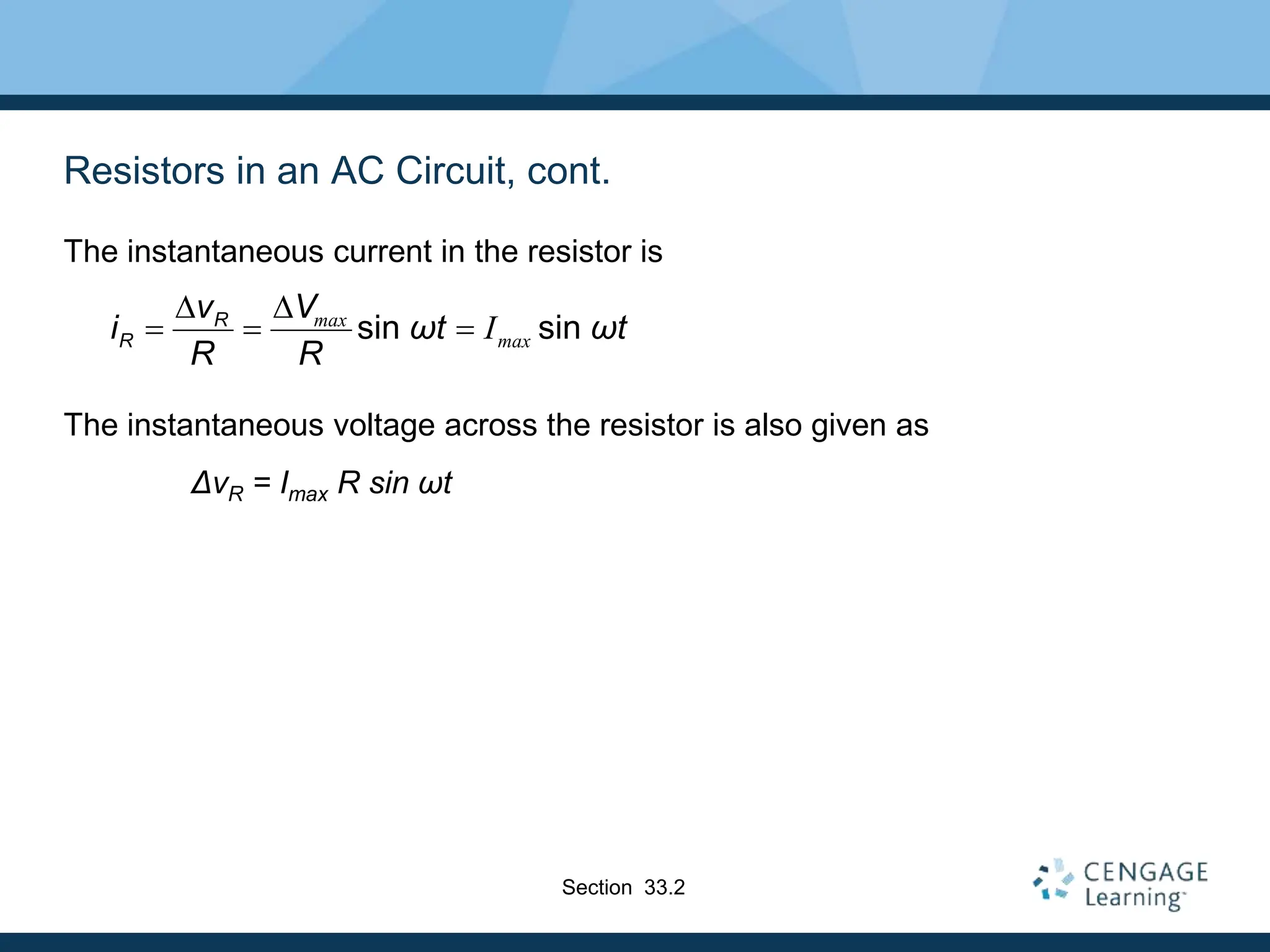
The instantaneous current in the resistor is
The instantaneous voltage across the resistor is also given as
ΔvR = Imax R sin ωt
sin sin
max
max
I
R
R
v V
i ωt ωt
R R
D D
  
Section 33.2
Resistors in an AC Circuit, final
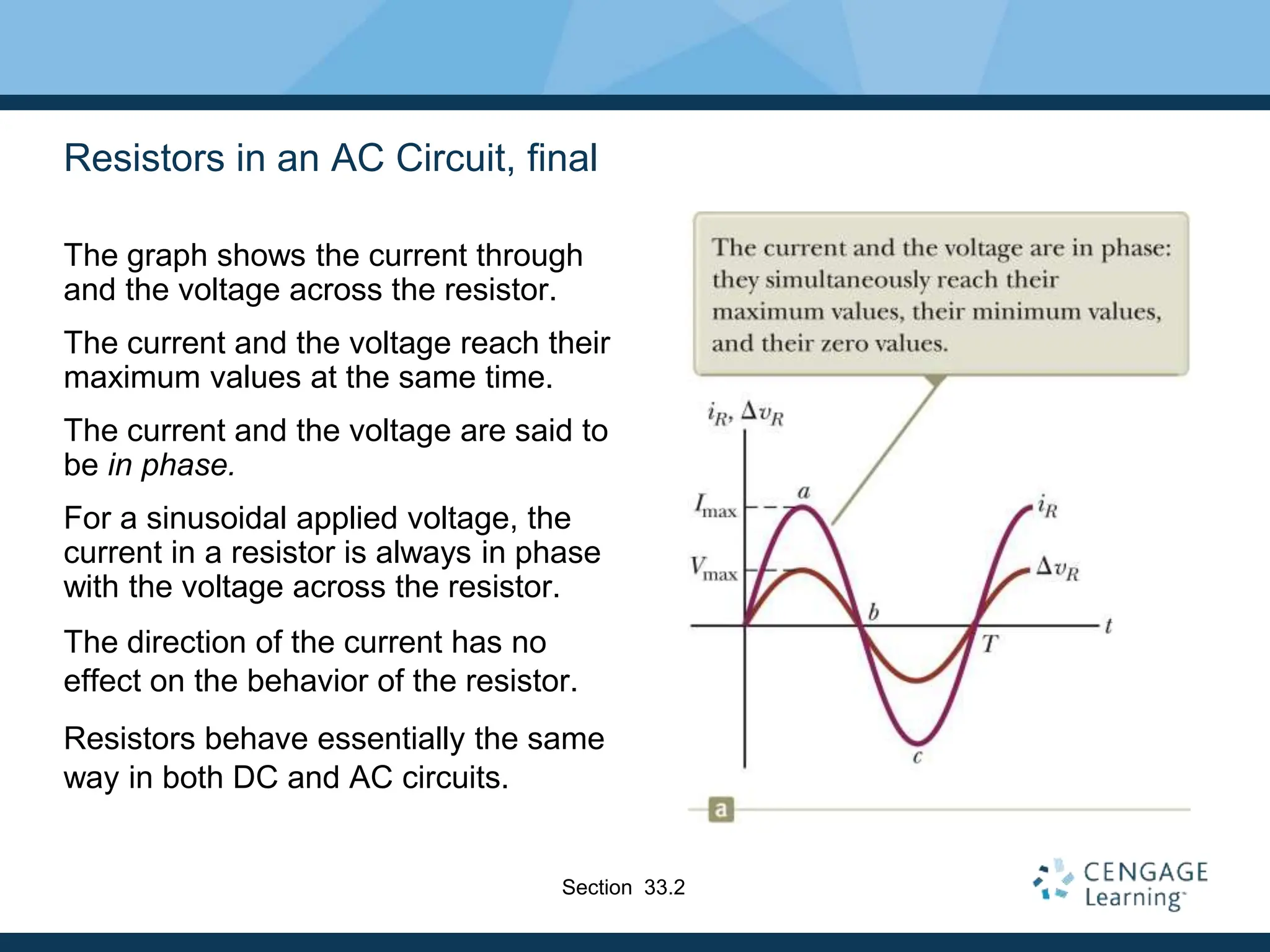
The graph shows the current through
and the voltage across the resistor.
The current and the voltage reach their
maximum values at the same time.
The current and the voltage are said to
be in phase.
For a sinusoidal applied voltage, the
current in a resistor is always in phase
with the voltage across the resistor.
The direction of the current has no
effect on the behavior of the resistor.
Resistors behave essentially the same
way in both DC and AC circuits.
Section 33.2
Phasor Diagram
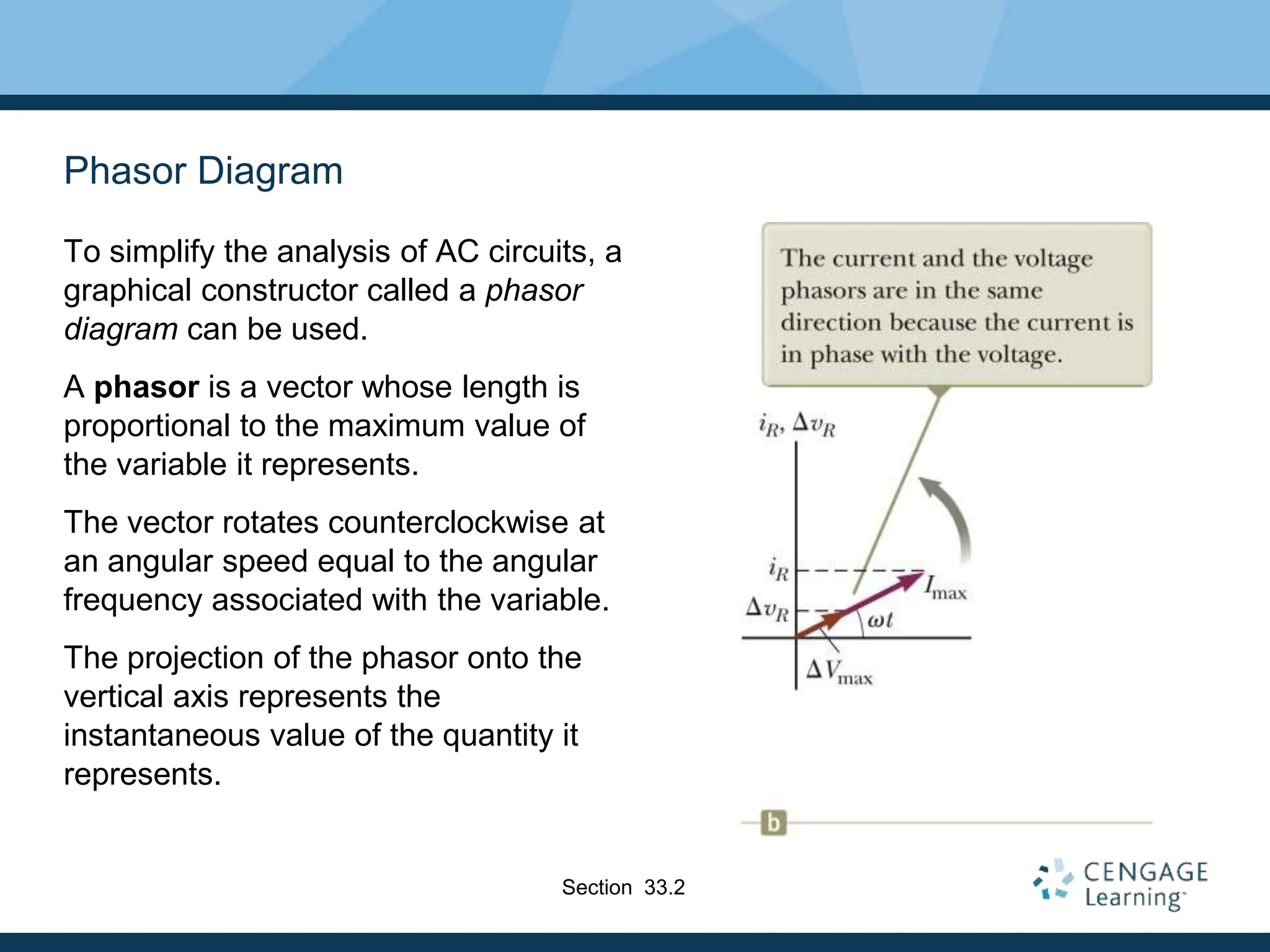
To simplify the analysis of AC circuits, a
graphical constructor called a phasor
diagram can be used.
A phasor is a vector whose length is
proportional to the maximum value of
the variable it represents.
The vector rotates counterclockwise at
an angular speed equal to the angular
frequency associated with the variable.
The projection of the phasor onto the
vertical axis represents the
instantaneous value of the quantity it
represents.
Section 33.2
A Phasor is Like a Graph
An alternating voltage can be presented in different representations.
One graphical representation is using rectangular coordinates.
 The voltage is on the vertical axis.
 Time is on the horizontal axis.
The phase space in which the phasor is drawn is similar to polar coordinate
graph paper.
 The radial coordinate represents the amplitude of the voltage.
 The angular coordinate is the phase angle.
 The vertical axis coordinate of the tip of the phasor represents the
instantaneous value of the voltage.
 The horizontal coordinate does not represent anything.
Alternating currents can also be represented by phasors.
Section 33.2
rms Current and Voltage
The average current in one cycle is zero.
Resistors experience a temperature increase which depends on the magnitude of
the current, but not the direction of the current.
The power is related to the square of the current.
The rms current is the average of importance in an AC circuit.
 rms stands for root mean square
Alternating voltages can also be discussed in terms of rms values.
0 707
2
max
rms max
I
I . I
 
0707
2
max
max
.
rms
V
V V
D
D   D
Section 33.2
Power
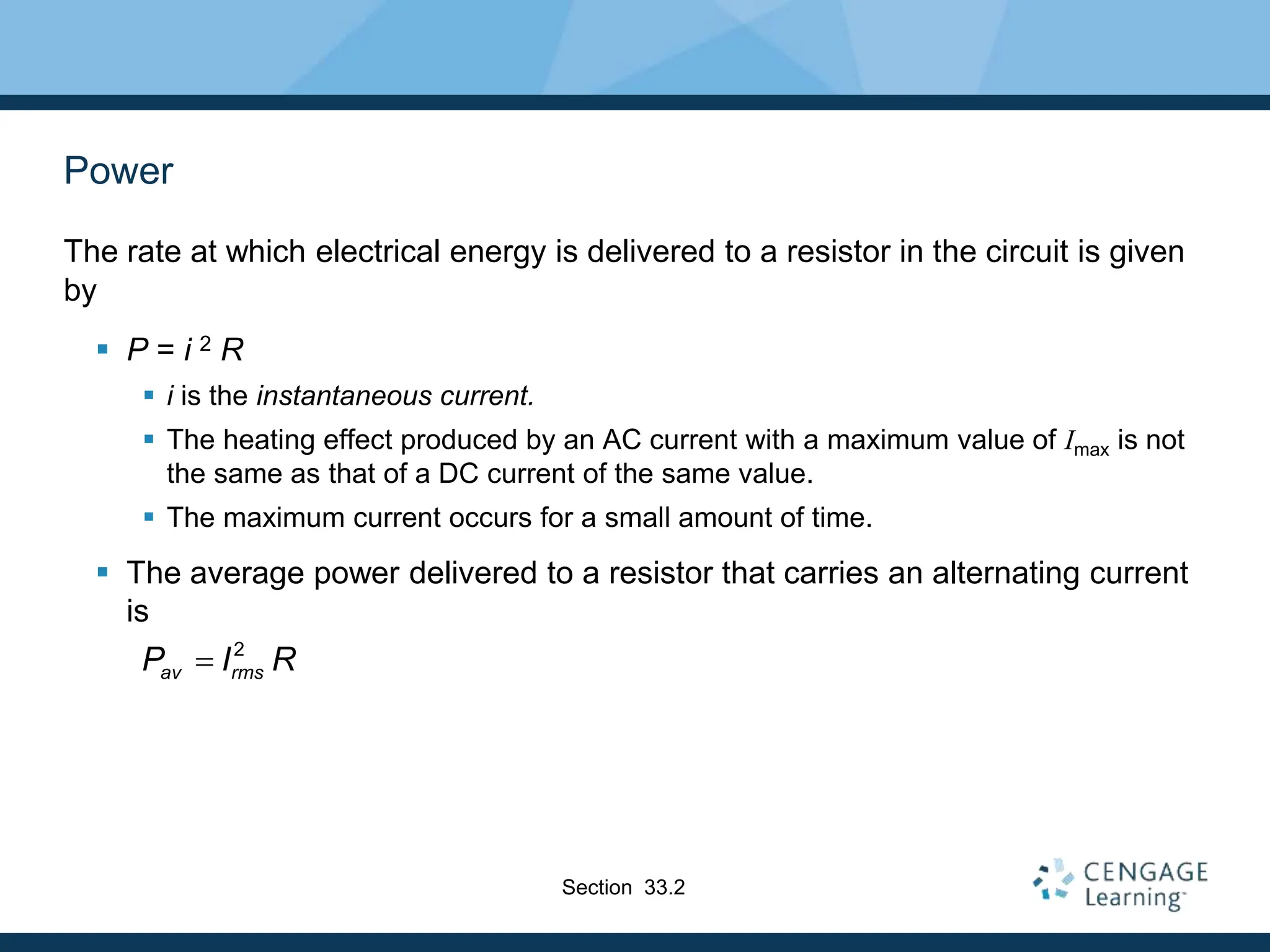
The rate at which electrical energy is delivered to a resistor in the circuit is given
by
 P = i 2 R
 i is the instantaneous current.
 The heating effect produced by an AC current with a maximum value of Imax is not
the same as that of a DC current of the same value.
 The maximum current occurs for a small amount of time.
 The average power delivered to a resistor that carries an alternating current
is
Section 33.2
2
av rms
P I R

Notes About rms Values
rms values are used when discussing alternating currents and voltages because
 AC ammeters and voltmeters are designed to read rms values.
 Many of the equations that will be used have the same form as their DC
counterparts.
Section 33.2
Inductors in an AC Circuit
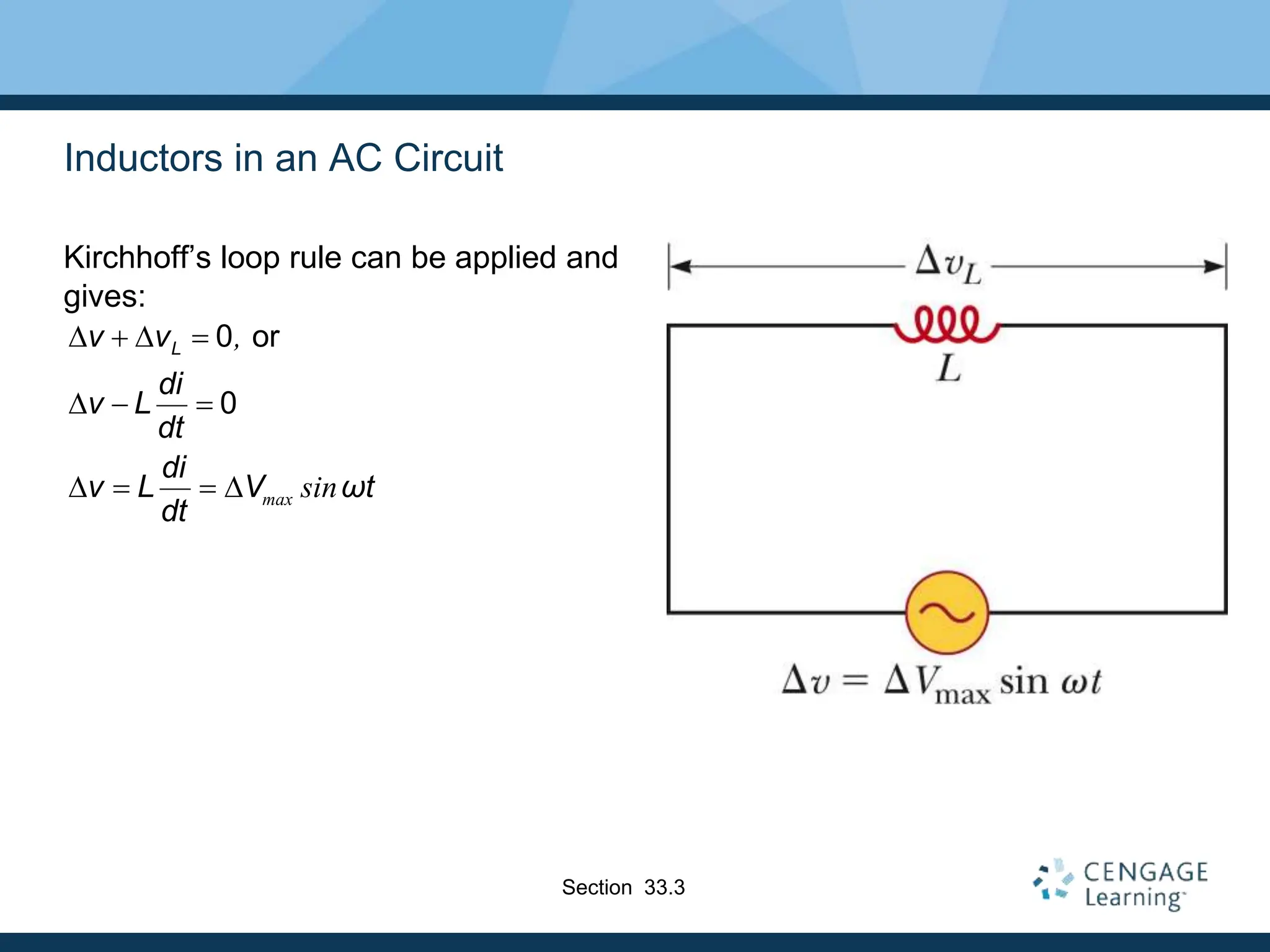
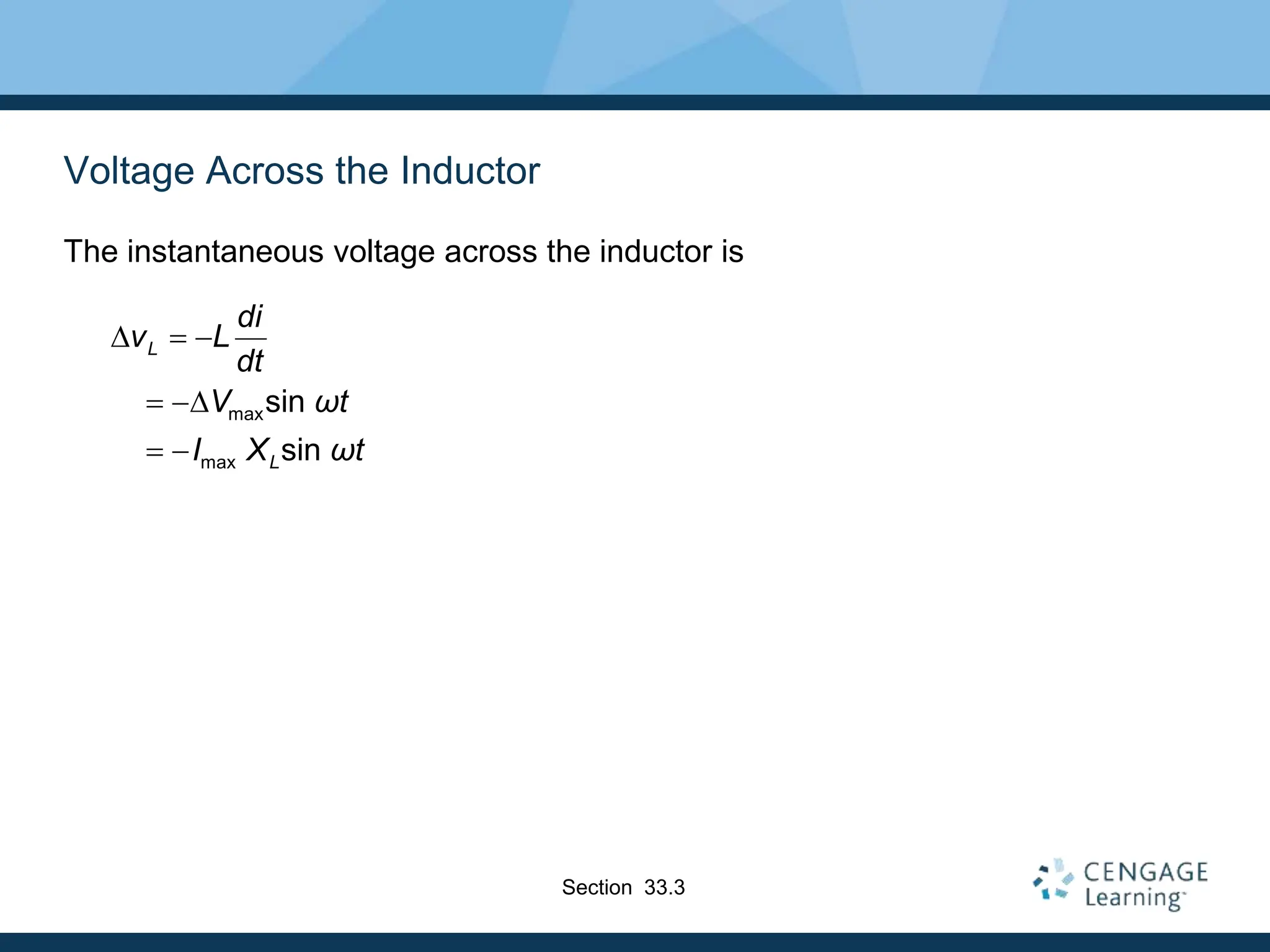
Kirchhoff’s loop rule can be applied and
gives:
0 or
0
max
,
sin
L
v v
di
v L
dt
di
v L V ωt
dt
D  D 
D  
D   D
Section 33.3
Current in an Inductor
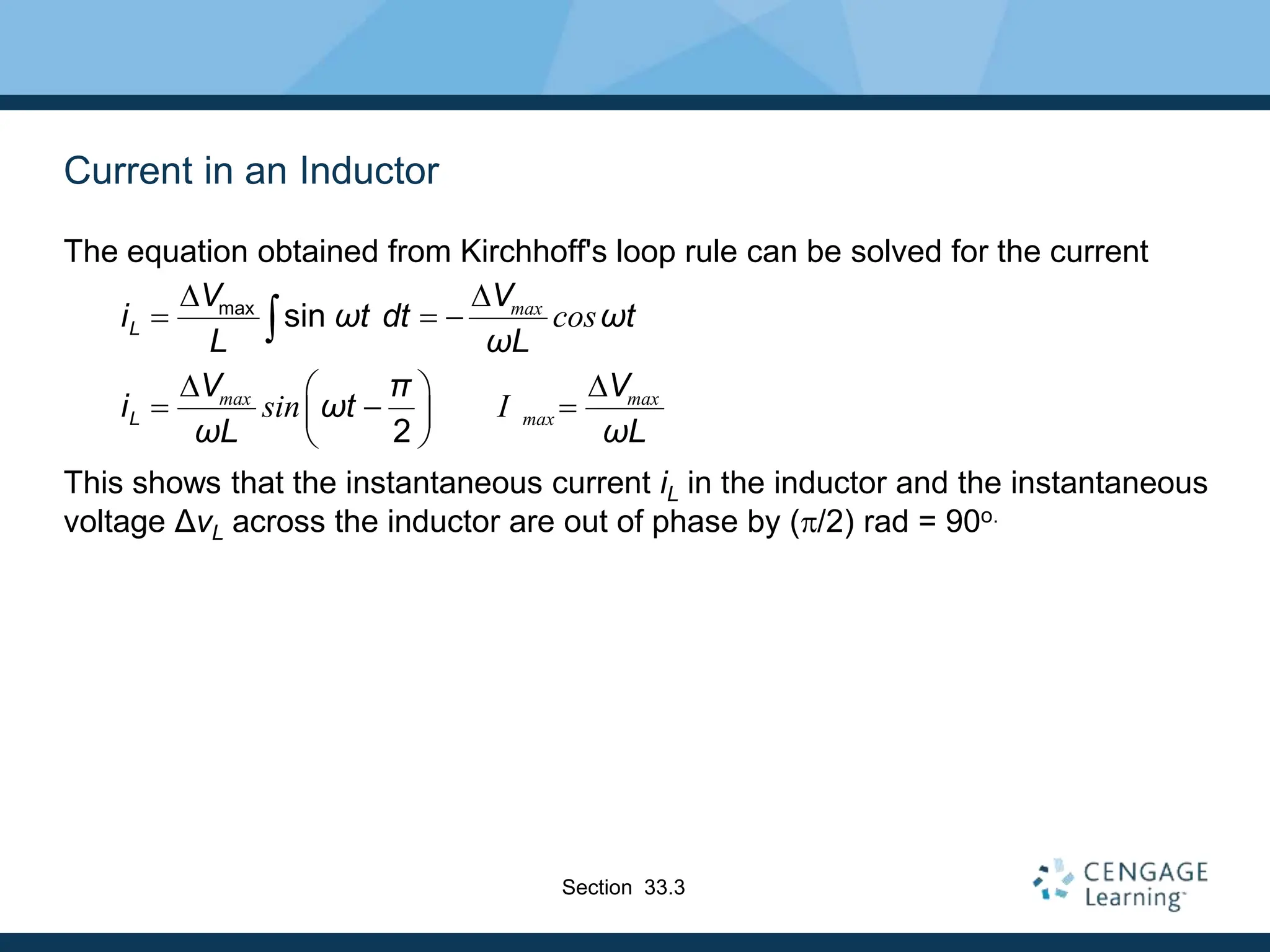
The equation obtained from Kirchhoff's loop rule can be solved for the current
This shows that the instantaneous current iL in the inductor and the instantaneous
voltage ΔvL across the inductor are out of phase by (p/2) rad = 90o.
max
sin
2
max
max max
max
cos
sin I
L
L
V V
i ωt dt ωt
L ωL
V π V
i ωt
ωL ωL
D D
  
D D
 
  
 
 

Section 33.3
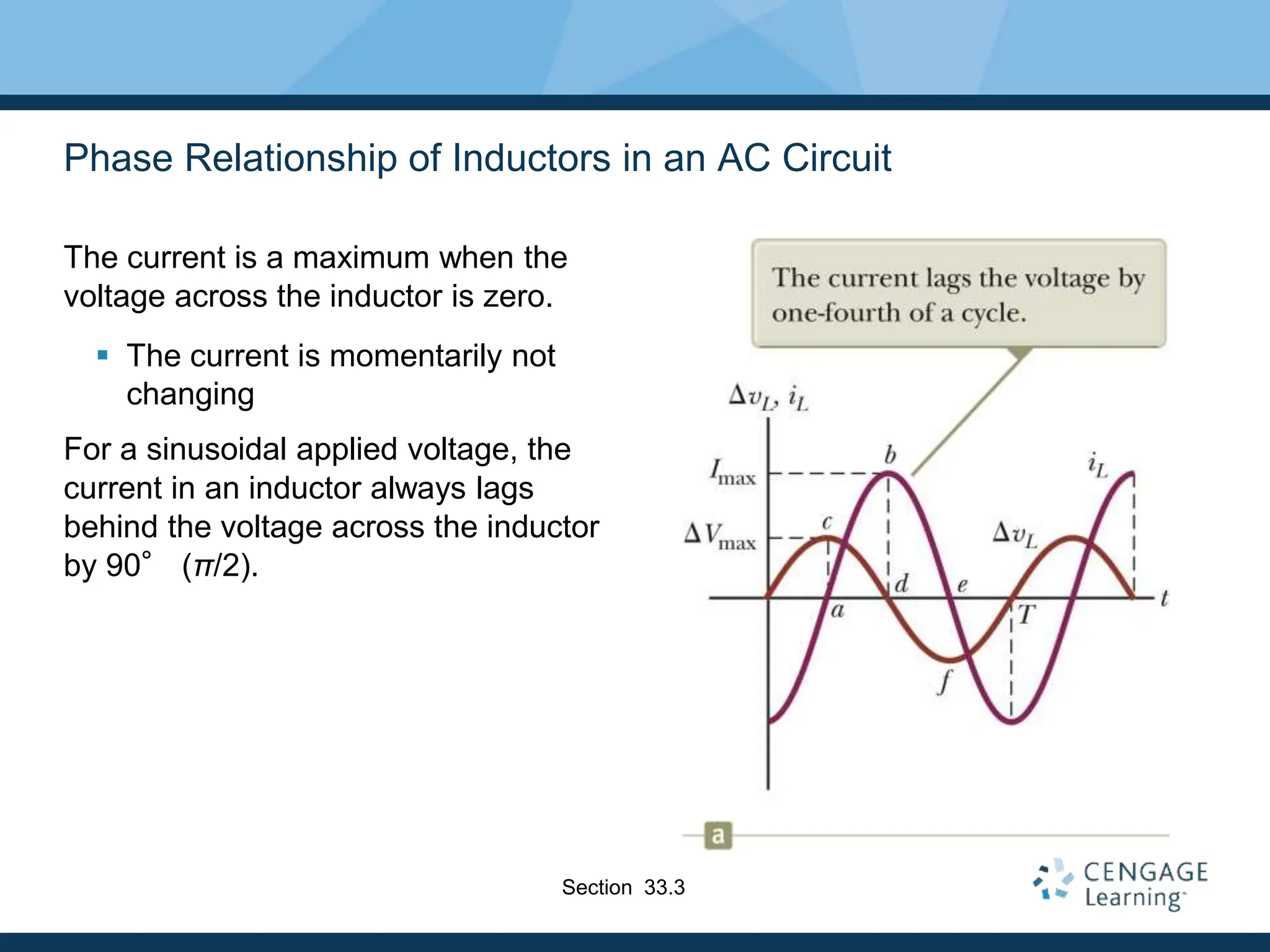
Phase Relationship of Inductors in an AC Circuit
The current is a maximum when the
voltage across the inductor is zero.
 The current is momentarily not
changing
For a sinusoidal applied voltage, the
current in an inductor always lags
behind the voltage across the inductor
by 90° (π/2).
Section 33.3
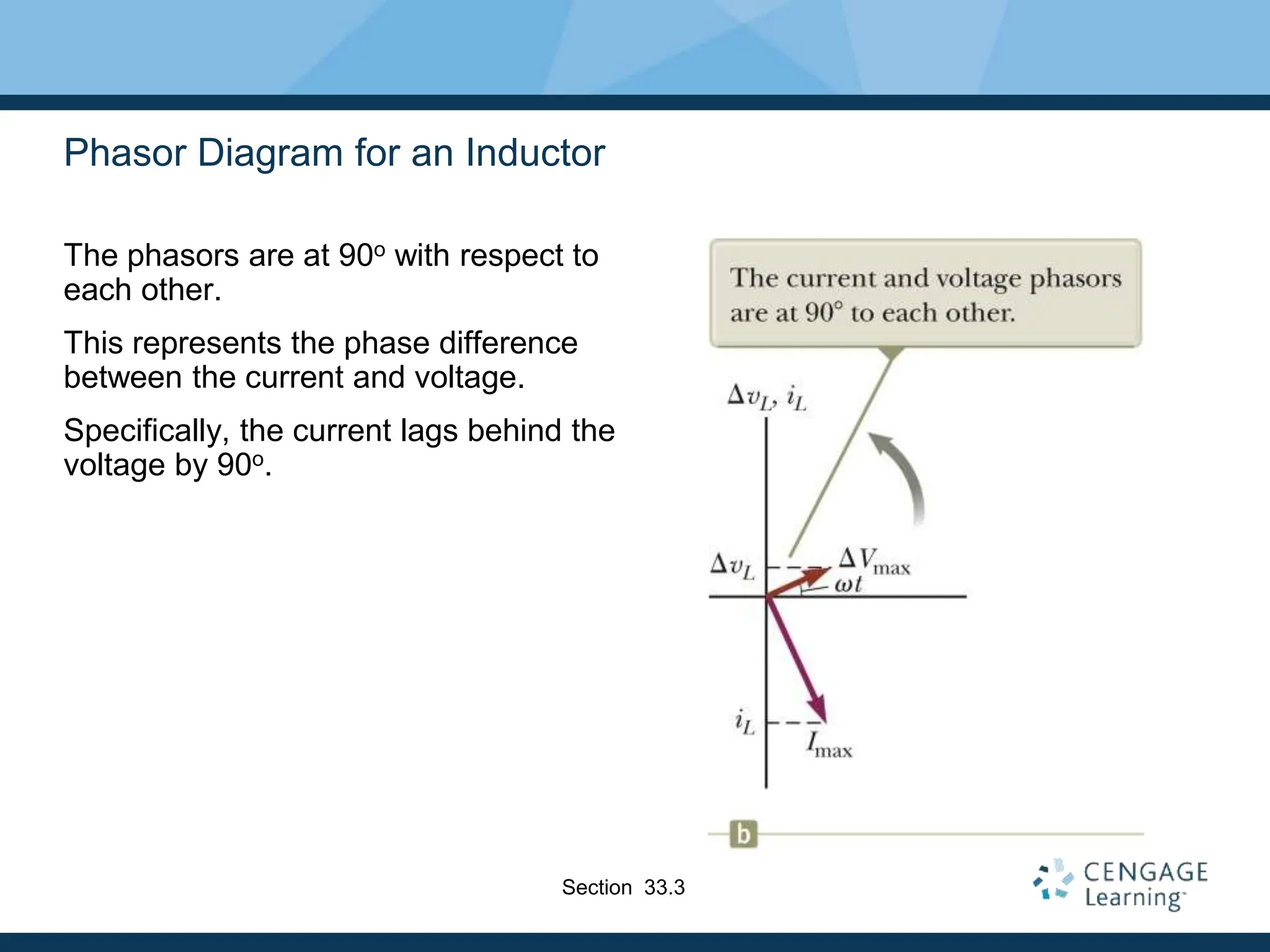
Phasor Diagram for an Inductor
The phasors are at 90o with respect to
each other.
This represents the phase difference
between the current and voltage.
Specifically, the current lags behind the
voltage by 90o.
Section 33.3
Inductive Reactance
The factor ωL has the same units as resistance and is related to current and
voltage in the same way as resistance.
Because ωL depends on the frequency, it reacts differently, in terms of offering
resistance to current, for different frequencies.
The factor is the inductive reactance and is given by:
 XL = ωL
Section 33.3
Inductive Reactance, cont.
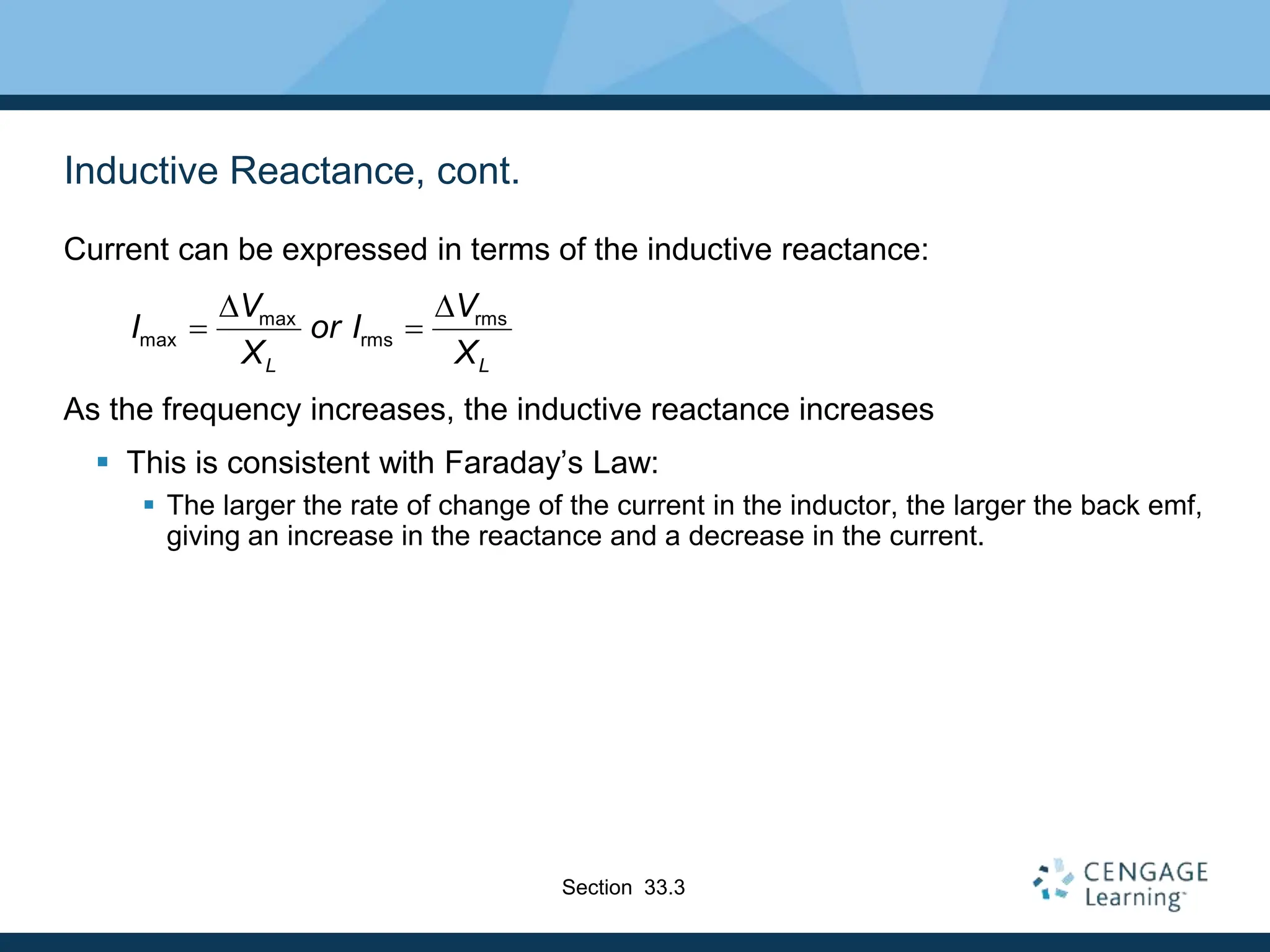
Current can be expressed in terms of the inductive reactance:
As the frequency increases, the inductive reactance increases
 This is consistent with Faraday’s Law:
 The larger the rate of change of the current in the inductor, the larger the back emf,
giving an increase in the reactance and a decrease in the current.
max rms
max rms
L L
V V
I or I
X X
D D
 
Section 33.3
Voltage Across the Inductor
The instantaneous voltage across the inductor is
max
max
sin
sin
L
L
di
v L
dt
V ωt
I X ωt
D  
 D
 
Section 33.3
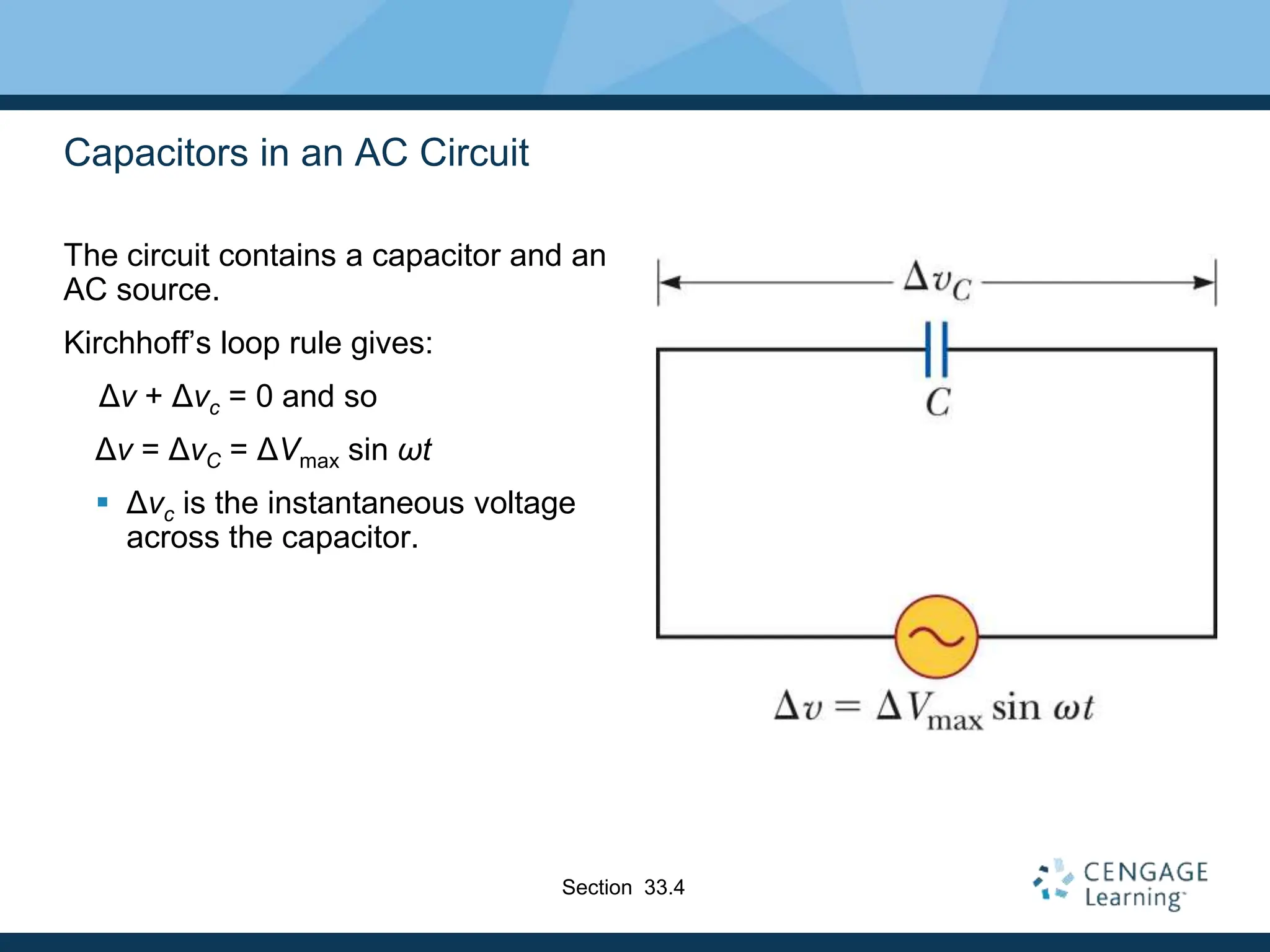
Capacitors in an AC Circuit
The circuit contains a capacitor and an
AC source.
Kirchhoff’s loop rule gives:
Δv + Δvc = 0 and so
Δv = ΔvC = ΔVmax sin ωt
 Δvc is the instantaneous voltage
across the capacitor.
Section 33.4
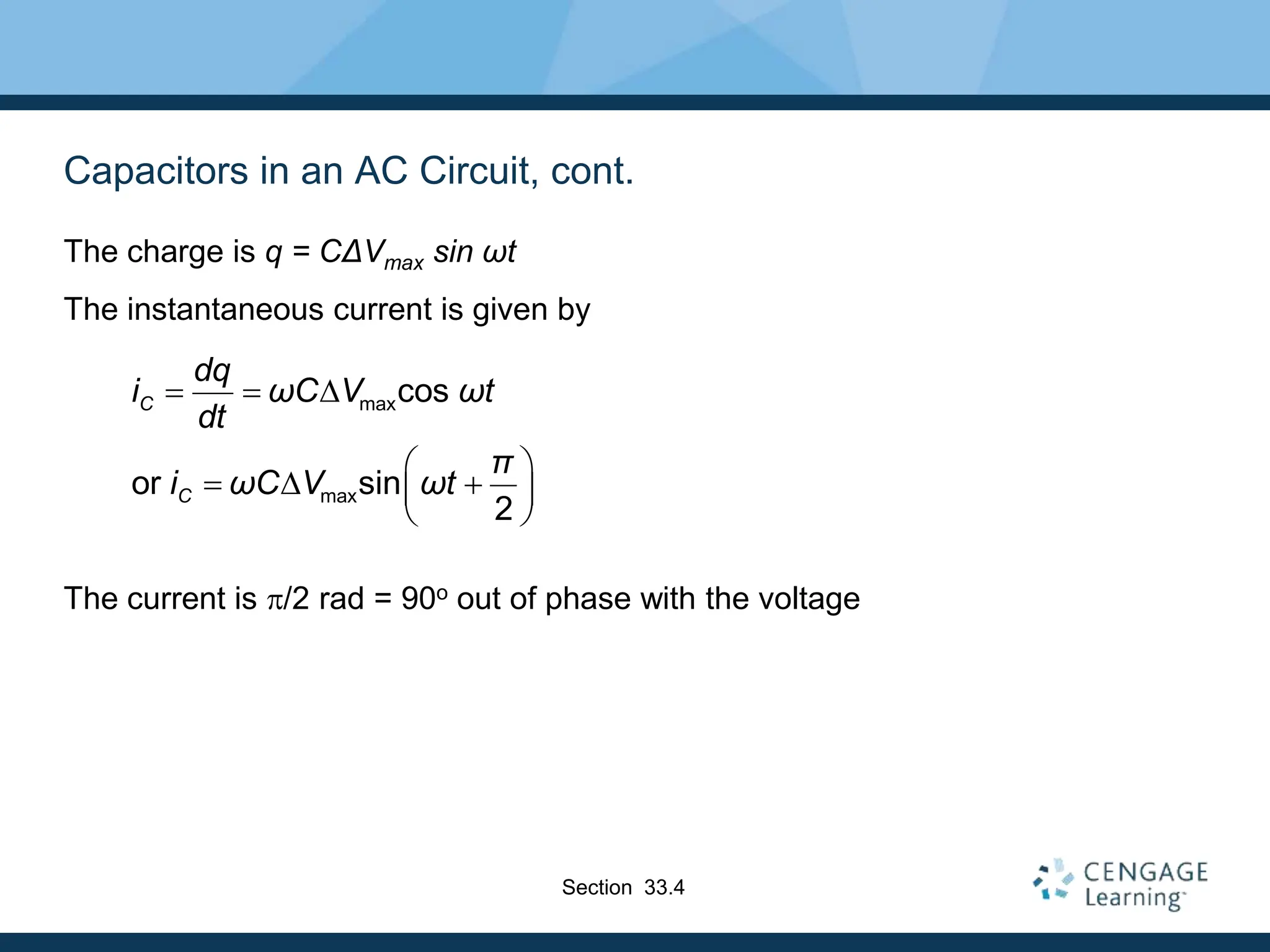
Capacitors in an AC Circuit, cont.
The charge is q = CΔVmax sin ωt
The instantaneous current is given by
The current is p/2 rad = 90o out of phase with the voltage
max
max
cos
or sin
2
C
C
dq
i ωC V ωt
dt
π
i ωC V ωt
  D
 
 D 
 
 
Section 33.4
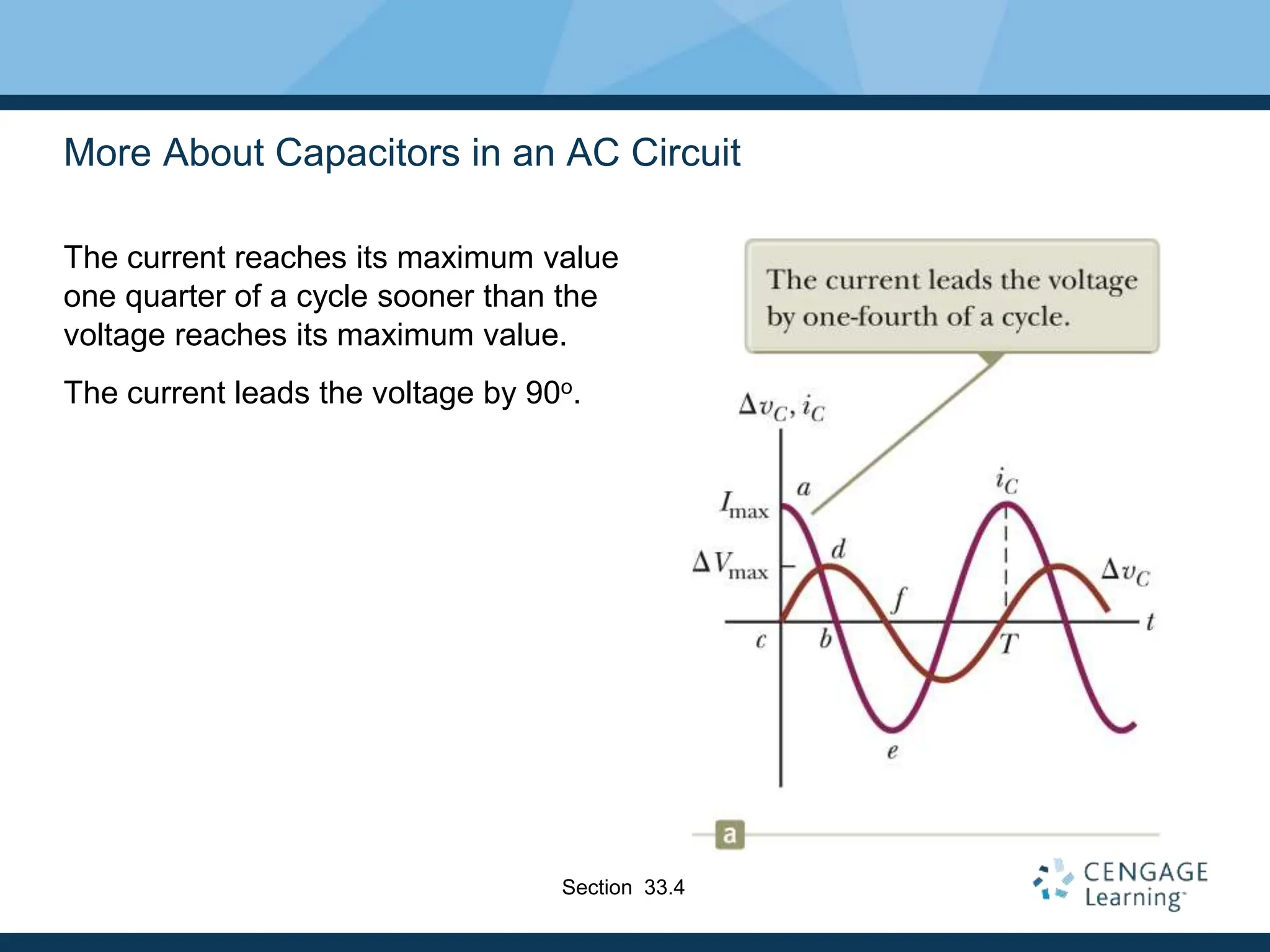
More About Capacitors in an AC Circuit
The current reaches its maximum value
one quarter of a cycle sooner than the
voltage reaches its maximum value.
The current leads the voltage by 90o.
Section 33.4
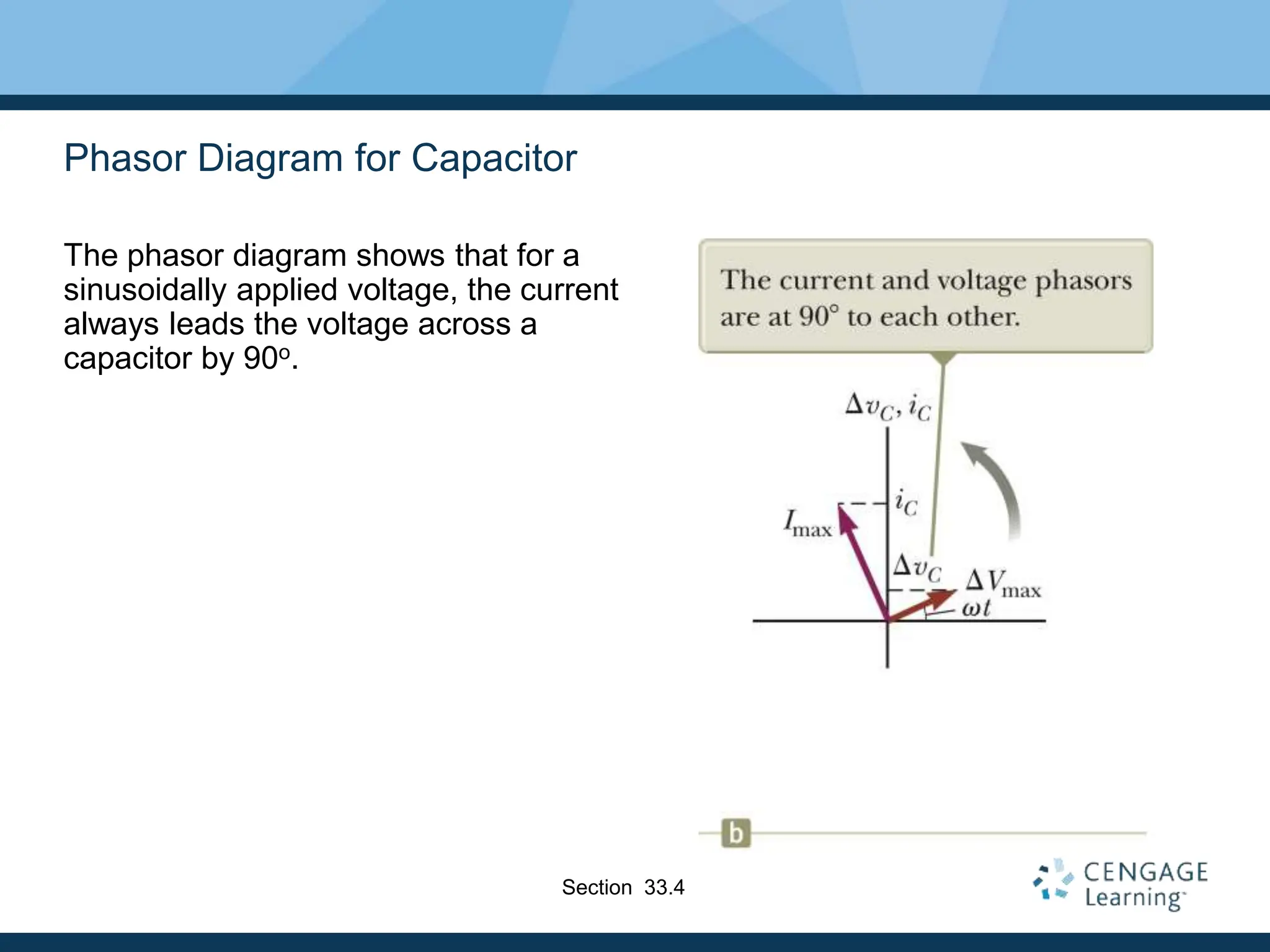
Phasor Diagram for Capacitor
The phasor diagram shows that for a
sinusoidally applied voltage, the current
always leads the voltage across a
capacitor by 90o.
Section 33.4
Capacitive Reactance
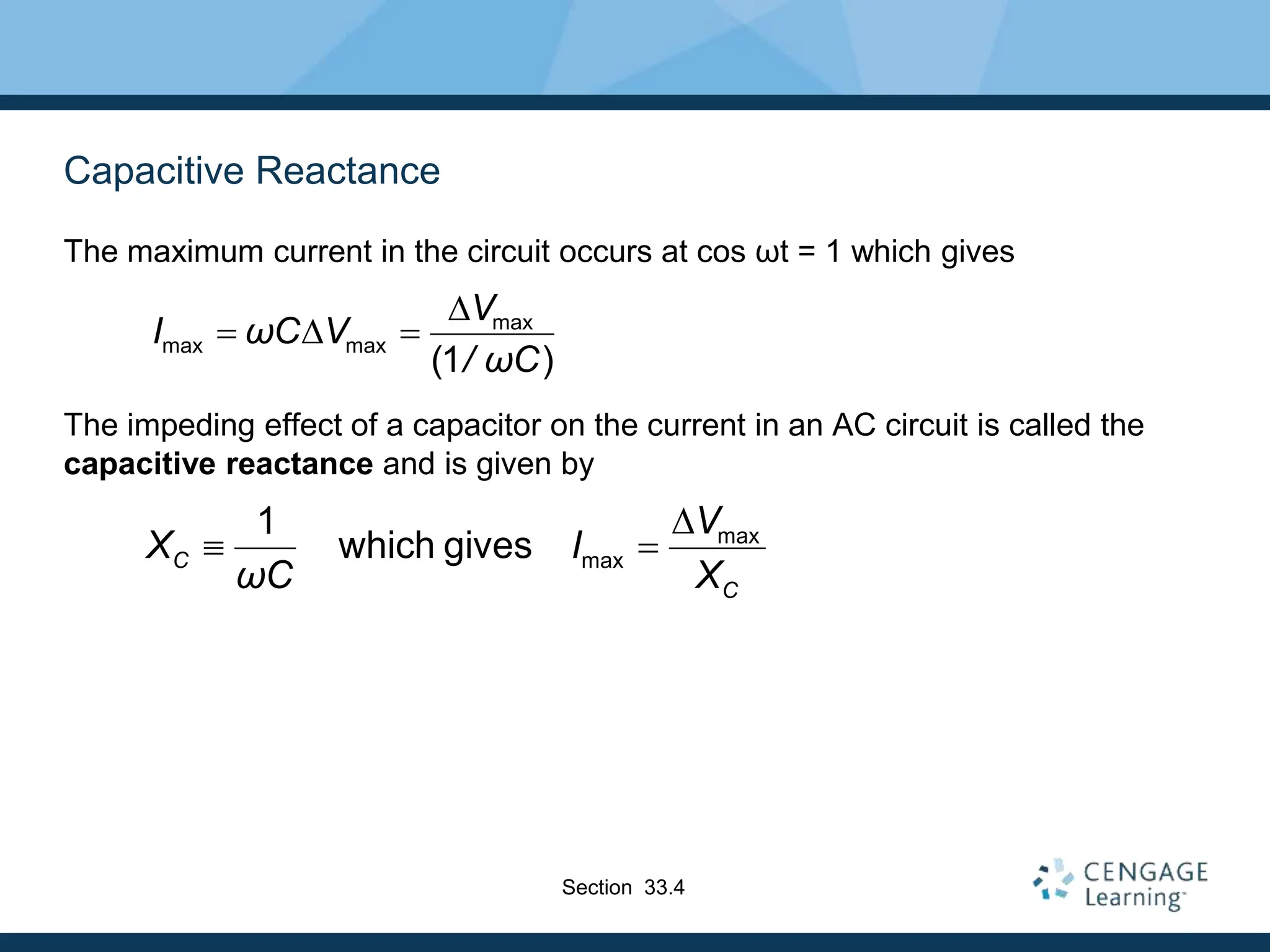
The maximum current in the circuit occurs at cos ωt = 1 which gives
The impeding effect of a capacitor on the current in an AC circuit is called the
capacitive reactance and is given by
max
max
1
which gives
C
C
V
X I
ωC X
D
 
max
max max
(1 )
V
I ωC V
/ ωC
D
 D 
Section 33.4
Voltage Across a Capacitor
The instantaneous voltage across the capacitor can be written as ΔvC = ΔVmax sin
ωt = Imax XC sin ωt.
As the frequency of the voltage source increases, the capacitive reactance
decreases and the maximum current increases.
As the frequency approaches zero, XC approaches infinity and the current
approaches zero.
 This would act like a DC voltage and the capacitor would act as an open
circuit.
Section 33.4
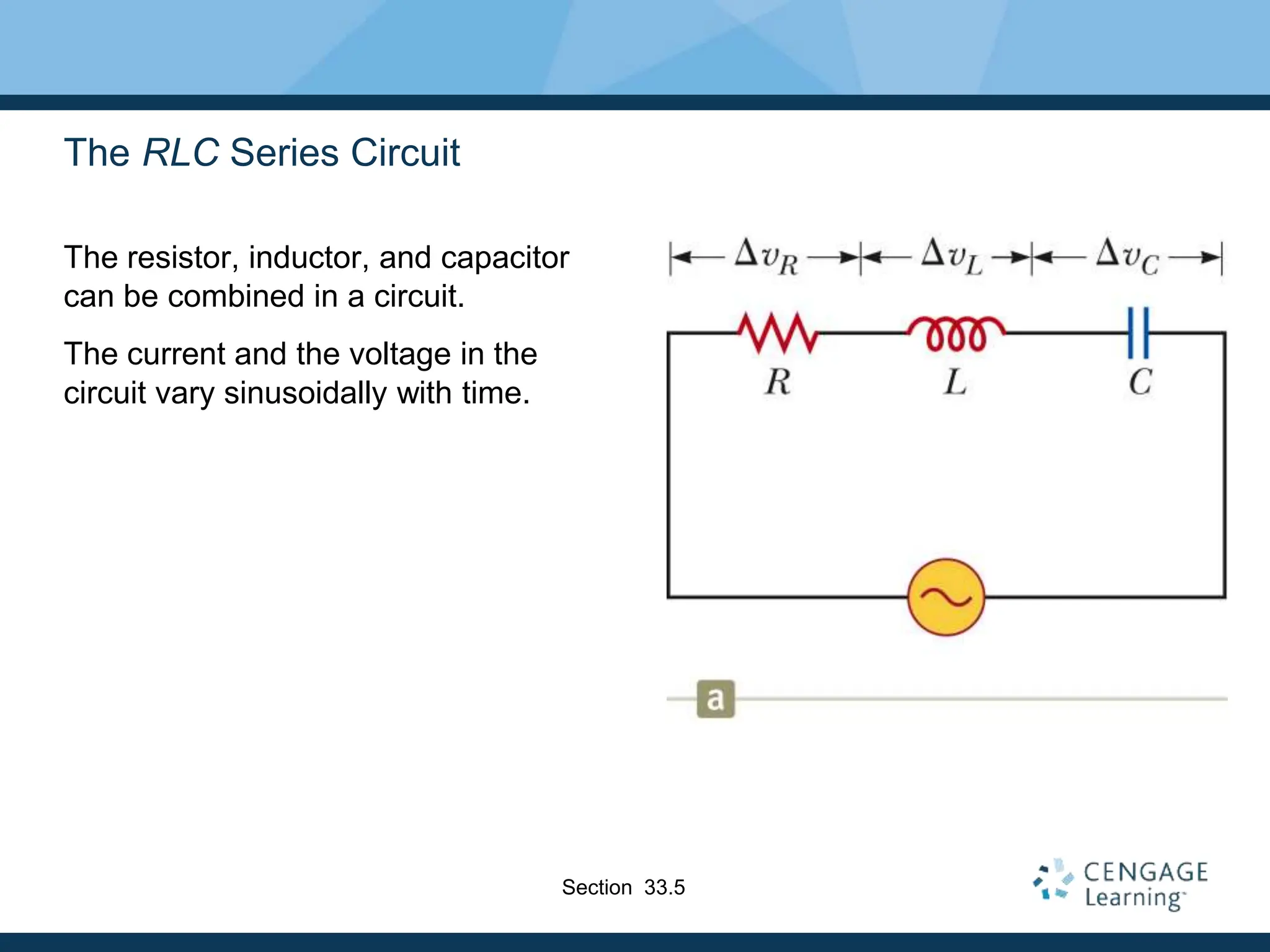
The RLC Series Circuit
The resistor, inductor, and capacitor
can be combined in a circuit.
The current and the voltage in the
circuit vary sinusoidally with time.
Section 33.5
The RLC Series Circuit, cont.
The instantaneous voltage would be given by Δv = ΔVmax sin ωt.
The instantaneous current would be given by i = Imax sin (ωt - φ).
 φ is the phase angle between the current and the applied voltage.
Since the elements are in series, the current at all points in the circuit has the
same amplitude and phase.
Section 33.5
i and v Phase Relationships – Graphical View
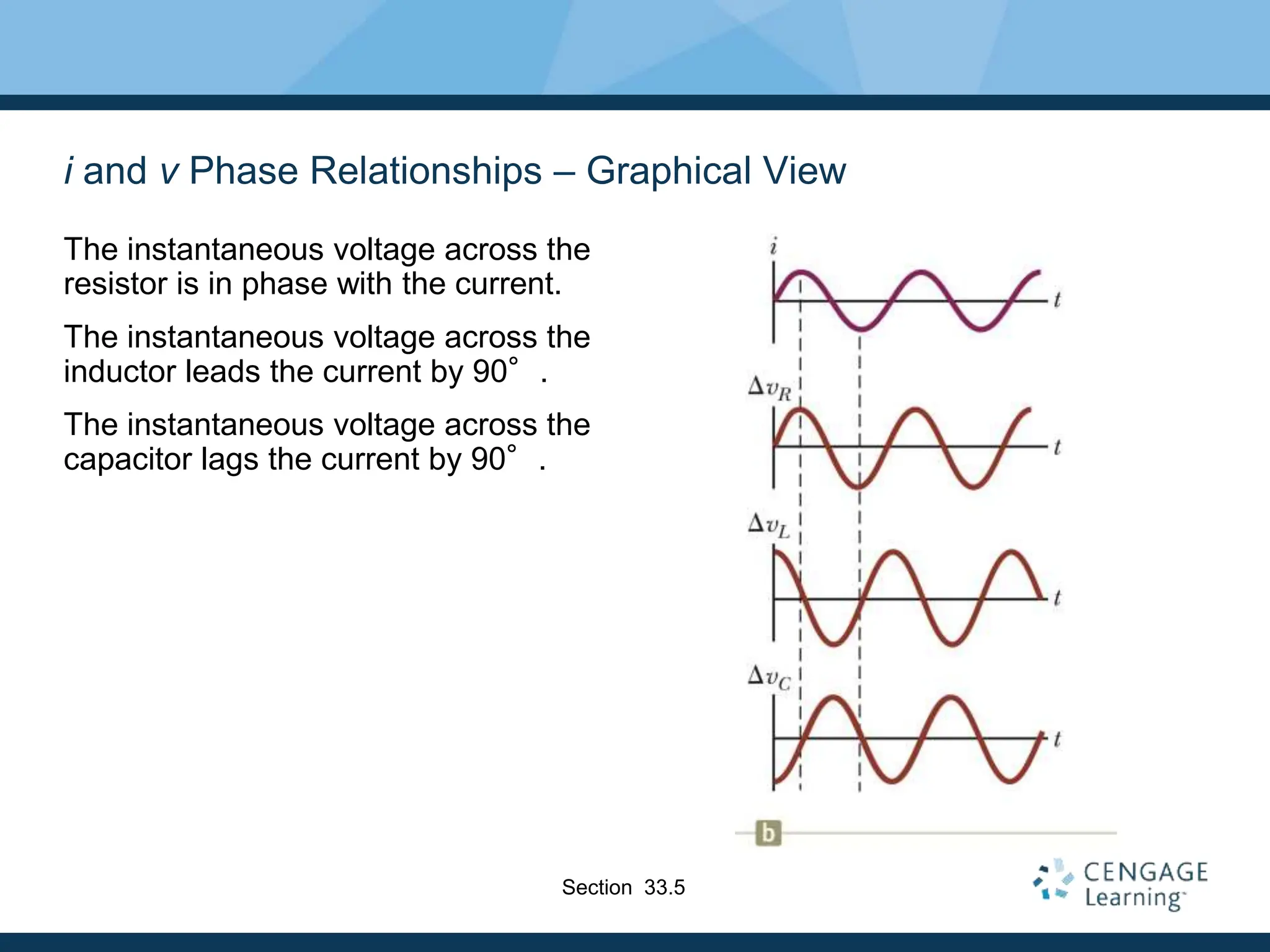
The instantaneous voltage across the
resistor is in phase with the current.
The instantaneous voltage across the
inductor leads the current by 90°.
The instantaneous voltage across the
capacitor lags the current by 90°.
Section 33.5
i and v Phase Relationships – Equations
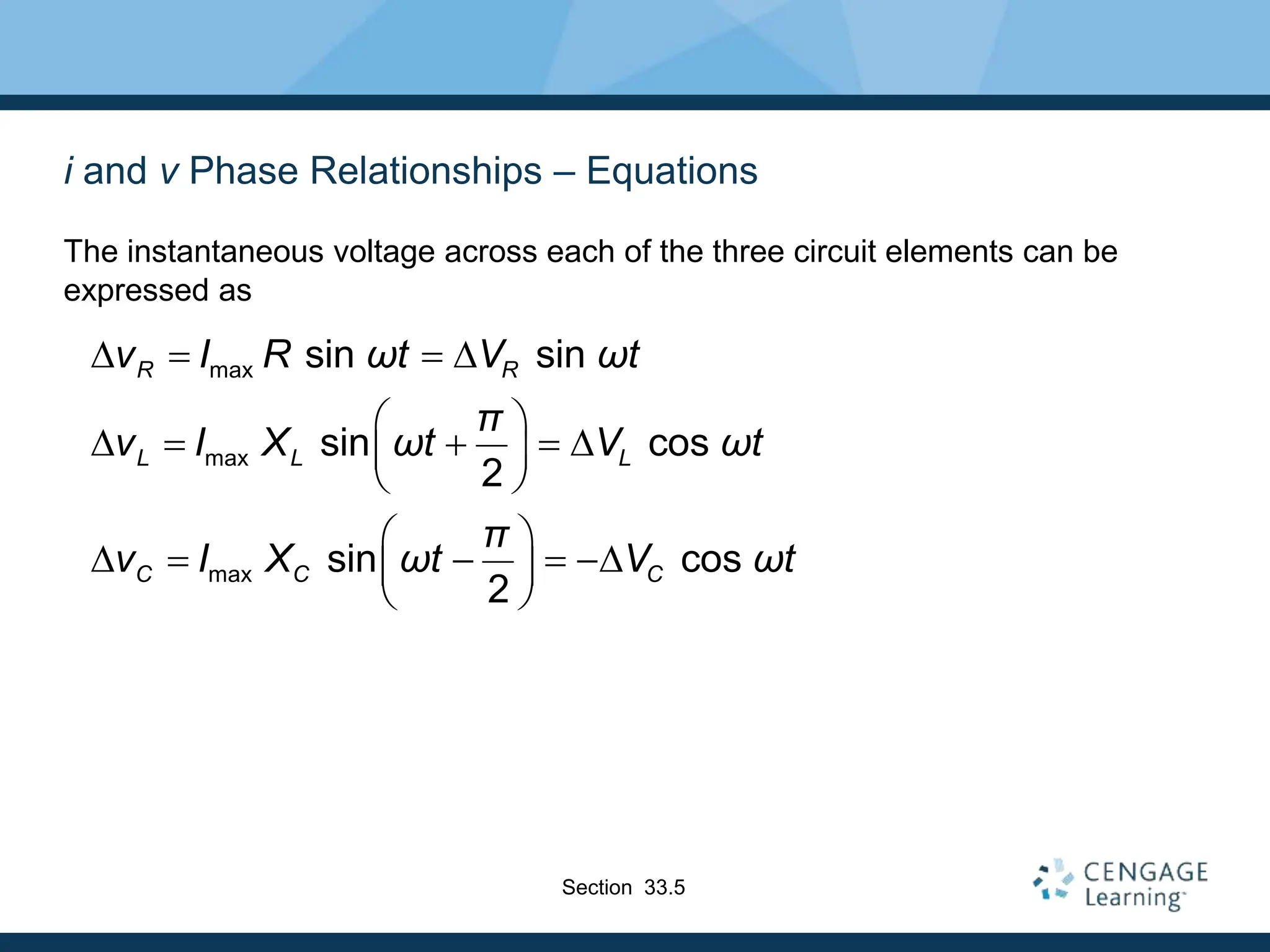
The instantaneous voltage across each of the three circuit elements can be
expressed as
max
max
max
sin sin
sin cos
2
sin cos
2
R R
L L L
C C C
v I R ωt V ωt
π
v I X ωt V ωt
π
v I X ωt V ωt
D   D
 
D    D
 
 
 
D    D
 
 
Section 33.5
More About Voltage in RLC Circuits
ΔVR is the maximum voltage across the resistor and ΔVR = ImaxR.
ΔVL is the maximum voltage across the inductor and ΔVL = ImaxXL.
ΔVC is the maximum voltage across the capacitor and ΔVC = ImaxXC.
The sum of these voltages must equal the voltage from the AC source.
Because of the different phase relationships with the current, they cannot be
added directly.
Section 33.5
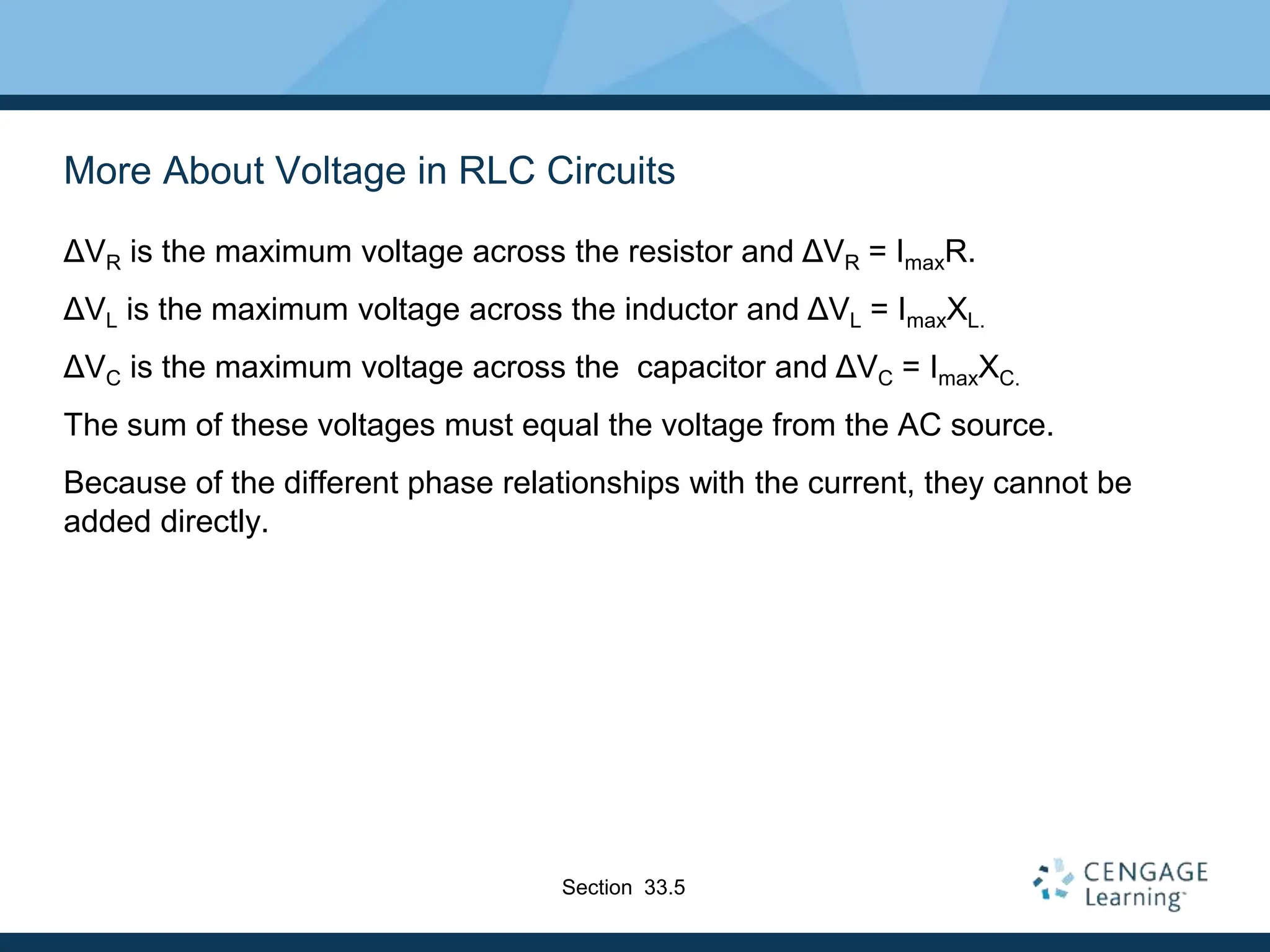
Phasor Diagrams
To account for the different phases of the voltage drops, vector techniques are
used.
Remember the phasors are rotating vectors
The phasors for the individual elements are shown.
Section 33.5
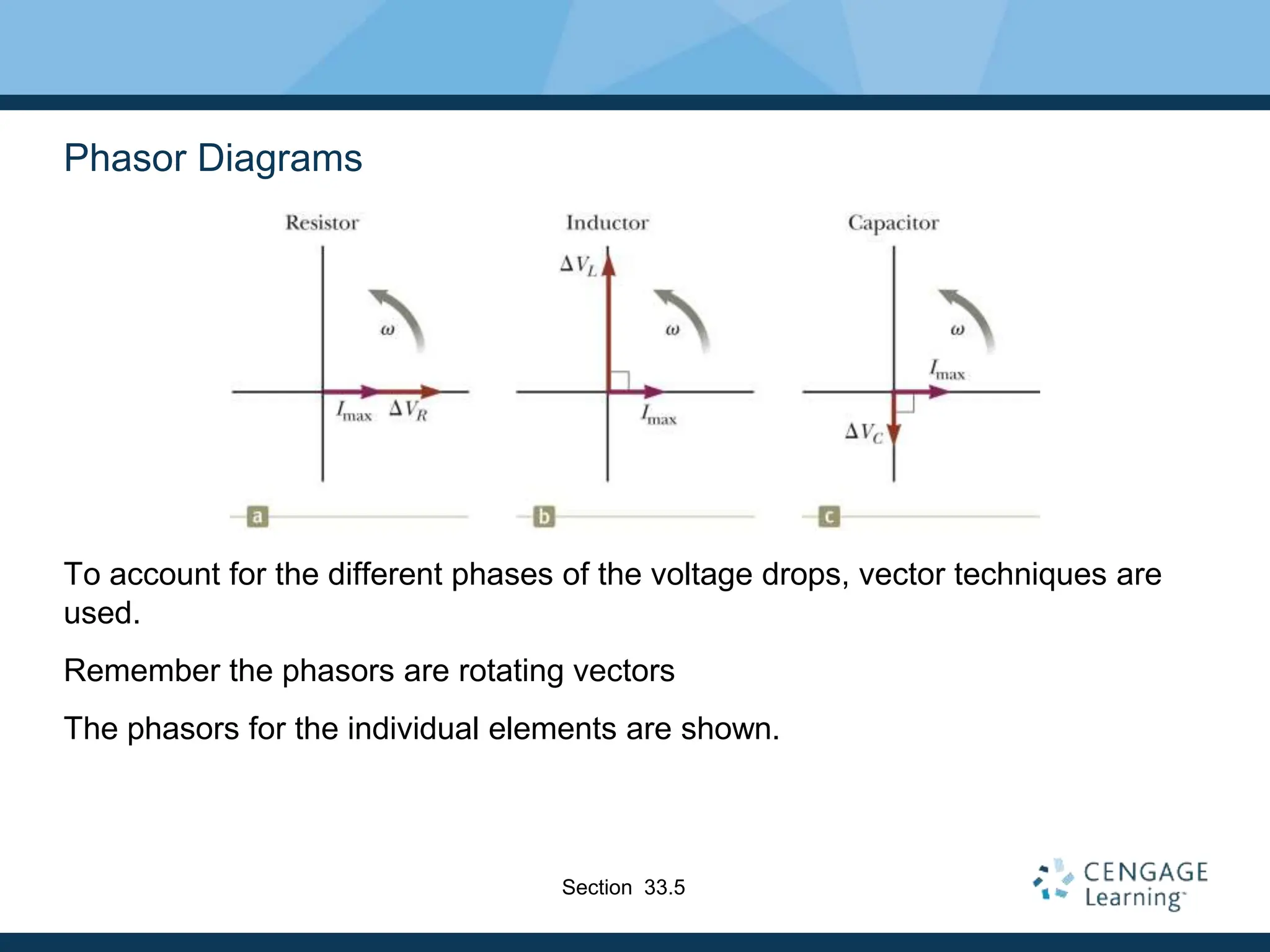
Resulting Phasor Diagram
The individual phasor diagrams can be
combined.
Here a single phasor Imax is used to
represent the current in each element.
 In series, the current is the same in
each element.
Section 33.5
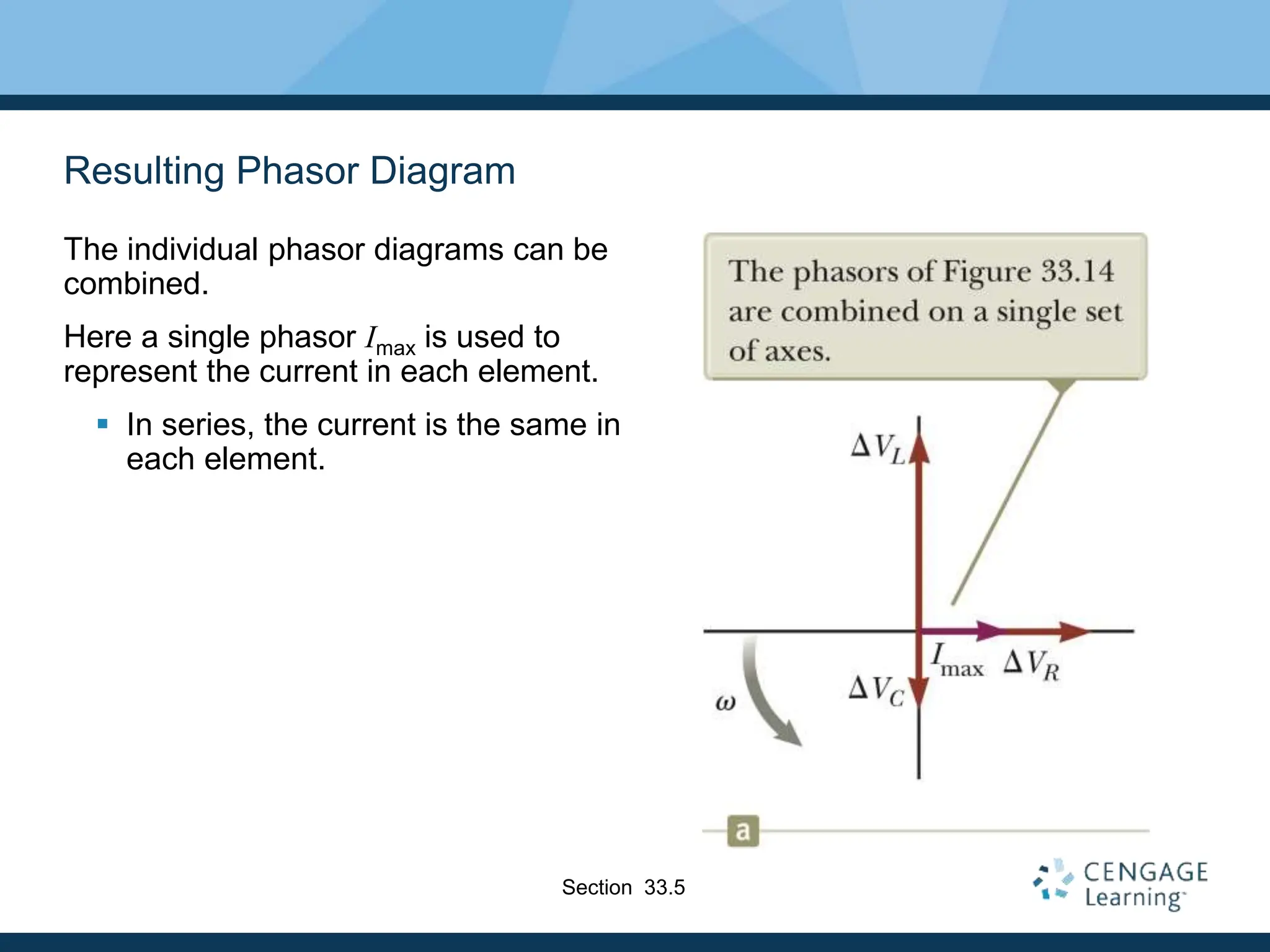
Vector Addition of the Phasor Diagram
Vector addition is used to combine the
voltage phasors.
ΔVL and ΔVC are in opposite
directions, so they can be combined.
Their resultant is perpendicular to ΔVR.
The resultant of all the individual
voltages across the individual elements
is Δvmax.
 This resultant makes an angle of φ
with the current phasor Imax.
Section 33.5
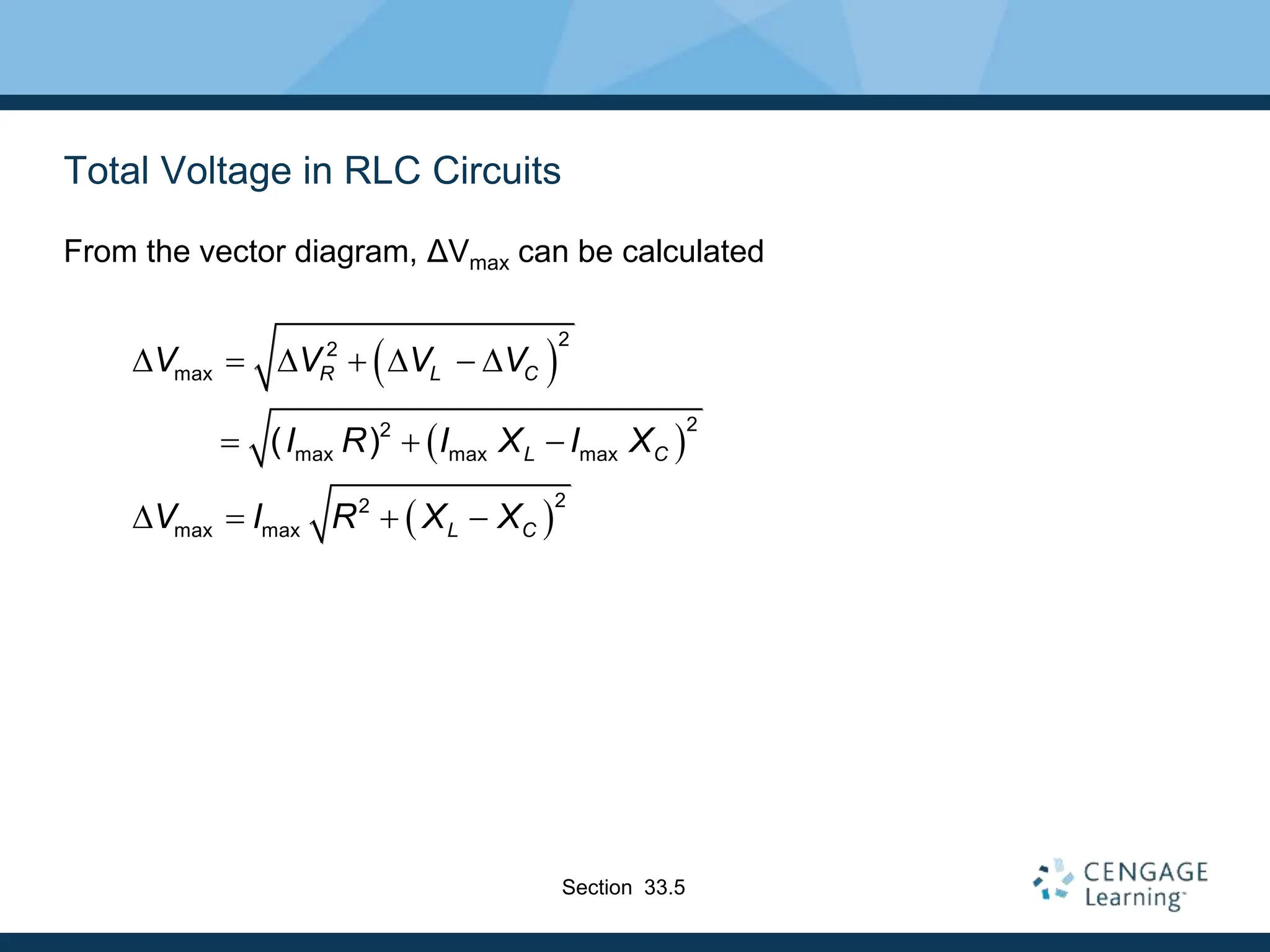
Total Voltage in RLC Circuits
From the vector diagram, ΔVmax can be calculated
 
 
 
2
2
max
2
2
max max max
2
2
max max
( )
R L C
L C
L C
V V V V
I R I X I X
V I R X X
D  D  D  D
  
D   
Section 33.5
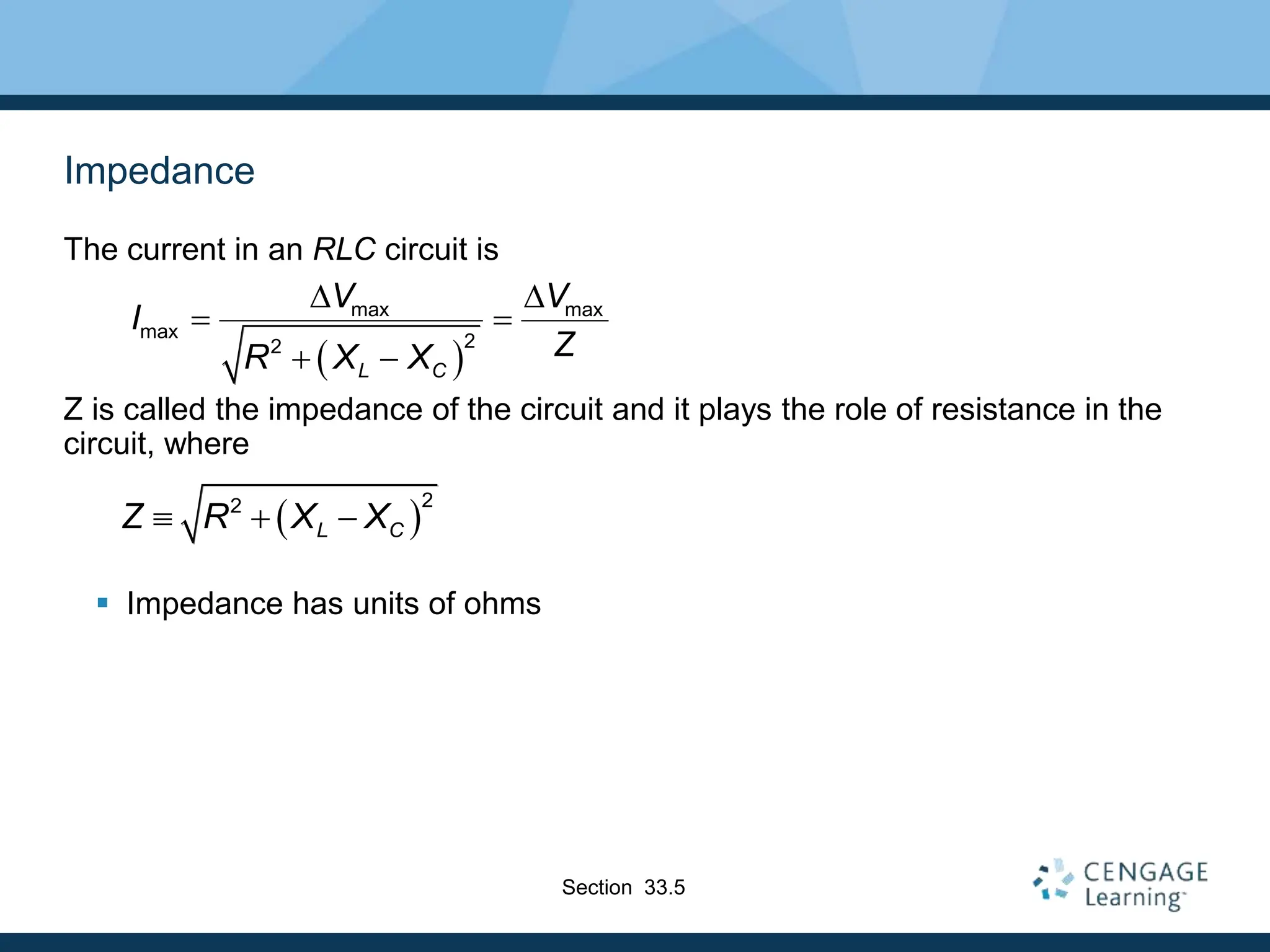
Impedance
The current in an RLC circuit is
Z is called the impedance of the circuit and it plays the role of resistance in the
circuit, where
 Impedance has units of ohms
 
max max
max 2
2
L C
V V
I
Z
R X X
D D
 
 
 
2
2
L C
Z R X X
  
Section 33.5
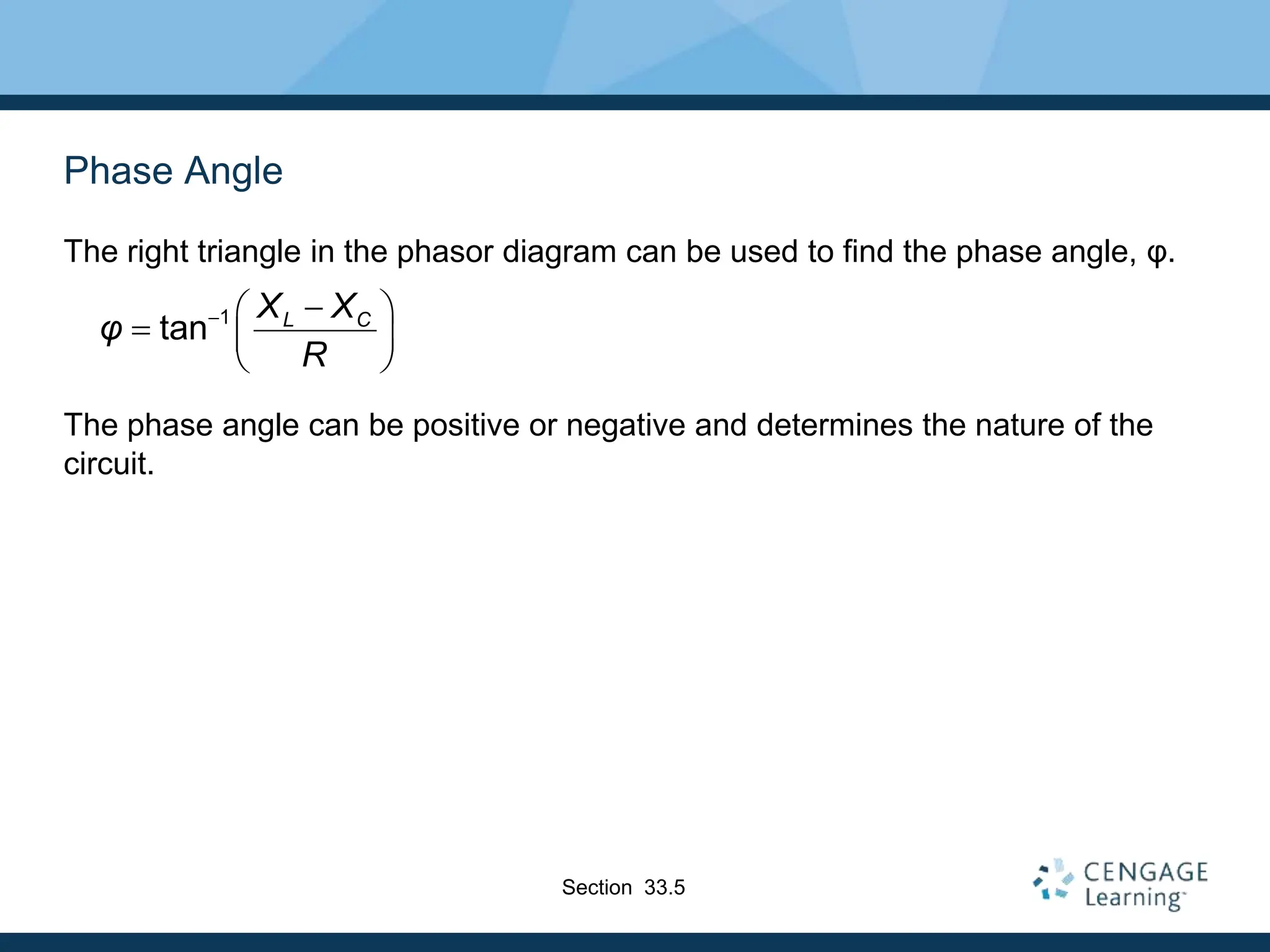
Phase Angle
The right triangle in the phasor diagram can be used to find the phase angle, φ.
The phase angle can be positive or negative and determines the nature of the
circuit.
1
tan L C
X X
φ
R
 
 
  
 
Section 33.5
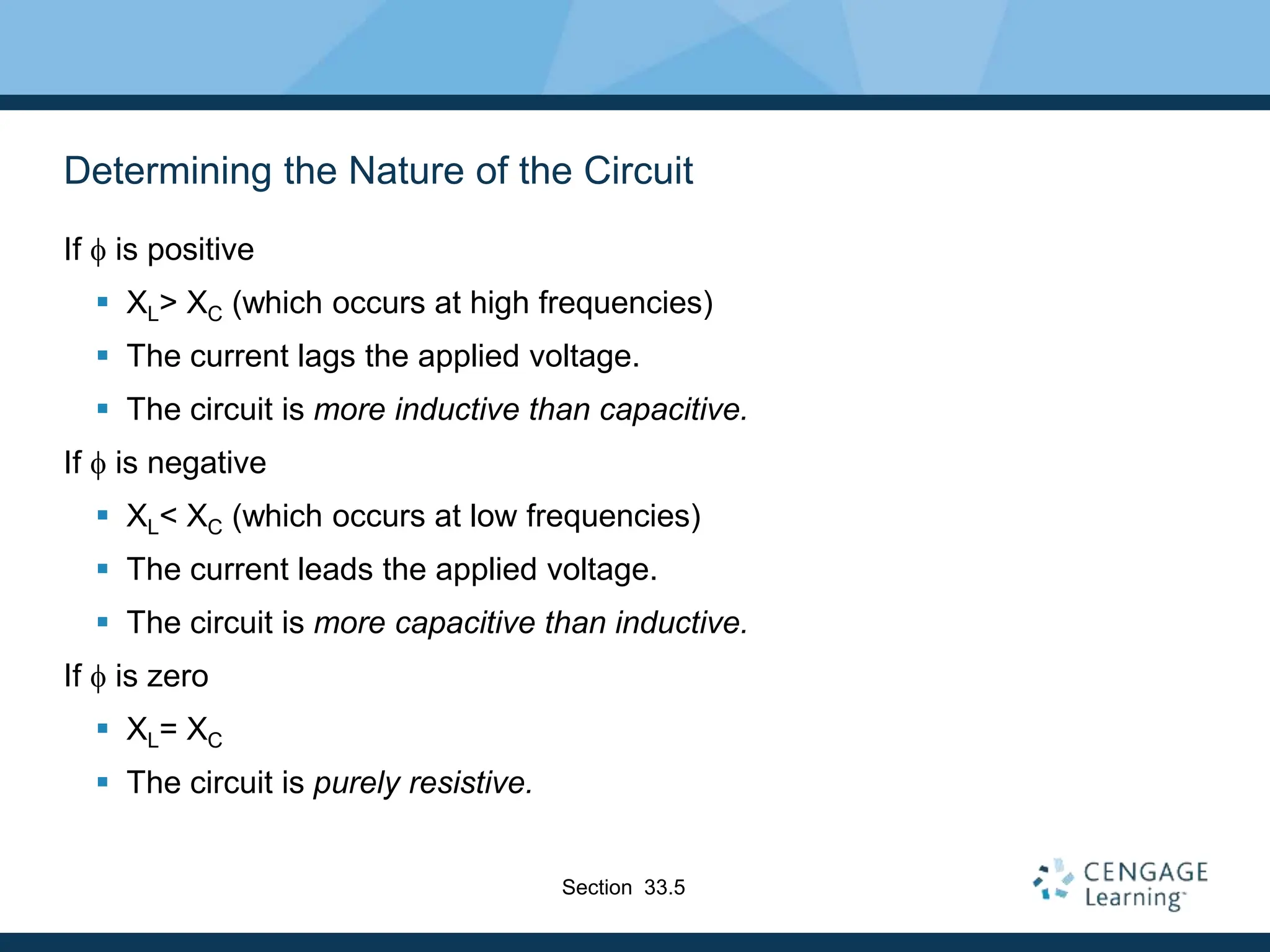
Determining the Nature of the Circuit
If f is positive
 XL> XC (which occurs at high frequencies)
 The current lags the applied voltage.
 The circuit is more inductive than capacitive.
If f is negative
 XL< XC (which occurs at low frequencies)
 The current leads the applied voltage.
 The circuit is more capacitive than inductive.
If f is zero
 XL= XC
 The circuit is purely resistive.
Section 33.5
Power in an AC Circuit
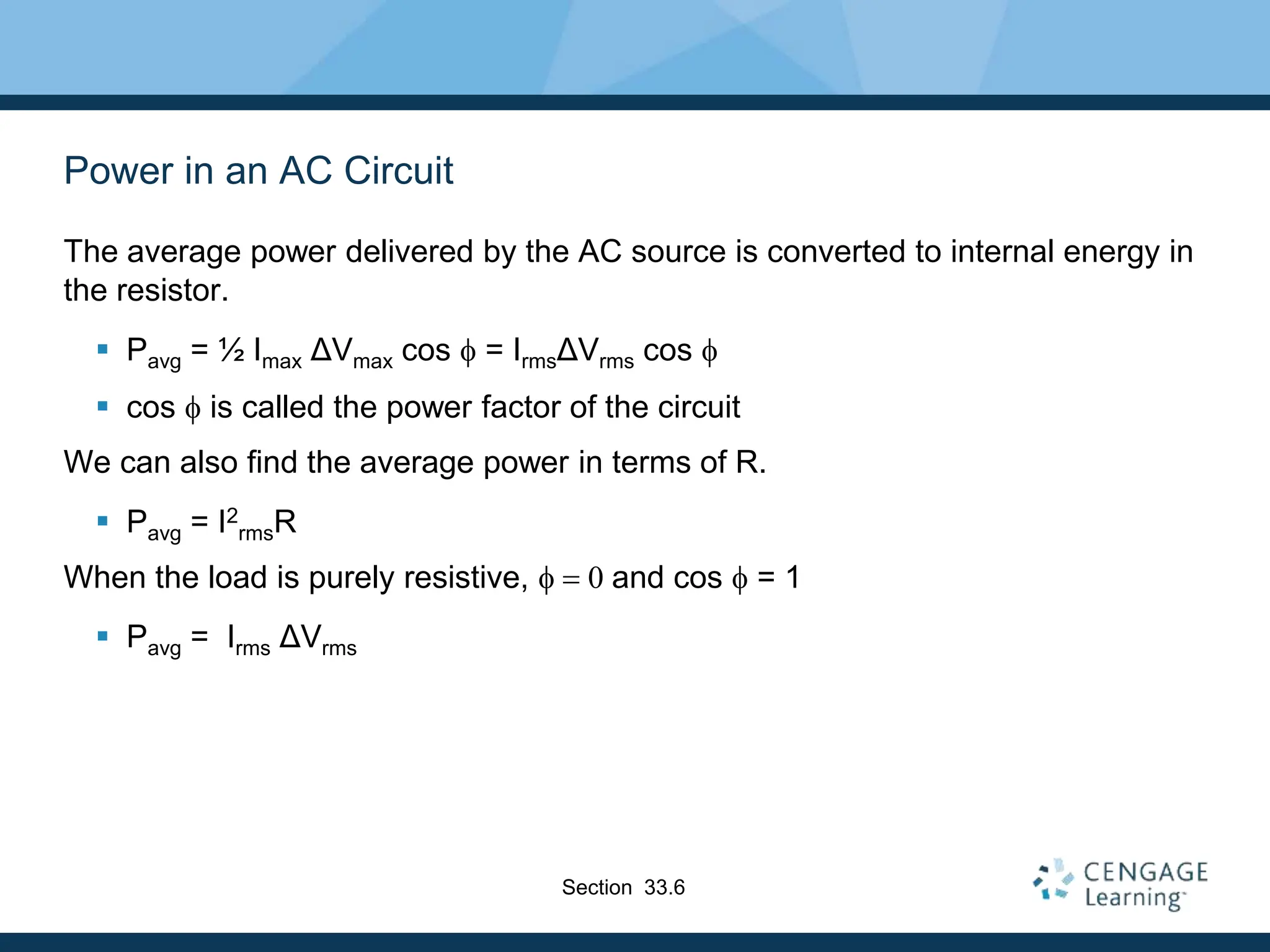
The average power delivered by the AC source is converted to internal energy in
the resistor.
 Pavg = ½ Imax ΔVmax cos f = IrmsΔVrms cos f
 cos f is called the power factor of the circuit
We can also find the average power in terms of R.
 Pavg = I2
rmsR
When the load is purely resistive, f  0 and cos f = 1
 Pavg = Irms ΔVrms
Section 33.6
Power in an AC Circuit, cont.
The average power delivered by the source is converted to internal energy in the
resistor.
No power losses are associated with pure capacitors and pure inductors in an AC
circuit.
 In a capacitor, during one-half of a cycle, energy is stored and during the
other half the energy is returned to the circuit and no power losses occur in
the capacitor.
 In an inductor, the source does work against the back emf of the inductor
and energy is stored in the inductor, but when the current begins to decrease
in the circuit, the energy is returned to the circuit.
The power delivered by an AC circuit depends on the phase.
Some applications include using capacitors to shift the phase to heavy motors or
other inductive loads so that excessively high voltages are not needed.
Section 33.6
Resonance in an AC Circuit
Resonance occurs at the frequency ωo where the current has its maximum value.
 To achieve maximum current, the impedance must have a minimum value.
 This occurs when XL = XC
 Solving for the frequency gives
The resonance frequency also corresponds to the natural frequency of oscillation
of an LC circuit.
The rms current has a maximum value when the frequency of the applied voltage
matches the natural oscillator frequency.
At the resonance frequency, the current is in phase with the applied voltage.
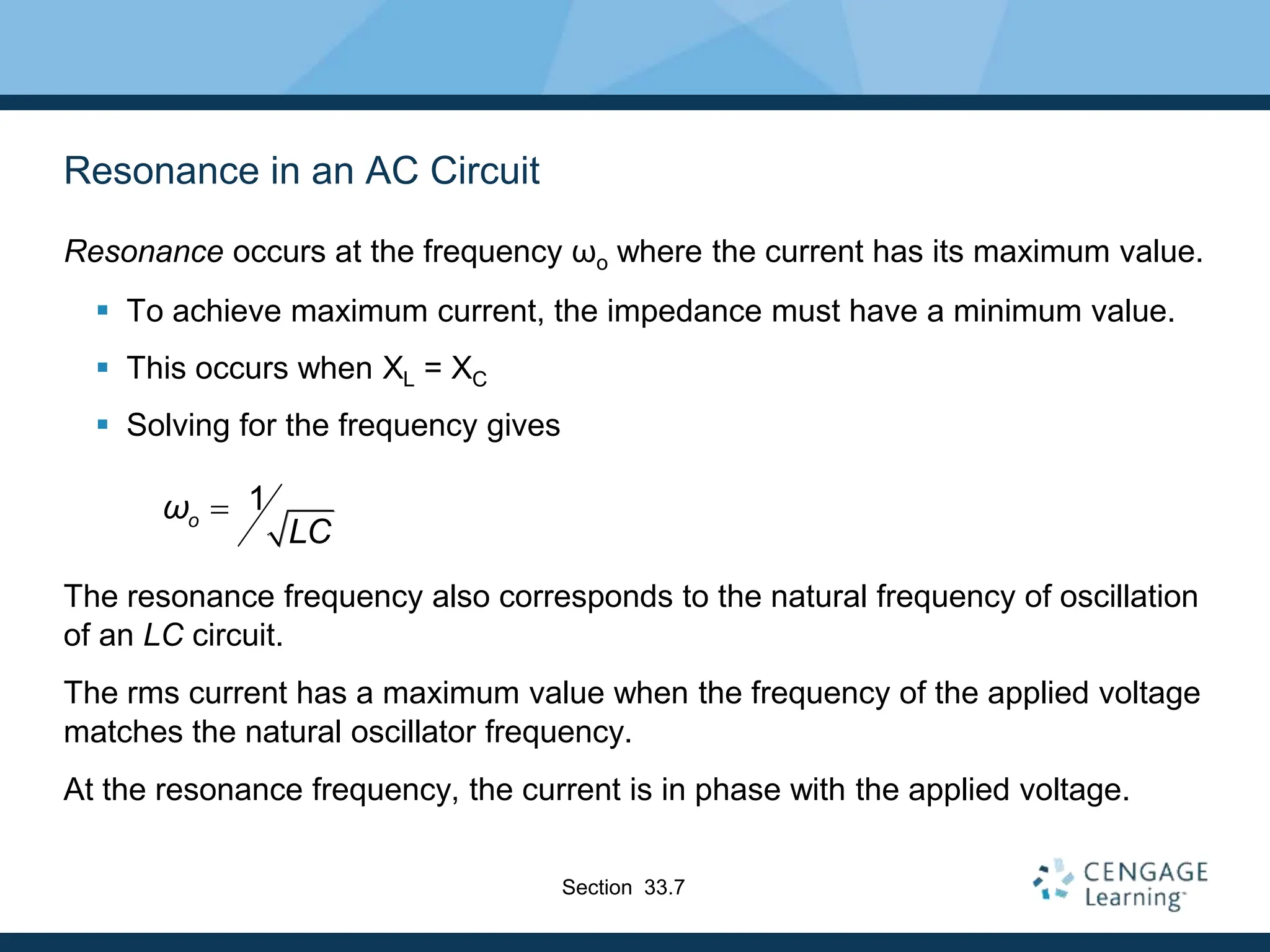
1
o
ω
LC

Section 33.7
Resonance, cont.
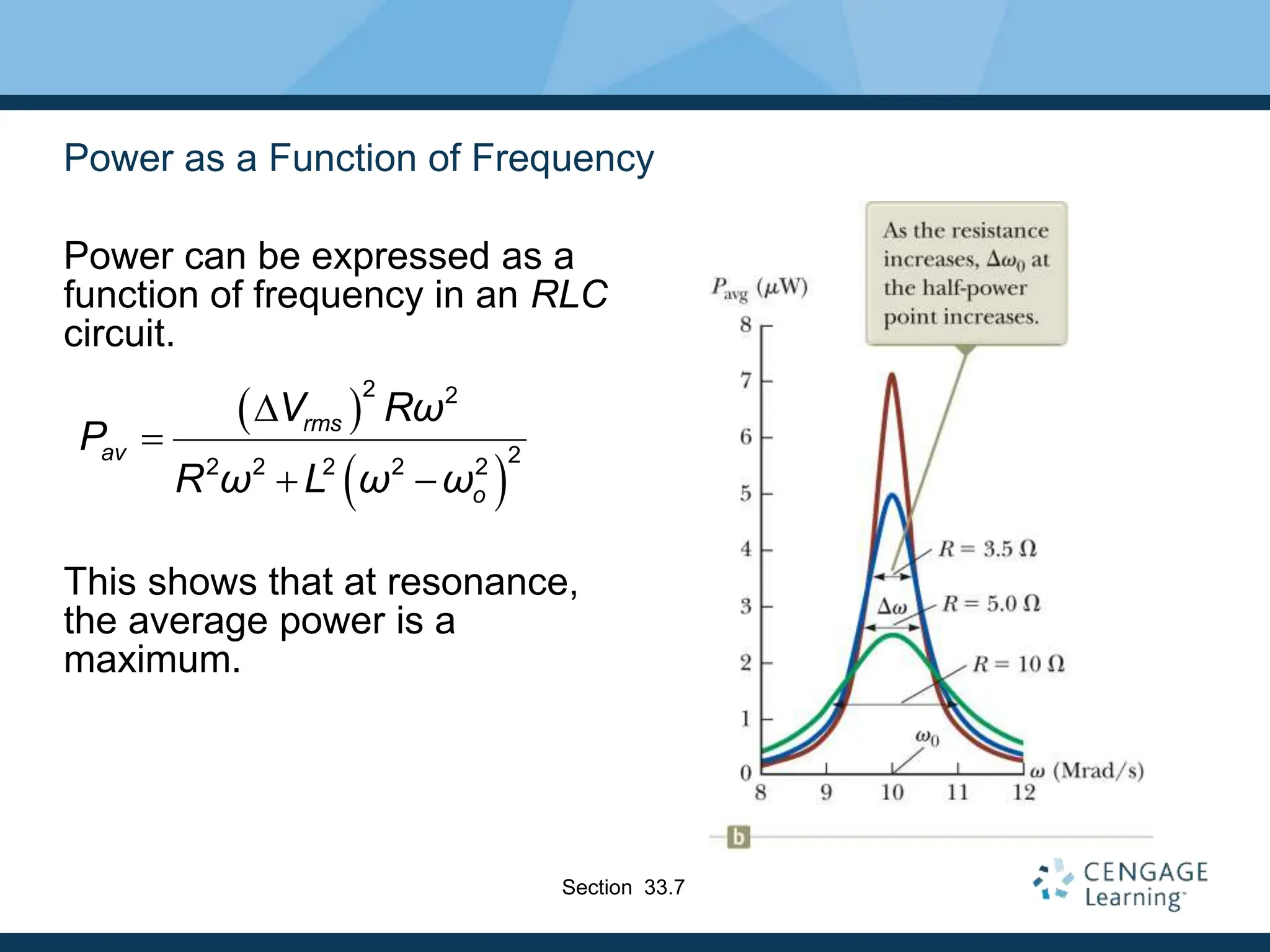
Resonance occurs at the same
frequency regardless of the value of R.
As R decreases, the curve becomes
narrower and taller.
Theoretically, if R = 0 the current would
be infinite at resonance.
 Real circuits always have some
resistance.
Section 33.7
Power as a Function of Frequency
Power can be expressed as a
function of frequency in an RLC
circuit.
This shows that at resonance,
the average power is a
maximum.
 
 
2 2
2
2 2 2 2 2
rms
av
o
V Rω
P
R ω L ω ω
D

 
Section 33.7
Quality Factor
The sharpness of the resonance curve is usually described by a dimensionless
parameter known as the quality factor, Q.
Q = ωo / Δω = (ωoL) / R
 Δω is the width of the curve, measured between the two values of ω for
which Pavg has half its maximum value.
 These points are called the half-power points.
A high-Q circuit responds only to a narrow range of frequencies.
 Narrow peak
A low-Q circuit can detect a much broader range of frequencies.
A radio’s receiving circuit is an important application of a resonant circuit.
Section 33.7
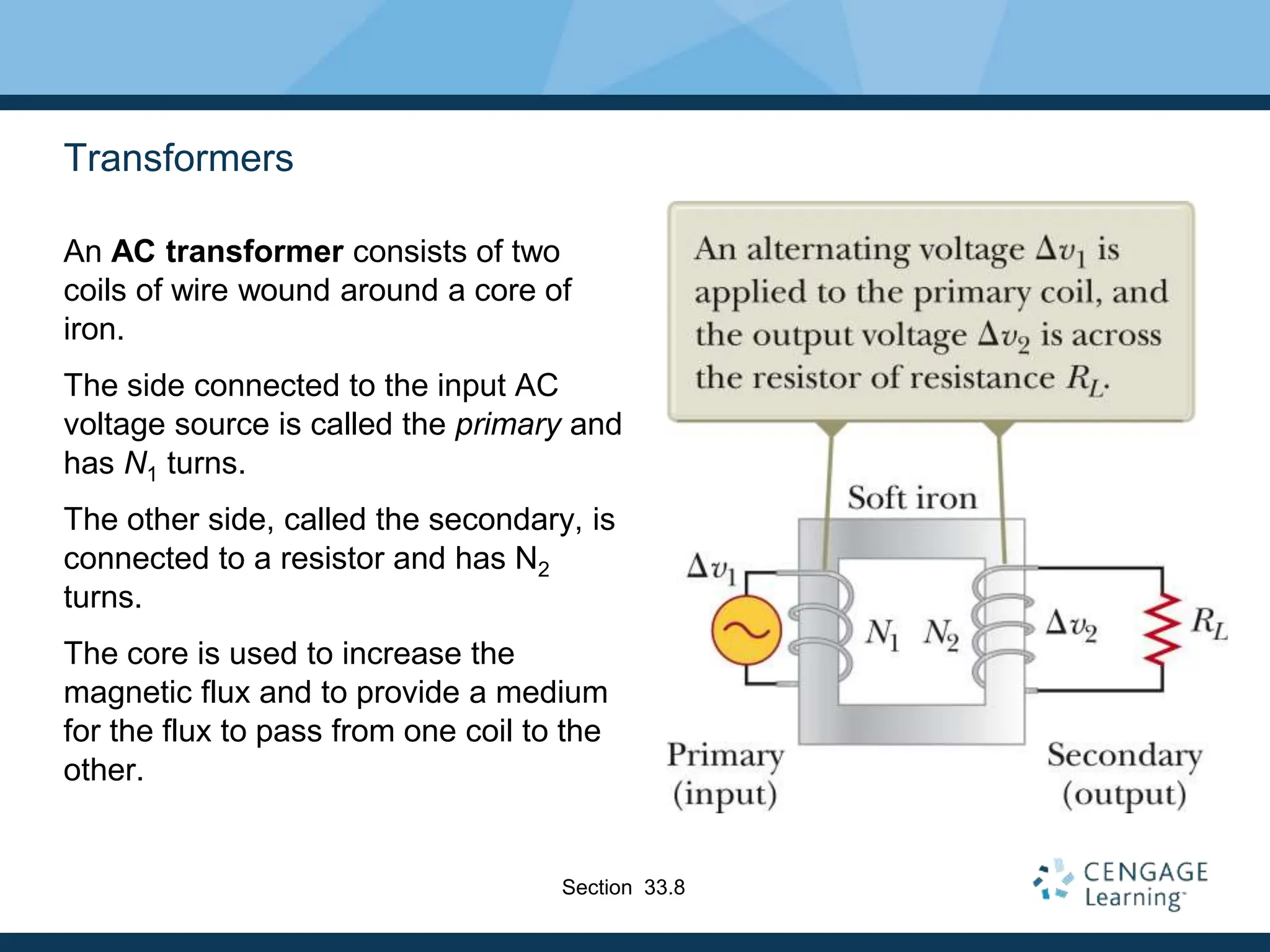
Transformers
An AC transformer consists of two
coils of wire wound around a core of
iron.
The side connected to the input AC
voltage source is called the primary and
has N1 turns.
The other side, called the secondary, is
connected to a resistor and has N2
turns.
The core is used to increase the
magnetic flux and to provide a medium
for the flux to pass from one coil to the
other.
Section 33.8
Transformers, cont.
Eddy-current losses are minimized by using a laminated core.
Assume an ideal transformer
One in which the energy losses in the windings and the core are zero.
 Typical transformers have power efficiencies of 90% to 99%.
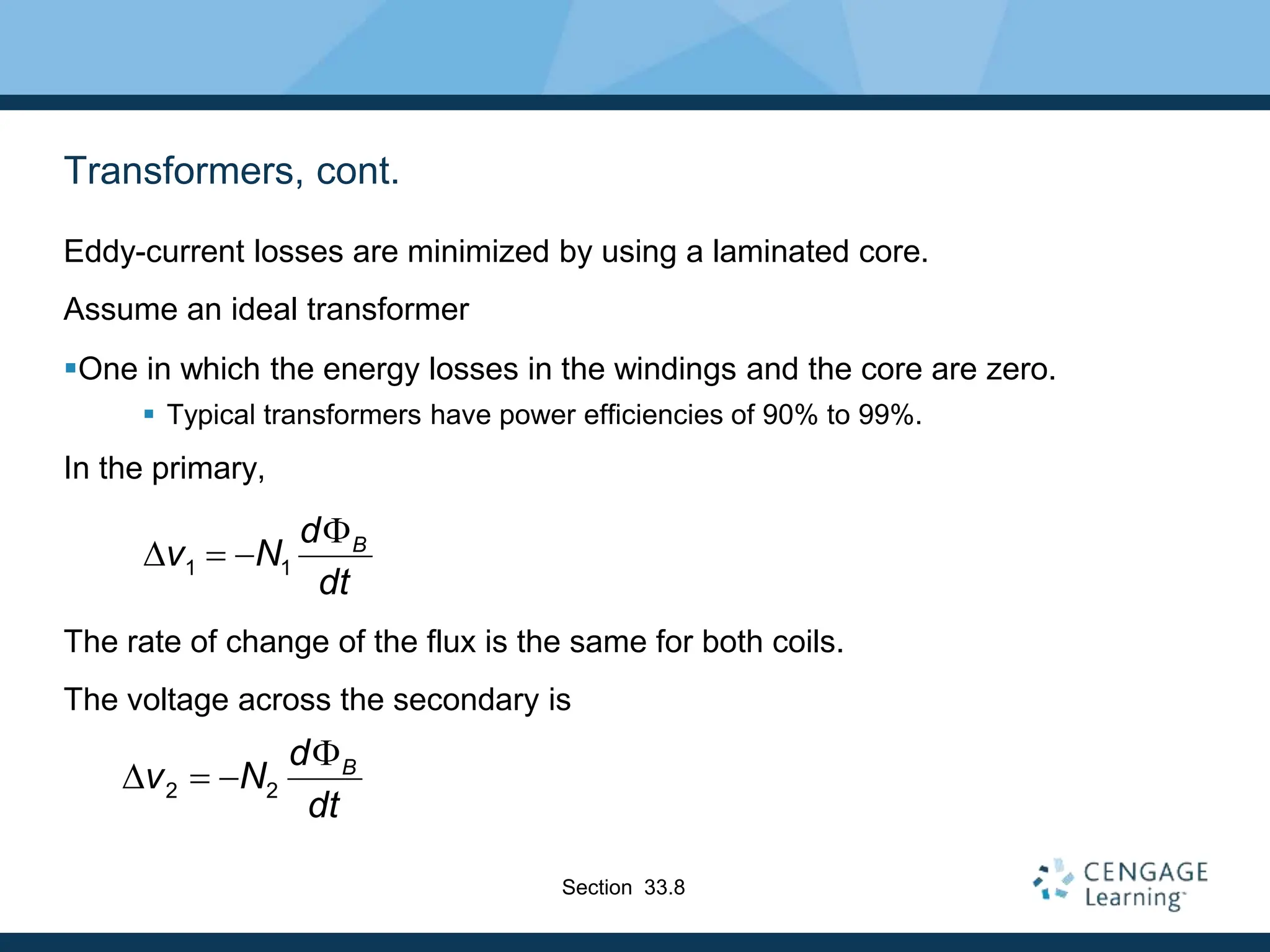
In the primary,
The rate of change of the flux is the same for both coils.
The voltage across the secondary is
1 1
B
d
v N
dt

D  
2 2
B
d
v N
dt

D  
Section 33.8
Transformers – Step-up and Step-down
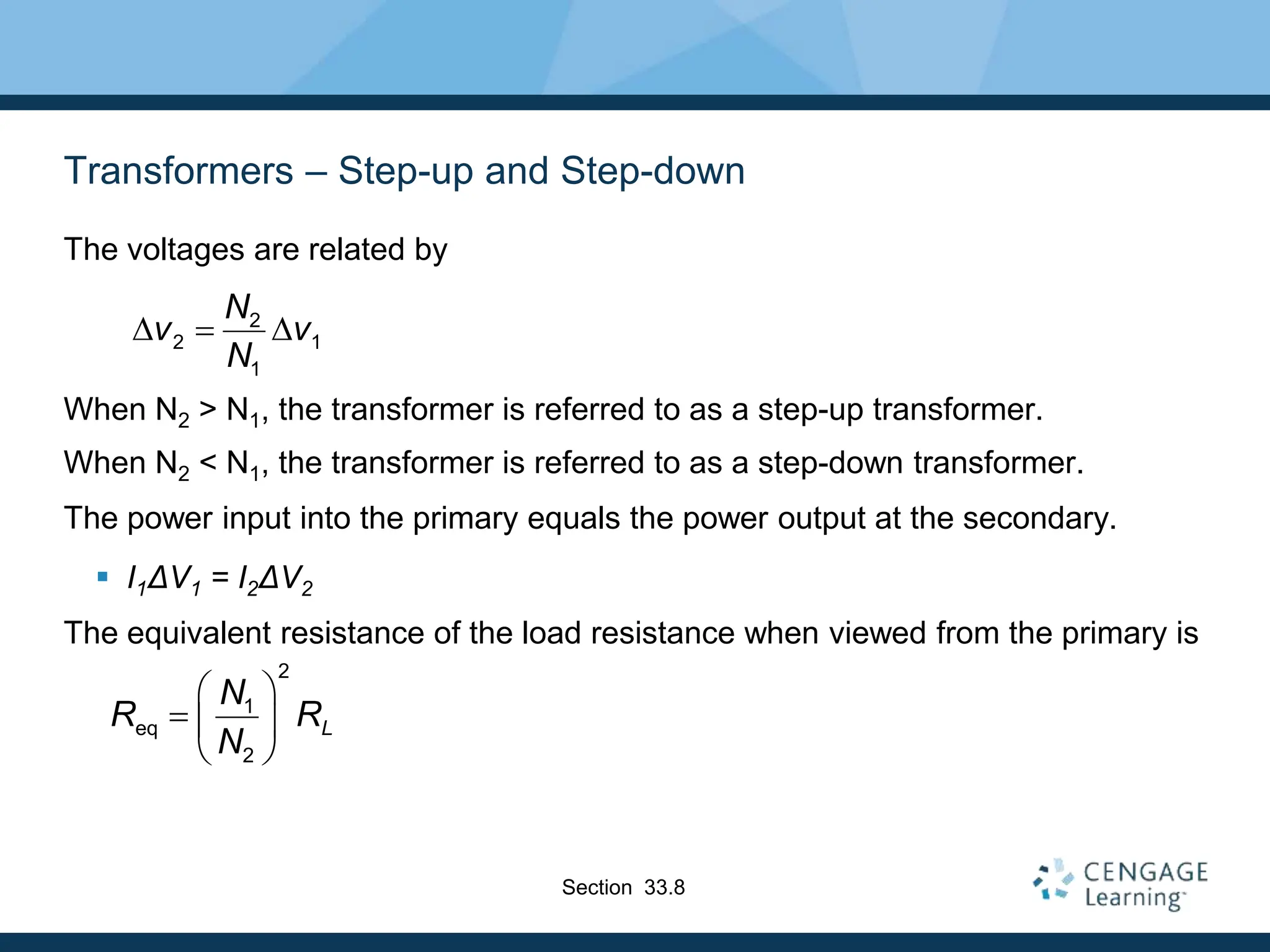
The voltages are related by
When N2 > N1, the transformer is referred to as a step-up transformer.
When N2 < N1, the transformer is referred to as a step-down transformer.
The power input into the primary equals the power output at the secondary.
 I1ΔV1 = I2ΔV2
The equivalent resistance of the load resistance when viewed from the primary is
2
2 1
1
N
v v
N
D  D
Section 33.8
2
1
eq
2
L
N
R R
N
 
  
 
Transformers, final
A transformer may be used to match resistances between the primary circuit and
the load.
This way, maximum power transfer can be achieved between a given power
source and the load resistance.
 In stereo terminology, this technique is called impedance matching.
Section 33.8
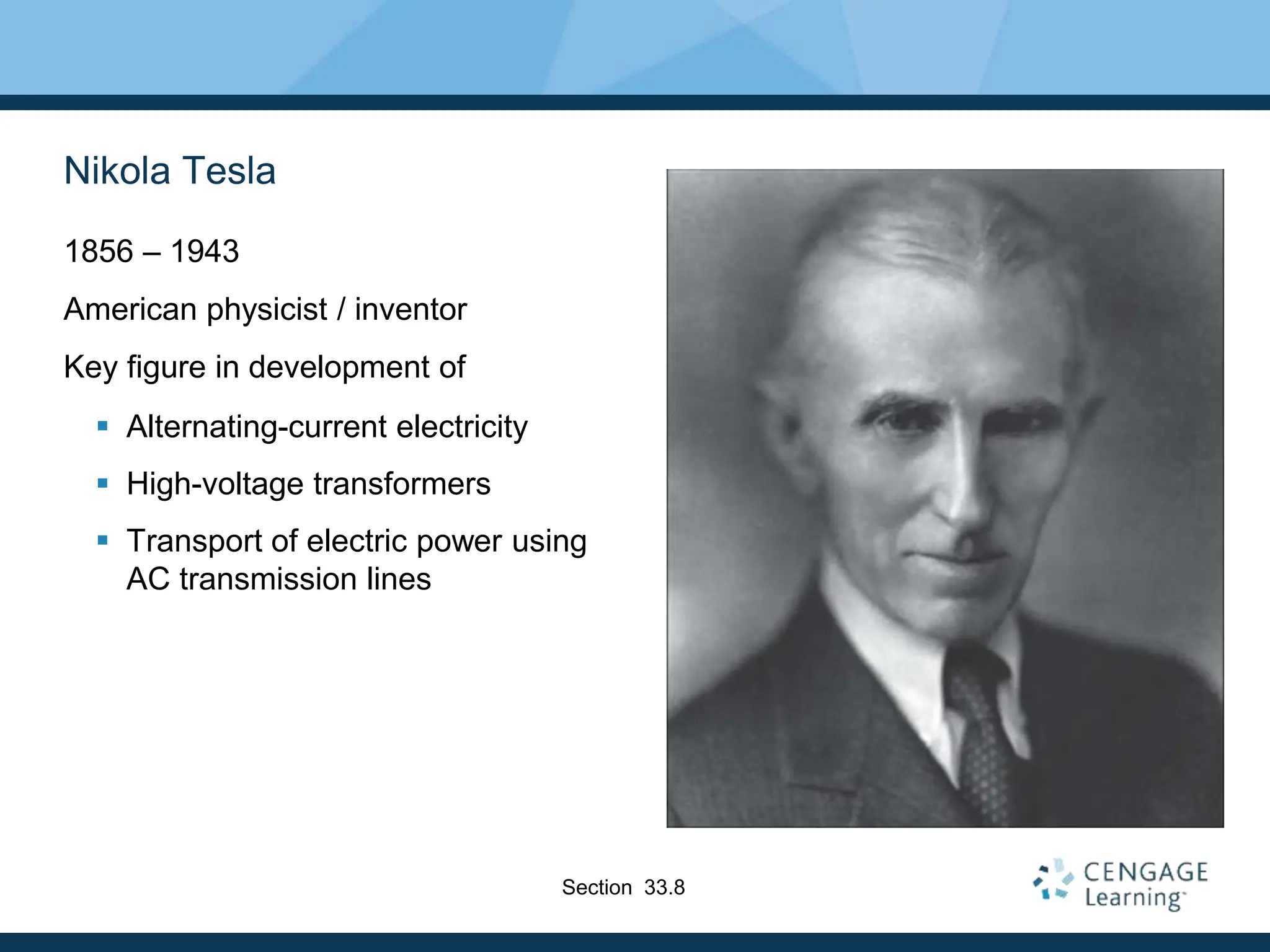
Nikola Tesla
1856 – 1943
American physicist / inventor
Key figure in development of
 Alternating-current electricity
 High-voltage transformers
 Transport of electric power using
AC transmission lines
Section 33.8
Rectifier
The process of converting alternating current to direct current is called
rectification.
A rectifier is the converting device.
The most important element in a rectifier circuit is the diode.
 A diode is a circuit element that conducts current in one direction but not the
other.
Section 33.9
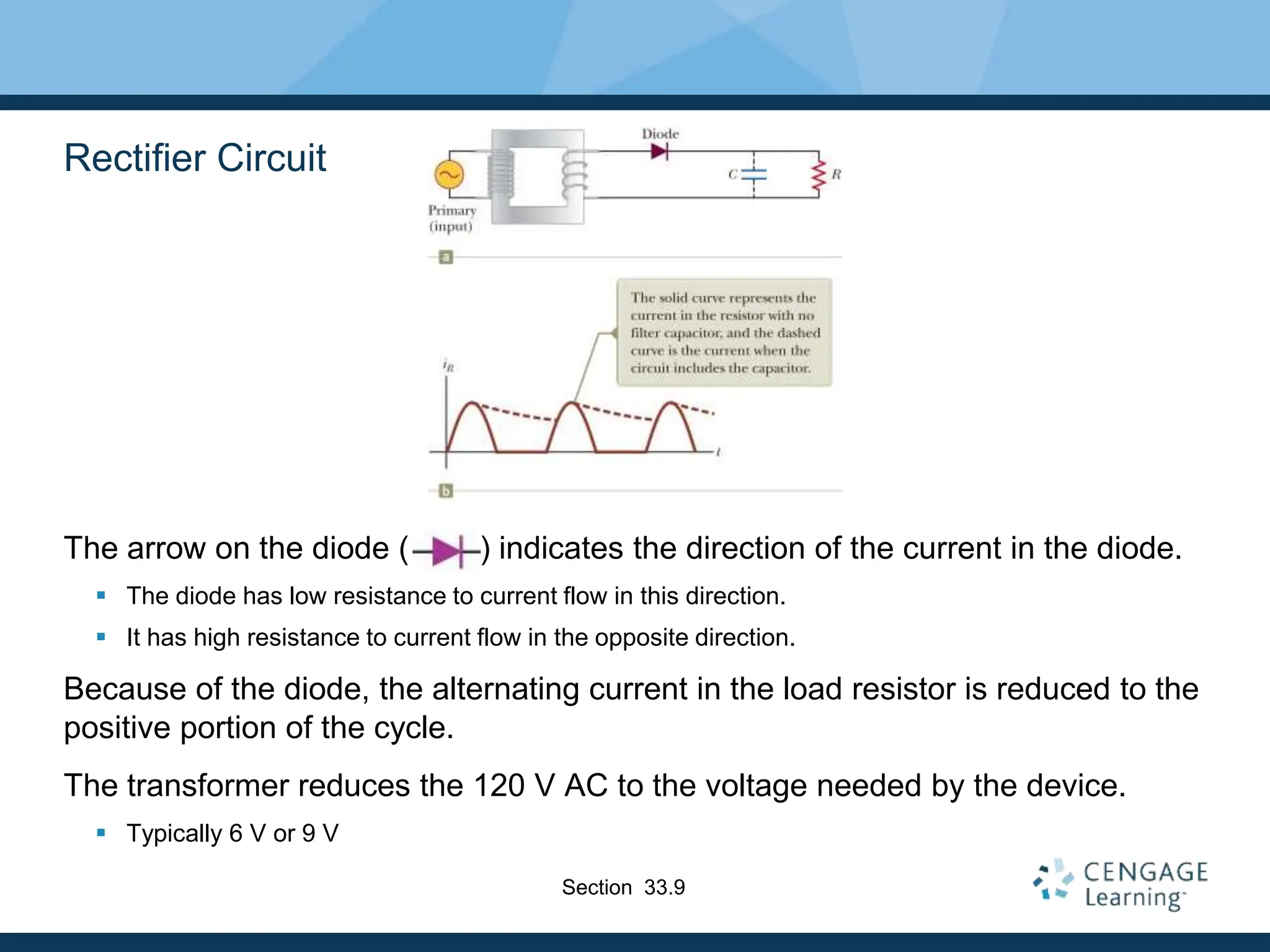
Rectifier Circuit
The arrow on the diode ( ) indicates the direction of the current in the diode.
 The diode has low resistance to current flow in this direction.
 It has high resistance to current flow in the opposite direction.
Because of the diode, the alternating current in the load resistor is reduced to the
positive portion of the cycle.
The transformer reduces the 120 V AC to the voltage needed by the device.
 Typically 6 V or 9 V
Section 33.9
Half-Wave Rectifier
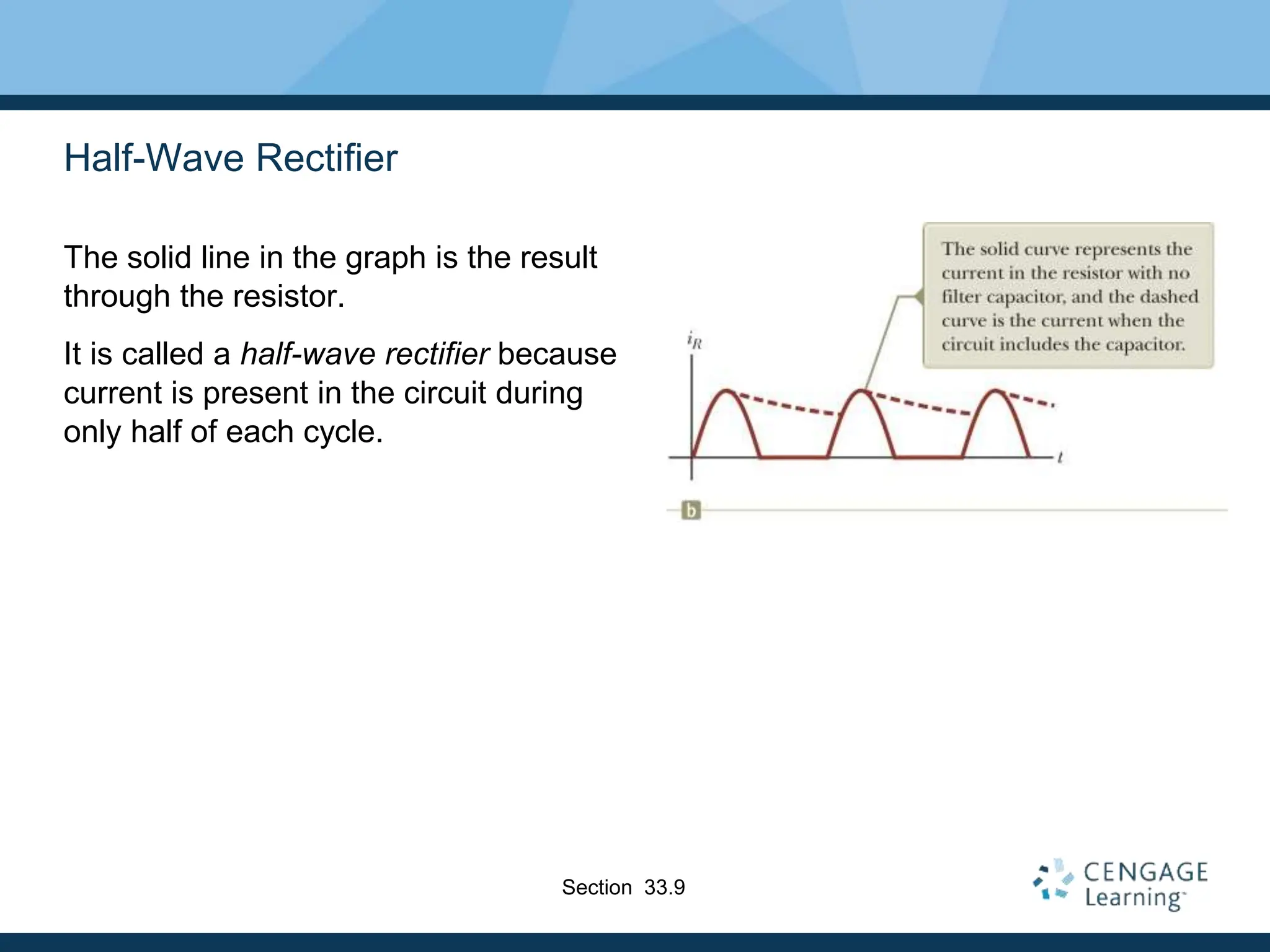
The solid line in the graph is the result
through the resistor.
It is called a half-wave rectifier because
current is present in the circuit during
only half of each cycle.
Section 33.9
Half-Wave Rectifier, Modification
A capacitor can be added to the circuit.
The circuit is now a simple DC power supply.
The time variation in the circuit is close to zero.
 It is determined by the RC time constant of the circuit.
 This is represented by the dotted lines in the graph shown in fig. 33.21 b.
Section 33.9
Filter Circuit, Example
A filter circuit is one used to smooth out or eliminate a time-varying signa.l
After rectification, a signal may still contain a small AC component.
 This component is often called a ripple.
By filtering, the ripple can be reduced.
Filters can also be built to respond differently to different frequencies.
Section 33.9
High-Pass Filter
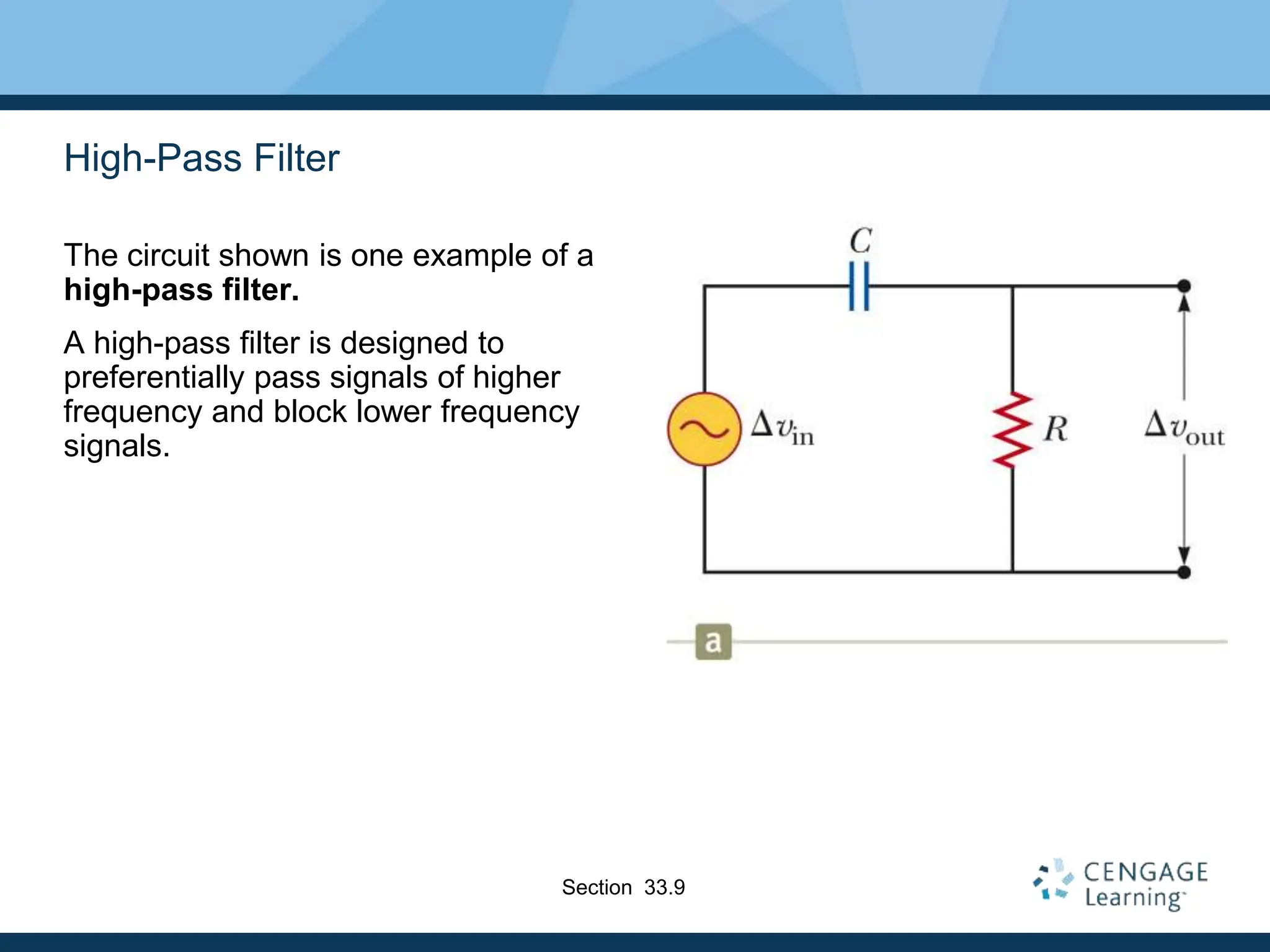
The circuit shown is one example of a
high-pass filter.
A high-pass filter is designed to
preferentially pass signals of higher
frequency and block lower frequency
signals.
Section 33.9
High-Pass Filter, cont
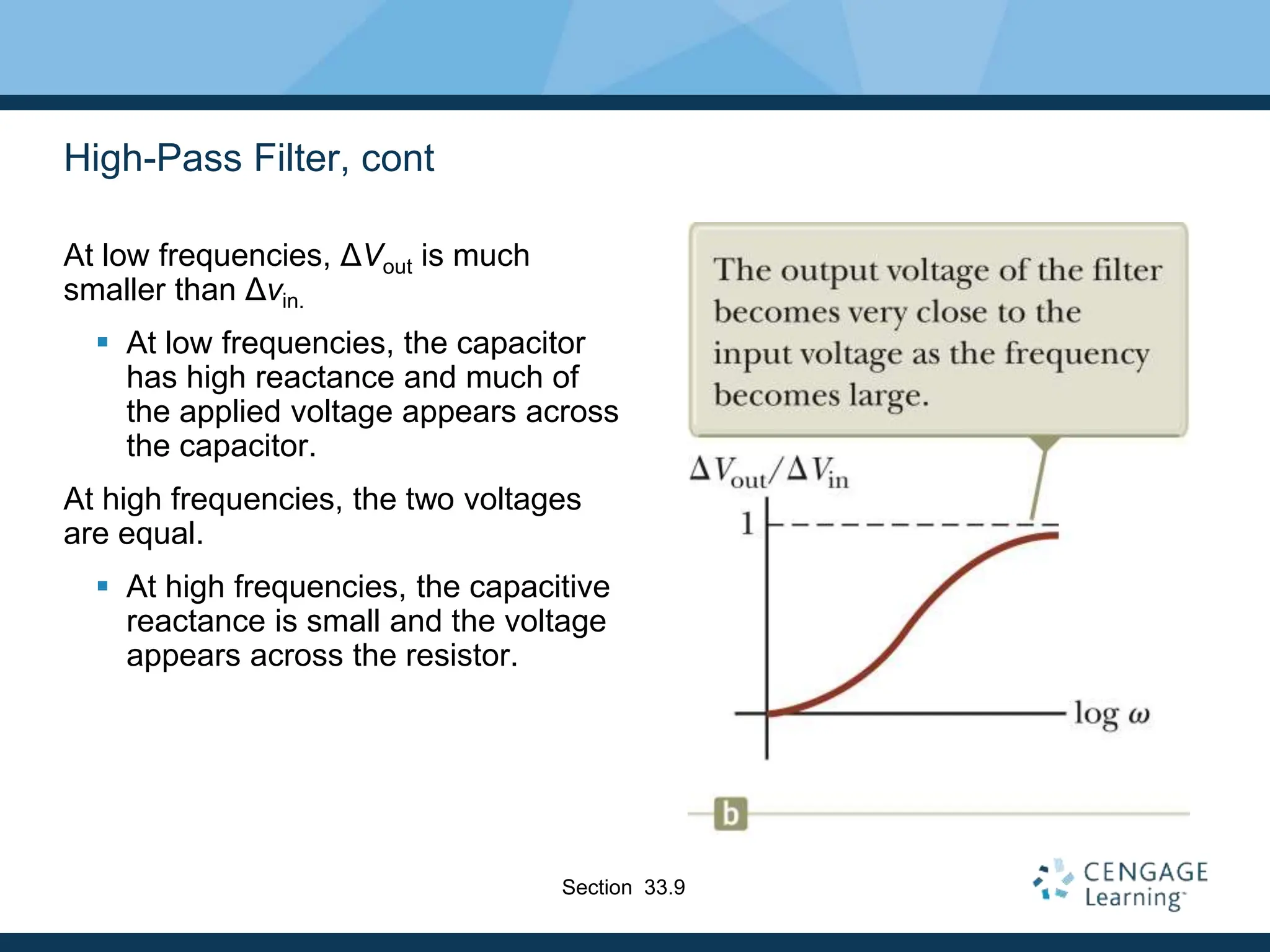
At low frequencies, ΔVout is much
smaller than Δvin.
 At low frequencies, the capacitor
has high reactance and much of
the applied voltage appears across
the capacitor.
At high frequencies, the two voltages
are equal.
 At high frequencies, the capacitive
reactance is small and the voltage
appears across the resistor.
Section 33.9
Low-Pass Filter
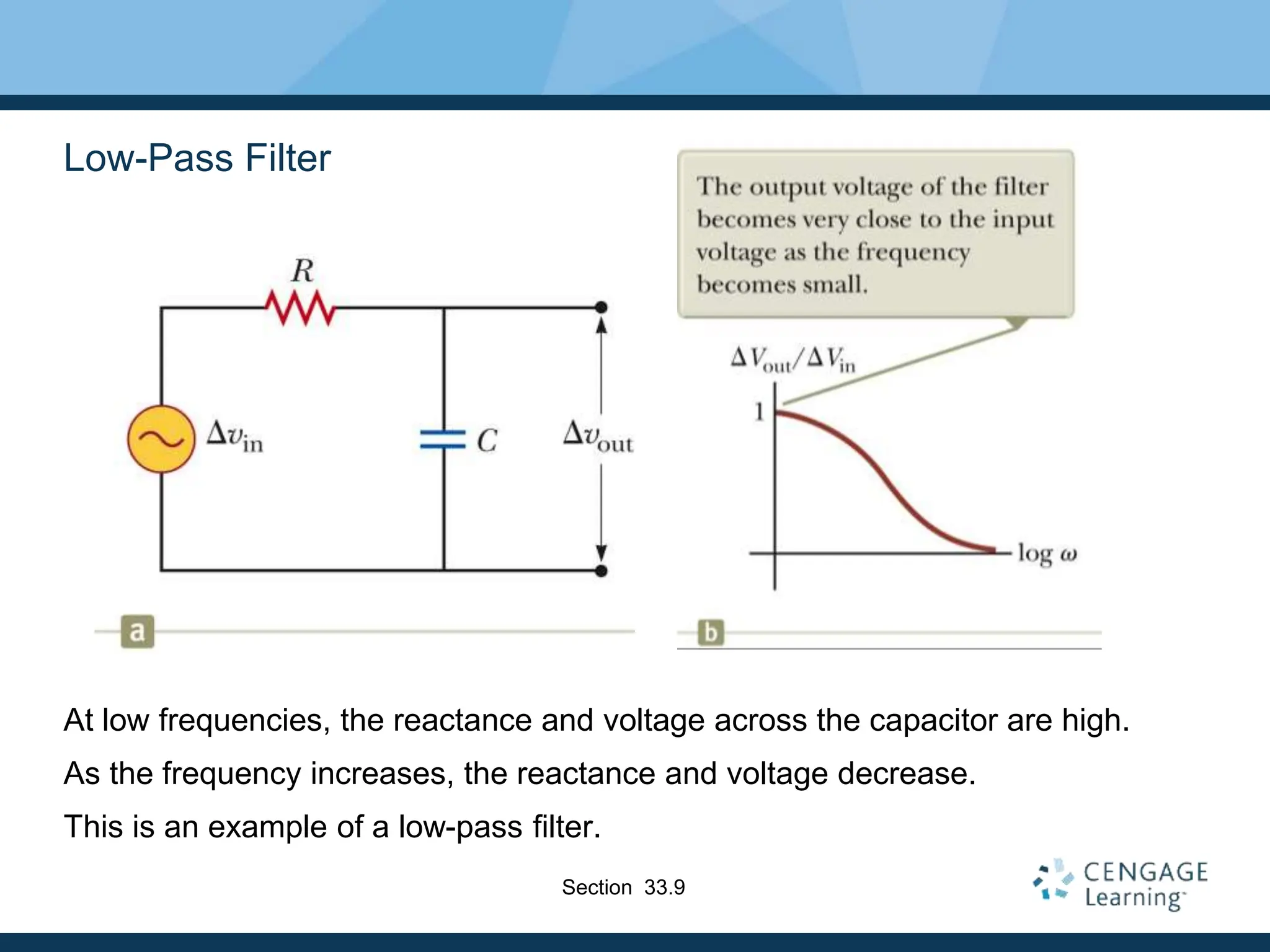
At low frequencies, the reactance and voltage across the capacitor are high.
As the frequency increases, the reactance and voltage decrease.
This is an example of a low-pass filter.
Section 33.9

Introduction to Alternating Currents AC Circuits

  • 1.
  • 2.
    Alternating Current Circuits Electricalappliances in the house use alternating current (AC) circuits. If an AC source applies an alternating voltage to a series circuit containing resistor, inductor, and capacitor, what are the amplitude and time characteristics of the alternating current. Other devices will be discussed  Transformers  Power transmission  Electrical filters Introduction
  • 3.
    AC Circuits An ACcircuit consists of a combination of circuit elements and a power source. The power source provides an alternating voltage, Dv. Notation note:  Lower case symbols will indicate instantaneous values.  Capital letters will indicate fixed values. Section 33.1
  • 4.
    AC Voltage The outputof an AC power source is sinusoidal and varies with time according to the following equation:  Δv = ΔVmax sin ωt  Δv is the instantaneous voltage.  ΔVmax is the maximum output voltage of the source.  Also called the voltage amplitude  ω is the angular frequency of the AC voltage. Section 33.1
  • 5.
    AC Voltage, cont. Theangular frequency is  ƒ is the frequency of the source.  T is the period of the source. The voltage is positive during one half of the cycle and negative during the other half. 2 2 ƒ π ω π T   Section 33.1
  • 6.
    AC Voltage, final Thecurrent in any circuit driven by an AC source is an alternating current that varies sinusoidally with time. Commercial electric power plants in the US use a frequency of 60 Hz.  This corresponds with an angular frequency of 377 rad/s. Section 33.1
  • 7.
    Resistors in anAC Circuit Consider a circuit consisting of an AC source and a resistor. The AC source is symbolized by ΔvR = DVmax= Vmax sin wt ΔvR is the instantaneous voltage across the resistor. Section 33.2
  • 8.
    Resistors in anAC Circuit, cont. The instantaneous current in the resistor is The instantaneous voltage across the resistor is also given as ΔvR = Imax R sin ωt sin sin max max I R R v V i ωt ωt R R D D    Section 33.2
  • 9.
    Resistors in anAC Circuit, final The graph shows the current through and the voltage across the resistor. The current and the voltage reach their maximum values at the same time. The current and the voltage are said to be in phase. For a sinusoidal applied voltage, the current in a resistor is always in phase with the voltage across the resistor. The direction of the current has no effect on the behavior of the resistor. Resistors behave essentially the same way in both DC and AC circuits. Section 33.2
  • 10.
    Phasor Diagram To simplifythe analysis of AC circuits, a graphical constructor called a phasor diagram can be used. A phasor is a vector whose length is proportional to the maximum value of the variable it represents. The vector rotates counterclockwise at an angular speed equal to the angular frequency associated with the variable. The projection of the phasor onto the vertical axis represents the instantaneous value of the quantity it represents. Section 33.2
  • 11.
    A Phasor isLike a Graph An alternating voltage can be presented in different representations. One graphical representation is using rectangular coordinates.  The voltage is on the vertical axis.  Time is on the horizontal axis. The phase space in which the phasor is drawn is similar to polar coordinate graph paper.  The radial coordinate represents the amplitude of the voltage.  The angular coordinate is the phase angle.  The vertical axis coordinate of the tip of the phasor represents the instantaneous value of the voltage.  The horizontal coordinate does not represent anything. Alternating currents can also be represented by phasors. Section 33.2
  • 12.
    rms Current andVoltage The average current in one cycle is zero. Resistors experience a temperature increase which depends on the magnitude of the current, but not the direction of the current. The power is related to the square of the current. The rms current is the average of importance in an AC circuit.  rms stands for root mean square Alternating voltages can also be discussed in terms of rms values. 0 707 2 max rms max I I . I   0707 2 max max . rms V V V D D   D Section 33.2
  • 13.
    Power The rate atwhich electrical energy is delivered to a resistor in the circuit is given by  P = i 2 R  i is the instantaneous current.  The heating effect produced by an AC current with a maximum value of Imax is not the same as that of a DC current of the same value.  The maximum current occurs for a small amount of time.  The average power delivered to a resistor that carries an alternating current is Section 33.2 2 av rms P I R 
  • 14.
    Notes About rmsValues rms values are used when discussing alternating currents and voltages because  AC ammeters and voltmeters are designed to read rms values.  Many of the equations that will be used have the same form as their DC counterparts. Section 33.2
  • 15.
    Inductors in anAC Circuit Kirchhoff’s loop rule can be applied and gives: 0 or 0 max , sin L v v di v L dt di v L V ωt dt D  D  D   D   D Section 33.3
  • 16.
    Current in anInductor The equation obtained from Kirchhoff's loop rule can be solved for the current This shows that the instantaneous current iL in the inductor and the instantaneous voltage ΔvL across the inductor are out of phase by (p/2) rad = 90o. max sin 2 max max max max cos sin I L L V V i ωt dt ωt L ωL V π V i ωt ωL ωL D D    D D           Section 33.3
  • 17.
    Phase Relationship ofInductors in an AC Circuit The current is a maximum when the voltage across the inductor is zero.  The current is momentarily not changing For a sinusoidal applied voltage, the current in an inductor always lags behind the voltage across the inductor by 90° (π/2). Section 33.3
  • 18.
    Phasor Diagram foran Inductor The phasors are at 90o with respect to each other. This represents the phase difference between the current and voltage. Specifically, the current lags behind the voltage by 90o. Section 33.3
  • 19.
    Inductive Reactance The factorωL has the same units as resistance and is related to current and voltage in the same way as resistance. Because ωL depends on the frequency, it reacts differently, in terms of offering resistance to current, for different frequencies. The factor is the inductive reactance and is given by:  XL = ωL Section 33.3
  • 20.
    Inductive Reactance, cont. Currentcan be expressed in terms of the inductive reactance: As the frequency increases, the inductive reactance increases  This is consistent with Faraday’s Law:  The larger the rate of change of the current in the inductor, the larger the back emf, giving an increase in the reactance and a decrease in the current. max rms max rms L L V V I or I X X D D   Section 33.3
  • 21.
    Voltage Across theInductor The instantaneous voltage across the inductor is max max sin sin L L di v L dt V ωt I X ωt D    D   Section 33.3
  • 22.
    Capacitors in anAC Circuit The circuit contains a capacitor and an AC source. Kirchhoff’s loop rule gives: Δv + Δvc = 0 and so Δv = ΔvC = ΔVmax sin ωt  Δvc is the instantaneous voltage across the capacitor. Section 33.4
  • 23.
    Capacitors in anAC Circuit, cont. The charge is q = CΔVmax sin ωt The instantaneous current is given by The current is p/2 rad = 90o out of phase with the voltage max max cos or sin 2 C C dq i ωC V ωt dt π i ωC V ωt   D    D      Section 33.4
  • 24.
    More About Capacitorsin an AC Circuit The current reaches its maximum value one quarter of a cycle sooner than the voltage reaches its maximum value. The current leads the voltage by 90o. Section 33.4
  • 25.
    Phasor Diagram forCapacitor The phasor diagram shows that for a sinusoidally applied voltage, the current always leads the voltage across a capacitor by 90o. Section 33.4
  • 26.
    Capacitive Reactance The maximumcurrent in the circuit occurs at cos ωt = 1 which gives The impeding effect of a capacitor on the current in an AC circuit is called the capacitive reactance and is given by max max 1 which gives C C V X I ωC X D   max max max (1 ) V I ωC V / ωC D  D  Section 33.4
  • 27.
    Voltage Across aCapacitor The instantaneous voltage across the capacitor can be written as ΔvC = ΔVmax sin ωt = Imax XC sin ωt. As the frequency of the voltage source increases, the capacitive reactance decreases and the maximum current increases. As the frequency approaches zero, XC approaches infinity and the current approaches zero.  This would act like a DC voltage and the capacitor would act as an open circuit. Section 33.4
  • 28.
    The RLC SeriesCircuit The resistor, inductor, and capacitor can be combined in a circuit. The current and the voltage in the circuit vary sinusoidally with time. Section 33.5
  • 29.
    The RLC SeriesCircuit, cont. The instantaneous voltage would be given by Δv = ΔVmax sin ωt. The instantaneous current would be given by i = Imax sin (ωt - φ).  φ is the phase angle between the current and the applied voltage. Since the elements are in series, the current at all points in the circuit has the same amplitude and phase. Section 33.5
  • 30.
    i and vPhase Relationships – Graphical View The instantaneous voltage across the resistor is in phase with the current. The instantaneous voltage across the inductor leads the current by 90°. The instantaneous voltage across the capacitor lags the current by 90°. Section 33.5
  • 31.
    i and vPhase Relationships – Equations The instantaneous voltage across each of the three circuit elements can be expressed as max max max sin sin sin cos 2 sin cos 2 R R L L L C C C v I R ωt V ωt π v I X ωt V ωt π v I X ωt V ωt D   D   D    D       D    D     Section 33.5
  • 32.
    More About Voltagein RLC Circuits ΔVR is the maximum voltage across the resistor and ΔVR = ImaxR. ΔVL is the maximum voltage across the inductor and ΔVL = ImaxXL. ΔVC is the maximum voltage across the capacitor and ΔVC = ImaxXC. The sum of these voltages must equal the voltage from the AC source. Because of the different phase relationships with the current, they cannot be added directly. Section 33.5
  • 33.
    Phasor Diagrams To accountfor the different phases of the voltage drops, vector techniques are used. Remember the phasors are rotating vectors The phasors for the individual elements are shown. Section 33.5
  • 34.
    Resulting Phasor Diagram Theindividual phasor diagrams can be combined. Here a single phasor Imax is used to represent the current in each element.  In series, the current is the same in each element. Section 33.5
  • 35.
    Vector Addition ofthe Phasor Diagram Vector addition is used to combine the voltage phasors. ΔVL and ΔVC are in opposite directions, so they can be combined. Their resultant is perpendicular to ΔVR. The resultant of all the individual voltages across the individual elements is Δvmax.  This resultant makes an angle of φ with the current phasor Imax. Section 33.5
  • 36.
    Total Voltage inRLC Circuits From the vector diagram, ΔVmax can be calculated       2 2 max 2 2 max max max 2 2 max max ( ) R L C L C L C V V V V I R I X I X V I R X X D  D  D  D    D    Section 33.5
  • 37.
    Impedance The current inan RLC circuit is Z is called the impedance of the circuit and it plays the role of resistance in the circuit, where  Impedance has units of ohms   max max max 2 2 L C V V I Z R X X D D       2 2 L C Z R X X    Section 33.5
  • 38.
    Phase Angle The righttriangle in the phasor diagram can be used to find the phase angle, φ. The phase angle can be positive or negative and determines the nature of the circuit. 1 tan L C X X φ R          Section 33.5
  • 39.
    Determining the Natureof the Circuit If f is positive  XL> XC (which occurs at high frequencies)  The current lags the applied voltage.  The circuit is more inductive than capacitive. If f is negative  XL< XC (which occurs at low frequencies)  The current leads the applied voltage.  The circuit is more capacitive than inductive. If f is zero  XL= XC  The circuit is purely resistive. Section 33.5
  • 40.
    Power in anAC Circuit The average power delivered by the AC source is converted to internal energy in the resistor.  Pavg = ½ Imax ΔVmax cos f = IrmsΔVrms cos f  cos f is called the power factor of the circuit We can also find the average power in terms of R.  Pavg = I2 rmsR When the load is purely resistive, f  0 and cos f = 1  Pavg = Irms ΔVrms Section 33.6
  • 41.
    Power in anAC Circuit, cont. The average power delivered by the source is converted to internal energy in the resistor. No power losses are associated with pure capacitors and pure inductors in an AC circuit.  In a capacitor, during one-half of a cycle, energy is stored and during the other half the energy is returned to the circuit and no power losses occur in the capacitor.  In an inductor, the source does work against the back emf of the inductor and energy is stored in the inductor, but when the current begins to decrease in the circuit, the energy is returned to the circuit. The power delivered by an AC circuit depends on the phase. Some applications include using capacitors to shift the phase to heavy motors or other inductive loads so that excessively high voltages are not needed. Section 33.6
  • 42.
    Resonance in anAC Circuit Resonance occurs at the frequency ωo where the current has its maximum value.  To achieve maximum current, the impedance must have a minimum value.  This occurs when XL = XC  Solving for the frequency gives The resonance frequency also corresponds to the natural frequency of oscillation of an LC circuit. The rms current has a maximum value when the frequency of the applied voltage matches the natural oscillator frequency. At the resonance frequency, the current is in phase with the applied voltage. 1 o ω LC  Section 33.7
  • 43.
    Resonance, cont. Resonance occursat the same frequency regardless of the value of R. As R decreases, the curve becomes narrower and taller. Theoretically, if R = 0 the current would be infinite at resonance.  Real circuits always have some resistance. Section 33.7
  • 44.
    Power as aFunction of Frequency Power can be expressed as a function of frequency in an RLC circuit. This shows that at resonance, the average power is a maximum.     2 2 2 2 2 2 2 2 rms av o V Rω P R ω L ω ω D    Section 33.7
  • 45.
    Quality Factor The sharpnessof the resonance curve is usually described by a dimensionless parameter known as the quality factor, Q. Q = ωo / Δω = (ωoL) / R  Δω is the width of the curve, measured between the two values of ω for which Pavg has half its maximum value.  These points are called the half-power points. A high-Q circuit responds only to a narrow range of frequencies.  Narrow peak A low-Q circuit can detect a much broader range of frequencies. A radio’s receiving circuit is an important application of a resonant circuit. Section 33.7
  • 46.
    Transformers An AC transformerconsists of two coils of wire wound around a core of iron. The side connected to the input AC voltage source is called the primary and has N1 turns. The other side, called the secondary, is connected to a resistor and has N2 turns. The core is used to increase the magnetic flux and to provide a medium for the flux to pass from one coil to the other. Section 33.8
  • 47.
    Transformers, cont. Eddy-current lossesare minimized by using a laminated core. Assume an ideal transformer One in which the energy losses in the windings and the core are zero.  Typical transformers have power efficiencies of 90% to 99%. In the primary, The rate of change of the flux is the same for both coils. The voltage across the secondary is 1 1 B d v N dt  D   2 2 B d v N dt  D   Section 33.8
  • 48.
    Transformers – Step-upand Step-down The voltages are related by When N2 > N1, the transformer is referred to as a step-up transformer. When N2 < N1, the transformer is referred to as a step-down transformer. The power input into the primary equals the power output at the secondary.  I1ΔV1 = I2ΔV2 The equivalent resistance of the load resistance when viewed from the primary is 2 2 1 1 N v v N D  D Section 33.8 2 1 eq 2 L N R R N       
  • 49.
    Transformers, final A transformermay be used to match resistances between the primary circuit and the load. This way, maximum power transfer can be achieved between a given power source and the load resistance.  In stereo terminology, this technique is called impedance matching. Section 33.8
  • 50.
    Nikola Tesla 1856 –1943 American physicist / inventor Key figure in development of  Alternating-current electricity  High-voltage transformers  Transport of electric power using AC transmission lines Section 33.8
  • 51.
    Rectifier The process ofconverting alternating current to direct current is called rectification. A rectifier is the converting device. The most important element in a rectifier circuit is the diode.  A diode is a circuit element that conducts current in one direction but not the other. Section 33.9
  • 52.
    Rectifier Circuit The arrowon the diode ( ) indicates the direction of the current in the diode.  The diode has low resistance to current flow in this direction.  It has high resistance to current flow in the opposite direction. Because of the diode, the alternating current in the load resistor is reduced to the positive portion of the cycle. The transformer reduces the 120 V AC to the voltage needed by the device.  Typically 6 V or 9 V Section 33.9
  • 53.
    Half-Wave Rectifier The solidline in the graph is the result through the resistor. It is called a half-wave rectifier because current is present in the circuit during only half of each cycle. Section 33.9
  • 54.
    Half-Wave Rectifier, Modification Acapacitor can be added to the circuit. The circuit is now a simple DC power supply. The time variation in the circuit is close to zero.  It is determined by the RC time constant of the circuit.  This is represented by the dotted lines in the graph shown in fig. 33.21 b. Section 33.9
  • 55.
    Filter Circuit, Example Afilter circuit is one used to smooth out or eliminate a time-varying signa.l After rectification, a signal may still contain a small AC component.  This component is often called a ripple. By filtering, the ripple can be reduced. Filters can also be built to respond differently to different frequencies. Section 33.9
  • 56.
    High-Pass Filter The circuitshown is one example of a high-pass filter. A high-pass filter is designed to preferentially pass signals of higher frequency and block lower frequency signals. Section 33.9
  • 57.
    High-Pass Filter, cont Atlow frequencies, ΔVout is much smaller than Δvin.  At low frequencies, the capacitor has high reactance and much of the applied voltage appears across the capacitor. At high frequencies, the two voltages are equal.  At high frequencies, the capacitive reactance is small and the voltage appears across the resistor. Section 33.9
  • 58.
    Low-Pass Filter At lowfrequencies, the reactance and voltage across the capacitor are high. As the frequency increases, the reactance and voltage decrease. This is an example of a low-pass filter. Section 33.9