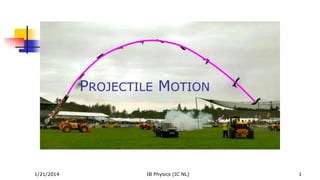
PROJECTILE MOTION

1/21/2014

IB Physics (IC NL)

1
Projectile Motion
Motion in Two Dimension

1/21/2014

IB Physics (IC NL)

2
Topic objectives









State the independence of the vertical and the horizontal
components of velocity for a projectile in a uniform field.
Describe and sketch the trajectory of projectile motion as
parabolic in the absence of air resistance.
Describe qualitatively the effect of air resistance on the
trajectory of a projectile.
Solve problems on projectile motion.
Remarks:
1. Proof of the parabolic nature of the trajectory is not required.
2. Problems may involve projectiles launched horizontally or at any angle above or below the
horizontal. Applying conservation of energy may provide a simpler solution to some problems
than using projectile motion kinematics equations.

1/21/2014

IB Physics (IC NL)

3
What is a projectile?






1/21/2014

When a body is in free motion, (moving
through the air without any forces apart
from gravity and air resistance), it is called a
projectile
Normally air resistance is ignored so the only
force acting on the object is the force due to
gravity
This is a uniform force acting downwards
IB Physics (IC NL)

4
Types of projectiles
There are three types of projectile depending on
the value of the angle between the initial velocity
and the x-axis.
1. θ = 0
horizontal projectile
2. θ = 90 vertical projectile (studied earlier)
3. θ = θ which is the general case.

1/21/2014

IB Physics (IC NL)

5
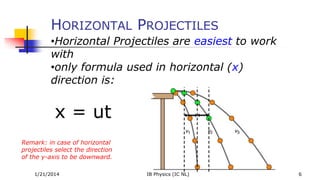
HORIZONTAL PROJECTILES
•Horizontal Projectiles are easiest to work
with
•only formula used in horizontal (x)
direction is:

x = ut
Remark: in case of horizontal
projectiles select the direction
of the y-axis to be downward.
1/21/2014

IB Physics (IC NL)

6
HORIZONTAL PROJECTILES
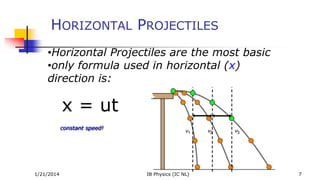
•Horizontal Projectiles are the most basic
•only formula used in horizontal (x)
direction is:

x = ut
constant speed!

1/21/2014

IB Physics (IC NL)

7
HORIZONTAL PROJECTILES
•vertical (y) direction is just freefall
•all of the initial velocity is in the x
direction
•So,
u
t1
t2
t3
t4
1/21/2014

IB Physics (IC NL)

8
EXAMPLE

A person decides to fire a rifle horizontally at a
bull’s-eye. The speed of the bullet as it leaves the
barrel of the gun is 890 m.s-1. He’s new to the
ideas of projectile motion so doesn’t aim high and
the bullet strikes the target 1.7 cm below the
center of the bull’s-eye.
What is the horizontal distance between the rifle
and the bull’s-eye?
start by drawing a picture:
label the explicit givens

890 m.s

1

1.7 cm

1/21/2014

IB Physics (IC NL)

9
EXAMPLE
What is the horizontal distance between the rifle
and the bull’s-eye?
X

ux

890 m.s

Y
1

y
ay
uy

1.7 cm
m
9.8 2
s 1
0 m.s
890 m.s

1m
100cm

0.017m

1

1.7 cm
want:

1/21/2014

dx

horizontal distance
IB Physics (IC NL)

10
EXAMPLE
which equation do we use?

use

y

0
1 2
ayt uyt
2

to find time

rewrite equation for t

t

1/21/2014

2y
ay

2(0.017)
9.8

IB Physics (IC NL)

0.059 s

11
EXAMPLE
Use t and ux to solve for x

x

1/21/2014

uxt

(890)(0.059)

IB Physics (IC NL)

52.4 m

12
1/21/2014

IB Physics (IC NL)

13
NON-HORIZONTAL PROJECTILES
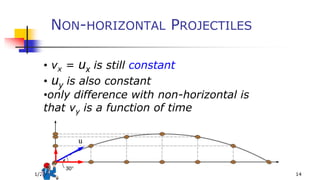
• vx = ux is still constant
• uy is also constant
•only difference with non-horizontal is
that vy is a function of time
u

1/21/2014

IB Physics (IC NL)

14
NON-HORIZONTAL PROJECTILES
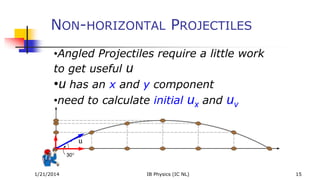
•Angled Projectiles require a little work
to get useful u
•u has an x and y component
•need to calculate initial ux and uy

u

1/21/2014

IB Physics (IC NL)

15
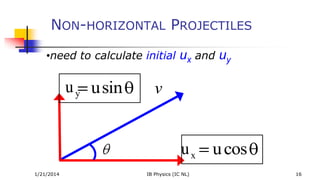
NON-HORIZONTAL PROJECTILES
•need to calculate initial

u y usin

ux and uy

v

ux
1/21/2014

IB Physics (IC NL)

u cos
16
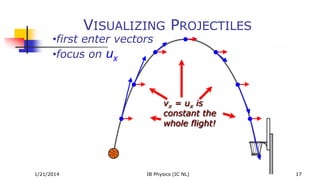
VISUALIZING PROJECTILES

•first enter vectors
•focus on ux

vx = ux is
constant the
whole flight!

1/21/2014

IB Physics (IC NL)

17
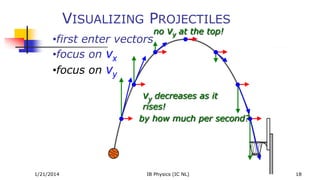
VISUALIZING PROJECTILES
•first enter vectors
•focus on vx
•focus on vy

no vy at the top!

vy decreases as it

rises!
by how much per second?

1/21/2014

IB Physics (IC NL)

18
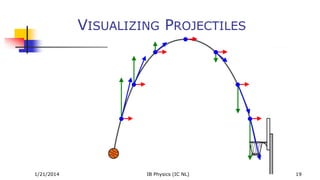
VISUALIZING PROJECTILES

1/21/2014

IB Physics (IC NL)

19
Boundary conditions: at t = 0, x0 = y0 = 0
ux = ucosθ and uy = usinθ

1/21/2014

IB Physics (IC NL)

20
Mathematical analysis


1/21/2014

IB Physics (IC NL)

21
Importance of time
Whatever you need to calculate look for time which is common for x and y



1/21/2014

IB Physics (IC NL)

22
LET’S

1/21/2014

ANALYZE THE JUMP

IB Physics (IC NL)

23
VARIED ANGLES
•which projectile angle shoots highest?
•larger θ means faster uy
•which projectile angle shoots farthest?
•45° has perfect balance of fast vx and long flight
time.

1/21/2014

IB Physics (IC NL)

24
If projectiles are launched at the same speed, but at different
angles, the height and range is of the projectile are affected.
1/21/2014

IB Physics (IC NL)

25
Solving Problems Involving Projectile
Motion
1. Read the problem carefully, and choose the
object(s) you are going to analyze.
2. Draw a diagram.
3. Choose an origin and a coordinate system.
4. Decide on the time interval; this is the same in
both directions, and includes only the time the
object is moving with constant acceleration g.
5.Examine the x and y motions separately.
Solving Problems Involving Projectile
Motion (cont.)
6. List known and unknown quantities.
Remember that vx never changes, and that
vy = 0 at the highest point.
7. Plan how you will proceed. Use the
appropriate equations; you may have to
combine some of them.

1/21/2014

IB Physics (IC NL)

28
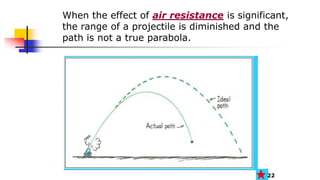
When the effect of air resistance is significant,
the range of a projectile is diminished and the
path is not a true parabola.

22
In the case of air resistance, the path of a high-speed
projectile falls below the idealized path and follows
the solid curve.

Computer-generated trajectories of a baseball with and
without drag.

23

Projectile motion

  • 1.
  • 2.
    Projectile Motion Motion inTwo Dimension 1/21/2014 IB Physics (IC NL) 2
  • 3.
    Topic objectives      State theindependence of the vertical and the horizontal components of velocity for a projectile in a uniform field. Describe and sketch the trajectory of projectile motion as parabolic in the absence of air resistance. Describe qualitatively the effect of air resistance on the trajectory of a projectile. Solve problems on projectile motion. Remarks: 1. Proof of the parabolic nature of the trajectory is not required. 2. Problems may involve projectiles launched horizontally or at any angle above or below the horizontal. Applying conservation of energy may provide a simpler solution to some problems than using projectile motion kinematics equations. 1/21/2014 IB Physics (IC NL) 3
  • 4.
    What is aprojectile?    1/21/2014 When a body is in free motion, (moving through the air without any forces apart from gravity and air resistance), it is called a projectile Normally air resistance is ignored so the only force acting on the object is the force due to gravity This is a uniform force acting downwards IB Physics (IC NL) 4
  • 5.
    Types of projectiles Thereare three types of projectile depending on the value of the angle between the initial velocity and the x-axis. 1. θ = 0 horizontal projectile 2. θ = 90 vertical projectile (studied earlier) 3. θ = θ which is the general case. 1/21/2014 IB Physics (IC NL) 5
  • 6.
    HORIZONTAL PROJECTILES •Horizontal Projectilesare easiest to work with •only formula used in horizontal (x) direction is: x = ut Remark: in case of horizontal projectiles select the direction of the y-axis to be downward. 1/21/2014 IB Physics (IC NL) 6
  • 7.
    HORIZONTAL PROJECTILES •Horizontal Projectilesare the most basic •only formula used in horizontal (x) direction is: x = ut constant speed! 1/21/2014 IB Physics (IC NL) 7
  • 8.
    HORIZONTAL PROJECTILES •vertical (y)direction is just freefall •all of the initial velocity is in the x direction •So, u t1 t2 t3 t4 1/21/2014 IB Physics (IC NL) 8
  • 9.
    EXAMPLE A person decidesto fire a rifle horizontally at a bull’s-eye. The speed of the bullet as it leaves the barrel of the gun is 890 m.s-1. He’s new to the ideas of projectile motion so doesn’t aim high and the bullet strikes the target 1.7 cm below the center of the bull’s-eye. What is the horizontal distance between the rifle and the bull’s-eye? start by drawing a picture: label the explicit givens 890 m.s 1 1.7 cm 1/21/2014 IB Physics (IC NL) 9
  • 10.
    EXAMPLE What is thehorizontal distance between the rifle and the bull’s-eye? X ux 890 m.s Y 1 y ay uy 1.7 cm m 9.8 2 s 1 0 m.s 890 m.s 1m 100cm 0.017m 1 1.7 cm want: 1/21/2014 dx horizontal distance IB Physics (IC NL) 10
  • 11.
    EXAMPLE which equation dowe use? use y 0 1 2 ayt uyt 2 to find time rewrite equation for t t 1/21/2014 2y ay 2(0.017) 9.8 IB Physics (IC NL) 0.059 s 11
  • 12.
    EXAMPLE Use t andux to solve for x x 1/21/2014 uxt (890)(0.059) IB Physics (IC NL) 52.4 m 12
  • 13.
  • 14.
    NON-HORIZONTAL PROJECTILES • vx= ux is still constant • uy is also constant •only difference with non-horizontal is that vy is a function of time u 1/21/2014 IB Physics (IC NL) 14
  • 15.
    NON-HORIZONTAL PROJECTILES •Angled Projectilesrequire a little work to get useful u •u has an x and y component •need to calculate initial ux and uy u 1/21/2014 IB Physics (IC NL) 15
  • 16.
    NON-HORIZONTAL PROJECTILES •need tocalculate initial u y usin ux and uy v ux 1/21/2014 IB Physics (IC NL) u cos 16
  • 17.
    VISUALIZING PROJECTILES •first entervectors •focus on ux vx = ux is constant the whole flight! 1/21/2014 IB Physics (IC NL) 17
  • 18.
    VISUALIZING PROJECTILES •first entervectors •focus on vx •focus on vy no vy at the top! vy decreases as it rises! by how much per second? 1/21/2014 IB Physics (IC NL) 18
  • 19.
  • 20.
    Boundary conditions: att = 0, x0 = y0 = 0 ux = ucosθ and uy = usinθ 1/21/2014 IB Physics (IC NL) 20
  • 21.
  • 22.
    Importance of time Whateveryou need to calculate look for time which is common for x and y  1/21/2014 IB Physics (IC NL) 22
  • 23.
  • 24.
    VARIED ANGLES •which projectileangle shoots highest? •larger θ means faster uy •which projectile angle shoots farthest? •45° has perfect balance of fast vx and long flight time. 1/21/2014 IB Physics (IC NL) 24
  • 25.
    If projectiles arelaunched at the same speed, but at different angles, the height and range is of the projectile are affected. 1/21/2014 IB Physics (IC NL) 25
  • 27.
    Solving Problems InvolvingProjectile Motion 1. Read the problem carefully, and choose the object(s) you are going to analyze. 2. Draw a diagram. 3. Choose an origin and a coordinate system. 4. Decide on the time interval; this is the same in both directions, and includes only the time the object is moving with constant acceleration g. 5.Examine the x and y motions separately.
  • 28.
    Solving Problems InvolvingProjectile Motion (cont.) 6. List known and unknown quantities. Remember that vx never changes, and that vy = 0 at the highest point. 7. Plan how you will proceed. Use the appropriate equations; you may have to combine some of them. 1/21/2014 IB Physics (IC NL) 28
  • 29.
    When the effectof air resistance is significant, the range of a projectile is diminished and the path is not a true parabola. 22
  • 30.
    In the caseof air resistance, the path of a high-speed projectile falls below the idealized path and follows the solid curve. Computer-generated trajectories of a baseball with and without drag. 23