 Characteristics of Sinusoidal
 Phasors
 Phasor Relationships for R, L and C
 Impedance
 Parallel and Series Resonance
 Examples for Sinusoidal Circuits Analysis
Single Phase AC
Sinusoidal Steady State Analysis
• Any steady state voltage or current in a linear circuit with a
sinusoidal source is a sinusoid
– All steady state voltages and currents have the same frequency as
the source
• In order to find a steady state voltage or current, all we need to know
is its magnitude and its phase relative to the source (we already know
its frequency)
• We do not have to find this differential equation from the circuit, nor
do we have to solve it
• Instead, we use the concepts of phasors and complex impedances
• Phasors and complex impedances convert problems involving
differential equations into circuit analysis problems
Characteristics of Sinusoids
Outline:
1. Time Period: T
2. Frequency: f (Hertz)
3. Angular Frequency:  (rad/sec)
4. Phase angle: Φ
5. Amplitude: Vm Im
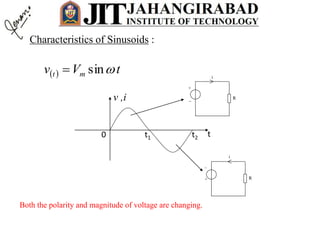
Characteristics of Sinusoids :
  tVv mt sin iI1
I1
I1 I1 I1 I1
R1
R1
R
5
5
+
_
IS 
E
I1
U1
+
-
U
I

iI1 I1 I1 I1
R1
R1
R
5
5
-
+
IS 
E
I1
U1
+
-
U
I

v ,i
tt1 t20
Both the polarity and magnitude of voltage are changing.
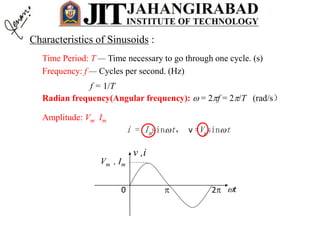
Radian frequency(Angular frequency):  = 2f = 2/T (rad/s)
Time Period: T — Time necessary to go through one cycle. (s)

Frequency: f — Cycles per second. (Hz)
f = 1/T
Amplitude: Vm Im
i = Imsint, v =Vmsint
v ,i
t 20
Vm , Im
Characteristics of Sinusoids :
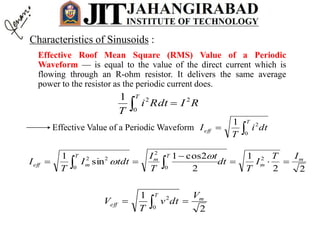
Effective Roof Mean Square (RMS) Value of a Periodic
Waveform — is equal to the value of the direct current which is
flowing through an R-ohm resistor. It delivers the same average
power to the resistor as the periodic current does.
RIRdti
T
T
2
0
21

Effective Value of a Periodic Waveform 
T
eff dti
T
I
0
21
22
1
2
2cos1
sin
1 2
0
2
0
22 m
m
T
m
T
meff
IT
I
T
dt
t
T
I
tdtI
T
I 

 


2
1
0
2 m
T
eff
V
dtv
T
V  
Characteristics of Sinusoids :
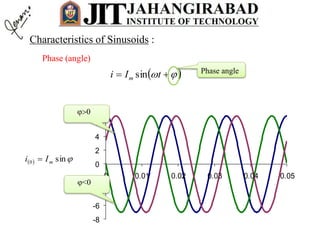
Phase (angle)
   tIi m sin
  sin0 mIi 
Phase angle
-8
-6
-4
-2
0
2
4
6
8
0 0.01 0.02 0.03 0.04 0.05
<0
0
Characteristics of Sinusoids :
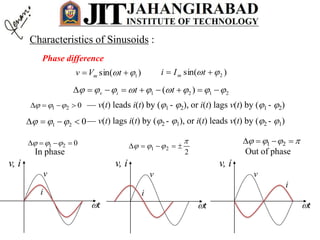
)sin( 1  tVv m
)sin( 2  tIi m
Phase difference
2121 )(   ttiv
021   — v(t) leads i(t) by (1 - 2), or i(t) lags v(t) by (1 - 2)
2
21

 
v, i
t
v
i
  21
Out of phase
t
v, i
v
i
v, i
t
v
i
021  
In phase
021   — v(t) lags i(t) by (2 - 1), or i(t) leads v(t) by (2 - 1)
Characteristics of Sinusoids :
Review
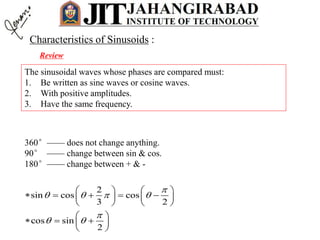
The sinusoidal waves whose phases are compared must:
1. Be written as sine waves or cosine waves.
2. With positive amplitudes.
3. Have the same frequency.
360°—— does not change anything.
90° —— change between sin & cos.
180°—— change between + & -
2
sin cos cos
3 2
cos sin
2

   

 
   
       
   
 
   
 
Characteristics of Sinusoids :
Phase difference
 
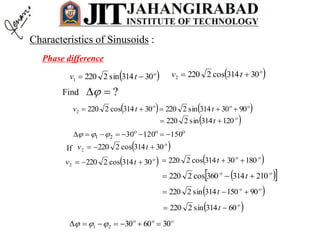
30314sin22201  tv
   
9030314sin222030314cos22202  ttv
 
120314sin2220  t

1501203021  
 
30314cos22202  tv
 
30314cos22202  tv  
18030314cos2220  t
  
210314360cos2220  t
 
90150314sin2220  t
 
60314sin2220  t

30603021  
Find ?
 
30314cos22202  tvIf
Characteristics of Sinusoids :
Phase difference
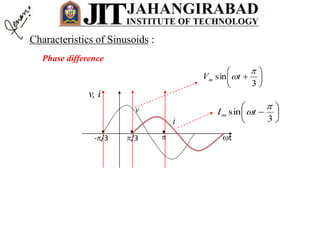
v, i
t
v
i
-/3 /3
• ••








3
sin

tVm







3
sin

tIm
Characteristics of Sinusoids :
Outline:
1. Complex Numbers
2. Rotating Vector
3. Phasors
A sinusoidal voltage/current at a given frequency, is characterized by only
two parameters : amplitude and phase
A phasor is a Complex Number which represents magnitude and phase of a sinusoid
Phasors
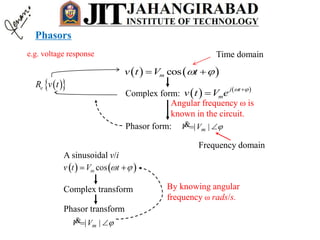
e.g. voltage response
A sinusoidal v/i
Complex transform
Phasor transform
By knowing angular
frequency ω rads/s.
Time domain
Frequency domain
  eR v t
Complex form:
   cosmv t V t  
Phasor form:
   j t
mv t V e
 

Angular frequency ω is
known in the circuit.
 || mVV
 || mVV
Phasors
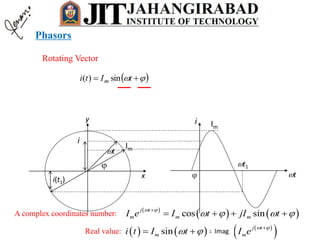
Rotating Vector
   tIti m sin)(
i
Im
t1
i
t
Im

t
x
y
 
   
     
 max
cos sin
sin
j t
m m m
j t
m m
I e I t jI t
i t I t I I e
 
 
   
 


   
  
A complex coordinates number:
Real value:
i(t1)
Imag
Phasors
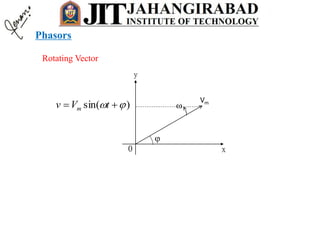
Rotating Vector
Vm
x
y
0

)sin(   tVv m
Phasors
Complex Numbers
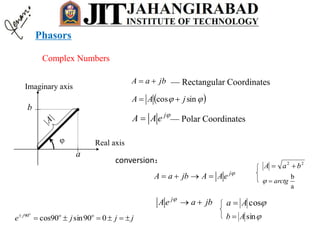
jbaA  — Rectangular Coordinates
  sincos jAA 
j
eAA  — Polar Coordinates
j
eAAjbaA 
conversion: 22
baA 
a
b
arctg
jbaeA j

cosAa 
sinAb 

a
b
Real axis
Imaginary axis
jjje j

090sin90cos90 
Phasors
Complex Numbers
Arithmetic With Complex Numbers
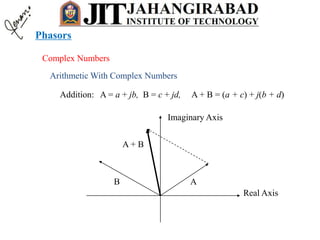
Addition: A = a + jb, B = c + jd, A + B = (a + c) + j(b + d)
Real Axis
Imaginary Axis
AB
A + B
Phasors
Complex Numbers
Arithmetic With Complex Numbers
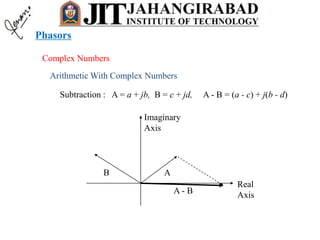
Subtraction : A = a + jb, B = c + jd, A - B = (a - c) + j(b - d)
Real
Axis
Imaginary
Axis
AB
A - B
Phasors
Complex Numbers
Arithmetic With Complex Numbers
Multiplication : A = Am  A, B = Bm  B
A  B = (Am  Bm)  (A + B)
Division: A = Am  A , B = Bm  B
A / B = (Am / Bm)  (A - B)
Phasors
Phasors
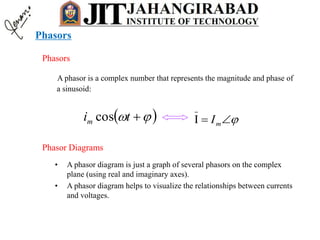
A phasor is a complex number that represents the magnitude and phase of
a sinusoid:
  tim cos  mI
Phasor Diagrams
• A phasor diagram is just a graph of several phasors on the complex
plane (using real and imaginary axes).
• A phasor diagram helps to visualize the relationships between currents
and voltages.
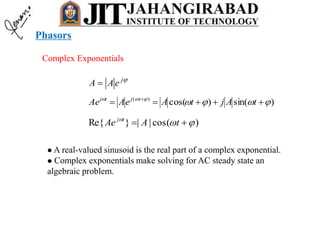
Phasors
)sin()cos()(

 
tAjtAeAAe tjtj
)cos(||}Re{ 
 tAAe tj
Complex Exponentials
j
eAA 
 A real-valued sinusoid is the real part of a complex exponential.
 Complex exponentials make solving for AC steady state an
algebraic problem.
Phasors
Phasor Relationships for R, L and C
Outline:
I-V Relationship for R, L and C,
Power conversion
Phasor Relationships for R, L and C
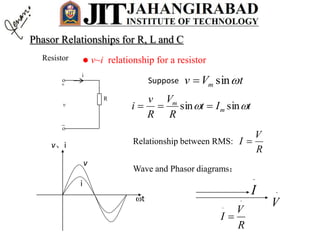
 v~i relationship for a resistor
_
v
i
R

 +
S 


tIt
R
V
R
v
i m
m
 sinsin 
tVv m sin
Relationship between RMS:
R
V
I 
Wave and Phasor diagrams:
v、i
t
v
i 
I 
V
R
V
I



Resistor
Suppose
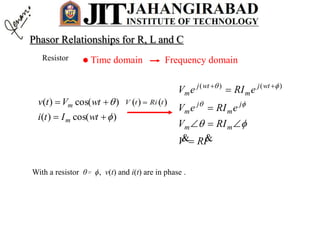
 Time domain Frequency domainResistor
With a resistor θ﹦ϕ, v(t) and i(t) are in phase .
)cos()(
)cos()(




wtIti
wtVtv
m
m
IRV
RIV
eRIeV
eRIeV
mm
j
m
j
m
wtj
m
wtj
m



 


 )()(
Phasor Relationships for R, L and C
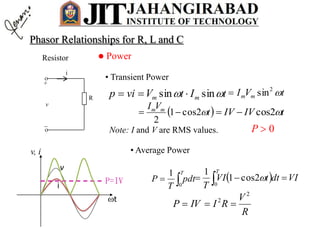
 PowerResistor
_
v
i
R
+

 P  0
tItVvip mm  sinsin  tVI mm 2
sin
 t
VI mm
2cos1
2
 tIVIV 2cos
v, i
t
v
i
P=IV 
T
pdt
T
P
0
1
  
T
VIdttVI
T 0
2cos1
1

R
V
RIIVP
2
2

• Average Power
• Transient Power
Note: I and V are RMS values.
Phasor Relationships for R, L and C
Resistor
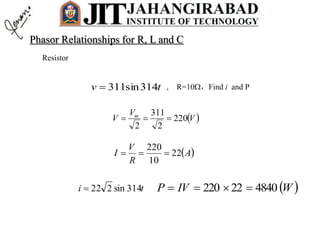
, R=10,Find i and Ptv 314sin311
 V
V
V m
220
2
311
2

 A
R
V
I 22
10
220

ti 314sin222  WIVP 484022220 
Phasor Relationships for R, L and C
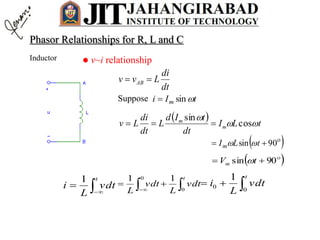
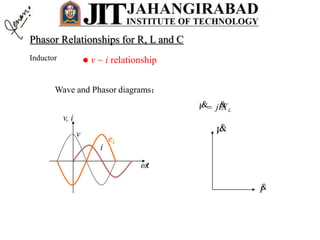
 v~i relationshipInductor
dt
di
Lvv AB 
  tLI
dt
tId
L
dt
di
Lv m
m


cos
sin

 
90sin  tLIm 
 
90sin  tVm 
 

t
vdt
L
i
1
 

t
vdt
L
vdt
L 0
0 11

t
vdt
L
i
0
0
1
tIi m sinSuppose
Phasor Relationships for R, L and C
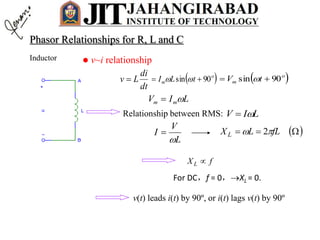
 v~i relationshipInductor
 
90sin  tLIm 
dt
di
Lv   
90sin  tVm 
LIV mm 
Relationship between RMS: LIV 
L
V
I

 fLLXL  2  
For DC,f = 0,XL = 0.
fXL 
v(t) leads i(t) by 90º, or i(t) lags v(t) by 90º
Phasor Relationships for R, L and C
 v ~ i relationshipInductor
v, i
t
v
i
eL
V
I
LXIjV 
Wave and Phasor diagrams:
Phasor Relationships for R, L and C
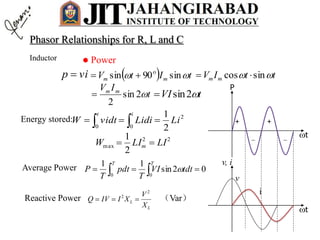
 PowerInductor
vip    tItV mm  sin90sin 
 ttIV mm  sincos 
t
IV mm
2sin
2
 tVI 2sin
P
t
v, i
t
v
i
++
--22
max
2
1
LILIW m 
2
00 2
1
LiLidividtW
it
 Energy stored:
  
T T
tdtVI
T
pdt
T
P
0 0
02sin
11
Average Power
Reactive Power
L
L
X
V
XIIVQ
2
2
 (Var)
Phasor Relationships for R, L and C
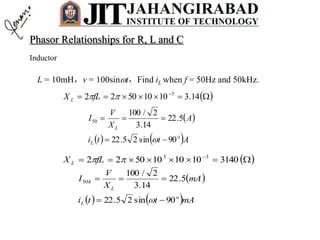
Inductor
L = 10mH,v = 100sint,Find iL when f = 50Hz and 50kHz.
  
14.310105022 3
fLX L
 
   Atti
A
X
V
I
L
L

90sin25.22
5.22
14.3
2/100
50



  
31401010105022 33
fLX L
 
   mAtti
mA
X
V
I
L
L
k

90sin25.22
5.22
14.3
2/100
50



Phasor Relationships for R, L and C
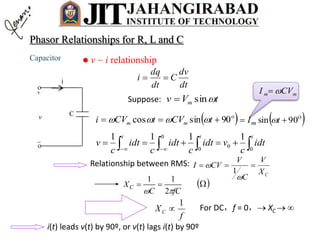
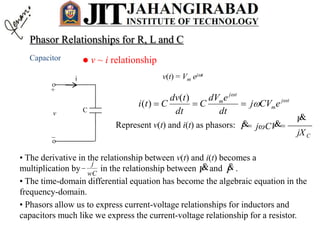
 v ~ i relationshipCapacitor
_
v
i
+


C
dt
dv
C
dt
dq
i 
tVv m sinSuppose:
 
90sincos  tCVtCVi mm   
90sin  tIm 
   

t tt
idt
c
vidt
c
idt
c
idt
c
v
0
0
0
0
1111
i(t) leads v(t) by 90º, or v(t) lags i(t) by 90º
Relationship between RMS:
CX
V
C
V
CVI 


1
 
fCC
XC
 2
11

For DC,f = 0, XC  
f
XC
1

mm CVI 
Phasor Relationships for R, L and C
_
v
i
+


C
tj
m
tj
m
eCVj
dt
edV
C
dt
tdv
Cti 


)(
)(
v(t) = Vm ejt
Represent v(t) and i(t) as phasors:
CjX
V
VCωjI ==


• The derivative in the relationship between v(t) and i(t) becomes a
multiplication by in the relationship between and .
• The time-domain differential equation has become the algebraic equation in the
frequency-domain.
• Phasors allow us to express current-voltage relationships for inductors and
capacitors much like we express the current-voltage relationship for a resistor.
 v ~ i relationshipCapacitor
V I
wC
j

Phasor Relationships for R, L and C
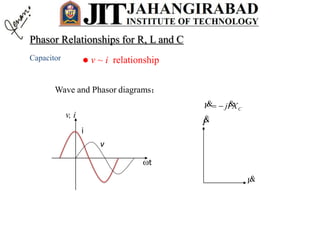
 v ~ i relationshipCapacitor
v, i
t
v
i
I
V
CXIjV  
Wave and Phasor diagrams:
Phasor Relationships for R, L and C
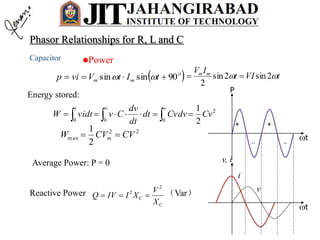
PowerCapacitor
Average Power: P = 0
Reactive Power
C
C
X
V
XIIVQ
2
2
 (Var)
 
90sinsin  tItVvip mm  tVIt
IV mm
 2sin2sin
2

P
t
v, i
t
v
i
++
--
Energy stored:
  
t vv
CvCvdvdt
dt
dv
CvvidtW
0 0
2
0 2
1
22
max
2
1
CVCVW m 
Phasor Relationships for R, L and C
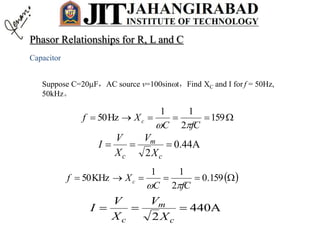
Capacitor
Suppose C=20F,AC source v=100sint,Find XC and I for f = 50Hz,
50kHz。
 159
2
11
Hz50
fCC
Xf c

A44.0
2

c
m
c X
V
X
V
I
  159.0
2
11
KHz50
fCC
Xf c

A440
2

c
m
c X
V
X
V
I
Phasor Relationships for R, L and C
Review (v – i Relationship)
Time domain Frequency domain
iRv  IRV  
I
Cj
V  

1
ILjV   
dt
di
LvL 
dt
dv
CiC 
C
XC

1

LXL ,
,
, v and i are in phase.
, v leads i by 90°.
, v lags i by 90°.
R
C
L
Phasor Relationships for R, L and C
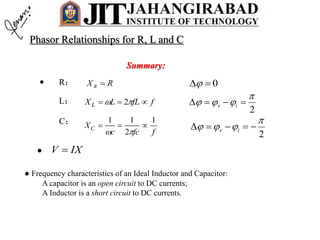
Summary:
 R: RX R  0
L: ffLLXL   2
2

  iv
C:
ffcc
XC
1
2
11

 2

  iv
 IXV 
 Frequency characteristics of an Ideal Inductor and Capacitor:
A capacitor is an open circuit to DC currents;
A Inductor is a short circuit to DC currents.
Phasor Relationships for R, L and C
Impedance (Z)
Outline:
Complex currents and voltages.
Impedance
Phasor Diagrams
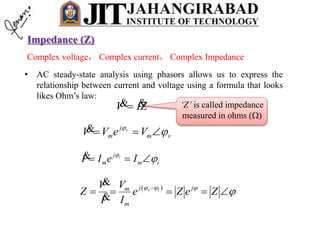
• AC steady-state analysis using phasors allows us to express the
relationship between current and voltage using a formula that looks
likes Ohm’s law:
ZIV 
Complex voltage, Complex current, Complex Impedance
vm
j
m VeVV v


im
j
m IeII i



 
ZeZe
I
V
I
V
Z jj
m
m iv )(


‘Z’ is called impedance
measured in ohms ()
Impedance (Z)
Complex Impedance

 
ZeZe
I
V
I
V
Z jj
m
m iv )(


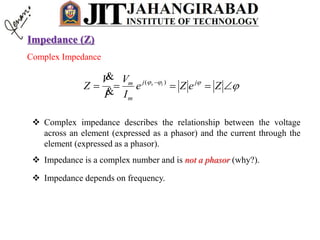
 Complex impedance describes the relationship between the voltage
across an element (expressed as a phasor) and the current through the
element (expressed as a phasor).
 Impedance is a complex number and is not a phasor (why?).
 Impedance depends on frequency.
Impedance (Z)
Complex Impedance
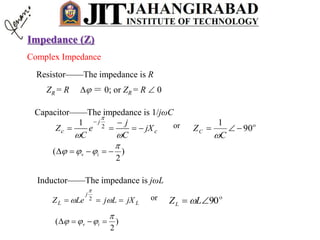
ZR = R  = 0; or ZR = R  0
Resistor——The impedance is R
c
j
c jX
C
j
e
C
Z 





21
)
2
(

  iv
or 
90
1

C
ZC

Capacitor——The impedance is 1/jωC
L
j
L jXLjLeZ  

2
)
2
(

  iv
or 
90 LZL 
Inductor——The impedance is jωL
Impedance (Z)
Complex Impedance
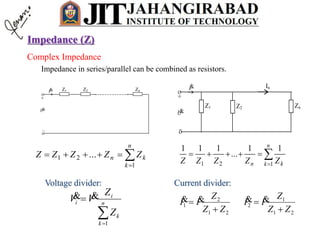
Impedance in series/parallel can be combined as resistors.
_
U
U
Z1
+

Z2 Zn


I



n
k
kn ZZZZZ
1
21 ...
_
US
In
I1
I1
I1 I1 I1 I1
 


R1
R1
Zn
5
5
5 5
+
+
_
US
IS 
U1
+
-
U

I

Z2Z1




n
k kn ZZZZZ 121
11
...
111
21
1
2
21
2
1
ZZ
Z
II
ZZ
Z
II



 
Current divider:

 n
k
k
i
i
Z
Z
VV
1

Voltage divider:
Impedance (Z)
Complex Impedance
_
+


V
 I


1IZ1
Z2 Z

 
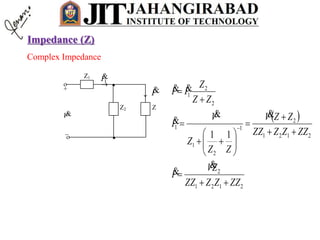
2121
2
2121
2
1
2
1
1
2
2
1
11
ZZZZZZ
ZV
I
ZZZZZZ
ZZV
ZZ
Z
V
I
ZZ
Z
II





















Impedance (Z)
Complex Impedance
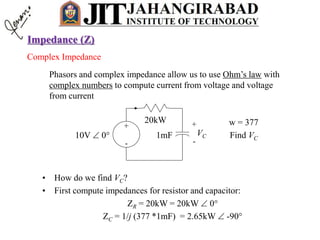
Phasors and complex impedance allow us to use Ohm’s law with
complex numbers to compute current from voltage and voltage
from current
20kW
+
-
1mF10V  0 VC
+
-
w = 377
Find VC
• How do we find VC?
• First compute impedances for resistor and capacitor:
ZR = 20kW = 20kW  0
ZC = 1/j (377 *1mF) = 2.65kW  -90
Impedance (Z)
Complex Impedance
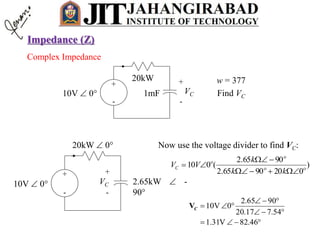
20kW
+
-
1mF10V  0 VC
+
-
w = 377
Find VC
20kW  0
+
-
2.65kW  -
90
10V  0 VC
+
-
Now use the voltage divider to find VC:




46.82V31.1
54.717.20
9065.2
010VCV
)
0209065.2
9065.2
(010 





kk
k
VVC
Impedance (Z)
Impedance allows us to use the same solution techniques
for AC steady state as we use for DC steady state.
• All the analysis techniques we have learned for the linear circuits are
applicable to compute phasors
– KCL & KVL
– node analysis / loop analysis
– Superposition
– Thevenin equivalents / Norton equivalents
– source exchange
• The only difference is that now complex numbers are used.
Complex Impedance
Impedance (Z)
Kirchhoff’s Laws
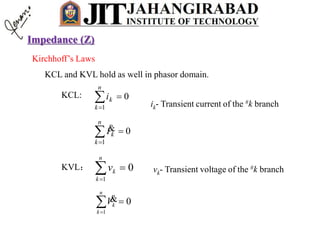
KCL and KVL hold as well in phasor domain.
KVL: 0
1

n
k
kv vk- Transient voltage of the #k branch
0
1

n
k
kV
KCL: 0
1


n
k
ki
0
1


n
k
kI
ik- Transient current of the #k branch
Impedance (Z)
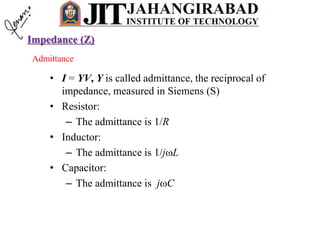
Admittance
• I = YV, Y is called admittance, the reciprocal of
impedance, measured in Siemens (S)
• Resistor:
– The admittance is 1/R
• Inductor:
– The admittance is 1/jL
• Capacitor:
– The admittance is jC
Impedance (Z)
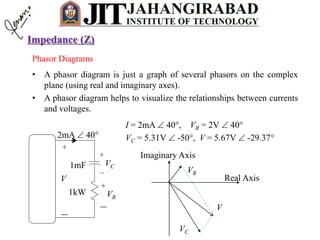
Phasor Diagrams
• A phasor diagram is just a graph of several phasors on the complex
plane (using real and imaginary axes).
• A phasor diagram helps to visualize the relationships between currents
and voltages.
2mA  40
–
1mF VC
+
–
1kW VR
+
+
–
V
I = 2mA  40, VR = 2V  40
VC = 5.31V  -50, V = 5.67V  -29.37
Real Axis
Imaginary Axis
VR
VC
V
Impedance (Z)
Parallel and Series Resonance
Outline:
RLC Circuit,
Series Resonance
Parallel Resonance
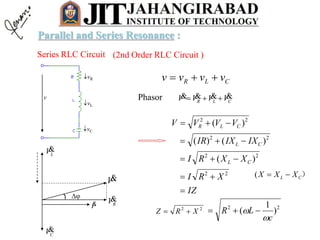
v
vR
vL
vC
CLR vvvv 
CLR VVVV  Phasor

I
V
LV
CV
RV
IZ
XRI
XXRI
IXIXIR
VVVV
CL
CL
CLR





22
22
22
22
)(
)()(
)(
)CL XXX (
22
XRZ 
22
)
1
(
c
LR

 
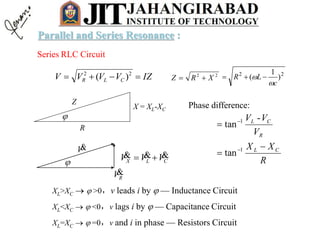
(2nd Order RLC Circuit )Series RLC Circuit
Parallel and Series Resonance :
22
XRZ 
22
)
1
(
c
LR

 IZVVVV CLR  22
)(
Z
X = XL-XC
R


V
RV
CLX VVV   R
XX
V
VV
CL
R
CL





1
1
tan
-
tan
Phase difference:
XL>XC   >0,v leads i by  — Inductance Circuit
XL<XC   <0,v lags i by  — Capacitance Circuit
XL=XC   =0,v and i in phase — Resistors Circuit
Series RLC Circuit
Parallel and Series Resonance :
CLR VVVV   CL XIjXIjRI  
ZIjXRIXXjRI CL
  )()]((
)( CL XXjR
I
V
Z 


 ZjXRZ
22
)( CL XXRZ 
R
XX CL 
 1
tan
iv  
v
vR
vL
vC
Series RLC Circuit
Parallel and Series Resonance :
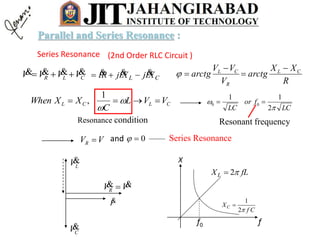
Series Resonance (2nd Order RLC Circuit )
CLR VVVV   CL XIjXIjRI  
R
XX
arctg
V
VV
arctg CL
R
CL 



CLCL VVL
C
XXWhen  

1
,
VVR  0and —— Series Resonance
Resonance condition
I
LV
CV
VVR
 
LC
for
LC 

2
11
00 
f0 f
X
Cf
XC
2
1

fLXL 2
Resonant frequency
Parallel and Series Resonance :
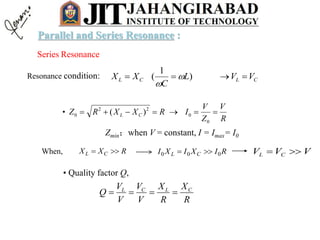
Series Resonance
R
V
Z
V
IRXXRZ CL 
0
0
22
0 )(•
Zmin;when V = constant, I = Imax= I0
RXX CL  RIXIXI CL 000  VVV CL 
• Quality factor Q,
R
X
R
X
V
V
V
V
Q CLCL

CLCL VVL
C
XX  )
1
( 

Resonance condition:
When,
Parallel and Series Resonance :
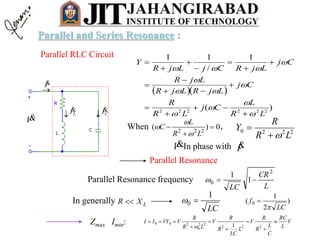
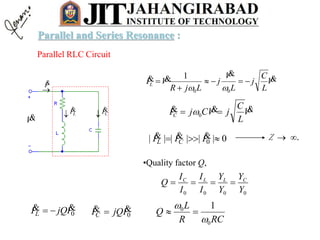
Parallel RLC Circuit
V

I
 LI
 CI
  
)(
1
/
11
222222
LR
L
Cj
LR
R
Cj
LjRLjR
LjR
Cj
LjRCjLjR
Y
























Parallel Resonance
Parallel Resonance frequency
L
CR
LC
2
0 1
1

LXR In generally )
2
1
( 0
LC
f


LC
1
0 
0)( 222



LR
L
C


When 2220
LR
R
Y

,
In phase withV I
V
L
RC
C
L
R
R
V
L
LC
R
R
V
LR
R
VVYII 






222
22
0
200
1
Zmax Imin:
Parallel and Series Resonance :
Parallel RLC Circuit
V

I
 LI
 CI
V
L
C
j
L
V
j
LjR
VIL


 


00
1

V
L
C
jVCjIC
  0
0|||||| 0  III CL
 Z  .
RCR
L
Q
0
0 1


0IjQIL
  0IjQIC
 
•Quality factor Q,
0000 Y
Y
Y
Y
I
I
I
I
Q CLLC

Parallel and Series Resonance :
Parallel RLC Circuit
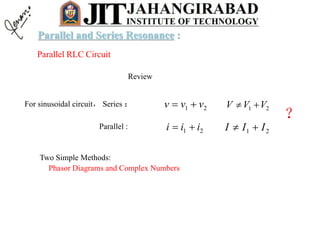
Review
For sinusoidal circuit, Series : 21 vvv  21 VVV 
21 iii  21 III 
?
Two Simple Methods:
Phasor Diagrams and Complex Numbers
Parallel :
Parallel and Series Resonance :

Ac single phase

  • 1.
     Characteristics ofSinusoidal  Phasors  Phasor Relationships for R, L and C  Impedance  Parallel and Series Resonance  Examples for Sinusoidal Circuits Analysis Single Phase AC
  • 2.
    Sinusoidal Steady StateAnalysis • Any steady state voltage or current in a linear circuit with a sinusoidal source is a sinusoid – All steady state voltages and currents have the same frequency as the source • In order to find a steady state voltage or current, all we need to know is its magnitude and its phase relative to the source (we already know its frequency) • We do not have to find this differential equation from the circuit, nor do we have to solve it • Instead, we use the concepts of phasors and complex impedances • Phasors and complex impedances convert problems involving differential equations into circuit analysis problems
  • 3.
    Characteristics of Sinusoids Outline: 1.Time Period: T 2. Frequency: f (Hertz) 3. Angular Frequency:  (rad/sec) 4. Phase angle: Φ 5. Amplitude: Vm Im
  • 4.
    Characteristics of Sinusoids:   tVv mt sin iI1 I1 I1 I1 I1 I1 R1 R1 R 5 5 + _ IS  E I1 U1 + - U I  iI1 I1 I1 I1 R1 R1 R 5 5 - + IS  E I1 U1 + - U I  v ,i tt1 t20 Both the polarity and magnitude of voltage are changing.
  • 5.
    Radian frequency(Angular frequency): = 2f = 2/T (rad/s) Time Period: T — Time necessary to go through one cycle. (s) Frequency: f — Cycles per second. (Hz) f = 1/T Amplitude: Vm Im i = Imsint, v =Vmsint v ,i t 20 Vm , Im Characteristics of Sinusoids :
  • 6.
    Effective Roof MeanSquare (RMS) Value of a Periodic Waveform — is equal to the value of the direct current which is flowing through an R-ohm resistor. It delivers the same average power to the resistor as the periodic current does. RIRdti T T 2 0 21  Effective Value of a Periodic Waveform  T eff dti T I 0 21 22 1 2 2cos1 sin 1 2 0 2 0 22 m m T m T meff IT I T dt t T I tdtI T I       2 1 0 2 m T eff V dtv T V   Characteristics of Sinusoids :
  • 7.
    Phase (angle)   tIi m sin   sin0 mIi  Phase angle -8 -6 -4 -2 0 2 4 6 8 0 0.01 0.02 0.03 0.04 0.05 <0 0 Characteristics of Sinusoids :
  • 8.
    )sin( 1 tVv m )sin( 2  tIi m Phase difference 2121 )(   ttiv 021   — v(t) leads i(t) by (1 - 2), or i(t) lags v(t) by (1 - 2) 2 21    v, i t v i   21 Out of phase t v, i v i v, i t v i 021   In phase 021   — v(t) lags i(t) by (2 - 1), or i(t) leads v(t) by (2 - 1) Characteristics of Sinusoids :
  • 9.
    Review The sinusoidal waveswhose phases are compared must: 1. Be written as sine waves or cosine waves. 2. With positive amplitudes. 3. Have the same frequency. 360°—— does not change anything. 90° —— change between sin & cos. 180°—— change between + & - 2 sin cos cos 3 2 cos sin 2                                 Characteristics of Sinusoids :
  • 10.
    Phase difference   30314sin22201 tv     9030314sin222030314cos22202  ttv   120314sin2220  t  1501203021     30314cos22202  tv   30314cos22202  tv   18030314cos2220  t    210314360cos2220  t   90150314sin2220  t   60314sin2220  t  30603021   Find ?   30314cos22202  tvIf Characteristics of Sinusoids :
  • 11.
    Phase difference v, i t v i -/3/3 • ••         3 sin  tVm        3 sin  tIm Characteristics of Sinusoids :
  • 12.
    Outline: 1. Complex Numbers 2.Rotating Vector 3. Phasors A sinusoidal voltage/current at a given frequency, is characterized by only two parameters : amplitude and phase A phasor is a Complex Number which represents magnitude and phase of a sinusoid Phasors
  • 13.
    e.g. voltage response Asinusoidal v/i Complex transform Phasor transform By knowing angular frequency ω rads/s. Time domain Frequency domain   eR v t Complex form:    cosmv t V t   Phasor form:    j t mv t V e    Angular frequency ω is known in the circuit.  || mVV  || mVV Phasors
  • 14.
    Rotating Vector   tIti m sin)( i Im t1 i t Im  t x y              max cos sin sin j t m m m j t m m I e I t jI t i t I t I I e                    A complex coordinates number: Real value: i(t1) Imag Phasors
  • 15.
  • 16.
    Complex Numbers jbaA — Rectangular Coordinates   sincos jAA  j eAA  — Polar Coordinates j eAAjbaA  conversion: 22 baA  a b arctg jbaeA j  cosAa  sinAb   a b Real axis Imaginary axis jjje j  090sin90cos90  Phasors
  • 17.
    Complex Numbers Arithmetic WithComplex Numbers Addition: A = a + jb, B = c + jd, A + B = (a + c) + j(b + d) Real Axis Imaginary Axis AB A + B Phasors
  • 18.
    Complex Numbers Arithmetic WithComplex Numbers Subtraction : A = a + jb, B = c + jd, A - B = (a - c) + j(b - d) Real Axis Imaginary Axis AB A - B Phasors
  • 19.
    Complex Numbers Arithmetic WithComplex Numbers Multiplication : A = Am  A, B = Bm  B A  B = (Am  Bm)  (A + B) Division: A = Am  A , B = Bm  B A / B = (Am / Bm)  (A - B) Phasors
  • 20.
    Phasors A phasor isa complex number that represents the magnitude and phase of a sinusoid:   tim cos  mI Phasor Diagrams • A phasor diagram is just a graph of several phasors on the complex plane (using real and imaginary axes). • A phasor diagram helps to visualize the relationships between currents and voltages. Phasors
  • 21.
    )sin()cos()(    tAjtAeAAe tjtj )cos(||}Re{  tAAe tj Complex Exponentials j eAA   A real-valued sinusoid is the real part of a complex exponential.  Complex exponentials make solving for AC steady state an algebraic problem. Phasors
  • 22.
    Phasor Relationships forR, L and C Outline: I-V Relationship for R, L and C, Power conversion
  • 23.
    Phasor Relationships forR, L and C  v~i relationship for a resistor _ v i R   + S    tIt R V R v i m m  sinsin  tVv m sin Relationship between RMS: R V I  Wave and Phasor diagrams: v、i t v i  I  V R V I    Resistor Suppose
  • 24.
     Time domainFrequency domainResistor With a resistor θ﹦ϕ, v(t) and i(t) are in phase . )cos()( )cos()(     wtIti wtVtv m m IRV RIV eRIeV eRIeV mm j m j m wtj m wtj m         )()( Phasor Relationships for R, L and C
  • 25.
     PowerResistor _ v i R +   P 0 tItVvip mm  sinsin  tVI mm 2 sin  t VI mm 2cos1 2  tIVIV 2cos v, i t v i P=IV  T pdt T P 0 1    T VIdttVI T 0 2cos1 1  R V RIIVP 2 2  • Average Power • Transient Power Note: I and V are RMS values. Phasor Relationships for R, L and C
  • 26.
    Resistor , R=10,Find iand Ptv 314sin311  V V V m 220 2 311 2   A R V I 22 10 220  ti 314sin222  WIVP 484022220  Phasor Relationships for R, L and C
  • 27.
     v~i relationshipInductor dt di LvvAB    tLI dt tId L dt di Lv m m   cos sin    90sin  tLIm    90sin  tVm     t vdt L i 1    t vdt L vdt L 0 0 11  t vdt L i 0 0 1 tIi m sinSuppose Phasor Relationships for R, L and C
  • 28.
     v~i relationshipInductor  90sin  tLIm  dt di Lv    90sin  tVm  LIV mm  Relationship between RMS: LIV  L V I   fLLXL  2   For DC,f = 0,XL = 0. fXL  v(t) leads i(t) by 90º, or i(t) lags v(t) by 90º Phasor Relationships for R, L and C
  • 29.
     v ~i relationshipInductor v, i t v i eL V I LXIjV  Wave and Phasor diagrams: Phasor Relationships for R, L and C
  • 30.
     PowerInductor vip   tItV mm  sin90sin   ttIV mm  sincos  t IV mm 2sin 2  tVI 2sin P t v, i t v i ++ --22 max 2 1 LILIW m  2 00 2 1 LiLidividtW it  Energy stored:    T T tdtVI T pdt T P 0 0 02sin 11 Average Power Reactive Power L L X V XIIVQ 2 2  (Var) Phasor Relationships for R, L and C
  • 31.
    Inductor L = 10mH,v= 100sint,Find iL when f = 50Hz and 50kHz.    14.310105022 3 fLX L      Atti A X V I L L  90sin25.22 5.22 14.3 2/100 50       31401010105022 33 fLX L      mAtti mA X V I L L k  90sin25.22 5.22 14.3 2/100 50    Phasor Relationships for R, L and C
  • 32.
     v ~i relationshipCapacitor _ v i +   C dt dv C dt dq i  tVv m sinSuppose:   90sincos  tCVtCVi mm    90sin  tIm       t tt idt c vidt c idt c idt c v 0 0 0 0 1111 i(t) leads v(t) by 90º, or v(t) lags i(t) by 90º Relationship between RMS: CX V C V CVI    1   fCC XC  2 11  For DC,f = 0, XC   f XC 1  mm CVI  Phasor Relationships for R, L and C
  • 33.
    _ v i +   C tj m tj m eCVj dt edV C dt tdv Cti    )( )( v(t) =Vm ejt Represent v(t) and i(t) as phasors: CjX V VCωjI ==   • The derivative in the relationship between v(t) and i(t) becomes a multiplication by in the relationship between and . • The time-domain differential equation has become the algebraic equation in the frequency-domain. • Phasors allow us to express current-voltage relationships for inductors and capacitors much like we express the current-voltage relationship for a resistor.  v ~ i relationshipCapacitor V I wC j  Phasor Relationships for R, L and C
  • 34.
     v ~i relationshipCapacitor v, i t v i I V CXIjV   Wave and Phasor diagrams: Phasor Relationships for R, L and C
  • 35.
    PowerCapacitor Average Power: P= 0 Reactive Power C C X V XIIVQ 2 2  (Var)   90sinsin  tItVvip mm  tVIt IV mm  2sin2sin 2  P t v, i t v i ++ -- Energy stored:    t vv CvCvdvdt dt dv CvvidtW 0 0 2 0 2 1 22 max 2 1 CVCVW m  Phasor Relationships for R, L and C
  • 36.
    Capacitor Suppose C=20F,AC sourcev=100sint,Find XC and I for f = 50Hz, 50kHz。  159 2 11 Hz50 fCC Xf c  A44.0 2  c m c X V X V I   159.0 2 11 KHz50 fCC Xf c  A440 2  c m c X V X V I Phasor Relationships for R, L and C
  • 37.
    Review (v –i Relationship) Time domain Frequency domain iRv  IRV   I Cj V    1 ILjV    dt di LvL  dt dv CiC  C XC  1  LXL , , , v and i are in phase. , v leads i by 90°. , v lags i by 90°. R C L Phasor Relationships for R, L and C
  • 38.
    Summary:  R: RXR  0 L: ffLLXL   2 2    iv C: ffcc XC 1 2 11   2    iv  IXV   Frequency characteristics of an Ideal Inductor and Capacitor: A capacitor is an open circuit to DC currents; A Inductor is a short circuit to DC currents. Phasor Relationships for R, L and C
  • 39.
    Impedance (Z) Outline: Complex currentsand voltages. Impedance Phasor Diagrams
  • 40.
    • AC steady-stateanalysis using phasors allows us to express the relationship between current and voltage using a formula that looks likes Ohm’s law: ZIV  Complex voltage, Complex current, Complex Impedance vm j m VeVV v   im j m IeII i      ZeZe I V I V Z jj m m iv )(   ‘Z’ is called impedance measured in ohms () Impedance (Z)
  • 41.
    Complex Impedance    ZeZe I V I V Zjj m m iv )(    Complex impedance describes the relationship between the voltage across an element (expressed as a phasor) and the current through the element (expressed as a phasor).  Impedance is a complex number and is not a phasor (why?).  Impedance depends on frequency. Impedance (Z)
  • 42.
    Complex Impedance ZR =R  = 0; or ZR = R  0 Resistor——The impedance is R c j c jX C j e C Z       21 ) 2 (    iv or  90 1  C ZC  Capacitor——The impedance is 1/jωC L j L jXLjLeZ    2 ) 2 (    iv or  90 LZL  Inductor——The impedance is jωL Impedance (Z)
  • 43.
    Complex Impedance Impedance inseries/parallel can be combined as resistors. _ U U Z1 +  Z2 Zn   I    n k kn ZZZZZ 1 21 ... _ US In I1 I1 I1 I1 I1 I1     R1 R1 Zn 5 5 5 5 + + _ US IS  U1 + - U  I  Z2Z1     n k kn ZZZZZ 121 11 ... 111 21 1 2 21 2 1 ZZ Z II ZZ Z II      Current divider:   n k k i i Z Z VV 1  Voltage divider: Impedance (Z)
  • 44.
    Complex Impedance _ +   V  I   1IZ1 Z2Z    2121 2 2121 2 1 2 1 1 2 2 1 11 ZZZZZZ ZV I ZZZZZZ ZZV ZZ Z V I ZZ Z II                      Impedance (Z)
  • 45.
    Complex Impedance Phasors andcomplex impedance allow us to use Ohm’s law with complex numbers to compute current from voltage and voltage from current 20kW + - 1mF10V  0 VC + - w = 377 Find VC • How do we find VC? • First compute impedances for resistor and capacitor: ZR = 20kW = 20kW  0 ZC = 1/j (377 *1mF) = 2.65kW  -90 Impedance (Z)
  • 46.
    Complex Impedance 20kW + - 1mF10V 0 VC + - w = 377 Find VC 20kW  0 + - 2.65kW  - 90 10V  0 VC + - Now use the voltage divider to find VC:     46.82V31.1 54.717.20 9065.2 010VCV ) 0209065.2 9065.2 (010       kk k VVC Impedance (Z)
  • 47.
    Impedance allows usto use the same solution techniques for AC steady state as we use for DC steady state. • All the analysis techniques we have learned for the linear circuits are applicable to compute phasors – KCL & KVL – node analysis / loop analysis – Superposition – Thevenin equivalents / Norton equivalents – source exchange • The only difference is that now complex numbers are used. Complex Impedance Impedance (Z)
  • 48.
    Kirchhoff’s Laws KCL andKVL hold as well in phasor domain. KVL: 0 1  n k kv vk- Transient voltage of the #k branch 0 1  n k kV KCL: 0 1   n k ki 0 1   n k kI ik- Transient current of the #k branch Impedance (Z)
  • 49.
    Admittance • I =YV, Y is called admittance, the reciprocal of impedance, measured in Siemens (S) • Resistor: – The admittance is 1/R • Inductor: – The admittance is 1/jL • Capacitor: – The admittance is jC Impedance (Z)
  • 50.
    Phasor Diagrams • Aphasor diagram is just a graph of several phasors on the complex plane (using real and imaginary axes). • A phasor diagram helps to visualize the relationships between currents and voltages. 2mA  40 – 1mF VC + – 1kW VR + + – V I = 2mA  40, VR = 2V  40 VC = 5.31V  -50, V = 5.67V  -29.37 Real Axis Imaginary Axis VR VC V Impedance (Z)
  • 51.
    Parallel and SeriesResonance Outline: RLC Circuit, Series Resonance Parallel Resonance
  • 52.
    v vR vL vC CLR vvvv  CLRVVVV  Phasor  I V LV CV RV IZ XRI XXRI IXIXIR VVVV CL CL CLR      22 22 22 22 )( )()( )( )CL XXX ( 22 XRZ  22 ) 1 ( c LR    (2nd Order RLC Circuit )Series RLC Circuit Parallel and Series Resonance :
  • 53.
    22 XRZ  22 ) 1 ( c LR   IZVVVVCLR  22 )( Z X = XL-XC R   V RV CLX VVV   R XX V VV CL R CL      1 1 tan - tan Phase difference: XL>XC   >0,v leads i by  — Inductance Circuit XL<XC   <0,v lags i by  — Capacitance Circuit XL=XC   =0,v and i in phase — Resistors Circuit Series RLC Circuit Parallel and Series Resonance :
  • 54.
    CLR VVVV  CL XIjXIjRI   ZIjXRIXXjRI CL   )()](( )( CL XXjR I V Z     ZjXRZ 22 )( CL XXRZ  R XX CL   1 tan iv   v vR vL vC Series RLC Circuit Parallel and Series Resonance :
  • 55.
    Series Resonance (2ndOrder RLC Circuit ) CLR VVVV   CL XIjXIjRI   R XX arctg V VV arctg CL R CL     CLCL VVL C XXWhen    1 , VVR  0and —— Series Resonance Resonance condition I LV CV VVR   LC for LC   2 11 00  f0 f X Cf XC 2 1  fLXL 2 Resonant frequency Parallel and Series Resonance :
  • 56.
    Series Resonance R V Z V IRXXRZ CL 0 0 22 0 )(• Zmin;when V = constant, I = Imax= I0 RXX CL  RIXIXI CL 000  VVV CL  • Quality factor Q, R X R X V V V V Q CLCL  CLCL VVL C XX  ) 1 (   Resonance condition: When, Parallel and Series Resonance :
  • 57.
    Parallel RLC Circuit V  I LI  CI    )( 1 / 11 222222 LR L Cj LR R Cj LjRLjR LjR Cj LjRCjLjR Y                         Parallel Resonance Parallel Resonance frequency L CR LC 2 0 1 1  LXR In generally ) 2 1 ( 0 LC f   LC 1 0  0)( 222    LR L C   When 2220 LR R Y  , In phase withV I V L RC C L R R V L LC R R V LR R VVYII        222 22 0 200 1 Zmax Imin: Parallel and Series Resonance :
  • 58.
    Parallel RLC Circuit V  I LI  CI V L C j L V j LjR VIL       00 1  V L C jVCjIC   0 0|||||| 0  III CL  Z  . RCR L Q 0 0 1   0IjQIL   0IjQIC   •Quality factor Q, 0000 Y Y Y Y I I I I Q CLLC  Parallel and Series Resonance :
  • 59.
    Parallel RLC Circuit Review Forsinusoidal circuit, Series : 21 vvv  21 VVV  21 iii  21 III  ? Two Simple Methods: Phasor Diagrams and Complex Numbers Parallel : Parallel and Series Resonance :