Alternating Current Ch. 31

   Phasors and AC            (sec. 31.1)
   Resistance and reactance (sec. 31.2) RLC
   series circuit           (sec. 31.3) Power in
   AC circuits              (sec. 31.4)
   Resonance in AC circuits  (sec. 31.5)
   Transformers              (sec. 31.6)
C 2012 J. F. Becker
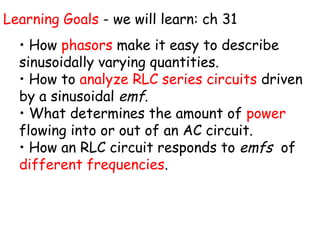
Learning Goals - we will learn: ch 31
  • How phasors make it easy to describe
  sinusoidally varying quantities.
  • How to analyze RLC series circuits driven
  by a sinusoidal emf.
  • What determines the amount of power
  flowing into or out of an AC circuit.
  • How an RLC circuit responds to emfs of
  different frequencies.
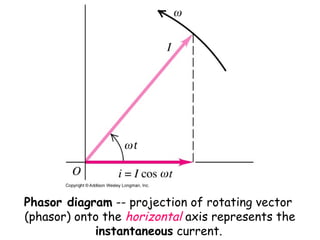
Phasor diagram -- projection of rotating vector
(phasor) onto the horizontal axis represents the
            instantaneous current.
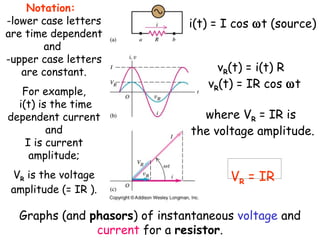
Notation:
-lower case letters            i(t) = I cos ωt (source)
are time dependent
       and
-upper case letters
   are constant.                    vR(t) = i(t) R
                                  vR(t) = IR cos ωt
   For example,
  i(t) is the time
dependent current                where VR = IR is
         and                   the voltage amplitude.
    I is current
     amplitude;
 VR is the voltage                    VR = IR
 amplitude (= IR ).

  Graphs (and phasors) of instantaneous voltage and
               current for a resistor.
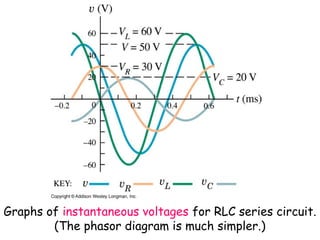
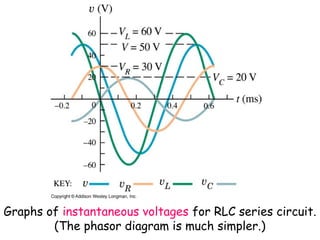
Graphs of instantaneous voltages for RLC series circuit.
        (The phasor diagram is much simpler.)
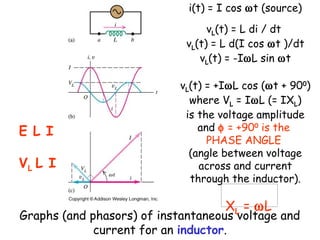
i(t) = I cos ωt (source)
                                  vL(t) = L di / dt
                             vL(t) = L d(I cos ωt )/dt
                                vL(t) = -IωL sin ωt

                            vL(t) = +IωL cos (ωt + 90 ) 0

                              where VL = IωL (= IXL)
                             is the voltage amplitude
E L I                           and φ = +90 is the
                                           0

                                  PHASE ANGLE
                              (angle between voltage
VL L I                          across and current
                              through the inductor).

                                     XL = ωL
Graphs (and phasors) of instantaneous voltage and
             current for an inductor.
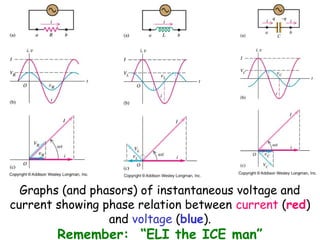
Graphs (and phasors) of instantaneous voltage and
current showing phase relation between current (red)
                 and voltage (blue).
        Remember: “ELI the ICE man”
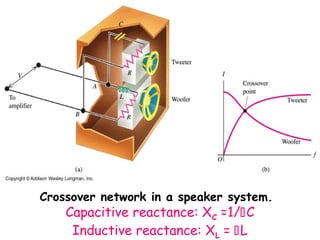
Crossover network in a speaker system.
    Capacitive reactance: XC =1/C
     Inductive reactance: XL = L
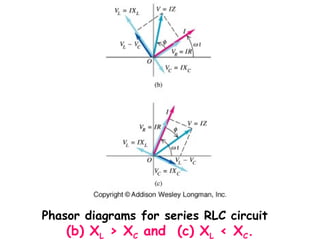
Phasor diagrams for series RLC circuit
    (b) XL > XC and (c) XL < XC.
Graphs of instantaneous voltages for RLC series circuit.
        (The phasor diagram is much simpler.)
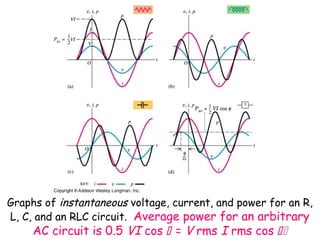
Graphs of instantaneous voltage, current, and power for an R,
L, C, and an RLC circuit. Average power for an arbitrary
     AC circuit is 0.5 VI cos  = V rms I rms cos 
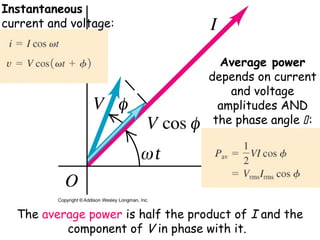
Instantaneous
current and voltage:


                                     Average power
                                   depends on current
                                       and voltage
                                     amplitudes AND
                                    the phase angle  :


  The average power is half the product of I and the
          component of V in phase with it.
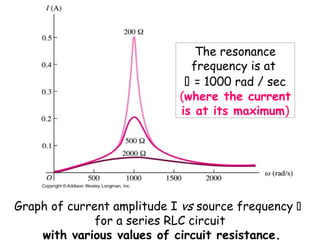
The resonance
                              frequency is at
                              = 1000 rad / sec
                            (where the current
                            is at its maximum)


Graph of current amplitude I vs source frequency 
              for a series RLC circuit
    with various values of circuit resistance.
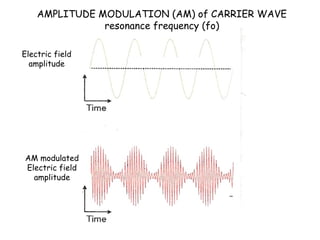
AMPLITUDE MODULATION (AM) of CARRIER WAVE
               resonance frequency (fo)

Electric field
  amplitude


AM modulated
Electric field
  amplitude
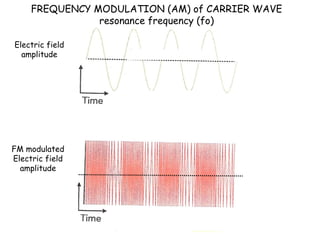
FREQUENCY MODULATION (AM) of CARRIER WAVE
                resonance frequency (fo)

Electric field
  amplitude


FM modulated
Electric field
  amplitude
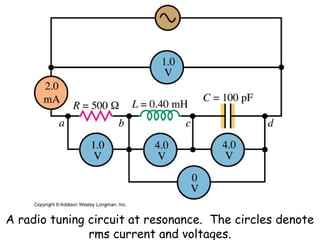
A radio tuning circuit at resonance. The circles denote
               rms current and voltages.
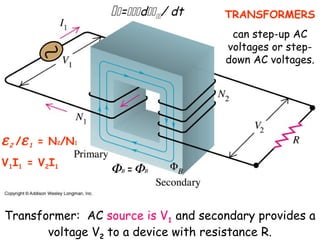
=d/ dt   TRANSFORMERS
                                        can step-up AC
                                       voltages or step-
                                       down AC voltages.


ε 2 /ε 1   = N2/N1
V1I1 = V2I1
                     Φ =Φ
                       Β    Β


Transformer: AC source is V1 and secondary provides a
       voltage V2 to a device with resistance R.
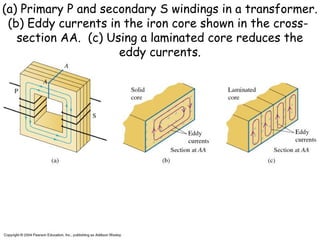
(a) Primary P and secondary S windings in a transformer.
 (b) Eddy currents in the iron core shown in the cross-
   section AA. (c) Using a laminated core reduces the
                     eddy currents.
Figure 32.2b
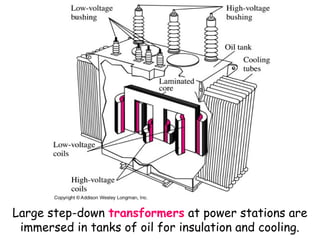
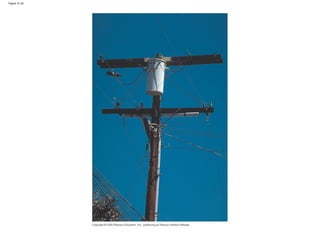
Large step-down transformers at power stations are
 immersed in tanks of oil for insulation and cooling.
Figure 31.22
Figure 31.23
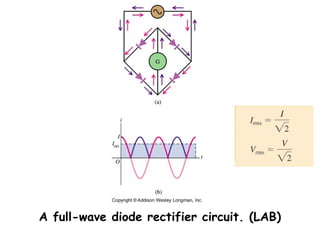
A full-wave diode rectifier circuit. (LAB)
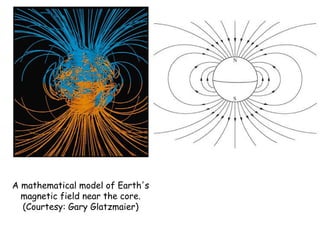
A mathematical model of Earth's
  magnetic field near the core.
  (Courtesy: Gary Glatzmaier)
Review


       See
       www.physics.sjsu.edu/becker/physics51

C 2012 J. F. Becker
PREPARATION FOR FINAL EXAM
At a minimum the following should be reviewed:

Gauss's Law - calculation of the magnitude of the electric field caused by
continuous distributions of charge starting with Gauss's Law and completing all the
steps including evaluation of the integrals.

Ampere's Law - calculation of the magnitude of the magnetic field caused by
electric currents using Ampere's Law (all steps including evaluation of the integrals).

Faraday's Law and Lenz's Law - calculation of induced voltage and current,
including the direction of the induced current.

Calculation of integrals to obtain values of electric field, electric potential, and
magnetic field caused by continuous distributions of electric charge and current
configurations (includes the Law of Biot and Savart for magnetic fields).

Maxwell's equations - Maxwell's contribution and significance.

DC circuits - Ohm's Law, Kirchhoff's Rules, series-parallel combinations, power.

Series RLC circuits - phasors, phase angle, current, power factor, average power.

Vectors - as used throughout the entire course.

rangkaian am dan fm

  • 1.
    Alternating Current Ch.31 Phasors and AC (sec. 31.1) Resistance and reactance (sec. 31.2) RLC series circuit (sec. 31.3) Power in AC circuits (sec. 31.4) Resonance in AC circuits (sec. 31.5) Transformers (sec. 31.6) C 2012 J. F. Becker
  • 2.
    Learning Goals -we will learn: ch 31 • How phasors make it easy to describe sinusoidally varying quantities. • How to analyze RLC series circuits driven by a sinusoidal emf. • What determines the amount of power flowing into or out of an AC circuit. • How an RLC circuit responds to emfs of different frequencies.
  • 3.
    Phasor diagram --projection of rotating vector (phasor) onto the horizontal axis represents the instantaneous current.
  • 4.
    Notation: -lower case letters i(t) = I cos ωt (source) are time dependent and -upper case letters are constant. vR(t) = i(t) R vR(t) = IR cos ωt For example, i(t) is the time dependent current where VR = IR is and the voltage amplitude. I is current amplitude; VR is the voltage VR = IR amplitude (= IR ). Graphs (and phasors) of instantaneous voltage and current for a resistor.
  • 5.
    Graphs of instantaneousvoltages for RLC series circuit. (The phasor diagram is much simpler.)
  • 6.
    i(t) = Icos ωt (source) vL(t) = L di / dt vL(t) = L d(I cos ωt )/dt vL(t) = -IωL sin ωt vL(t) = +IωL cos (ωt + 90 ) 0 where VL = IωL (= IXL) is the voltage amplitude E L I and φ = +90 is the 0 PHASE ANGLE (angle between voltage VL L I across and current through the inductor). XL = ωL Graphs (and phasors) of instantaneous voltage and current for an inductor.
  • 7.
    Graphs (and phasors)of instantaneous voltage and current showing phase relation between current (red) and voltage (blue). Remember: “ELI the ICE man”
  • 8.
    Crossover network ina speaker system. Capacitive reactance: XC =1/C Inductive reactance: XL = L
  • 9.
    Phasor diagrams forseries RLC circuit (b) XL > XC and (c) XL < XC.
  • 10.
    Graphs of instantaneousvoltages for RLC series circuit. (The phasor diagram is much simpler.)
  • 11.
    Graphs of instantaneousvoltage, current, and power for an R, L, C, and an RLC circuit. Average power for an arbitrary AC circuit is 0.5 VI cos  = V rms I rms cos 
  • 12.
    Instantaneous current and voltage: Average power depends on current and voltage amplitudes AND the phase angle  : The average power is half the product of I and the component of V in phase with it.
  • 13.
    The resonance frequency is at  = 1000 rad / sec (where the current is at its maximum) Graph of current amplitude I vs source frequency  for a series RLC circuit with various values of circuit resistance.
  • 14.
    AMPLITUDE MODULATION (AM)of CARRIER WAVE resonance frequency (fo) Electric field amplitude AM modulated Electric field amplitude
  • 15.
    FREQUENCY MODULATION (AM)of CARRIER WAVE resonance frequency (fo) Electric field amplitude FM modulated Electric field amplitude
  • 16.
    A radio tuningcircuit at resonance. The circles denote rms current and voltages.
  • 17.
    =d/ dt TRANSFORMERS can step-up AC voltages or step- down AC voltages. ε 2 /ε 1 = N2/N1 V1I1 = V2I1 Φ =Φ Β Β Transformer: AC source is V1 and secondary provides a voltage V2 to a device with resistance R.
  • 18.
    (a) Primary Pand secondary S windings in a transformer. (b) Eddy currents in the iron core shown in the cross- section AA. (c) Using a laminated core reduces the eddy currents.
  • 19.
  • 20.
    Large step-down transformersat power stations are immersed in tanks of oil for insulation and cooling.
  • 21.
  • 22.
  • 23.
    A full-wave dioderectifier circuit. (LAB)
  • 24.
    A mathematical modelof Earth's magnetic field near the core. (Courtesy: Gary Glatzmaier)
  • 25.
    Review See www.physics.sjsu.edu/becker/physics51 C 2012 J. F. Becker
  • 26.
    PREPARATION FOR FINALEXAM At a minimum the following should be reviewed: Gauss's Law - calculation of the magnitude of the electric field caused by continuous distributions of charge starting with Gauss's Law and completing all the steps including evaluation of the integrals. Ampere's Law - calculation of the magnitude of the magnetic field caused by electric currents using Ampere's Law (all steps including evaluation of the integrals). Faraday's Law and Lenz's Law - calculation of induced voltage and current, including the direction of the induced current. Calculation of integrals to obtain values of electric field, electric potential, and magnetic field caused by continuous distributions of electric charge and current configurations (includes the Law of Biot and Savart for magnetic fields). Maxwell's equations - Maxwell's contribution and significance. DC circuits - Ohm's Law, Kirchhoff's Rules, series-parallel combinations, power. Series RLC circuits - phasors, phase angle, current, power factor, average power. Vectors - as used throughout the entire course.

Editor's Notes

  • #2 OVERVIEW
  • #7 -sin A = cos(A+90)
  • #24 i^2 = I^2 cos^2 wt and cos^2 A = 0.5 (1 + cos 2A). Average of cos 2A is zero, so just need to take sqrt of 0.5 I^2.
  • #26 OVERVIEW