Jamhuriya University Of Science & Technology
Faculty Of Engineering
Department of Electronics and Communication Engineering
Hysteresis & Eddy Current ©Associated to you by AbdulAziz Ahmed Siyad
11/11/2015
Hysteresis and Eddy
current losses
Referenced from:-
 Hysteresis and Eddy current losses journal by prof P. Parthasaradhy & S.V. Ranganayakulu.
 Magnetic circuits and core losses Module 6 by kharagbur.
 Principles and Applications fourth edition by Allan R. Hambley
 Electrical Circuit Theory & Technology 4th Edition By John Bird.
Hysteresis & Eddy Current ©Associated to you by AbdulAziz Ahmed Siyad
11/11/2015
Losses in Magnetic Circuit
There are two types of magnetic losses
a) Hysteresis losses
b) Eddy Current Losses
Total iron loss is the sum of these two losses
Hysteresis & Eddy Current ©Associated to you by AbdulAziz Ahmed Siyad
11/11/2015
Hysteresis loss
 Hysteresis is the ‘lagging’ effect of flux density B whenever
there are changes in the magnetic field strength H. When an
initially unmagnetized ferromagnetic material is subjected to a
varying magnetic field strength H, the flux density B produced
in the material varies.
 Hysteresis loss is associated with the phenomena of hysteresis
and is an expression of the fact when ferromagnetic material is
involved, not all the energy of the magnetic field is returned to
the circuit when mmf is removed. It is known as hysteresis loss.
The core of a transformer is subjected to an alternating
magnetizing force and for each cycle of emf a hysteresis loop is
traced out.
Hysteresis & Eddy Current ©Associated to you by AbdulAziz Ahmed Siyad
11/11/2015
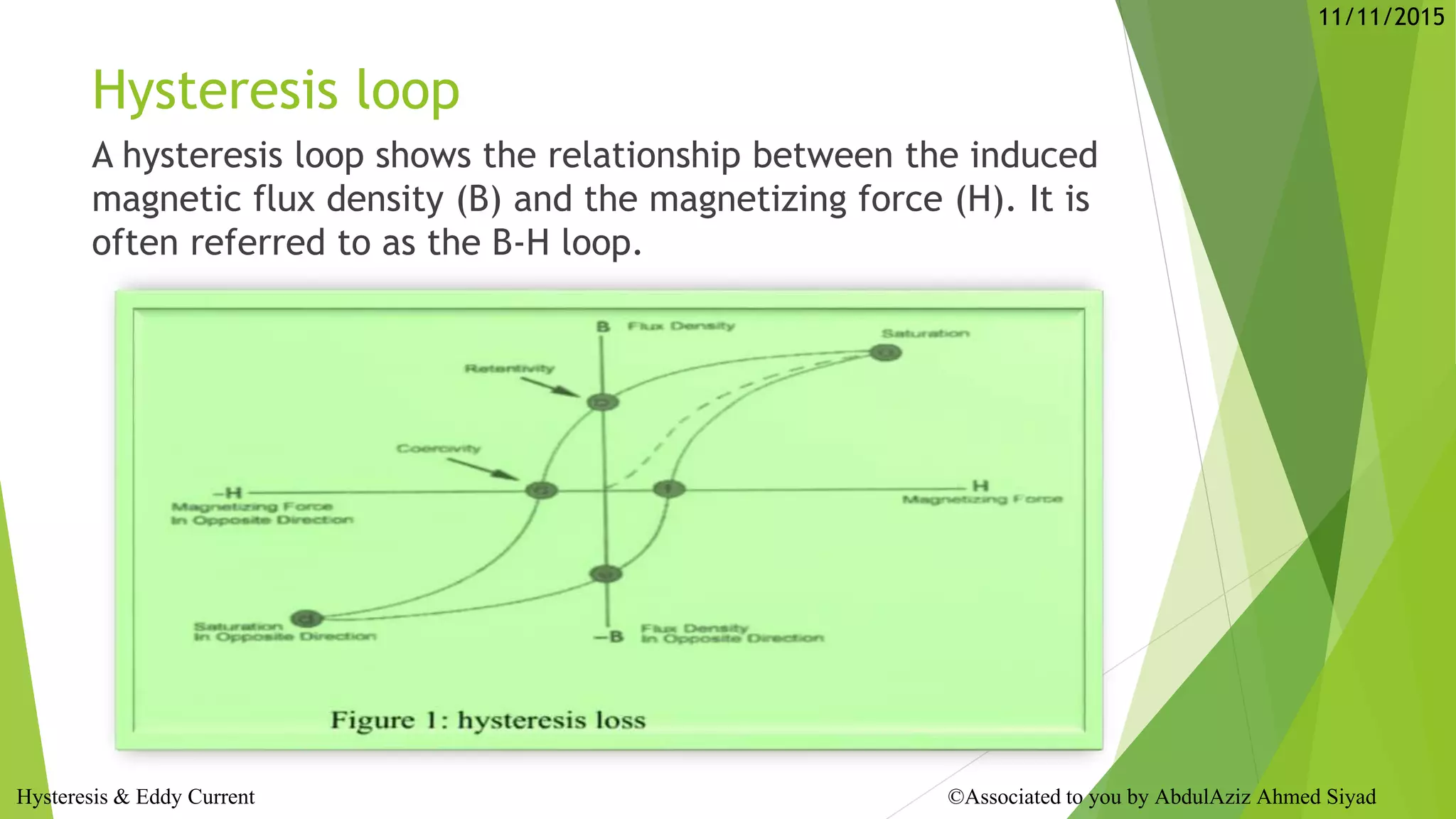
 The lagging phenomenon of B behind H is called hysteresis.
The tip of hysteresis loop can be joined to obtain the
magnetization characteristics.
 Hysteresis results in a dissipation of energy which appears as a
heating of the magnetic material. The energy loss associated
with hysteresis is proportional to the area of the hysteresis
loop.
 For AC-excited devices the hysteresis loop is repeated every
cycle of alternating current. Thus a hysteresis loop with a
large area is often unsuitable since the energy loss would be
considerable.
 Silicon steel has a narrow hysteresis loop, and thus small
hysteresis loss, and is suitable for transformer cores and
rotating machine armatures.
Hysteresis & Eddy Current ©Associated to you by AbdulAziz Ahmed Siyad
11/11/2015
Hysteresis & Eddy Current ©Associated to you by AbdulAziz Ahmed Siyad
11/11/2015
Hysteresis loop
A hysteresis loop shows the relationship between the induced
magnetic flux density (B) and the magnetizing force (H). It is
often referred to as the B-H loop.
Hysteresis & Eddy Current ©Associated to you by AbdulAziz Ahmed Siyad
11/11/2015
The area of a hysteresis loop varies with the type of
material. The area, and thus the energy loss, is much
greater for hard materials than for soft materials.
 hard material, which has a high remanence and a large
coercivity.
 soft steel, which has a large remanence and small
coercivity.
 ferrite, this being a ceramic-like magnetic substance
made from oxides of iron, nickel, cobalt,
magnesium, aluminium and mangenese; the hysteresis of
ferrite is very small.
Hysteresis & Eddy Current ©Associated to you by AbdulAziz Ahmed Siyad
11/11/2015
 The area of a hysteresis loop varies with the type of material.
The area, and thus the energy loss, is much greater for hard
materials than for soft materials.
 A disturbance in the alignment of the domains of a
ferromagnetic material causes energy to be expended in
taking it through a cycle of magnetization. This energy
appears as heat in the specimen and is called the hysteresis
loss
Hysteresis & Eddy Current ©Associated to you by AbdulAziz Ahmed Siyad
11/11/2015
Separation of core loss
The sum of hysteresis and eddy current losses is
called core loss as both the losses occur within the
core (magnetic material). For a given magnetic
circuit with a core of ferromagnetic material, volume
and thickness of the plates are constant and the total
core loss can be expressed as follows.
Core loss = Hysteresis loss + Eddy current loss
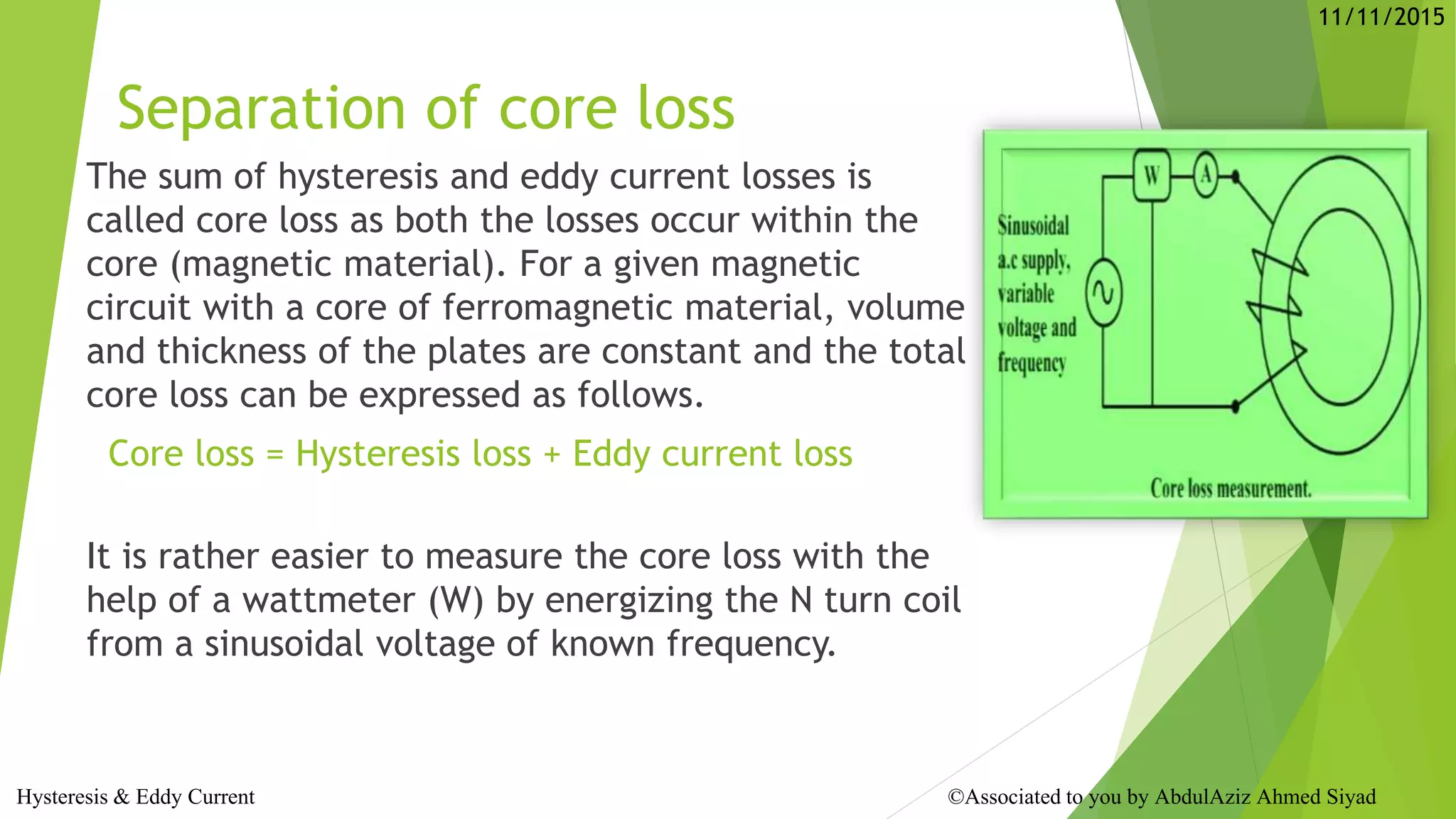
It is rather easier to measure the core loss with the
help of a wattmeter (W) by energizing the N turn coil
from a sinusoidal voltage of known frequency.
Hysteresis & Eddy Current ©Associated to you by AbdulAziz Ahmed Siyad
11/11/2015
Eddy current loss
An eddy current is an electric current set up by an
alternating magnetic field.
These losses arise from the fact that the core itself is
composed of conducting material, so that the voltage
induced in it by the varying flux produces circulating
currents in the material.
Eddy current loss depends upon the rate of change of flux as
well as the resistance of the path, it is reasonable to expect
this loss to vary as the square of both the maximum flux
density and frequency
Hysteresis & Eddy Current ©Associated to you by AbdulAziz Ahmed Siyad
11/11/2015
Eddy Current
Eddy current:
As we saw, a flux induces a voltage on a coil.
Q: Why not inducing a voltage on the core itself?
A: It actually does.
The result is eddy current. That is why the transformers core are
laminated.
Hysteresis & Eddy Current ©Associated to you by AbdulAziz Ahmed Siyad
11/11/2015
Hysteresis & Eddy Current ©Associated to you by AbdulAziz Ahmed Siyad
Eddy current loss
flux Current
flux
Because of time variation of flux flowing through the
magnetic material as shown, current is induced in the
magnetic material, following Faraday’s law. This current is
called eddy current.
This current can be reduced by using laminated (thin sheet)
iron structure, with Insulation between the laminations.
Laminations
11/11/2015
Eddy-Current Loss
As the magnetic field changes in a material, it causes
“eddy currents” to flow. Power loss due to eddy
currents is proportional to the square of frequency,
assuming constant peak flux.
Eddy currents result in a loss of power, with consequent
heating of the material.
R
v
P
2

Hysteresis & Eddy Current ©Associated to you by AbdulAziz Ahmed Siyad
11/11/2015
End of the Lecture
Hysteresis & Eddy Current ©Associated to you by AbdulAziz Ahmed Siyad
11/11/2015

Hysteresis and Eddy-current losses

  • 1.
    Jamhuriya University OfScience & Technology Faculty Of Engineering Department of Electronics and Communication Engineering Hysteresis & Eddy Current ©Associated to you by AbdulAziz Ahmed Siyad 11/11/2015
  • 2.
    Hysteresis and Eddy currentlosses Referenced from:-  Hysteresis and Eddy current losses journal by prof P. Parthasaradhy & S.V. Ranganayakulu.  Magnetic circuits and core losses Module 6 by kharagbur.  Principles and Applications fourth edition by Allan R. Hambley  Electrical Circuit Theory & Technology 4th Edition By John Bird. Hysteresis & Eddy Current ©Associated to you by AbdulAziz Ahmed Siyad 11/11/2015
  • 3.
    Losses in MagneticCircuit There are two types of magnetic losses a) Hysteresis losses b) Eddy Current Losses Total iron loss is the sum of these two losses Hysteresis & Eddy Current ©Associated to you by AbdulAziz Ahmed Siyad 11/11/2015
  • 4.
    Hysteresis loss  Hysteresisis the ‘lagging’ effect of flux density B whenever there are changes in the magnetic field strength H. When an initially unmagnetized ferromagnetic material is subjected to a varying magnetic field strength H, the flux density B produced in the material varies.  Hysteresis loss is associated with the phenomena of hysteresis and is an expression of the fact when ferromagnetic material is involved, not all the energy of the magnetic field is returned to the circuit when mmf is removed. It is known as hysteresis loss. The core of a transformer is subjected to an alternating magnetizing force and for each cycle of emf a hysteresis loop is traced out. Hysteresis & Eddy Current ©Associated to you by AbdulAziz Ahmed Siyad 11/11/2015
  • 5.
     The laggingphenomenon of B behind H is called hysteresis. The tip of hysteresis loop can be joined to obtain the magnetization characteristics.  Hysteresis results in a dissipation of energy which appears as a heating of the magnetic material. The energy loss associated with hysteresis is proportional to the area of the hysteresis loop.  For AC-excited devices the hysteresis loop is repeated every cycle of alternating current. Thus a hysteresis loop with a large area is often unsuitable since the energy loss would be considerable.  Silicon steel has a narrow hysteresis loop, and thus small hysteresis loss, and is suitable for transformer cores and rotating machine armatures. Hysteresis & Eddy Current ©Associated to you by AbdulAziz Ahmed Siyad 11/11/2015
  • 6.
    Hysteresis & EddyCurrent ©Associated to you by AbdulAziz Ahmed Siyad 11/11/2015
  • 7.
    Hysteresis loop A hysteresisloop shows the relationship between the induced magnetic flux density (B) and the magnetizing force (H). It is often referred to as the B-H loop. Hysteresis & Eddy Current ©Associated to you by AbdulAziz Ahmed Siyad 11/11/2015
  • 8.
    The area ofa hysteresis loop varies with the type of material. The area, and thus the energy loss, is much greater for hard materials than for soft materials.  hard material, which has a high remanence and a large coercivity.  soft steel, which has a large remanence and small coercivity.  ferrite, this being a ceramic-like magnetic substance made from oxides of iron, nickel, cobalt, magnesium, aluminium and mangenese; the hysteresis of ferrite is very small. Hysteresis & Eddy Current ©Associated to you by AbdulAziz Ahmed Siyad 11/11/2015
  • 9.
     The areaof a hysteresis loop varies with the type of material. The area, and thus the energy loss, is much greater for hard materials than for soft materials.  A disturbance in the alignment of the domains of a ferromagnetic material causes energy to be expended in taking it through a cycle of magnetization. This energy appears as heat in the specimen and is called the hysteresis loss Hysteresis & Eddy Current ©Associated to you by AbdulAziz Ahmed Siyad 11/11/2015
  • 10.
    Separation of coreloss The sum of hysteresis and eddy current losses is called core loss as both the losses occur within the core (magnetic material). For a given magnetic circuit with a core of ferromagnetic material, volume and thickness of the plates are constant and the total core loss can be expressed as follows. Core loss = Hysteresis loss + Eddy current loss It is rather easier to measure the core loss with the help of a wattmeter (W) by energizing the N turn coil from a sinusoidal voltage of known frequency. Hysteresis & Eddy Current ©Associated to you by AbdulAziz Ahmed Siyad 11/11/2015
  • 11.
    Eddy current loss Aneddy current is an electric current set up by an alternating magnetic field. These losses arise from the fact that the core itself is composed of conducting material, so that the voltage induced in it by the varying flux produces circulating currents in the material. Eddy current loss depends upon the rate of change of flux as well as the resistance of the path, it is reasonable to expect this loss to vary as the square of both the maximum flux density and frequency Hysteresis & Eddy Current ©Associated to you by AbdulAziz Ahmed Siyad 11/11/2015
  • 12.
    Eddy Current Eddy current: Aswe saw, a flux induces a voltage on a coil. Q: Why not inducing a voltage on the core itself? A: It actually does. The result is eddy current. That is why the transformers core are laminated. Hysteresis & Eddy Current ©Associated to you by AbdulAziz Ahmed Siyad 11/11/2015
  • 13.
    Hysteresis & EddyCurrent ©Associated to you by AbdulAziz Ahmed Siyad Eddy current loss flux Current flux Because of time variation of flux flowing through the magnetic material as shown, current is induced in the magnetic material, following Faraday’s law. This current is called eddy current. This current can be reduced by using laminated (thin sheet) iron structure, with Insulation between the laminations. Laminations 11/11/2015
  • 14.
    Eddy-Current Loss As themagnetic field changes in a material, it causes “eddy currents” to flow. Power loss due to eddy currents is proportional to the square of frequency, assuming constant peak flux. Eddy currents result in a loss of power, with consequent heating of the material. R v P 2  Hysteresis & Eddy Current ©Associated to you by AbdulAziz Ahmed Siyad 11/11/2015
  • 15.
    End of theLecture Hysteresis & Eddy Current ©Associated to you by AbdulAziz Ahmed Siyad 11/11/2015