A.C Drives 
By 
A.S.Krishna
AACC DDRRIIVVEESS 
AC motor Drives are used in many industrial and 
domestic application, such as in conveyer, lift, mixer, 
escalator etc. 
TThhee AACC mmoottoorr hhaavvee aa nnuummbbeerr ooff aaddvvaannttaaggeess :: 
• LLiigghhttwweeiigghhtt ((2200%% ttoo 4400%% lliigghhtteerr tthhaann eeqquuiivvaalleenntt DDCC mmoottoorr)) 
• IInneexxppeennssiivvee 
• LLooww mmaaiinntteennaannccee 
TThhee DDiissaaddvvaannttaaggeess AACC mmoottoorr :: 
** TThhee ppoowweerr ccoonnttrrooll rreellaattiivveellyy ccoommpplleexx aanndd mmoorree 
eexxppeennssiivvee 
TThheerree aarree ttwwoo ttyyppee ooff AACC mmoottoorr DDrriivveess :: 
11.. IInndduuccttiioonn MMoottoorr DDrriivveess 
22.. SSyynncchhrroonnoouuss MMoottoorr DDrriivveess
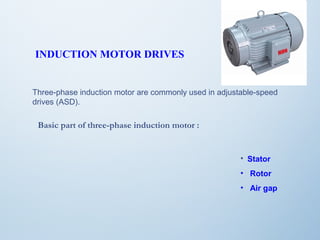
INDUCTION MOTOR DRIVES 
Three-phase induction motor are commonly used in adjustable-speed 
drives (ASD). 
Basic part of three-phase induction motor : 
• Stator 
• Rotor 
• Air gap
The stator winding are supplied with balanced three-phase AC voltage, 
which produce induced voltage in the rotor windings. It is possible to 
arrange the distribution of stator winding so that there is an effect of 
multiple poles, producing several cycle of magnetomotive force (mmf) or 
field around the air gap. 
The speed of rotation of field is called the synchronous speed ws , which 
is defined by :  
ωs is syncronous speed [rad/sec] 
Ns is syncronous speed [rpm] 
p is numbers of poles 
ω is the supply frequency [rad/sec] 
f is the supply frequency [Hz] 
Nm p is motor speed 
w = 2w 
s p 
N =120 
f s 
or
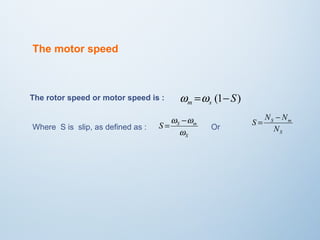
The rotor speed or motor speed is : (1 S) m s w =w - 
Where S is slip, as defined as : 
S = N - N 
=w -w Or S 
S S m 
w 
S 
S m 
N 
The motor speed
Equivalent Circuit OOff IInndduuccttiioonn MMoottoorr 
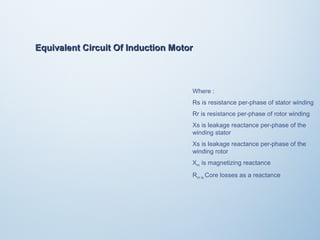
Where : 
Rs is resistance per-phase of stator winding 
Rr is resistance per-phase of rotor winding 
Xs is leakage reactance per-phase of the 
winding stator 
Xs is leakage reactance per-phase of the 
winding rotor 
Xm is magnetizing reactance 
Rm is Core losses as a reactance
Performance Characteristic of 
Induction Motor 
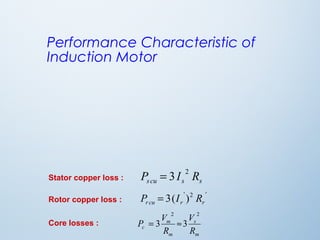
Stator copper loss : s cu s s P = 3 I 2 R 
3( ' )2 ' r cu r r Rotor copper loss : P = I R 
s 
P V 
c R 
m 
m 
m 
V 
R 
2 2 
Core losses : = 3 »3
Performance Characteristic of 
Induction Motor 
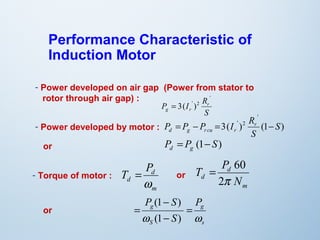
- Power developed on air gap (Power from stator to 
rotor through air gap) : 
P I Rr 
g r 
S 
' 
= 3( ' )2 
' 
P P P I Rr 
d g r cu r = - = - 
P P (1 S) d g = - 
' 2 S 
3( ) (1 ) 
S 
- Power developed by motor : 
or 
- Torque of motor : 
T P 
d 
m 
d 
w 
= 
T P 
= 60 or 
P S 
P 
g g 
w w 
s 
S 
(1 ) 
S 
= 
- 
- 
= 
(1 ) 
or 
m 
d 
d 2p 
N
Performance Characteristic of 
Induction Motor 
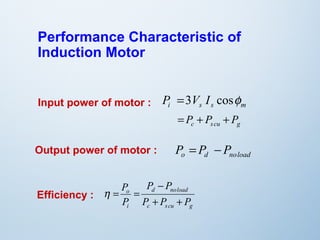
i s s m P =3V I cosf 
c s cu g = P + P + P 
Input power of motor : 
o d noload P = P - P 
Output power of motor : 
P - 
P 
d noload 
c s cu g 
P 
o 
i 
P P P 
P 
+ + 
h = = 
Efficiency :
Performance Characteristic of 
Induction Motor 
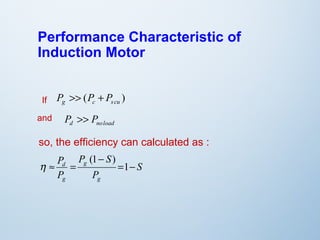
( ) g c s cu P >> P + P 
If 
and 
P >> P 
d noload so, the efficiency can calculated as : 
S 
P S 
(1 ) 
d = - 
P 
P 
P 
g 
g 
g 
- 
» = 1 
h
Performance Characteristic of 
Induction Motor 
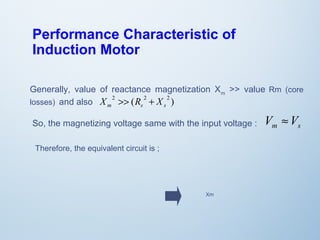
Generally, value of reactance magnetization X>> value Rm (core 
m losses) and also 
X 2 >> ( R 2 + X 
2 ) 
m s s So, the magnetizing voltage same with the input voltage : V »V 
m s Therefore, the equivalent circuit is ; 
Xm
Performance Characteristic of 
Induction Motor 
X X X jX R R 
- + + + 
= 
( ) ( ) 
' 
( ) 
' 
' 
' 
m s r 
R R 
r 
s 
r 
m s r m s 
i 
j X X X 
S 
S 
Z 
+ + + + 
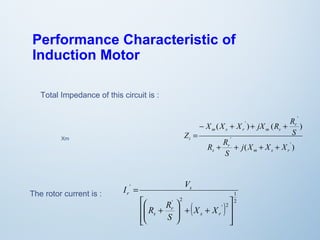
Total Impedance of this circuit is : 
Xm 
The rotor current is : 
1 
ù 
( ) 2 
' 2 
I V 
' 2 
' 
ú ú 
û 
é 
æ 
ê ê 
ë 
ö 
+ + ÷ ÷ø 
ç çè 
R + 
R 
= 
s r 
r 
s 
s 
r 
X X 
S
( ) 
ù 
ú ú 
û 
T R V 
é 
æ 
S R R 
ê ê 
ë 
3 ' 2 
+ + ÷ ÷ø ö 
ç çè 
+ 
= 
' 2 
' 2 
s r 
r 
s s 
r s 
d 
X X 
S 
w 
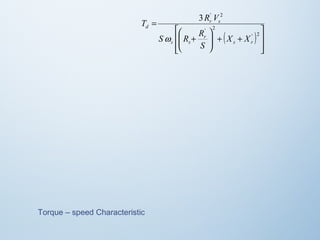
Torque – speed Characteristic
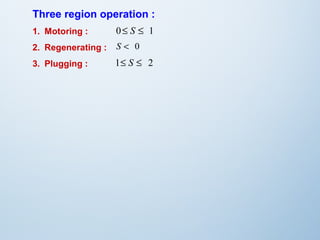
Three region operation : 
1. Motoring : 
0£ S £ 1 
2. Regenerating : 
S < 0 
3. Plugging : 
1£ S £ 2
Performance Characteristic of 
Induction Motor 
Starting speed of motor is wm = 0 or S = 1, 
Starting torque of motor is : 
3 ' 2 
( ) 
ù 
ú ú 
û 
T R V 
é 
æ 
ê ê 
ë 
ö 
+ + ÷ ÷ø 
ç çè 
R + 
R 
= 
' 2 
' 2 
s r 
r 
s s 
r s 
st 
X X 
S 
w 
d Td 
Slip for the maximum torque Smax can be found by setting : = 0 
dS 
So, the slip on maximum torque is : 
' 
S R 
r 
[( ) 2 ( ' ) 1 
2 
]2 
max 
R + X + 
X 
s s r 
= ±
Performance Characteristic of 
Induction Motor 
2 
( ) úû ù 
T V 
êë é 
s 
R + R + X + 
X 
= 
2 ' 2 
max 
w 
2 
3 
s s s s r 
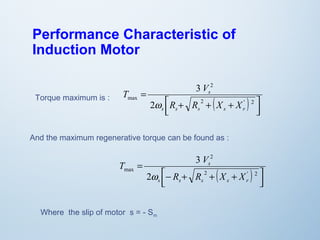
Torque maximum is : 
And the maximum regenerative torque can be found as : 
( ) úû ù 
T V 
êë é 
2 
s 
R R X X 
- + + + 
= 
2 ' 2 
max 
w 
2 
3 
s s s s r 
Where the slip of motor s = - Sm
( ) 
ù 
ú ú 
û 
T R V 
é 
S R R 
ê ê 
ë 
3 ' 2 
ö 
+ + ÷ ÷ø 
ç çè æ 
+ 
= 
' 2 
' 2 
s r 
r 
s s 
r s 
d 
X X 
S 
w 
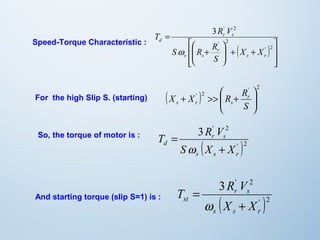
Speed-Torque Characteristic : 
( X X ' ) 2 
R Rr 
' ö 
2 
s r s 
÷ ÷ø 
æ 
ç çè 
+ >> + 
S 
3 ' 2 
T R V 
r s 
( ' )2 
d S X + 
X 
s s r 
= 
w 
3 ' 2 
T R V 
r s 
( ' )2 
= 
w 
st X + 
X 
s s r 
For the high Slip S. (starting) 
So, the torque of motor is : 
And starting torque (slip S=1) is :
For low slip S region, the motor speed near unity or synchronous 
speed, in this region the impedance motor is : 
X + X ' 2 << R' >> 
( ) r 
R 
s r s 
S 
3 2 
w 
T V S 
s 
d R 
' 
s r 
= 
So, the motor torque is : 
' 
S R 
r 
[( ) 2 ( ' ) 1 
2 
]2 
max 
R + X + 
X 
s s r 
And the slip at maximum torque is : = ± 
The maximum motor torque is : 
( ) 
ù 
ú úû 
T R V 
é 
æ 
S R R 
ê êë 
3 ' 2 
ö 
+ + ÷ ÷ø 
ç çè 
+ 
= 
' 2 
' 2 
s r 
r 
s s 
r s 
d 
X X 
S 
w
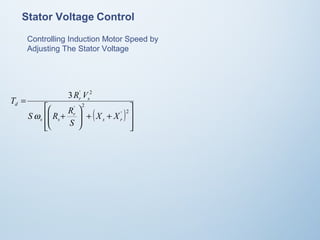
Stator Voltage Control 
Controlling Induction Motor Speed by 
Adjusting The Stator Voltage 
( ) 
ù 
ú ú 
û 
T R V 
é 
æ 
S R R 
ê ê 
ë 
3 ' 2 
ö 
+ + ÷ ÷ø 
ç çè 
+ 
= 
' 2 
' 2 
s r 
r 
s s 
r s 
d 
X X 
S 
w
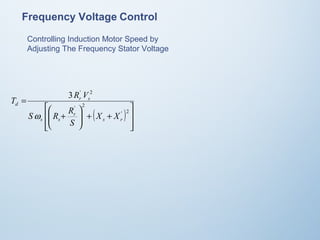
Frequency Voltage Control 
Controlling Induction Motor Speed by 
Adjusting The Frequency Stator Voltage 
( ) 
ú úû ù 
T R V 
é 
æ 
S R R 
ê êë 
3 ' 2 
ö 
+ + ÷ ÷ø 
ç çè 
+ 
= 
' 2 
' 2 
s r 
r 
s s 
r s 
d 
X X 
S 
w
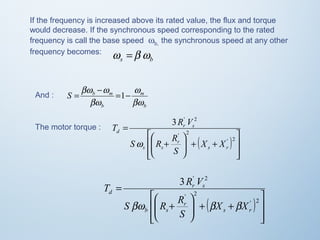
If the frequency is increased above its rated value, the flux and torque 
would decrease. If the synchronous speed corresponding to the rated 
frequency is call the base speed wb, the synchronous speed at any other 
frequency becomes: 
s b w =b w 
And : 
w 
m 
b 
= bw -w =1- 
S b m 
b 
bw 
bw 
The motor torque : 
( ) 
ù 
ú ú 
û 
T R V 
é 
æ 
S R R 
ê ê 
ë 
3 ' 2 
ö 
+ + ÷ ÷ø 
ç çè 
+ 
= 
' 2 
' 2 
s r 
r 
s s 
r s 
d 
X X 
S 
w 
3 ' 2 
( ) 
ù 
ú úû 
T R V 
é 
æ 
S R R 
bw b b 
ê êë 
ö 
+ + ÷ ÷ø 
ç çè 
+ 
= 
' 2 
' 2 
s r 
r 
b s 
r s 
d 
X X 
S
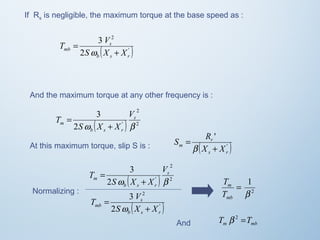
If Rs is negligible, the maximum torque at the base speed as : 
2 
T V 
( ' ) 
2 
3 
s 
b s r 
mb S X + 
X 
= 
w 
And the maximum torque at any other frequency is : 
2 
3 
s 
( ) 2 
2 ' 
w b 
b s r 
m 
V 
S X X 
T 
+ 
= 
S R 
' 
r 
s r 
At this maximum torque, slip S is : m ( X + 
X 
' ) 
= 
b 
Normalizing : 
3 
s 
( ) 2 
2 
T V 
( ' ) 
2 
3 
s 
b s r 
mb S X + 
X 
= 
w 
2 
2 ' 
w b 
b s r 
m 
V 
S X X 
T 
+ 
= 
1 
b 
2 
= 
T 
m 
T 
mb 
And m mb T b 2 =T
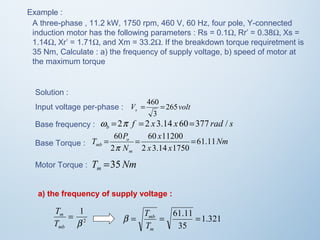
Example : 
A three-phase , 11.2 kW, 1750 rpm, 460 V, 60 Hz, four pole, Y-connected 
induction motor has the following parameters : Rs = 0.1W, Rr’ = 0.38W, Xs = 
1.14W, Xr’ = 1.71W, and Xm = 33.2W. If the breakdown torque requiretment is 
35 Nm, Calculate : a) the frequency of supply voltage, b) speed of motor at 
the maximum torque 
Solution : 
Input voltage per-phase : 
V = 460 = 
265 
volt s 3 
Base frequency : w = 2p f = 2 x 3.14 x 60=377 rad / 
s b Nm 
x 
= 60 = 60 11200 
= 
p 
T =35 
Nm m mb 61.11 
x x 
T P 
o 
N 
m 
2 3.14 1750 
2 
Base Torque : 
Motor Torque : 
a) the frequency of supply voltage : 
1 
b 
2 
= 
T 
m 
T 
mb 
1.321 
= = 61.11 = 
35 
mb 
T 
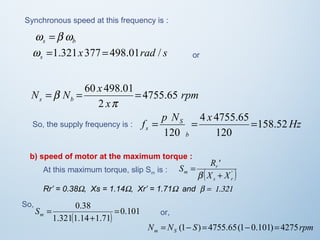
m 
b T
Synchronous speed at this frequency is : 
s b w =b w 
x rad s s w =1.321 377 =498.01 / or 
rpm 
N = N = 60 x 498.01= 
4755.65 
s b x 
2 
p 
b 
p N 4 x 
4755.65 
So, the supply frequency is : f = = = 
Hz s 158.52 
b 
S 
120 
120 
b) speed of motor at the maximum torque : 
S R 
' 
r 
s r 
At this maximum torque, slip Sis : m m ( X + 
X 
' ) 
= 
b 
Rr’ = 0.38W, Xs = 1.14W, Xr’ = 1.71W  and b =  1.321 
0.38 = 
( ) 0.101 
+ 
1.3211.14 1.71 
= m S 
So, 
or, 
N N S rpm m S = (1- ) = 4755.65(1- 0.101)= 4275
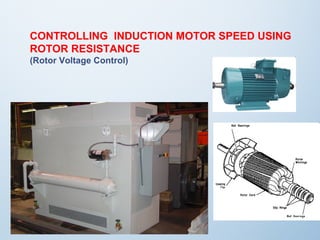
CONTROLLING INDUCTION MOTOR SPEED USING 
ROTOR RESISTANCE 
(Rotor Voltage Control)
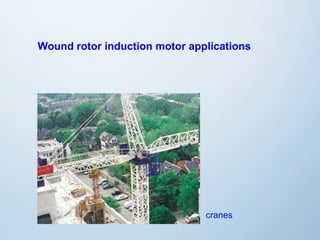
Wound rotor induction motor applications 
cranes
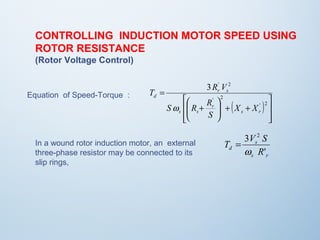
CONTROLLING INDUCTION MOTOR SPEED USING 
ROTOR RESISTANCE 
(Rotor Voltage Control) 
Equation of Speed-Torque : 
( ) 
ù 
ú úû 
T R V 
é 
æ 
S R R 
ê êë 
3 ' 2 
ö 
+ + ÷ ÷ø 
ç çè 
+ 
= 
' 2 
' 2 
s r 
r 
s s 
r s 
d 
X X 
S 
w 
3 2 
w 
T V S 
s 
d R 
' 
s r 
In a wound rotor induction motor, an external = 
three-phase resistor may be connected to its 
slip rings,
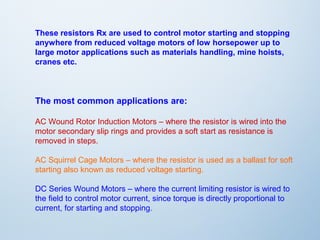
These resistors Rx are used to control motor starting and stopping 
anywhere from reduced voltage motors of low horsepower up to 
large motor applications such as materials handling, mine hoists, 
cranes etc. 
The most common applications are: 
AC Wound Rotor Induction Motors – where the resistor is wired into the 
motor secondary slip rings and provides a soft start as resistance is 
removed in steps. 
AC Squirrel Cage Motors – where the resistor is used as a ballast for soft 
starting also known as reduced voltage starting. 
DC Series Wound Motors – where the current limiting resistor is wired to 
the field to control motor current, since torque is directly proportional to 
current, for starting and stopping.
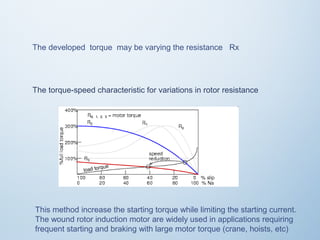
The developed torque may be varying the resistance Rx 
The torque-speed characteristic for variations in rotor resistance 
This method increase the starting torque while limiting the starting current. 
The wound rotor induction motor are widely used in applications requiring 
frequent starting and braking with large motor torque (crane, hoists, etc)
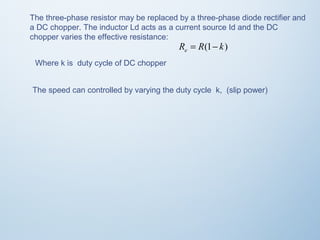
The three-phase resistor may be replaced by a three-phase diode rectifier and 
a DC chopper. The inductor Ld acts as a current source Id and the DC 
chopper varies the effective resistance: 
R R(1 k) e = - 
Where k is duty cycle of DC chopper 
The speed can controlled by varying the duty cycle k, (slip power)
The slip power in the rotor circuit may be returned to the supply by replacing 
the DC converter and resistance R with a three-phase full converter 
(inverter)
Example: 
A three-phase induction motor, 460, 60Hz, six-pole, Y connected, wound rotor 
that speed is controlled by slip power such as shown in Figure below. The 
motor parameters are Rs=0.041 W, Rr’=0.044 W, Xs=0.29 W, Xr’=0.44 W and 
Xm=6.1 W. The turn ratio of the rotor to stator winding is nm=Nr/Ns=0.9. The 
inductance Ld is very large and its current Id has negligible ripple. 
The value of Rs, Rr’, Xs and Xr’ for equivalent circuit can be considered 
negligible compared with the effective impedance of Ld. The no-load of motor is 
negligible. The losses of rectifier and Dc chopper are also negligible. 
The load torque, which is proportional to speed square is 750 Nm at 1175 rpm. 
(a) If the motor has to operate with a minimum speed of 800 rpm, determine 
the resistance R, if the desired speed is 1050 rpm, 
(b) Calculate the inductor current Id. 
(c) The duty cycle k of the DC chopper. 
(d)The voltage Vd. 
(e)The efficiency. 
(f)The power factor of input line of the motor.
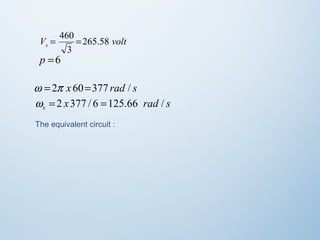
V = 460 = 
265.58 
volt s 3 
p =6 
w =2p x 60=377 rad / s 
x rad s s w = 2 377 / 6 =125.66 / 
The equivalent circuit :
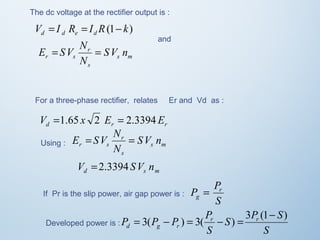
The dc voltage at the rectifier output is : 
V I R I R(1 k) d d e d = = - 
E = SV N = 
r s SV n 
s m 
r 
s 
N 
and 
For a three-phase rectifier, relates Er and Vd as : 
V =1.65 x 2 E = 2.3394 E 
d r r E = SV N r 
Using : = 
SV n 
r s s m 
s 
N 
d s m V = 2.3394 SV n 
P Pr 
g = 
If Pr is the slip power, air gap power is : S 
P P P Pr r 
d g r 
S P S 
= 3( - ) = 3( - ) = 3 (1- ) 
Developed power is : S 
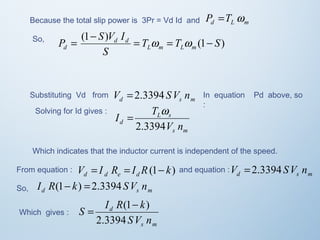
S
Because the total slip power is 3Pr = Vd Id and d L m P =T w 
So, (1 ) T T (1 S) 
P S V I L m L m 
d = - = w = w - 
S 
d d 
Substituting Vd from d s m V = 2.3394 SV n In equation Pd above, so 
: 
Solving for Id gives : 
s m 
I T 
= w 
L s 
d 2.3394 
V n 
Which indicates that the inductor current is independent of the speed. 
From equation : V I R I R(1 k) d d e d = = - and equation : d s m V = 2.3394 SV n 
So, d s m I R(1- k) = 2.3394 SV n 
Which gives : 
S I R k 
= (1- ) 
s m 
d 
SV n 
2.3394
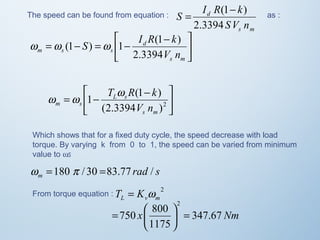
The speed can be found from equation : 
S I R k 
= (1- ) as : 
s m 
d 
SV n 
2.3394 
ù 
úû 
é - = - = - 
S I R k 
w w (1 ) w 1 (1 ) 
êë 
s m 
d 
m s s 2.3394 
V n 
ù 
úû 
é - = - (2.3394 )2 
w w T w R k 
1 (1 ) 
êë 
s m 
L s 
m s V n 
Which shows that for a fixed duty cycle, the speed decrease with load 
torque. By varying k from 0 to 1, the speed can be varied from minimum 
value to ws 
rad s m w =180 p / 30 =83.77 / 
From torque equation : 2 
L v m T = K w 
750 800 
2 
= ÷ø 
= æ 
ö çè 
x 347.67 Nm 
1175
From equation : 
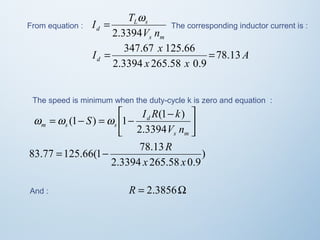
= w The corresponding inductor current is : 
s m 
I T 
L s 
d 2.3394 
V n 
A 
I = 347.67 x 125.66 = 
78.13 
d x x 
2.3394 265.58 0.9 
The speed is minimum when the duty-cycle k is zero and equation : 
ù 
úû 
êë é - = - = - 
S I R k 
w w (1 ) w 1 (1 ) 
s m 
d 
m s s 2.3394 
V n 
) 
= - R 
83.77 125.66(1 78.13 
x x 
2.3394 265.58 0.9 
And : R = 2.3856W

A.C Drives

  • 1.
    A.C Drives By A.S.Krishna
  • 2.
    AACC DDRRIIVVEESS ACmotor Drives are used in many industrial and domestic application, such as in conveyer, lift, mixer, escalator etc. TThhee AACC mmoottoorr hhaavvee aa nnuummbbeerr ooff aaddvvaannttaaggeess :: • LLiigghhttwweeiigghhtt ((2200%% ttoo 4400%% lliigghhtteerr tthhaann eeqquuiivvaalleenntt DDCC mmoottoorr)) • IInneexxppeennssiivvee • LLooww mmaaiinntteennaannccee TThhee DDiissaaddvvaannttaaggeess AACC mmoottoorr :: ** TThhee ppoowweerr ccoonnttrrooll rreellaattiivveellyy ccoommpplleexx aanndd mmoorree eexxppeennssiivvee TThheerree aarree ttwwoo ttyyppee ooff AACC mmoottoorr DDrriivveess :: 11.. IInndduuccttiioonn MMoottoorr DDrriivveess 22.. SSyynncchhrroonnoouuss MMoottoorr DDrriivveess
  • 3.
    INDUCTION MOTOR DRIVES Three-phase induction motor are commonly used in adjustable-speed drives (ASD). Basic part of three-phase induction motor : • Stator • Rotor • Air gap
  • 4.
    The stator windingare supplied with balanced three-phase AC voltage, which produce induced voltage in the rotor windings. It is possible to arrange the distribution of stator winding so that there is an effect of multiple poles, producing several cycle of magnetomotive force (mmf) or field around the air gap. The speed of rotation of field is called the synchronous speed ws , which is defined by : ωs is syncronous speed [rad/sec] Ns is syncronous speed [rpm] p is numbers of poles ω is the supply frequency [rad/sec] f is the supply frequency [Hz] Nm p is motor speed w = 2w s p N =120 f s or
  • 5.
    The rotor speedor motor speed is : (1 S) m s w =w - Where S is slip, as defined as : S = N - N =w -w Or S S S m w S S m N The motor speed
  • 6.
    Equivalent Circuit OOffIInndduuccttiioonn MMoottoorr Where : Rs is resistance per-phase of stator winding Rr is resistance per-phase of rotor winding Xs is leakage reactance per-phase of the winding stator Xs is leakage reactance per-phase of the winding rotor Xm is magnetizing reactance Rm is Core losses as a reactance
  • 7.
    Performance Characteristic of Induction Motor Stator copper loss : s cu s s P = 3 I 2 R 3( ' )2 ' r cu r r Rotor copper loss : P = I R s P V c R m m m V R 2 2 Core losses : = 3 »3
  • 8.
    Performance Characteristic of Induction Motor - Power developed on air gap (Power from stator to rotor through air gap) : P I Rr g r S ' = 3( ' )2 ' P P P I Rr d g r cu r = - = - P P (1 S) d g = - ' 2 S 3( ) (1 ) S - Power developed by motor : or - Torque of motor : T P d m d w = T P = 60 or P S P g g w w s S (1 ) S = - - = (1 ) or m d d 2p N
  • 9.
    Performance Characteristic of Induction Motor i s s m P =3V I cosf c s cu g = P + P + P Input power of motor : o d noload P = P - P Output power of motor : P - P d noload c s cu g P o i P P P P + + h = = Efficiency :
  • 10.
    Performance Characteristic of Induction Motor ( ) g c s cu P >> P + P If and P >> P d noload so, the efficiency can calculated as : S P S (1 ) d = - P P P g g g - » = 1 h
  • 11.
    Performance Characteristic of Induction Motor Generally, value of reactance magnetization X>> value Rm (core m losses) and also X 2 >> ( R 2 + X 2 ) m s s So, the magnetizing voltage same with the input voltage : V »V m s Therefore, the equivalent circuit is ; Xm
  • 12.
    Performance Characteristic of Induction Motor X X X jX R R - + + + = ( ) ( ) ' ( ) ' ' ' m s r R R r s r m s r m s i j X X X S S Z + + + + Total Impedance of this circuit is : Xm The rotor current is : 1 ù ( ) 2 ' 2 I V ' 2 ' ú ú û é æ ê ê ë ö + + ÷ ÷ø ç çè R + R = s r r s s r X X S
  • 13.
    ( ) ù ú ú û T R V é æ S R R ê ê ë 3 ' 2 + + ÷ ÷ø ö ç çè + = ' 2 ' 2 s r r s s r s d X X S w Torque – speed Characteristic
  • 14.
    Three region operation: 1. Motoring : 0£ S £ 1 2. Regenerating : S < 0 3. Plugging : 1£ S £ 2
  • 15.
    Performance Characteristic of Induction Motor Starting speed of motor is wm = 0 or S = 1, Starting torque of motor is : 3 ' 2 ( ) ù ú ú û T R V é æ ê ê ë ö + + ÷ ÷ø ç çè R + R = ' 2 ' 2 s r r s s r s st X X S w d Td Slip for the maximum torque Smax can be found by setting : = 0 dS So, the slip on maximum torque is : ' S R r [( ) 2 ( ' ) 1 2 ]2 max R + X + X s s r = ±
  • 16.
    Performance Characteristic of Induction Motor 2 ( ) úû ù T V êë é s R + R + X + X = 2 ' 2 max w 2 3 s s s s r Torque maximum is : And the maximum regenerative torque can be found as : ( ) úû ù T V êë é 2 s R R X X - + + + = 2 ' 2 max w 2 3 s s s s r Where the slip of motor s = - Sm
  • 17.
    ( ) ù ú ú û T R V é S R R ê ê ë 3 ' 2 ö + + ÷ ÷ø ç çè æ + = ' 2 ' 2 s r r s s r s d X X S w Speed-Torque Characteristic : ( X X ' ) 2 R Rr ' ö 2 s r s ÷ ÷ø æ ç çè + >> + S 3 ' 2 T R V r s ( ' )2 d S X + X s s r = w 3 ' 2 T R V r s ( ' )2 = w st X + X s s r For the high Slip S. (starting) So, the torque of motor is : And starting torque (slip S=1) is :
  • 18.
    For low slipS region, the motor speed near unity or synchronous speed, in this region the impedance motor is : X + X ' 2 << R' >> ( ) r R s r s S 3 2 w T V S s d R ' s r = So, the motor torque is : ' S R r [( ) 2 ( ' ) 1 2 ]2 max R + X + X s s r And the slip at maximum torque is : = ± The maximum motor torque is : ( ) ù ú úû T R V é æ S R R ê êë 3 ' 2 ö + + ÷ ÷ø ç çè + = ' 2 ' 2 s r r s s r s d X X S w
  • 19.
    Stator Voltage Control Controlling Induction Motor Speed by Adjusting The Stator Voltage ( ) ù ú ú û T R V é æ S R R ê ê ë 3 ' 2 ö + + ÷ ÷ø ç çè + = ' 2 ' 2 s r r s s r s d X X S w
  • 20.
    Frequency Voltage Control Controlling Induction Motor Speed by Adjusting The Frequency Stator Voltage ( ) ú úû ù T R V é æ S R R ê êë 3 ' 2 ö + + ÷ ÷ø ç çè + = ' 2 ' 2 s r r s s r s d X X S w
  • 21.
    If the frequencyis increased above its rated value, the flux and torque would decrease. If the synchronous speed corresponding to the rated frequency is call the base speed wb, the synchronous speed at any other frequency becomes: s b w =b w And : w m b = bw -w =1- S b m b bw bw The motor torque : ( ) ù ú ú û T R V é æ S R R ê ê ë 3 ' 2 ö + + ÷ ÷ø ç çè + = ' 2 ' 2 s r r s s r s d X X S w 3 ' 2 ( ) ù ú úû T R V é æ S R R bw b b ê êë ö + + ÷ ÷ø ç çè + = ' 2 ' 2 s r r b s r s d X X S
  • 22.
    If Rs isnegligible, the maximum torque at the base speed as : 2 T V ( ' ) 2 3 s b s r mb S X + X = w And the maximum torque at any other frequency is : 2 3 s ( ) 2 2 ' w b b s r m V S X X T + = S R ' r s r At this maximum torque, slip S is : m ( X + X ' ) = b Normalizing : 3 s ( ) 2 2 T V ( ' ) 2 3 s b s r mb S X + X = w 2 2 ' w b b s r m V S X X T + = 1 b 2 = T m T mb And m mb T b 2 =T
  • 23.
    Example : Athree-phase , 11.2 kW, 1750 rpm, 460 V, 60 Hz, four pole, Y-connected induction motor has the following parameters : Rs = 0.1W, Rr’ = 0.38W, Xs = 1.14W, Xr’ = 1.71W, and Xm = 33.2W. If the breakdown torque requiretment is 35 Nm, Calculate : a) the frequency of supply voltage, b) speed of motor at the maximum torque Solution : Input voltage per-phase : V = 460 = 265 volt s 3 Base frequency : w = 2p f = 2 x 3.14 x 60=377 rad / s b Nm x = 60 = 60 11200 = p T =35 Nm m mb 61.11 x x T P o N m 2 3.14 1750 2 Base Torque : Motor Torque : a) the frequency of supply voltage : 1 b 2 = T m T mb 1.321 = = 61.11 = 35 mb T m b T
  • 24.
    Synchronous speed atthis frequency is : s b w =b w x rad s s w =1.321 377 =498.01 / or rpm N = N = 60 x 498.01= 4755.65 s b x 2 p b p N 4 x 4755.65 So, the supply frequency is : f = = = Hz s 158.52 b S 120 120 b) speed of motor at the maximum torque : S R ' r s r At this maximum torque, slip Sis : m m ( X + X ' ) = b Rr’ = 0.38W, Xs = 1.14W, Xr’ = 1.71W and b = 1.321 0.38 = ( ) 0.101 + 1.3211.14 1.71 = m S So, or, N N S rpm m S = (1- ) = 4755.65(1- 0.101)= 4275
  • 25.
    CONTROLLING INDUCTION MOTORSPEED USING ROTOR RESISTANCE (Rotor Voltage Control)
  • 26.
    Wound rotor inductionmotor applications cranes
  • 27.
    CONTROLLING INDUCTION MOTORSPEED USING ROTOR RESISTANCE (Rotor Voltage Control) Equation of Speed-Torque : ( ) ù ú úû T R V é æ S R R ê êë 3 ' 2 ö + + ÷ ÷ø ç çè + = ' 2 ' 2 s r r s s r s d X X S w 3 2 w T V S s d R ' s r In a wound rotor induction motor, an external = three-phase resistor may be connected to its slip rings,
  • 28.
    These resistors Rxare used to control motor starting and stopping anywhere from reduced voltage motors of low horsepower up to large motor applications such as materials handling, mine hoists, cranes etc. The most common applications are: AC Wound Rotor Induction Motors – where the resistor is wired into the motor secondary slip rings and provides a soft start as resistance is removed in steps. AC Squirrel Cage Motors – where the resistor is used as a ballast for soft starting also known as reduced voltage starting. DC Series Wound Motors – where the current limiting resistor is wired to the field to control motor current, since torque is directly proportional to current, for starting and stopping.
  • 29.
    The developed torquemay be varying the resistance Rx The torque-speed characteristic for variations in rotor resistance This method increase the starting torque while limiting the starting current. The wound rotor induction motor are widely used in applications requiring frequent starting and braking with large motor torque (crane, hoists, etc)
  • 30.
    The three-phase resistormay be replaced by a three-phase diode rectifier and a DC chopper. The inductor Ld acts as a current source Id and the DC chopper varies the effective resistance: R R(1 k) e = - Where k is duty cycle of DC chopper The speed can controlled by varying the duty cycle k, (slip power)
  • 31.
    The slip powerin the rotor circuit may be returned to the supply by replacing the DC converter and resistance R with a three-phase full converter (inverter)
  • 32.
    Example: A three-phaseinduction motor, 460, 60Hz, six-pole, Y connected, wound rotor that speed is controlled by slip power such as shown in Figure below. The motor parameters are Rs=0.041 W, Rr’=0.044 W, Xs=0.29 W, Xr’=0.44 W and Xm=6.1 W. The turn ratio of the rotor to stator winding is nm=Nr/Ns=0.9. The inductance Ld is very large and its current Id has negligible ripple. The value of Rs, Rr’, Xs and Xr’ for equivalent circuit can be considered negligible compared with the effective impedance of Ld. The no-load of motor is negligible. The losses of rectifier and Dc chopper are also negligible. The load torque, which is proportional to speed square is 750 Nm at 1175 rpm. (a) If the motor has to operate with a minimum speed of 800 rpm, determine the resistance R, if the desired speed is 1050 rpm, (b) Calculate the inductor current Id. (c) The duty cycle k of the DC chopper. (d)The voltage Vd. (e)The efficiency. (f)The power factor of input line of the motor.
  • 33.
    V = 460= 265.58 volt s 3 p =6 w =2p x 60=377 rad / s x rad s s w = 2 377 / 6 =125.66 / The equivalent circuit :
  • 34.
    The dc voltageat the rectifier output is : V I R I R(1 k) d d e d = = - E = SV N = r s SV n s m r s N and For a three-phase rectifier, relates Er and Vd as : V =1.65 x 2 E = 2.3394 E d r r E = SV N r Using : = SV n r s s m s N d s m V = 2.3394 SV n P Pr g = If Pr is the slip power, air gap power is : S P P P Pr r d g r S P S = 3( - ) = 3( - ) = 3 (1- ) Developed power is : S S
  • 35.
    Because the totalslip power is 3Pr = Vd Id and d L m P =T w So, (1 ) T T (1 S) P S V I L m L m d = - = w = w - S d d Substituting Vd from d s m V = 2.3394 SV n In equation Pd above, so : Solving for Id gives : s m I T = w L s d 2.3394 V n Which indicates that the inductor current is independent of the speed. From equation : V I R I R(1 k) d d e d = = - and equation : d s m V = 2.3394 SV n So, d s m I R(1- k) = 2.3394 SV n Which gives : S I R k = (1- ) s m d SV n 2.3394
  • 36.
    The speed canbe found from equation : S I R k = (1- ) as : s m d SV n 2.3394 ù úû é - = - = - S I R k w w (1 ) w 1 (1 ) êë s m d m s s 2.3394 V n ù úû é - = - (2.3394 )2 w w T w R k 1 (1 ) êë s m L s m s V n Which shows that for a fixed duty cycle, the speed decrease with load torque. By varying k from 0 to 1, the speed can be varied from minimum value to ws rad s m w =180 p / 30 =83.77 / From torque equation : 2 L v m T = K w 750 800 2 = ÷ø = æ ö çè x 347.67 Nm 1175
  • 37.
    From equation : = w The corresponding inductor current is : s m I T L s d 2.3394 V n A I = 347.67 x 125.66 = 78.13 d x x 2.3394 265.58 0.9 The speed is minimum when the duty-cycle k is zero and equation : ù úû êë é - = - = - S I R k w w (1 ) w 1 (1 ) s m d m s s 2.3394 V n ) = - R 83.77 125.66(1 78.13 x x 2.3394 265.58 0.9 And : R = 2.3856W