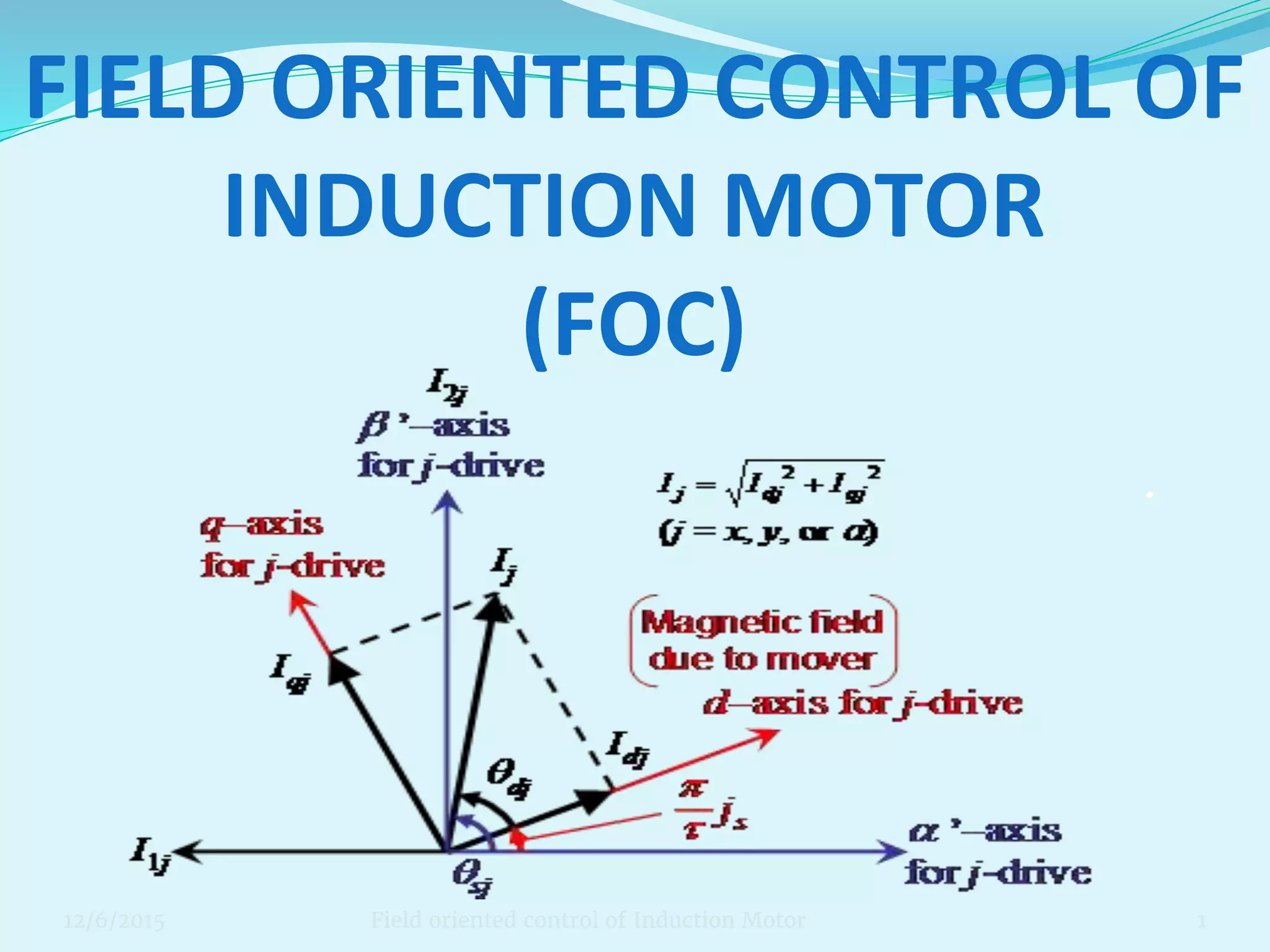
FIELD ORIENTED CONTROL OF
INDUCTION MOTOR
(FOC)
.
1Field oriented control of Induction Motor12/6/2015
Presented by:
Mohit Sharma | 2K13/EE/074
Rahatul Ashfeen |
2K13/EE/096
Submitted to:
Dr. Mini Sreejeth
(Project advisor)
Dr. S.K. Velluru
(Project Coordinator)
DELHI TECHNOLOGICAL UNIVERSITY
(DEPARTMENT OF ELECTRICAL ENGINEERING)
2Field oriented control of Induction Motor12/6/2015
Before FOC
scalar control
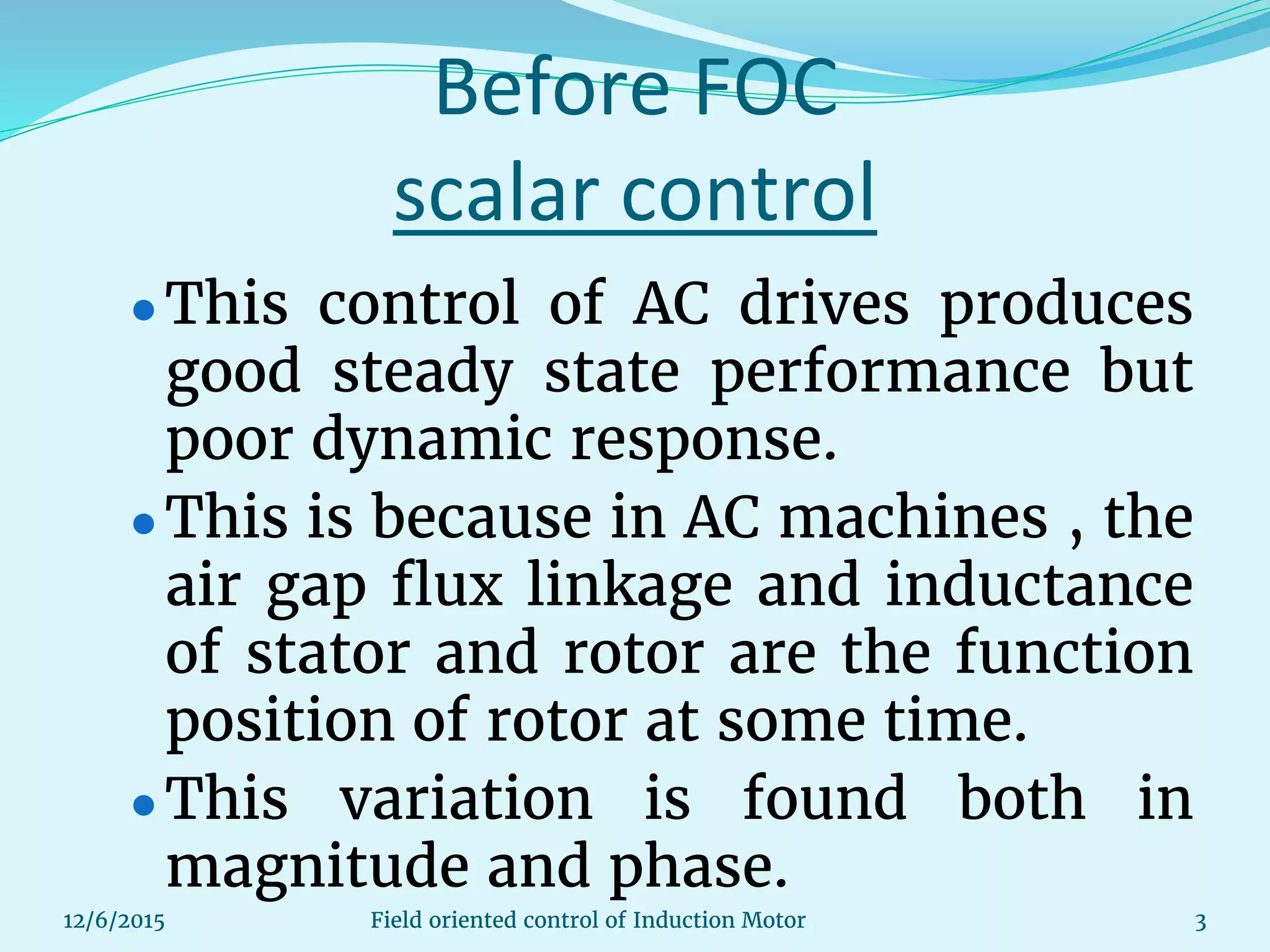
●This control of AC drives produces
good steady state performance but
poor dynamic response.
●This is because in AC machines , the
air gap flux linkage and inductance
of stator and rotor are the function
position of rotor at some time.
●This variation is found both in
magnitude and phase.
3Field oriented control of Induction Motor12/6/2015
Before FOC
scalar control (contd.)
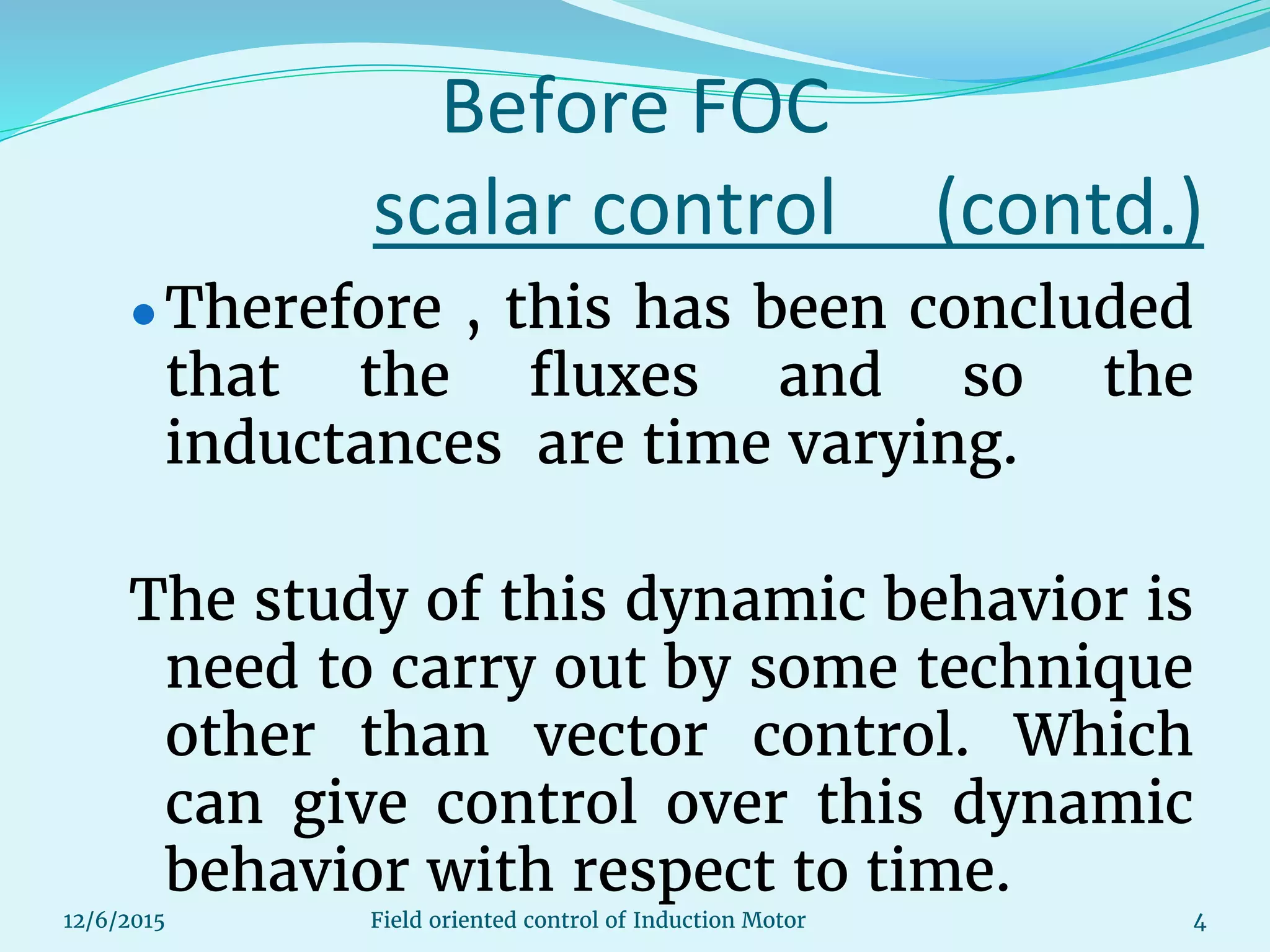
●Therefore , this has been concluded
that the fluxes and so the
inductances are time varying.
The study of this dynamic behavior is
need to carry out by some technique
other than vector control. Which
can give control over this dynamic
behavior with respect to time.
4Field oriented control of Induction Motor12/6/2015
Introduction
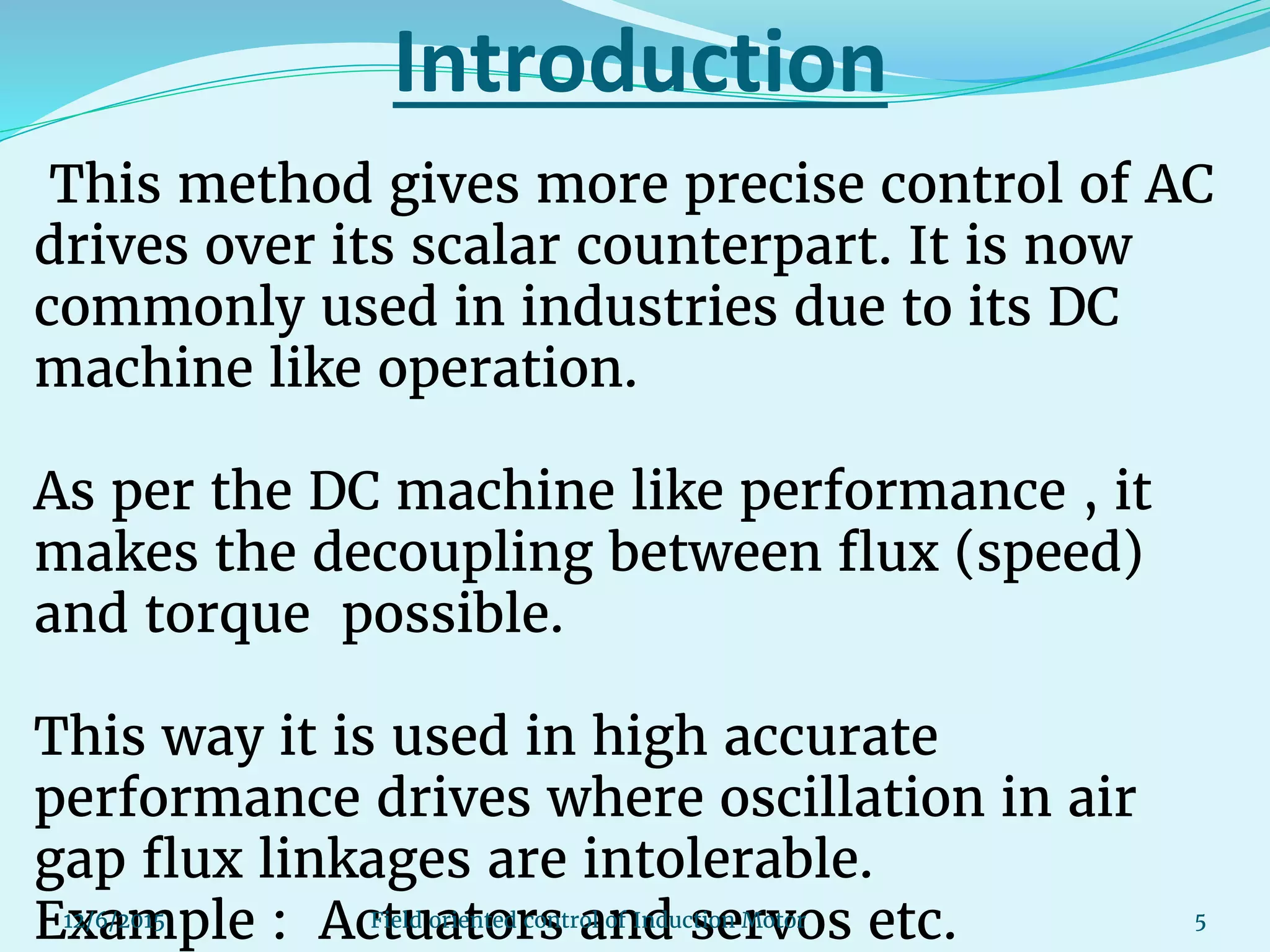
This method gives more precise control of AC
drives over its scalar counterpart. It is now
commonly used in industries due to its DC
machine like operation.
As per the DC machine like performance , it
makes the decoupling between flux (speed)
and torque possible.
This way it is used in high accurate
performance drives where oscillation in air
gap flux linkages are intolerable.
Example : Actuators and servos etc. 5Field oriented control of Induction Motor12/6/2015
Introduction
contd.
In scalar control both flux and torque are
the function of voltage/current and
frequency. This tends the system into
instability due to higher order harmonics.
While in vector control both these are
independently controllable. Because of the
decoupled nature of flux and torque in
this control
6Field oriented control of Induction Motor12/6/2015
Induction motor
(d-q model and circuit)
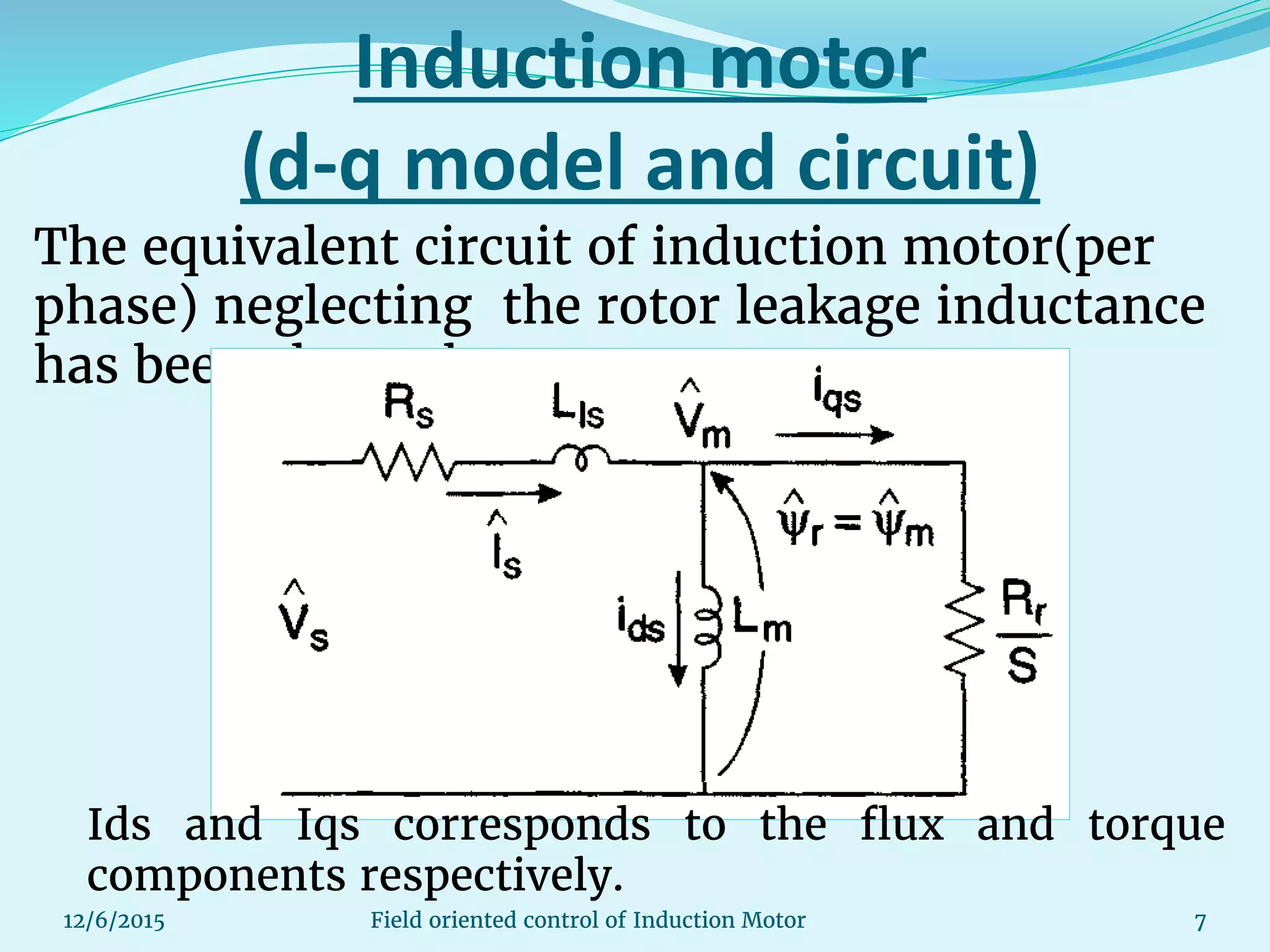
The equivalent circuit of induction motor(per
phase) neglecting the rotor leakage inductance
has been shown here:
Ids and Iqs corresponds to the flux and torque
components respectively.
7Field oriented control of Induction Motor12/6/2015
Induction motor
(d-q model and circuit) contd..
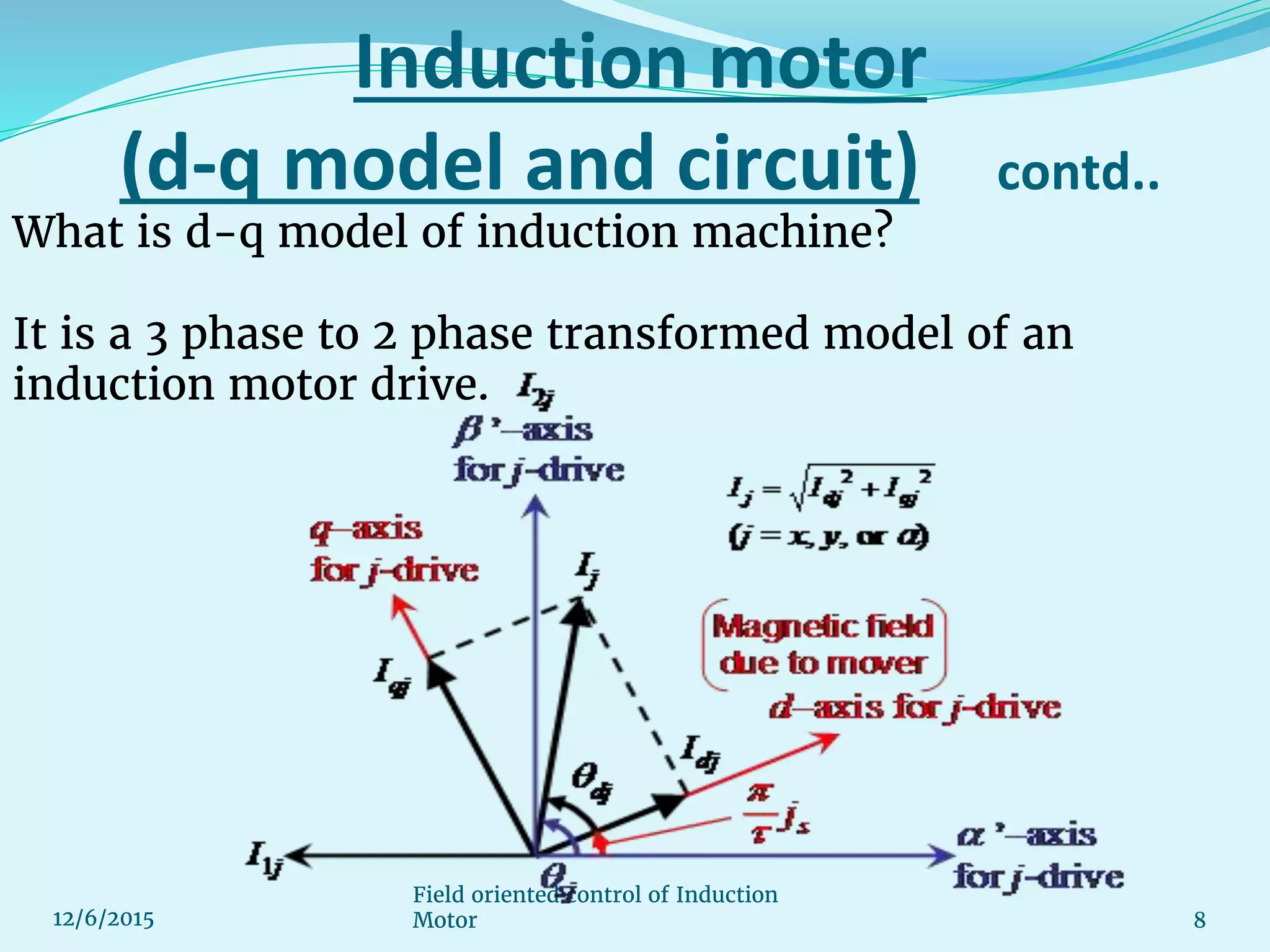
What is d-q model of induction machine?
It is a 3 phase to 2 phase transformed model of an
induction motor drive.
8
Field oriented control of Induction
Motor12/6/2015
Induction motor
(d-q model and circuit) contd..
9Field oriented control of Induction Motor12/6/2015
This model is obtained by a series of transformations as follows:
1) Clark’s transformation : [3-2 phase stationary ds-qs model.]
2) Park’s transformation : [2 phase stationary to 2 phase synchronously
rotating reference frame.]
Induction motor
(d-q model and circuit) contd..
10Field oriented control of Induction Motor12/6/2015
After these transformation the d-q model variable
are Ids and Iqs. Which are merely DC quantities that
means time - invariant.
Therefore the total current is given by :
Is=√(Ids²+Iqs²)
Phasor Diagrams for Induction Motor
11Field oriented control of Induction Motor12/6/2015
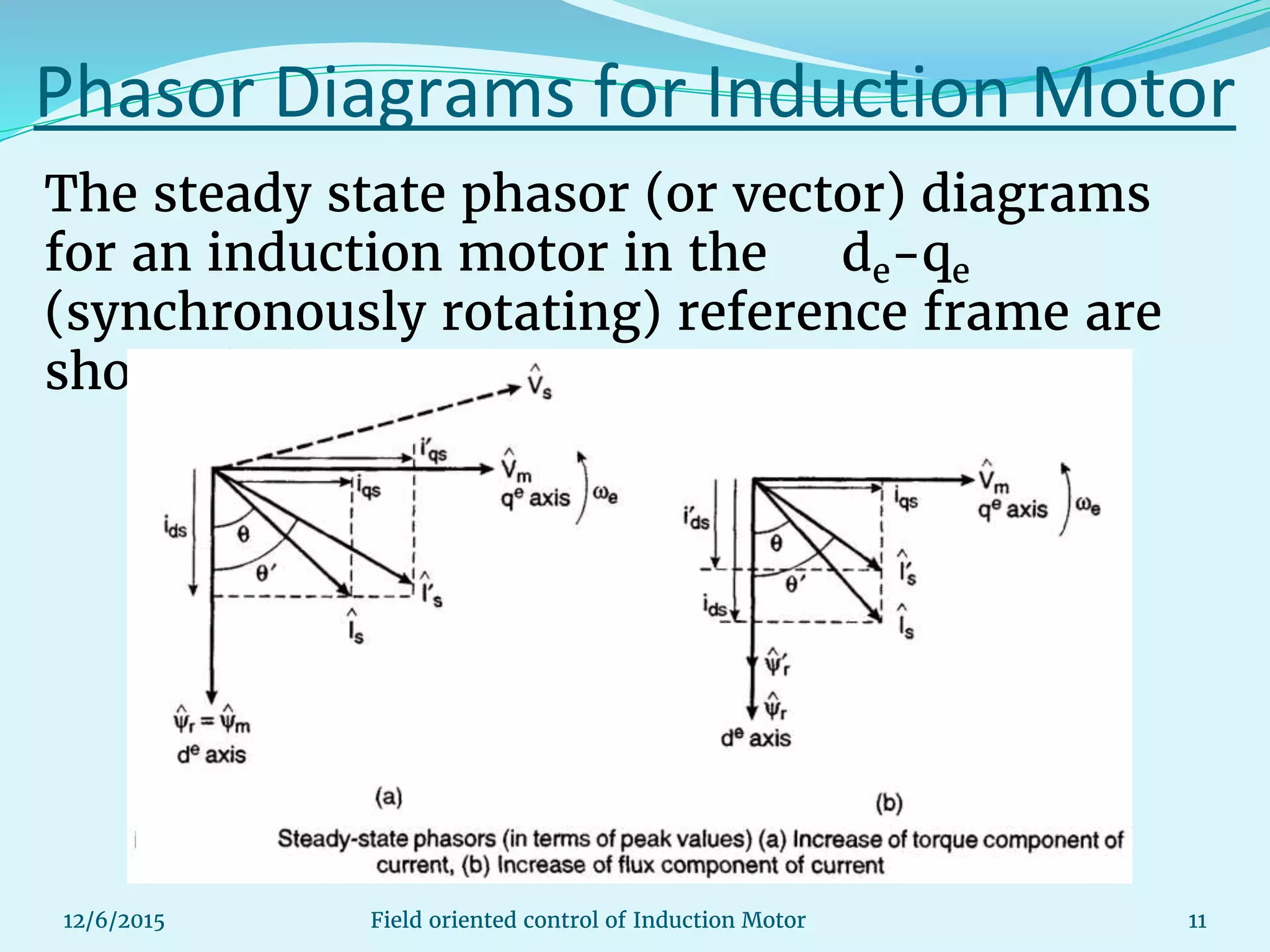
The steady state phasor (or vector) diagrams
for an induction motor in the de-qe
(synchronously rotating) reference frame are
shown below:
Phasor Diagrams for Induction Motor
12Field oriented control of Induction Motor12/6/2015
An increase in Ids component will increase the
flux without affecting the torque and
similarly, An increase in torque component Iqs
cause increase in torque without affecting the
flux. This is as seen in the DC machine.
As seen from the figure because of orthogonal
orientation of torque (Iqs) and flux (Ids)
components , they can be controlled
independently.
However , it is first necessary to maintain this
orientation throughout the operation.
Principle of vector control
13Field oriented control of Induction Motor12/6/2015
The basic implementation of vector control
is illustrated in the following block
diagrams:1. Here the 3 phase
currents from the
input AC supply are
converted into 2
phase DC
quantities by using
the Clark’s and
Park’s
transformation.
2. This is given to the
machine-model for
DC machine like
control.
Principle of vector control
14Field oriented control of Induction Motor12/6/2015
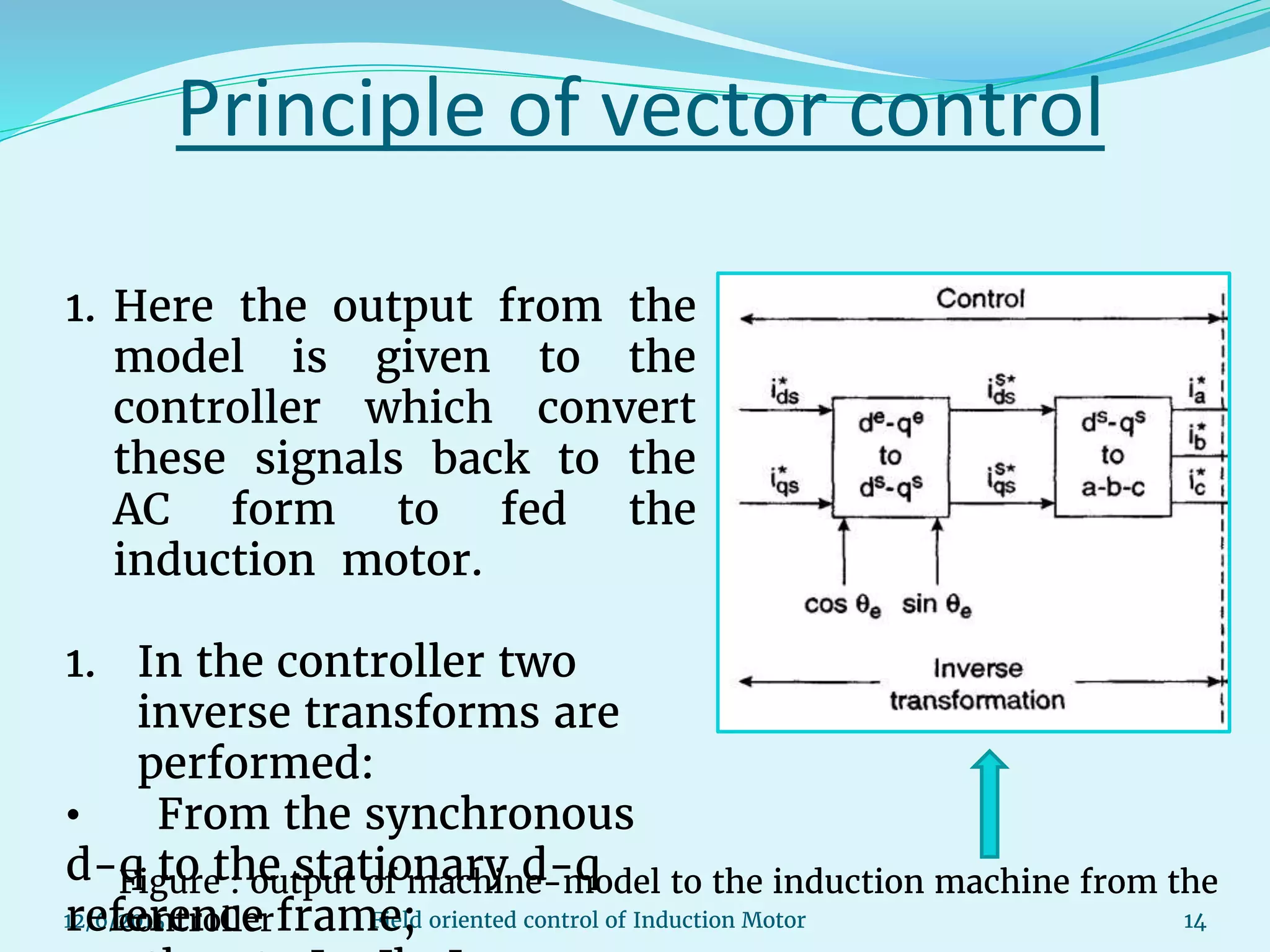
Figure : output of machine-model to the induction machine from the
controller
1. Here the output from the
model is given to the
controller which convert
these signals back to the
AC form to fed the
induction motor.
1. In the controller two
inverse transforms are
performed:
• From the synchronous
d-q to the stationary d-q
reference frame;
Types of vector control techniques
15Field oriented control of Induction Motor12/6/2015
There are two approaches to vector control:
1) Direct field oriented current control
- here the rotation angle of the iqs vector with
respect to the stator flux ψqr is being directly
determined (e.g. by measuring air gap flux).
2) Indirect field oriented current control
- here the rotor angle is being measured
indirectly, such as by measuring slip speed.
There are some other techniques as well:
Sensorless vector control , stator flux oriented vector
control etc.
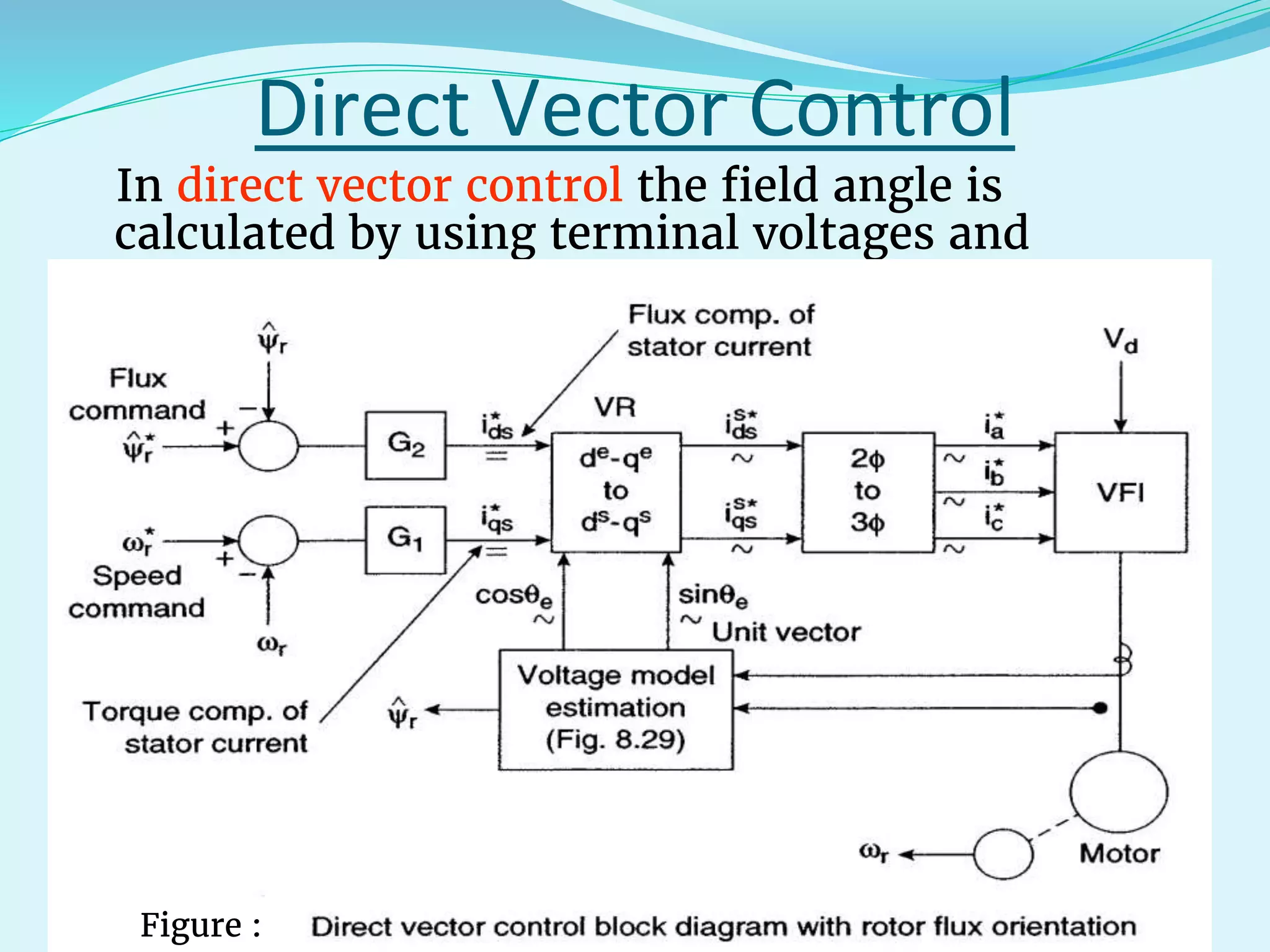
Direct Vector Control
In direct vector control the field angle is
calculated by using terminal voltages and
current or Hall sensors.
12/6/2015 Field oriented control of Induction Motor 16Figure :
Direct Vector Control contd…
● The principal vector control parameters, ids
and iqs , which are dc values in the
synchronously rotating reference frame,
are converted to the stationary reference
frame (using the vector rotation (VR)
block) by using the unit vector cosθe and
sinθe.
● These stationary reference frame control
parameters ids
s and iqs
s are then changed to
the phase current command signals, ia , ib
and ic which are fed to the given type of12/6/2015 Field oriented control of Induction Motor 17
Direct Vector Control contd…
12/6/2015 Field oriented control of Induction Motor 18
A flux control loop is used to
precisely control the flux. Torque
control is achieved through the
current iqs which is generated from
the speed control loop. The torque
can be negative which will result in a
negative phase orientation for iqs in
the phasor diagram.
Direct Vector Control contd…
12/6/2015 Field oriented control of Induction Motor 19
Figure : ds-qs and de-qe phasors showing rotor flux
orientation
Direct Vector Control contd…
● Here the de-qe frame is rotating at synchronous
speed ωe with respect to the stationary reference
frame ds-qs, and at any point in time, the angular
position of the de axis with respect to the ds axis is
θe (=ωet).
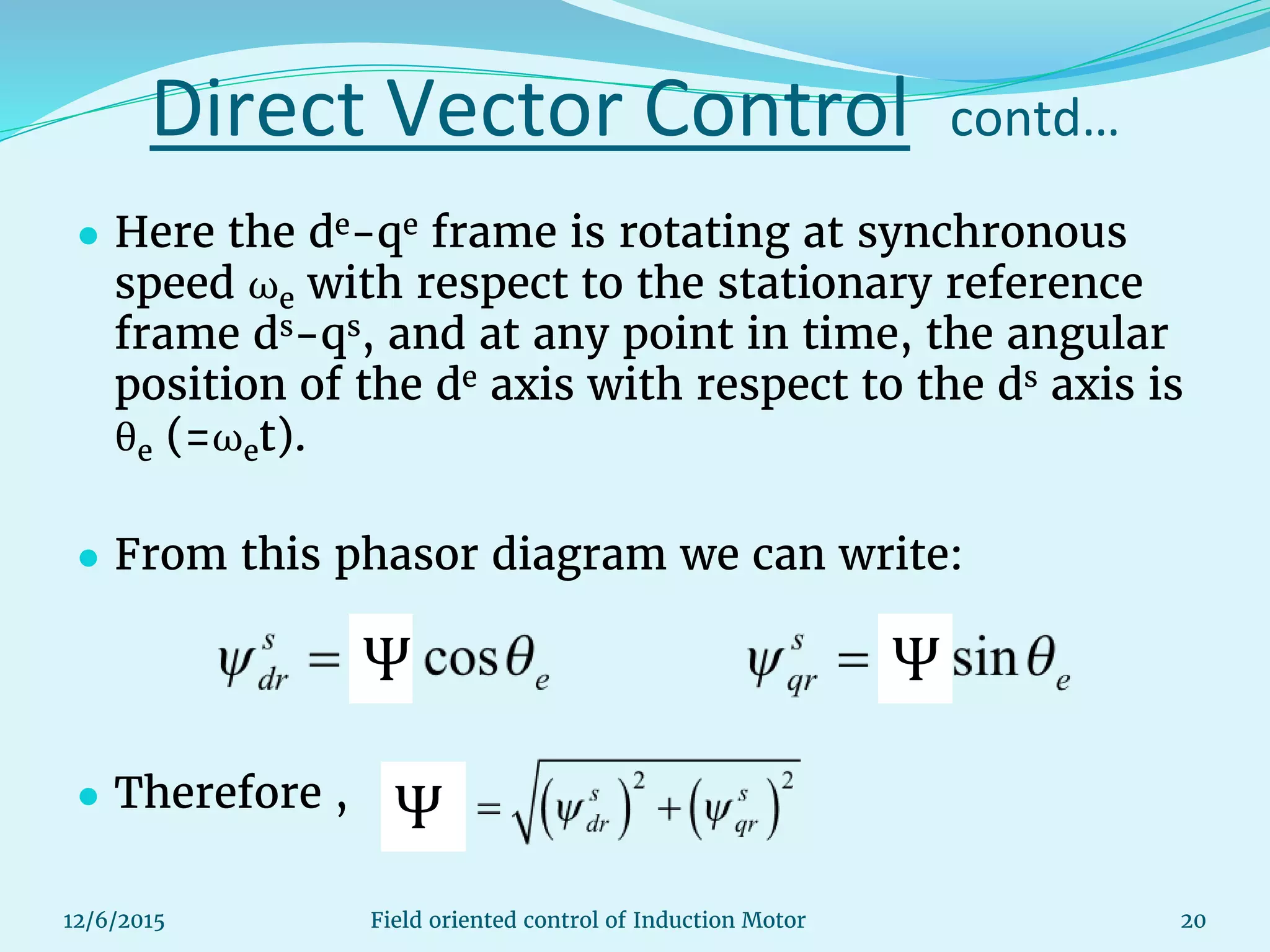
● From this phasor diagram we can write:
● Therefore ,
12/6/2015 Field oriented control of Induction Motor 20
Ψ Ψ
Ψ
Direct Vector Control contd…
12/6/2015 Field oriented control of Induction Motor 21
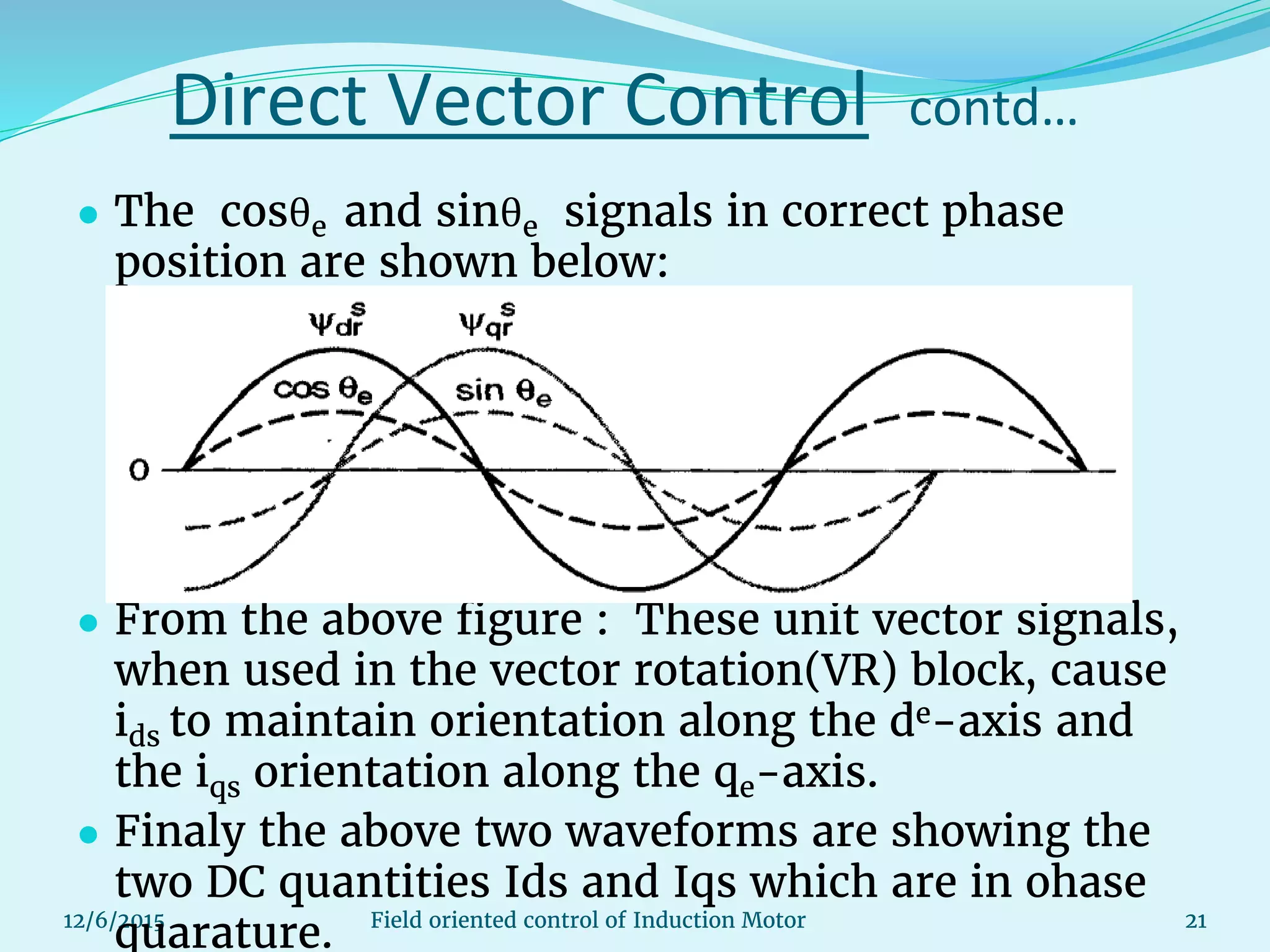
● The cosθe and sinθe signals in correct phase
position are shown below:
● From the above figure : These unit vector signals,
when used in the vector rotation(VR) block, cause
ids to maintain orientation along the de-axis and
the iqs orientation along the qe-axis.
● Finaly the above two waveforms are showing the
two DC quantities Ids and Iqs which are in ohase
quarature.
Advantages of vector control
A few of the salient features of vector control
are:
● The motor is “self-controlled” by using
the unit vectors(by vector rotation block)
to help control the frequency and phase.
● There is no concern about instability
because limiting within the safe limit
automatically limits operation to the stable
region.12/6/2015 Field oriented control of Induction Motor 22
Advantages of vector control contd….
● Transient response will be fast because
torque control by iqs does not affect flux.
● Vector control allows for speed control in
all four quadrants (without additional
control elements) since negative torque is
directly taken care of in vector control.
● Dynamic speed accuracy.
● Reduction in size of motor, cost and power
consumption.
12/6/2015 Field oriented control of Induction Motor 23
Disadvantage
● With the number of steps involved in
conversions from 3 to 2 phase d-q model this
method is complex in nature.
● This method is impractical with complete
accuracy.
12/6/2015 Field oriented control of Induction Motor 24
MATLAB Work
● The MATLAB SIMULINK modeling of
Induction machine of prescribed rating is
shown below:
12/6/2015 Field oriented control of Induction Motor 25
Phase conversion inside
Induction machine model
MATLAB Work(PI Control)
12/6/2015 Field oriented control of Induction Motor 26
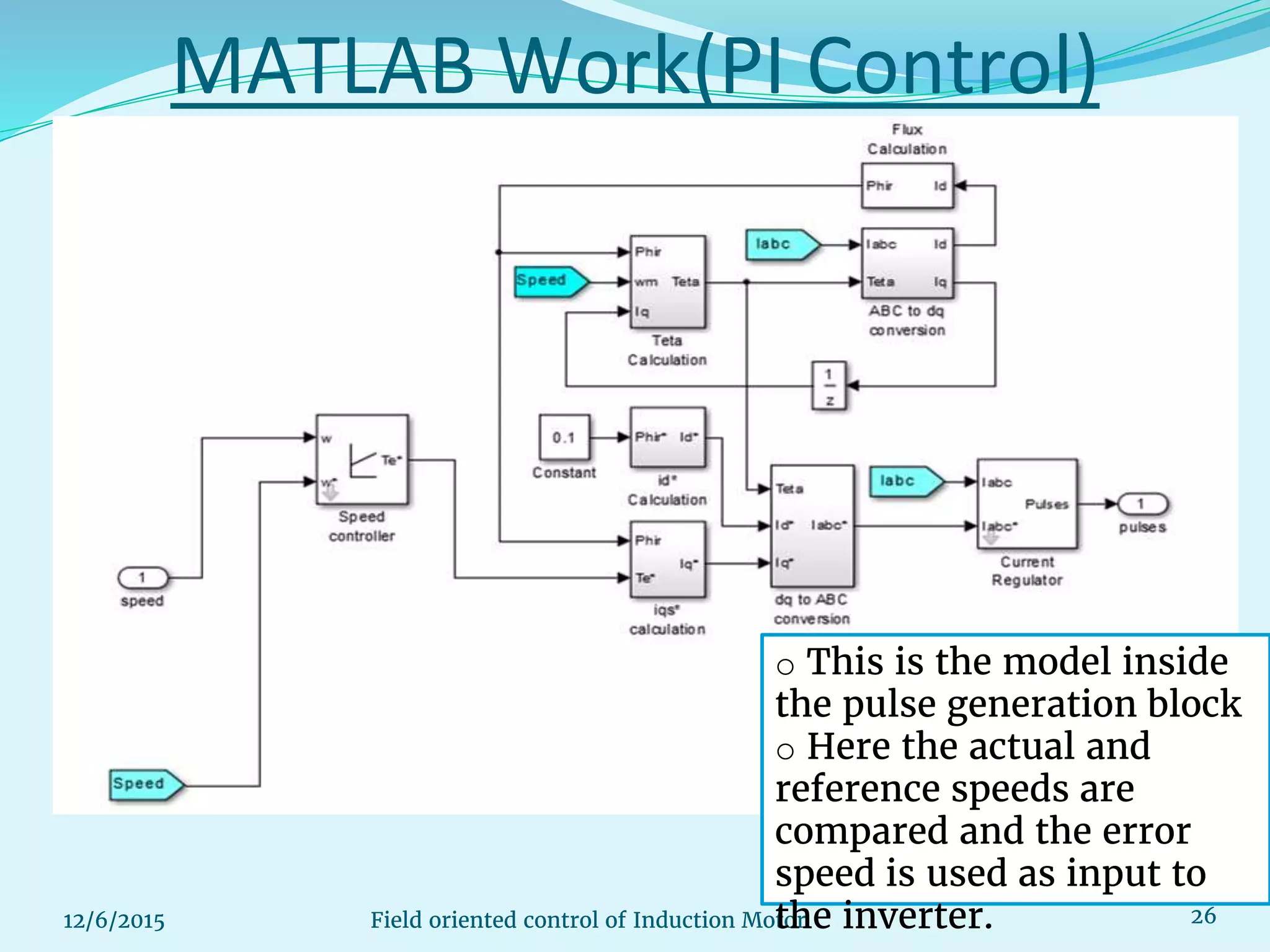
o This is the model inside
the pulse generation block
o Here the actual and
reference speeds are
compared and the error
speed is used as input to
the inverter.
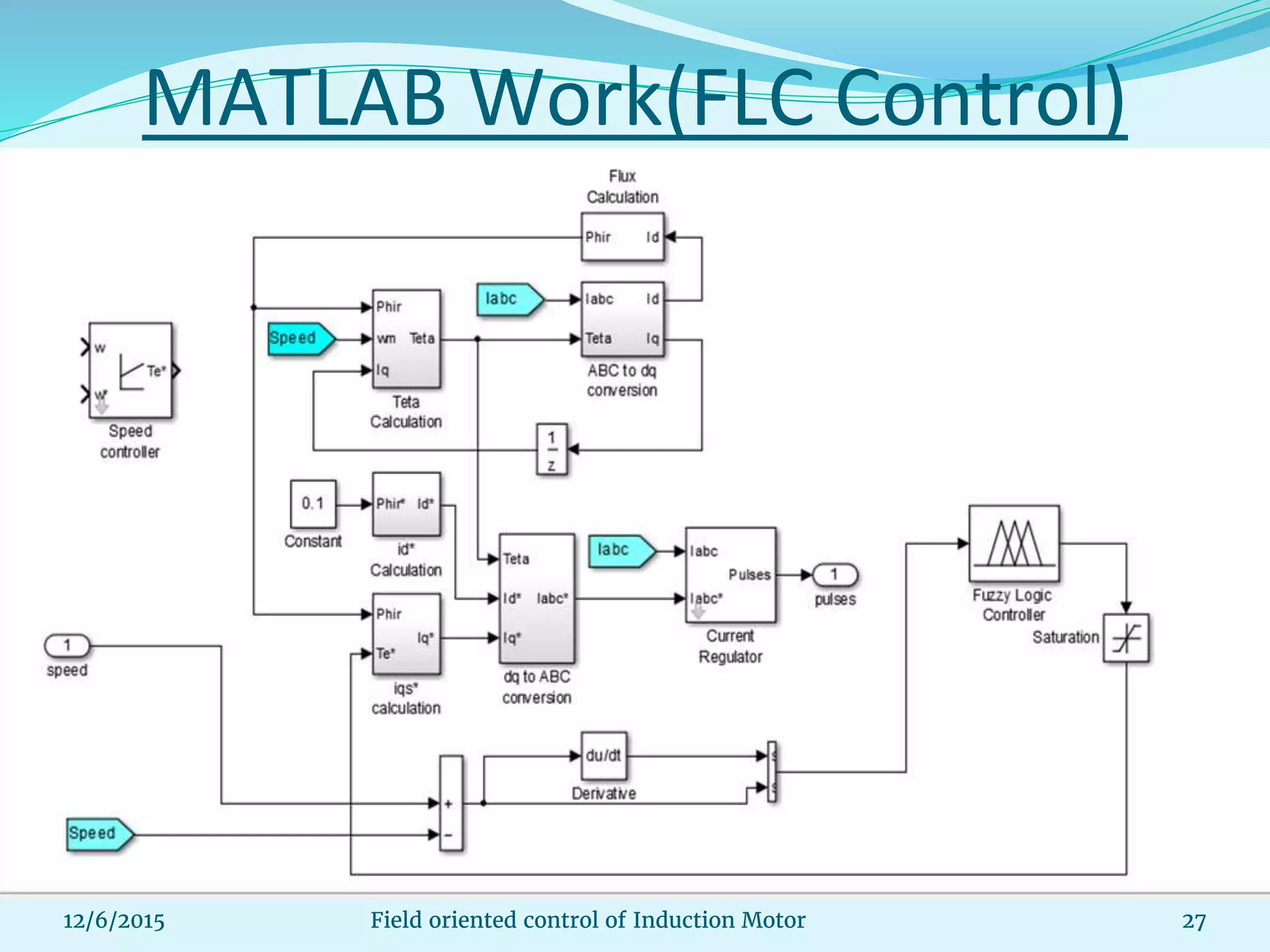
MATLAB Work(FLC Control)
12/6/2015 Field oriented control of Induction Motor 27
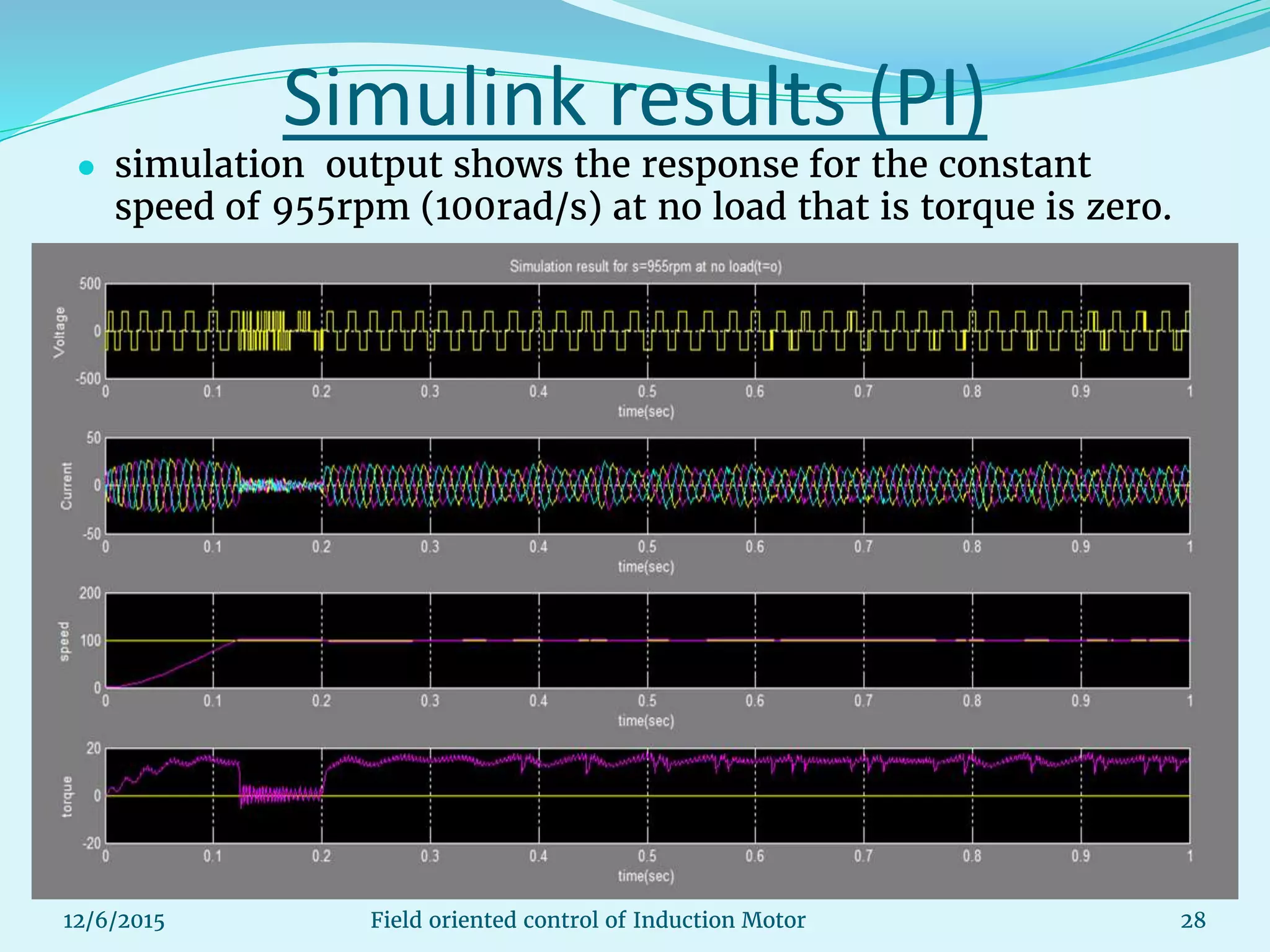
Simulink results (PI)
● simulation output shows the response for the constant
speed of 955rpm (100rad/s) at no load that is torque is zero.
12/6/2015 Field oriented control of Induction Motor 28
Simulink results (PI)
● For step speed of 1430rpm (150rad/s) at 0.2s.
12/6/2015 Field oriented control of Induction Motor 29
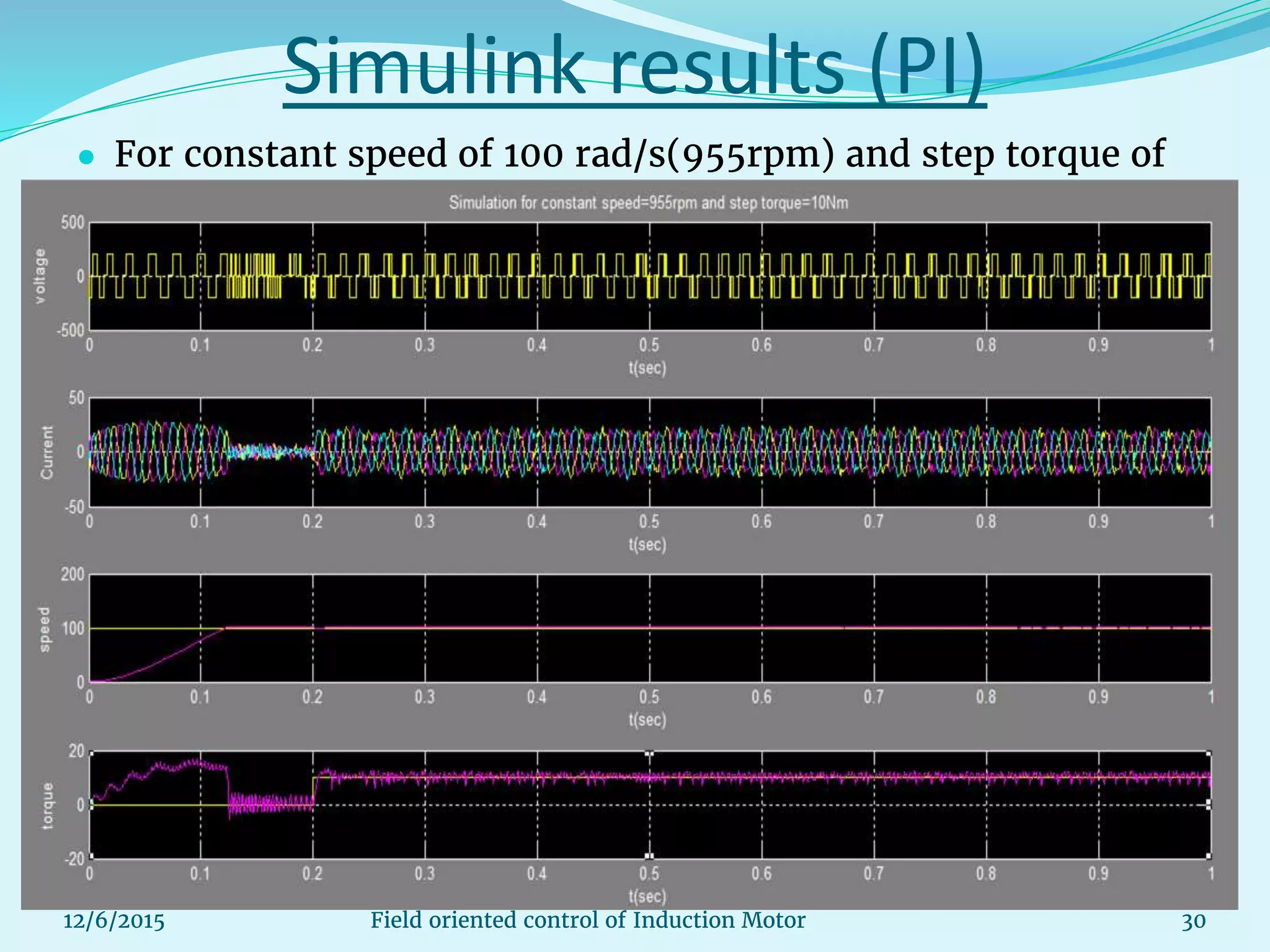
Simulink results (PI)
● For constant speed of 100 rad/s(955rpm) and step torque of
10Nm at 0.2s.
12/6/2015 Field oriented control of Induction Motor 30
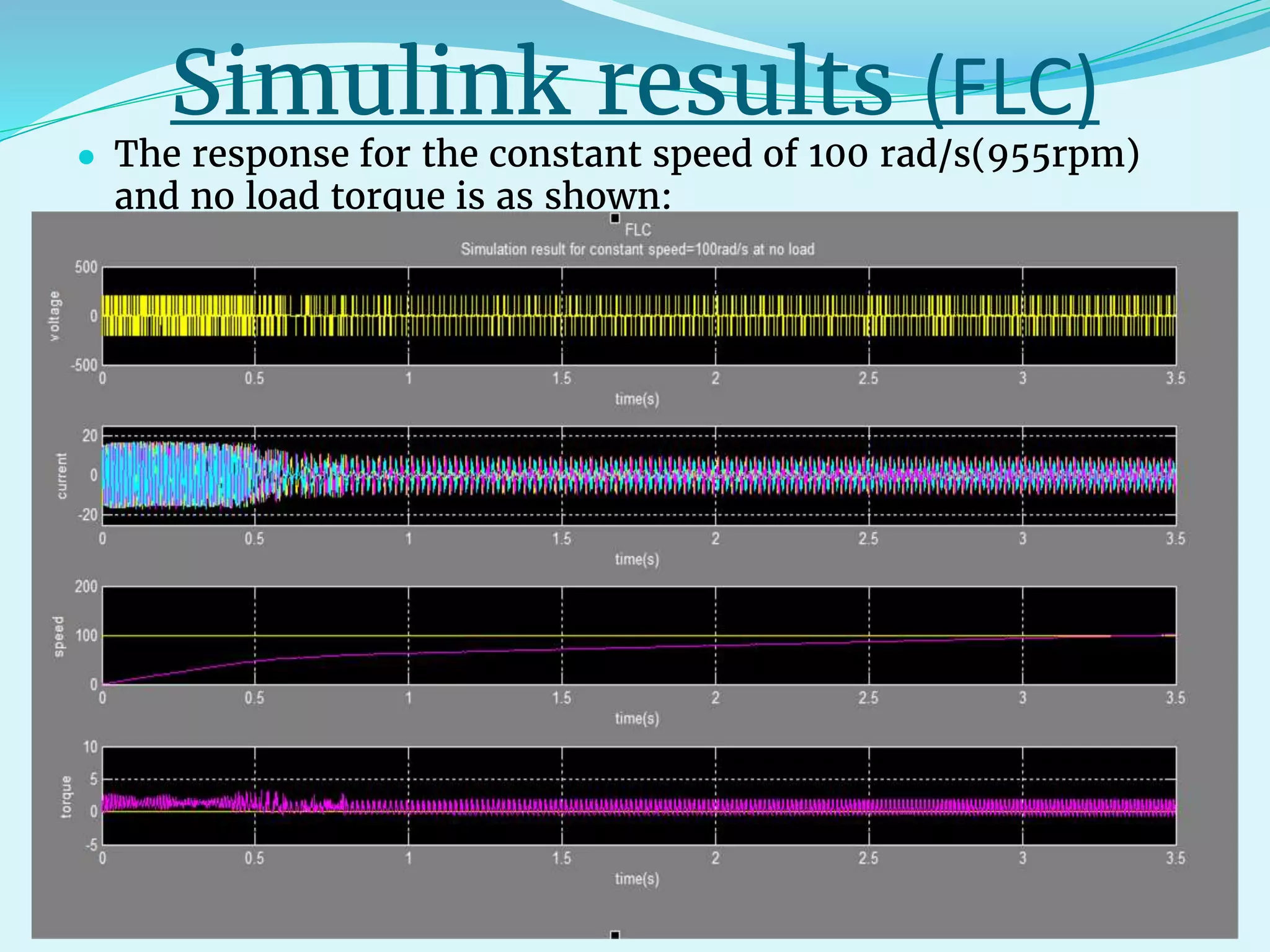
Simulink results (FLC)
● The response for the constant speed of 100 rad/s(955rpm)
and no load torque is as shown:
12/6/2015 Field oriented control of Induction Motor 31
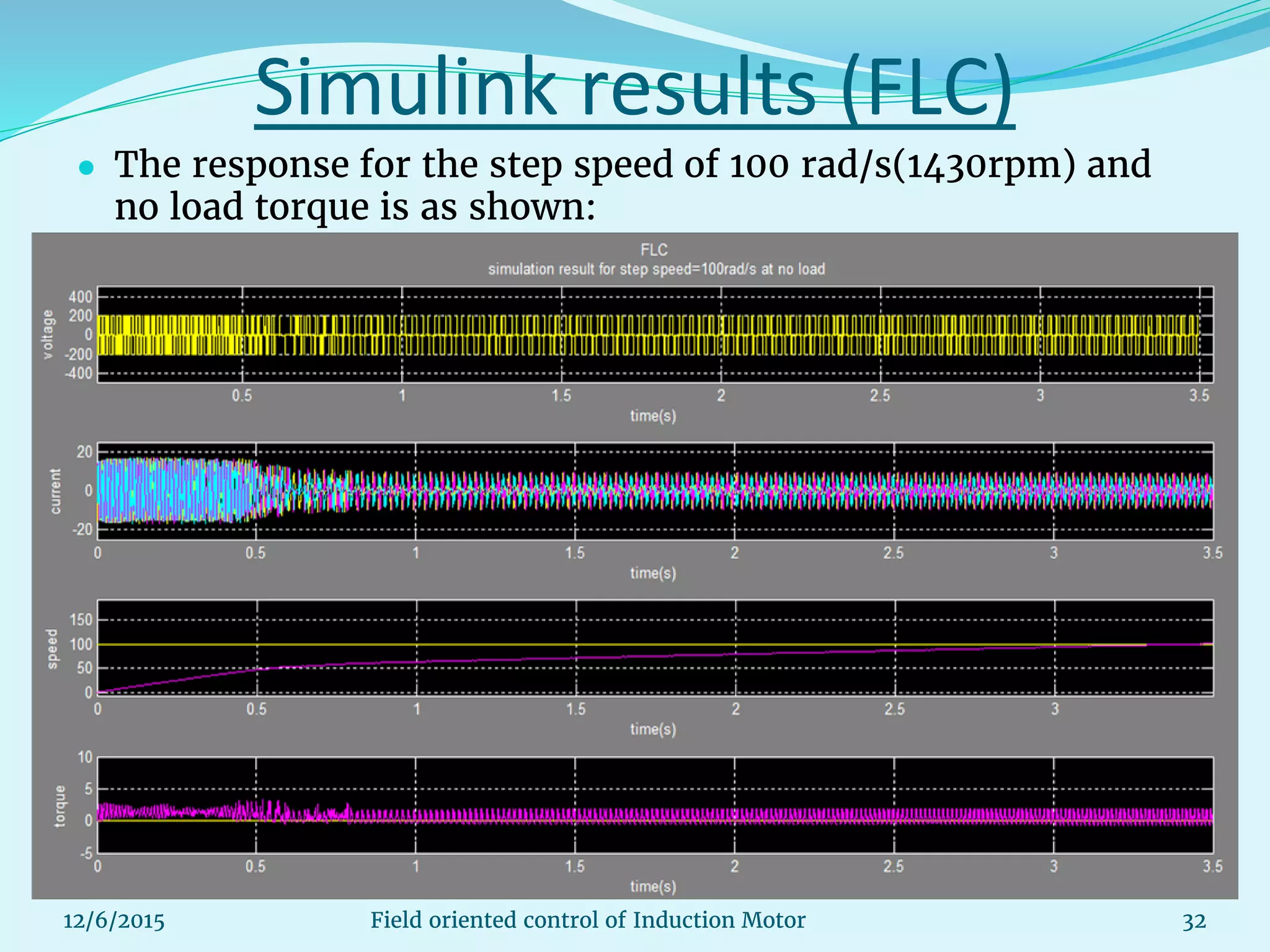
Simulink results (FLC)
● The response for the step speed of 100 rad/s(1430rpm) and
no load torque is as shown:
12/6/2015 Field oriented control of Induction Motor 32
Conclusion
● By using this method we obtained maximum
response in minimum time.
● On comparing with scalar control method this
method is fast, accurate and control variable speed
of induction motor.
12/6/2015 Field oriented control of Induction Motor 33
References
● 1. Matlab mathworks.com Induction machine model.
● 2. B.K. Bose, Power Electronics and AC Drives, Prentice-Hall,’’ NJ, USA, 2002.
● 3.www.wikipedia.com
● 4. www.google.com
● 5.Nptel lectures of Induction motor Modeling.
● 6. Vas, P. ,"Vector Control of AC Machines", Oxford University Press, Oxford,1990.
● 7. Lai, Y-S.,"Modelling and Vector Control of Induction Machines- a New Unified
Approach", in Conf. Rec. Power Engineering Soc. Winter Meeting, Vol. I, 1999, pp.
47-52.
● 8. H. C. Stanley, An Analysis of the Induction Motor , AIEE Transactions, Vol. 57
(Supplement), 1938, pp. 751-755.
● 9. Adel Aktaibi & Daw Ghanim,”Dynamic Simulation of a Three-Phase Induction
Motor Using Matlab Simulink”,IEEE,Canada
● 10. Sandeep Goyat , Rajesh Kr. Ahuja,” SPEED CONTROL OF INDUCTION MOTOR
USING VECTOR OR FIELD ORIENTED CONTROL”,IJAET, ISSN: 2231-1963 475 Vol. ,July
2012.
12/6/2015 Field oriented control of Induction Motor 34
Thank you …
12/6/2015 Field oriented control of Induction Motor 35
Questions…
12/6/2015 Field oriented control of Induction Motor 36

Updated field oriented control of induction motor.pptx

  • 1.
    FIELD ORIENTED CONTROLOF INDUCTION MOTOR (FOC) . 1Field oriented control of Induction Motor12/6/2015
  • 2.
    Presented by: Mohit Sharma| 2K13/EE/074 Rahatul Ashfeen | 2K13/EE/096 Submitted to: Dr. Mini Sreejeth (Project advisor) Dr. S.K. Velluru (Project Coordinator) DELHI TECHNOLOGICAL UNIVERSITY (DEPARTMENT OF ELECTRICAL ENGINEERING) 2Field oriented control of Induction Motor12/6/2015
  • 3.
    Before FOC scalar control ●Thiscontrol of AC drives produces good steady state performance but poor dynamic response. ●This is because in AC machines , the air gap flux linkage and inductance of stator and rotor are the function position of rotor at some time. ●This variation is found both in magnitude and phase. 3Field oriented control of Induction Motor12/6/2015
  • 4.
    Before FOC scalar control(contd.) ●Therefore , this has been concluded that the fluxes and so the inductances are time varying. The study of this dynamic behavior is need to carry out by some technique other than vector control. Which can give control over this dynamic behavior with respect to time. 4Field oriented control of Induction Motor12/6/2015
  • 5.
    Introduction This method givesmore precise control of AC drives over its scalar counterpart. It is now commonly used in industries due to its DC machine like operation. As per the DC machine like performance , it makes the decoupling between flux (speed) and torque possible. This way it is used in high accurate performance drives where oscillation in air gap flux linkages are intolerable. Example : Actuators and servos etc. 5Field oriented control of Induction Motor12/6/2015
  • 6.
    Introduction contd. In scalar controlboth flux and torque are the function of voltage/current and frequency. This tends the system into instability due to higher order harmonics. While in vector control both these are independently controllable. Because of the decoupled nature of flux and torque in this control 6Field oriented control of Induction Motor12/6/2015
  • 7.
    Induction motor (d-q modeland circuit) The equivalent circuit of induction motor(per phase) neglecting the rotor leakage inductance has been shown here: Ids and Iqs corresponds to the flux and torque components respectively. 7Field oriented control of Induction Motor12/6/2015
  • 8.
    Induction motor (d-q modeland circuit) contd.. What is d-q model of induction machine? It is a 3 phase to 2 phase transformed model of an induction motor drive. 8 Field oriented control of Induction Motor12/6/2015
  • 9.
    Induction motor (d-q modeland circuit) contd.. 9Field oriented control of Induction Motor12/6/2015 This model is obtained by a series of transformations as follows: 1) Clark’s transformation : [3-2 phase stationary ds-qs model.] 2) Park’s transformation : [2 phase stationary to 2 phase synchronously rotating reference frame.]
  • 10.
    Induction motor (d-q modeland circuit) contd.. 10Field oriented control of Induction Motor12/6/2015 After these transformation the d-q model variable are Ids and Iqs. Which are merely DC quantities that means time - invariant. Therefore the total current is given by : Is=√(Ids²+Iqs²)
  • 11.
    Phasor Diagrams forInduction Motor 11Field oriented control of Induction Motor12/6/2015 The steady state phasor (or vector) diagrams for an induction motor in the de-qe (synchronously rotating) reference frame are shown below:
  • 12.
    Phasor Diagrams forInduction Motor 12Field oriented control of Induction Motor12/6/2015 An increase in Ids component will increase the flux without affecting the torque and similarly, An increase in torque component Iqs cause increase in torque without affecting the flux. This is as seen in the DC machine. As seen from the figure because of orthogonal orientation of torque (Iqs) and flux (Ids) components , they can be controlled independently. However , it is first necessary to maintain this orientation throughout the operation.
  • 13.
    Principle of vectorcontrol 13Field oriented control of Induction Motor12/6/2015 The basic implementation of vector control is illustrated in the following block diagrams:1. Here the 3 phase currents from the input AC supply are converted into 2 phase DC quantities by using the Clark’s and Park’s transformation. 2. This is given to the machine-model for DC machine like control.
  • 14.
    Principle of vectorcontrol 14Field oriented control of Induction Motor12/6/2015 Figure : output of machine-model to the induction machine from the controller 1. Here the output from the model is given to the controller which convert these signals back to the AC form to fed the induction motor. 1. In the controller two inverse transforms are performed: • From the synchronous d-q to the stationary d-q reference frame;
  • 15.
    Types of vectorcontrol techniques 15Field oriented control of Induction Motor12/6/2015 There are two approaches to vector control: 1) Direct field oriented current control - here the rotation angle of the iqs vector with respect to the stator flux ψqr is being directly determined (e.g. by measuring air gap flux). 2) Indirect field oriented current control - here the rotor angle is being measured indirectly, such as by measuring slip speed. There are some other techniques as well: Sensorless vector control , stator flux oriented vector control etc.
  • 16.
    Direct Vector Control Indirect vector control the field angle is calculated by using terminal voltages and current or Hall sensors. 12/6/2015 Field oriented control of Induction Motor 16Figure :
  • 17.
    Direct Vector Controlcontd… ● The principal vector control parameters, ids and iqs , which are dc values in the synchronously rotating reference frame, are converted to the stationary reference frame (using the vector rotation (VR) block) by using the unit vector cosθe and sinθe. ● These stationary reference frame control parameters ids s and iqs s are then changed to the phase current command signals, ia , ib and ic which are fed to the given type of12/6/2015 Field oriented control of Induction Motor 17
  • 18.
    Direct Vector Controlcontd… 12/6/2015 Field oriented control of Induction Motor 18 A flux control loop is used to precisely control the flux. Torque control is achieved through the current iqs which is generated from the speed control loop. The torque can be negative which will result in a negative phase orientation for iqs in the phasor diagram.
  • 19.
    Direct Vector Controlcontd… 12/6/2015 Field oriented control of Induction Motor 19 Figure : ds-qs and de-qe phasors showing rotor flux orientation
  • 20.
    Direct Vector Controlcontd… ● Here the de-qe frame is rotating at synchronous speed ωe with respect to the stationary reference frame ds-qs, and at any point in time, the angular position of the de axis with respect to the ds axis is θe (=ωet). ● From this phasor diagram we can write: ● Therefore , 12/6/2015 Field oriented control of Induction Motor 20 Ψ Ψ Ψ
  • 21.
    Direct Vector Controlcontd… 12/6/2015 Field oriented control of Induction Motor 21 ● The cosθe and sinθe signals in correct phase position are shown below: ● From the above figure : These unit vector signals, when used in the vector rotation(VR) block, cause ids to maintain orientation along the de-axis and the iqs orientation along the qe-axis. ● Finaly the above two waveforms are showing the two DC quantities Ids and Iqs which are in ohase quarature.
  • 22.
    Advantages of vectorcontrol A few of the salient features of vector control are: ● The motor is “self-controlled” by using the unit vectors(by vector rotation block) to help control the frequency and phase. ● There is no concern about instability because limiting within the safe limit automatically limits operation to the stable region.12/6/2015 Field oriented control of Induction Motor 22
  • 23.
    Advantages of vectorcontrol contd…. ● Transient response will be fast because torque control by iqs does not affect flux. ● Vector control allows for speed control in all four quadrants (without additional control elements) since negative torque is directly taken care of in vector control. ● Dynamic speed accuracy. ● Reduction in size of motor, cost and power consumption. 12/6/2015 Field oriented control of Induction Motor 23
  • 24.
    Disadvantage ● With thenumber of steps involved in conversions from 3 to 2 phase d-q model this method is complex in nature. ● This method is impractical with complete accuracy. 12/6/2015 Field oriented control of Induction Motor 24
  • 25.
    MATLAB Work ● TheMATLAB SIMULINK modeling of Induction machine of prescribed rating is shown below: 12/6/2015 Field oriented control of Induction Motor 25 Phase conversion inside Induction machine model
  • 26.
    MATLAB Work(PI Control) 12/6/2015Field oriented control of Induction Motor 26 o This is the model inside the pulse generation block o Here the actual and reference speeds are compared and the error speed is used as input to the inverter.
  • 27.
    MATLAB Work(FLC Control) 12/6/2015Field oriented control of Induction Motor 27
  • 28.
    Simulink results (PI) ●simulation output shows the response for the constant speed of 955rpm (100rad/s) at no load that is torque is zero. 12/6/2015 Field oriented control of Induction Motor 28
  • 29.
    Simulink results (PI) ●For step speed of 1430rpm (150rad/s) at 0.2s. 12/6/2015 Field oriented control of Induction Motor 29
  • 30.
    Simulink results (PI) ●For constant speed of 100 rad/s(955rpm) and step torque of 10Nm at 0.2s. 12/6/2015 Field oriented control of Induction Motor 30
  • 31.
    Simulink results (FLC) ●The response for the constant speed of 100 rad/s(955rpm) and no load torque is as shown: 12/6/2015 Field oriented control of Induction Motor 31
  • 32.
    Simulink results (FLC) ●The response for the step speed of 100 rad/s(1430rpm) and no load torque is as shown: 12/6/2015 Field oriented control of Induction Motor 32
  • 33.
    Conclusion ● By usingthis method we obtained maximum response in minimum time. ● On comparing with scalar control method this method is fast, accurate and control variable speed of induction motor. 12/6/2015 Field oriented control of Induction Motor 33
  • 34.
    References ● 1. Matlabmathworks.com Induction machine model. ● 2. B.K. Bose, Power Electronics and AC Drives, Prentice-Hall,’’ NJ, USA, 2002. ● 3.www.wikipedia.com ● 4. www.google.com ● 5.Nptel lectures of Induction motor Modeling. ● 6. Vas, P. ,"Vector Control of AC Machines", Oxford University Press, Oxford,1990. ● 7. Lai, Y-S.,"Modelling and Vector Control of Induction Machines- a New Unified Approach", in Conf. Rec. Power Engineering Soc. Winter Meeting, Vol. I, 1999, pp. 47-52. ● 8. H. C. Stanley, An Analysis of the Induction Motor , AIEE Transactions, Vol. 57 (Supplement), 1938, pp. 751-755. ● 9. Adel Aktaibi & Daw Ghanim,”Dynamic Simulation of a Three-Phase Induction Motor Using Matlab Simulink”,IEEE,Canada ● 10. Sandeep Goyat , Rajesh Kr. Ahuja,” SPEED CONTROL OF INDUCTION MOTOR USING VECTOR OR FIELD ORIENTED CONTROL”,IJAET, ISSN: 2231-1963 475 Vol. ,July 2012. 12/6/2015 Field oriented control of Induction Motor 34
  • 35.
    Thank you … 12/6/2015Field oriented control of Induction Motor 35
  • 36.
    Questions… 12/6/2015 Field orientedcontrol of Induction Motor 36