BRUSHLESS
DC MOTOR
A brief
Introduction
AVIRAL SINGHAL
15115036
B.Tech Pre-Final Year
ELECTRICAL ENGINEERING DEPARTMENT
INDIAN INSTITUTE OF TECHNOLOGY ROORKEE
INTRODUCTION
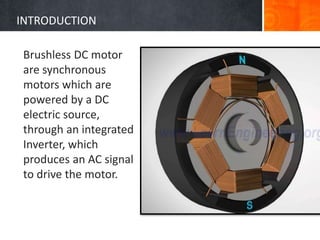
Brushless DC motor
are synchronous
motors which are
powered by a DC
electric source,
through an integrated
Inverter, which
produces an AC signal
to drive the motor.
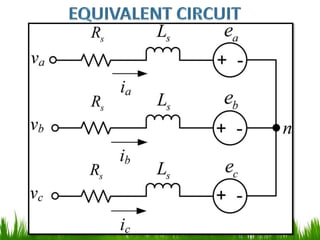
Construction
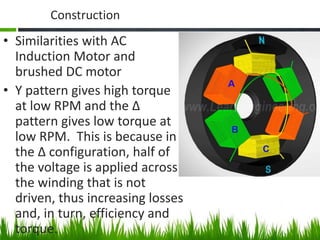
• Similarities with AC
Induction Motor and
brushed DC motor
• Y pattern gives high torque
at low RPM and the ∆
pattern gives low torque at
low RPM. This is because in
the ∆ configuration, half of
the voltage is applied across
the winding that is not
driven, thus increasing losses
and, in turn, efficiency and
torque.
STATOR
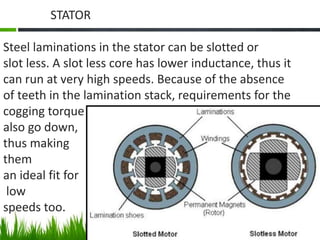
Steel laminations in the stator can be slotted or
slot less. A slot less core has lower inductance, thus it
can run at very high speeds. Because of the absence
of teeth in the lamination stack, requirements for the
cogging torque
also go down,
thus making
them
an ideal fit for
low
speeds too.
ROTOR
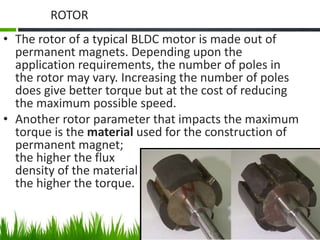
• The rotor of a typical BLDC motor is made out of
permanent magnets. Depending upon the
application requirements, the number of poles in
the rotor may vary. Increasing the number of poles
does give better torque but at the cost of reducing
the maximum possible speed.
• Another rotor parameter that impacts the maximum
torque is the material used for the construction of
permanent magnet;
the higher the flux
density of the material
the higher the torque.
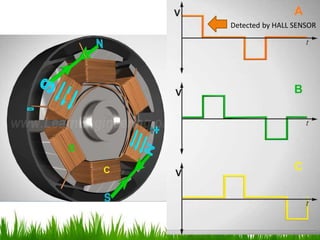
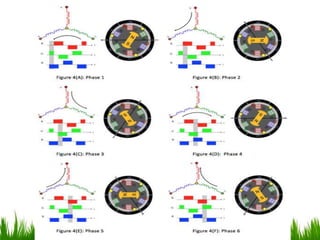
Detected by HALL SENSOR
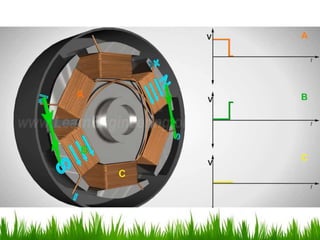
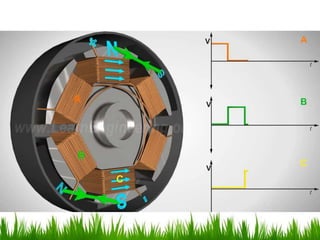
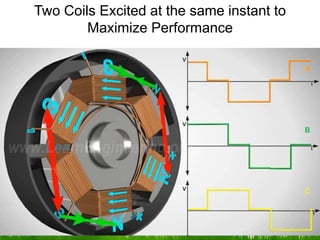
Two Coils Excited at the same instant to
Maximize Performance
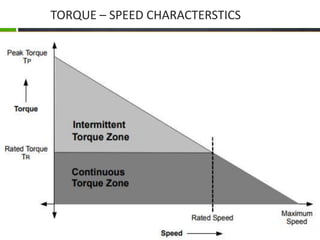
TORQUE – SPEED CHARACTERSTICS
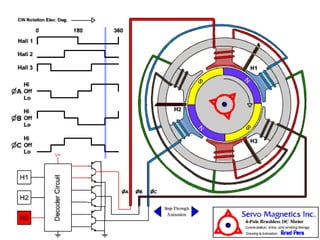
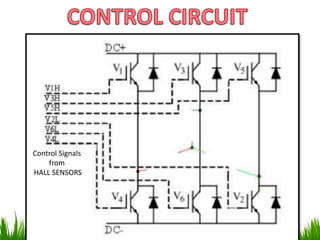
Control Signals
from
HALL SENSORS
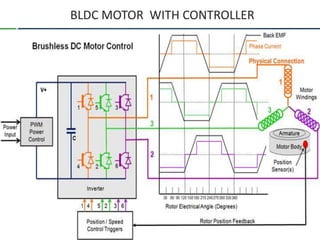
BLDC MOTOR WITH CONTROLLER
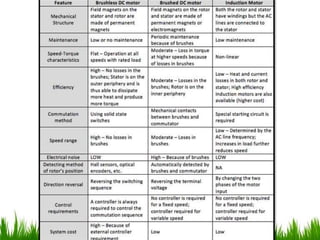
COMPARISION
A better way to Understand !!!
CONTROL
SPEED CONTROL
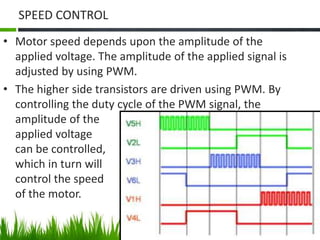
• Motor speed depends upon the amplitude of the
applied voltage. The amplitude of the applied signal is
adjusted by using PWM.
• The higher side transistors are driven using PWM. By
controlling the duty cycle of the PWM signal, the
amplitude of the
applied voltage
can be controlled,
which in turn will
control the speed
of the motor.
TORQUE CONTROL
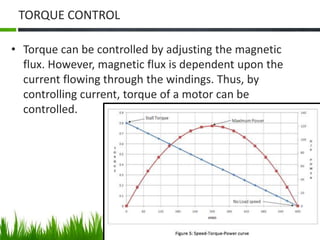
• Torque can be controlled by adjusting the magnetic
flux. However, magnetic flux is dependent upon the
current flowing through the windings. Thus, by
controlling current, torque of a motor can be
controlled.
• Dynamic Braking – Short circuiting
• Plugging – Sequence Reversal
• Regenerative Braking – Power back to
source
MOTOR PROTECTION
• Peak current :-This is the maximum instantaneous current
allowed to flow through the windings for safe operation. This
condition occurs in case of a short circuit.
• Under Voltage : – When the system is running on batteries, it
becomes important to cut off the supply if the battery voltage
drops below a particular limit.
• Hall Sensor Failure : – The commutation sequence will break,
which may cause the BLDC motor to become stuck and the
current to rise above a particular limit. Signal changes its logic
level or not. If it gets stuck to a particular level, then it can be
detected as a failure and the motor drive can be disconnected,
letting it run on inertia or be stopped by applying the brake.
ADVANTAGES
• As brushes are absent, the
mechanical energy loss due to
friction is less which
enhanced efficiency, more
reliable, high life
expectancies, and
maintenance free operation.
• BLDC motor can operate at
high-speed under any
condition.
• There is no sparking and
much less noise during
operation.
• Accelerate and decelerate
easily because of low rotor
inertia.
• High performance motor
that provides large torque
per unit volume over a vast
speed range.
• Such motors cooled by
conduction and no air flow
are required for inside
cooling.
DISADVANTAGES
• BLDC motor cost more than brushless DC
motor.
• The limited high power could be supplied
to BLDC motor, otherwise too much heat
weakens the magnets and insulation of
winding may get damaged.
CAN A BLDC MOTOR BE
USED AS GENERATOR ???
APPLICATIONS
• Single-speed – Induction motors are suitable, but if the speed has to be
maintained with the variation in load, then because of the flat speed-torque
curve of BLDC motor, BLDC motors are a good fit.
• Adjustable speed – BLDC motors become a more suitable fit for such
applications because variable speed induction motors will need an
additional controller, thus adding to system cost. Brushed DC motors will
also be a more expensive solution because of regular maintenance.
• Position control – BLDC motors use optical encoders, and complex
controllers are required to monitor torque, speed, and position.
• Low-noise applications – Brushed DC motors are known for generating more
EMI noise, so BLDC is a better fit, by using Field-Oriented Control (FOC)
sinusoidal BLDC motor control.
• Hard Drives, CD Drivers, PC Cooling Fans, RC airplanes
• Medical - Artificial Heart, Microscopes, centrifuges, Dental Surgical Tools
• Vehicles - Electronics Power Steering, Electrical Vehicles & AIRPLANES
REFERENCES
• Permanent Magnet Synchronous and Brushless DC Motor Drives by R. Krishnan,
2009 Edition.
• Design of Brushless Permanent-magnet Motors by J. R. Hendershot and Miller
Timothy J. E., 2nd Edition 2010.
• M.V.Ramesh, Gorantla.S.Rao, J.Amarnath, S.Kamakshaiah, B.Jawaharlal “Speed
Torque Characteristics of Brushless DC motor in Either Direction on Load using
ARM controller” IEEE 2011.
• M.Rakesh, P.V.R.L. Narasimham “Different Braking Techniques Employed to a
Brushless DC Motor Drive used in Locomotives” IEEJ 2012
• P.Pillay and R.Krishnan, “Modeling, simulation and analysis of permanent-magnet
motor drives, part-II: the brushless DC motor drives,” IEEE Trans. on Industry
Applications, vol. 25, pp.274-279, March/April1989.
• T. Jahns, R. C. Bccerra, and M. Ehsani, “lntcgrated current regulation for a brushless
ECM drive,” IEEE Trans. Pother Iron., vol. 6, no. I, pp. 118-126, Jan. 1991.
• Texas Instruments BLDC Motor & Controller Reference Guide.
• NXP (Freescale Pvt. Ltd.) BLDC MOTOR CONTROLLER Guide.
BLDC Motor

BLDC Motor

  • 1.
    BRUSHLESS DC MOTOR A brief Introduction AVIRALSINGHAL 15115036 B.Tech Pre-Final Year ELECTRICAL ENGINEERING DEPARTMENT INDIAN INSTITUTE OF TECHNOLOGY ROORKEE
  • 2.
    INTRODUCTION Brushless DC motor aresynchronous motors which are powered by a DC electric source, through an integrated Inverter, which produces an AC signal to drive the motor.
  • 3.
    Construction • Similarities withAC Induction Motor and brushed DC motor • Y pattern gives high torque at low RPM and the ∆ pattern gives low torque at low RPM. This is because in the ∆ configuration, half of the voltage is applied across the winding that is not driven, thus increasing losses and, in turn, efficiency and torque.
  • 4.
    STATOR Steel laminations inthe stator can be slotted or slot less. A slot less core has lower inductance, thus it can run at very high speeds. Because of the absence of teeth in the lamination stack, requirements for the cogging torque also go down, thus making them an ideal fit for low speeds too.
  • 5.
    ROTOR • The rotorof a typical BLDC motor is made out of permanent magnets. Depending upon the application requirements, the number of poles in the rotor may vary. Increasing the number of poles does give better torque but at the cost of reducing the maximum possible speed. • Another rotor parameter that impacts the maximum torque is the material used for the construction of permanent magnet; the higher the flux density of the material the higher the torque.
  • 7.
  • 10.
    Two Coils Excitedat the same instant to Maximize Performance
  • 13.
    TORQUE – SPEEDCHARACTERSTICS
  • 15.
  • 16.
    BLDC MOTOR WITHCONTROLLER
  • 17.
    COMPARISION A better wayto Understand !!!
  • 19.
  • 20.
    SPEED CONTROL • Motorspeed depends upon the amplitude of the applied voltage. The amplitude of the applied signal is adjusted by using PWM. • The higher side transistors are driven using PWM. By controlling the duty cycle of the PWM signal, the amplitude of the applied voltage can be controlled, which in turn will control the speed of the motor.
  • 21.
    TORQUE CONTROL • Torquecan be controlled by adjusting the magnetic flux. However, magnetic flux is dependent upon the current flowing through the windings. Thus, by controlling current, torque of a motor can be controlled.
  • 22.
    • Dynamic Braking– Short circuiting • Plugging – Sequence Reversal • Regenerative Braking – Power back to source
  • 23.
    MOTOR PROTECTION • Peakcurrent :-This is the maximum instantaneous current allowed to flow through the windings for safe operation. This condition occurs in case of a short circuit. • Under Voltage : – When the system is running on batteries, it becomes important to cut off the supply if the battery voltage drops below a particular limit. • Hall Sensor Failure : – The commutation sequence will break, which may cause the BLDC motor to become stuck and the current to rise above a particular limit. Signal changes its logic level or not. If it gets stuck to a particular level, then it can be detected as a failure and the motor drive can be disconnected, letting it run on inertia or be stopped by applying the brake.
  • 24.
    ADVANTAGES • As brushesare absent, the mechanical energy loss due to friction is less which enhanced efficiency, more reliable, high life expectancies, and maintenance free operation. • BLDC motor can operate at high-speed under any condition. • There is no sparking and much less noise during operation. • Accelerate and decelerate easily because of low rotor inertia. • High performance motor that provides large torque per unit volume over a vast speed range. • Such motors cooled by conduction and no air flow are required for inside cooling.
  • 25.
    DISADVANTAGES • BLDC motorcost more than brushless DC motor. • The limited high power could be supplied to BLDC motor, otherwise too much heat weakens the magnets and insulation of winding may get damaged.
  • 26.
    CAN A BLDCMOTOR BE USED AS GENERATOR ???
  • 27.
  • 28.
    • Single-speed –Induction motors are suitable, but if the speed has to be maintained with the variation in load, then because of the flat speed-torque curve of BLDC motor, BLDC motors are a good fit. • Adjustable speed – BLDC motors become a more suitable fit for such applications because variable speed induction motors will need an additional controller, thus adding to system cost. Brushed DC motors will also be a more expensive solution because of regular maintenance. • Position control – BLDC motors use optical encoders, and complex controllers are required to monitor torque, speed, and position. • Low-noise applications – Brushed DC motors are known for generating more EMI noise, so BLDC is a better fit, by using Field-Oriented Control (FOC) sinusoidal BLDC motor control. • Hard Drives, CD Drivers, PC Cooling Fans, RC airplanes • Medical - Artificial Heart, Microscopes, centrifuges, Dental Surgical Tools • Vehicles - Electronics Power Steering, Electrical Vehicles & AIRPLANES
  • 29.
    REFERENCES • Permanent MagnetSynchronous and Brushless DC Motor Drives by R. Krishnan, 2009 Edition. • Design of Brushless Permanent-magnet Motors by J. R. Hendershot and Miller Timothy J. E., 2nd Edition 2010. • M.V.Ramesh, Gorantla.S.Rao, J.Amarnath, S.Kamakshaiah, B.Jawaharlal “Speed Torque Characteristics of Brushless DC motor in Either Direction on Load using ARM controller” IEEE 2011. • M.Rakesh, P.V.R.L. Narasimham “Different Braking Techniques Employed to a Brushless DC Motor Drive used in Locomotives” IEEJ 2012 • P.Pillay and R.Krishnan, “Modeling, simulation and analysis of permanent-magnet motor drives, part-II: the brushless DC motor drives,” IEEE Trans. on Industry Applications, vol. 25, pp.274-279, March/April1989. • T. Jahns, R. C. Bccerra, and M. Ehsani, “lntcgrated current regulation for a brushless ECM drive,” IEEE Trans. Pother Iron., vol. 6, no. I, pp. 118-126, Jan. 1991. • Texas Instruments BLDC Motor & Controller Reference Guide. • NXP (Freescale Pvt. Ltd.) BLDC MOTOR CONTROLLER Guide.